Stress & Stress Management:Dealing with the Demands of Life and WorkPrepared for UHS 2062 lectures, UTM Skudai, Malaysia. srsiwok@ gmail.com
Stress influence our behaviour  and thus our relations with others at workStress has serious health implications if not properly managed.To properly manage  stress, it has to be identified, understood, and learn ways to handle it. Introduction
What is stress?Stress is the psychological  and physical reaction  to certain  life events  or situations (Aamodt, 2007)Stress is the non-specific responses of the body  to any demand made on it. (Hans Selye, 1930 in Huffman, 2007). Stress is the general term  describing the psychological  and physical response to a stimuli that alters the body’s equilibrium (Lazarus & Folkman, 1984 in Kosslyn & Rosenberg, 2006)
The stimulus that throws the body out of its equilibrium state is called a stressor. The body’s  response to a stressor is the stress response.This response  consists of the bodily changes  to help us cope with the stressor. Eg: the production of endorphins and enkephalins when we get a puncture wound. Stress and stressor
The body is nearly always  in a some state of stress, whether pleasant or unpleasant, mild or severe  (Huffman, 2007).A total absence of stress means a total absence of stimulation , which would eventually lead to death!When stress is beneficial, it is called eustress.The bad or harmful one is called distress.Because health psychology has been chiefly concerned with negative effects of stress, the word “stress” usually refers to the harmful stress. Stress and stressor
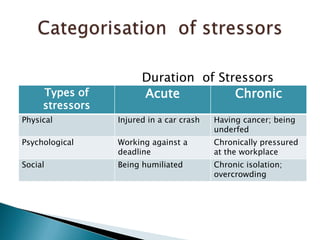
Categorisation  of stressors Duration  of Stressors
Eustressis the type of stress you experience right before you have the need to exert physical force. The feelings of stress is converted into positive energy and motivates the person.Eustressprepares the muscles, heart, and mind for the strength needed for whatever is about to occur.Eustress
Eustress can also apply to creative endeavors. When a person needs to have some extra energy or creativity, eustress kicks in to bring them the inspiration they need.An example is the anxiety you feel before taking the exam, without the anxiety, you might not have the motivation  and energy to spend the necessary time to study. Eustress
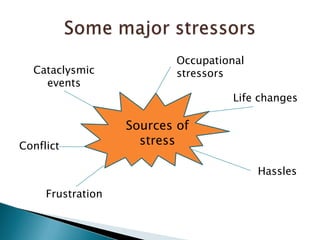
Some major stressorsOccupational stressorsCataclysmic eventsLife changesSources of stressConflictHasslesFrustration
Eg : the tsunami (2004), hurricane Katrina (2005)…. they occur suddenly and affect many people simultaneously. Devastating effect to all parts of the victims’ lives.Survivors may develop a prolonged  and severe stress reaction  known as PTSD (post traumatic  stress disorder) . Cataclysmic events
The largest source of chronic stressor is work or occupation.   Researchers documented that stress at work can cause serious stress at home. Occupational stressor can be grouped under two broad categories: job characteristics and organizational characteristics Work
Three job characteristics cause stress: role conflictrole ambiguity role overloadJob characteristics
Role conflict occurs when our work expectations  and what we think we should be doing  don’t match with the work we actually have to do. Role conflict also  occurs when an employee has competing roles or conflicting  roles. Role conflict
Role ambiguity  occurs when  an individual’s job duties and performance expectations are not clearly definedRole ambiguity
Role overload develops when individuals either feel they lack the skills or workplace resources to complete a task or perceive that the task cannot be done in the required amount of timeRole overload
Organizational characteristics that are likely to cause stress include factors such as person-organization fit, organization rules and policies, supervisory relationships and organizational change.Organizational stressors
Organizational stressor
Person-organizational fit refers to how well factors such as your skills, knowledge, abilities, personalities, values etc match those of the organization.Besides the “work related” fit,  there are other areas in which compatibility is critical for an employee to feel “fit” into an organization and perform well, such as the philosophy of the organization. Person-organizational fit
A major contributor to organizational stress is change in the work place: such as downsizing and restructuring Change
Co workers and customers can be a major source of stress. Relations with others
Meta analyses by a number of researchers found that an important source of employee stress is the perceived use of organizational politics. Organizational politics
NoiseTemperature Stressors in the physical work environment
Thomas Holmes and Richard Rahe believed that change of any kind that required some adjustment in behaviour or lifestyle could cause stress. Life changes
Hassles are little problems of daily living, which are not significant in themselves but sometimes pile up to become a major source of stress.Some hassles are shared by all, such as time pressure , problems with family and co-workers and financial concerns. Reactions to hassles may vary- compared to women, men tend to have more impairment to their immune system and increased heart rate in response to hassles ( Delahanty et al, 2000, in Huffman, 2007)Hassles
Conflict occurs when we have to make a choice between at least two incompatible  alternatives.The amount of stress produced by the these forced choices  depends on the complexity of the conflict and the difficulty involved in resolving it. Conflict
Frustration is a negative emotional state  generally associated with a blocked  goal.The more  motivated we are, the more frustration we experience when our goals are blocked.Frustration
Impairment of immune system functioningThere is evidence that stress can affect the growth of some cancerous tumors, due to:The inability of the NK cells to work well to prevent the spread of tumors cells when the immune system is suppressed.Stress facilitate the growth of capillaries feeding into the tumor.Consequences of Stress
Heart diseaseEliciting negative emotions such as anger, fear, sadness and helplessness. When the stress is chronic, it can lead to despair, helplessness and depression. Depression appears to be associated with greater likelihood  of heart disease. Likeability  to engage in health-impairing /self-destructing behaviours. Consequences of Stress
Organizational consequence of stress
Chronic stressors on the job, physical and mental exhaustion , a sense of little accomplishment add up to burnout .Burnout is a state of being overwhelmed by stress.Symptoms : lack of energy, frustration , tension, dreading to come to work and may seems to display detachment toward people. Burnout
Absenteeism and turnoverDrug and alcohol abuseOther consequences
ExerciseLaughterDietStop smokingSleep Support networkSelf empowermentImprove coping skills Management of Stress
Easing the child-care facilities:On site child-care facilitiesVoucher systemEasing the elderly –care burden Providing rest through paid time off.Easing the daily-chore burden:Flexi hours Increasing the no. of annual leavesProviding essential services on siteStress reduction intervention related to the life/work issues
There appear  to be individual differences in the extent  to which people are  susceptible to stress (predisposed to tolerate stress) {Aamodt, 2007}.One of the way to explain the differences is that some personalities are tend to respond to stressors negatively than others. These include individuals with Type A personalities and neurotics (Aamodt, 2007) Predisposition to stress
These are individuals characterised mainly by achievement, striving , impatience, urgency, hostility and anger. Type A personality tends to be multitasking, fast-paced individuals( who talk and walk fast)  seem to always on the go, achievement-orientated, competitive and place work before pleasure.  The characteristics of Type A personality become exaggerated when  experiencing stress (Schaubroeck, Ganster& Kemmerer, 1994 in Aamodt, 2007).Type A personality
Type A employees  under stress are more likely than others to exhibit  high  blood pressure  and high levels of stress-related  hormones.Type A individuals are slow to recover after a stressor  is removed (Schaubroeck, Ganster & Kemmerer, 1994 in Aamodt, 2007)Type A personality
Type B individuals are more laid-back.When  a stress-producing  event occurs, Type B personality are better at keeping things in perspective and use positive ways to deal with it. Type B personalities are more relaxed and  more agreeable. Type B personality
Several personality traits such as pessimism, negative affectivity, reduced hardiness and low self-esteem fall under the general trait call neuroticism.Neurotics are anxious, often depressed , pessimistic and lack of hope, perceived events as being stressful. Neurotics  are also more likely to have negative reactions to stressful events than are people who are  more emotionally stable (Conard & Matthews, 2005 in Aamodt, 2007  Stress and neurotics
Most models of stress construe personality as having one or more roles in the stress process: Direct effect on stress outcome: example- anxious people may be more tense  in all kinds of situations, which can lead to psychological and physical health problems.A  moderating effect in the stress or strain relationship; which means that certain personality characteristics are more affected  than others  by an aspect of their  work situation. A direct perceptual effect. Personality may have impact on  a person’s perception of what a job is like .Personality and stress
Studies have shown that people with high anxiety levels suffer  more from role conflicts  than do people  who are  more flexible  in their approach  to life) Anxiety-prone  individuals  experience role conflict  more acutely and react  to it  with greater tension  than people who were anxiety-prone (. Personality and stress
Studies by Sparks and Cooper, 1999 and Cooper et al., 2001 (in Arnold, 2005) have shown that the locus of control, the hardy personality  and Type A behaviour are moderators between the stressors and strains in the stress process; that is, personality or lifestyle factors  can mitigate  the effects of a stressor, as well as eliminating  or  minimising the stressor itself.  Personality and stress
Hardy personality refers to the a combination of internal locus of control, self-confidence and motivation {especially to recover from disappointments} (Arnold, 2005). Personality and stress
Locus of control refers to the extent  to which a person believes s/he has control  over his/her life. In many circumstances having an internal locus of control (i.e believing  one is in control ) is helpful  because it encourages  a person to do something  about the stressful situation.If there is really nothing that a person can do (really beyond his/her control), having a high  internal locus of control may increase a person’s frustration. Personality and coping
Aamodt, M.G (2007). Industrial /organizational psychology. An applied approach. Belmont, CA: Thomson.Huffman, K ( 2007). Psychology in Action (8thed). New Jersey: Wiley Arnold, J. (2005). Work Psychology. Understanding Human Behaviour in the WorKplace. England: Pearson Education LtdKosslynn, S. M. & Rosenberg, R. S (2006). Psychology in Action (3rd. Ed). Boston: Pearson International      References :

Uhs 2062 Stress Management

  • 1.
    Stress & StressManagement:Dealing with the Demands of Life and WorkPrepared for UHS 2062 lectures, UTM Skudai, Malaysia. srsiwok@ gmail.com
  • 2.
    Stress influence ourbehaviour and thus our relations with others at workStress has serious health implications if not properly managed.To properly manage stress, it has to be identified, understood, and learn ways to handle it. Introduction
  • 3.
    What is stress?Stressis the psychological and physical reaction to certain life events or situations (Aamodt, 2007)Stress is the non-specific responses of the body to any demand made on it. (Hans Selye, 1930 in Huffman, 2007). Stress is the general term describing the psychological and physical response to a stimuli that alters the body’s equilibrium (Lazarus & Folkman, 1984 in Kosslyn & Rosenberg, 2006)
  • 4.
    The stimulus thatthrows the body out of its equilibrium state is called a stressor. The body’s response to a stressor is the stress response.This response consists of the bodily changes to help us cope with the stressor. Eg: the production of endorphins and enkephalins when we get a puncture wound. Stress and stressor
  • 5.
    The body isnearly always in a some state of stress, whether pleasant or unpleasant, mild or severe (Huffman, 2007).A total absence of stress means a total absence of stimulation , which would eventually lead to death!When stress is beneficial, it is called eustress.The bad or harmful one is called distress.Because health psychology has been chiefly concerned with negative effects of stress, the word “stress” usually refers to the harmful stress. Stress and stressor
  • 6.
    Categorisation ofstressors Duration of Stressors
  • 7.
    Eustressis the typeof stress you experience right before you have the need to exert physical force. The feelings of stress is converted into positive energy and motivates the person.Eustressprepares the muscles, heart, and mind for the strength needed for whatever is about to occur.Eustress
  • 8.
    Eustress can alsoapply to creative endeavors. When a person needs to have some extra energy or creativity, eustress kicks in to bring them the inspiration they need.An example is the anxiety you feel before taking the exam, without the anxiety, you might not have the motivation and energy to spend the necessary time to study. Eustress
  • 9.
    Some major stressorsOccupationalstressorsCataclysmic eventsLife changesSources of stressConflictHasslesFrustration
  • 10.
    Eg : thetsunami (2004), hurricane Katrina (2005)…. they occur suddenly and affect many people simultaneously. Devastating effect to all parts of the victims’ lives.Survivors may develop a prolonged and severe stress reaction known as PTSD (post traumatic stress disorder) . Cataclysmic events
  • 11.
    The largest sourceof chronic stressor is work or occupation. Researchers documented that stress at work can cause serious stress at home. Occupational stressor can be grouped under two broad categories: job characteristics and organizational characteristics Work
  • 12.
    Three job characteristicscause stress: role conflictrole ambiguity role overloadJob characteristics
  • 13.
    Role conflict occurswhen our work expectations and what we think we should be doing don’t match with the work we actually have to do. Role conflict also occurs when an employee has competing roles or conflicting roles. Role conflict
  • 14.
    Role ambiguity occurs when an individual’s job duties and performance expectations are not clearly definedRole ambiguity
  • 15.
    Role overload developswhen individuals either feel they lack the skills or workplace resources to complete a task or perceive that the task cannot be done in the required amount of timeRole overload
  • 16.
    Organizational characteristics thatare likely to cause stress include factors such as person-organization fit, organization rules and policies, supervisory relationships and organizational change.Organizational stressors
  • 17.
  • 18.
    Person-organizational fit refersto how well factors such as your skills, knowledge, abilities, personalities, values etc match those of the organization.Besides the “work related” fit, there are other areas in which compatibility is critical for an employee to feel “fit” into an organization and perform well, such as the philosophy of the organization. Person-organizational fit
  • 19.
    A major contributorto organizational stress is change in the work place: such as downsizing and restructuring Change
  • 20.
    Co workers andcustomers can be a major source of stress. Relations with others
  • 21.
    Meta analyses bya number of researchers found that an important source of employee stress is the perceived use of organizational politics. Organizational politics
  • 22.
    NoiseTemperature Stressors inthe physical work environment
  • 23.
    Thomas Holmes andRichard Rahe believed that change of any kind that required some adjustment in behaviour or lifestyle could cause stress. Life changes
  • 24.
    Hassles are littleproblems of daily living, which are not significant in themselves but sometimes pile up to become a major source of stress.Some hassles are shared by all, such as time pressure , problems with family and co-workers and financial concerns. Reactions to hassles may vary- compared to women, men tend to have more impairment to their immune system and increased heart rate in response to hassles ( Delahanty et al, 2000, in Huffman, 2007)Hassles
  • 25.
    Conflict occurs whenwe have to make a choice between at least two incompatible alternatives.The amount of stress produced by the these forced choices depends on the complexity of the conflict and the difficulty involved in resolving it. Conflict
  • 26.
    Frustration is anegative emotional state generally associated with a blocked goal.The more motivated we are, the more frustration we experience when our goals are blocked.Frustration
  • 27.
    Impairment of immunesystem functioningThere is evidence that stress can affect the growth of some cancerous tumors, due to:The inability of the NK cells to work well to prevent the spread of tumors cells when the immune system is suppressed.Stress facilitate the growth of capillaries feeding into the tumor.Consequences of Stress
  • 28.
    Heart diseaseEliciting negativeemotions such as anger, fear, sadness and helplessness. When the stress is chronic, it can lead to despair, helplessness and depression. Depression appears to be associated with greater likelihood of heart disease. Likeability to engage in health-impairing /self-destructing behaviours. Consequences of Stress
  • 29.
  • 30.
    Chronic stressors onthe job, physical and mental exhaustion , a sense of little accomplishment add up to burnout .Burnout is a state of being overwhelmed by stress.Symptoms : lack of energy, frustration , tension, dreading to come to work and may seems to display detachment toward people. Burnout
  • 31.
    Absenteeism and turnoverDrugand alcohol abuseOther consequences
  • 32.
    ExerciseLaughterDietStop smokingSleep SupportnetworkSelf empowermentImprove coping skills Management of Stress
  • 33.
    Easing the child-carefacilities:On site child-care facilitiesVoucher systemEasing the elderly –care burden Providing rest through paid time off.Easing the daily-chore burden:Flexi hours Increasing the no. of annual leavesProviding essential services on siteStress reduction intervention related to the life/work issues
  • 34.
    There appear to be individual differences in the extent to which people are susceptible to stress (predisposed to tolerate stress) {Aamodt, 2007}.One of the way to explain the differences is that some personalities are tend to respond to stressors negatively than others. These include individuals with Type A personalities and neurotics (Aamodt, 2007) Predisposition to stress
  • 35.
    These are individualscharacterised mainly by achievement, striving , impatience, urgency, hostility and anger. Type A personality tends to be multitasking, fast-paced individuals( who talk and walk fast) seem to always on the go, achievement-orientated, competitive and place work before pleasure. The characteristics of Type A personality become exaggerated when experiencing stress (Schaubroeck, Ganster& Kemmerer, 1994 in Aamodt, 2007).Type A personality
  • 36.
    Type A employees under stress are more likely than others to exhibit high blood pressure and high levels of stress-related hormones.Type A individuals are slow to recover after a stressor is removed (Schaubroeck, Ganster & Kemmerer, 1994 in Aamodt, 2007)Type A personality
  • 37.
    Type B individualsare more laid-back.When a stress-producing event occurs, Type B personality are better at keeping things in perspective and use positive ways to deal with it. Type B personalities are more relaxed and more agreeable. Type B personality
  • 38.
    Several personality traitssuch as pessimism, negative affectivity, reduced hardiness and low self-esteem fall under the general trait call neuroticism.Neurotics are anxious, often depressed , pessimistic and lack of hope, perceived events as being stressful. Neurotics are also more likely to have negative reactions to stressful events than are people who are more emotionally stable (Conard & Matthews, 2005 in Aamodt, 2007 Stress and neurotics
  • 39.
    Most models ofstress construe personality as having one or more roles in the stress process: Direct effect on stress outcome: example- anxious people may be more tense in all kinds of situations, which can lead to psychological and physical health problems.A moderating effect in the stress or strain relationship; which means that certain personality characteristics are more affected than others by an aspect of their work situation. A direct perceptual effect. Personality may have impact on a person’s perception of what a job is like .Personality and stress
  • 40.
    Studies have shownthat people with high anxiety levels suffer more from role conflicts than do people who are more flexible in their approach to life) Anxiety-prone individuals experience role conflict more acutely and react to it with greater tension than people who were anxiety-prone (. Personality and stress
  • 41.
    Studies by Sparksand Cooper, 1999 and Cooper et al., 2001 (in Arnold, 2005) have shown that the locus of control, the hardy personality and Type A behaviour are moderators between the stressors and strains in the stress process; that is, personality or lifestyle factors can mitigate the effects of a stressor, as well as eliminating or minimising the stressor itself. Personality and stress
  • 42.
    Hardy personality refersto the a combination of internal locus of control, self-confidence and motivation {especially to recover from disappointments} (Arnold, 2005). Personality and stress
  • 43.
    Locus of controlrefers to the extent to which a person believes s/he has control over his/her life. In many circumstances having an internal locus of control (i.e believing one is in control ) is helpful because it encourages a person to do something about the stressful situation.If there is really nothing that a person can do (really beyond his/her control), having a high internal locus of control may increase a person’s frustration. Personality and coping
  • 44.
    Aamodt, M.G (2007).Industrial /organizational psychology. An applied approach. Belmont, CA: Thomson.Huffman, K ( 2007). Psychology in Action (8thed). New Jersey: Wiley Arnold, J. (2005). Work Psychology. Understanding Human Behaviour in the WorKplace. England: Pearson Education LtdKosslynn, S. M. & Rosenberg, R. S (2006). Psychology in Action (3rd. Ed). Boston: Pearson International References :