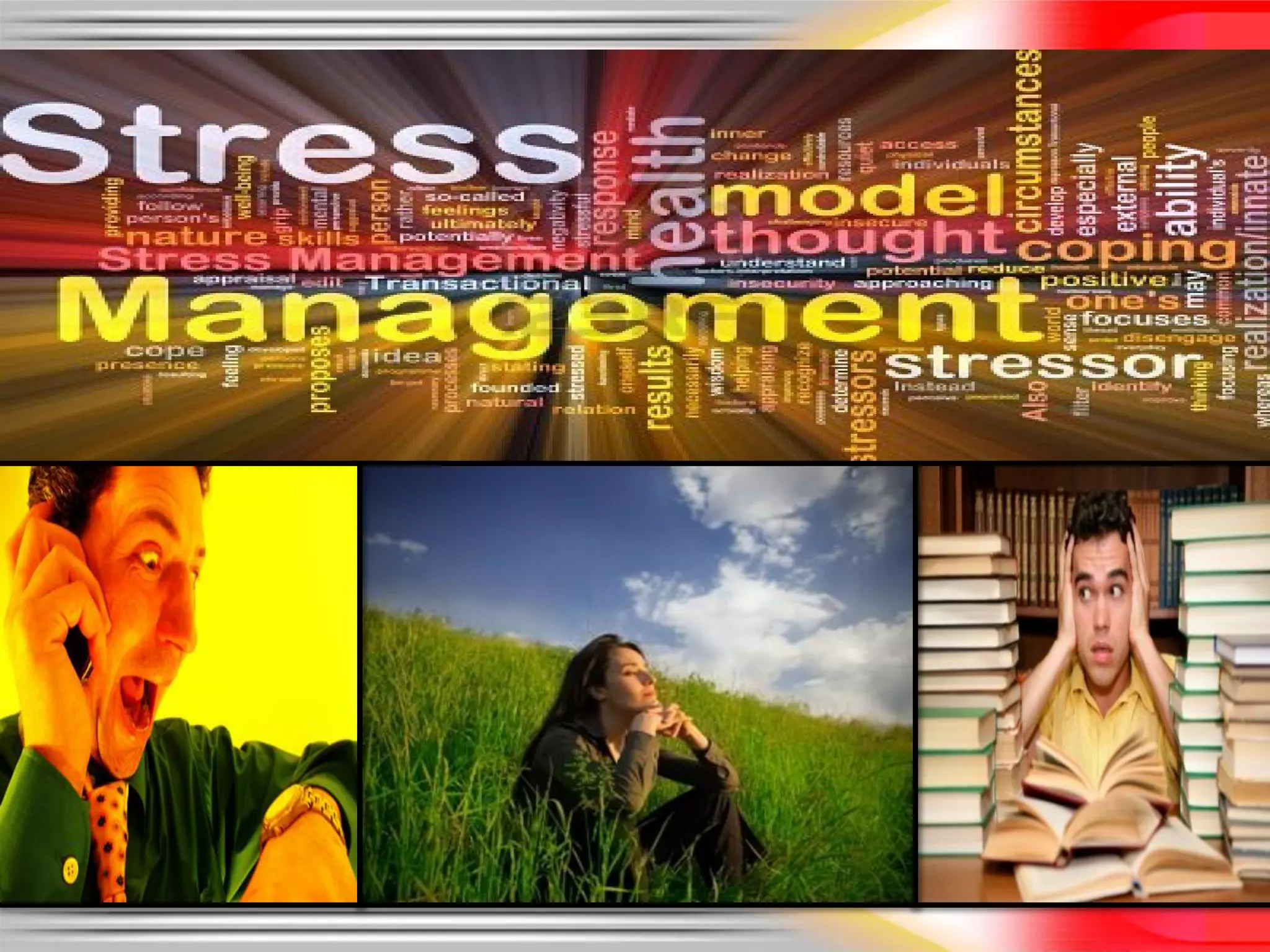
Dynamics of Stress


Presentation by –
Group 5
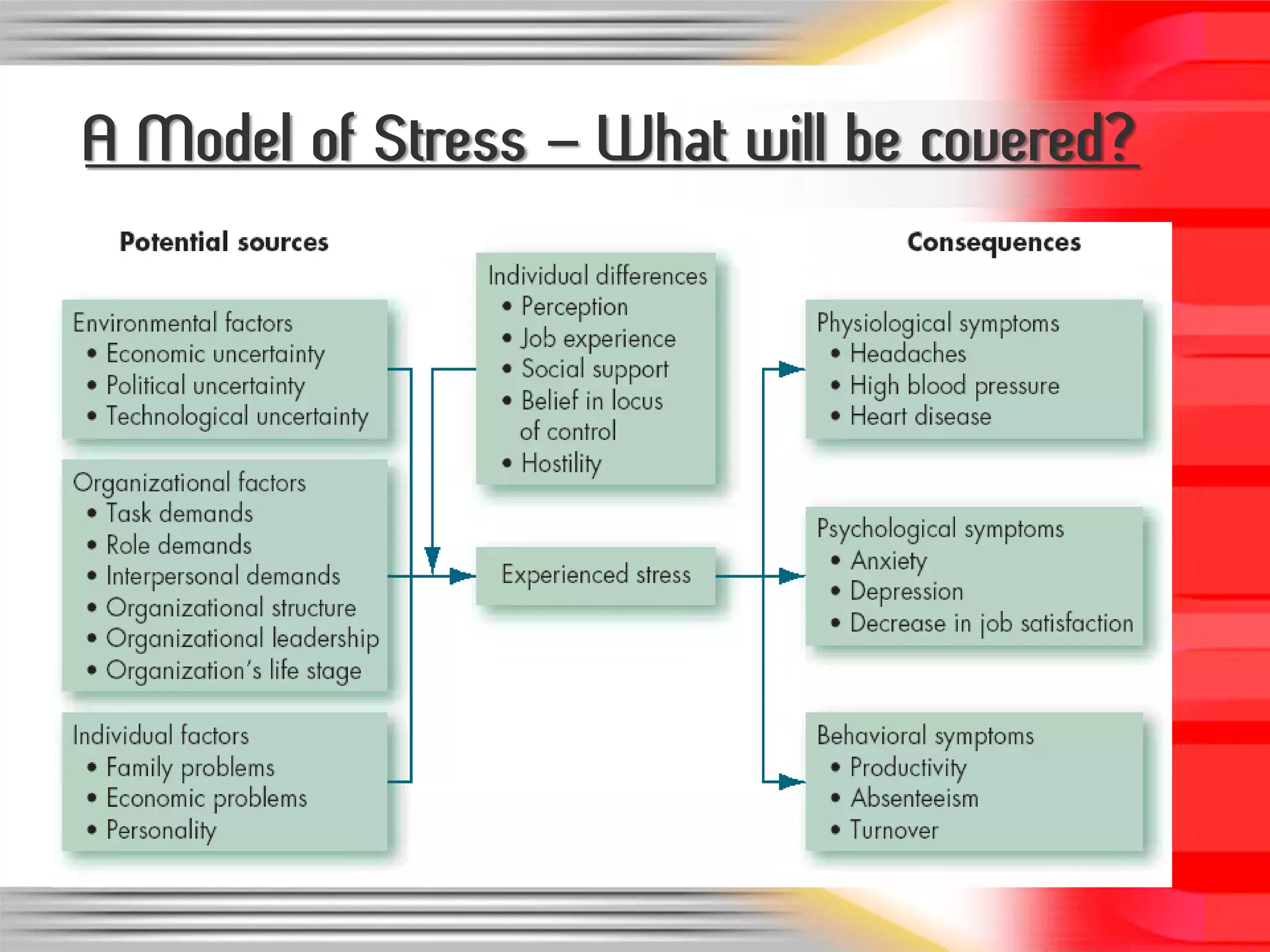
A Model of Stress – What will be covered?
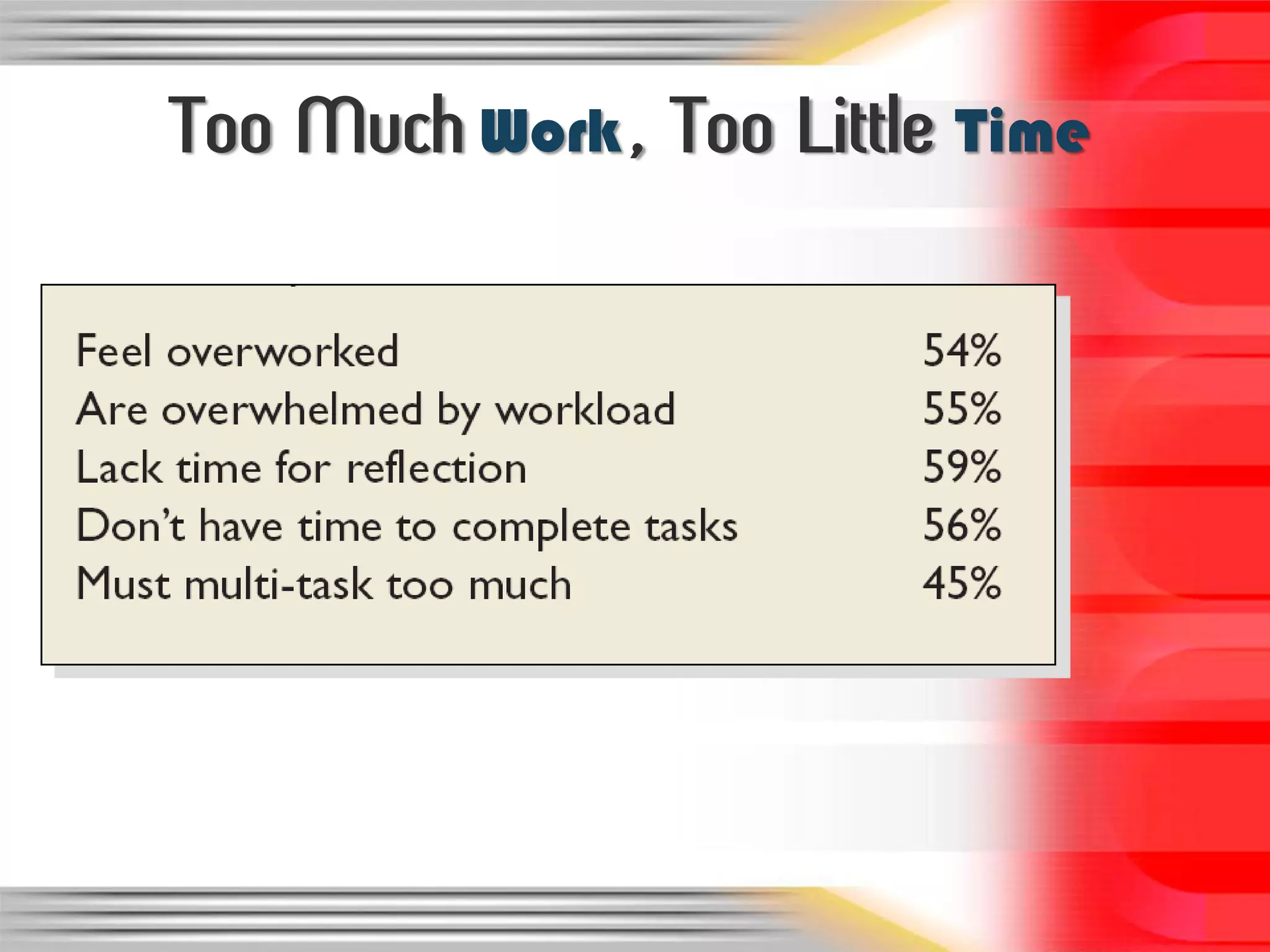
Too Much Work , Too Little Time
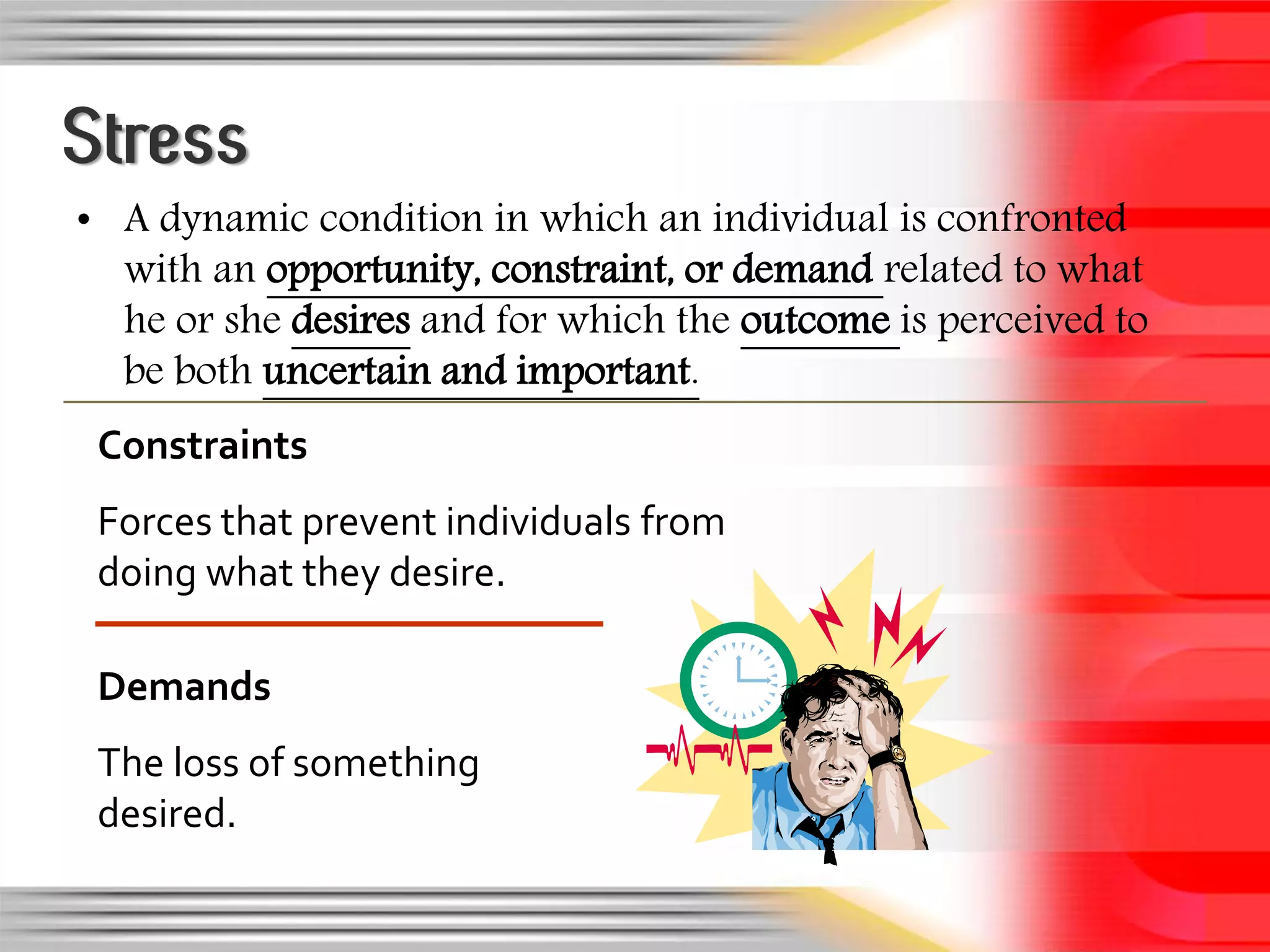
Stress
• A dynamic condition in which an individual is confronted
  with an opportunity, constraint, or demand related to what
  he or she desires and for which the outcome is perceived to
  be both uncertain and important.
 Constraints
 Forces that prevent individuals from
 doing what they desire.

 Demands
 The loss of something
 desired.
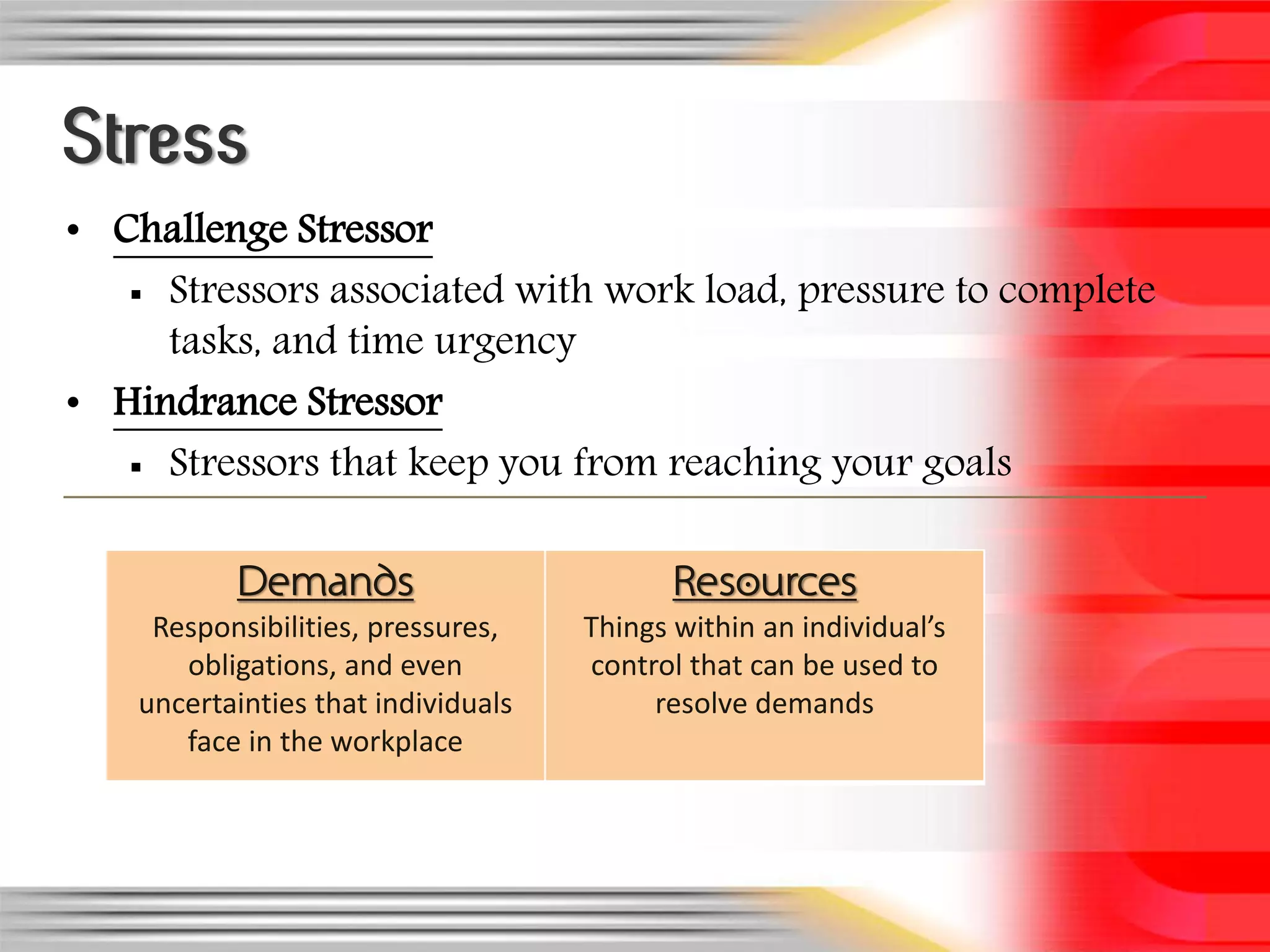
Stress
• Challenge Stressor
    Stressors associated with work load, pressure to complete
     tasks, and time urgency
• Hindrance Stressor
    Stressors that keep you from reaching your goals


           Demands                          Resources
     Responsibilities, pressures,    Things within an individual’s
       obligations, and even         control that can be used to
    uncertainties that individuals        resolve demands
       face in the workplace
Potential Sources of Stress
• Environmental Factors
     Economic uncertainties of the business cycle
     Political uncertainties of political systems
     Technological uncertainties of technical
      innovations
     Terrorism in threats to physical safety and
      security
Potential Sources of Stress
• Organizational Factors
     Task demands related to the job
     Role demands of functioning in an organization
     Interpersonal demands created by other employees
     Organizational structure (rules and regulations)
     Organizational leadership (managerial style)
     Organization’s life stage (growth, stability, or decline)
Potential Sources of Stress
• Individual Factors
     Family and personal relationships
     Economic problems from exceeding earning capacity
     Personality problems arising for basic disposition
Potential Sources of Stress
• Individual Differences
     Perceptual variations of how reality will affect the
      individual’s future.
     Greater job experience moderates stress effects.
     Social support buffers job stress.
     Internal locus of control lowers perceived job stress.
     Strong feelings of self-efficacy reduce reactions to job
      stress.
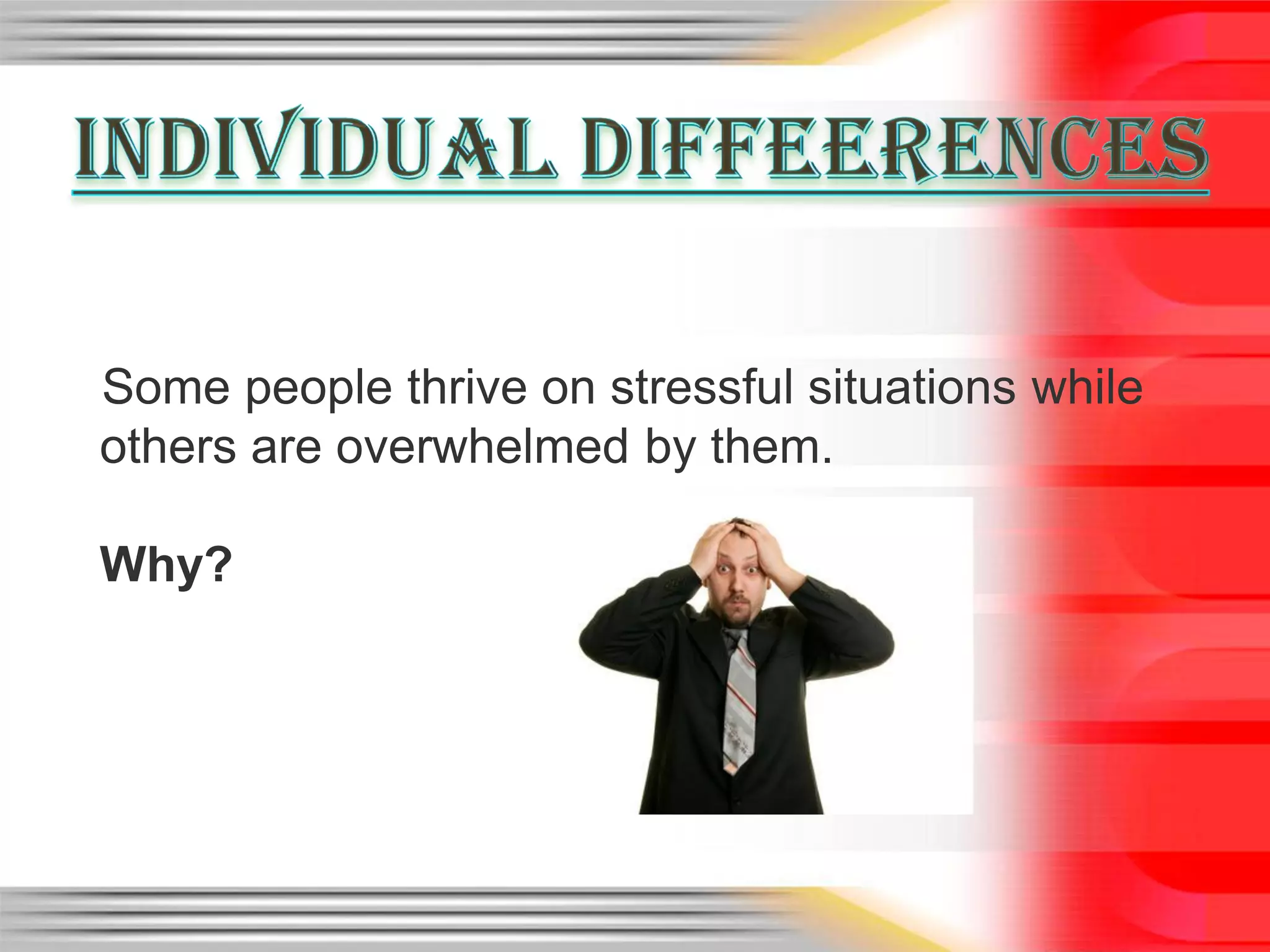
Some people thrive on stressful situations while
others are overwhelmed by them.

Why?
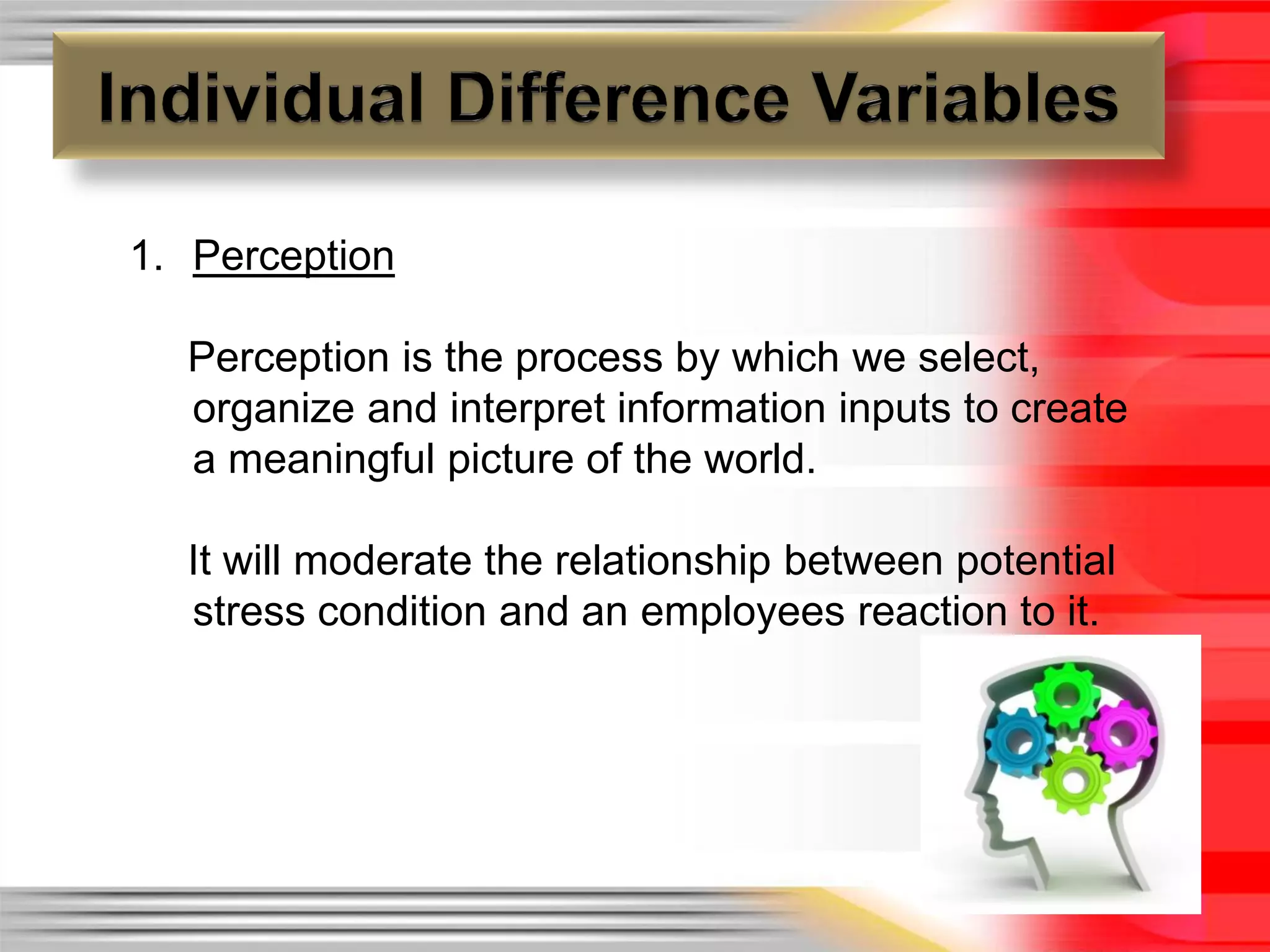
1. Perception

  Perception is the process by which we select,
  organize and interpret information inputs to create
  a meaningful picture of the world.

  It will moderate the relationship between potential
  stress condition and an employees reaction to it.
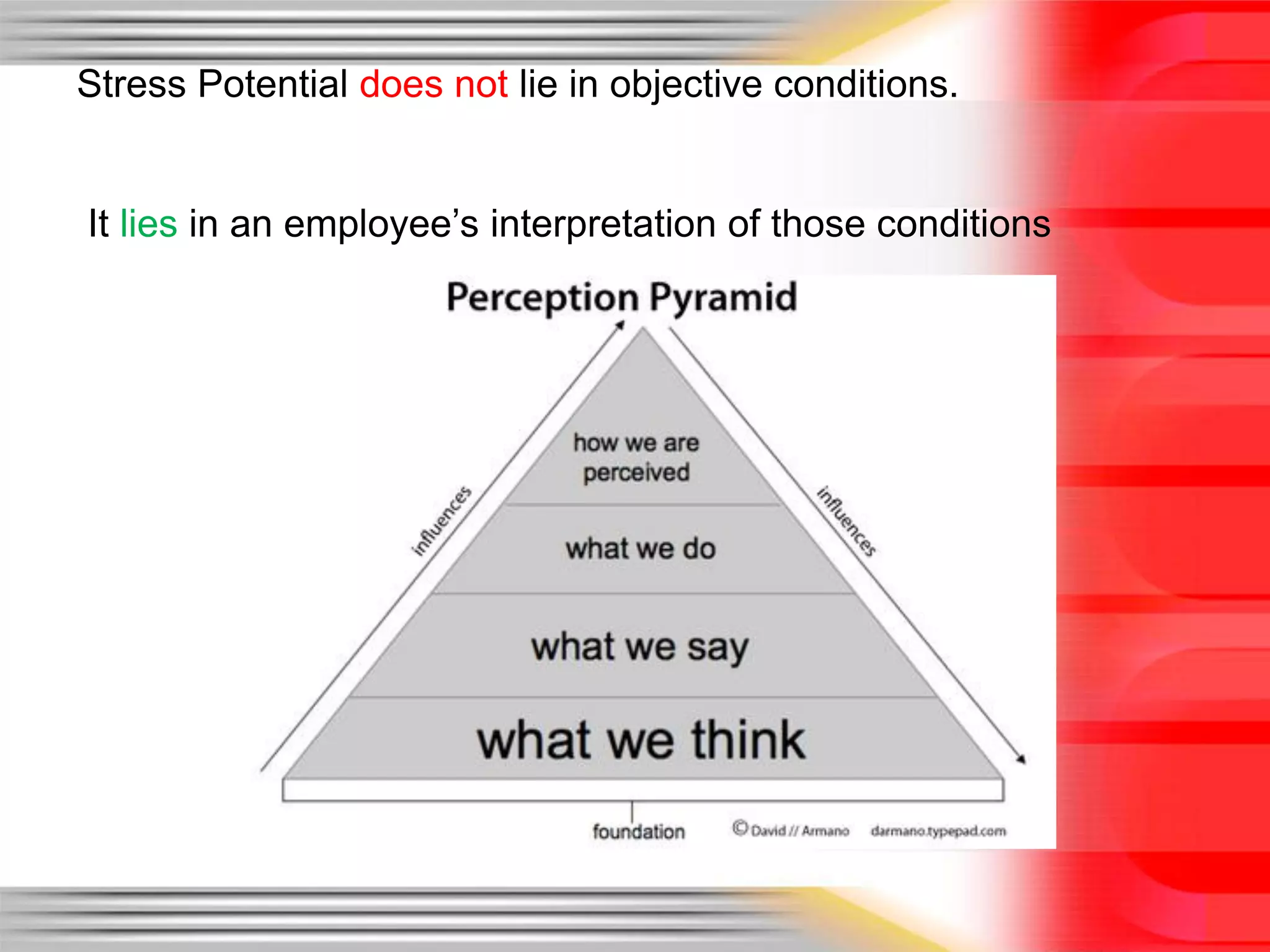
Stress Potential does not lie in objective conditions.


It lies in an employee’s interpretation of those conditions
2. Job Expereince

   Experience on job tends to be negatively
   related to work stress due to two reasons:-

(a) Voluntary turnover is more probable among
    people who experience more stress.

(b) People eventually develop coping
    mechanisms to deal with stress.
3. Social Support

  Social support is collegial relationships with co
  workers or supervisors.

   It acts as a palliative mitigating the negative
   effects of even high strain jobs.
4. Personality

  Personality is the particular combination of
  emotional, attitudinal, and behavioral
  response patterns of an individual.

   The most widely studied personality trait in
   stress is Type A personality, particularly
   that aspect which manifests in itself anger
   and hostility.
Physiological and Psychological Symptoms of Stress


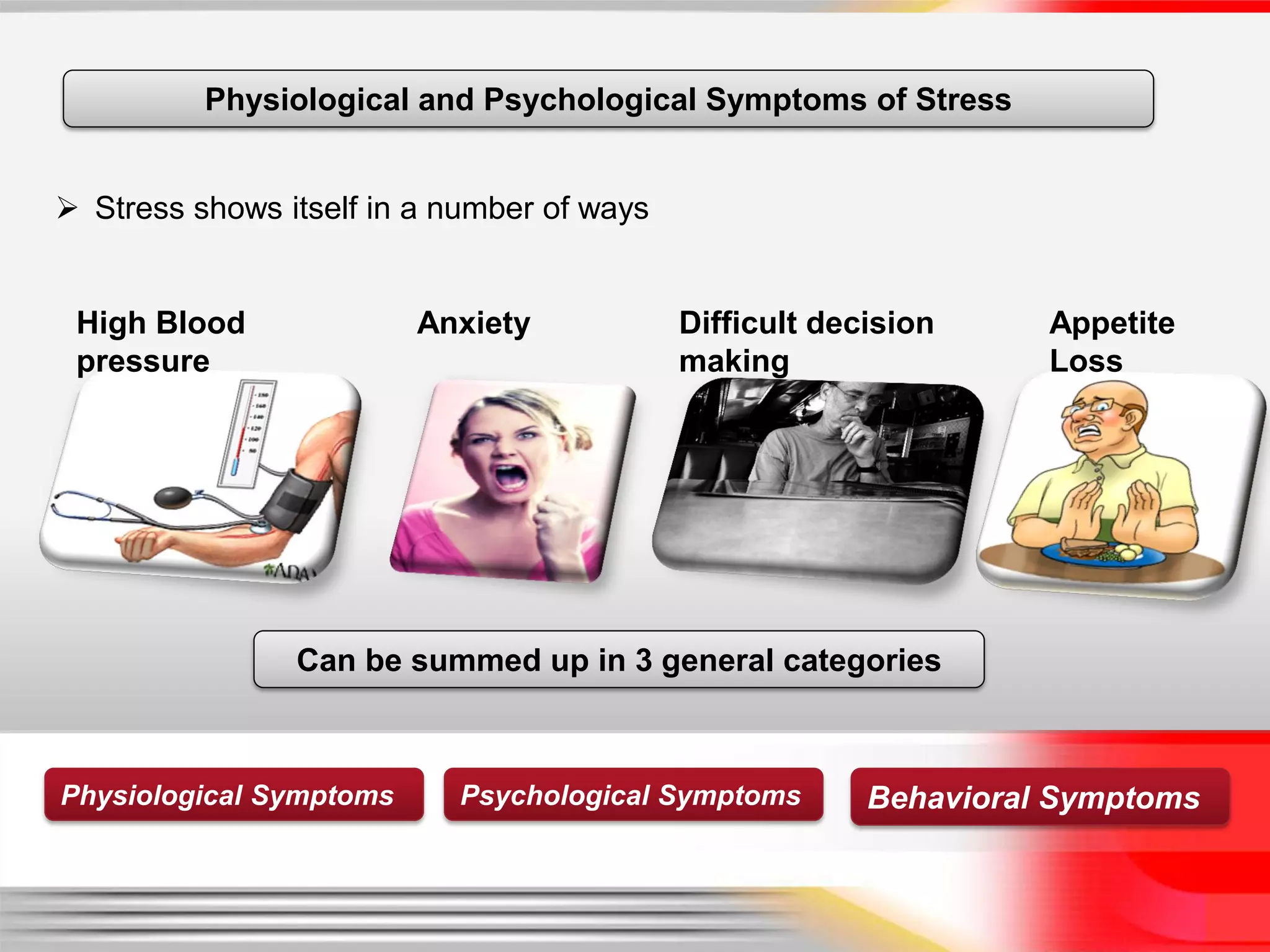
 Stress shows itself in a number of ways


 High Blood              Anxiety            Difficult decision     Appetite
 pressure                                   making                 Loss


                Can be summed up in 3 general categories


Physiological Symptoms     Psychological Symptoms        Behavioral Symptoms
Physiological Symptoms of Stress

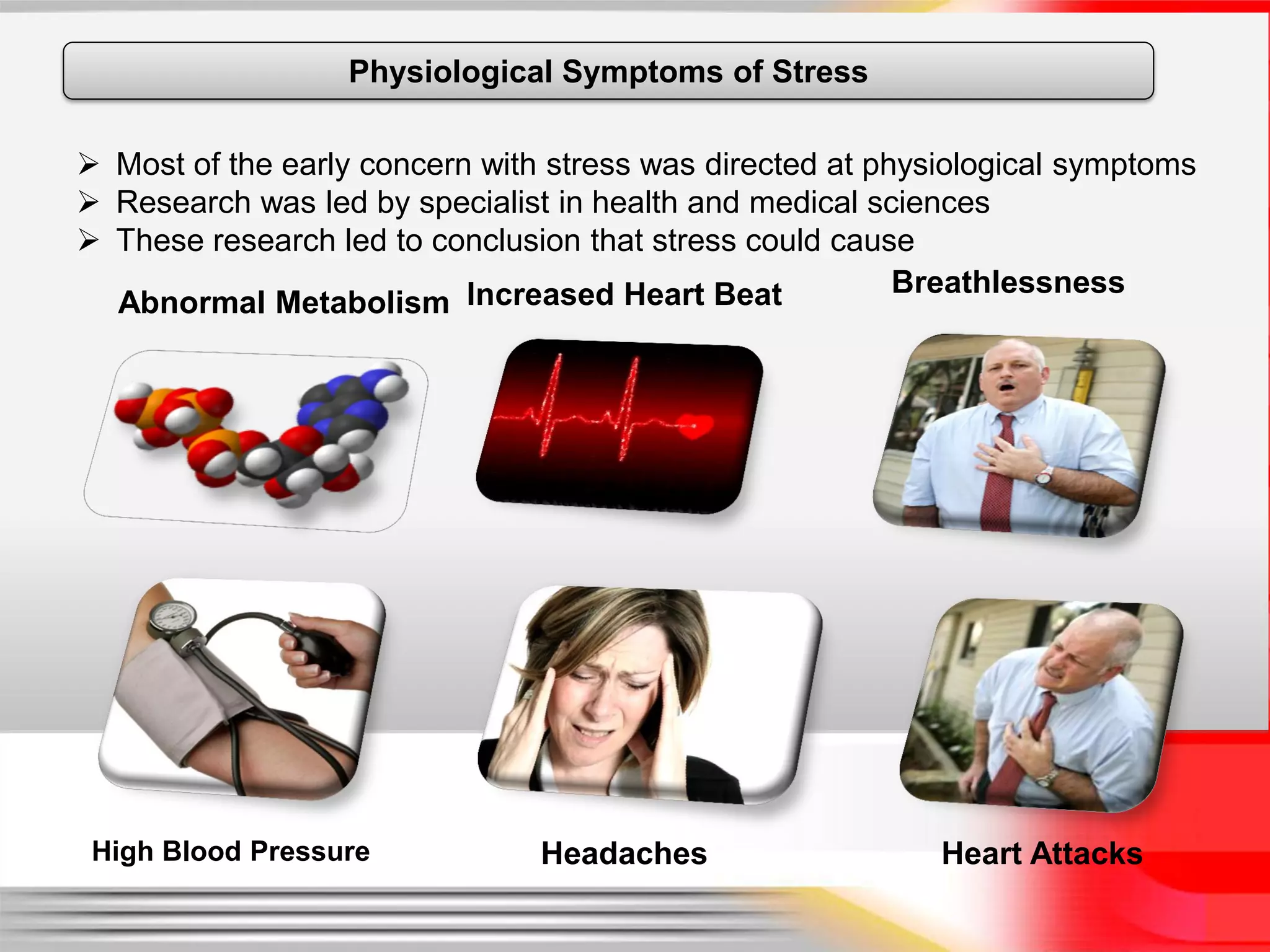
 Most of the early concern with stress was directed at physiological symptoms
 Research was led by specialist in health and medical sciences
 These research led to conclusion that stress could cause
                                                          Breathlessness
  Abnormal Metabolism Increased Heart Beat


 High Blood Pressure            Headaches                   Heart Attacks
Physiological Symptoms of Stress

 The link between stress and particular physiological symptom is not clear
 Only a few consistent relationships have been found
 Sheer complexity of symptoms and difficulty in measuring them objectively

 Example

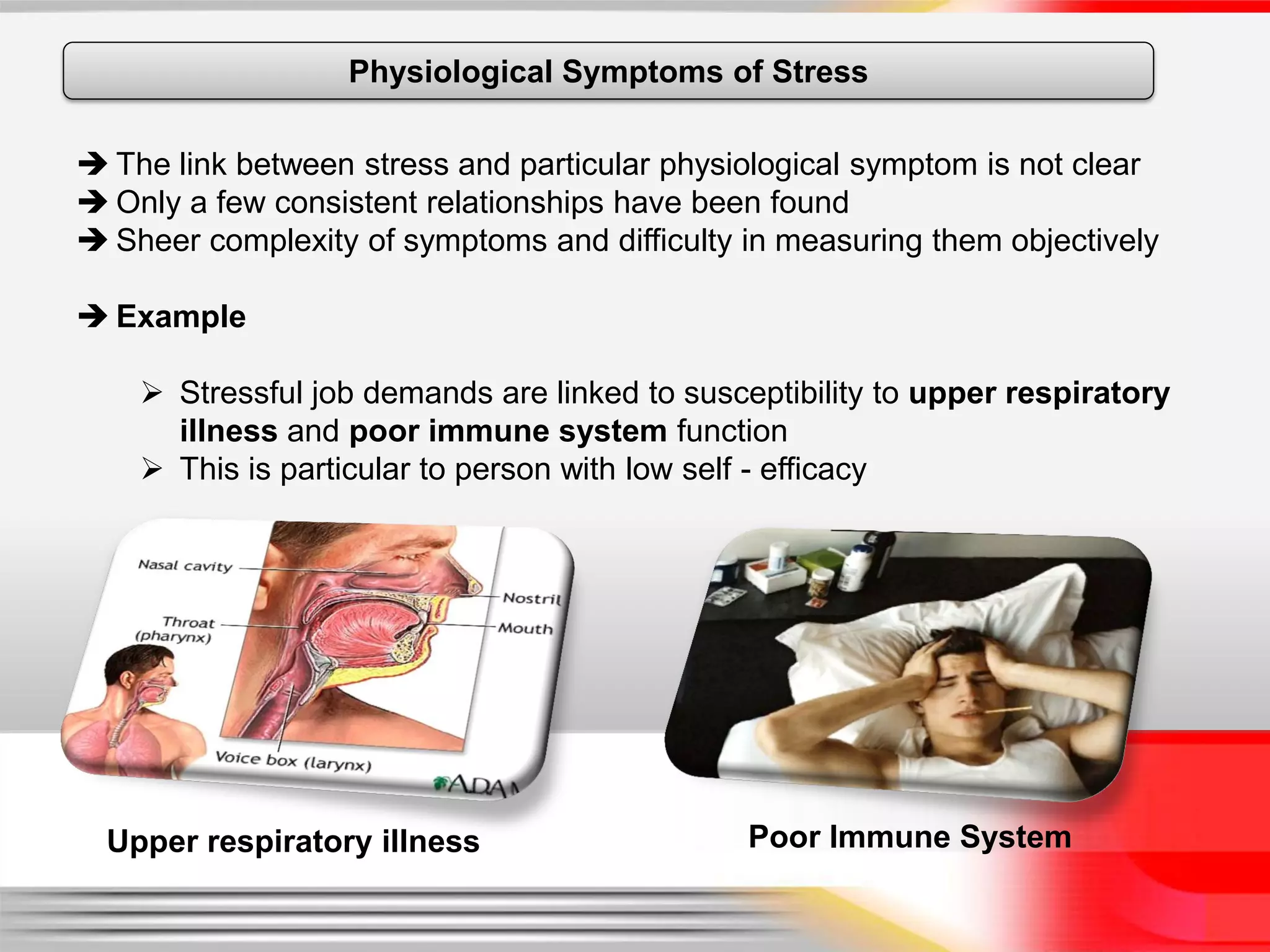
     Stressful job demands are linked to susceptibility to upper respiratory
      illness and poor immune system function
     This is particular to person with low self - efficacy


  Upper respiratory illness                    Poor Immune System
Psychological Symptoms of Stress

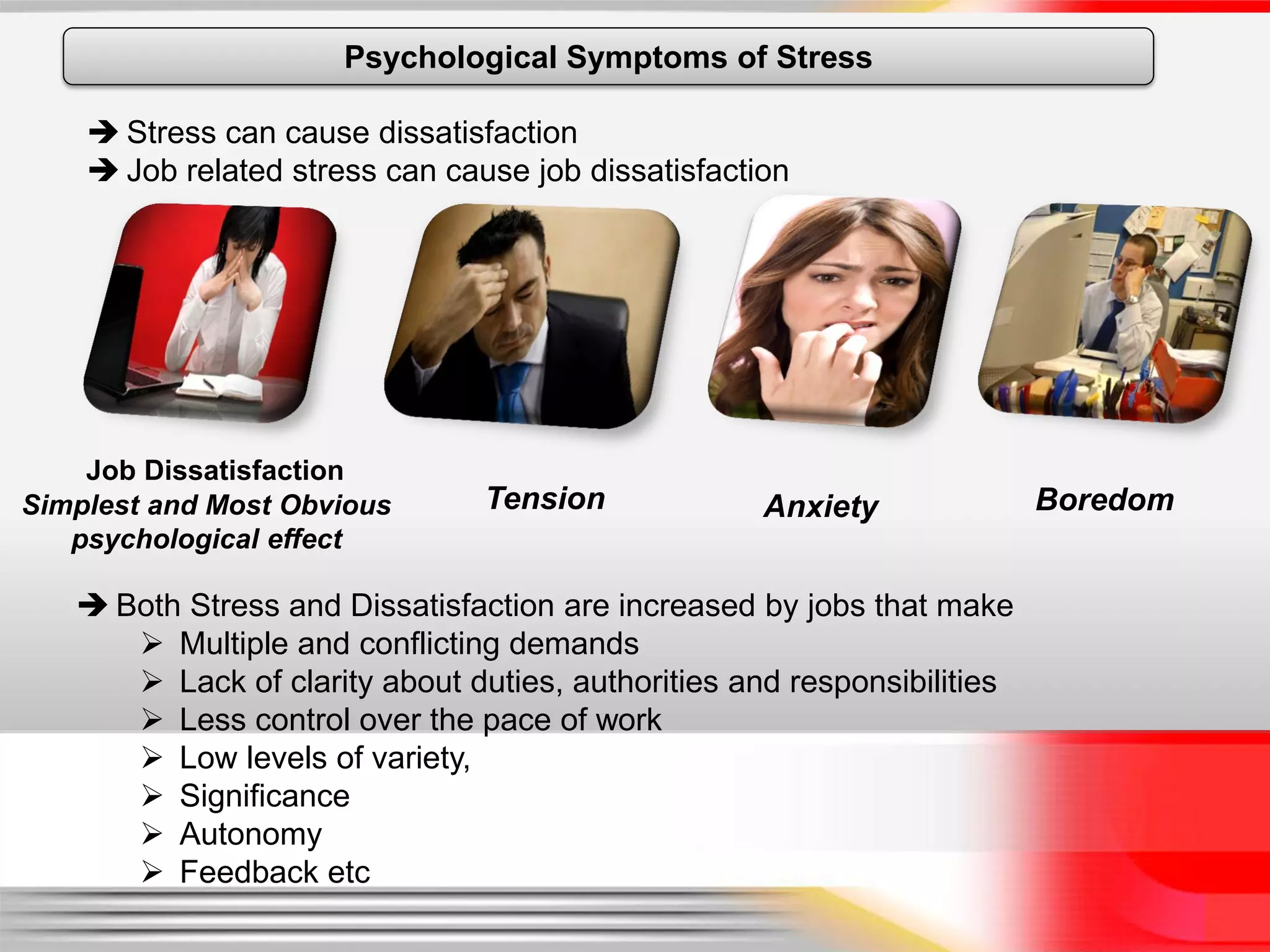
     Stress can cause dissatisfaction
     Job related stress can cause job dissatisfaction


    Job Dissatisfaction
Simplest and Most Obvious       Tension             Anxiety              Boredom
   psychological effect

    Both Stress and Dissatisfaction are increased by jobs that make
       Multiple and conflicting demands
       Lack of clarity about duties, authorities and responsibilities
       Less control over the pace of work
       Low levels of variety,
       Significance
       Autonomy
       Feedback etc
Behavioral Symptoms of Stress

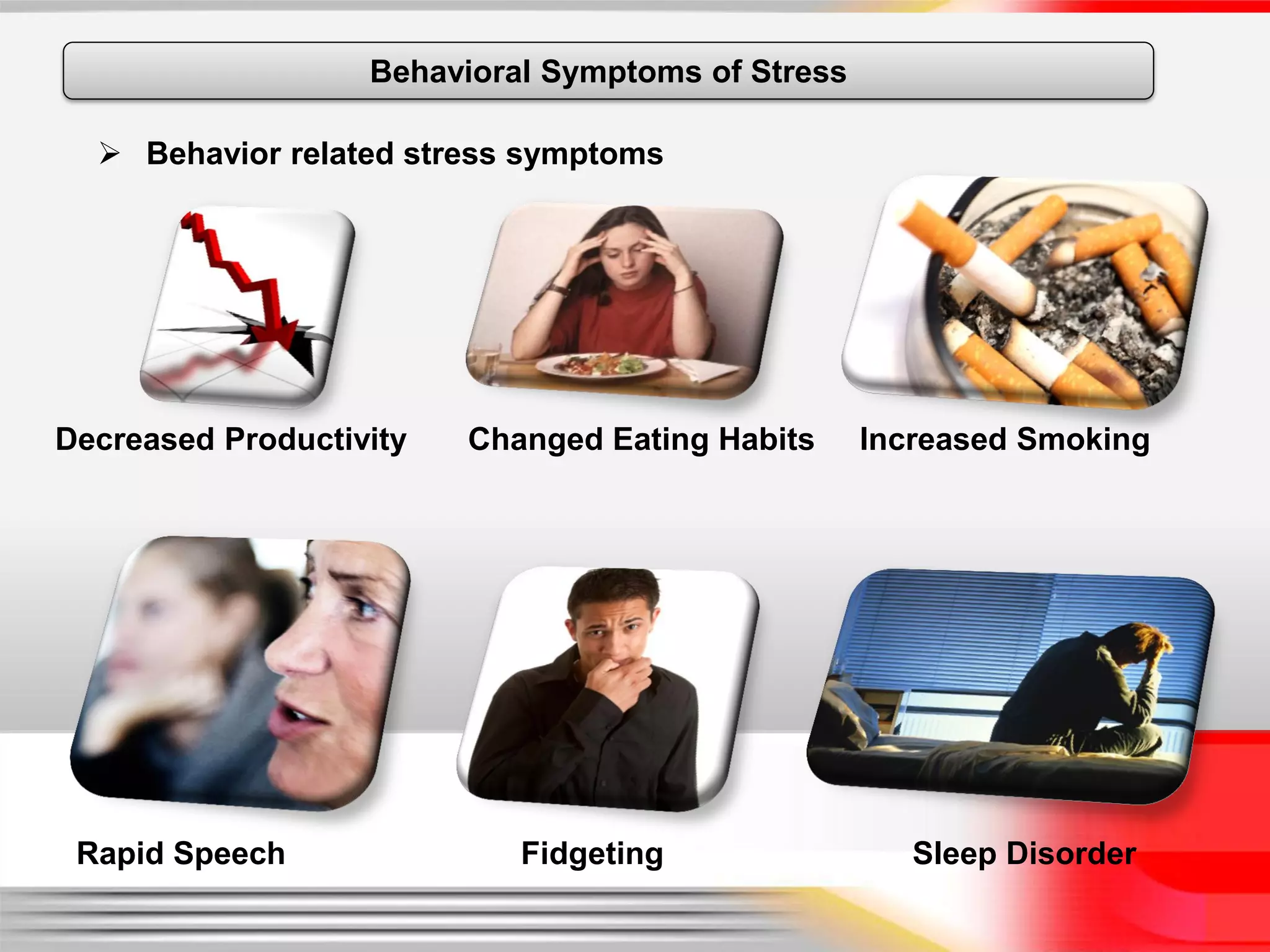
   Behavior related stress symptoms


Decreased Productivity   Changed Eating Habits     Increased Smoking


 Rapid Speech               Fidgeting                 Sleep Disorder
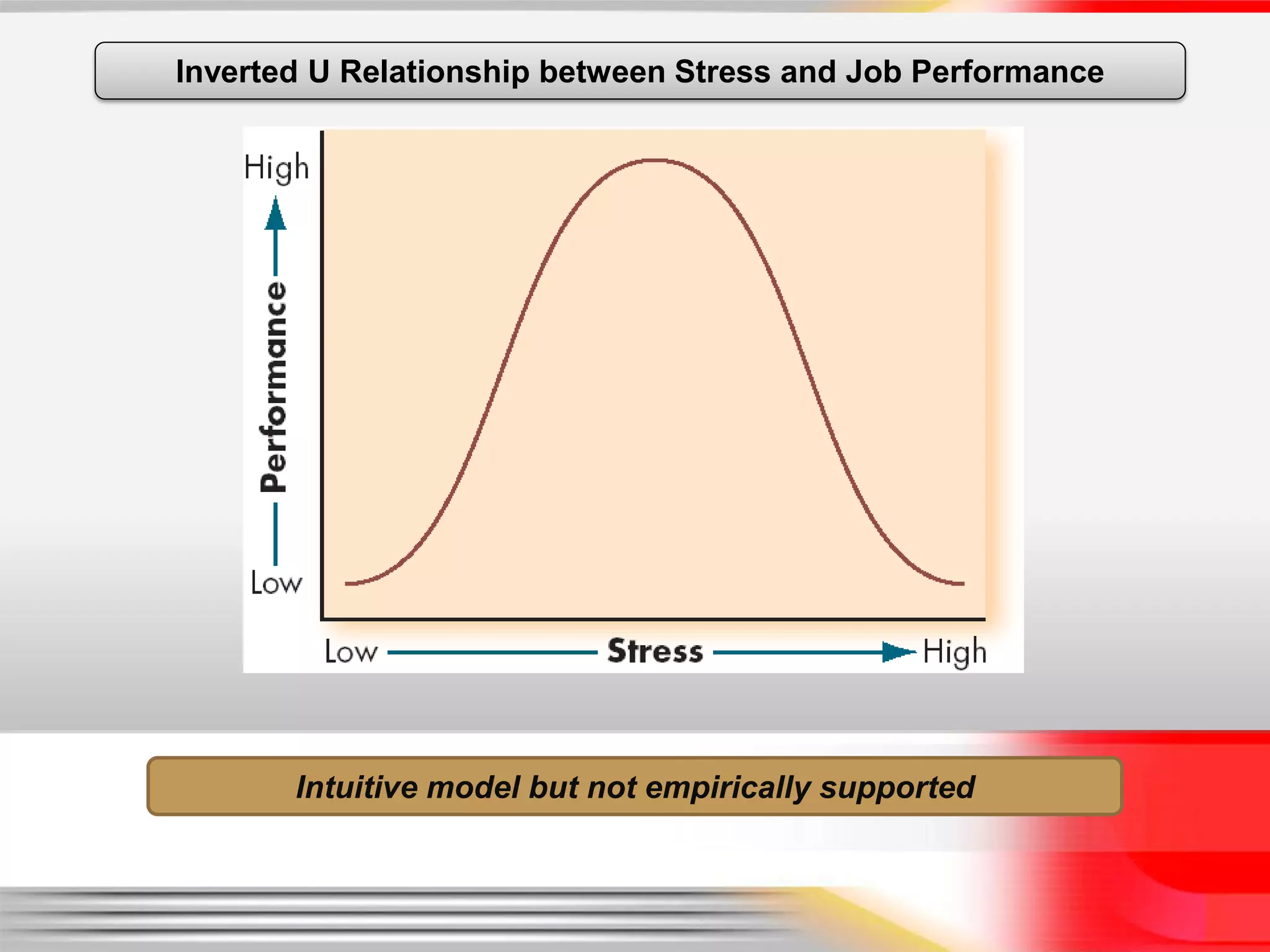
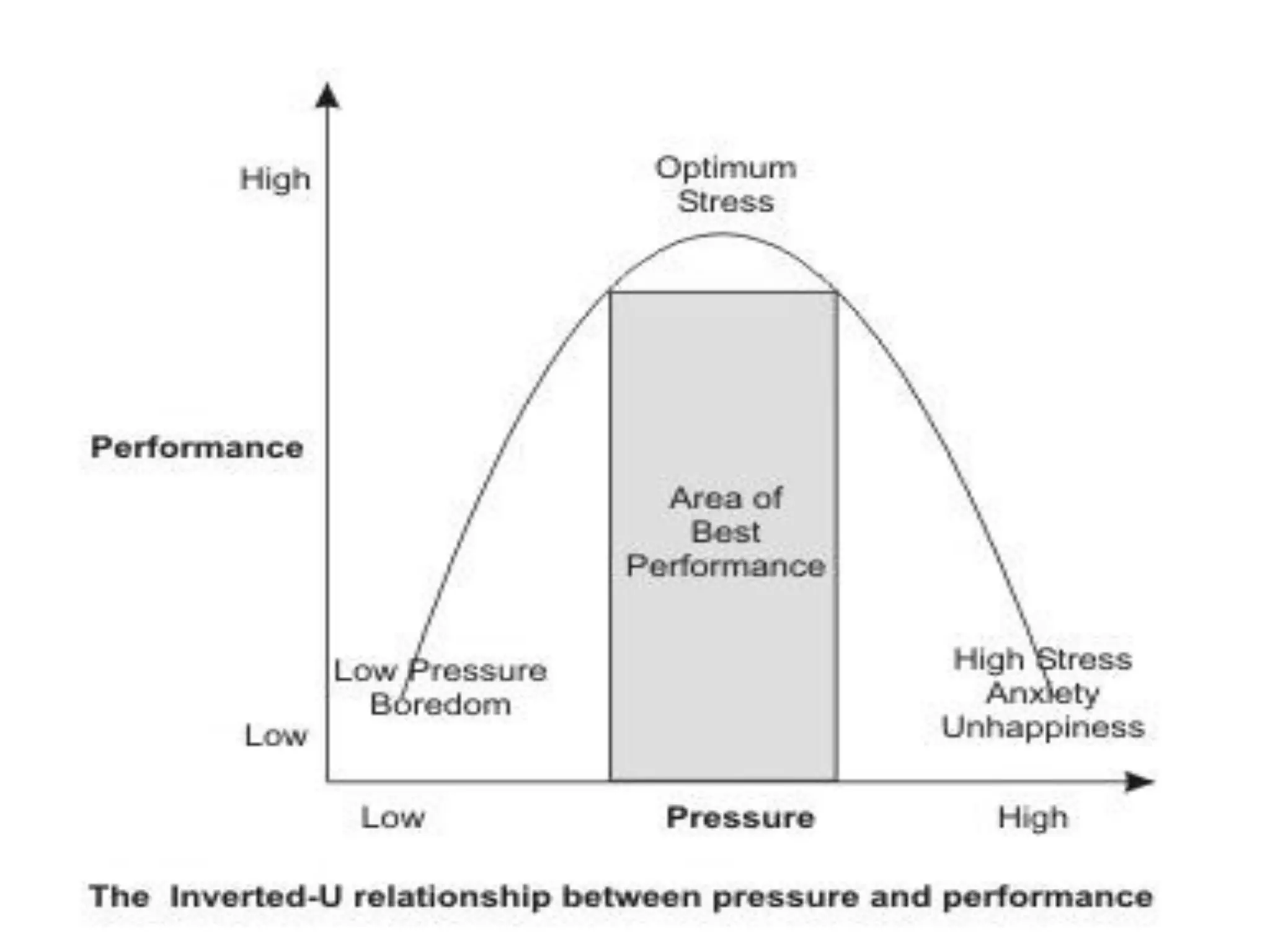
Inverted U Relationship between Stress and Job Performance


       Intuitive model but not empirically supported
CONSEQUENCES OF STRESS ON THE
           JOB
The consequences are very
         severe

 Individual level

 Organisational level
Individual level
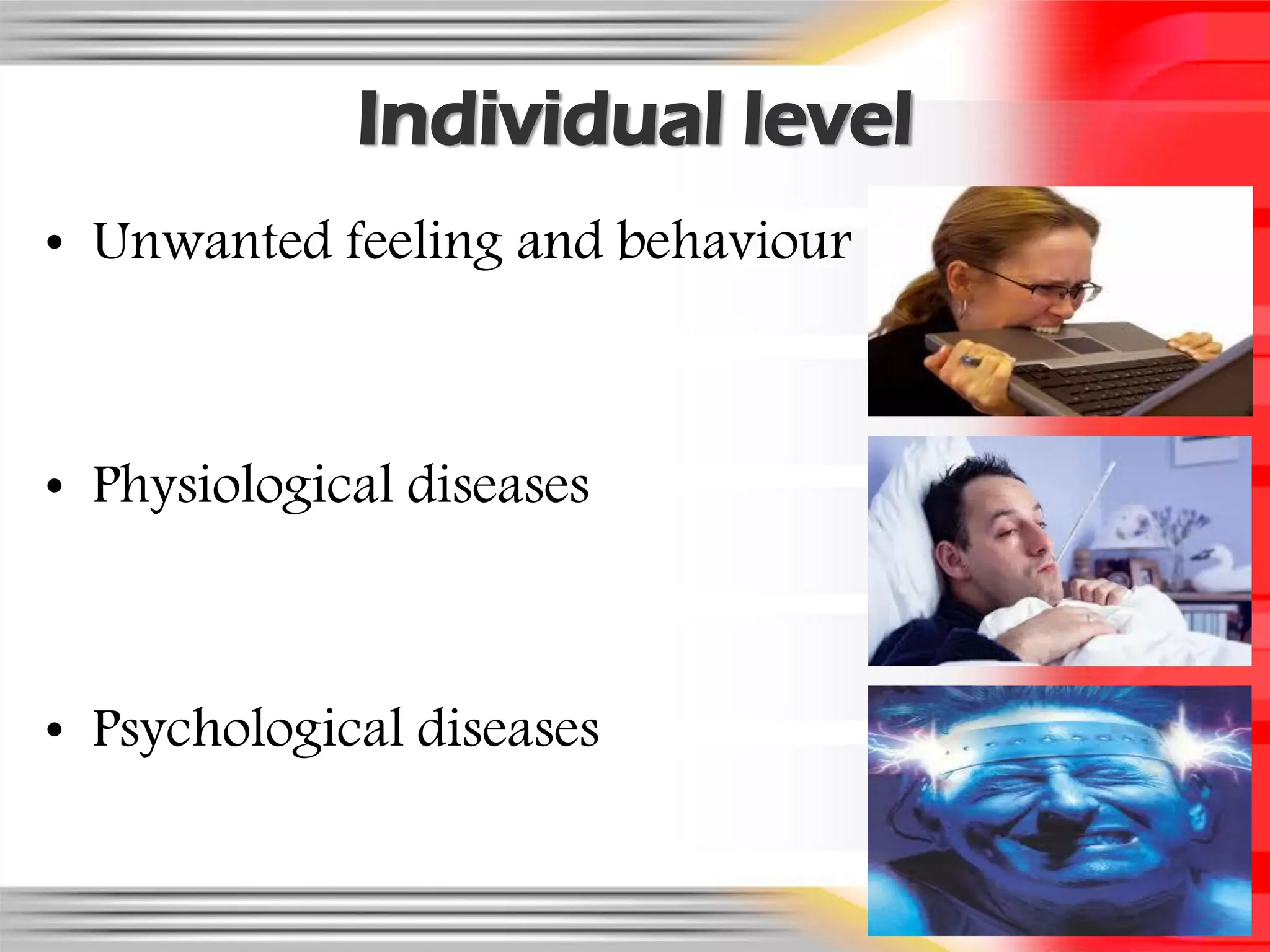
• Unwanted feeling and behaviour


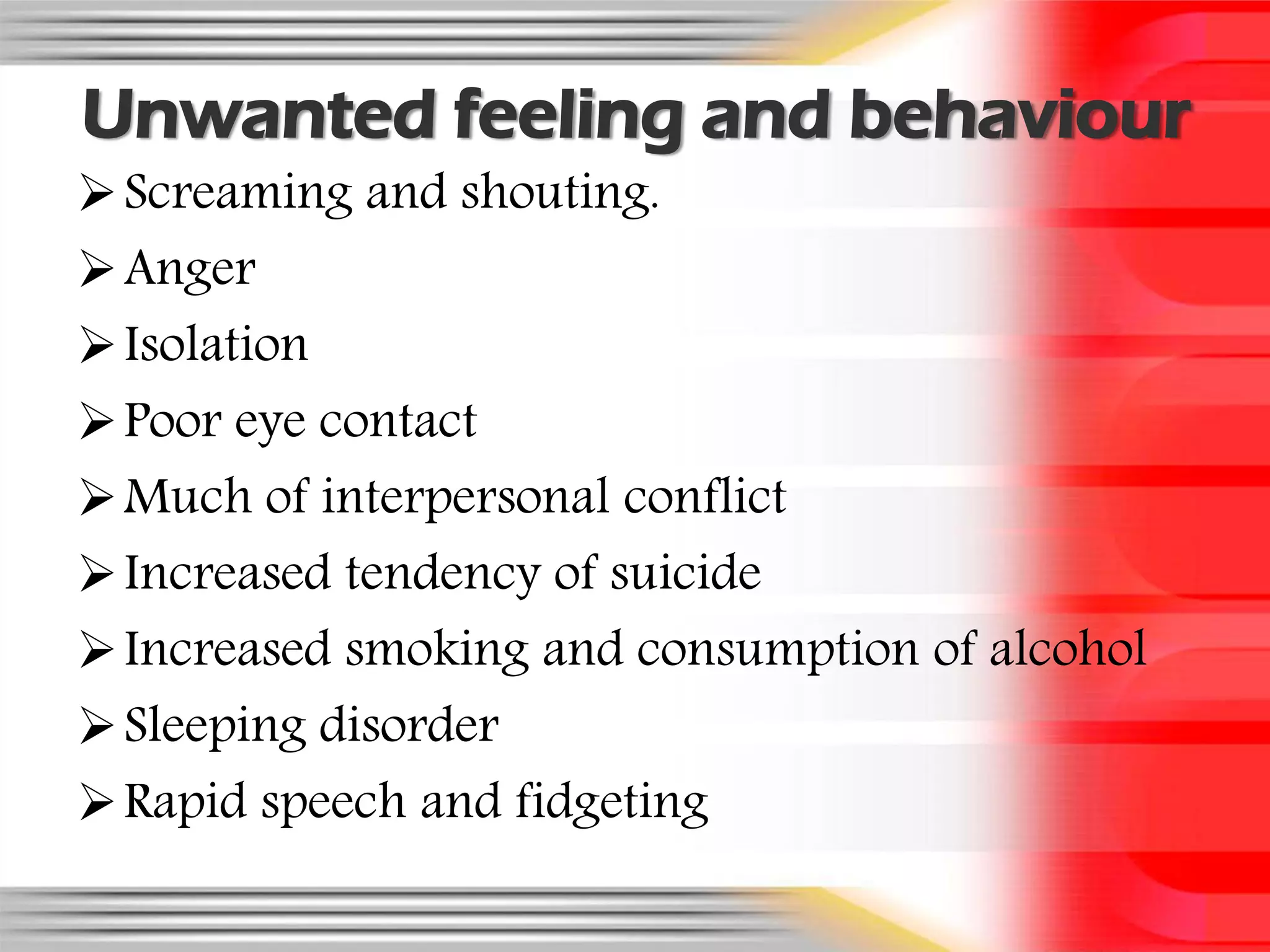
• Physiological diseases


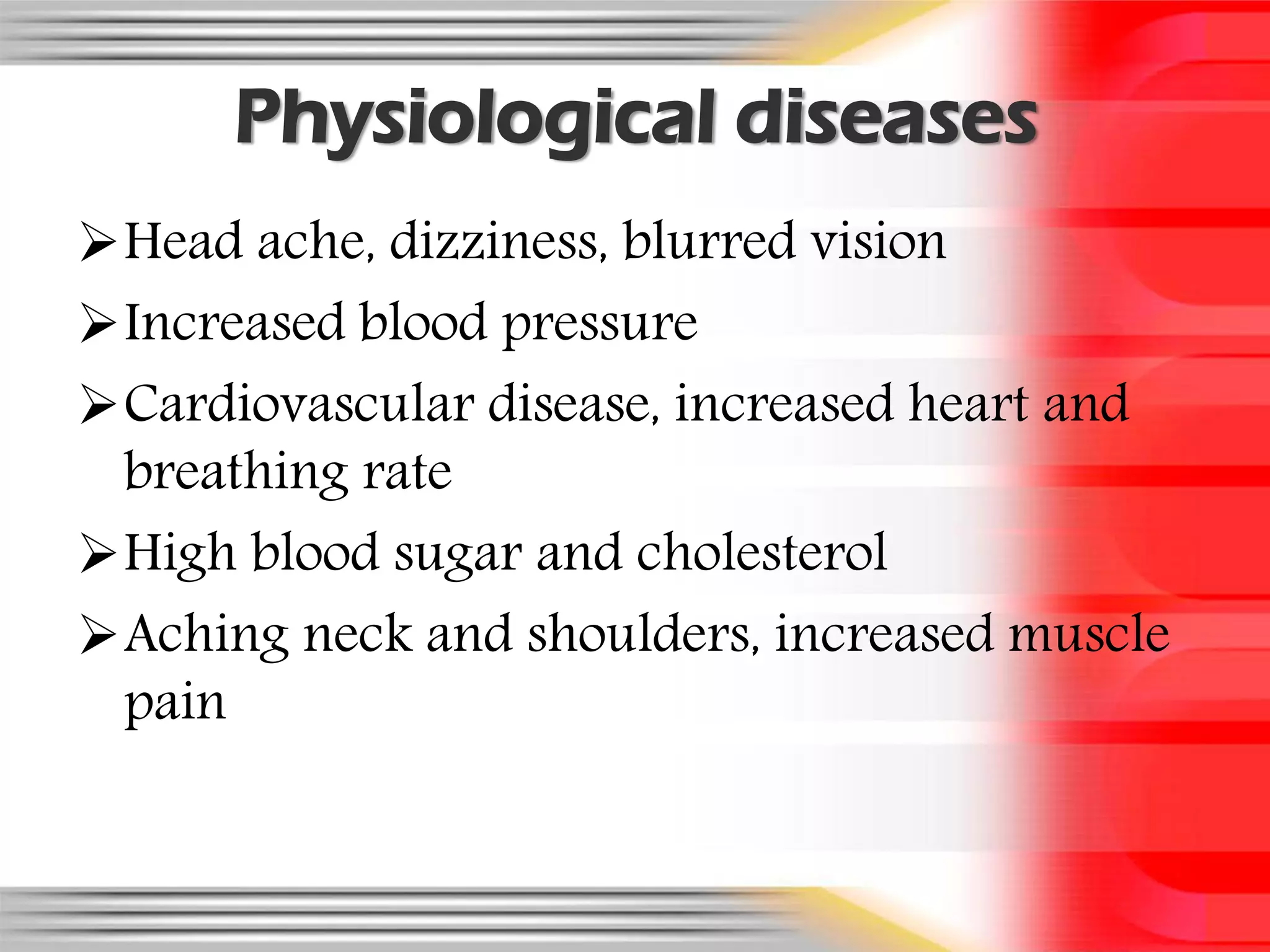
• Psychological diseases
Unwanted feeling and behaviour
 Screaming and shouting.
 Anger
 Isolation
 Poor eye contact
 Much of interpersonal conflict
 Increased tendency of suicide
 Increased smoking and consumption of alcohol
 Sleeping disorder
 Rapid speech and fidgeting
Physiological diseases
Head ache, dizziness, blurred vision
Increased blood pressure
Cardiovascular disease, increased heart and
 breathing rate
High blood sugar and cholesterol
Aching neck and shoulders, increased muscle
 pain
Psychological diseases
Depression and anxiousness

Short-temperament

Passiveness and aggressiveness

Lose of self confidence and self esteem

Inability to take sound decisions
A recent research shows
anywhere from 2/3rd of the
illness in humans is stress
related.
Organizational level
• Job dissatisfaction
• Lower productivity, decreased quality and
  quantity of work
• Less organizational commitment
• Intention to leave the job, high labour turnover
• Absenteeism
• Performance and productivity losses/ low quality
  of product and services
• Increasing complaints from customers
• Higher sick leave
• Loss of valuable staff, permanent vacancies,
  premature retirement.
World health organisation has labelled
stress as worldwide epidemic. According
to recent study, today workplace stress is
estimated to cost companies more than $300
billion a year in poor performance,
absenteeism and health cost.
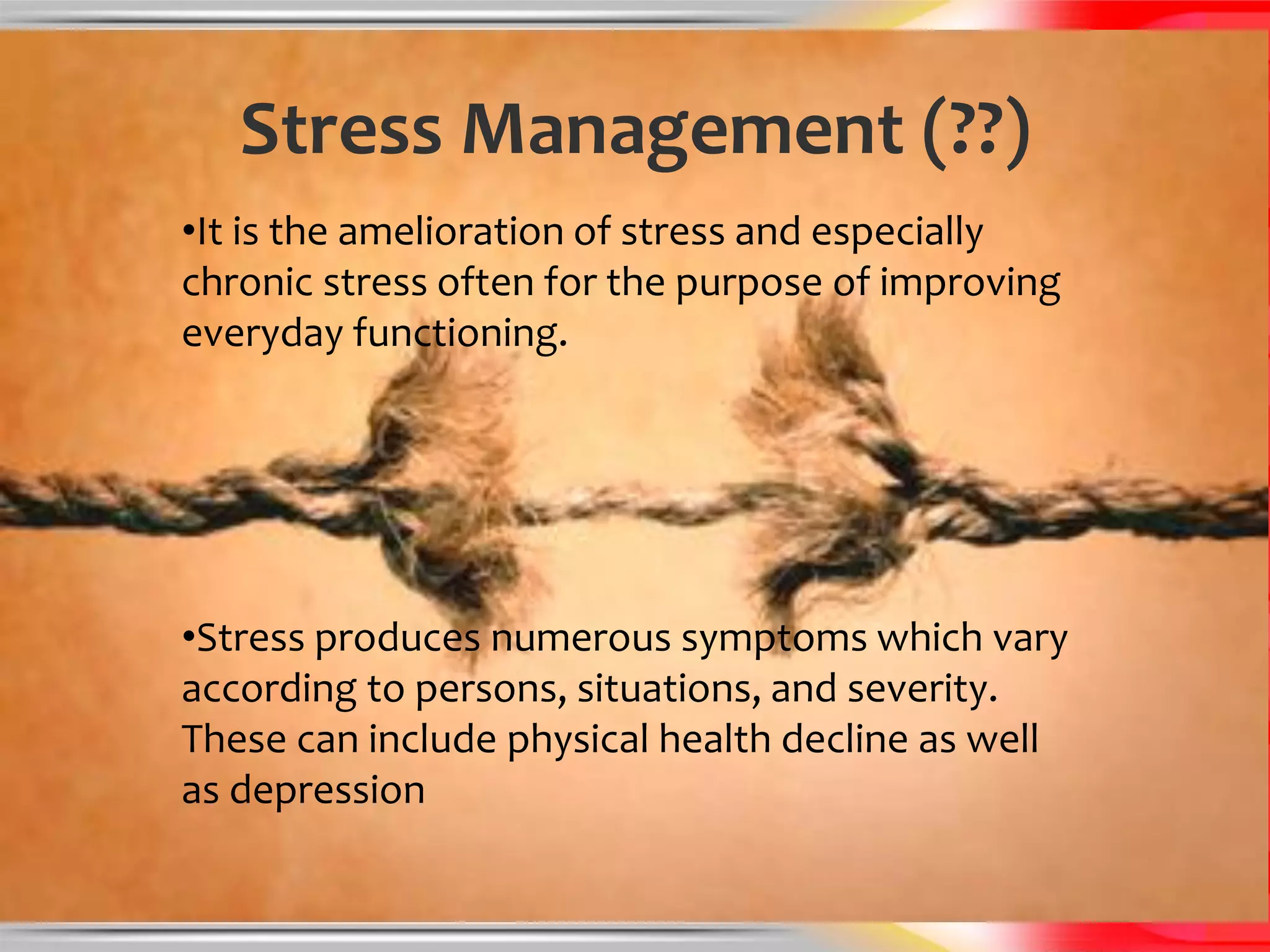
Stress Management (??)
•It is the amelioration of stress and especially
chronic stress often for the purpose of improving
everyday functioning.


•Stress produces numerous symptoms which vary
according to persons, situations, and severity.
These can include physical health decline as well
as depression
Stress - Different Perspectives
• Organizations’ View -> Low to moderate stress
  increases employee performance

• High levels of stress or even sustained low
  levels over long periods can lead to adverse
   effects

• Individuals’ Standpoint -> Even low stress is
  perceived as undesirable excessive pressure
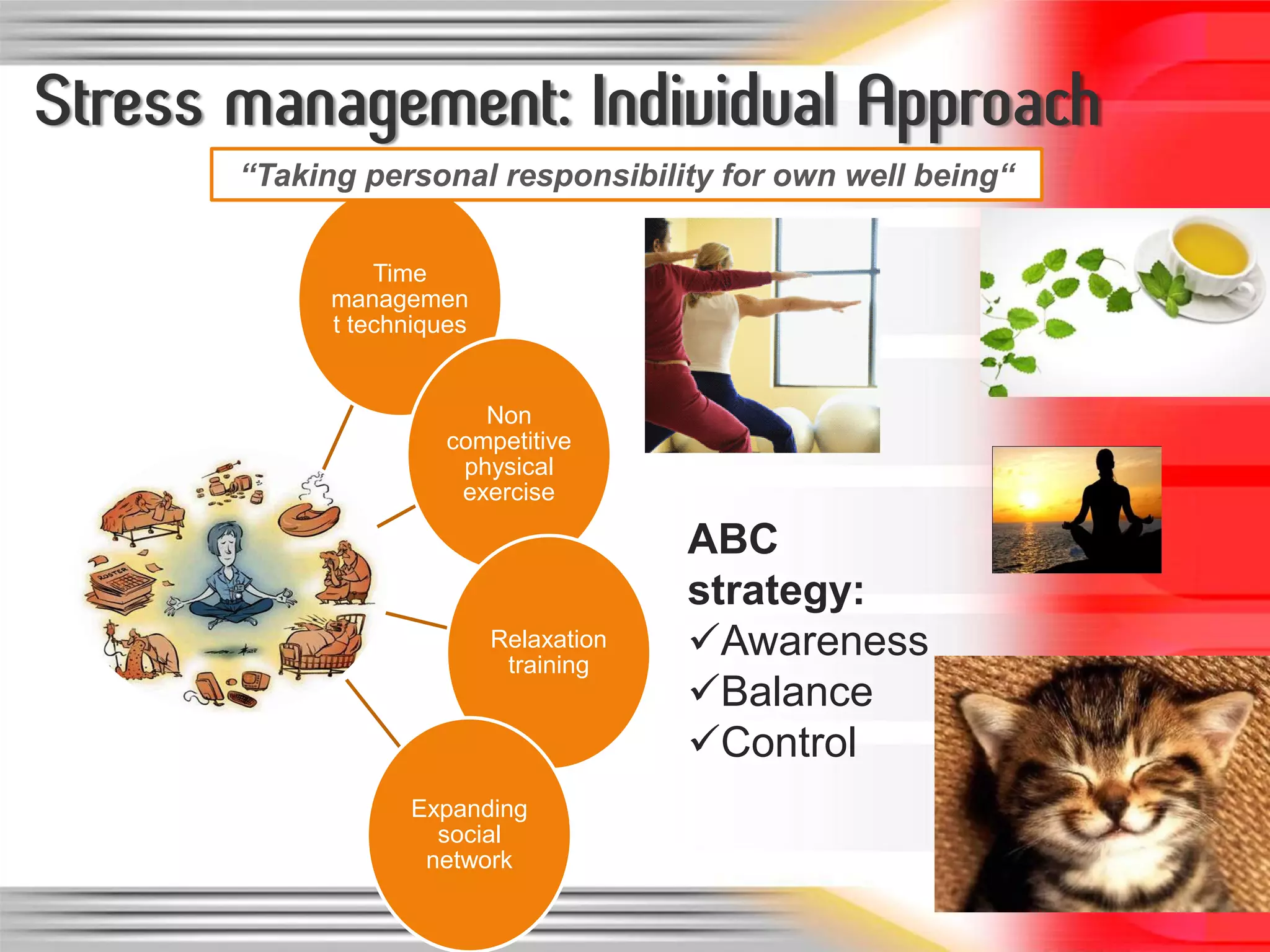
Stress management: Individual Approach
       “Taking personal responsibility for own well being“


                 Time
             managemen
             t techniques


                          Non
                       competitive
                        physical
                        exercise

                                         ABC
                                         strategy:
                            Relaxation
                             training
                                         Awareness
                                         Balance
                                         Control
                   Expanding
                     social
                    network
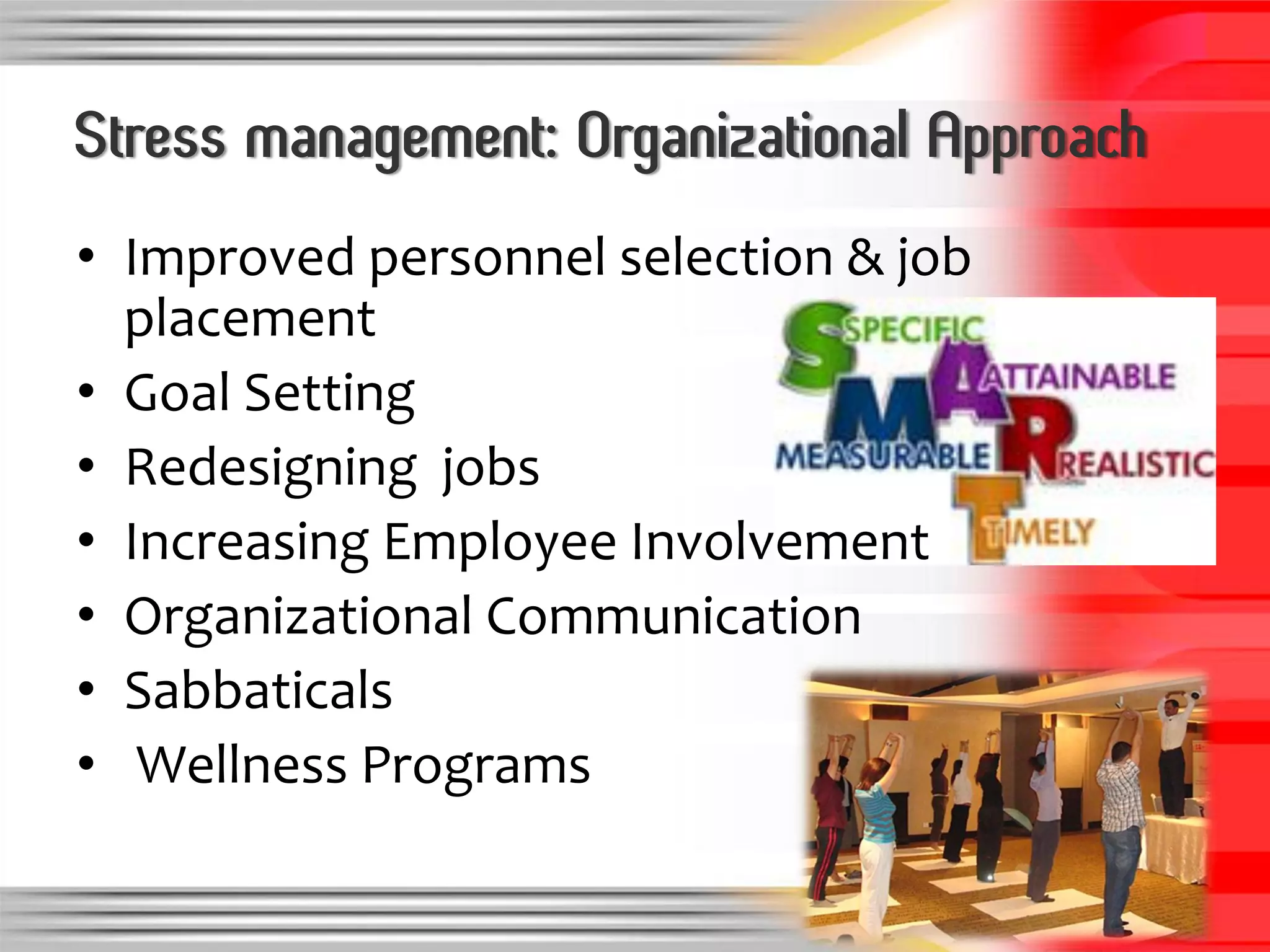
Stress management: Organizational Approach
• Improved personnel selection & job
  placement
• Goal Setting
• Redesigning jobs
• Increasing Employee Involvement
• Organizational Communication
• Sabbaticals
• Wellness Programs
Thank You!

Dynamics of Stress

  • 1.
  • 2.
    A Model ofStress – What will be covered?
  • 3.
    Too Much Work, Too Little Time
  • 5.
    Stress • A dynamiccondition in which an individual is confronted with an opportunity, constraint, or demand related to what he or she desires and for which the outcome is perceived to be both uncertain and important. Constraints Forces that prevent individuals from doing what they desire. Demands The loss of something desired.
  • 6.
    Stress • Challenge Stressor  Stressors associated with work load, pressure to complete tasks, and time urgency • Hindrance Stressor  Stressors that keep you from reaching your goals Demands Resources Responsibilities, pressures, Things within an individual’s obligations, and even control that can be used to uncertainties that individuals resolve demands face in the workplace
  • 7.
    Potential Sources ofStress • Environmental Factors  Economic uncertainties of the business cycle  Political uncertainties of political systems  Technological uncertainties of technical innovations  Terrorism in threats to physical safety and security
  • 8.
    Potential Sources ofStress • Organizational Factors  Task demands related to the job  Role demands of functioning in an organization  Interpersonal demands created by other employees  Organizational structure (rules and regulations)  Organizational leadership (managerial style)  Organization’s life stage (growth, stability, or decline)
  • 9.
    Potential Sources ofStress • Individual Factors  Family and personal relationships  Economic problems from exceeding earning capacity  Personality problems arising for basic disposition
  • 10.
    Potential Sources ofStress • Individual Differences  Perceptual variations of how reality will affect the individual’s future.  Greater job experience moderates stress effects.  Social support buffers job stress.  Internal locus of control lowers perceived job stress.  Strong feelings of self-efficacy reduce reactions to job stress.
  • 11.
    Some people thriveon stressful situations while others are overwhelmed by them. Why?
  • 12.
    1. Perception Perception is the process by which we select, organize and interpret information inputs to create a meaningful picture of the world. It will moderate the relationship between potential stress condition and an employees reaction to it.
  • 13.
    Stress Potential doesnot lie in objective conditions. It lies in an employee’s interpretation of those conditions
  • 14.
    2. Job Expereince Experience on job tends to be negatively related to work stress due to two reasons:- (a) Voluntary turnover is more probable among people who experience more stress. (b) People eventually develop coping mechanisms to deal with stress.
  • 15.
    3. Social Support Social support is collegial relationships with co workers or supervisors. It acts as a palliative mitigating the negative effects of even high strain jobs.
  • 16.
    4. Personality Personality is the particular combination of emotional, attitudinal, and behavioral response patterns of an individual. The most widely studied personality trait in stress is Type A personality, particularly that aspect which manifests in itself anger and hostility.
  • 17.
    Physiological and PsychologicalSymptoms of Stress  Stress shows itself in a number of ways High Blood Anxiety Difficult decision Appetite pressure making Loss Can be summed up in 3 general categories Physiological Symptoms Psychological Symptoms Behavioral Symptoms
  • 18.
    Physiological Symptoms ofStress  Most of the early concern with stress was directed at physiological symptoms  Research was led by specialist in health and medical sciences  These research led to conclusion that stress could cause Breathlessness Abnormal Metabolism Increased Heart Beat High Blood Pressure Headaches Heart Attacks
  • 19.
    Physiological Symptoms ofStress  The link between stress and particular physiological symptom is not clear  Only a few consistent relationships have been found  Sheer complexity of symptoms and difficulty in measuring them objectively  Example  Stressful job demands are linked to susceptibility to upper respiratory illness and poor immune system function  This is particular to person with low self - efficacy Upper respiratory illness Poor Immune System
  • 20.
    Psychological Symptoms ofStress  Stress can cause dissatisfaction  Job related stress can cause job dissatisfaction Job Dissatisfaction Simplest and Most Obvious Tension Anxiety Boredom psychological effect  Both Stress and Dissatisfaction are increased by jobs that make  Multiple and conflicting demands  Lack of clarity about duties, authorities and responsibilities  Less control over the pace of work  Low levels of variety,  Significance  Autonomy  Feedback etc
  • 21.
    Behavioral Symptoms ofStress  Behavior related stress symptoms Decreased Productivity Changed Eating Habits Increased Smoking Rapid Speech Fidgeting Sleep Disorder
  • 22.
    Inverted U Relationshipbetween Stress and Job Performance Intuitive model but not empirically supported
  • 23.
  • 24.
    The consequences arevery severe  Individual level  Organisational level
  • 25.
    Individual level • Unwantedfeeling and behaviour • Physiological diseases • Psychological diseases
  • 26.
    Unwanted feeling andbehaviour  Screaming and shouting.  Anger  Isolation  Poor eye contact  Much of interpersonal conflict  Increased tendency of suicide  Increased smoking and consumption of alcohol  Sleeping disorder  Rapid speech and fidgeting
  • 27.
    Physiological diseases Head ache,dizziness, blurred vision Increased blood pressure Cardiovascular disease, increased heart and breathing rate High blood sugar and cholesterol Aching neck and shoulders, increased muscle pain
  • 28.
    Psychological diseases Depression andanxiousness Short-temperament Passiveness and aggressiveness Lose of self confidence and self esteem Inability to take sound decisions
  • 29.
    A recent researchshows anywhere from 2/3rd of the illness in humans is stress related.
  • 30.
    Organizational level • Jobdissatisfaction • Lower productivity, decreased quality and quantity of work • Less organizational commitment • Intention to leave the job, high labour turnover • Absenteeism • Performance and productivity losses/ low quality of product and services • Increasing complaints from customers • Higher sick leave • Loss of valuable staff, permanent vacancies, premature retirement.
  • 32.
    World health organisationhas labelled stress as worldwide epidemic. According to recent study, today workplace stress is estimated to cost companies more than $300 billion a year in poor performance, absenteeism and health cost.
  • 34.
    Stress Management (??) •Itis the amelioration of stress and especially chronic stress often for the purpose of improving everyday functioning. •Stress produces numerous symptoms which vary according to persons, situations, and severity. These can include physical health decline as well as depression
  • 35.
    Stress - DifferentPerspectives • Organizations’ View -> Low to moderate stress increases employee performance • High levels of stress or even sustained low levels over long periods can lead to adverse effects • Individuals’ Standpoint -> Even low stress is perceived as undesirable excessive pressure
  • 36.
    Stress management: IndividualApproach “Taking personal responsibility for own well being“ Time managemen t techniques Non competitive physical exercise ABC strategy: Relaxation training Awareness Balance Control Expanding social network
  • 37.
    Stress management: OrganizationalApproach • Improved personnel selection & job placement • Goal Setting • Redesigning jobs • Increasing Employee Involvement • Organizational Communication • Sabbaticals • Wellness Programs
  • 38.