STRESS MANAGEMENT
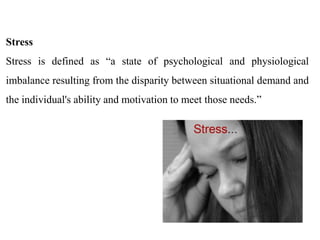
Stress
Stress is defined as “a state of psychological and physiological
imbalance resulting from the disparity between situational demand and
the individual's ability and motivation to meet those needs.”
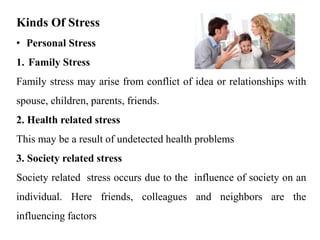
Kinds Of Stress
• Personal Stress
1. Family Stress
Family stress may arise from conflict of idea or relationships with
spouse, children, parents, friends.
2. Health related stress
This may be a result of undetected health problems
3. Society related stress
Society related stress occurs due to the influence of society on an
individual. Here friends, colleagues and neighbors are the
influencing factors
• Work related stress
Work related stress relates to the working environment and policies of
the organization
1. Organizational stress
The stress resulting from the conflict of organizational goals with
personal goals is called organizational stress
2. Job stress
Stress that occurs due to lack of resources or scarce resources at the
workplace is called job stress.
Common Sources of Work Stress
• Low salaries.
• Excessive workloads.
• Few opportunities for growth.
• Work that isn't engaging or challenging.
• Lack of social support.
• Not having enough control over job-related decisions.
• Unclear performance expectations.
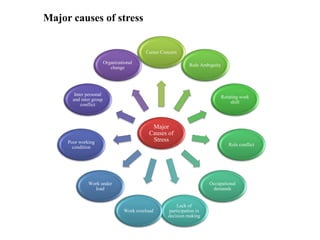
Major causes of stress
Major
Causes of
Stress
Career Concern
Role Ambiguity
Rotating work
shift
Role conflict
Occupational
demands
Lack of
participation in
decision making
Work overload
Work under
load
Poor working
condition
Inter personal
and inter group
conflict
Organizational
change
Career Concern: If an employee feels that he is very much
behind in the corporate ladder, then he may experience
stress.
Role Ambiguity: It occurs when the person doesn't know
what he is supposed to do, on the job. His tasks and
responsibilities are not clear.
Rotating Work Shifts: Stress may occur in those individuals
who work on different work shifts. That may create problems in
adjusting to the shift timings, and it can affect not only personal
life but also family life of the employee.
Role Conflict: It takes place when people have different
expectations from the person performing a particular role. It can
also occur if the job is not as per expectation, or when a job
demands a certain type of behavior that is against the person's
moral values.
Occupational Demands: Some jobs are more demanding than
others. Jobs that involve risk, and danger are more stressful.
Lack of Participation in Decision-making: Many experienced
employees feel that management should consult them on
matters affecting their jobs.
Work Overload: Excessive workload leads to stress as it puts a
person under tremendous pressure.
Work Under load: In this, case, too little work or very easy work is
expected on the part of the employee. Doing less work or jobs of
routine and simple nature would lead to monotony and boredom,
which can lead to stress.
Poor Working Conditions: Employees may be subject to poor
working conditions. It would include bad lighting and ventilation,
unhygienic sanitation facilities, excessive noise, and dust, presence
of toxic gasses and fumes, inadequate safety measures, etc. All these
unpleasant conditions create physiological and psychological
imbalance in humans thereby causing stress.
Lack of Group Cohesiveness: Every group is characterized by its
cohesiveness, although they differ widely in its degree. Individuals
experience stress when there is no unity among work group
members. There are mistrust, jealousy, frequent quarrels, etc., in
groups and this lead to stress to employees.
Interpersonal and Intergroup Conflict: These conflicts take
place due to differences in perceptions, attitudes, values and
beliefs between two or more individuals and groups. Such
conflicts can be a source of stress for group members.
Organizational Changes: When changes occur, people have
to adapt to those changes, and this may cause stress. Stress
is higher when changes are significant or unusual like transfer
or adoption of new technology.
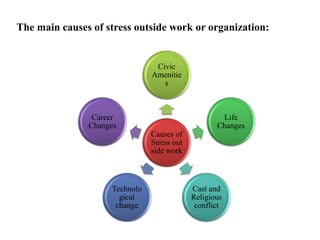
The main causes of stress outside work or organization:
Causes of
Stress out
side work
Civic
Amenitie
s
Life
Changes
Cast and
Religious
conflict
Technolo
gical
change
Career
Changes
Civic Amenities: Poor civic amenities in the area in which one
lives can be a cause of stress. Inadequate or lack of public
facilities like improper water supply, excessive noise or air
pollution, lack of proper transport facility can be quite
stressful.
Life Changes: Life changes can bring stress to a person. Life
changes can be slow or sudden. Gradual life changes include
getting older, and abrupt life changes include death or accident
of a loved one. Sudden life changes are highly stressful and
very difficult to cope.
Caste, and Religious Conflicts: Employees living in areas,
which are often prone to conflicts among people based on
differences seen in their race, caste and religion do suffer more
from stress. In the case of a religion, the minorities and lower-
caste people (especially in India) are subject to more stress.
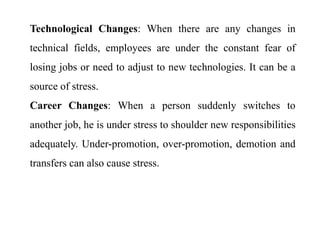
Technological Changes: When there are any changes in
technical fields, employees are under the constant fear of
losing jobs or need to adjust to new technologies. It can be a
source of stress.
Career Changes: When a person suddenly switches to
another job, he is under stress to shoulder new responsibilities
adequately. Under-promotion, over-promotion, demotion and
transfers can also cause stress.
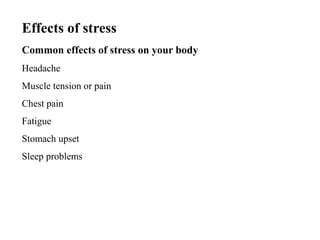
Effects of stress
Common effects of stress on your body
Headache
Muscle tension or pain
Chest pain
Fatigue
Stomach upset
Sleep problems
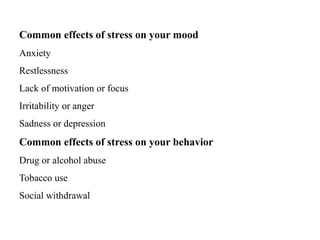
Common effects of stress on your mood
Anxiety
Restlessness
Lack of motivation or focus
Irritability or anger
Sadness or depression
Common effects of stress on your behavior
Drug or alcohol abuse
Tobacco use
Social withdrawal
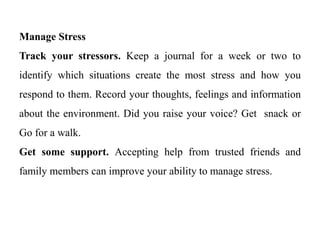
Manage Stress
Track your stressors. Keep a journal for a week or two to
identify which situations create the most stress and how you
respond to them. Record your thoughts, feelings and information
about the environment. Did you raise your voice? Get snack or
Go for a walk.
Get some support. Accepting help from trusted friends and
family members can improve your ability to manage stress.
Develop healthy responses. Exercise is a great stress-buster.
Yoga can be an excellent choice, and any form of physical
activity is beneficial. Also make time for hobbies and favorite
activities. Whether it's reading a novel, going to concerts or
playing games with your family.
Establish boundaries. In today's digital world, it's easy to feel
pressure to be available 24 hours a day. Establish some work-
life boundaries for yourself. That might mean making a rule
not to check email from home in the evening, or not answering
the phone during dinner etc.
Take time to recharge: this recovery process requires
“switching off” from work by having periods of time when
you are neither engaging in work-related activities, nor
thinking about work. Don't let your vacation days go to waste.
Learn how to relax. Techniques such as meditation, deep
breathing exercises and mindfulness can help melt away stress.
Start by taking a few minutes each day to focus on a simple activity
like breathing, walking or enjoying a meal.
Talk to your supervisor. Healthy employees are typically more
productive, so your boss has an incentive to create a work
environment that promotes employee well-being. Start by having
an open conversation with your supervisor.
Burnout
Burnout may be as a result of excessive stress but they do not mean
the same thing. Burnout is a cycle of negative emotions, paralysis
and withdrawal. It is the body’s response to putting too much effort
into something without taking in what you require to restore
yourself. It is mental, emotional and physical exhaustion that leads
to diminished interest in performing tasks. Burnout is related to the
work place where a person feels overworked, underpaid,
unrecognized, confused, etc.
Burnout
· The person’s emotions are blunted
· It makes one lose motivation, ideals, and hope
· It leads to depression
· Its primary damage is emotional
Stress
· The person’s emotions are over reactive
· It leads to loss of energy
· It leads to anxiety disorders
· Its primary damage is physical
Symptoms of burnout
• Irritability
• Self criticism
• Anger
• Fatigue
• Feeling of urgency
• Absenteeism
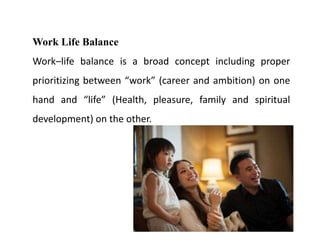
Work Life Balance
Work–life balance is a broad concept including proper
prioritizing between “work” (career and ambition) on one
hand and “life” (Health, pleasure, family and spiritual
development) on the other.
Measures to achieve work life balance
• Discourage employees from working late
• Take a regular employees satisfaction survey that can identify the
fit falls in the work pattern
• Provide a vacations and encourage employees to take breaks
• Provide opportunities like work from home, flexi times
Benefits from work life balance
Achieving a work life balance benefits both employers and
employees while the employers get the benefit of productive and
active employees, the employees feel secure and loyal. It also
improves confidence, focus, self esteem, and loyalty among the
employees.
Strategies for coping with stress
prioritize work
In order to do your job effectively and to the best of your ability it
helps to prioritize your tasks. Planning your day ensures you meet
company goals and deadlines, and it helps keep you in line with
what is expected from you by management.
Delegate work
Some individuals prefer doing all the work themselves. This adds
to their stress. They should learn to delegate routine work to
others.
Humour
Everybody loves to laugh. But laughter is actually a stress
fighter. It helps us release tension, gets our minds off of our
troubles and it also causes physiological changes in the body
that are similar to the changes we experience when we
exercise.
Relaxation breathing
Research shows that slow, deep breathing – exhaling slowly
is particularly important – lowers the heart rate and blood
pressure, and has other effects that help people to feel calmer
and more focused. Relaxation breathing is easy to learn and
can be can be done almost anywhere.
Exercise
Exercise and other physical activity produce endorphins—
chemicals in the brain that act as natural painkillers—and also
improve the ability to sleep, which in turn reduces stress.
Diet
B vitamins are an important part of a healthy diet and can
help to reduce stress. Even keep lower blood pressure level.
sleeping
High stress levels can make sleeping more difficult. They can
even lead to sleep disorders. At the same time, getting
a good night's sleep can help reduce the effects of stress
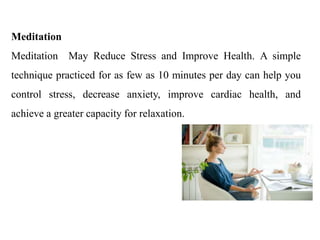
Meditation
Meditation May Reduce Stress and Improve Health. A simple
technique practiced for as few as 10 minutes per day can help you
control stress, decrease anxiety, improve cardiac health, and
achieve a greater capacity for relaxation.
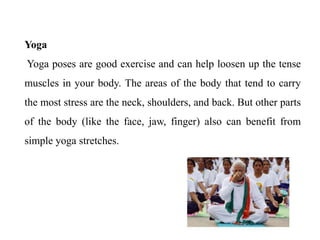
Yoga
Yoga poses are good exercise and can help loosen up the tense
muscles in your body. The areas of the body that tend to carry
the most stress are the neck, shoulders, and back. But other parts
of the body (like the face, jaw, finger) also can benefit from
simple yoga stretches.
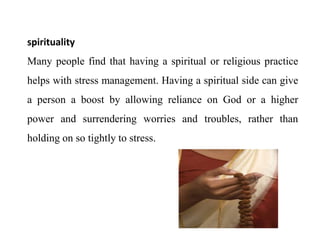
spirituality
Many people find that having a spiritual or religious practice
helps with stress management. Having a spiritual side can give
a person a boost by allowing reliance on God or a higher
power and surrendering worries and troubles, rather than
holding on so tightly to stress.
THANK YOU

Stress management

  • 1.
  • 2.
    Stress Stress is definedas “a state of psychological and physiological imbalance resulting from the disparity between situational demand and the individual's ability and motivation to meet those needs.”
  • 3.
    Kinds Of Stress •Personal Stress 1. Family Stress Family stress may arise from conflict of idea or relationships with spouse, children, parents, friends. 2. Health related stress This may be a result of undetected health problems 3. Society related stress Society related stress occurs due to the influence of society on an individual. Here friends, colleagues and neighbors are the influencing factors
  • 4.
    • Work relatedstress Work related stress relates to the working environment and policies of the organization 1. Organizational stress The stress resulting from the conflict of organizational goals with personal goals is called organizational stress 2. Job stress Stress that occurs due to lack of resources or scarce resources at the workplace is called job stress.
  • 5.
    Common Sources ofWork Stress • Low salaries. • Excessive workloads. • Few opportunities for growth. • Work that isn't engaging or challenging. • Lack of social support. • Not having enough control over job-related decisions. • Unclear performance expectations.
  • 6.
    Major causes ofstress Major Causes of Stress Career Concern Role Ambiguity Rotating work shift Role conflict Occupational demands Lack of participation in decision making Work overload Work under load Poor working condition Inter personal and inter group conflict Organizational change
  • 7.
    Career Concern: Ifan employee feels that he is very much behind in the corporate ladder, then he may experience stress. Role Ambiguity: It occurs when the person doesn't know what he is supposed to do, on the job. His tasks and responsibilities are not clear.
  • 8.
    Rotating Work Shifts:Stress may occur in those individuals who work on different work shifts. That may create problems in adjusting to the shift timings, and it can affect not only personal life but also family life of the employee. Role Conflict: It takes place when people have different expectations from the person performing a particular role. It can also occur if the job is not as per expectation, or when a job demands a certain type of behavior that is against the person's moral values.
  • 9.
    Occupational Demands: Somejobs are more demanding than others. Jobs that involve risk, and danger are more stressful. Lack of Participation in Decision-making: Many experienced employees feel that management should consult them on matters affecting their jobs.
  • 10.
    Work Overload: Excessiveworkload leads to stress as it puts a person under tremendous pressure. Work Under load: In this, case, too little work or very easy work is expected on the part of the employee. Doing less work or jobs of routine and simple nature would lead to monotony and boredom, which can lead to stress.
  • 11.
    Poor Working Conditions:Employees may be subject to poor working conditions. It would include bad lighting and ventilation, unhygienic sanitation facilities, excessive noise, and dust, presence of toxic gasses and fumes, inadequate safety measures, etc. All these unpleasant conditions create physiological and psychological imbalance in humans thereby causing stress. Lack of Group Cohesiveness: Every group is characterized by its cohesiveness, although they differ widely in its degree. Individuals experience stress when there is no unity among work group members. There are mistrust, jealousy, frequent quarrels, etc., in groups and this lead to stress to employees.
  • 12.
    Interpersonal and IntergroupConflict: These conflicts take place due to differences in perceptions, attitudes, values and beliefs between two or more individuals and groups. Such conflicts can be a source of stress for group members. Organizational Changes: When changes occur, people have to adapt to those changes, and this may cause stress. Stress is higher when changes are significant or unusual like transfer or adoption of new technology.
  • 13.
    The main causesof stress outside work or organization: Causes of Stress out side work Civic Amenitie s Life Changes Cast and Religious conflict Technolo gical change Career Changes
  • 14.
    Civic Amenities: Poorcivic amenities in the area in which one lives can be a cause of stress. Inadequate or lack of public facilities like improper water supply, excessive noise or air pollution, lack of proper transport facility can be quite stressful. Life Changes: Life changes can bring stress to a person. Life changes can be slow or sudden. Gradual life changes include getting older, and abrupt life changes include death or accident of a loved one. Sudden life changes are highly stressful and very difficult to cope.
  • 15.
    Caste, and ReligiousConflicts: Employees living in areas, which are often prone to conflicts among people based on differences seen in their race, caste and religion do suffer more from stress. In the case of a religion, the minorities and lower- caste people (especially in India) are subject to more stress.
  • 16.
    Technological Changes: Whenthere are any changes in technical fields, employees are under the constant fear of losing jobs or need to adjust to new technologies. It can be a source of stress. Career Changes: When a person suddenly switches to another job, he is under stress to shoulder new responsibilities adequately. Under-promotion, over-promotion, demotion and transfers can also cause stress.
  • 17.
    Effects of stress Commoneffects of stress on your body Headache Muscle tension or pain Chest pain Fatigue Stomach upset Sleep problems
  • 18.
    Common effects ofstress on your mood Anxiety Restlessness Lack of motivation or focus Irritability or anger Sadness or depression Common effects of stress on your behavior Drug or alcohol abuse Tobacco use Social withdrawal
  • 19.
    Manage Stress Track yourstressors. Keep a journal for a week or two to identify which situations create the most stress and how you respond to them. Record your thoughts, feelings and information about the environment. Did you raise your voice? Get snack or Go for a walk. Get some support. Accepting help from trusted friends and family members can improve your ability to manage stress.
  • 20.
    Develop healthy responses.Exercise is a great stress-buster. Yoga can be an excellent choice, and any form of physical activity is beneficial. Also make time for hobbies and favorite activities. Whether it's reading a novel, going to concerts or playing games with your family.
  • 21.
    Establish boundaries. Intoday's digital world, it's easy to feel pressure to be available 24 hours a day. Establish some work- life boundaries for yourself. That might mean making a rule not to check email from home in the evening, or not answering the phone during dinner etc.
  • 22.
    Take time torecharge: this recovery process requires “switching off” from work by having periods of time when you are neither engaging in work-related activities, nor thinking about work. Don't let your vacation days go to waste.
  • 23.
    Learn how torelax. Techniques such as meditation, deep breathing exercises and mindfulness can help melt away stress. Start by taking a few minutes each day to focus on a simple activity like breathing, walking or enjoying a meal.
  • 24.
    Talk to yoursupervisor. Healthy employees are typically more productive, so your boss has an incentive to create a work environment that promotes employee well-being. Start by having an open conversation with your supervisor.
  • 25.
    Burnout Burnout may beas a result of excessive stress but they do not mean the same thing. Burnout is a cycle of negative emotions, paralysis and withdrawal. It is the body’s response to putting too much effort into something without taking in what you require to restore yourself. It is mental, emotional and physical exhaustion that leads to diminished interest in performing tasks. Burnout is related to the work place where a person feels overworked, underpaid, unrecognized, confused, etc.
  • 26.
    Burnout · The person’semotions are blunted · It makes one lose motivation, ideals, and hope · It leads to depression · Its primary damage is emotional Stress · The person’s emotions are over reactive · It leads to loss of energy · It leads to anxiety disorders · Its primary damage is physical
  • 27.
    Symptoms of burnout •Irritability • Self criticism • Anger • Fatigue • Feeling of urgency • Absenteeism
  • 28.
    Work Life Balance Work–lifebalance is a broad concept including proper prioritizing between “work” (career and ambition) on one hand and “life” (Health, pleasure, family and spiritual development) on the other.
  • 29.
    Measures to achievework life balance • Discourage employees from working late • Take a regular employees satisfaction survey that can identify the fit falls in the work pattern • Provide a vacations and encourage employees to take breaks • Provide opportunities like work from home, flexi times
  • 30.
    Benefits from worklife balance Achieving a work life balance benefits both employers and employees while the employers get the benefit of productive and active employees, the employees feel secure and loyal. It also improves confidence, focus, self esteem, and loyalty among the employees.
  • 31.
    Strategies for copingwith stress prioritize work In order to do your job effectively and to the best of your ability it helps to prioritize your tasks. Planning your day ensures you meet company goals and deadlines, and it helps keep you in line with what is expected from you by management. Delegate work Some individuals prefer doing all the work themselves. This adds to their stress. They should learn to delegate routine work to others.
  • 32.
    Humour Everybody loves tolaugh. But laughter is actually a stress fighter. It helps us release tension, gets our minds off of our troubles and it also causes physiological changes in the body that are similar to the changes we experience when we exercise. Relaxation breathing Research shows that slow, deep breathing – exhaling slowly is particularly important – lowers the heart rate and blood pressure, and has other effects that help people to feel calmer and more focused. Relaxation breathing is easy to learn and can be can be done almost anywhere.
  • 33.
    Exercise Exercise and otherphysical activity produce endorphins— chemicals in the brain that act as natural painkillers—and also improve the ability to sleep, which in turn reduces stress. Diet B vitamins are an important part of a healthy diet and can help to reduce stress. Even keep lower blood pressure level. sleeping High stress levels can make sleeping more difficult. They can even lead to sleep disorders. At the same time, getting a good night's sleep can help reduce the effects of stress
  • 34.
    Meditation Meditation May ReduceStress and Improve Health. A simple technique practiced for as few as 10 minutes per day can help you control stress, decrease anxiety, improve cardiac health, and achieve a greater capacity for relaxation.
  • 35.
    Yoga Yoga poses aregood exercise and can help loosen up the tense muscles in your body. The areas of the body that tend to carry the most stress are the neck, shoulders, and back. But other parts of the body (like the face, jaw, finger) also can benefit from simple yoga stretches.
  • 36.
    spirituality Many people findthat having a spiritual or religious practice helps with stress management. Having a spiritual side can give a person a boost by allowing reliance on God or a higher power and surrendering worries and troubles, rather than holding on so tightly to stress.
  • 37.