Quadratics! Three Forms and Graphing
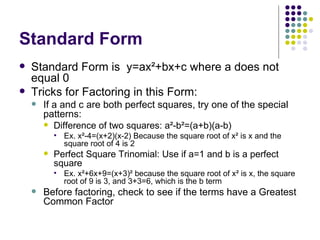
Standard Form Standard Form is  y=ax ²+bx+c where a does not equal 0 Tricks for Factoring in this Form: If a and c are both perfect squares, try one of the special patterns: Difference of two squares: a²-b²=(a+b)(a-b) Ex. x²-4=(x+2)(x-2) Because the square root of x² is x and the square root of 4 is 2 Perfect Square Trinomial: Use if a=1 and b is a perfect square Ex. x²+6x+9=(x+3)² because the square root of x² is x, the square root of 9 is 3, and 3+3=6, which is the b term Before factoring, check to see if the terms have a Greatest Common Factor
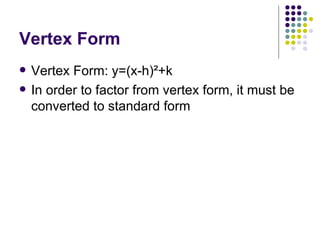
Vertex Form Vertex Form: y=(x-h) ²+k In order to factor from vertex form, it must be converted to standard form
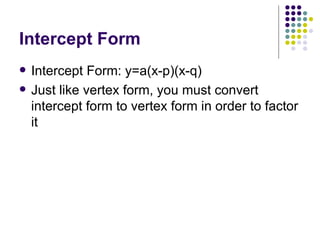
Intercept Form Intercept Form: y=a(x-p)(x-q) Just like vertex form, you must convert intercept form to vertex form in order to factor it
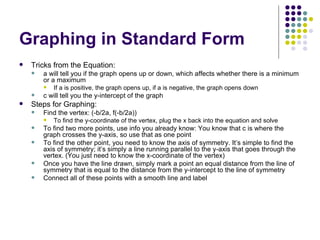
Graphing in Standard Form Tricks from the Equation: a will tell you if the graph opens up or down, which affects whether there is a minimum or a maximum If a is positive, the graph opens up, if a is negative, the graph opens down c will tell you the y-intercept of the graph Steps for Graphing: Find the vertex: (-b/2a, f(-b/2a)) To find the y-coordinate of the vertex, plug the x back into the equation and solve To find two more points, use info you already know: You know that c is where the graph crosses the y-axis, so use that as one point To find the other point, you need to know the axis of symmetry. It’s simple to find the axis of symmetry; it’s simply a line running parallel to the y-axis that goes through the vertex. (You just need to know the x-coordinate of the vertex) Once you have the line drawn, simply mark a point an equal distance from the line of symmetry that is equal to the distance from the y-intercept to the line of symmetry Connect all of these points with a smooth line and label
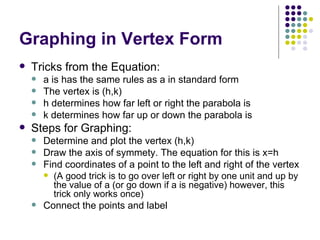
Graphing in Vertex Form Tricks from the Equation: a is has the same rules as a in standard form The vertex is (h,k) h determines how far left or right the parabola is k determines how far up or down the parabola is Steps for Graphing: Determine and plot the vertex (h,k) Draw the axis of symmety. The equation for this is x=h Find coordinates of a point to the left and right of the vertex  (A good trick is to go over left or right by one unit and up by the value of a (or go down if a is negative) however, this trick only works once) Connect the points and label
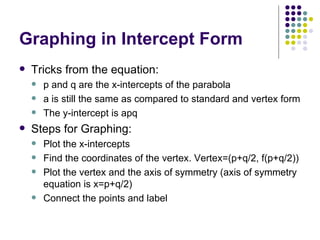
Graphing in Intercept Form Tricks from the equation: p and q are the x-intercepts of the parabola a is still the same as compared to standard and vertex form The y-intercept is apq Steps for Graphing: Plot the x-intercepts Find the coordinates of the vertex. Vertex=(p+q/2, f(p+q/2))  Plot the vertex and the axis of symmetry (axis of symmetry equation is x=p+q/2) Connect the points and label
Now go watch the videos that demonstrate graphing!

Solving Quadratics

  • 1.
  • 2.
    Standard Form StandardForm is y=ax ²+bx+c where a does not equal 0 Tricks for Factoring in this Form: If a and c are both perfect squares, try one of the special patterns: Difference of two squares: a²-b²=(a+b)(a-b) Ex. x²-4=(x+2)(x-2) Because the square root of x² is x and the square root of 4 is 2 Perfect Square Trinomial: Use if a=1 and b is a perfect square Ex. x²+6x+9=(x+3)² because the square root of x² is x, the square root of 9 is 3, and 3+3=6, which is the b term Before factoring, check to see if the terms have a Greatest Common Factor
  • 3.
    Vertex Form VertexForm: y=(x-h) ²+k In order to factor from vertex form, it must be converted to standard form
  • 4.
    Intercept Form InterceptForm: y=a(x-p)(x-q) Just like vertex form, you must convert intercept form to vertex form in order to factor it
  • 5.
    Graphing in StandardForm Tricks from the Equation: a will tell you if the graph opens up or down, which affects whether there is a minimum or a maximum If a is positive, the graph opens up, if a is negative, the graph opens down c will tell you the y-intercept of the graph Steps for Graphing: Find the vertex: (-b/2a, f(-b/2a)) To find the y-coordinate of the vertex, plug the x back into the equation and solve To find two more points, use info you already know: You know that c is where the graph crosses the y-axis, so use that as one point To find the other point, you need to know the axis of symmetry. It’s simple to find the axis of symmetry; it’s simply a line running parallel to the y-axis that goes through the vertex. (You just need to know the x-coordinate of the vertex) Once you have the line drawn, simply mark a point an equal distance from the line of symmetry that is equal to the distance from the y-intercept to the line of symmetry Connect all of these points with a smooth line and label
  • 6.
    Graphing in VertexForm Tricks from the Equation: a is has the same rules as a in standard form The vertex is (h,k) h determines how far left or right the parabola is k determines how far up or down the parabola is Steps for Graphing: Determine and plot the vertex (h,k) Draw the axis of symmety. The equation for this is x=h Find coordinates of a point to the left and right of the vertex (A good trick is to go over left or right by one unit and up by the value of a (or go down if a is negative) however, this trick only works once) Connect the points and label
  • 7.
    Graphing in InterceptForm Tricks from the equation: p and q are the x-intercepts of the parabola a is still the same as compared to standard and vertex form The y-intercept is apq Steps for Graphing: Plot the x-intercepts Find the coordinates of the vertex. Vertex=(p+q/2, f(p+q/2)) Plot the vertex and the axis of symmetry (axis of symmetry equation is x=p+q/2) Connect the points and label
  • 8.
    Now go watchthe videos that demonstrate graphing!