Exponential Functions
Definition of Exponential Functions
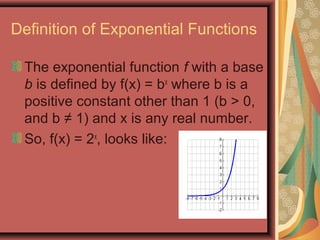
The exponential function f with a base
b is defined by f(x) = bx
where b is a
positive constant other than 1 (b > 0,
and b ≠ 1) and x is any real number.
So, f(x) = 2x
, looks like:
Graphing Exponential Functions
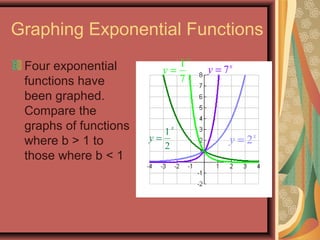
Four exponential
functions have
been graphed.
Compare the
graphs of functions
where b > 1 to
those where b < 1
2x
y =
7x
y =
1
2
x
y =
1
7
x
y =
Graphing Exponential Functions
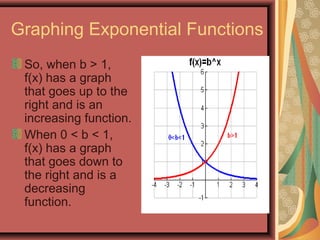
So, when b > 1,
f(x) has a graph
that goes up to the
right and is an
increasing function.
When 0 < b < 1,
f(x) has a graph
that goes down to
the right and is a
decreasing
function.
Characteristics
The domain of f(x) = bx
consists of all real
numbers (-∞, ∞). The range of f(x) = bx
consists of all positive real numbers
(0, ∞).
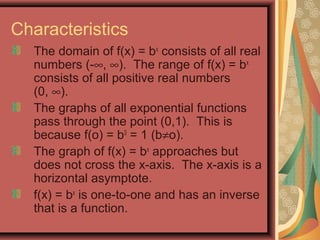
The graphs of all exponential functions
pass through the point (0,1). This is
because f(o) = b0
= 1 (b≠o).
The graph of f(x) = bx
approaches but
does not cross the x-axis. The x-axis is a
horizontal asymptote.
f(x) = bx
is one-to-one and has an inverse
that is a function.
Transformations
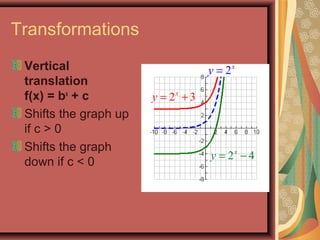
Vertical
translation
f(x) = bx
+ c
Shifts the graph up
if c > 0
Shifts the graph
down if c < 0
2x
y =
2 3x
y = +
2 4x
y = −
Transformations
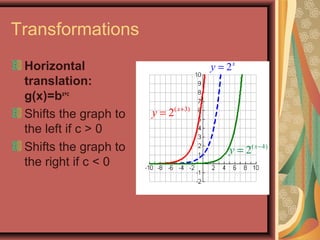
Horizontal
translation:
g(x)=bx+c
Shifts the graph to
the left if c > 0
Shifts the graph to
the right if c < 0
2x
y =
( 3)
2 x
y +
=
( 4)
2 x
y −
=
Transformations
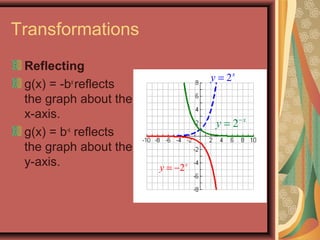
Reflecting
g(x) = -bx
reflects
the graph about the
x-axis.
g(x) = b-x
reflects
the graph about the
y-axis.
2x
y =
2x
y = −
2 x
y −
=
Transformations
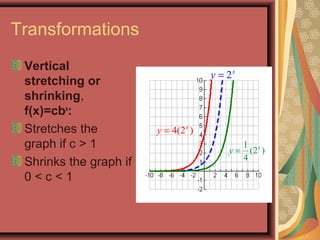
Vertical
stretching or
shrinking,
f(x)=cbx
:
Stretches the
graph if c > 1
Shrinks the graph if
0 < c < 1
2x
y =
4(2 )x
y =
1
(2 )
4
x
y =
Transformations
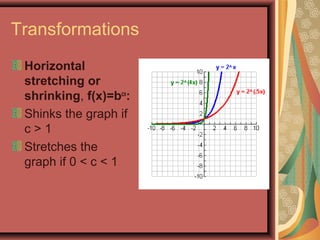
Horizontal
stretching or
shrinking, f(x)=bcx
:
Shinks the graph if
c > 1
Stretches the
graph if 0 < c < 1
2x
y =
4(2 )x
y =
1
(2 )
4
x
y =
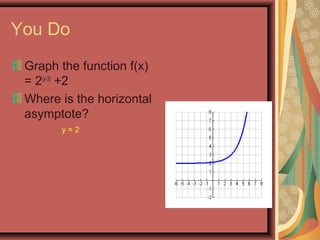
You Do
Graph the function f(x)
= 2(x-3)
+2
Where is the horizontal
asymptote?
y = 2
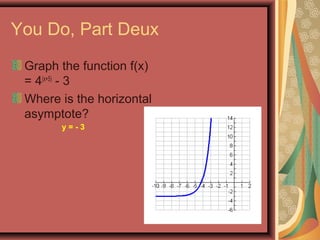
You Do, Part Deux
Graph the function f(x)
= 4(x+5)
- 3
Where is the horizontal
asymptote?
y = - 3
The Number e
The number e is known as Euler’s number.
Leonard Euler (1700’s) discovered it’s
importance.
The number e has physical meaning. It
occurs naturally in any situation where a
quantity increases at a rate proportional to
its value, such as a bank account producing
interest, or a population increasing as its
members reproduce.
The Number e - Definition
An irrational number, symbolized by the letter
e, appears as the base in many applied
exponential functions. It models a variety of
situations in which a quantity grows or decays
continuously: money, drugs in the body,
probabilities, population studies, atmospheric
pressure, optics, and even spreading rumors!
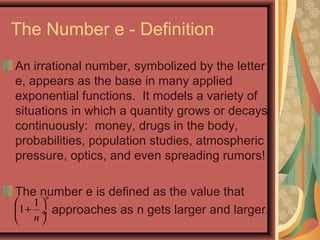
The number e is defined as the value that
approaches as n gets larger and larger.
1
1
n
n
 
+ ÷
 
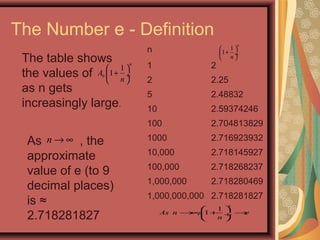
The Number e - Definition
n
1 2
2 2.25
5 2.48832
10 2.59374246
100 2.704813829
1000 2.716923932
10,000 2.718145927
100,000 2.718268237
1,000,000 2.718280469
1,000,000,000 2.718281827
1
1
n
n
 
+ ÷
 
0
1
1
n
A
n
 
+ ÷
 
1
, 1
n
As n e
n
 
→∞ + → ÷
 
The table shows
the values of
as n gets
increasingly large.
n → ∞As , the
approximate
value of e (to 9
decimal places)
is ≈
2.718281827
The Number e - Definition
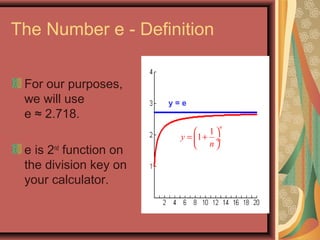
For our purposes,
we will use
e ≈ 2.718.
e is 2nd
function on
the division key on
your calculator.
y = e
1
1
n
y
n
 
= + ÷
 
The Number e - Definition
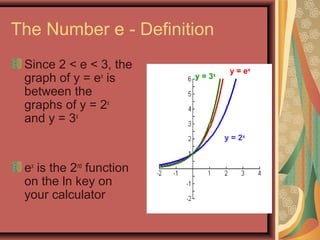
Since 2 < e < 3, the
graph of y = ex
is
between the
graphs of y = 2x
and y = 3x
ex
is the 2nd
function
on the ln key on
your calculator
y =e
y = 2x
y = 3x
y = ex
Natural Base
The irrational number e, is called the
natural base.
The function f(x) = ex
is called the
natural exponential function.
Compound Interest
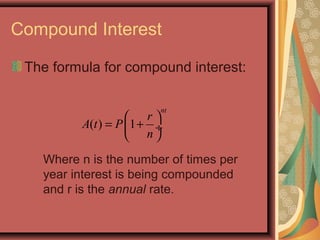
The formula for compound interest:
( ) 1
 
= + ÷
 
nt
r
A t P
n
Where n is the number of times per
year interest is being compounded
and r is the annual rate.
Compound Interest - Example
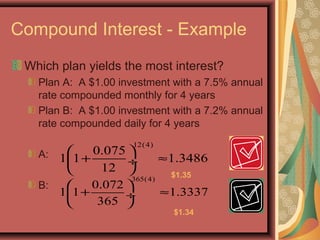
Which plan yields the most interest?
Plan A: A $1.00 investment with a 7.5% annual
rate compounded monthly for 4 years
Plan B: A $1.00 investment with a 7.2% annual
rate compounded daily for 4 years
A:
B:
12(4)
0.075
1 1 1.3486
12
 
+ ≈ ÷
 
365(4)
0.072
1 1 1.3337
365
 
+ ≈ ÷
 
$1.35
$1.34
Interest Compounded Continuously
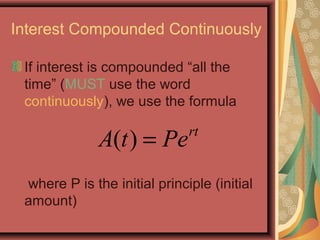
If interest is compounded “all the
time” (MUST use the word
continuously), we use the formula
where P is the initial principle (initial
amount)
( ) = rt
A t Pe
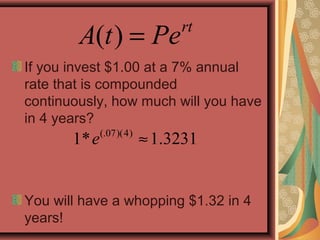
( ) = rt
A t Pe
If you invest $1.00 at a 7% annual
rate that is compounded
continuously, how much will you have
in 4 years?
You will have a whopping $1.32 in 4
years!
(.07)(4)
1* 1.3231e ≈
You Do
You decide to invest $8000 for 6
years and have a choice between 2
accounts. The first pays 7% per year,
compounded monthly. The second
pays 6.85% per year, compounded
continuously. Which is the better
investment?
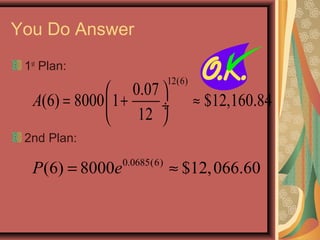
You Do Answer
1st
Plan:
2nd Plan:
0.0685(6)
(6) 8000 $12,066.60P e= ≈
12(6)
0.07
(6) 8000 1 $12,160.84
12
A
 
= + ≈ ÷
 

exponential functions (copied)

  • 1.
  • 2.
    Definition of ExponentialFunctions The exponential function f with a base b is defined by f(x) = bx where b is a positive constant other than 1 (b > 0, and b ≠ 1) and x is any real number. So, f(x) = 2x , looks like:
  • 3.
    Graphing Exponential Functions Fourexponential functions have been graphed. Compare the graphs of functions where b > 1 to those where b < 1 2x y = 7x y = 1 2 x y = 1 7 x y =
  • 4.
    Graphing Exponential Functions So,when b > 1, f(x) has a graph that goes up to the right and is an increasing function. When 0 < b < 1, f(x) has a graph that goes down to the right and is a decreasing function.
  • 5.
    Characteristics The domain off(x) = bx consists of all real numbers (-∞, ∞). The range of f(x) = bx consists of all positive real numbers (0, ∞). The graphs of all exponential functions pass through the point (0,1). This is because f(o) = b0 = 1 (b≠o). The graph of f(x) = bx approaches but does not cross the x-axis. The x-axis is a horizontal asymptote. f(x) = bx is one-to-one and has an inverse that is a function.
  • 6.
    Transformations Vertical translation f(x) = bx +c Shifts the graph up if c > 0 Shifts the graph down if c < 0 2x y = 2 3x y = + 2 4x y = −
  • 7.
    Transformations Horizontal translation: g(x)=bx+c Shifts the graphto the left if c > 0 Shifts the graph to the right if c < 0 2x y = ( 3) 2 x y + = ( 4) 2 x y − =
  • 8.
    Transformations Reflecting g(x) = -bx reflects thegraph about the x-axis. g(x) = b-x reflects the graph about the y-axis. 2x y = 2x y = − 2 x y − =
  • 9.
    Transformations Vertical stretching or shrinking, f(x)=cbx : Stretches the graphif c > 1 Shrinks the graph if 0 < c < 1 2x y = 4(2 )x y = 1 (2 ) 4 x y =
  • 10.
    Transformations Horizontal stretching or shrinking, f(x)=bcx : Shinksthe graph if c > 1 Stretches the graph if 0 < c < 1 2x y = 4(2 )x y = 1 (2 ) 4 x y =
  • 11.
    You Do Graph thefunction f(x) = 2(x-3) +2 Where is the horizontal asymptote? y = 2
  • 12.
    You Do, PartDeux Graph the function f(x) = 4(x+5) - 3 Where is the horizontal asymptote? y = - 3
  • 13.
    The Number e Thenumber e is known as Euler’s number. Leonard Euler (1700’s) discovered it’s importance. The number e has physical meaning. It occurs naturally in any situation where a quantity increases at a rate proportional to its value, such as a bank account producing interest, or a population increasing as its members reproduce.
  • 14.
    The Number e- Definition An irrational number, symbolized by the letter e, appears as the base in many applied exponential functions. It models a variety of situations in which a quantity grows or decays continuously: money, drugs in the body, probabilities, population studies, atmospheric pressure, optics, and even spreading rumors! The number e is defined as the value that approaches as n gets larger and larger. 1 1 n n   + ÷  
  • 15.
    The Number e- Definition n 1 2 2 2.25 5 2.48832 10 2.59374246 100 2.704813829 1000 2.716923932 10,000 2.718145927 100,000 2.718268237 1,000,000 2.718280469 1,000,000,000 2.718281827 1 1 n n   + ÷   0 1 1 n A n   + ÷   1 , 1 n As n e n   →∞ + → ÷   The table shows the values of as n gets increasingly large. n → ∞As , the approximate value of e (to 9 decimal places) is ≈ 2.718281827
  • 16.
    The Number e- Definition For our purposes, we will use e ≈ 2.718. e is 2nd function on the division key on your calculator. y = e 1 1 n y n   = + ÷  
  • 17.
    The Number e- Definition Since 2 < e < 3, the graph of y = ex is between the graphs of y = 2x and y = 3x ex is the 2nd function on the ln key on your calculator y =e y = 2x y = 3x y = ex
  • 18.
    Natural Base The irrationalnumber e, is called the natural base. The function f(x) = ex is called the natural exponential function.
  • 19.
    Compound Interest The formulafor compound interest: ( ) 1   = + ÷   nt r A t P n Where n is the number of times per year interest is being compounded and r is the annual rate.
  • 20.
    Compound Interest -Example Which plan yields the most interest? Plan A: A $1.00 investment with a 7.5% annual rate compounded monthly for 4 years Plan B: A $1.00 investment with a 7.2% annual rate compounded daily for 4 years A: B: 12(4) 0.075 1 1 1.3486 12   + ≈ ÷   365(4) 0.072 1 1 1.3337 365   + ≈ ÷   $1.35 $1.34
  • 21.
    Interest Compounded Continuously Ifinterest is compounded “all the time” (MUST use the word continuously), we use the formula where P is the initial principle (initial amount) ( ) = rt A t Pe
  • 22.
    ( ) =rt A t Pe If you invest $1.00 at a 7% annual rate that is compounded continuously, how much will you have in 4 years? You will have a whopping $1.32 in 4 years! (.07)(4) 1* 1.3231e ≈
  • 23.
    You Do You decideto invest $8000 for 6 years and have a choice between 2 accounts. The first pays 7% per year, compounded monthly. The second pays 6.85% per year, compounded continuously. Which is the better investment?
  • 24.
    You Do Answer 1st Plan: 2ndPlan: 0.0685(6) (6) 8000 $12,066.60P e= ≈ 12(6) 0.07 (6) 8000 1 $12,160.84 12 A   = + ≈ ÷  