Evaluating a Function
FUNCTIONS TERMINOLOGY
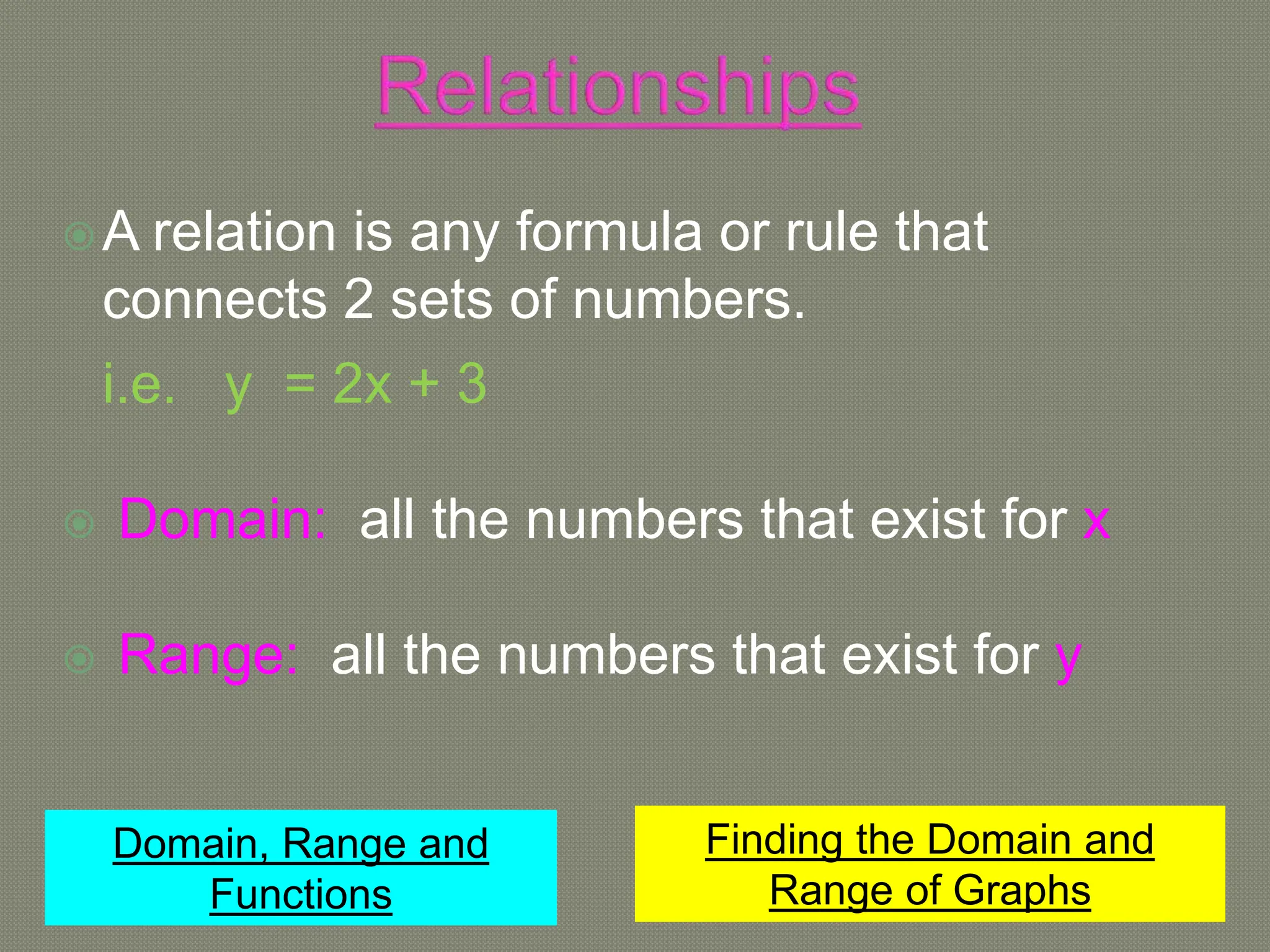
A relation is any formula or rule that
connects 2 sets of numbers.
i.e. y = 2x + 3
 Domain: all the numbers that exist for x
 Range: all the numbers that exist for y
Finding the Domain and
Range of Graphs
Domain, Range and
Functions
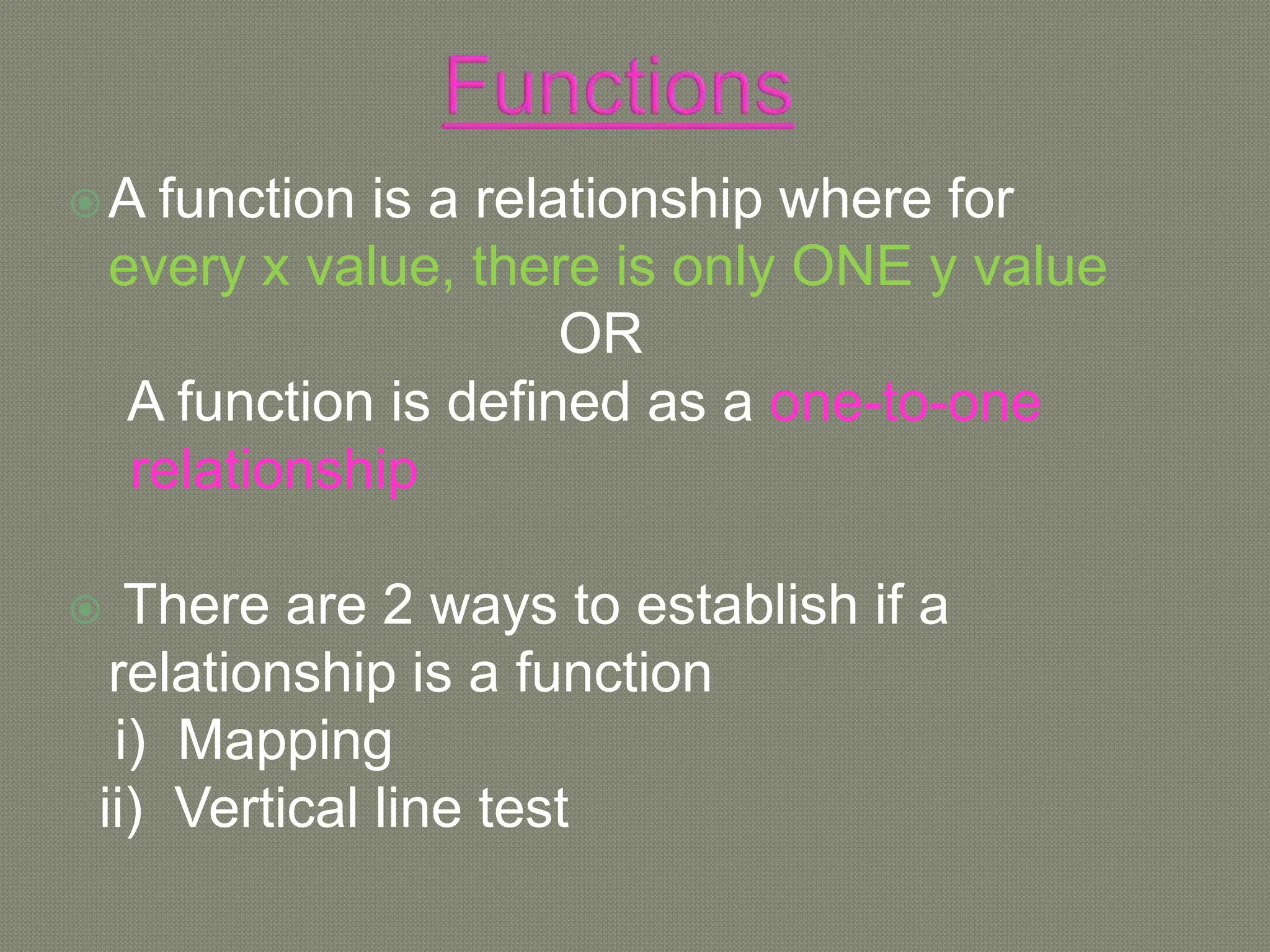
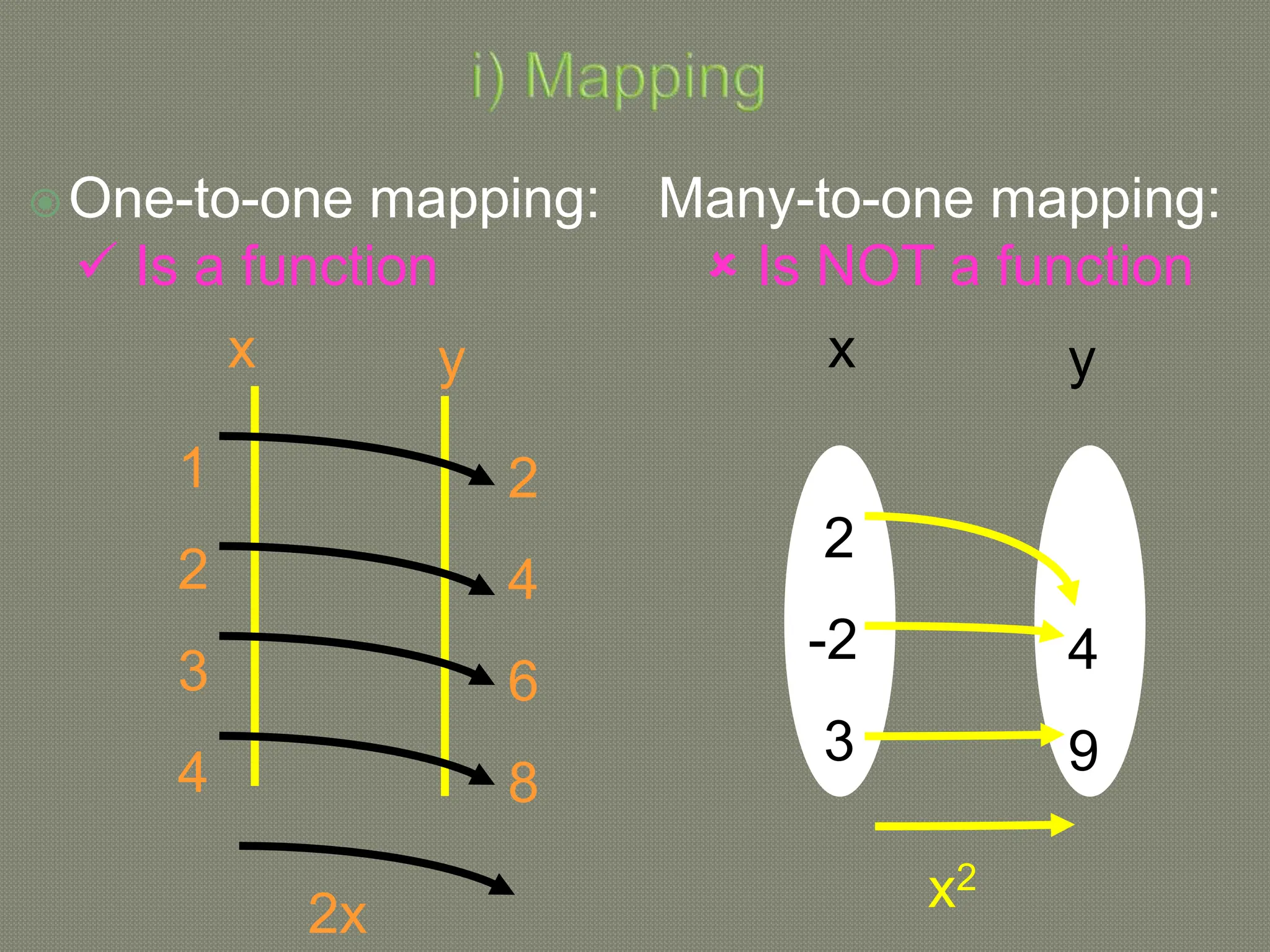
A function is a relationship where for
every x value, there is only ONE y value
OR
A function is defined as a one-to-one
relationship
 There are 2 ways to establish if a
relationship is a function
i) Mapping
ii) Vertical line test
One-to-one mapping:
 Is a function
1
2
3
4
2
4
6
8
2
-2
3
4
9
2x x2
x y y
x
Many-to-one mapping:
 Is NOT a function
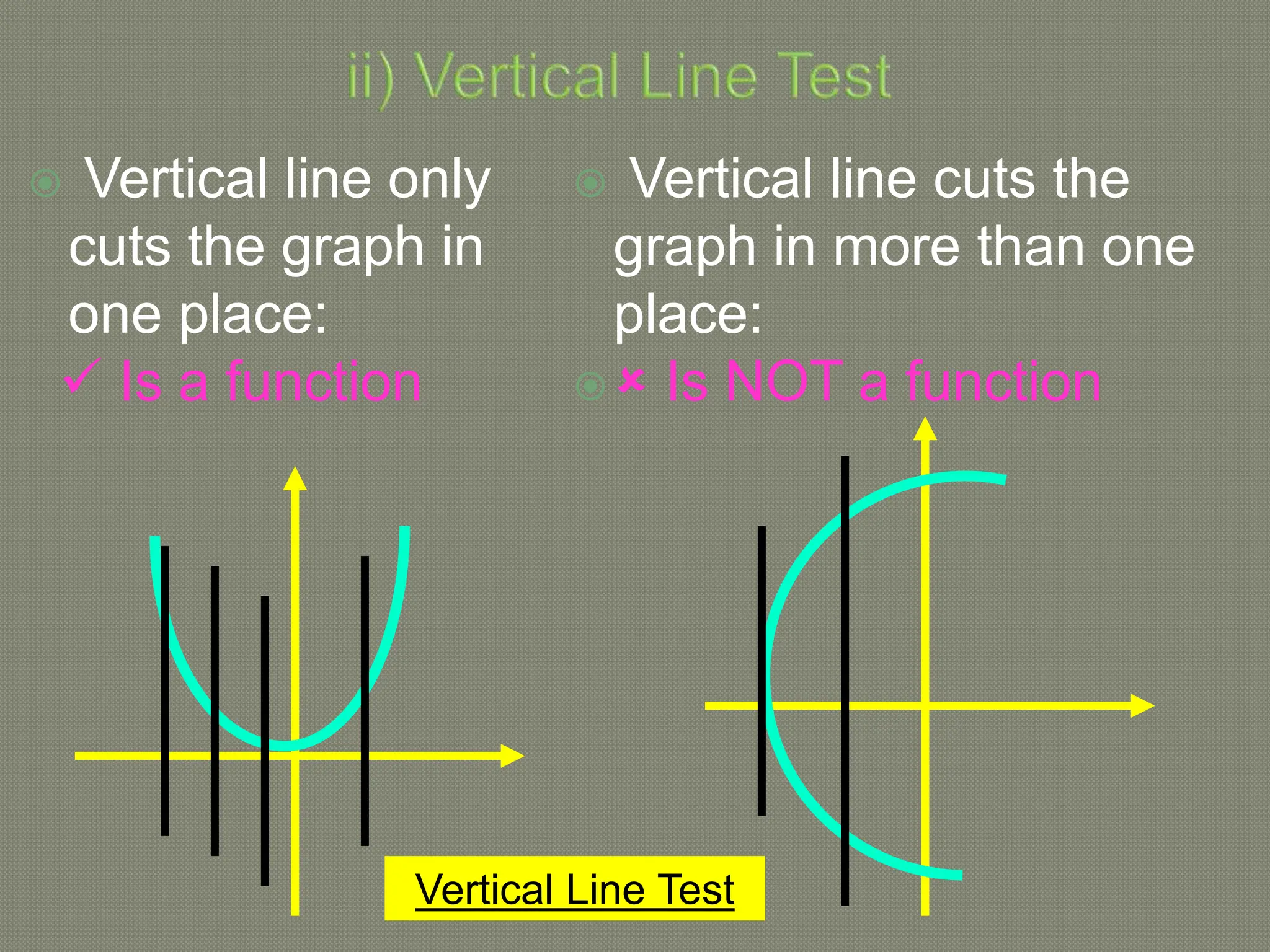
 Vertical line only
cuts the graph in
one place:
 Is a function
 Vertical line cuts the
graph in more than one
place:
 Is NOT a function
Vertical Line Test
INVERSE FUNCTIONS
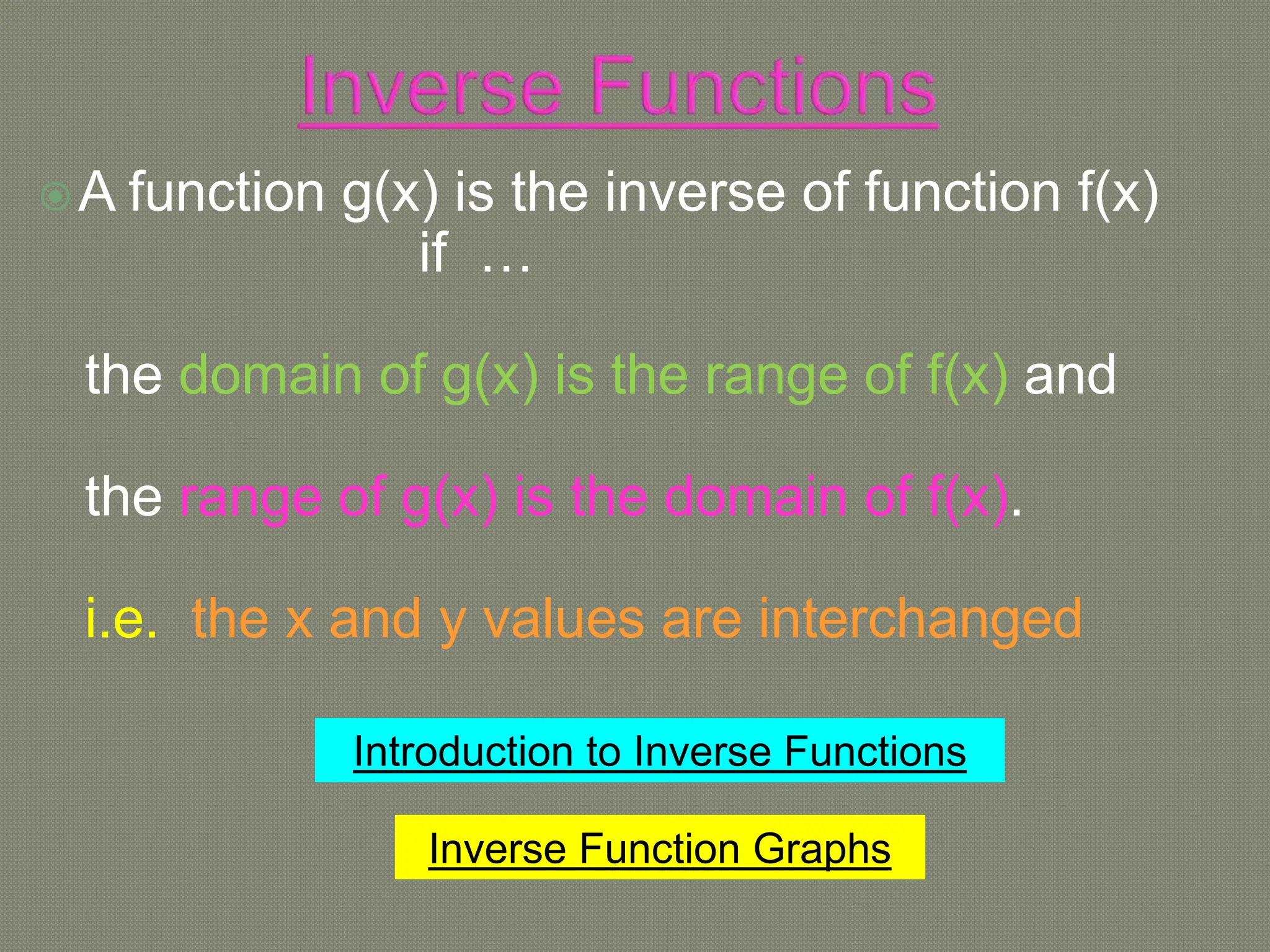
A function g(x) is the inverse of function f(x)
if …
the domain of g(x) is the range of f(x) and
the range of g(x) is the domain of f(x).
i.e. the x and y values are interchanged
Inverse Function Graphs
Introduction to Inverse Functions
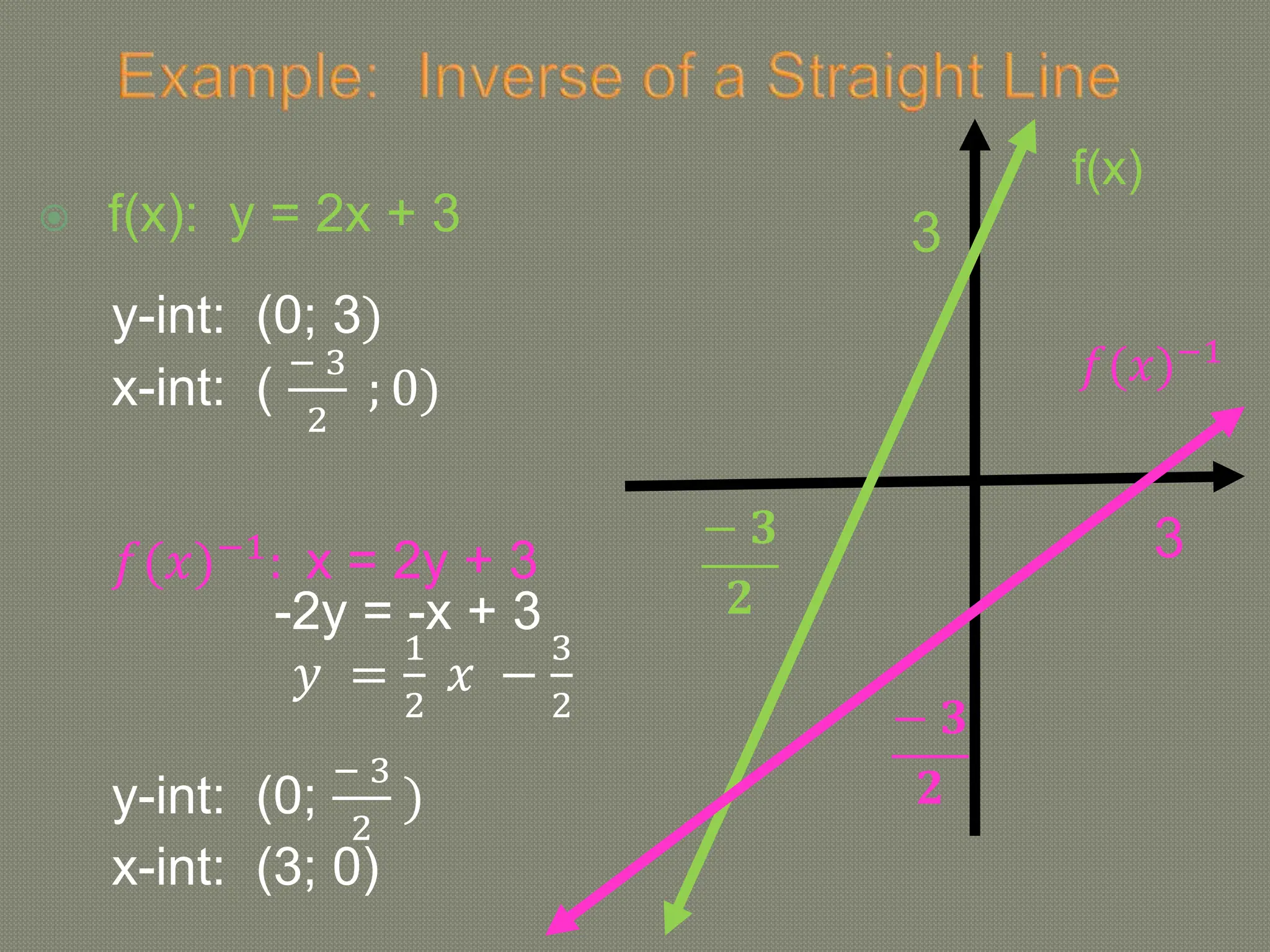
 f(x): y = 2x + 3
y-int: (0; 3)
x-int: (
− 3
2
; 0)
𝑓(𝑥)−1
: x = 2y + 3
-2y = -x + 3
𝑦 =
1
2
𝑥 −
3
2
y-int: (0;
− 3
2
)
x-int: (3; 0)
3
3
− 𝟑
𝟐
− 𝟑
𝟐
f(x)
𝑓(𝑥)−1
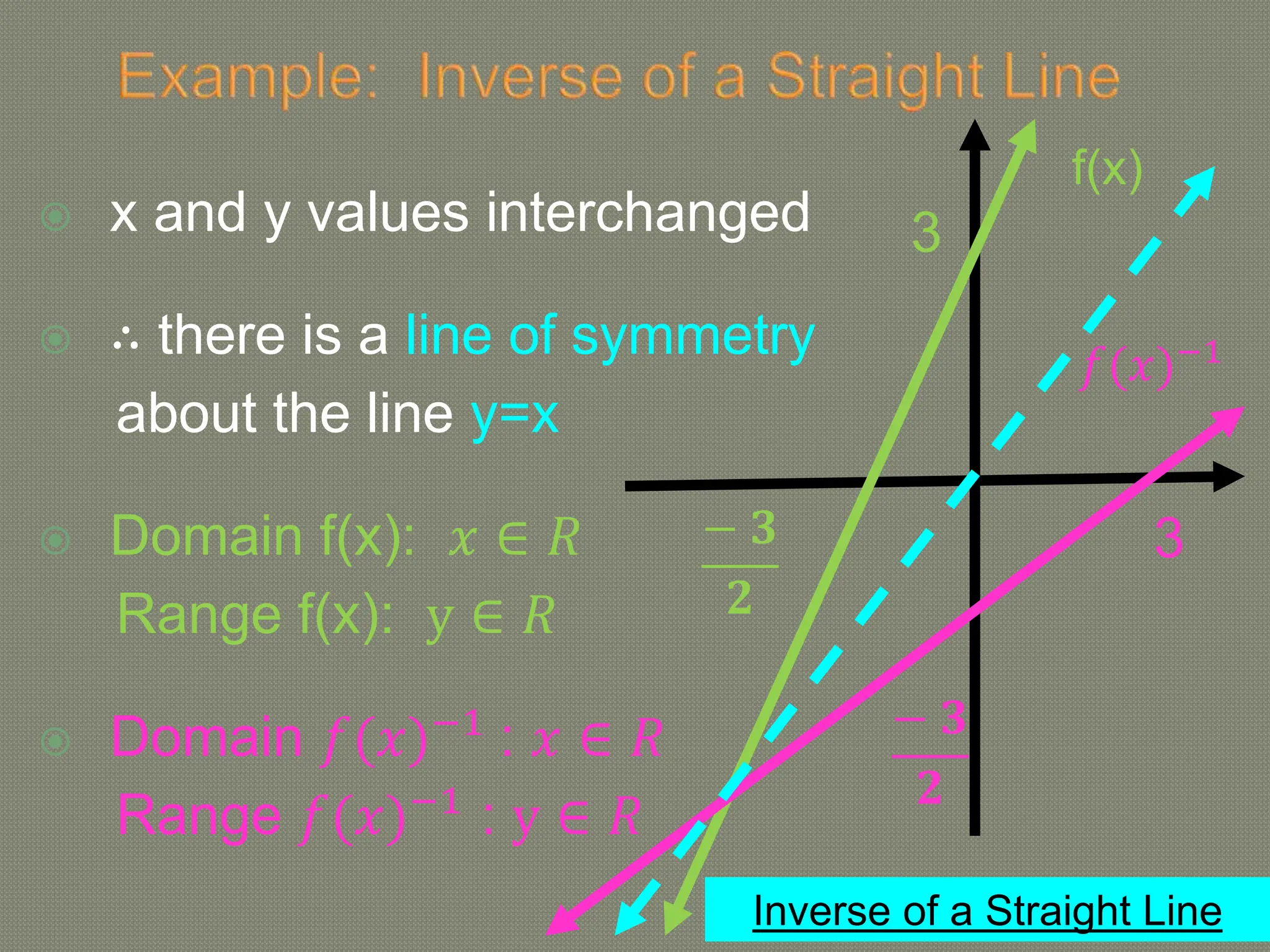
 x and y values interchanged
 ∴ there is a line of symmetry
about the line y=x
 Domain f(x): 𝑥 ∈ 𝑅
Range f(x): y ∈ 𝑅
 Domain 𝑓(𝑥)−1
: 𝑥 ∈ 𝑅
Range 𝑓(𝑥)−1
: y ∈ 𝑅
3
3
− 𝟑
𝟐
− 𝟑
𝟐
f(x)
𝑓(𝑥)−1
Inverse of a Straight Line
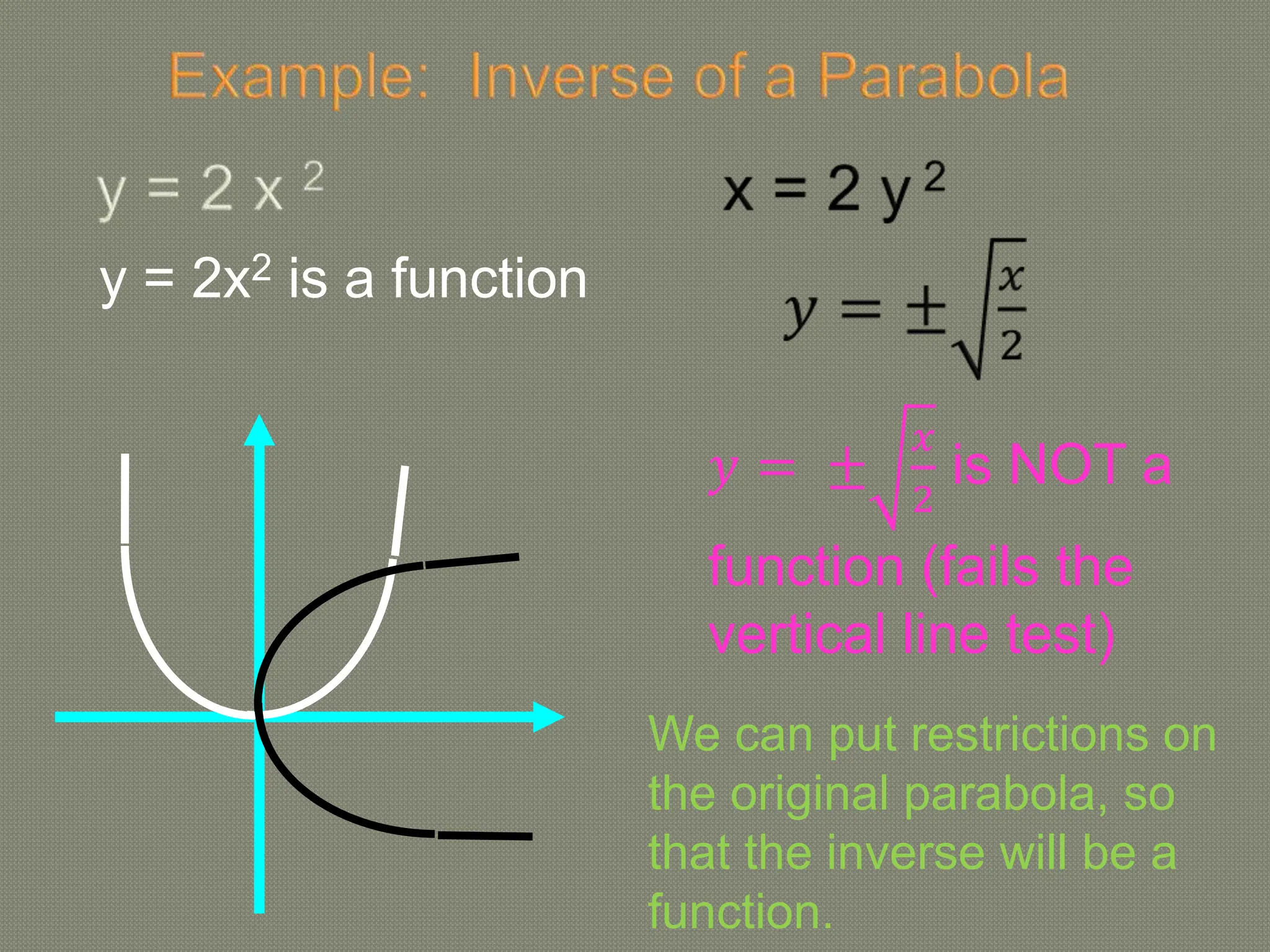
y = 2x2 is a function
𝑦 = ±
𝑥
2
is NOT a
function (fails the
vertical line test)
We can put restrictions on
the original parabola, so
that the inverse will be a
function.
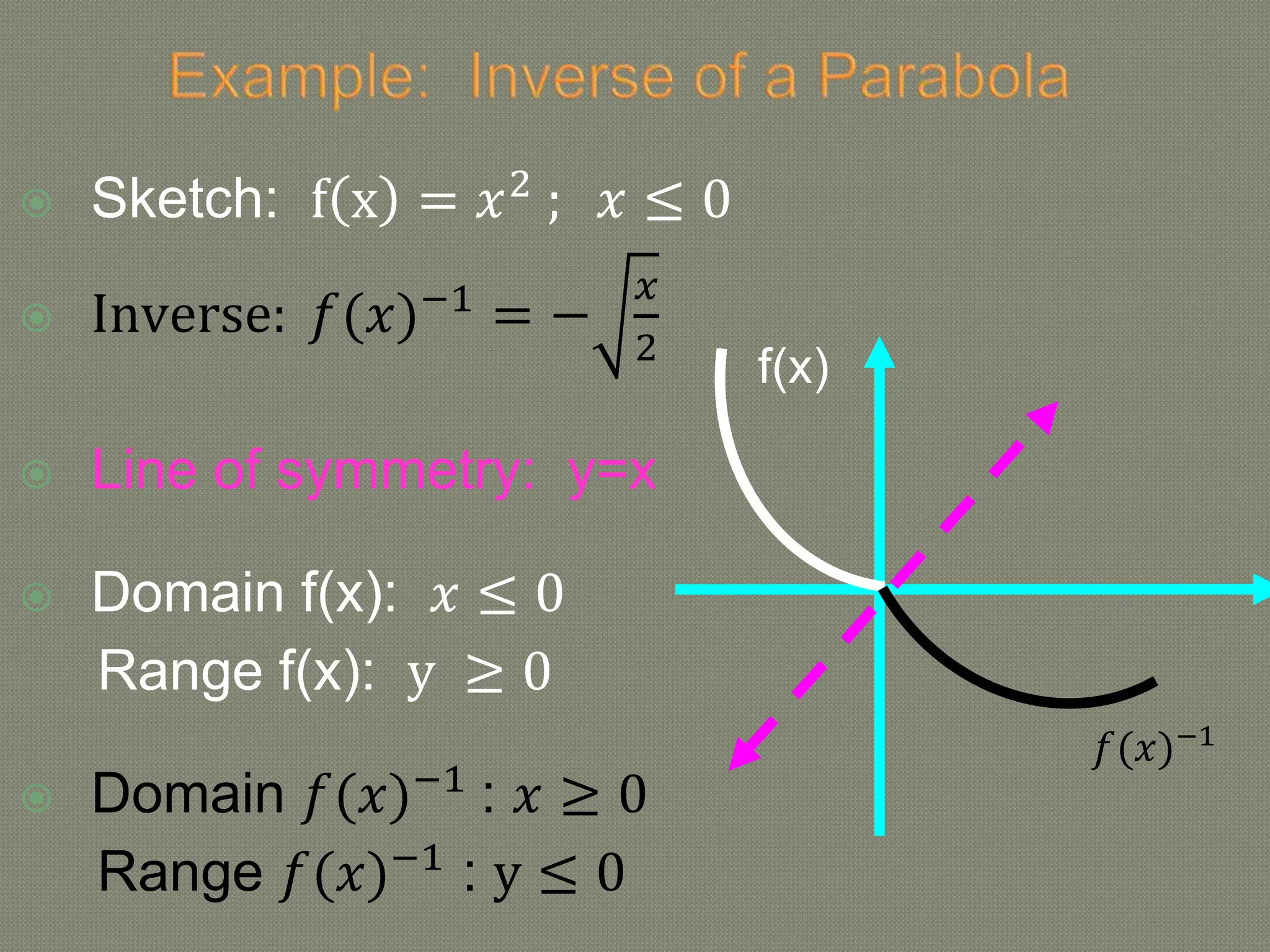
 Sketch: f x = 𝑥2
; 𝑥 ≤ 0
 Inverse: 𝑓(𝑥)−1
= −
𝑥
2
 Line of symmetry: y=x
 Domain f(x): 𝑥 ≤ 0
Range f(x): y ≥ 0
 Domain 𝑓(𝑥)−1
: 𝑥 ≥ 0
Range 𝑓(𝑥)−1
: y ≤ 0
f(x)
𝑓(𝑥)−1
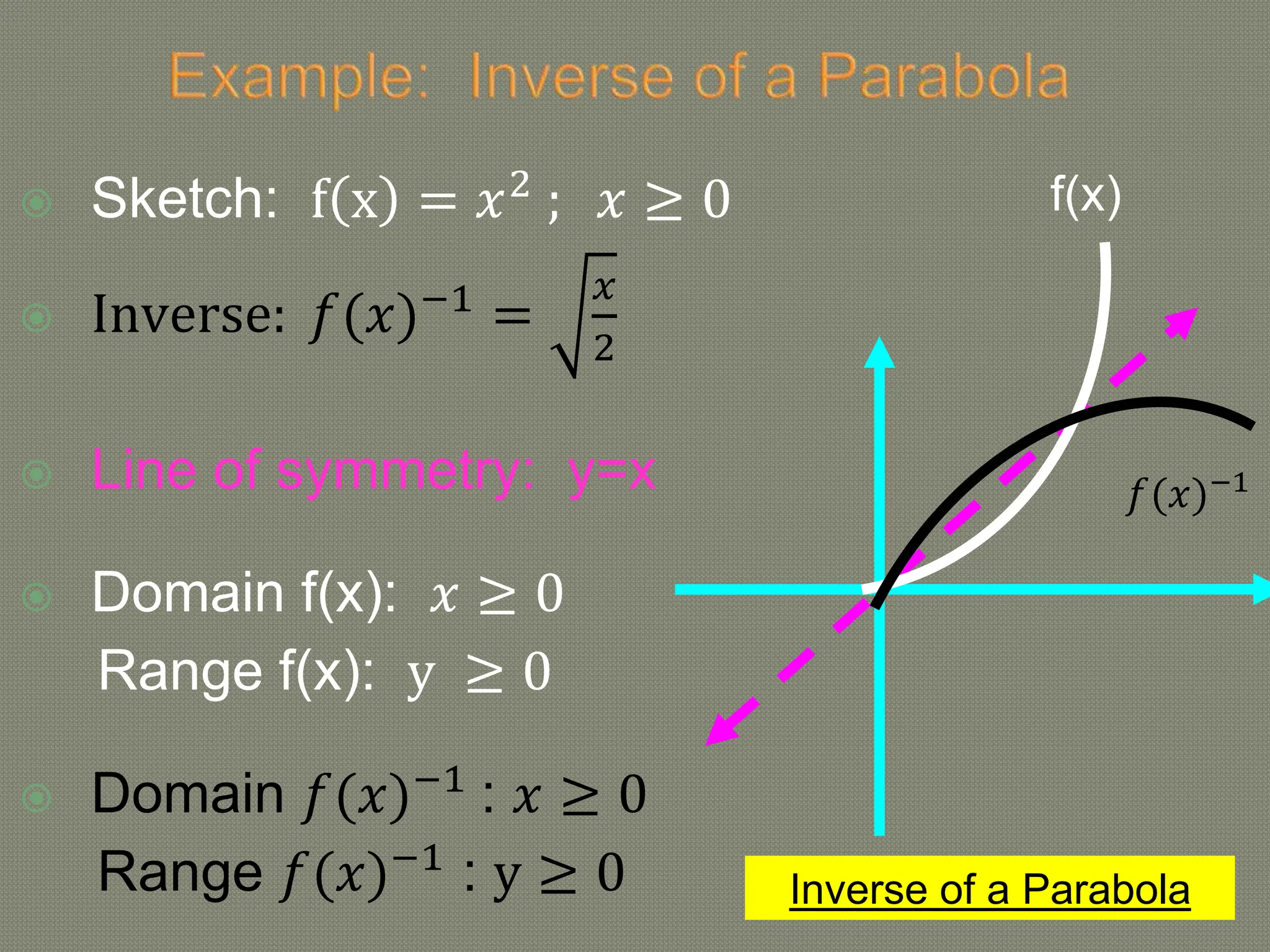
Inverse of a Parabola
 Sketch: f x = 𝑥2
; 𝑥 ≥ 0
 Inverse: 𝑓(𝑥)−1
=
𝑥
2
 Line of symmetry: y=x
 Domain f(x): 𝑥 ≥ 0
Range f(x): y ≥ 0
 Domain 𝑓(𝑥)−1
: 𝑥 ≥ 0
Range 𝑓(𝑥)−1
: y ≥ 0
f(x)
𝑓(𝑥)−1
EXPONENTIAL & LOG
GRAPHS
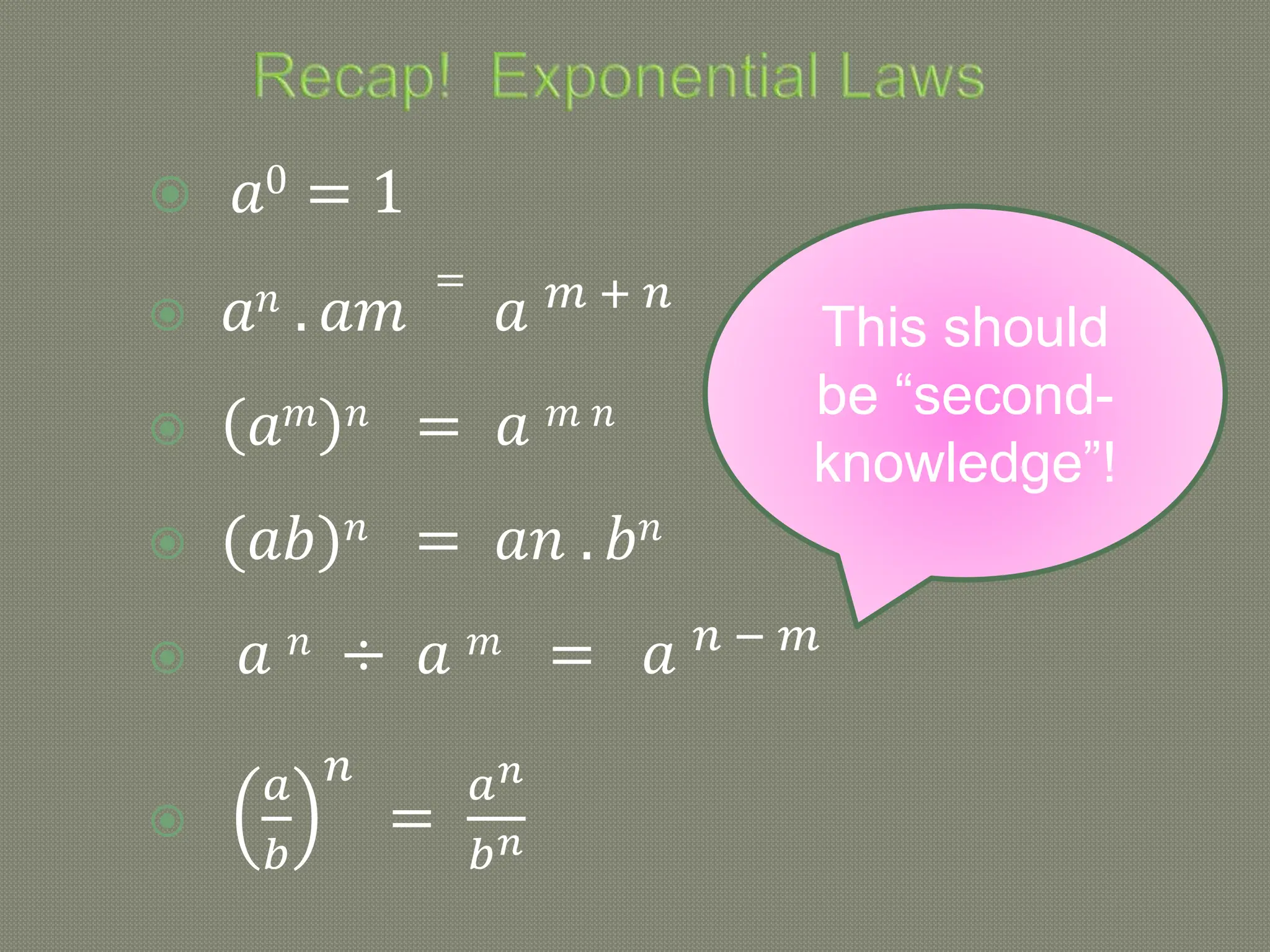
 𝑎0 = 1
 𝑎𝑛 . 𝑎𝑚
=
𝑎 𝑚 + 𝑛
 𝑎𝑚 𝑛 = 𝑎 𝑚 𝑛
 (𝑎𝑏)𝑛 = 𝑎𝑛 . 𝑏𝑛
 𝑎 𝑛 ÷ 𝑎 𝑚 = 𝑎 𝑛 − 𝑚

𝑎
𝑏
𝑛
=
𝑎𝑛
𝑏𝑛
This should
be “second-
knowledge”!
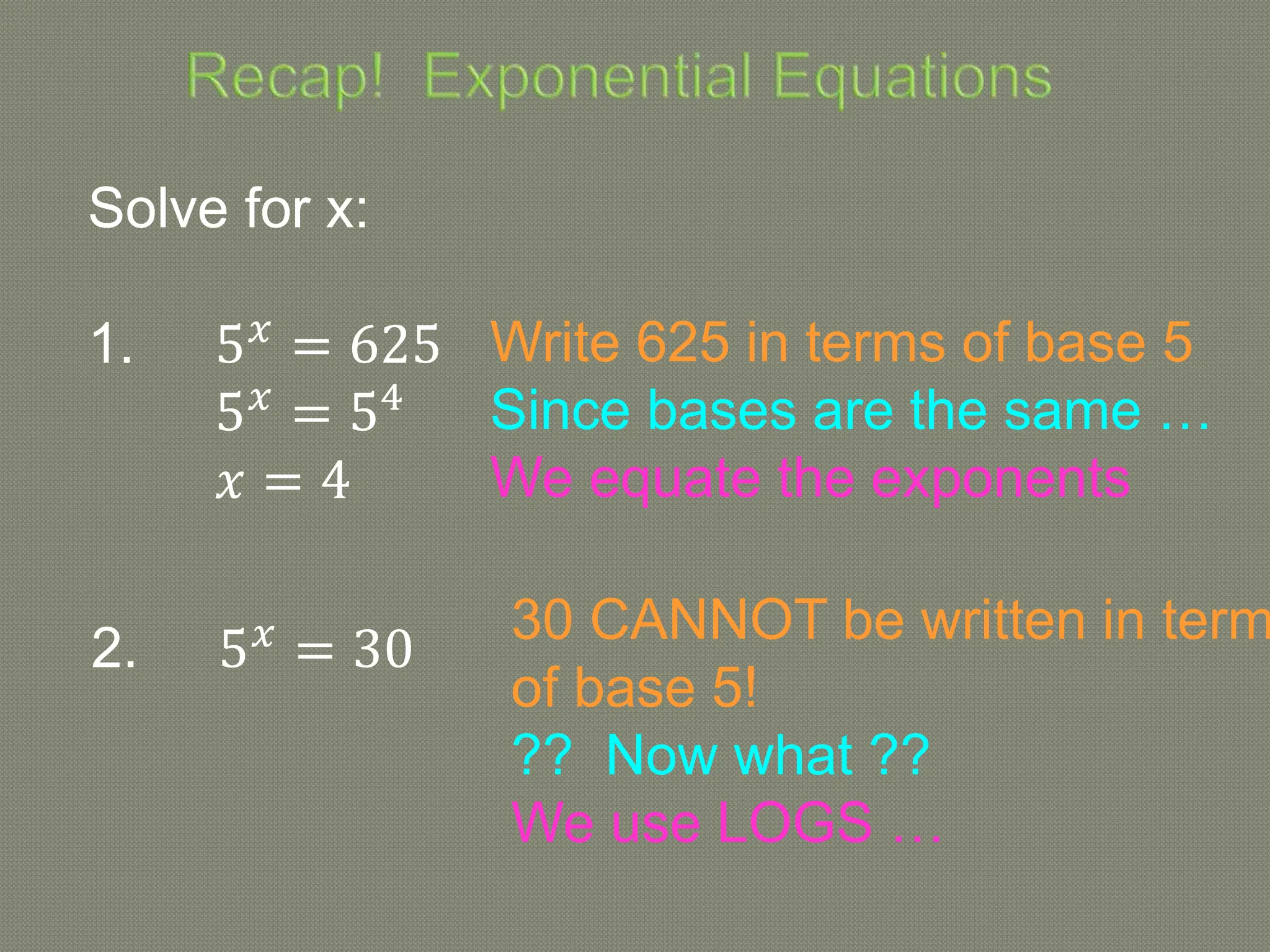
Solve for x:
1. 5𝑥
= 625
5𝑥
= 54
𝑥 = 4
2. 5𝑥
= 30
Write 625 in terms of base 5
Since bases are the same …
We equate the exponents
30 CANNOT be written in term
of base 5!
?? Now what ??
We use LOGS …
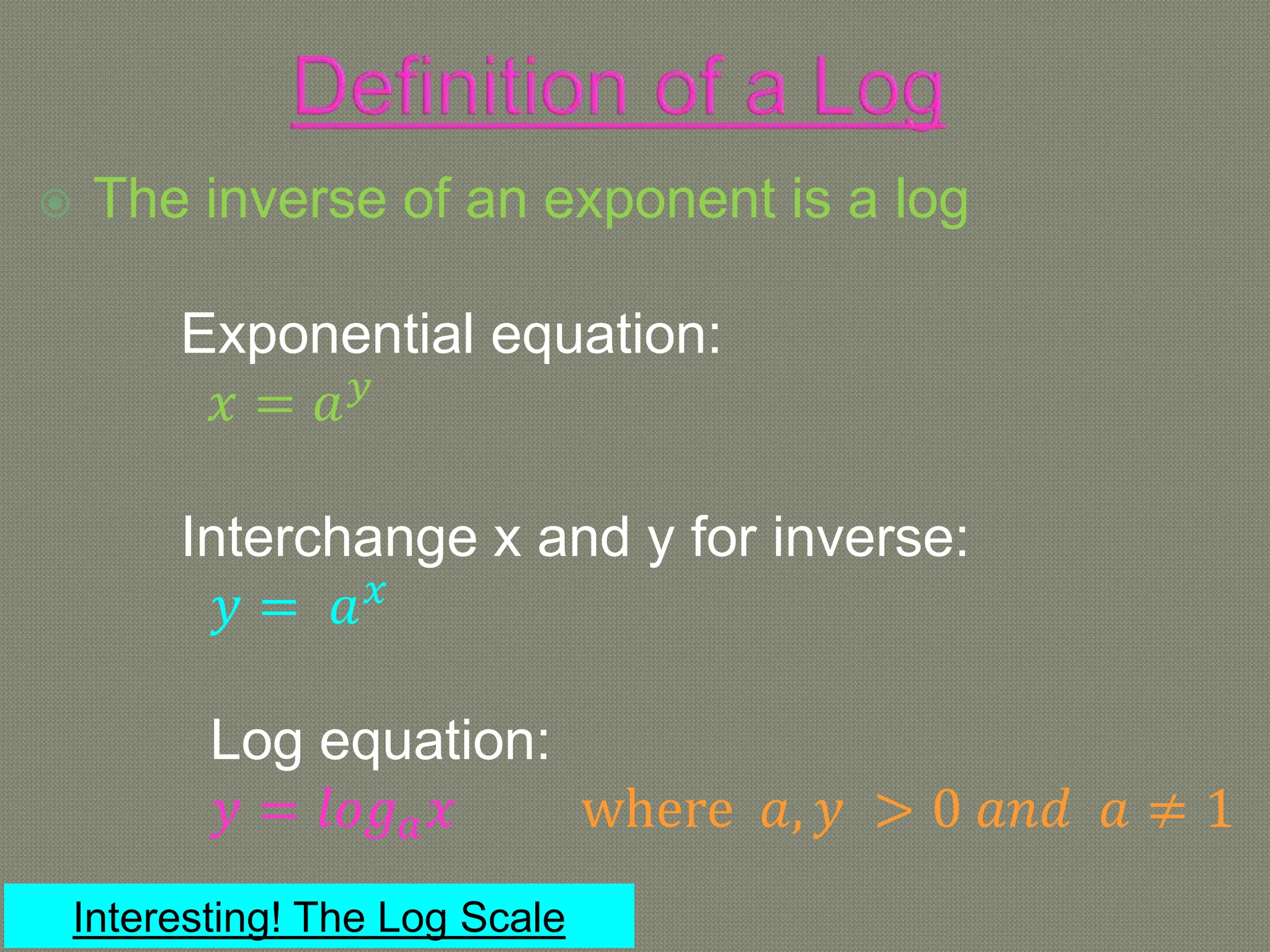
 The inverse of an exponent is a log
Exponential equation:
𝑥 = 𝑎𝑦
Interchange x and y for inverse:
𝑦 = 𝑎𝑥
Log equation:
𝑦 = 𝑙𝑜𝑔𝑎𝑥 where 𝑎, 𝑦 > 0 𝑎𝑛𝑑 𝑎 ≠ 1
Interesting! The Log Scale
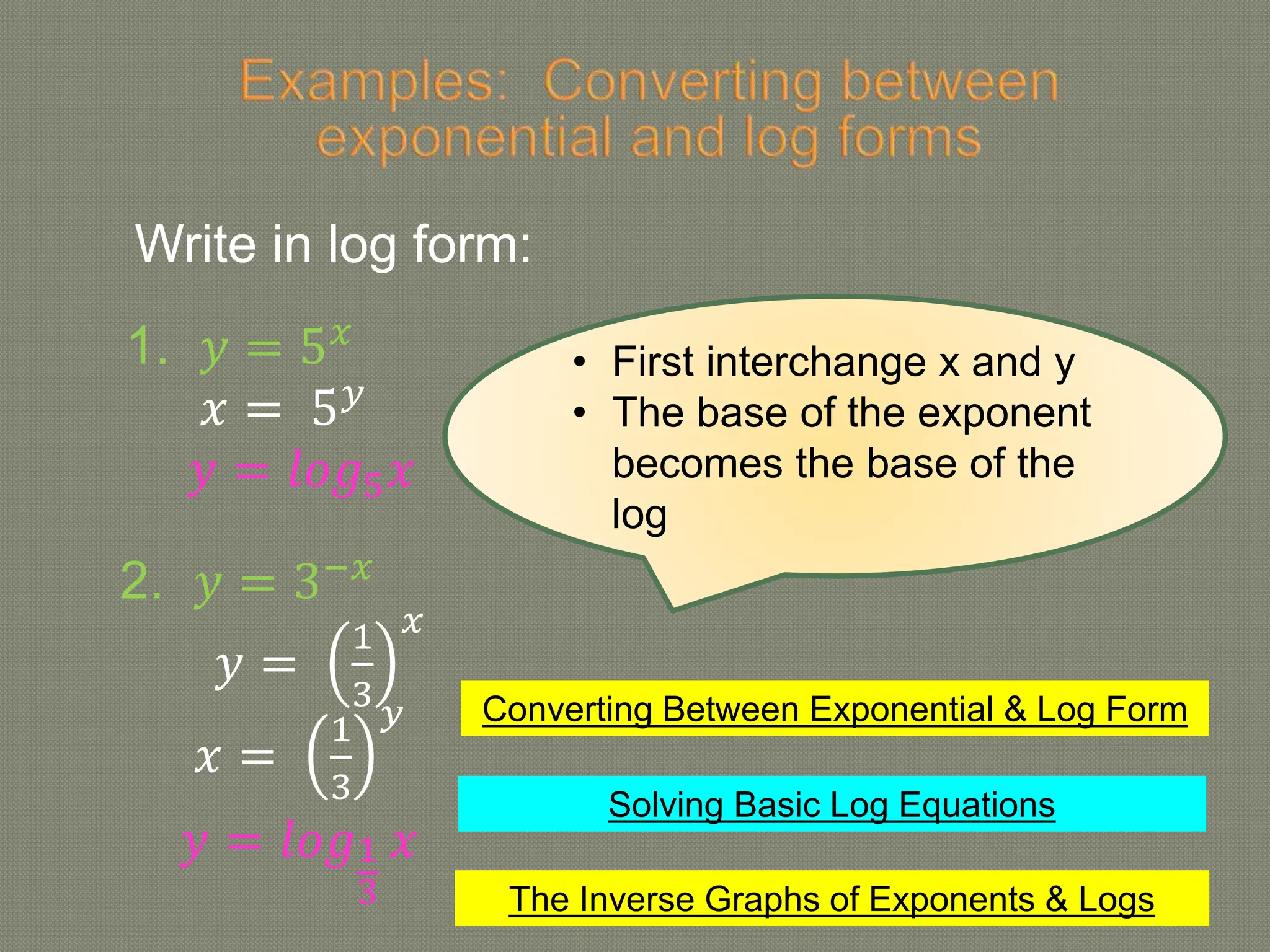
Write in log form:
1. 𝑦 = 5𝑥
𝑥 = 5𝑦
𝑦 = 𝑙𝑜𝑔5𝑥
2. 𝑦 = 3−𝑥
𝑦 =
1
3
𝑥
𝑥 =
1
3
𝑦
𝑦 = 𝑙𝑜𝑔1
3
𝑥
• First interchange x and y
• The base of the exponent
becomes the base of the
log
Converting Between Exponential & Log Form
The Inverse Graphs of Exponents & Logs
Solving Basic Log Equations
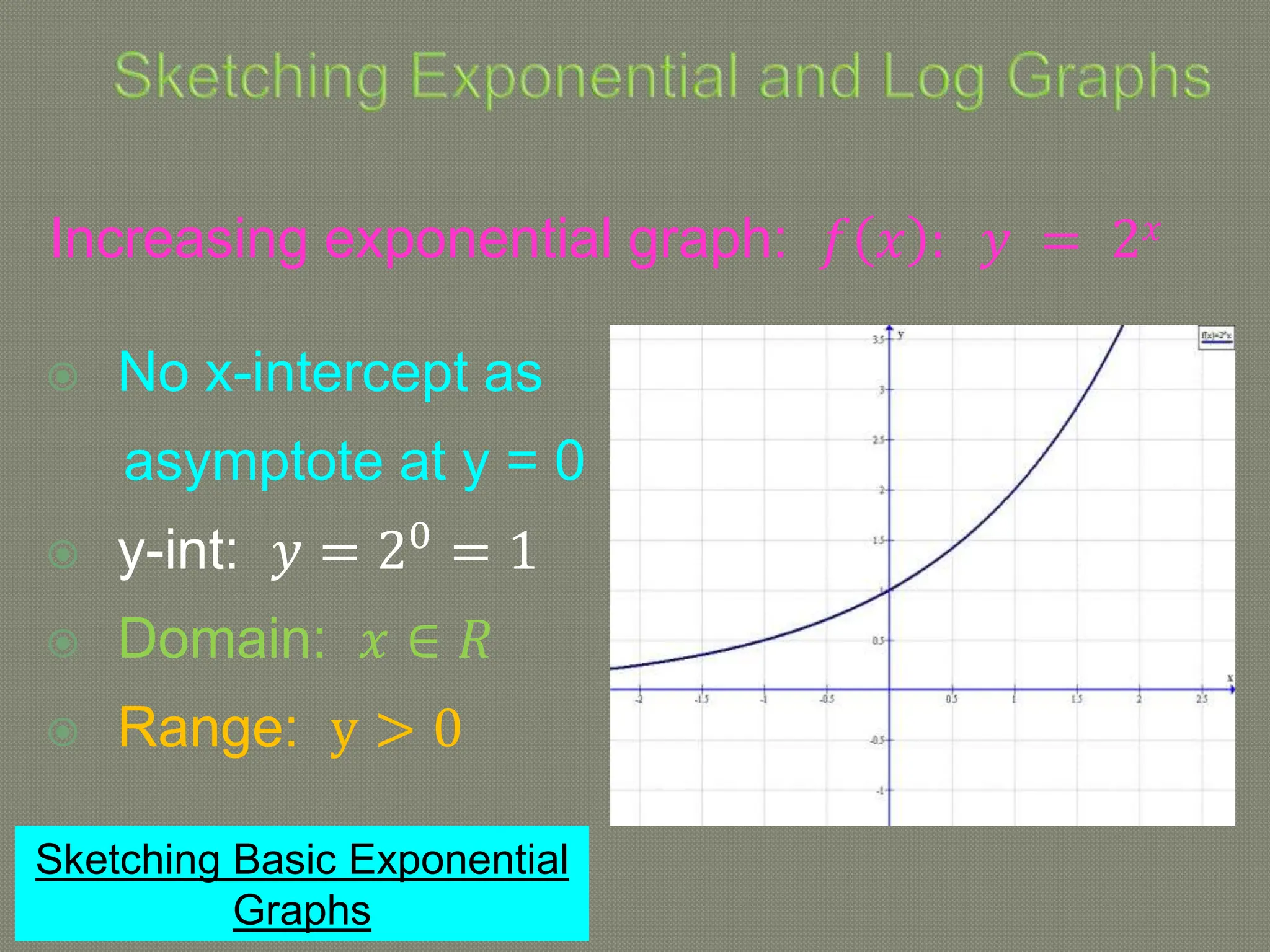
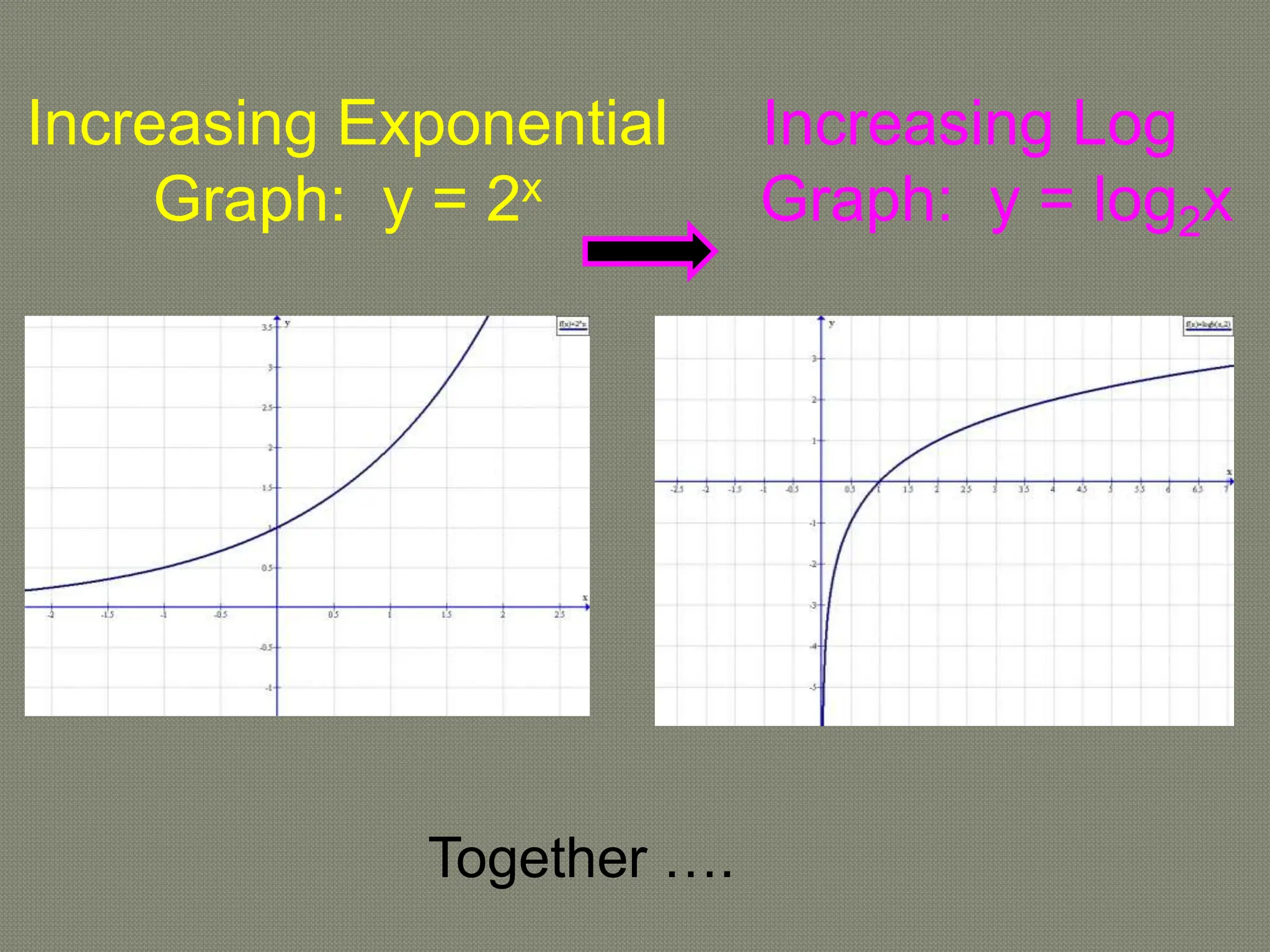
Increasing exponential graph: 𝑓 𝑥 : 𝑦 = 2𝑥
 No x-intercept as
asymptote at y = 0
 y-int: 𝑦 = 20
= 1
 Domain: 𝑥 ∈ 𝑅
 Range: y > 0
Sketching Basic Exponential
Graphs
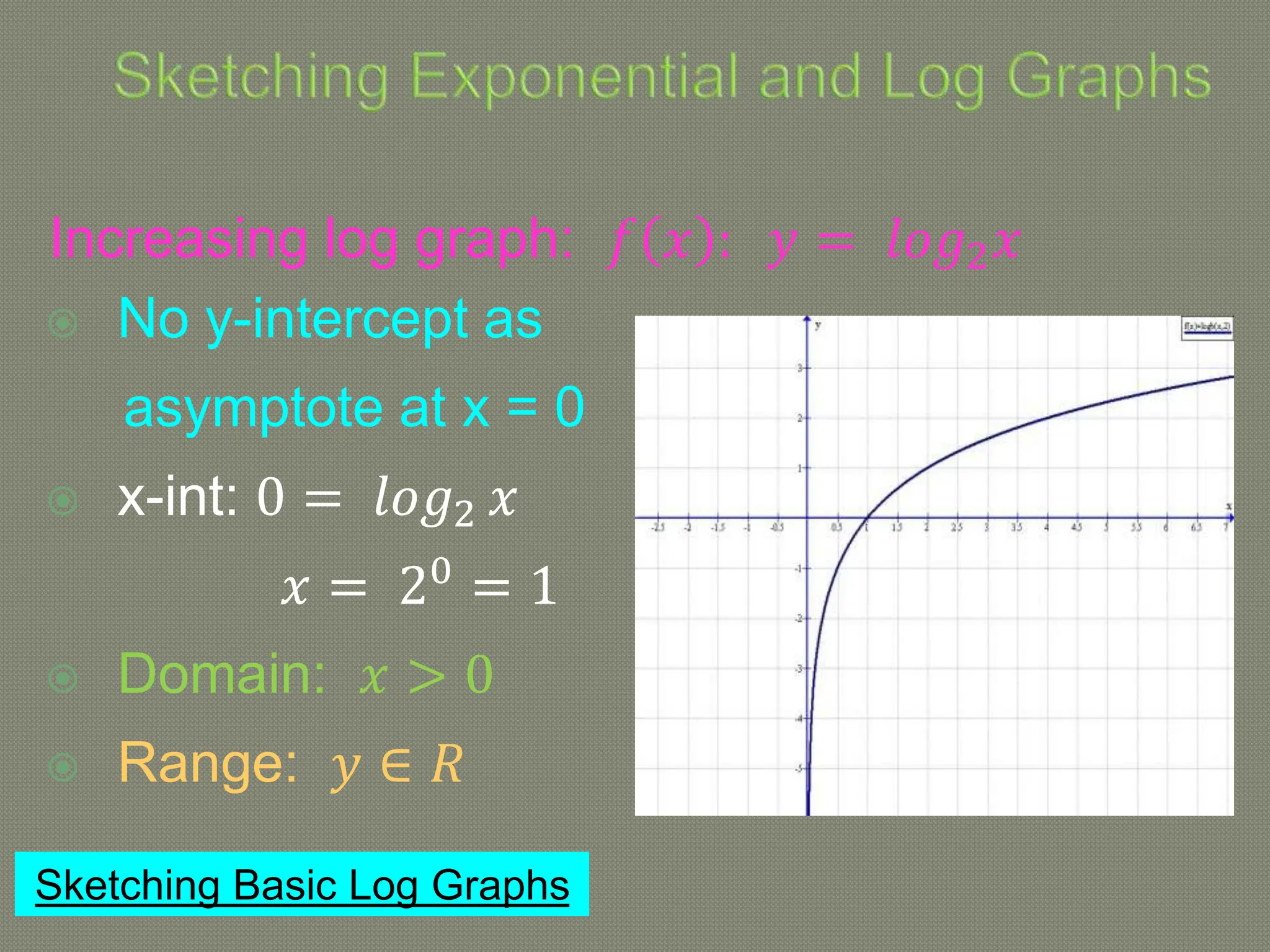
Increasing log graph: 𝑓 𝑥 : 𝑦 = 𝑙𝑜𝑔2𝑥
 No y-intercept as
asymptote at x = 0
 x-int: 0 = 𝑙𝑜𝑔2 𝑥
𝑥 = 20
= 1
 Domain: 𝑥 > 0
 Range: 𝑦 ∈ 𝑅
Sketching Basic Log Graphs
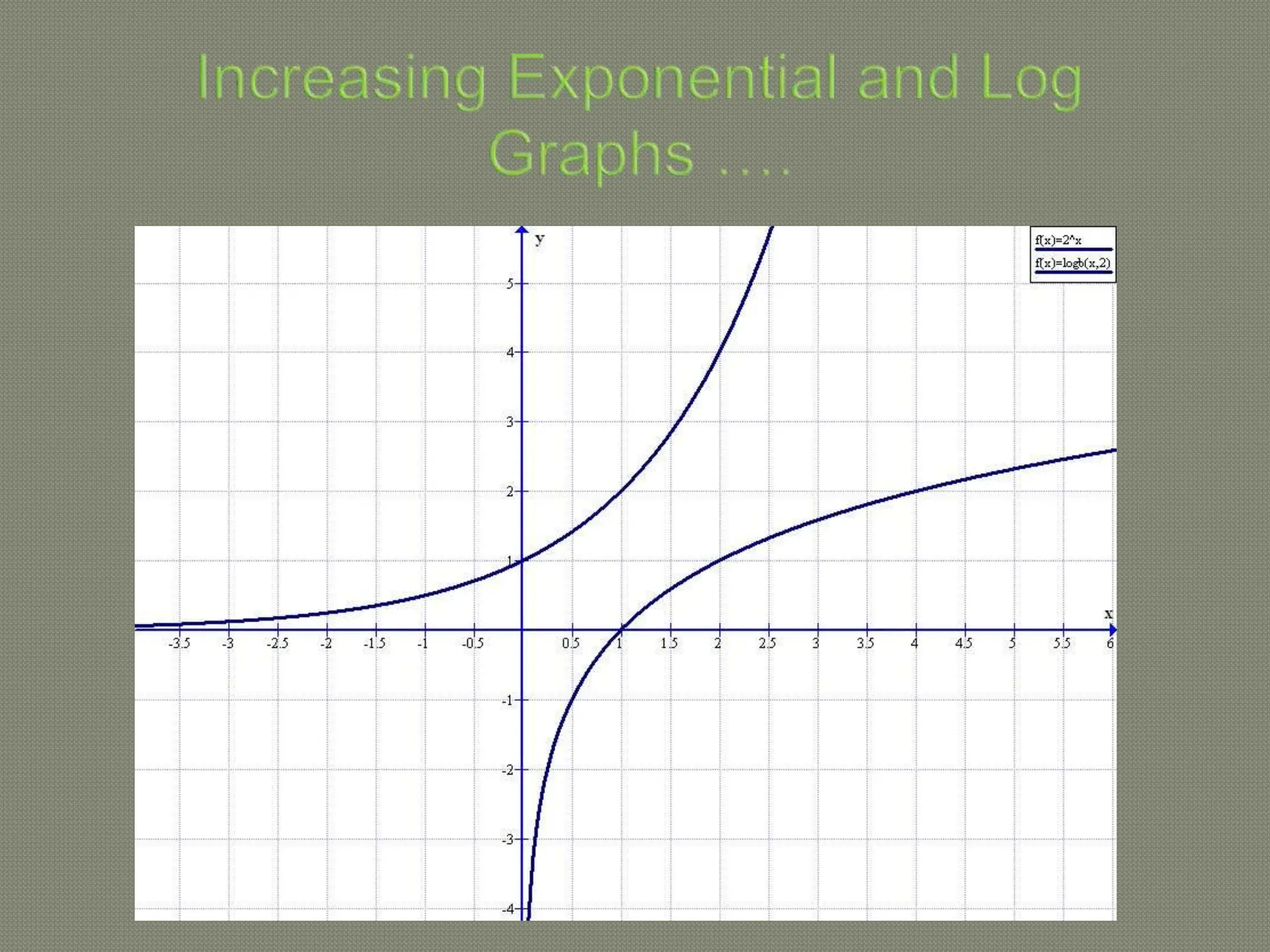
Increasing Exponential
Graph: y = 2x
Increasing Log
Graph: y = log2x
Together ….
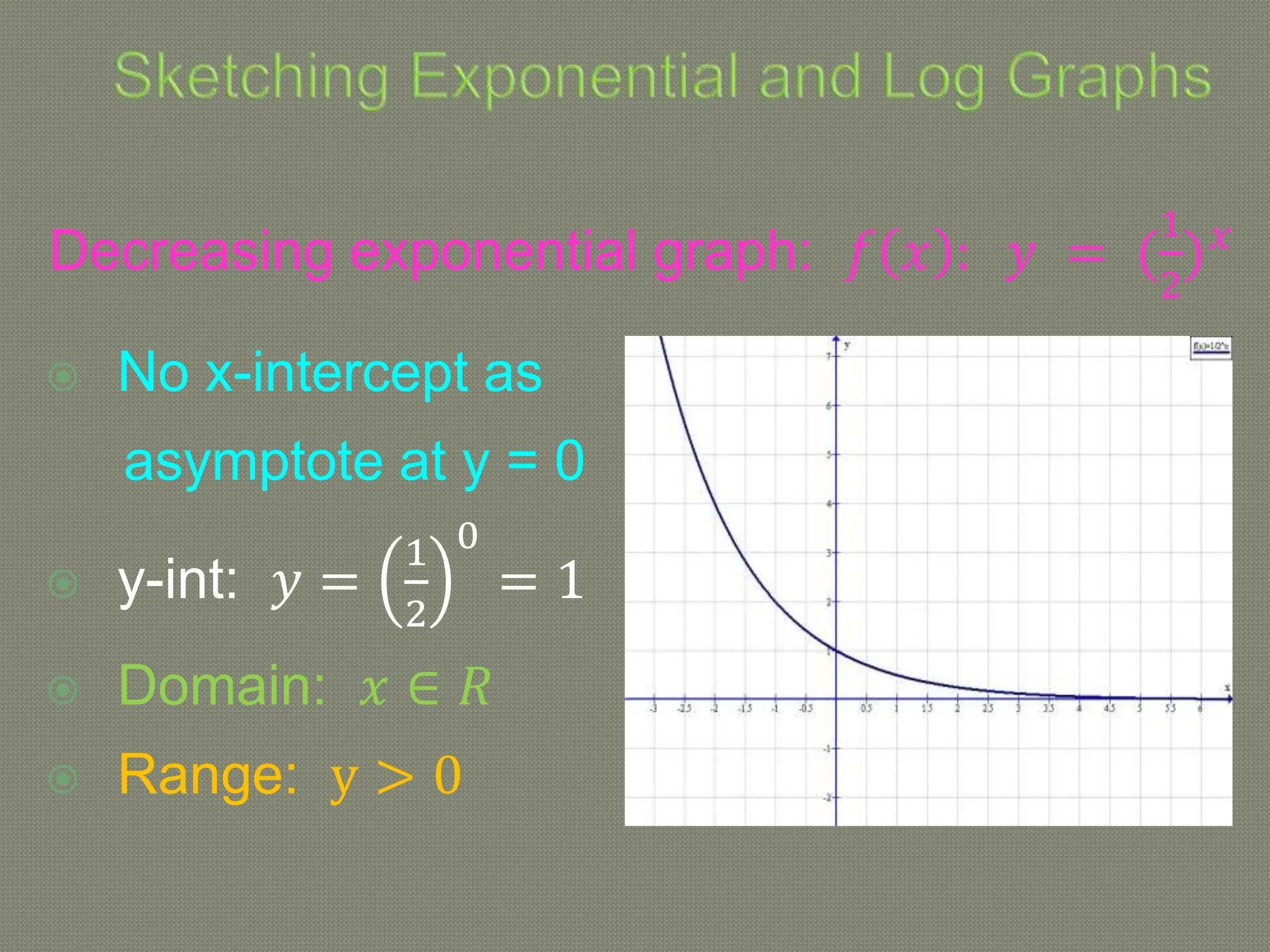
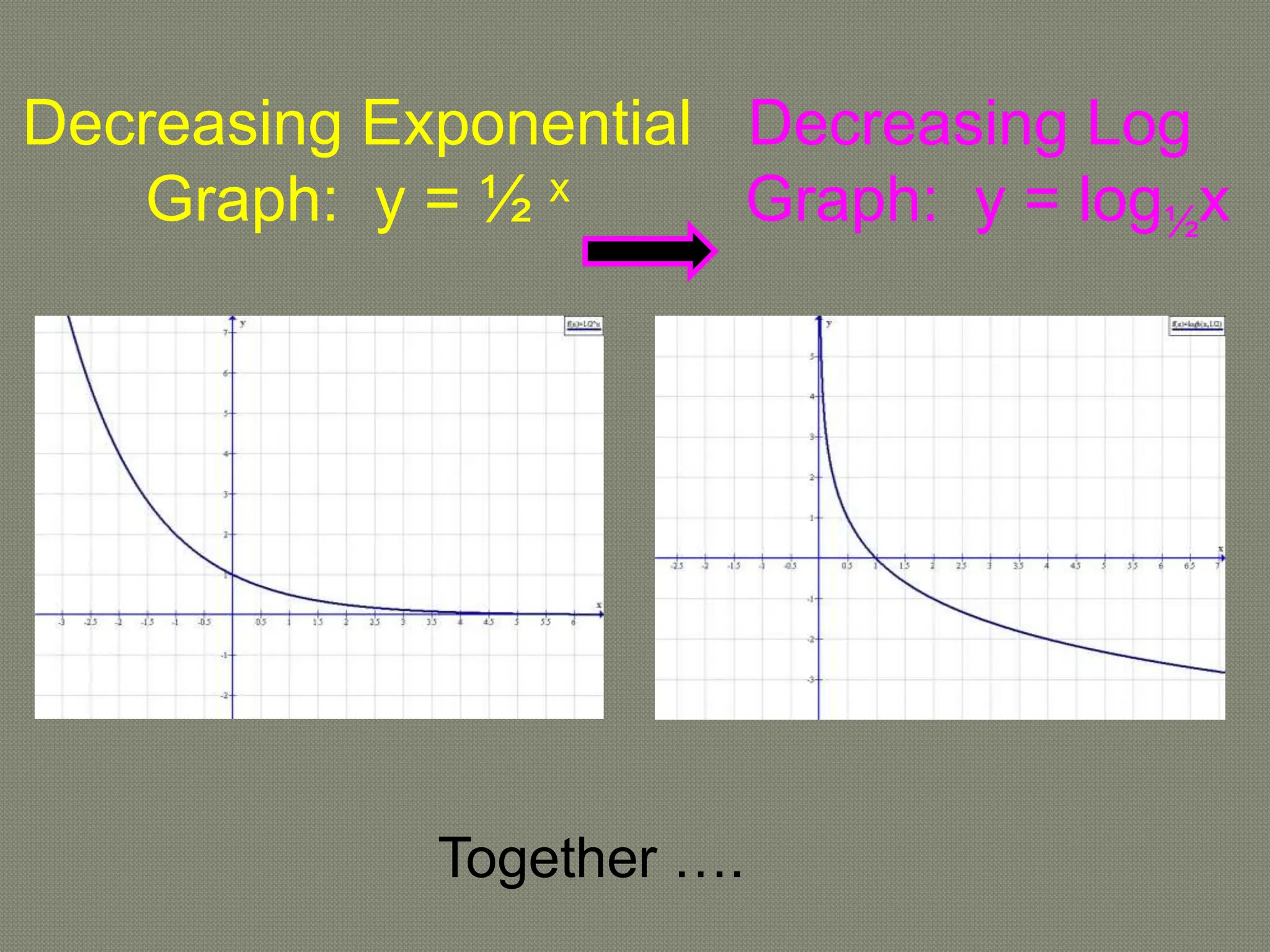
Decreasing exponential graph: 𝑓 𝑥 : 𝑦 = (
1
2
)𝑥
 No x-intercept as
asymptote at y = 0
 y-int: 𝑦 =
1
2
0
= 1
 Domain: 𝑥 ∈ 𝑅
 Range: y > 0
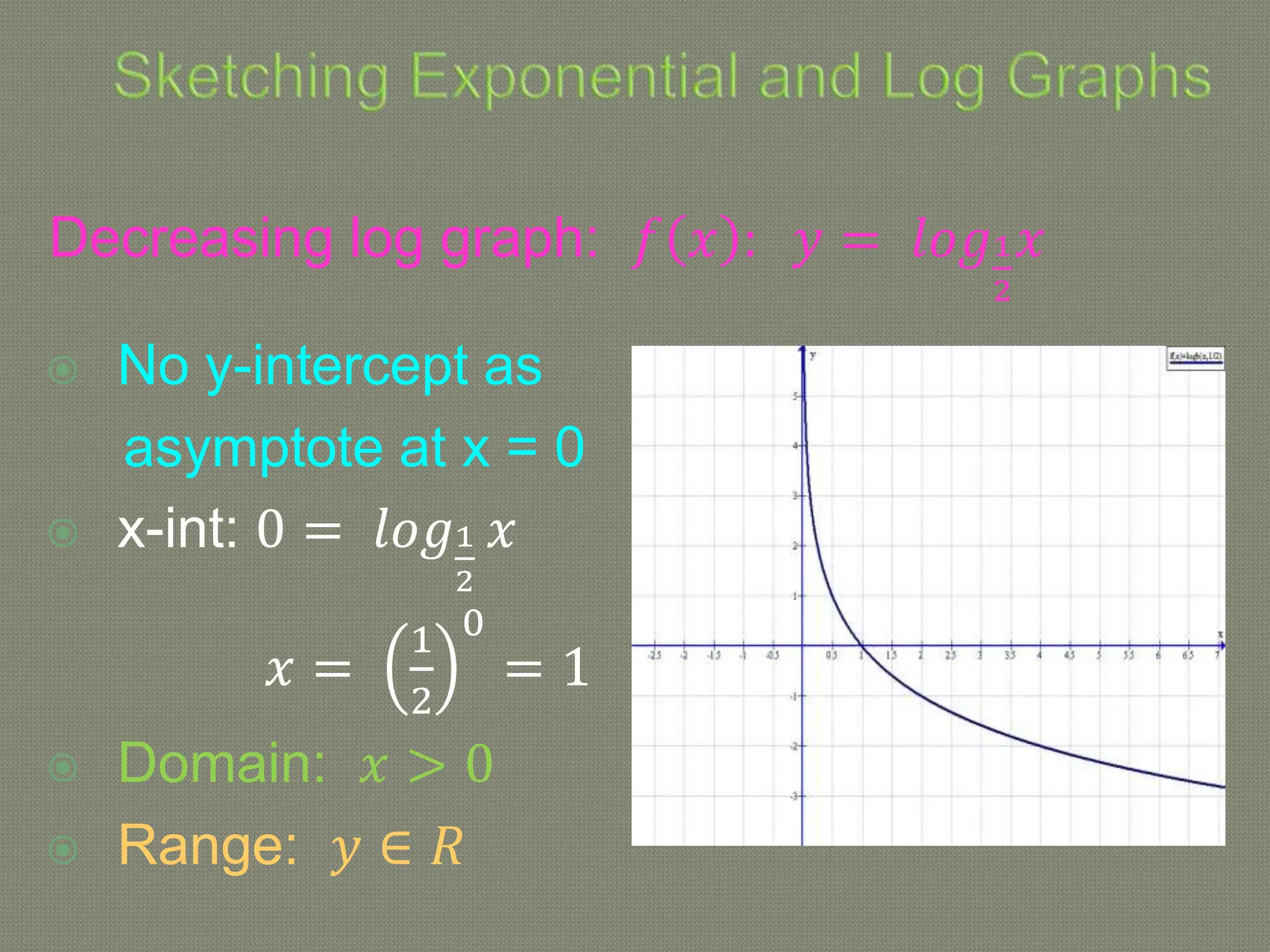
Decreasing log graph: 𝑓 𝑥 : 𝑦 = 𝑙𝑜𝑔1
2
𝑥
 No y-intercept as
asymptote at x = 0
 x-int: 0 = 𝑙𝑜𝑔1
2
𝑥
𝑥 =
1
2
0
= 1
 Domain: 𝑥 > 0
 Range: 𝑦 ∈ 𝑅
Decreasing Exponential
Graph: y = ½ x
Decreasing Log
Graph: y = log½x
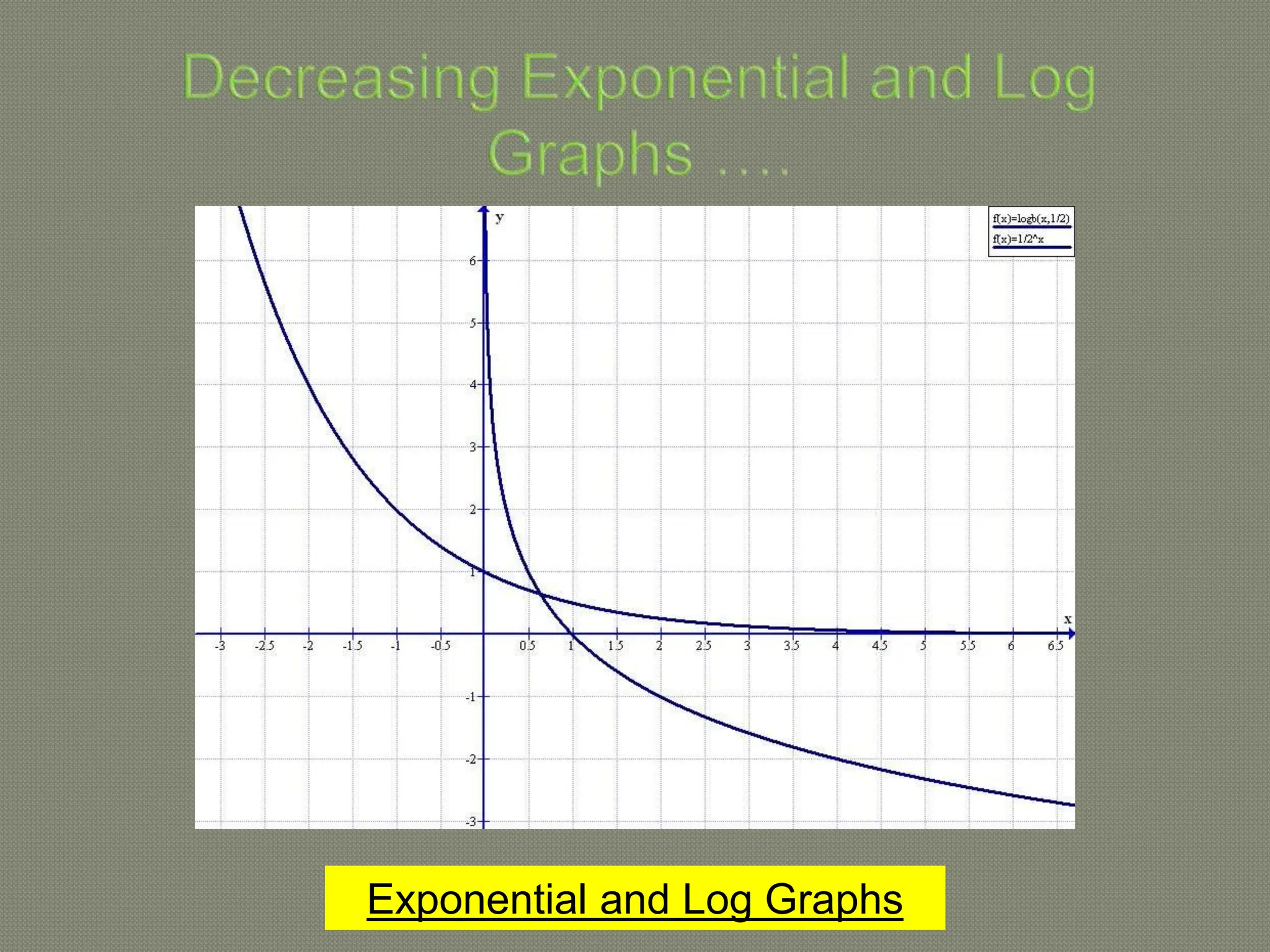
Together ….
Exponential and Log Graphs
SOLVING CUBIC
EXPRESSIONS
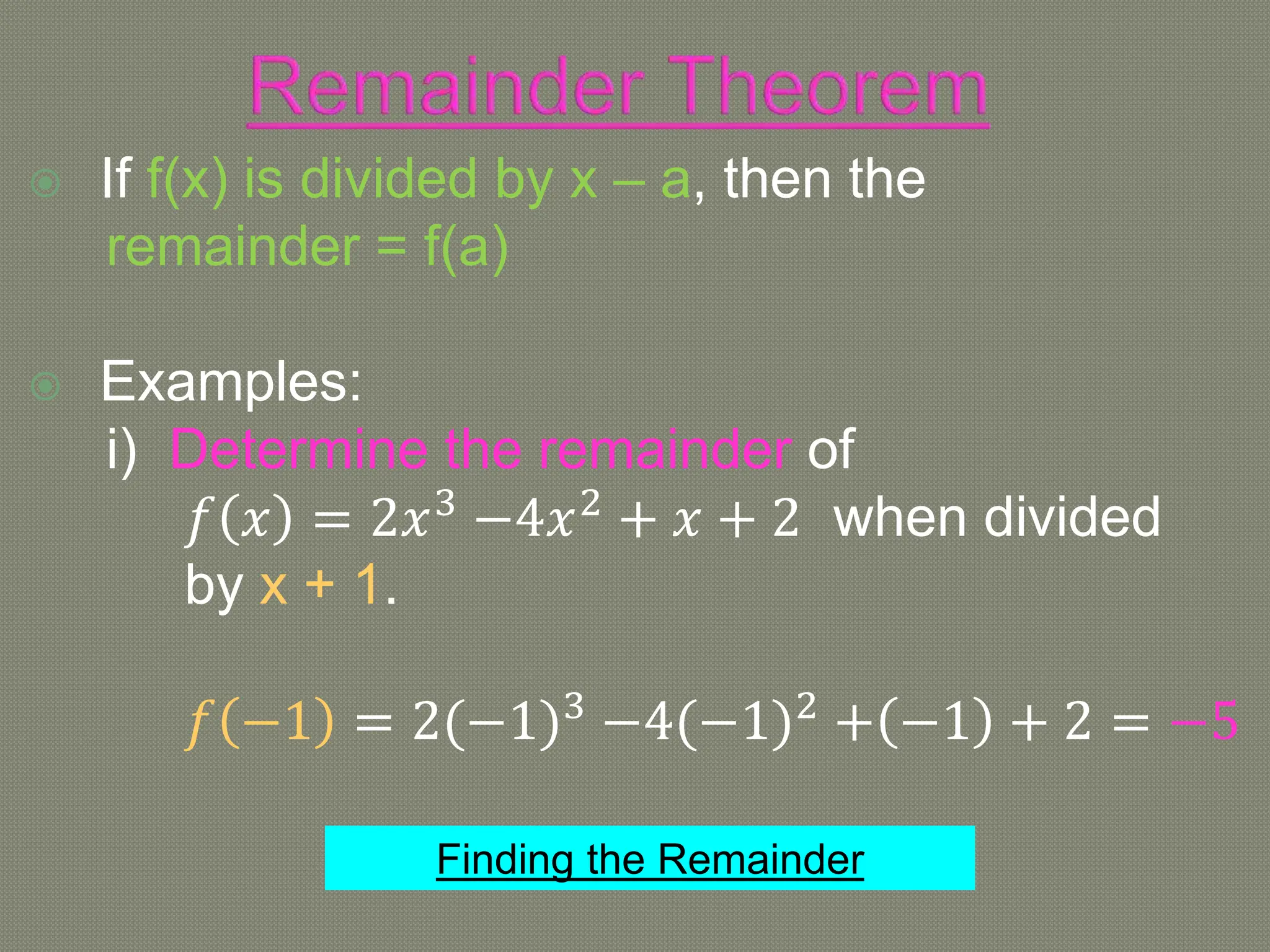
 If f(x) is divided by x – a, then the
remainder = f(a)
 Examples:
i) Determine the remainder of
𝑓 𝑥 = 2𝑥3
−4𝑥2
+ 𝑥 + 2 when divided
by x + 1.
𝑓 −1 = 2(−1)3
−4(−1)2
+ −1 + 2 = −5
Finding the Remainder
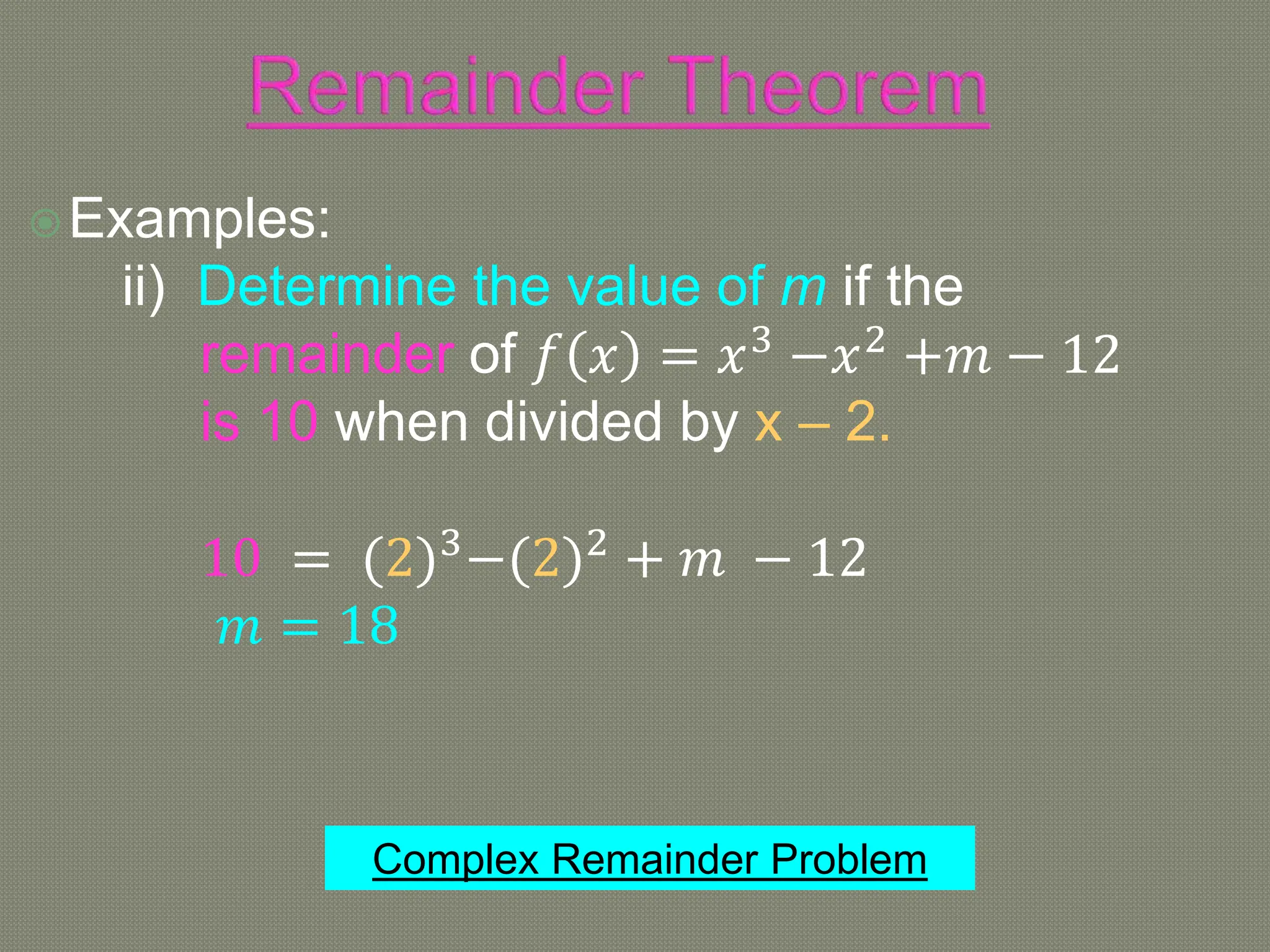
Examples:
ii) Determine the value of m if the
remainder of 𝑓 𝑥 = 𝑥3
−𝑥2
+𝑚 − 12
is 10 when divided by x – 2.
10 = (2)3
−(2)2
+ 𝑚 − 12
𝑚 = 18
Complex Remainder Problem
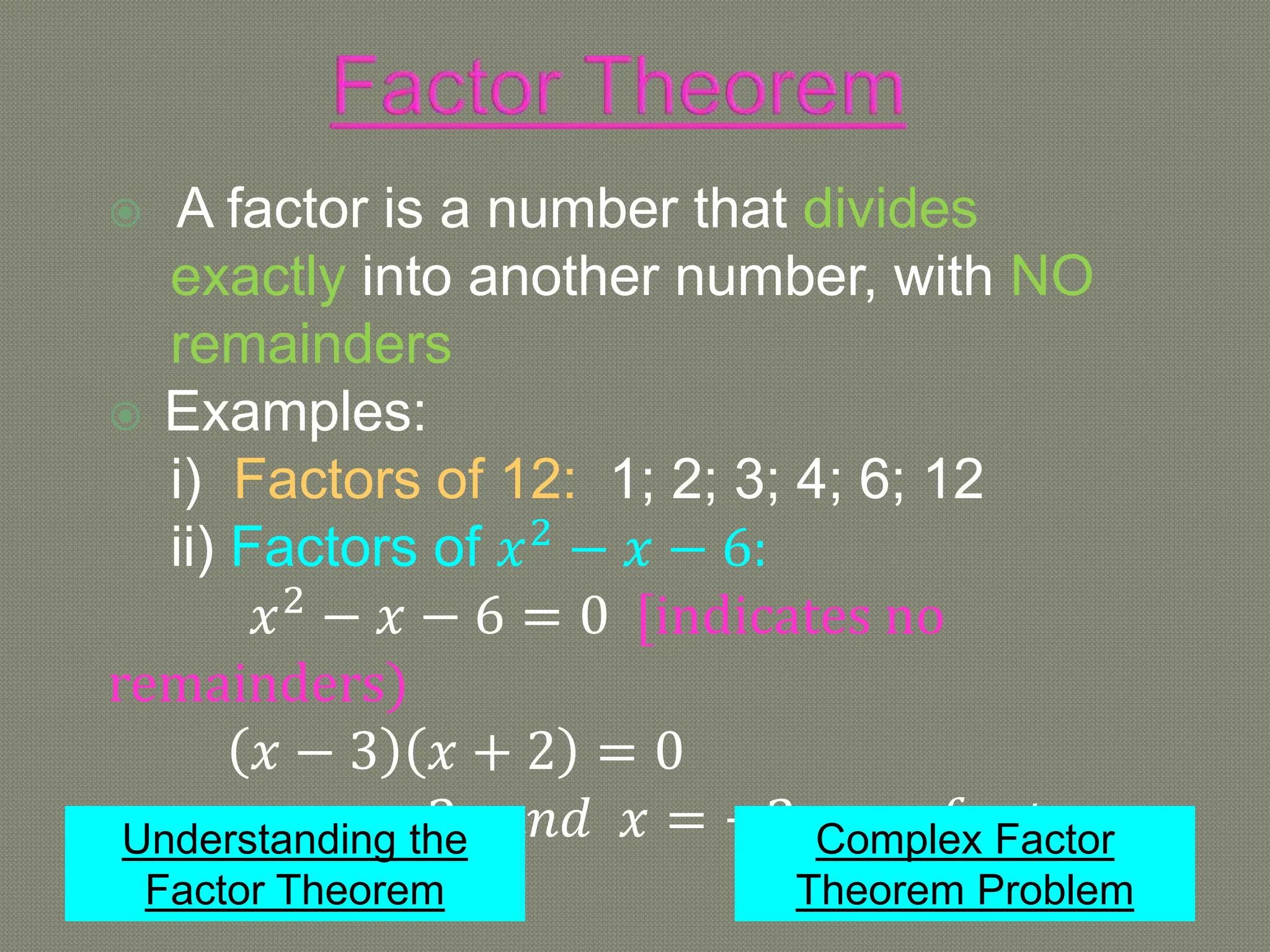
 A factor is a number that divides
exactly into another number, with NO
remainders
 Examples:
i) Factors of 12: 1; 2; 3; 4; 6; 12
ii) Factors of 𝑥2
− 𝑥 − 6:
𝑥2
− 𝑥 − 6 = 0 [indicates no
remainders)
𝑥 − 3 𝑥 + 2 = 0
∴ 𝑥 = 3 𝑎𝑛𝑑 𝑥 = −2 𝑎𝑟𝑒 𝑓𝑎𝑐𝑡𝑜𝑟𝑠
Understanding the
Factor Theorem
Complex Factor
Theorem Problem
Visualizing Factors &
Remainders
Calculating Remainders
given Factors
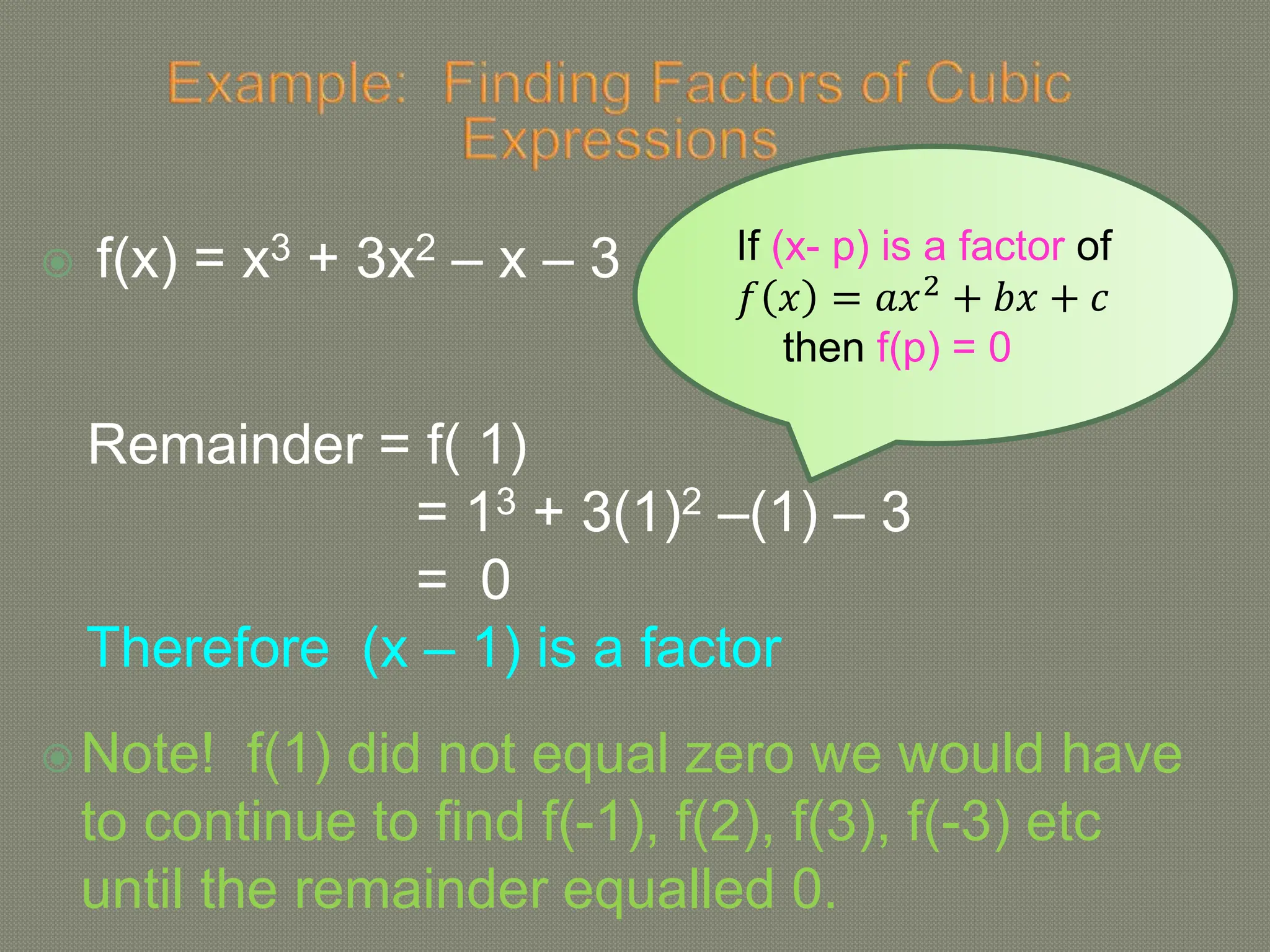
 f(x) = x3 + 3x2 – x – 3
Remainder = f( 1)
= 13 + 3(1)2 –(1) – 3
= 0
Therefore (x – 1) is a factor
Note! f(1) did not equal zero we would have
to continue to find f(-1), f(2), f(3), f(-3) etc
until the remainder equalled 0.
If (x- p) is a factor of
𝑓 𝑥 = 𝑎𝑥2 + 𝑏𝑥 + 𝑐
then f(p) = 0
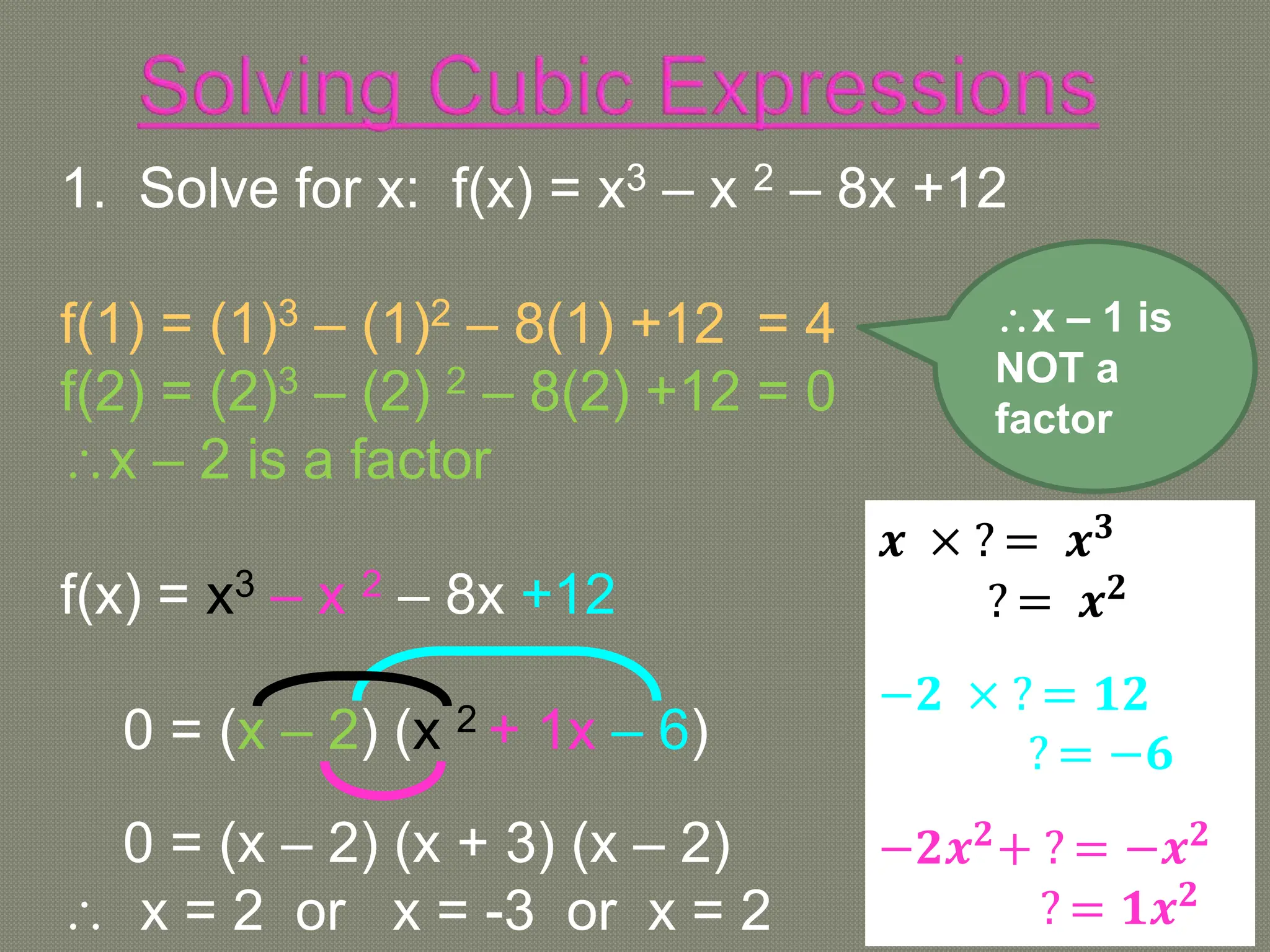
1. Solve for x: f(x) = x3 – x 2 – 8x +12
f(1) = (1)3 – (1)2 – 8(1) +12 = 4
f(2) = (2)3 – (2) 2 – 8(2) +12 = 0
x – 2 is a factor
f(x) = x3 – x 2 – 8x +12
0 = (x – 2) (x 2 + 1x – 6)
0 = (x – 2) (x + 3) (x – 2)
 x = 2 or x = -3 or x = 2
x – 1 is
NOT a
factor
𝒙 × ? = 𝒙𝟑
? = 𝒙𝟐
−𝟐 × ? = 𝟏𝟐
? = −𝟔
−𝟐𝒙𝟐
+ ? = −𝒙𝟐
? = 𝟏𝒙𝟐
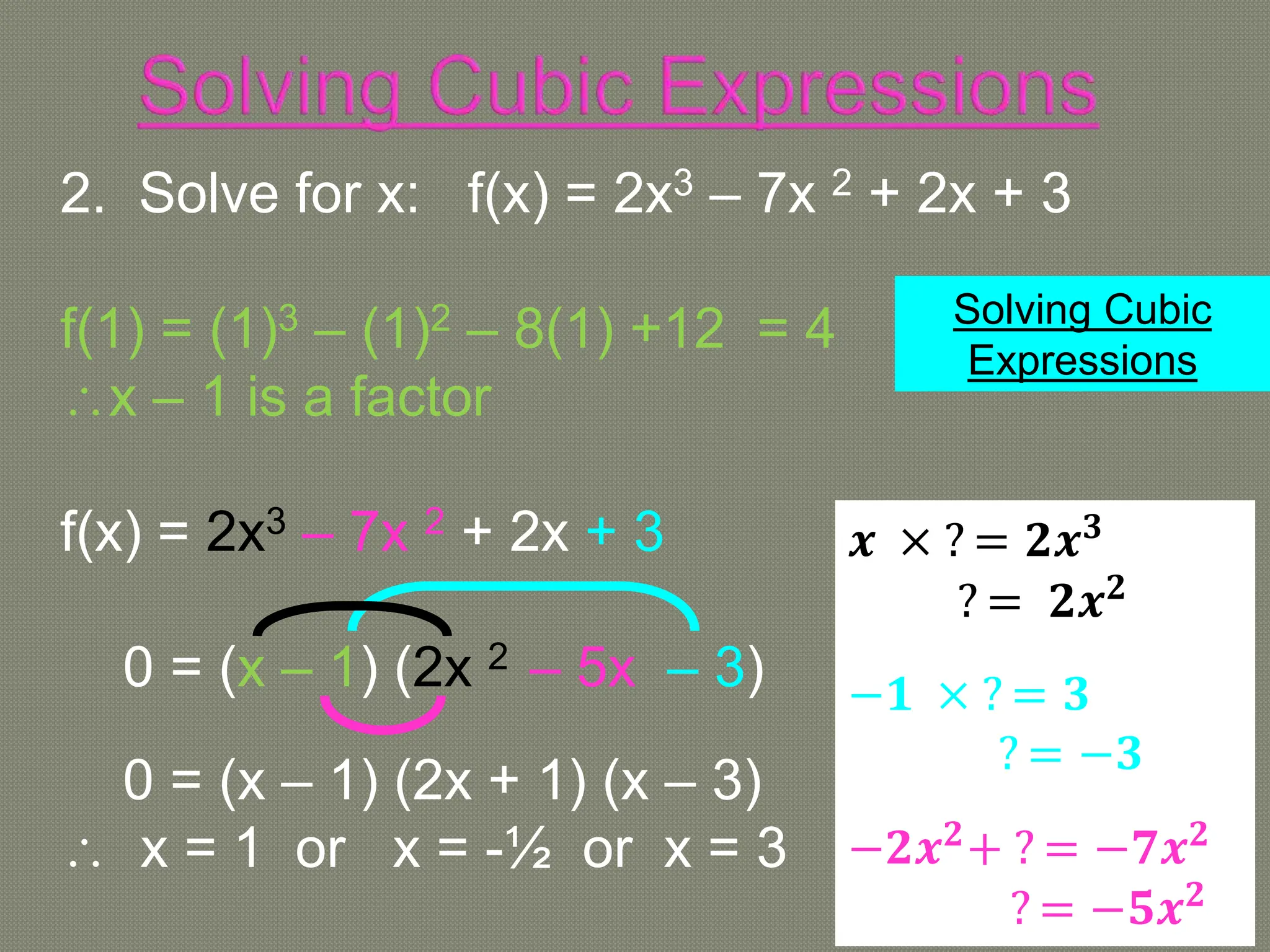
2. Solve for x: f(x) = 2x3 – 7x 2 + 2x + 3
f(1) = (1)3 – (1)2 – 8(1) +12 = 4
x – 1 is a factor
f(x) = 2x3 – 7x 2 + 2x + 3
0 = (x – 1) (2x 2 – 5x – 3)
0 = (x – 1) (2x + 1) (x – 3)
 x = 1 or x = -½ or x = 3
𝒙 × ? = 𝟐𝒙𝟑
? = 𝟐𝒙𝟐
−𝟏 × ? = 𝟑
? = −𝟑
−𝟐𝒙𝟐
+ ? = −𝟕𝒙𝟐
? = −𝟓𝒙𝟐
Solving Cubic
Expressions

Function evaluation, termination, vertical line test etc

  • 1.
  • 2.
  • 3.
    A relation isany formula or rule that connects 2 sets of numbers. i.e. y = 2x + 3  Domain: all the numbers that exist for x  Range: all the numbers that exist for y Finding the Domain and Range of Graphs Domain, Range and Functions
  • 4.
    A function isa relationship where for every x value, there is only ONE y value OR A function is defined as a one-to-one relationship  There are 2 ways to establish if a relationship is a function i) Mapping ii) Vertical line test
  • 5.
    One-to-one mapping:  Isa function 1 2 3 4 2 4 6 8 2 -2 3 4 9 2x x2 x y y x Many-to-one mapping:  Is NOT a function
  • 6.
     Vertical lineonly cuts the graph in one place:  Is a function  Vertical line cuts the graph in more than one place:  Is NOT a function Vertical Line Test
  • 7.
  • 8.
    A function g(x)is the inverse of function f(x) if … the domain of g(x) is the range of f(x) and the range of g(x) is the domain of f(x). i.e. the x and y values are interchanged Inverse Function Graphs Introduction to Inverse Functions
  • 9.
     f(x): y= 2x + 3 y-int: (0; 3) x-int: ( − 3 2 ; 0) 𝑓(𝑥)−1 : x = 2y + 3 -2y = -x + 3 𝑦 = 1 2 𝑥 − 3 2 y-int: (0; − 3 2 ) x-int: (3; 0) 3 3 − 𝟑 𝟐 − 𝟑 𝟐 f(x) 𝑓(𝑥)−1
  • 10.
     x andy values interchanged  ∴ there is a line of symmetry about the line y=x  Domain f(x): 𝑥 ∈ 𝑅 Range f(x): y ∈ 𝑅  Domain 𝑓(𝑥)−1 : 𝑥 ∈ 𝑅 Range 𝑓(𝑥)−1 : y ∈ 𝑅 3 3 − 𝟑 𝟐 − 𝟑 𝟐 f(x) 𝑓(𝑥)−1 Inverse of a Straight Line
  • 11.
    y = 2x2is a function 𝑦 = ± 𝑥 2 is NOT a function (fails the vertical line test) We can put restrictions on the original parabola, so that the inverse will be a function.
  • 12.
     Sketch: fx = 𝑥2 ; 𝑥 ≤ 0  Inverse: 𝑓(𝑥)−1 = − 𝑥 2  Line of symmetry: y=x  Domain f(x): 𝑥 ≤ 0 Range f(x): y ≥ 0  Domain 𝑓(𝑥)−1 : 𝑥 ≥ 0 Range 𝑓(𝑥)−1 : y ≤ 0 f(x) 𝑓(𝑥)−1
  • 13.
    Inverse of aParabola  Sketch: f x = 𝑥2 ; 𝑥 ≥ 0  Inverse: 𝑓(𝑥)−1 = 𝑥 2  Line of symmetry: y=x  Domain f(x): 𝑥 ≥ 0 Range f(x): y ≥ 0  Domain 𝑓(𝑥)−1 : 𝑥 ≥ 0 Range 𝑓(𝑥)−1 : y ≥ 0 f(x) 𝑓(𝑥)−1
  • 14.
  • 15.
     𝑎0 =1  𝑎𝑛 . 𝑎𝑚 = 𝑎 𝑚 + 𝑛  𝑎𝑚 𝑛 = 𝑎 𝑚 𝑛  (𝑎𝑏)𝑛 = 𝑎𝑛 . 𝑏𝑛  𝑎 𝑛 ÷ 𝑎 𝑚 = 𝑎 𝑛 − 𝑚  𝑎 𝑏 𝑛 = 𝑎𝑛 𝑏𝑛 This should be “second- knowledge”!
  • 16.
    Solve for x: 1.5𝑥 = 625 5𝑥 = 54 𝑥 = 4 2. 5𝑥 = 30 Write 625 in terms of base 5 Since bases are the same … We equate the exponents 30 CANNOT be written in term of base 5! ?? Now what ?? We use LOGS …
  • 17.
     The inverseof an exponent is a log Exponential equation: 𝑥 = 𝑎𝑦 Interchange x and y for inverse: 𝑦 = 𝑎𝑥 Log equation: 𝑦 = 𝑙𝑜𝑔𝑎𝑥 where 𝑎, 𝑦 > 0 𝑎𝑛𝑑 𝑎 ≠ 1 Interesting! The Log Scale
  • 18.
    Write in logform: 1. 𝑦 = 5𝑥 𝑥 = 5𝑦 𝑦 = 𝑙𝑜𝑔5𝑥 2. 𝑦 = 3−𝑥 𝑦 = 1 3 𝑥 𝑥 = 1 3 𝑦 𝑦 = 𝑙𝑜𝑔1 3 𝑥 • First interchange x and y • The base of the exponent becomes the base of the log Converting Between Exponential & Log Form The Inverse Graphs of Exponents & Logs Solving Basic Log Equations
  • 19.
    Increasing exponential graph:𝑓 𝑥 : 𝑦 = 2𝑥  No x-intercept as asymptote at y = 0  y-int: 𝑦 = 20 = 1  Domain: 𝑥 ∈ 𝑅  Range: y > 0 Sketching Basic Exponential Graphs
  • 20.
    Increasing log graph:𝑓 𝑥 : 𝑦 = 𝑙𝑜𝑔2𝑥  No y-intercept as asymptote at x = 0  x-int: 0 = 𝑙𝑜𝑔2 𝑥 𝑥 = 20 = 1  Domain: 𝑥 > 0  Range: 𝑦 ∈ 𝑅 Sketching Basic Log Graphs
  • 21.
    Increasing Exponential Graph: y= 2x Increasing Log Graph: y = log2x Together ….
  • 23.
    Decreasing exponential graph:𝑓 𝑥 : 𝑦 = ( 1 2 )𝑥  No x-intercept as asymptote at y = 0  y-int: 𝑦 = 1 2 0 = 1  Domain: 𝑥 ∈ 𝑅  Range: y > 0
  • 24.
    Decreasing log graph:𝑓 𝑥 : 𝑦 = 𝑙𝑜𝑔1 2 𝑥  No y-intercept as asymptote at x = 0  x-int: 0 = 𝑙𝑜𝑔1 2 𝑥 𝑥 = 1 2 0 = 1  Domain: 𝑥 > 0  Range: 𝑦 ∈ 𝑅
  • 25.
    Decreasing Exponential Graph: y= ½ x Decreasing Log Graph: y = log½x Together ….
  • 26.
  • 27.
  • 28.
     If f(x)is divided by x – a, then the remainder = f(a)  Examples: i) Determine the remainder of 𝑓 𝑥 = 2𝑥3 −4𝑥2 + 𝑥 + 2 when divided by x + 1. 𝑓 −1 = 2(−1)3 −4(−1)2 + −1 + 2 = −5 Finding the Remainder
  • 29.
    Examples: ii) Determine thevalue of m if the remainder of 𝑓 𝑥 = 𝑥3 −𝑥2 +𝑚 − 12 is 10 when divided by x – 2. 10 = (2)3 −(2)2 + 𝑚 − 12 𝑚 = 18 Complex Remainder Problem
  • 30.
     A factoris a number that divides exactly into another number, with NO remainders  Examples: i) Factors of 12: 1; 2; 3; 4; 6; 12 ii) Factors of 𝑥2 − 𝑥 − 6: 𝑥2 − 𝑥 − 6 = 0 [indicates no remainders) 𝑥 − 3 𝑥 + 2 = 0 ∴ 𝑥 = 3 𝑎𝑛𝑑 𝑥 = −2 𝑎𝑟𝑒 𝑓𝑎𝑐𝑡𝑜𝑟𝑠 Understanding the Factor Theorem Complex Factor Theorem Problem
  • 31.
  • 32.
     f(x) =x3 + 3x2 – x – 3 Remainder = f( 1) = 13 + 3(1)2 –(1) – 3 = 0 Therefore (x – 1) is a factor Note! f(1) did not equal zero we would have to continue to find f(-1), f(2), f(3), f(-3) etc until the remainder equalled 0. If (x- p) is a factor of 𝑓 𝑥 = 𝑎𝑥2 + 𝑏𝑥 + 𝑐 then f(p) = 0
  • 33.
    1. Solve forx: f(x) = x3 – x 2 – 8x +12 f(1) = (1)3 – (1)2 – 8(1) +12 = 4 f(2) = (2)3 – (2) 2 – 8(2) +12 = 0 x – 2 is a factor f(x) = x3 – x 2 – 8x +12 0 = (x – 2) (x 2 + 1x – 6) 0 = (x – 2) (x + 3) (x – 2)  x = 2 or x = -3 or x = 2 x – 1 is NOT a factor 𝒙 × ? = 𝒙𝟑 ? = 𝒙𝟐 −𝟐 × ? = 𝟏𝟐 ? = −𝟔 −𝟐𝒙𝟐 + ? = −𝒙𝟐 ? = 𝟏𝒙𝟐
  • 34.
    2. Solve forx: f(x) = 2x3 – 7x 2 + 2x + 3 f(1) = (1)3 – (1)2 – 8(1) +12 = 4 x – 1 is a factor f(x) = 2x3 – 7x 2 + 2x + 3 0 = (x – 1) (2x 2 – 5x – 3) 0 = (x – 1) (2x + 1) (x – 3)  x = 1 or x = -½ or x = 3 𝒙 × ? = 𝟐𝒙𝟑 ? = 𝟐𝒙𝟐 −𝟏 × ? = 𝟑 ? = −𝟑 −𝟐𝒙𝟐 + ? = −𝟕𝒙𝟐 ? = −𝟓𝒙𝟐 Solving Cubic Expressions