Slide - 1Copyright © 2018, 2014, 2010 Pearson Education Inc.A L W A Y S L E A R N I N G
2
Graphs of Linear
Equations and
Inequalities in Two
Variables
11
Slide - 2Copyright © 2018, 2014, 2010 Pearson Education Inc.A L W A Y S L E A R N I N G
1. Graph linear inequalities in two variables.
2. Graph an inequality with boundary through
the origin.
Objectives
11.6 Graphing Linear Inequalities in Two
Variables
Slide - 3Copyright © 2018, 2014, 2010 Pearson Education Inc.A L W A Y S L E A R N I N G
The inequality 2x + 3y ≤ 6 means that
2x + 3y < 6 or 2x + 3y = 6.
The graph of 2x + 3y = 6 is a line. This boundary line
divides the plane into two regions. The graph of the
solutions of the inequality 2x + 3y < 6 will include only one
of these regions. We find the required region by checking
a test point.
We choose any point not on the boundary line. Because
(0, 0) is easy to substitute, we often use it.
Graph Linear Inequalities
Example
Graph the inequality 2x + 3y  6.
Slide - 4Copyright © 2018, 2014, 2010 Pearson Education Inc.A L W A Y S L E A R N I N G
Graph Linear Inequalities
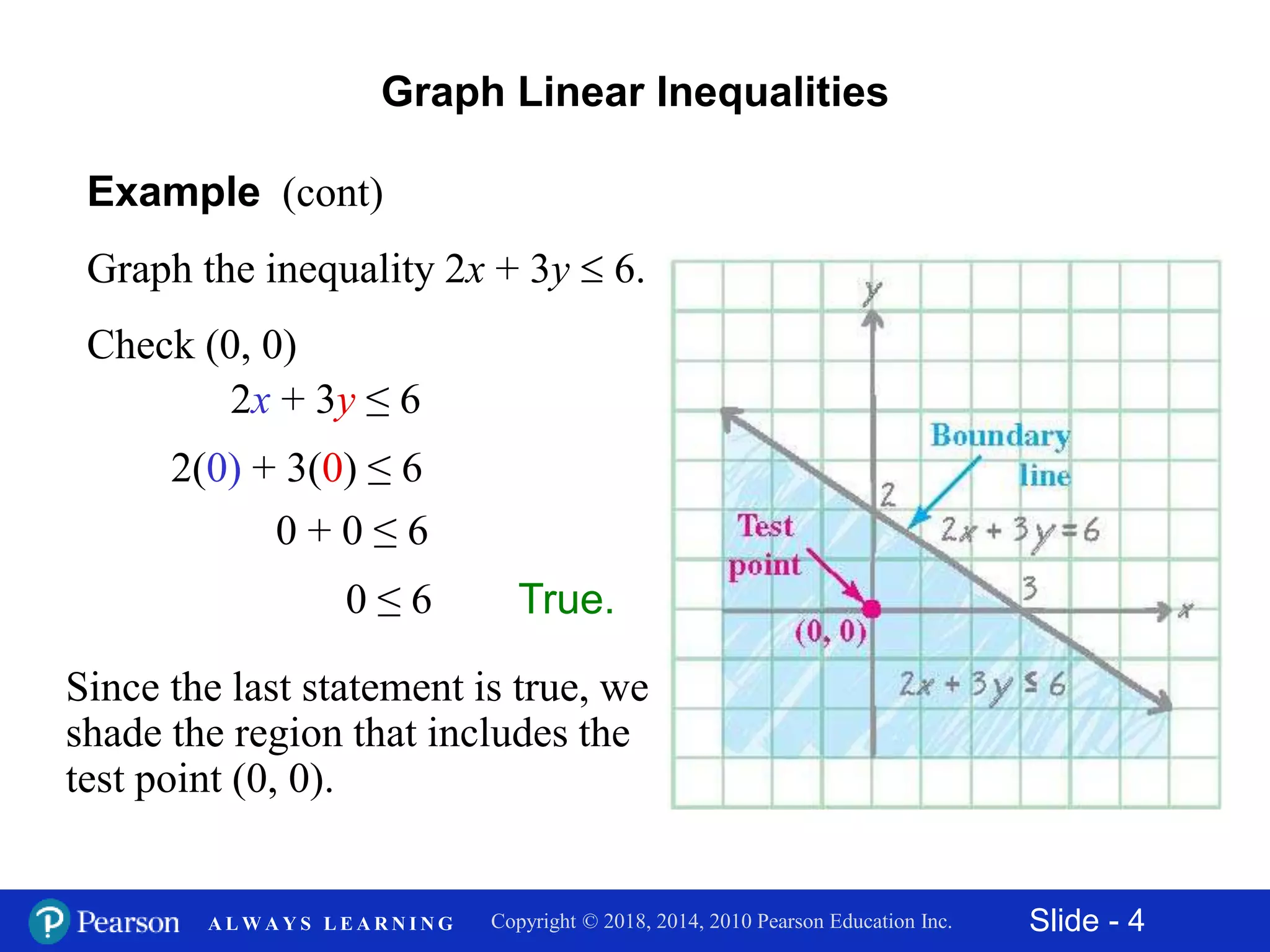
2x + 3y ≤ 6
2(0) + 3(0) ≤ 6
0 ≤ 6 True.
0 + 0 ≤ 6
Example (cont)
Graph the inequality 2x + 3y  6.
Check (0, 0)
Since the last statement is true, we
shade the region that includes the
test point (0, 0).
Slide - 5Copyright © 2018, 2014, 2010 Pearson Education Inc.A L W A Y S L E A R N I N G
Graphing Linear Inequalities
Graphing a Linear Inequality
Step 1 Graph the boundary. Graph the line that is
the boundary of the region. Draw a solid line if
the inequality has ≤ or ≥; draw a dashed line if
the inequality has < or >.
Step 2 Shade the appropriate side. Use any point
not on the line as a test point. Substitute for x
and y in the inequality. If a true statement
results, shade the side containing the test
point. If a false statement results, shade the
other side.
Slide - 6Copyright © 2018, 2014, 2010 Pearson Education Inc.A L W A Y S L E A R N I N G
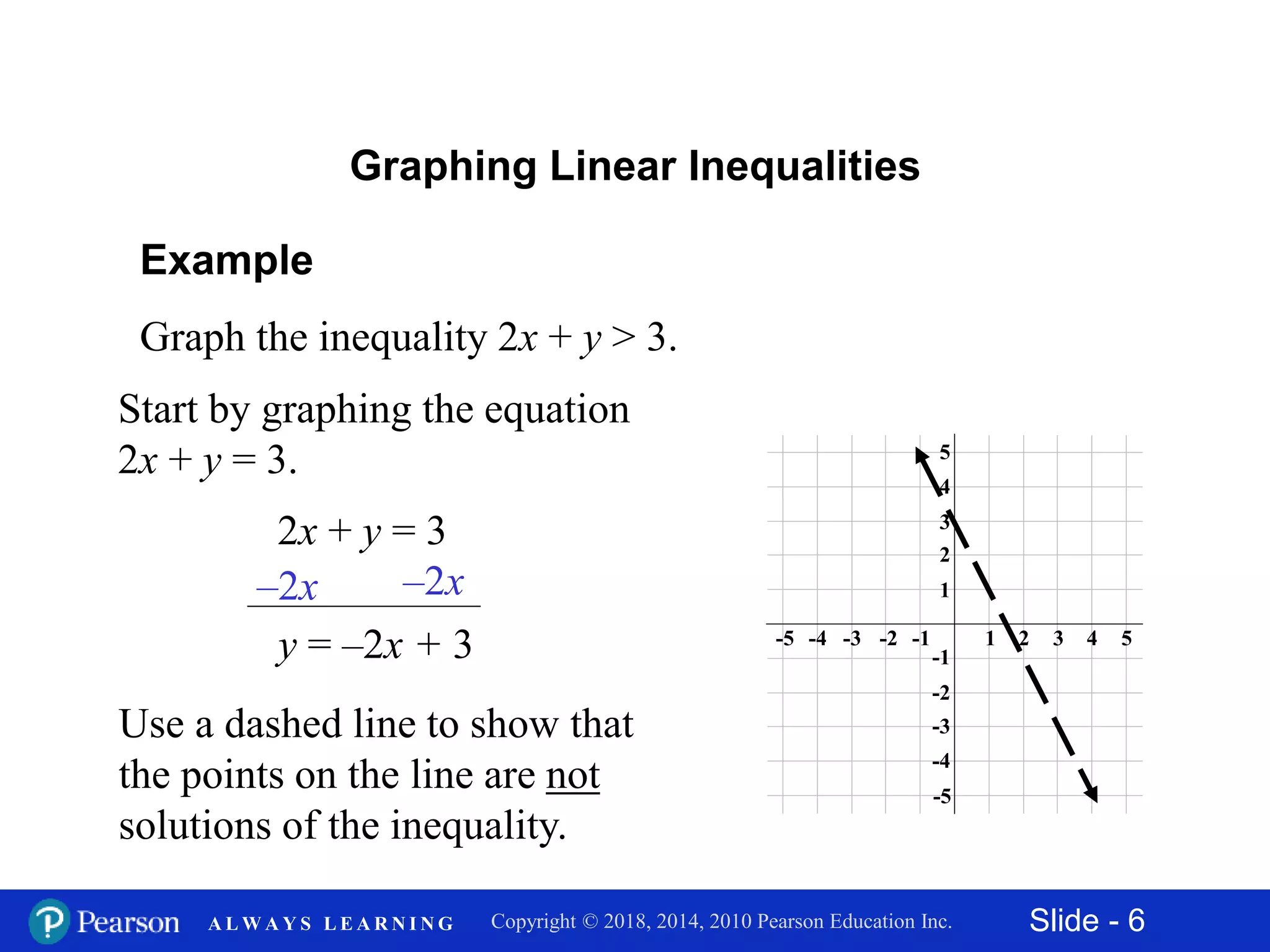
Example
Graph the inequality 2x + y > 3.
Start by graphing the equation
2x + y = 3.
Graphing Linear Inequalities
2x + y = 3
–2x –2x
y = –2x + 3
Use a dashed line to show that
the points on the line are not
solutions of the inequality.
-5
-3
-1
-4
-2
1
3
5
2
4
42-2-4 531-1-3-5
Slide - 7Copyright © 2018, 2014, 2010 Pearson Education Inc.A L W A Y S L E A R N I N G
Example (cont)
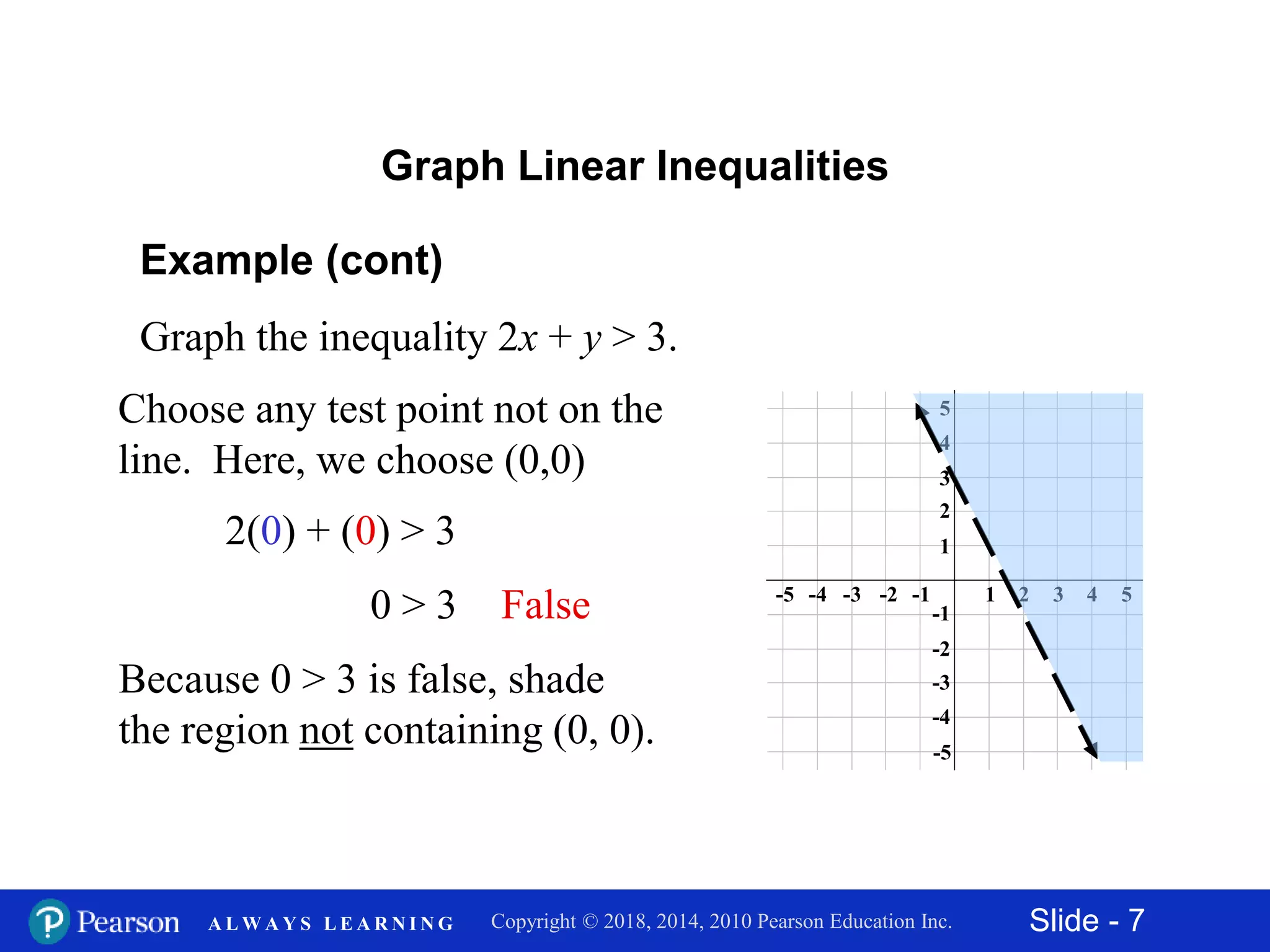
Graph the inequality 2x + y > 3.
Choose any test point not on the
line. Here, we choose (0,0)
Graph Linear Inequalities
2(0) + (0) > 3
0 > 3
Because 0 > 3 is false, shade
the region not containing (0, 0).
False
-5
-3
-1
-4
-2
1
3
5
2
4
42-2-4 531-1-3-5
Slide - 8Copyright © 2018, 2014, 2010 Pearson Education Inc.A L W A Y S L E A R N I N G
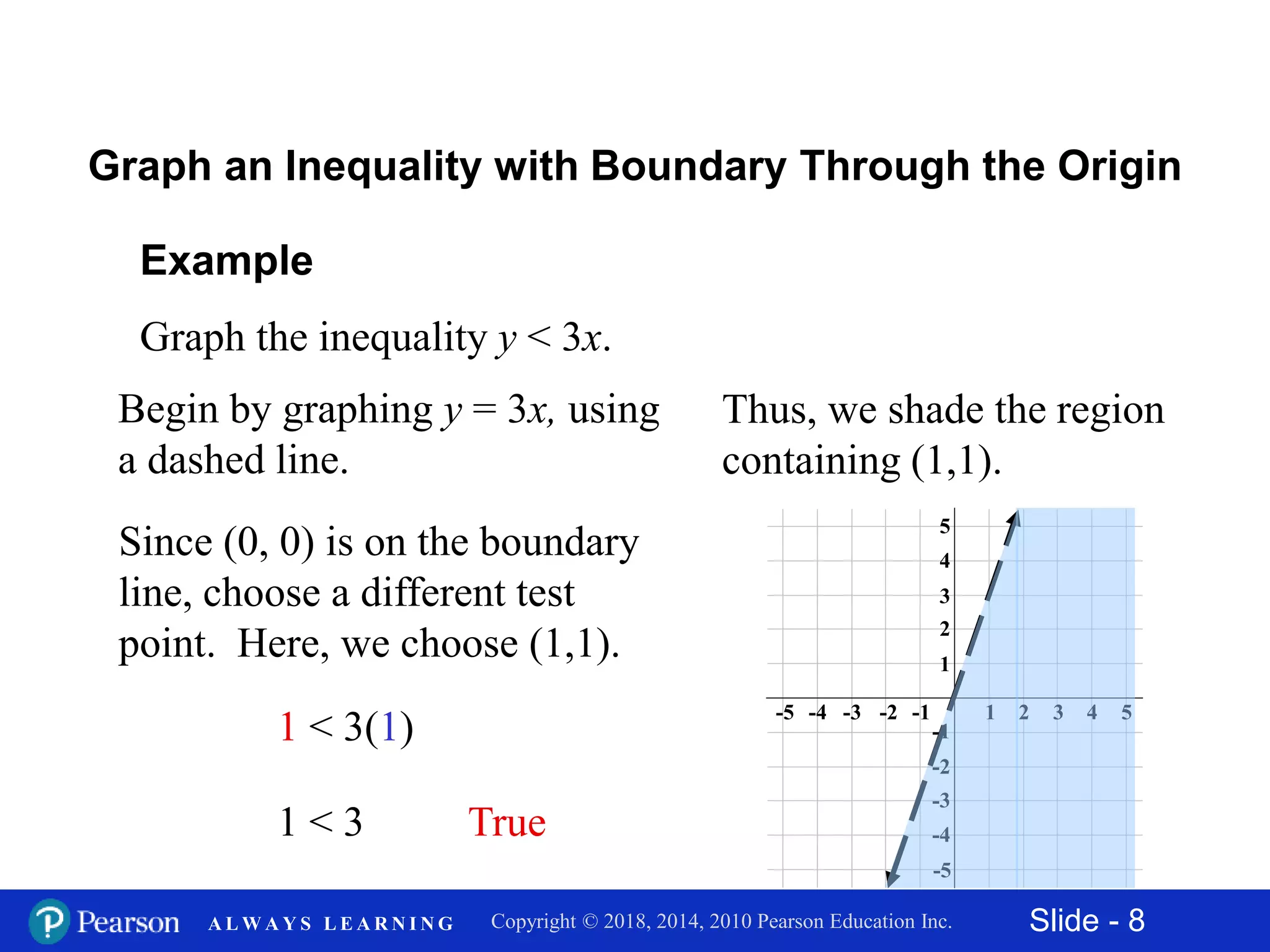
Example
Graph the inequality y < 3x.
Begin by graphing y = 3x, using
a dashed line.
Graph an Inequality with Boundary Through the Origin
-5
-3
-1
-4
-2
1
3
5
2
4
42-2-4 531-1-3-5
Since (0, 0) is on the boundary
line, choose a different test
point. Here, we choose (1,1).
1 < 3(1)
1 < 3 True
Thus, we shade the region
containing (1,1).

11.6 graphing linear inequalities in two variables

  • 1.
    Slide - 1Copyright© 2018, 2014, 2010 Pearson Education Inc.A L W A Y S L E A R N I N G 2 Graphs of Linear Equations and Inequalities in Two Variables 11
  • 2.
    Slide - 2Copyright© 2018, 2014, 2010 Pearson Education Inc.A L W A Y S L E A R N I N G 1. Graph linear inequalities in two variables. 2. Graph an inequality with boundary through the origin. Objectives 11.6 Graphing Linear Inequalities in Two Variables
  • 3.
    Slide - 3Copyright© 2018, 2014, 2010 Pearson Education Inc.A L W A Y S L E A R N I N G The inequality 2x + 3y ≤ 6 means that 2x + 3y < 6 or 2x + 3y = 6. The graph of 2x + 3y = 6 is a line. This boundary line divides the plane into two regions. The graph of the solutions of the inequality 2x + 3y < 6 will include only one of these regions. We find the required region by checking a test point. We choose any point not on the boundary line. Because (0, 0) is easy to substitute, we often use it. Graph Linear Inequalities Example Graph the inequality 2x + 3y  6.
  • 4.
    Slide - 4Copyright© 2018, 2014, 2010 Pearson Education Inc.A L W A Y S L E A R N I N G Graph Linear Inequalities 2x + 3y ≤ 6 2(0) + 3(0) ≤ 6 0 ≤ 6 True. 0 + 0 ≤ 6 Example (cont) Graph the inequality 2x + 3y  6. Check (0, 0) Since the last statement is true, we shade the region that includes the test point (0, 0).
  • 5.
    Slide - 5Copyright© 2018, 2014, 2010 Pearson Education Inc.A L W A Y S L E A R N I N G Graphing Linear Inequalities Graphing a Linear Inequality Step 1 Graph the boundary. Graph the line that is the boundary of the region. Draw a solid line if the inequality has ≤ or ≥; draw a dashed line if the inequality has < or >. Step 2 Shade the appropriate side. Use any point not on the line as a test point. Substitute for x and y in the inequality. If a true statement results, shade the side containing the test point. If a false statement results, shade the other side.
  • 6.
    Slide - 6Copyright© 2018, 2014, 2010 Pearson Education Inc.A L W A Y S L E A R N I N G Example Graph the inequality 2x + y > 3. Start by graphing the equation 2x + y = 3. Graphing Linear Inequalities 2x + y = 3 –2x –2x y = –2x + 3 Use a dashed line to show that the points on the line are not solutions of the inequality. -5 -3 -1 -4 -2 1 3 5 2 4 42-2-4 531-1-3-5
  • 7.
    Slide - 7Copyright© 2018, 2014, 2010 Pearson Education Inc.A L W A Y S L E A R N I N G Example (cont) Graph the inequality 2x + y > 3. Choose any test point not on the line. Here, we choose (0,0) Graph Linear Inequalities 2(0) + (0) > 3 0 > 3 Because 0 > 3 is false, shade the region not containing (0, 0). False -5 -3 -1 -4 -2 1 3 5 2 4 42-2-4 531-1-3-5
  • 8.
    Slide - 8Copyright© 2018, 2014, 2010 Pearson Education Inc.A L W A Y S L E A R N I N G Example Graph the inequality y < 3x. Begin by graphing y = 3x, using a dashed line. Graph an Inequality with Boundary Through the Origin -5 -3 -1 -4 -2 1 3 5 2 4 42-2-4 531-1-3-5 Since (0, 0) is on the boundary line, choose a different test point. Here, we choose (1,1). 1 < 3(1) 1 < 3 True Thus, we shade the region containing (1,1).