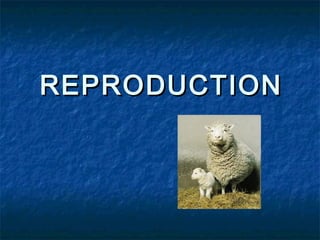
REPRODUCTION
WHAT IS REPRODUCTION?
It is the biological process by which new
individual organisms are produced.
There are two types of Reproduction:

   Asexual reproduction: requires only one
    parent which produces new living beings.
   Sexual reproduction: requires two parents,
    a male and a female.
ASEXUAL
REPRODUCTION IN
    ANIMALS
   It is common in unicellular organisms.
   There are two main types of asexual reproduction:

       Fragmentation → Division of the progenitor’s body
        in various fragments, creating new individuals
        (worms, starfish, fungi, plants…).

       Gemmation → Small buds appear on the body of
        the progenitor. These buds may separate from the
        parent and become a new individual, or remain
        joined and form a colony.
SEXUAL
REPRODUCTION IN
    ANIMALS
   Sexual reproduction in animals requires two members of
    the opposite sex, a male and a female.
   They have different reproductive organs called gonads.
   These organs make reproductive cells called gametes.

            MALE                       FEMALE
The male gonads are the The female gonads are the
testicles.              ovaries.
The male gamete is the The female gamete is the ovum
spermatozoon (small and (larger than spermatozoa, but
mobile).                they are immobile).
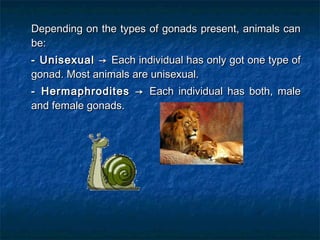
Depending on the types of gonads present, animals can
be:
- Unisexual → Each individual has only got one type of
gonad. Most animals are unisexual.
- Hermaphrodites → Each individual has both, male
and female gonads.
Some animals can produce both, sexually and asexually.
For example, jellyfish pass through two life phases
during their life cycle: asexual or polyp phase , and
sexual or medusa phase .
Fertilisation is the union of an ovum and a
spermatozoon. When the nuclei of the ovum and
spermatozoon unite, they form the first cell of the new
living being, called Zygote.


Types of Fertilisation:
- External fertilisation → is the union of the gametes
which occurs outside the female’s body. The female
releases the unfertilised eggs. Then the male releases
sperm to fertilise them. It is typical of aquatic animals,
some terrestrial amphibians, and insects.
- Internal fertilisation → it is the fusion of the gametes
which occurs inside the body of the female. It involves
copulation, the transmission of spermatozoa of the
male into the female reproductive system. It is typical of
most terrestrial animals, and some fish.
The embryonic development
   It includes the processes from the formation of the
    zygote to the birth of the new individual.

   Depending on where embryonic development takes
    place, animals can be classified as:

       Viviparous.
       Oviparous.
       Ovoviviparous.
Complete this chart using your book:


               Viviparous   Oviparous   Ovoviviparous

 Where does
  the embryo
   develop?
 Where does
  the embryo
     grow?
  How is the
 embryo fed?
 When does
 the embryo
develop end?
  Example
ASEXUAL
REPRODUCTION IN
     PLANTS
Asexual reproduction involves the formation of new
individuals from the cells of a single parent. There are
two main types of asexual reproduction in plants:

   Spore Formation → a cell from an individual divides
    repeatedly, forming various daugther cells, called
    spores . These individual cells create new plants.
   Vegetative Reproduction → plants create new
    individuals from a particular organ, mainly the stem.
    This occurs through stolons, bulbs, stem tubers
    and rhizomes.
SEXUAL REPRODUCTION
     IN PLANTS
   It is typical of plants with seeds.
   The reproductive part of the plant is the flower :
It has the following parts:

      Calyx: green sepals which protect the development
       of the flower.

      Corolla: coloured petals.

      Stamen: the male reproductive organ of the
       flower. It consists of a filament and sacks, anthers ,
       where pollen is stored.

      Pistil: the female reproductive organ          of the
       flower. It consists of one ovary , a style     and a
       stigma.
   Sexual reproduction in plants has various stages:

       POLLINATION → Pollen is transported from the
        stamens to the pistil. Wind and insects disperse the
        pollen.
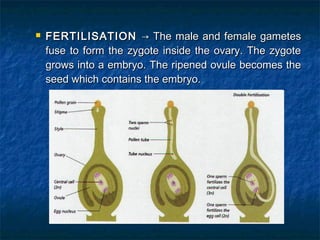
   FERTILISATION → The male and female gametes
    fuse to form the zygote inside the ovary. The zygote
    grows into a embryo. The ripened ovule becomes the
    seed which contains the embryo.
   FORMATION OF THE FRUIT                   → The       fruit
    originates from the ripened ovary. Its   function   is to
    protect and disperse the seed.

Reproduction

  • 1.
  • 2.
    WHAT IS REPRODUCTION? Itis the biological process by which new individual organisms are produced. There are two types of Reproduction:  Asexual reproduction: requires only one parent which produces new living beings.  Sexual reproduction: requires two parents, a male and a female.
  • 4.
  • 5.
    It is common in unicellular organisms.  There are two main types of asexual reproduction:  Fragmentation → Division of the progenitor’s body in various fragments, creating new individuals (worms, starfish, fungi, plants…).  Gemmation → Small buds appear on the body of the progenitor. These buds may separate from the parent and become a new individual, or remain joined and form a colony.
  • 7.
  • 8.
    Sexual reproduction in animals requires two members of the opposite sex, a male and a female.  They have different reproductive organs called gonads.  These organs make reproductive cells called gametes. MALE FEMALE The male gonads are the The female gonads are the testicles. ovaries. The male gamete is the The female gamete is the ovum spermatozoon (small and (larger than spermatozoa, but mobile). they are immobile).
  • 9.
    Depending on thetypes of gonads present, animals can be: - Unisexual → Each individual has only got one type of gonad. Most animals are unisexual. - Hermaphrodites → Each individual has both, male and female gonads.
  • 10.
    Some animals canproduce both, sexually and asexually. For example, jellyfish pass through two life phases during their life cycle: asexual or polyp phase , and sexual or medusa phase .
  • 11.
    Fertilisation is theunion of an ovum and a spermatozoon. When the nuclei of the ovum and spermatozoon unite, they form the first cell of the new living being, called Zygote. Types of Fertilisation:
  • 12.
    - External fertilisation→ is the union of the gametes which occurs outside the female’s body. The female releases the unfertilised eggs. Then the male releases sperm to fertilise them. It is typical of aquatic animals, some terrestrial amphibians, and insects.
  • 13.
    - Internal fertilisation→ it is the fusion of the gametes which occurs inside the body of the female. It involves copulation, the transmission of spermatozoa of the male into the female reproductive system. It is typical of most terrestrial animals, and some fish.
  • 14.
    The embryonic development  It includes the processes from the formation of the zygote to the birth of the new individual.  Depending on where embryonic development takes place, animals can be classified as:  Viviparous.  Oviparous.  Ovoviviparous.
  • 16.
    Complete this chartusing your book: Viviparous Oviparous Ovoviviparous Where does the embryo develop? Where does the embryo grow? How is the embryo fed? When does the embryo develop end? Example
  • 17.
  • 18.
    Asexual reproduction involvesthe formation of new individuals from the cells of a single parent. There are two main types of asexual reproduction in plants:  Spore Formation → a cell from an individual divides repeatedly, forming various daugther cells, called spores . These individual cells create new plants.
  • 19.
    Vegetative Reproduction → plants create new individuals from a particular organ, mainly the stem. This occurs through stolons, bulbs, stem tubers and rhizomes.
  • 20.
  • 21.
    It is typical of plants with seeds.  The reproductive part of the plant is the flower :
  • 22.
    It has thefollowing parts:  Calyx: green sepals which protect the development of the flower.  Corolla: coloured petals.  Stamen: the male reproductive organ of the flower. It consists of a filament and sacks, anthers , where pollen is stored.  Pistil: the female reproductive organ of the flower. It consists of one ovary , a style and a stigma.
  • 23.
    Sexual reproduction in plants has various stages:  POLLINATION → Pollen is transported from the stamens to the pistil. Wind and insects disperse the pollen.
  • 24.
    FERTILISATION → The male and female gametes fuse to form the zygote inside the ovary. The zygote grows into a embryo. The ripened ovule becomes the seed which contains the embryo.
  • 25.
    FORMATION OF THE FRUIT → The fruit originates from the ripened ovary. Its function is to protect and disperse the seed.