ANIMAL
REPRODCUTION
KIP AIZA F. GABAWA, MAED - SCIENCE
Pre - test
1. What type of reproduction involves the fusion of gametes or sex cells?
a. Sexual b. Asexual c. both A & B d. None of the above
2. What type of reproduction produces an offspring which genetically
identical to its parent cell?
a. Sexual b. Asexual c. both A & B d. None of the above
3. Sexual reproduction leads to _____ in organisms?
a. Similarities b. variation c. duplication c. resemblanc
4. What is the ideal duration of pregnancy among humans?
a. 32 weeks b. 34 weeks c. 36 weeks d. 38 week
5.
2/13/2023 2
ANIMAL
REPRODUCTIO
N
BY: KIP AIZA F. GABAWA,
MAED-SCIE
WHAT IS
REPRODUCTIO
N?
Is one of the key
survivals of a
species – it is a
way to continue
life
The male and
female
organisms will
mate and
produce
offspring.
WAYS OF HOW
REPRESENTATI
VE ANIMALS
REPRODUCE
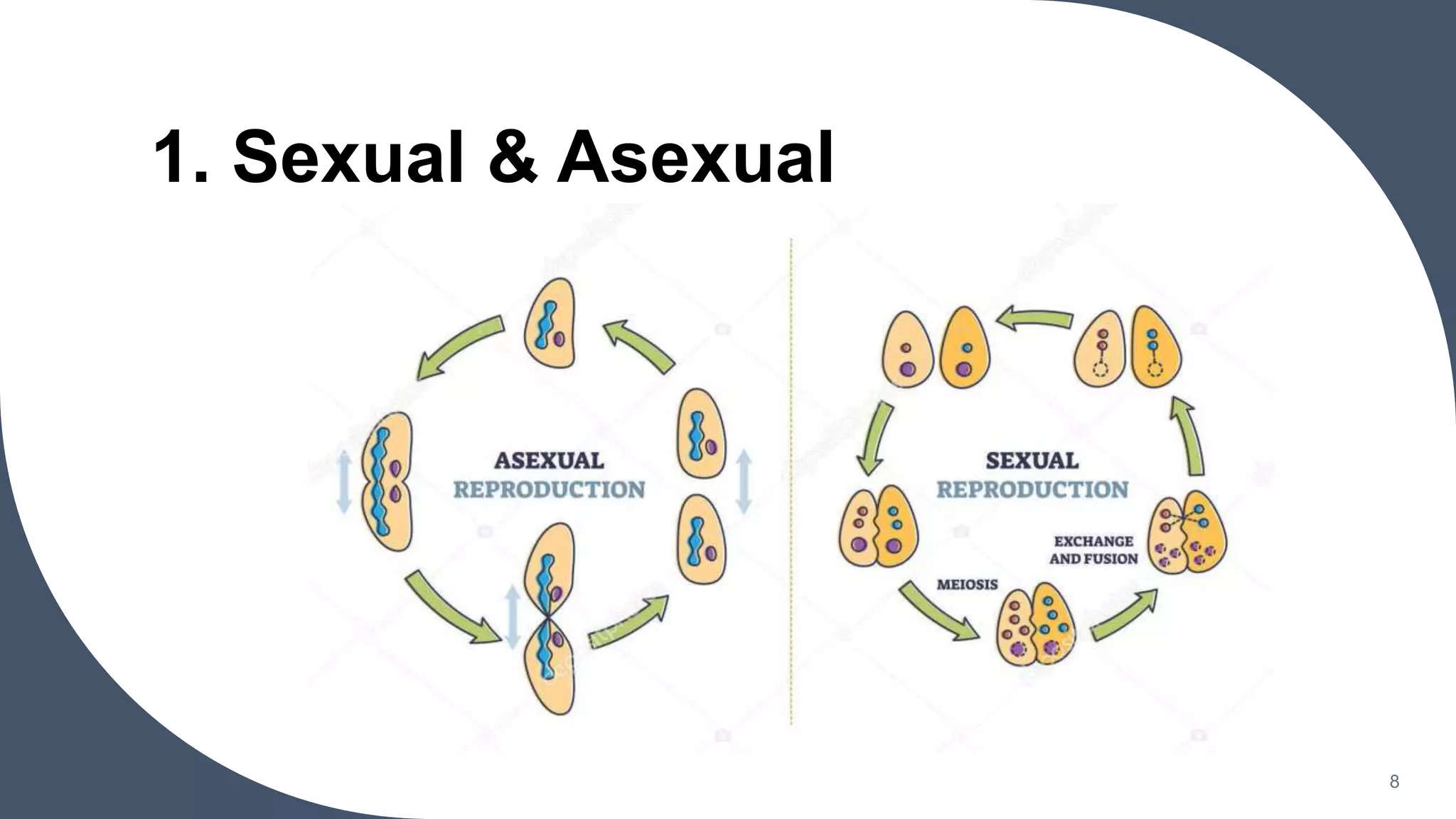
1. Sexual & Asexual
8
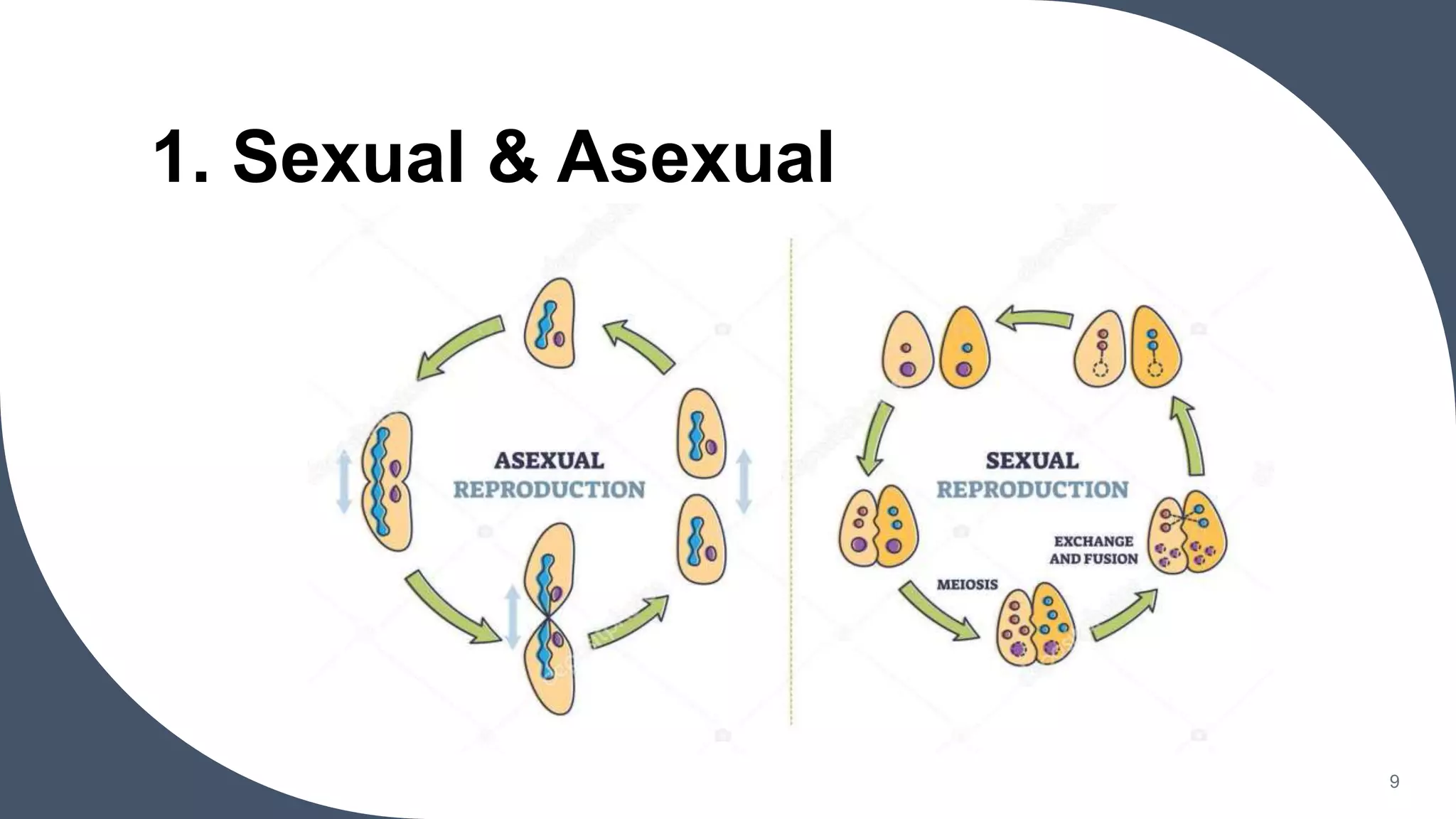
1. Sexual & Asexual
9
Sexual reproduction
2/13/2023 ANIMAL REPRODUCTION 10
In sexual reproduction, a male and female
gamete is needed to produce the offspring. In
most instances, there is male and female
organisms to produce the gametes but, this
isn’t always the case. Finding a partner for
sexual animals can sometimes prove difficult,
and so, an adaptive mechanism and
evolutionary solution, some animal exhibit
HERMAPHRODITISM.
2/13/2023 ANIMAL REPRODUCTION 11
HERMAPHRODITISM this is when an
organism has both the male and female
reproductive systems. This common
among sessile (stationary animals). In
hermaphroditism, the organism may or
may not have a partner for fertilization to
occur.
Asexual reproduction
2/13/2023 ANIMAL REPRODUCTION 12
Asexual reproduction is a mode of reproduction
in which a new offspring is produced by a single
parent. The new individuals produced are genetically
and physically identical to each other, i.e., they are
the clones of their parents.
Asexual reproduction is observed in both
multicellular and unicellular organisms. This process
does not involve any kind of gamete fusion and there
won’t be any change in the number of chromosomes
either. It will inherit the same genes as the parent,
except for some cases where there is a chance of a
rare mutation occurring.
TYPES OF
ASEXUAL
REPRODUCTION
2/13/2023 ANIMAL REPRODUCTION 13
1. BINARY FISSION
2/13/2023 ANIMAL REPRODUCTION 14
occurs in single-
celled organisms. It
is when a parent cell
divides itself into two
equal parts and
creates offspring.
This type of
reproduction is like
cloning
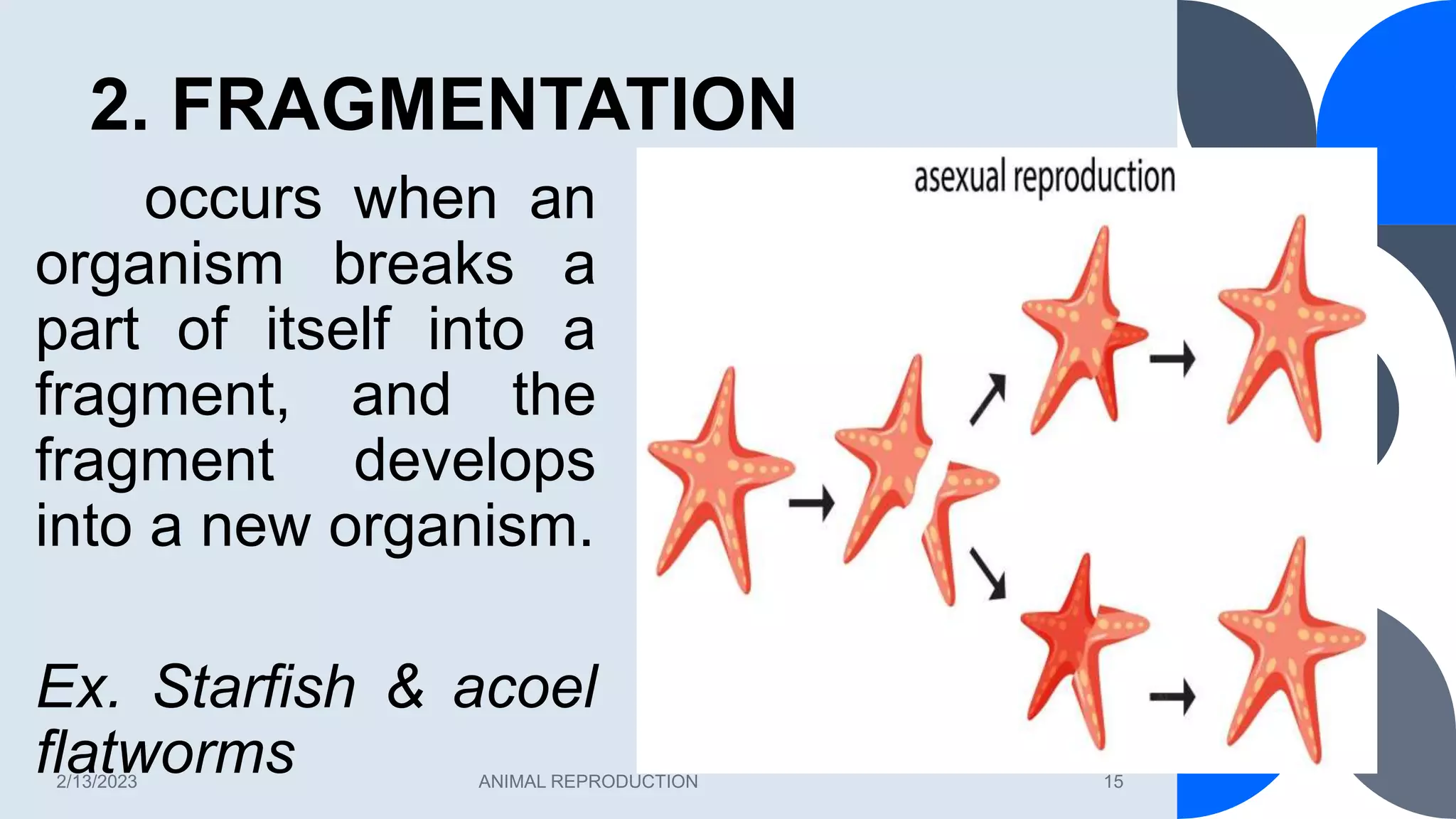
2. FRAGMENTATION
2/13/2023 ANIMAL REPRODUCTION 15
occurs when an
organism breaks a
part of itself into a
fragment, and the
fragment develops
into a new organism.
Ex. Starfish & acoel
flatworms
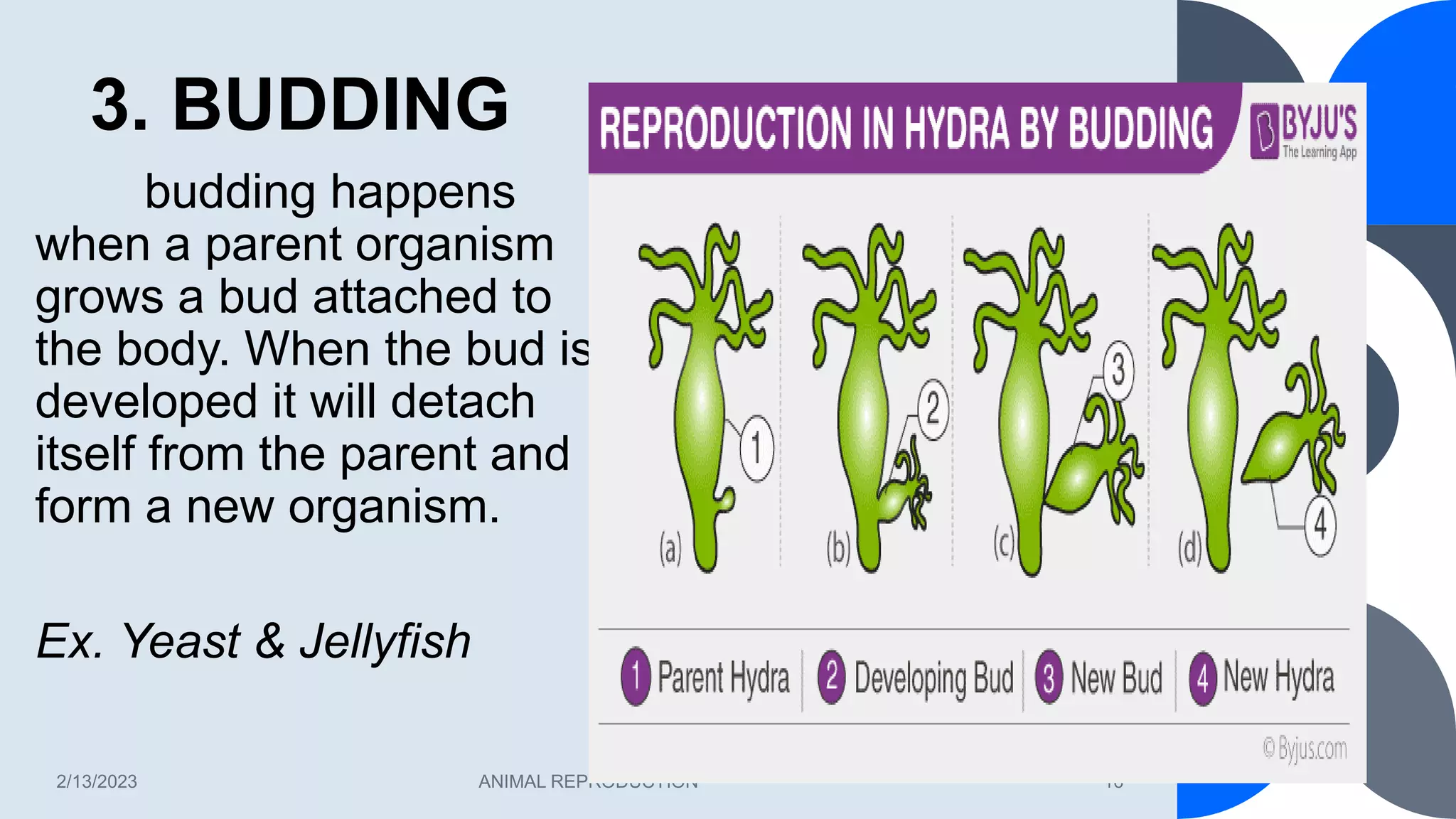
3. BUDDING
2/13/2023 ANIMAL REPRODUCTION 16
budding happens
when a parent organism
grows a bud attached to
the body. When the bud is
developed it will detach
itself from the parent and
form a new organism.
Ex. Yeast & Jellyfish
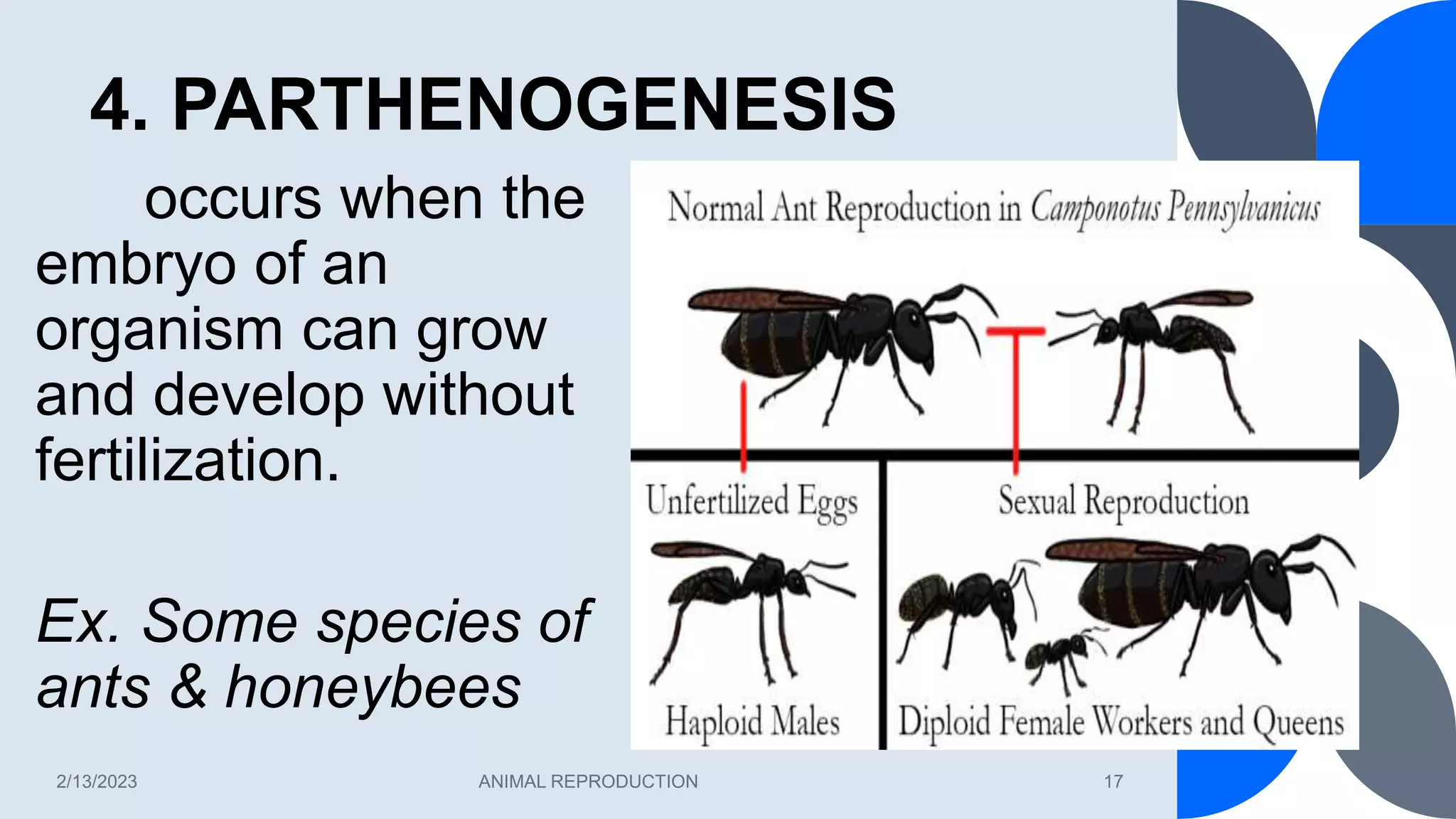
4. PARTHENOGENESIS
2/13/2023 ANIMAL REPRODUCTION 17
occurs when the
embryo of an
organism can grow
and develop without
fertilization.
Ex. Some species of
ants & honeybees
MECHANICS OF
FERTILIZATION
2/13/2023 ANIMAL REPRODUCTION 18
MECHANICS OF
FERTILIZATION
2/13/2023 ANIMAL REPRODUCTION 19
2 TYPES OF
FERTILIZATION
1. INTERNAL
FERTILIZATION
2/13/2023 ANIMAL REPRODUCTION 21
occurs when the fusion of gametes is inside
the female body.
2. EXTERNAL
FERTILIZATION
occurs when the fusion of gametes is outside
the female body.
3 TYPES OF
INTERNAL
FERTILIZATION
1. OVIPARITY
2/13/2023 ANIMAL REPRODUCTION 23
the female has
fertilized eggs laid outside
its body. The young will
get nourishment from its
yolk and will be protected
by the external covering
of the egg.
Ex. chickens
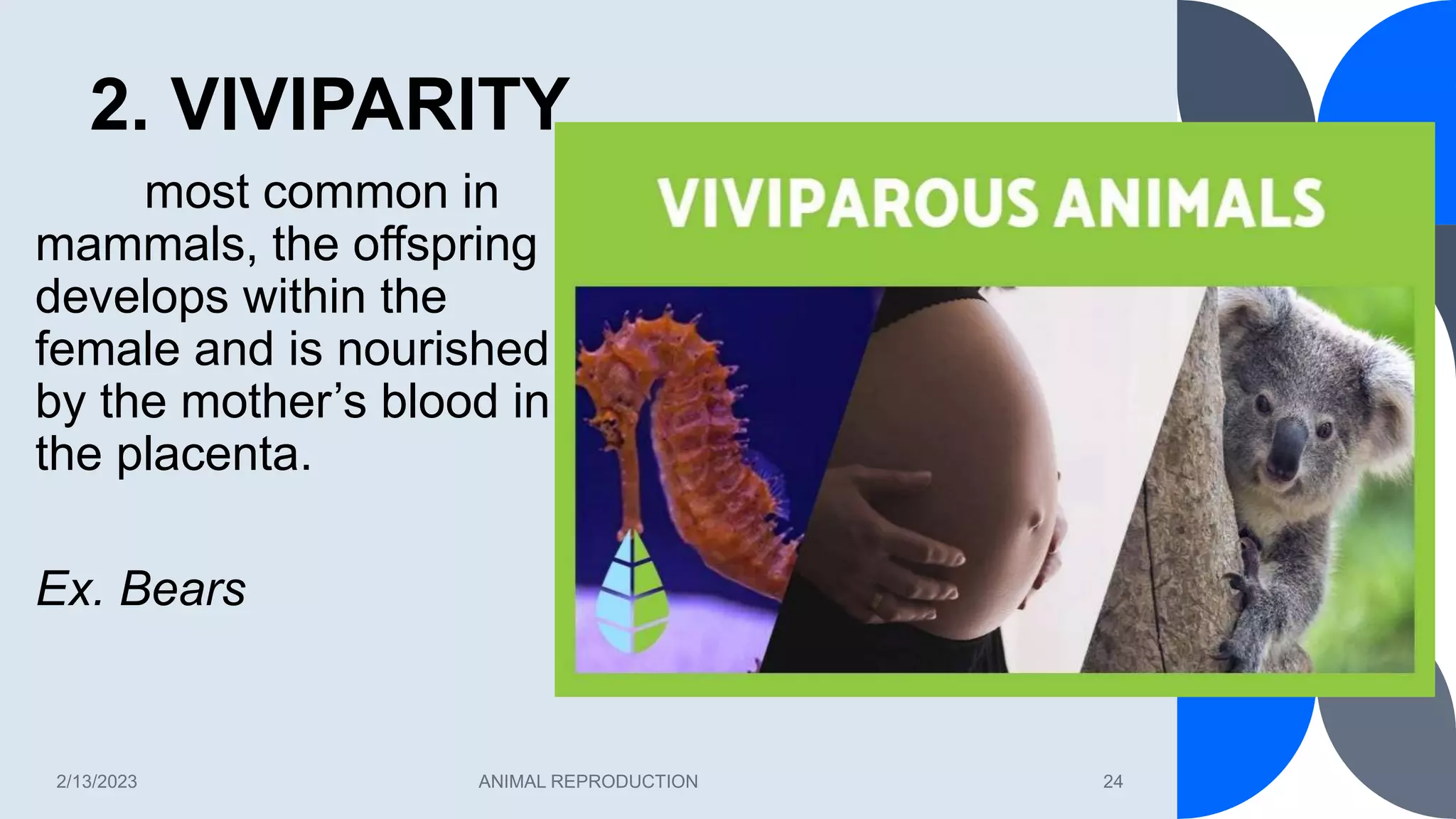
2. VIVIPARITY
2/13/2023 ANIMAL REPRODUCTION 24
most common in
mammals, the offspring
develops within the
female and is nourished
by the mother’s blood in
the placenta.
Ex. Bears
3. OVOVIVIPARITY
2/13/2023 ANIMAL REPRODUCTION 25
like oviparity,
ovoviviparity has fertilized
eggs that nourished the
young from its yolk. The
key difference between
them is when the
ovoviviparous animals
only lay the eggs when
they are ready to hatch.
Ex. Great Whale Sharks
PLANT
REPRODUCTION
THESE PARTS PRODUCE SEX CELLS OR
GAMETES IN THE FORM OF OVULES
AND POLLEN GRAINS. THESE ARE THE
REPRODUCTIVE PARTS OF THE PLANTS:
FLOWER
IN FLOWERING PLANTS, SEX CELLS ARE
PRODUCED IN CERTAIN FLORAL ORGANS.
Peduncle: The stalk of a flower.
Receptacle: The part of a flower stalk where the parts of the flower are
attached.
Sepal: The outer parts of the flower (often green and leaf-like) that
enclose a developing bud.
Petal: The parts of a flower that are often conspicuously colored. Stamen:
The pollen producing part of a flower, usually with a slender filament
supporting the anther.
Anther: The part of the stamen where pollen is produced.
Pistil: The ovule producing part of a flower. The ovary often supports a long
style, topped by a stigma. The mature ovary is a fruit, and the mature ovule
is a seed.
Stigma: The part of the pistil where pollen germinates.
Ovary: The enlarged basal portion of the pistil where ovules are
produced.
THE MALE REPRODUCTIVE
ORGAN IS CALLED THE STAMEN
WHICH HAS TWO PARTS: THE
ANTHER (PRODUCES THE
POLLEN, WHICH CONTAINS THE
MALE SPERM CELLS) AND THE
FILAMENT (THAT HOLDS OR
SUPPORTS THE ANTHER)
THE FEMALE REPRODUCTIVE
ORGAN IS PISTIL. THE OVULES
ARE EQUIVALENT TO THE
POLLEN GRAINS OF THE MALE
REPRODUCTIVE ORGAN.
OTHER PARTS OF PISTIL
(STIGMA, STYLE, OVARY AND
THE OVULE)
TYPES OF REPRODUCTION IN PLANTS
SELF-FERTILIZATION/SELF-POLLINATION OCCURS IN
bisexual organisms, including most flowering plants,
numerous protozoans, and many invertebrates. the mechanism
is observed
most often in some legumes such as peanuts.in other
legumes like soybeans, the flowers open and remain receptive
to insect cross pollination during the day; if this not
accomplished, the flower may self-pollinated as they are
closing. other plants that can self-pollinated are orchids, peas,
sunflowers, tridax, etc.
CROSS-FERTILIZATION
occur between members of the same species, for
example, it is impossible to create a hybrid of a cucumber and a
zucchini as they separate species with in the same family,
however,it would be possible to cross a zucchini with another
squash, like pumpkin as they belong to the same species. cross-
fertilization on plants where the insects are the agents (apples,
plums, pears, raspberries,blackberries, blackcurrants,
strawberries, runner beans, pumpkins, daffodils, tulips, heather,
lavender, and etc. cross-fertilization on plants where wind is the
main agent(grass,catkins, dandelions, maple trees, and goat’s
beard)
ASEXUAL REPRODUCTION
a single individual (parent) is capable of
producing offspring, as a result, the offspring that
are produced are not only identical to one
another but are also exact copies of their parent.
all these methods of reproduction work well.
however, they do not make it possible for plants
to move to new locations.in addition to
reproducing asexually, most land plants also
reproduce sexually.
A)BINARY FISSION (“DIVISION IN HALF”)
IS A KIND OF ASEXUAL REPRODUCTION.ANOTHER TYPE OF FISSION IS
MULTIPLE FISSION,WHICH IS ADVANTAGEOUS TO THE PLANT LIFE
CYCLE.MULTIPLE FISSION,AT THE CELLULAR LEVEL OF OCCURS IN MANY
PROTIST.
B)BUDDING
INVOLVES THE GROWTH OF A SMALL BULB-LIKE PROJECTION CALLED
BUD.IT GROWS AND DETACHES ITSELF FROM THE PARENT CELL TO
GROW INDEPENDENTLY INTO A NEW ORGANISM.
C)FRAGMENTATION
INVOLVES BREAKING DOWN OF FILAMENTS INTO FRAGMENTS THAT
GROW IN TO YOUNG ONES.
D) ARTIFICIAL VEGETATIVE PROPAGATION
THE PROCESS OF PROPAGATING PLANTS THROUGH ARTIFICIAL METHODS IS
CALLED ARTIFICIAL PROPAGATION.THE DIFFERENT METHODS OF ARTIFICIAL PROPAGATION
ARE GRAFTING,CUTTING,LAYERING, AND TISSUE CULTURE
I. GRAFTING
THE METHOD WHICH INVOLVES DEVELOPMENT OF NEW VARETIES OF FRUIT
PLANTS.
II.CUTTING
INVOLVES PLANTING A YOUNG CUTTING OF THE STEM WITH BUDS INTO MOIST
SOIL.
III.LAYERING
INVOLVES BENDING OF A YOUNG STEM TOWARDS THE
GROUND AND LET IT GROW UNDER THE SOIL.
IV.TISSUES CULTURE
A MASS OF TISSUE IS SELECTED FROM THE GROWING TIP OF PLANT. THIS IS
TERMED AS CALLUS
E) NATURAL VEGETATIVE REPRODUCTION
ASEXUAL REPRODUCTION IS ALSO USED IN AGGRICULTURE AND
HORTICULTURE TO PROPAGATE A PARTICULARLY DESIRABLE PLANT. MOST
ROSES AND POTATOES,ARE VEGETATIVELY PROPAGATED.
1)STOLONS
ARE STEMS WHICH GROW AT THE SOIL SURFACE OR JUST BELOW GROUND
THAT FORM ADVENTITIOUS ROOTS AT THE NODES, AND NEW PLANTS FROM THE
BUDS.
2)RHIZOMES
ARE ALSO IMPORTANT REPRODUCTIVE SRUCTURES, PARTICULARLY IN GRASS
AND SEDGES.IT INVADE AREAS NEAR THE PARENT PLANT, AND EACH NODE CAN GIVE
RISE TO A NEW FLOWERING SHOT.
3)SUCKERS
IS A PLANT GROWING NOT FROM A SEED BUT FROM
A MERISTEM OF THE ROOT AT THE BASE ORAT A CERTAIN DISTANCE FROM A TREE OR
SHRUB.
4)ADVENTITIOUS LEAVES
ADVENTITIOUS BUDS DEVELOP FROM PLACES OTHER THAN A SHOOT APICAL MERISTEM,
WHICH OCCURS AT THE TIP OF A STEM, OR ON A SHOOT NODE, AT THE LEAF AXIL, THE BUD BEING LEFT
THERE DURING THE PRIMARY GROWTH.
5)APOMIXIS
AS REPLACEMENT OF THE NORMAL SEXUAL REPRODUCTION BY ASEXUAL REPRODUCTION,
WITHOUT FERTILIZATION.
F) SEXUAL REPRODUCTION
INVOLVES TWO FUNDAMENTAL PROCESSES: MEIOSIS, WHICH REARRANGES THE GENES
AND REDUCES THE NUMBER OF CHROMOSOMES, AND FERTILIZATION, WHICH RESTORES THE
CHROMOSOME TO A COMPLETE DIPLOID NUMBER. IN BETWEEN THESE TWO PROCESSES,
DIFFERENT TYPES OF PLANTS AND ALGAE VARY, BUT MANY OF THEM, INCLUDING ALL LAND PLANTS,
UNDERGO ALTERNATION OF GENERATIONS, WITH TWO DIFFERENT MULTICELLULAR STRUCTURES
(PHASES), A GAMETOPHYTE AND A SPOROPHYTE.
I.CONIFEROUS TREES
A GROUP OF PLANTS CALLED GYMNOSPERM DEVELOPED WIND BORNE POLLEN LIKE THE
CYCADS, GINKOS AND NEEDLE-BEARING TREES SUCH AS PINES AND REDWOODS.
II.THE DEVELOPMENT OF FLOWER
A NEW GROUP OF PLANTS, THE ANGIOSPERMS,APPEARED ABOUT 110 MILLION YEARS
AGO. THESE PLANTS DEVELOPED A NUMBER OF STRUCTURAL INNOVATIONS, THE MOST STRIKING OF
WHICH IS THE FLOWER.
ORGANS OF PLANTS
THE ORGANS OF PLANTS ARE DIVIDED INTO VEGETATIVE AND REPRODUCTIVE
.THE VEGETATIVE ORAGANS ARE THE LEAVES, STEM, AND ROOTS. THE LEAVES
TAKE CARE FOR FOOD MANUFACTURE AND TRANSPIRATION. THE STEM
SUPPORTS THE LEAVE AND PARTS OF THE PLANT. THE ROOTS ABSORB WATER
AND MINERALS AND ANCHOR THE PLANT TO THE SOIL.THE REPRODUCTIVE
ORGANS ARE RESPONSIBLE FOR THE PERPETUATION OF THE PLANT. THESE
ARE THE FLOWERS, FRUIT AND SEEDS.
I. FLOWER HAS TREE MAIN ORAGANS,NAMELY: ESSENTIAL ORGANS
WHICH FUNCTION FOR ATTRACTION;AND THE
ACCESSORY ORGANS WHICH PERFORM FUNCTIONS LIKE SUPPORT AND
PROTECTION
Thank you

ANIMAL REPRODUCTION.pptx

  • 1.
    ANIMAL REPRODCUTION KIP AIZA F.GABAWA, MAED - SCIENCE
  • 2.
    Pre - test 1.What type of reproduction involves the fusion of gametes or sex cells? a. Sexual b. Asexual c. both A & B d. None of the above 2. What type of reproduction produces an offspring which genetically identical to its parent cell? a. Sexual b. Asexual c. both A & B d. None of the above 3. Sexual reproduction leads to _____ in organisms? a. Similarities b. variation c. duplication c. resemblanc 4. What is the ideal duration of pregnancy among humans? a. 32 weeks b. 34 weeks c. 36 weeks d. 38 week 5. 2/13/2023 2
  • 3.
  • 4.
  • 5.
    Is one ofthe key survivals of a species – it is a way to continue life
  • 6.
    The male and female organismswill mate and produce offspring.
  • 7.
    WAYS OF HOW REPRESENTATI VEANIMALS REPRODUCE
  • 8.
    1. Sexual &Asexual 8
  • 9.
    1. Sexual &Asexual 9
  • 10.
    Sexual reproduction 2/13/2023 ANIMALREPRODUCTION 10 In sexual reproduction, a male and female gamete is needed to produce the offspring. In most instances, there is male and female organisms to produce the gametes but, this isn’t always the case. Finding a partner for sexual animals can sometimes prove difficult, and so, an adaptive mechanism and evolutionary solution, some animal exhibit HERMAPHRODITISM.
  • 11.
    2/13/2023 ANIMAL REPRODUCTION11 HERMAPHRODITISM this is when an organism has both the male and female reproductive systems. This common among sessile (stationary animals). In hermaphroditism, the organism may or may not have a partner for fertilization to occur.
  • 12.
    Asexual reproduction 2/13/2023 ANIMALREPRODUCTION 12 Asexual reproduction is a mode of reproduction in which a new offspring is produced by a single parent. The new individuals produced are genetically and physically identical to each other, i.e., they are the clones of their parents. Asexual reproduction is observed in both multicellular and unicellular organisms. This process does not involve any kind of gamete fusion and there won’t be any change in the number of chromosomes either. It will inherit the same genes as the parent, except for some cases where there is a chance of a rare mutation occurring.
  • 13.
  • 14.
    1. BINARY FISSION 2/13/2023ANIMAL REPRODUCTION 14 occurs in single- celled organisms. It is when a parent cell divides itself into two equal parts and creates offspring. This type of reproduction is like cloning
  • 15.
    2. FRAGMENTATION 2/13/2023 ANIMALREPRODUCTION 15 occurs when an organism breaks a part of itself into a fragment, and the fragment develops into a new organism. Ex. Starfish & acoel flatworms
  • 16.
    3. BUDDING 2/13/2023 ANIMALREPRODUCTION 16 budding happens when a parent organism grows a bud attached to the body. When the bud is developed it will detach itself from the parent and form a new organism. Ex. Yeast & Jellyfish
  • 17.
    4. PARTHENOGENESIS 2/13/2023 ANIMALREPRODUCTION 17 occurs when the embryo of an organism can grow and develop without fertilization. Ex. Some species of ants & honeybees
  • 18.
  • 19.
  • 20.
  • 21.
    1. INTERNAL FERTILIZATION 2/13/2023 ANIMALREPRODUCTION 21 occurs when the fusion of gametes is inside the female body. 2. EXTERNAL FERTILIZATION occurs when the fusion of gametes is outside the female body.
  • 22.
  • 23.
    1. OVIPARITY 2/13/2023 ANIMALREPRODUCTION 23 the female has fertilized eggs laid outside its body. The young will get nourishment from its yolk and will be protected by the external covering of the egg. Ex. chickens
  • 24.
    2. VIVIPARITY 2/13/2023 ANIMALREPRODUCTION 24 most common in mammals, the offspring develops within the female and is nourished by the mother’s blood in the placenta. Ex. Bears
  • 25.
    3. OVOVIVIPARITY 2/13/2023 ANIMALREPRODUCTION 25 like oviparity, ovoviviparity has fertilized eggs that nourished the young from its yolk. The key difference between them is when the ovoviviparous animals only lay the eggs when they are ready to hatch. Ex. Great Whale Sharks
  • 26.
  • 27.
    THESE PARTS PRODUCESEX CELLS OR GAMETES IN THE FORM OF OVULES AND POLLEN GRAINS. THESE ARE THE REPRODUCTIVE PARTS OF THE PLANTS:
  • 28.
    FLOWER IN FLOWERING PLANTS,SEX CELLS ARE PRODUCED IN CERTAIN FLORAL ORGANS.
  • 30.
    Peduncle: The stalkof a flower. Receptacle: The part of a flower stalk where the parts of the flower are attached. Sepal: The outer parts of the flower (often green and leaf-like) that enclose a developing bud. Petal: The parts of a flower that are often conspicuously colored. Stamen: The pollen producing part of a flower, usually with a slender filament supporting the anther. Anther: The part of the stamen where pollen is produced. Pistil: The ovule producing part of a flower. The ovary often supports a long style, topped by a stigma. The mature ovary is a fruit, and the mature ovule is a seed. Stigma: The part of the pistil where pollen germinates. Ovary: The enlarged basal portion of the pistil where ovules are produced.
  • 31.
    THE MALE REPRODUCTIVE ORGANIS CALLED THE STAMEN WHICH HAS TWO PARTS: THE ANTHER (PRODUCES THE POLLEN, WHICH CONTAINS THE MALE SPERM CELLS) AND THE FILAMENT (THAT HOLDS OR SUPPORTS THE ANTHER)
  • 32.
    THE FEMALE REPRODUCTIVE ORGANIS PISTIL. THE OVULES ARE EQUIVALENT TO THE POLLEN GRAINS OF THE MALE REPRODUCTIVE ORGAN. OTHER PARTS OF PISTIL (STIGMA, STYLE, OVARY AND THE OVULE)
  • 33.
    TYPES OF REPRODUCTIONIN PLANTS SELF-FERTILIZATION/SELF-POLLINATION OCCURS IN bisexual organisms, including most flowering plants, numerous protozoans, and many invertebrates. the mechanism is observed most often in some legumes such as peanuts.in other legumes like soybeans, the flowers open and remain receptive to insect cross pollination during the day; if this not accomplished, the flower may self-pollinated as they are closing. other plants that can self-pollinated are orchids, peas, sunflowers, tridax, etc.
  • 35.
    CROSS-FERTILIZATION occur between membersof the same species, for example, it is impossible to create a hybrid of a cucumber and a zucchini as they separate species with in the same family, however,it would be possible to cross a zucchini with another squash, like pumpkin as they belong to the same species. cross- fertilization on plants where the insects are the agents (apples, plums, pears, raspberries,blackberries, blackcurrants, strawberries, runner beans, pumpkins, daffodils, tulips, heather, lavender, and etc. cross-fertilization on plants where wind is the main agent(grass,catkins, dandelions, maple trees, and goat’s beard)
  • 37.
    ASEXUAL REPRODUCTION a singleindividual (parent) is capable of producing offspring, as a result, the offspring that are produced are not only identical to one another but are also exact copies of their parent. all these methods of reproduction work well. however, they do not make it possible for plants to move to new locations.in addition to reproducing asexually, most land plants also reproduce sexually.
  • 39.
    A)BINARY FISSION (“DIVISIONIN HALF”) IS A KIND OF ASEXUAL REPRODUCTION.ANOTHER TYPE OF FISSION IS MULTIPLE FISSION,WHICH IS ADVANTAGEOUS TO THE PLANT LIFE CYCLE.MULTIPLE FISSION,AT THE CELLULAR LEVEL OF OCCURS IN MANY PROTIST. B)BUDDING INVOLVES THE GROWTH OF A SMALL BULB-LIKE PROJECTION CALLED BUD.IT GROWS AND DETACHES ITSELF FROM THE PARENT CELL TO GROW INDEPENDENTLY INTO A NEW ORGANISM. C)FRAGMENTATION INVOLVES BREAKING DOWN OF FILAMENTS INTO FRAGMENTS THAT GROW IN TO YOUNG ONES.
  • 40.
    D) ARTIFICIAL VEGETATIVEPROPAGATION THE PROCESS OF PROPAGATING PLANTS THROUGH ARTIFICIAL METHODS IS CALLED ARTIFICIAL PROPAGATION.THE DIFFERENT METHODS OF ARTIFICIAL PROPAGATION ARE GRAFTING,CUTTING,LAYERING, AND TISSUE CULTURE I. GRAFTING THE METHOD WHICH INVOLVES DEVELOPMENT OF NEW VARETIES OF FRUIT PLANTS. II.CUTTING INVOLVES PLANTING A YOUNG CUTTING OF THE STEM WITH BUDS INTO MOIST SOIL. III.LAYERING INVOLVES BENDING OF A YOUNG STEM TOWARDS THE GROUND AND LET IT GROW UNDER THE SOIL. IV.TISSUES CULTURE A MASS OF TISSUE IS SELECTED FROM THE GROWING TIP OF PLANT. THIS IS TERMED AS CALLUS
  • 41.
    E) NATURAL VEGETATIVEREPRODUCTION ASEXUAL REPRODUCTION IS ALSO USED IN AGGRICULTURE AND HORTICULTURE TO PROPAGATE A PARTICULARLY DESIRABLE PLANT. MOST ROSES AND POTATOES,ARE VEGETATIVELY PROPAGATED. 1)STOLONS ARE STEMS WHICH GROW AT THE SOIL SURFACE OR JUST BELOW GROUND THAT FORM ADVENTITIOUS ROOTS AT THE NODES, AND NEW PLANTS FROM THE BUDS. 2)RHIZOMES ARE ALSO IMPORTANT REPRODUCTIVE SRUCTURES, PARTICULARLY IN GRASS AND SEDGES.IT INVADE AREAS NEAR THE PARENT PLANT, AND EACH NODE CAN GIVE RISE TO A NEW FLOWERING SHOT. 3)SUCKERS IS A PLANT GROWING NOT FROM A SEED BUT FROM A MERISTEM OF THE ROOT AT THE BASE ORAT A CERTAIN DISTANCE FROM A TREE OR SHRUB.
  • 42.
    4)ADVENTITIOUS LEAVES ADVENTITIOUS BUDSDEVELOP FROM PLACES OTHER THAN A SHOOT APICAL MERISTEM, WHICH OCCURS AT THE TIP OF A STEM, OR ON A SHOOT NODE, AT THE LEAF AXIL, THE BUD BEING LEFT THERE DURING THE PRIMARY GROWTH. 5)APOMIXIS AS REPLACEMENT OF THE NORMAL SEXUAL REPRODUCTION BY ASEXUAL REPRODUCTION, WITHOUT FERTILIZATION. F) SEXUAL REPRODUCTION INVOLVES TWO FUNDAMENTAL PROCESSES: MEIOSIS, WHICH REARRANGES THE GENES AND REDUCES THE NUMBER OF CHROMOSOMES, AND FERTILIZATION, WHICH RESTORES THE CHROMOSOME TO A COMPLETE DIPLOID NUMBER. IN BETWEEN THESE TWO PROCESSES, DIFFERENT TYPES OF PLANTS AND ALGAE VARY, BUT MANY OF THEM, INCLUDING ALL LAND PLANTS, UNDERGO ALTERNATION OF GENERATIONS, WITH TWO DIFFERENT MULTICELLULAR STRUCTURES (PHASES), A GAMETOPHYTE AND A SPOROPHYTE. I.CONIFEROUS TREES A GROUP OF PLANTS CALLED GYMNOSPERM DEVELOPED WIND BORNE POLLEN LIKE THE CYCADS, GINKOS AND NEEDLE-BEARING TREES SUCH AS PINES AND REDWOODS. II.THE DEVELOPMENT OF FLOWER A NEW GROUP OF PLANTS, THE ANGIOSPERMS,APPEARED ABOUT 110 MILLION YEARS AGO. THESE PLANTS DEVELOPED A NUMBER OF STRUCTURAL INNOVATIONS, THE MOST STRIKING OF WHICH IS THE FLOWER.
  • 43.
    ORGANS OF PLANTS THEORGANS OF PLANTS ARE DIVIDED INTO VEGETATIVE AND REPRODUCTIVE .THE VEGETATIVE ORAGANS ARE THE LEAVES, STEM, AND ROOTS. THE LEAVES TAKE CARE FOR FOOD MANUFACTURE AND TRANSPIRATION. THE STEM SUPPORTS THE LEAVE AND PARTS OF THE PLANT. THE ROOTS ABSORB WATER AND MINERALS AND ANCHOR THE PLANT TO THE SOIL.THE REPRODUCTIVE ORGANS ARE RESPONSIBLE FOR THE PERPETUATION OF THE PLANT. THESE ARE THE FLOWERS, FRUIT AND SEEDS. I. FLOWER HAS TREE MAIN ORAGANS,NAMELY: ESSENTIAL ORGANS WHICH FUNCTION FOR ATTRACTION;AND THE ACCESSORY ORGANS WHICH PERFORM FUNCTIONS LIKE SUPPORT AND PROTECTION
  • 45.

Editor's Notes

  • #4 REPRODUCTION
  • #5 REPRODUCTION
  • #6 REPRODUCTION
  • #7 REPRODUCTION
  • #8 REPRODUCTION
  • #9 In asexual reproduction a parent organism will not need a mate or partner for it to produce the offspring. The offspring of asexual organism are the exact same copy of its parents organism.
  • #10 In sexual reproduction, a male and female gamete is needed to produce the offspring. In most instances, there is male and female organisms to produce the gametes but, this isn’t always the case. Finding a partner for sexual animals can sometimes prove difficult, and so, an adaptive mechanism and evolutionary solution, some anima HERMAPHRODITISM.
  • #19 Organisms are diverse, unique and have equally unique features that help them survive in their environment. These features have something to do with the animal’s environment, size, habitat, and so many more factors.
  • #20 One unique features is the way these organisms undergo fertilization