Otosclerosis


         DR Kamlesh Dubey
          AIIMS, New Delhi
Introduction
   Otosclerosis
       Primary metabolic bone disease of the otic capsule
        and ossicles
       Results in fixation of the ossicles and conductive
        hearing loss
       May have sensorineural component if the cochlea
        is involved
       Genetically mediated
            Autosomal dominant with incomplete penetrance (40%)
             and variable expressivity
History of Otosclerosis and Stapes
                 Surgery
   1704 – Valsalva first described stapes fixation
   1857 – Toynbee linked stapes fixation to
            hearing loss
   1890 – Katz was first to find microscopic
            evidence of otosclerosis
   1893 – Politzer described the clinical entity of
           “otosclerosis”
History of Otosclerosis and Stapes
                 Surgery
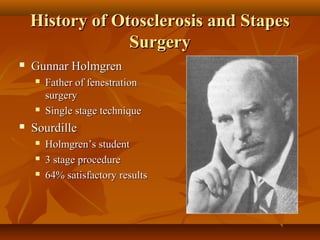
   Gunnar Holmgren
       Father of fenestration
        surgery
       Single stage technique
   Sourdille
       Holmgren’s student
       3 stage procedure
       64% satisfactory results
History of Otosclerosis and Stapes
                 Surgery
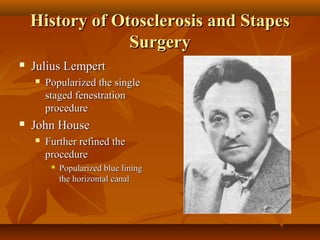
   Julius Lempert
       Popularized the single
        staged fenestration
        procedure
   John House
       Further refined the
        procedure
            Popularized blue lining
             the horizontal canal
History of Otosclerosis and Stapes
                 Surgery

   Fenestration procedure for otosclerosis
       Fenestration in the horizontal canal with a tissue
        graft covering
       >2% profound SNHL
       Rarely complete closure of the ABG
History of Otosclerosis and Stapes
                 Surgery
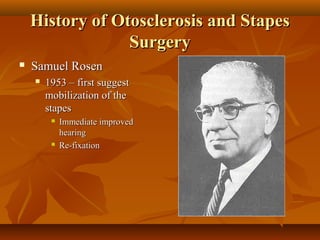
   Samuel Rosen
       1953 – first suggest
        mobilization of the
        stapes
            Immediate improved
             hearing
            Re-fixation
History of Otosclerosis and Stapes
                 Surgery
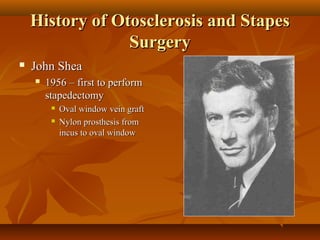
   John Shea
       1956 – first to perform
        stapedectomy
            Oval window vein graft
            Nylon prosthesis from
             incus to oval window
Epidemiology

   10% overall prevalence of histologic
    otosclerosis
   1% overall prevalence of clinically significant
    otosclerosis
Epidemiology
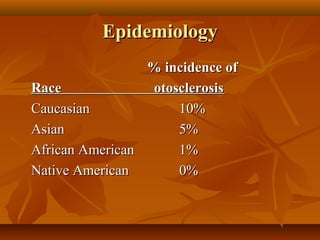
                 % incidence of
Race             otosclerosis
Caucasian            10%
Asian                5%
African American     1%
Native American      0%
Epidemiology
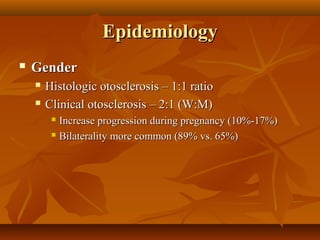
   Gender
       Histologic otosclerosis – 1:1 ratio
       Clinical otosclerosis – 2:1 (W:M)
          Increase progression during pregnancy (10%-17%)
          Bilaterality more common (89% vs. 65%)
Epidemiology
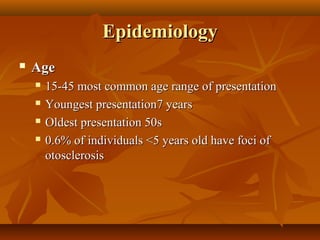
   Age
       15-45 most common age range of presentation
       Youngest presentation7 years
       Oldest presentation 50s
       0.6% of individuals <5 years old have foci of
        otosclerosis
Pathophysiology

   Osseous dyscrasia
       Resorption and formation of new bone
       Limited to the temporal bone and ossicles
       Inciting event unknown
            Hereditary, endocrine, metabolic, infectious, vascular,
             autoimmune, hormonal
Pathophysiology
   Siebenmann – first to describe the microscopic
    appearance
       Spongy
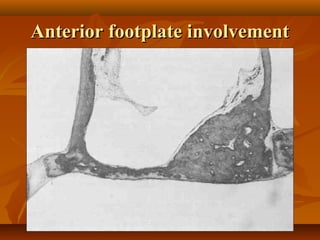
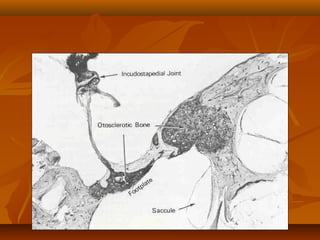
       Usually limited to the anterior footplate
Pathology
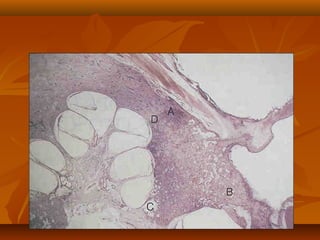
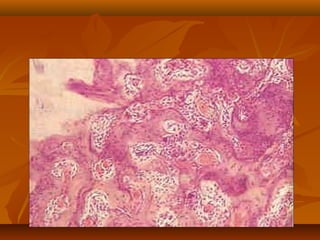
   Two phases of disease
          Active (otospongiosis phase)
               Osteocytes, histiocytes, osteoblasts
               Active resorption of bone
               Dilation of vessels
                   Schwartze’s sign

          Mature (sclerotic phase)
               Deposition of new bone (sclerotic and less dense than normal
                bone)
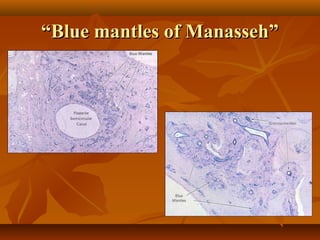
“Blue mantles of Manasseh”
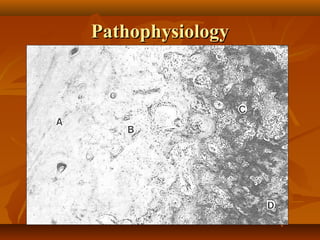
Pathophysiology
Pathology

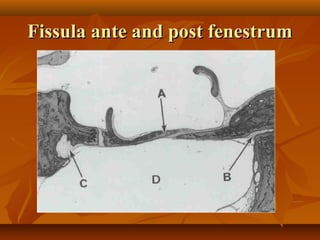
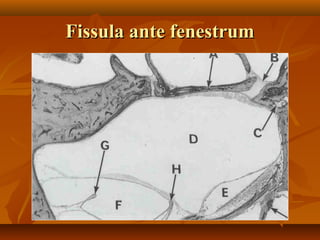
   Most common sites of involvement
      Fissula ante fenestrum
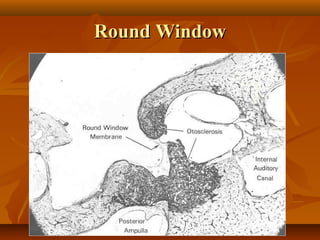
      Round window niche (30%-50% of cases)

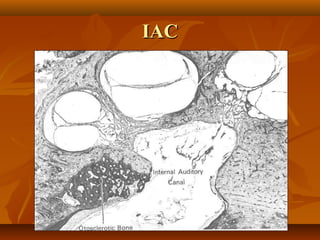
      Anterior wall of the IAC
Fissula ante and post fenestrum
Fissula ante fenestrum
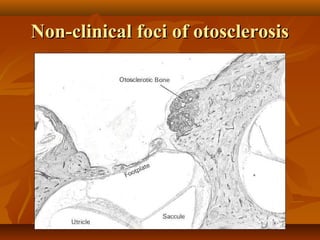
Non-clinical foci of otosclerosis
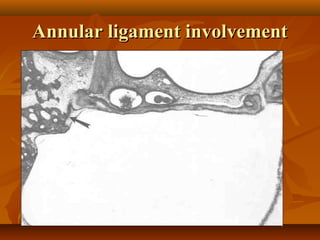
Annular ligament involvement
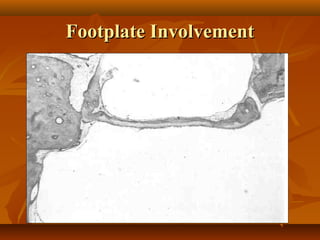
Footplate Involvement
Anterior footplate involvement
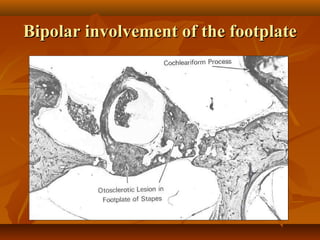
Bipolar involvement of the footplate
Round Window
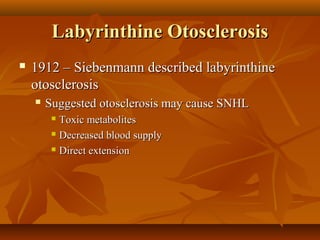
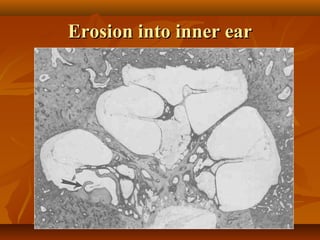
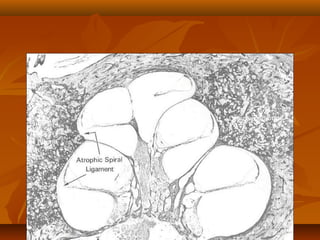
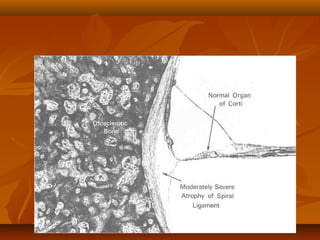
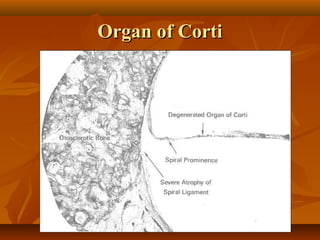
Labyrinthine Otosclerosis
   1912 – Siebenmann described labyrinthine
    otosclerosis
       Suggested otosclerosis may cause SNHL
          Toxic metabolites
          Decreased blood supply

          Direct extension
IAC
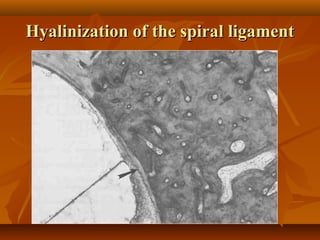
Hyalinization of the spiral ligament
Erosion into inner ear
Organ of Corti
Diagnosis
History
   Most common presentation
       Women in her 20s or 30s
       Conductive or Mixed hearing loss
          Slowly progressive,
          Bilateral (80%)

          asymmetric

       Tinnitus (75%)
History
   Age of onset of hearing loss
   Progression
   Laterality
   Associated symptoms
       Dizziness
       Otalgia
       Otorrhea
       Tinnitus
History

   Vestibular symptoms
       25%
       Most commonly dysequilibrium
       Occasionally attacks of vertigo with rotatory
        nystagmus
   Prior otologic surgery
   History of ear infections
History
   Family history
       2/3 have a significant family history
       Particularly helpful in patients with severe or
        profound mixed hearing loss
Physical Exam
   Otomicroscopy
       Most helpful in ruling out other disorders
            Middle ear effusions
            Tympanosclerosis
            Tympanic membrane perforations
            Cholesteatoma or retraction pockets
       Schwartze’s sign
            Red hue in oval window niche area
            10% of cases
   Pneumatic otoscopy
       Distinguish from malleus fixation
Physical Exam
   Tuning forks
       Hearing loss progresses form low frequencies to
        high frequencies
       256, 512, and 1024 Hz TF should be used
            Rinne
                 256 Hz – negative test indicates at least a 20 dB ABG
                 512 Hz – negative test indicates at least a 25 dB ABG
Differential Diagnosis
   Ossicular discontinuity
   Congenital stapes fixation
   Malleus head fixation
   Paget’s disease
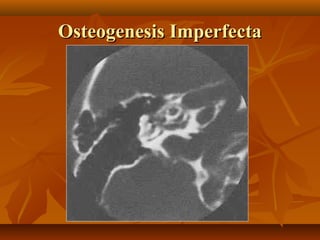
   Osteogenesis imperfecta
Audiometry
   Tympanometry
   Impedance testing
       Acoustic reflexes
   Pure tones
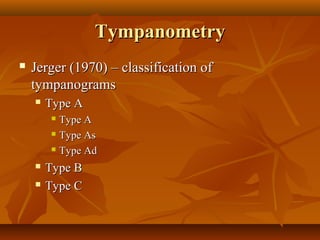
Tympanometry
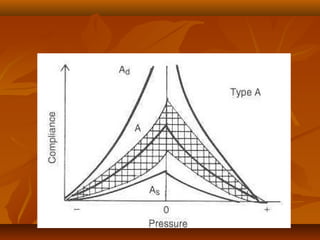
   Jerger (1970) – classification of
    tympanograms
       Type A
         Type A
         Type As

         Type Ad

       Type B
       Type C
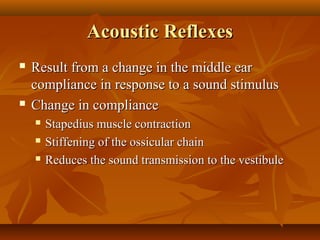
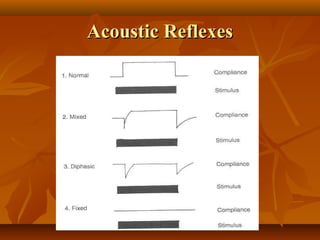
Acoustic Reflexes
   Result from a change in the middle ear
    compliance in response to a sound stimulus
   Change in compliance
       Stapedius muscle contraction
       Stiffening of the ossicular chain
       Reduces the sound transmission to the vestibule
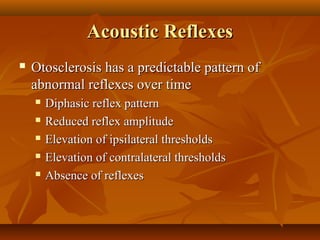
Acoustic Reflexes
   Otosclerosis has a predictable pattern of
    abnormal reflexes over time
       Diphasic reflex pattern
       Reduced reflex amplitude
       Elevation of ipsilateral thresholds
       Elevation of contralateral thresholds
       Absence of reflexes
Acoustic Reflexes
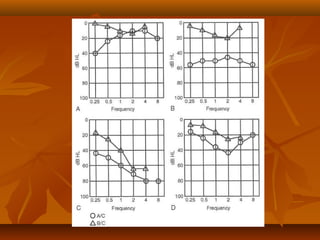
Pure Tone Audiometry

   Most useful audiometric test for otosclerosis
       Characterizes the severity of disease
       Frequency specific
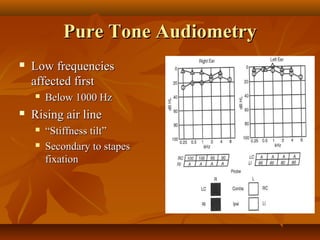
Pure Tone Audiometry
   Low frequencies
    affected first
       Below 1000 Hz
   Rising air line
       “Stiffness tilt”
       Secondary to stapes
        fixation
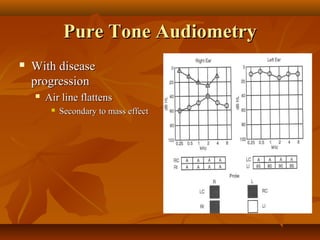
Pure Tone Audiometry
   With disease
    progression
       Air line flattens
            Secondary to mass effect
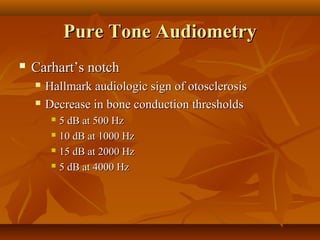
Pure Tone Audiometry
   Carhart’s notch
       Hallmark audiologic sign of otosclerosis
       Decrease in bone conduction thresholds
          5 dB at 500 Hz
          10 dB at 1000 Hz

          15 dB at 2000 Hz

          5 dB at 4000 Hz
Pure Tone Audiometry
   Carhart’s notch
       Proposed theory
          Stapes fixation disrupts the normal ossicular resonance
           (2000 Hz)
          Normal compressional mode of bone conduction is

           disturbed because of relative perilymph immobility
       Mechanical artifact
       Reverses with stapes mobilization
Imaging
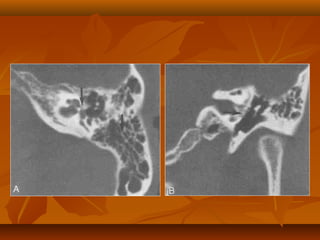
   Computed tomography (CT) of the temporal
    bone
       Proponents of CT for evaluation of otosclerosis
            Pre-op
                 Characterize the extent of otosclerosis
                 Severe or profound mixed hearing loss
                 Evaluate for enlarge cochlear aqueduct
            Post-op
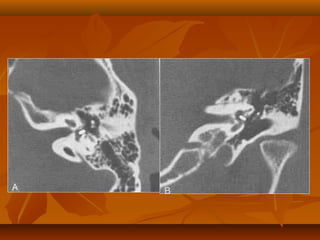
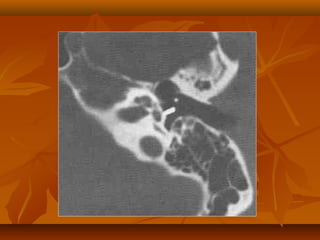
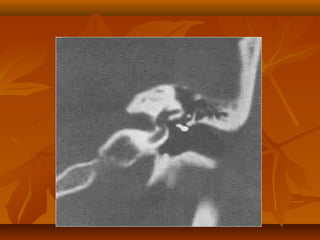
                 Recurrent CHL
                     Re-obliteration vs. prosthesis dislocation

                     Vertigo
Imaging
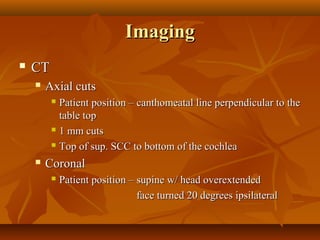
   CT
       Axial cuts
          Patient position – canthomeatal line perpendicular to the
           table top
          1 mm cuts

          Top of sup. SCC to bottom of the cochlea

       Coronal
            Patient position – supine w/ head overextended
                                face turned 20 degrees ipsilateral
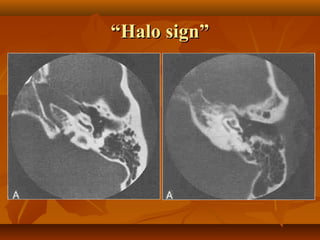
“Halo sign”
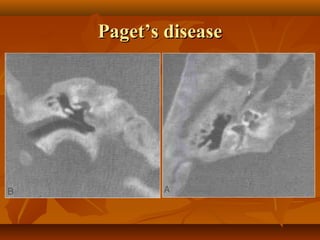
Paget’s disease
Osteogenesis Imperfecta
Natural history of otosclerosis
   90% of all cases are never clinically apparent
   Foci begins in childhood
   Most commonly becomes symptomatic in the 3rd and
    4th decades
   After clinical presentation
       Conductive hearing loss progressive
       Periods of quiescence and deterioration
       Worsening tinnitus
       Associated SNHL (rarely purely SN)
   Matures by age 50-70 with max. CHL of 50 dB
Management
   Medical – Sodium Fluoride
   Amplification
   Surgery
   Combinations
Patient Selection
   Factors
       Result of TF tests and audiometry
       Skill of the surgeon
       Facilities
       Medical condition of the patient
       Patient wishes
Patient Counseling
   Options for treatment
       Advantages and disadvantages of each
   Repeat clinic visit
Surgery
   Best surgical candidate
       Previously un-operated ear
       Good health
       Unacceptable ABG
          25 to 40 dB, bilateral ABG recommended by different
           authorities
          Negative Rinne test

       Excellent discrimination
       Desire for surgery
Surgery
   Other factors
       Age of the patient
            Elderly
                 Poorer results in the high frequencies
          Congenital stapes fixation (44% success rate)
          Juvenile otosclerosis (82% success rate)

       Occupation
          Diver
          Pilot

          Airline steward/stewardess
Surgery
   Other factors
       Vestibular symptoms
            Meniere's disease
       Concomitant otologic disease
          Cholesteatoma
          Tympanic membrane perforation
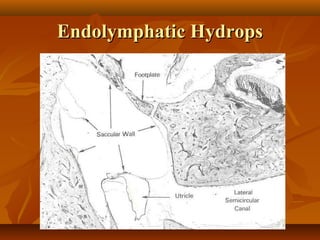
Endolymphatic Hydrops
Surgical Steps
   Subtleties of technique and style
       Local vs. general anesthesia
       Stapedectomy vs. partial stapedectomy vs.
        stapedotomy
       Laser vs. drill vs. cold instrumentation
       Oval window seals
       Prosthesis
   Pre-op
       Confirm the correct ear (largest ABG)
          With the patient
          Audiogram

          History and physical exam

       Place CT and audiogram in a visible location in the
        OR for easy intra-operative evaluation
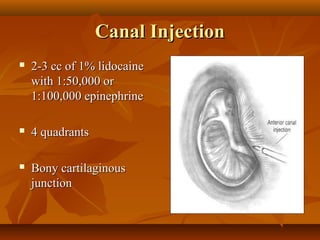
Canal Injection
   2-3 cc of 1% lidocaine
    with 1:50,000 or
    1:100,000 epinephrine

   4 quadrants

   Bony cartilaginous
    junction
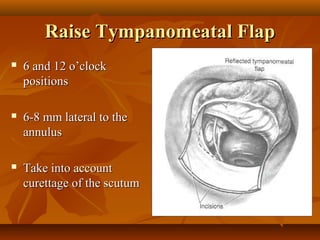
Raise Tympanomeatal Flap
   6 and 12 o’clock
    positions

   6-8 mm lateral to the
    annulus

   Take into account
    curettage of the scutum
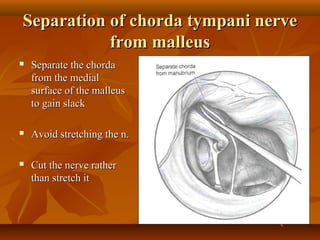
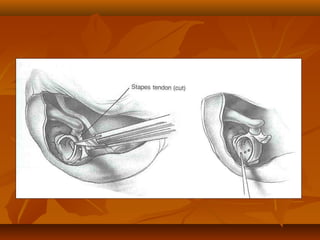
Separation of chorda tympani nerve
           from malleus
   Separate the chorda
    from the medial
    surface of the malleus
    to gain slack

   Avoid stretching the n.

   Cut the nerve rather
    than stretch it
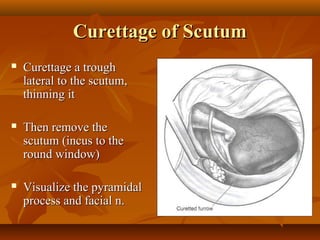
Curettage of Scutum
   Curettage a trough
    lateral to the scutum,
    thinning it

   Then remove the
    scutum (incus to the
    round window)

   Visualize the pyramidal
    process and facial n.
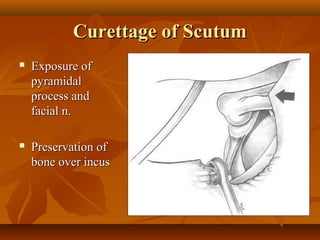
Curettage of Scutum
   Exposure of
    pyramidal
    process and
    facial n.

   Preservation of
    bone over incus
Middle ear examination
   Mobility of ossicles
       Confirm stapes fixation
       Evaluate for malleus or incus fixation
   Abnormal anatomy
       Dehiscent facial nerve
       Overhanging facial nerve
       Deep narrow oval window niche
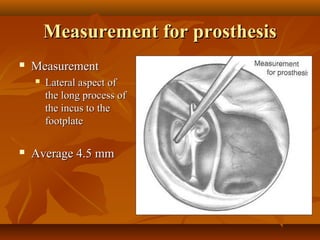
Measurement for prosthesis
   Measurement
       Lateral aspect of
        the long process of
        the incus to the
        footplate

   Average 4.5 mm
Total Stapedectomy
   Uses
       Extensive fixation of the footplate
       Floating footplate
   Disadvantages
       Increased post-op vestibular symptoms
       More technically difficult
       Increased potential for prosthesis migration
Stapedotomy/Small Fenestra
   Originally for obliterated or solid footplates
       Europe
       1970-80
   First laser stapedotomy performed by Perkins
    in 1978
   Advantages
       Less trauma to the vestibule
       Less incidence of prosthesis migration
       Less fixation of prosthesis by scar tissue
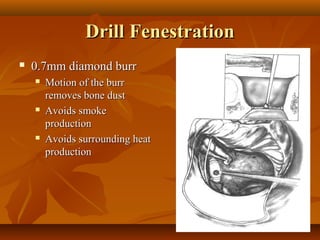
Drill Fenestration
   0.7mm diamond burr
       Motion of the burr
        removes bone dust
       Avoids smoke
        production
       Avoids surrounding heat
        production
Laser Fenestration
   Laser
       Avoids manipulation of the footplate
       Argon and Potassium titanyl phosphate (KTP/532)
            Wave length 500 nm
            Visible light
            Absorbed by hemoglobin
            Surgical and aiming beam
       Carbon dioxide (CO2)
            10,000 nm
            Not in visible light range
            Surgical beam only
                  Requires separate laser for an aiming beam (red helium-neon)
            Ill defined fuzzy beam
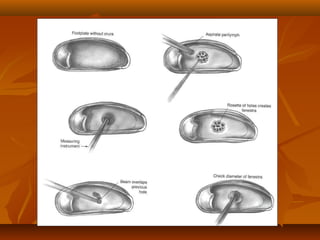
Fenestration
   Causse et al. (1993)
       Recommends posteriorly placed fenestration to
        better recreate the natural physiologic dynamics of
        the footplate
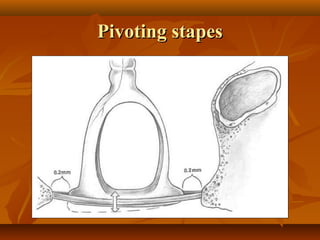
Pivoting stapes
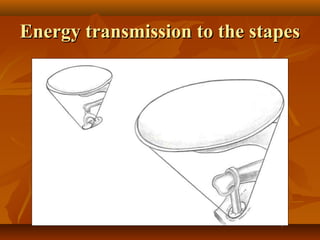
Energy transmission to the stapes
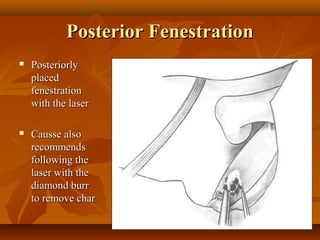
Posterior Fenestration
   Posteriorly
    placed
    fenestration
    with the laser

   Causse also
    recommends
    following the
    laser with the
    diamond burr
    to remove char
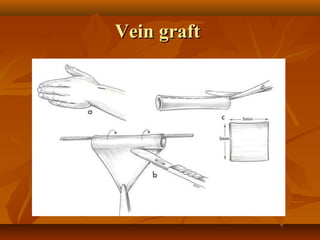
Oval window seal
   Tragal perichondrium
   Vein (hand or wrist)
   Temporalis fascia
   Blood
   Fat
Vein graft
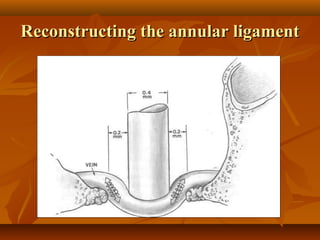
Reconstructing the annular ligament
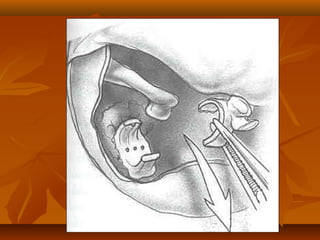
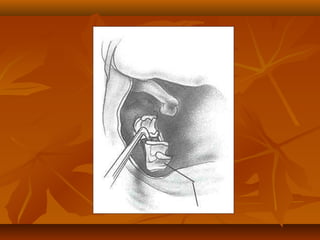
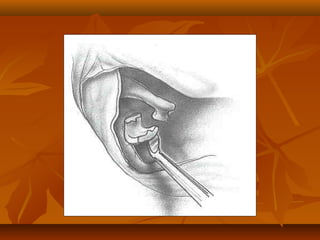
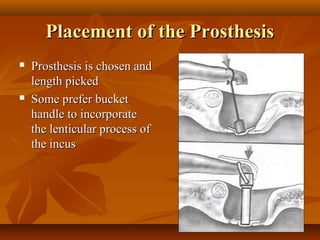
Placement of the Prosthesis
   Prosthesis is chosen and
    length picked
   Some prefer bucket
    handle to incorporate
    the lenticular process of
    the incus
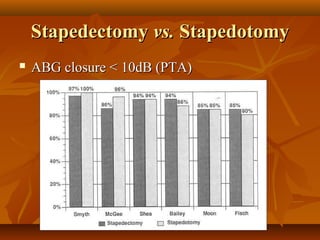
Stapedectomy vs. Stapedotomy
   ABG closure < 10dB (PTA)
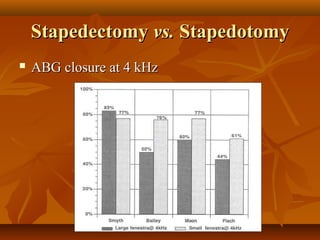
Stapedectomy vs. Stapedotomy
   ABG closure at 4 kHz
Special Considerations and
 Complications in Stapes
         Surgery
Overhanging Facial Nerve
   Usually dehiscent
   Consider aborting the procedure
   Facial nerve displacement (Perkins, 2001)
       Facial nerve is compressed superiorly with No. 24 suction
        (5 second periods)
       10-15 sec delay between compressions
       Perkins describes laser stapedotomy while nerve is
        compressed
   Wire piston used
       Add 0.5 to 0.75 mm to accommodate curve around the
        nerve
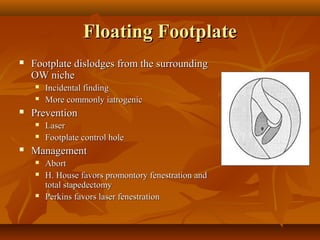
Floating Footplate
   Footplate dislodges from the surrounding
    OW niche
       Incidental finding
       More commonly iatrogenic
   Prevention
       Laser
       Footplate control hole
   Management
       Abort
       H. House favors promontory fenestration and
        total stapedectomy
       Perkins favors laser fenestration
Floating Footplate
   Hearing results
       Thin or blue footplate – 97% ABG closure
        (<10dB)
       White or “biscuit” footplate – 52% ABG closure
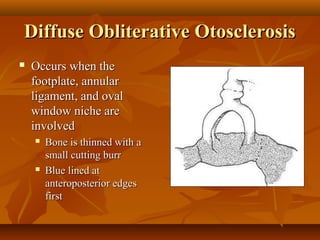
Diffuse Obliterative Otosclerosis
   Occurs when the
    footplate, annular
    ligament, and oval
    window niche are
    involved
       Bone is thinned with a
        small cutting burr
       Blue lined at
        anteroposterior edges
        first
Perilymphatic Gusher
   Associated with patent cochlear aqueduct
   More common on the left
   Increased incidence with congenital stapes fixation
   Increases risk of SNHL
   Management
       Ruff up the footplate
       Rapid placement of the OW seal then the prosthesis
       HOB elevated, stool softeners, bed rest, avoid Valsalva, +/-
        lumbar drain
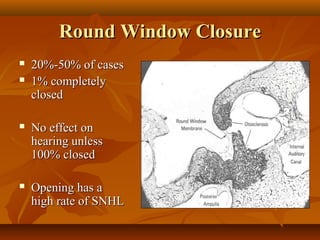
Round Window Closure
   20%-50% of cases
   1% completely
    closed

   No effect on
    hearing unless
    100% closed

   Opening has a
    high rate of SNHL
SNHL
   1%-3% incidence of profound permanent SNHL
       Surgeon experience
       Extent of disease
            Cochlear
       Prior stapes surgery
   Temporary
       Serous labyrinthitis
       Reparative granuloma
   Permanent
       Suppurative labyrinthitis
       Extensive drilling
       Basilar membrane breaks
       Vascular compromise
       Sudden drop in perilymph pressure
Reparative Granuloma
   Granuloma formation around the prosthesis and incus
   2 -3 weeks postop
   Initial good hearing results followed by an increase in
    the high frequency bone line thresholds
   Associated tinnitus and vertigo
   Exam – reddish discoloration of the posterior TM
   Treatment
       ME exploration
       Removal of granuloma
   Prognosis – return of hearing with early excision
Vertigo
   Most commonly short lived (2-3 days)
   More prolonged after stapedectomy compared
    to stapedotomy
       Due to serous labyrinthitis
   Medialization of the prosthesis into the
    vestibule
       With or without perilymphatic fistula
   Reparative granuloma
Recurrent Conductive Hearing Loss
   Slippage or displacement of the prosthesis
       Most common cause of failure
       Immediate
            Technique
            Trauma
       Delayed
            Slippage from incus narrowing or erosion
            Adherence to edge of OW niche
            Stapes re-fixation
            Progression of disease with re-obliteration of OW
            Malleus or incus ankylosis
Amplification
   Amplification
       Excellent alternative
          Non-surgical candidates
          Patients who do not desire surgery

       Satisfaction rate less than with successful Sx
          Canal occlusion effect
          Amplification not used at night
Medical
   Sodium Fluoride
       1923 - Escot suggested using calcium fluoride
       1965 – Shambaugh popularized its use
       Mechanism
          Fluoride ion replaces hydroxyl group in bone forming
           fluorapatite
          resistant to resorption

          Increases calcification of new bone

          Causes maturation of active foci of otosclerosis
   Sodium Fluoride
       Reduces tinnitus, reverses Schwartze’s sign, resolution of
        otospongiosis seen on CT
       OTC – Florical
       Dose – 20-120mg
       Indications
            Non-surgical candidates
            Patients who do not want surgery
            Surgical candidates with + Schwartze’s sign
                  Treat for 6 mo pre-op
                  Postop if otospongiosis detected intra-op
   Sodium fluoride
       Hearing results
          50% stabilize
          30% improve

       Re-evaluate q 2 yrs with CT and for Schwartze’s
        sign to resolve
       If fluoride are stopped – expect re-activation
        within 2-3 years

Otosclerosis 2013

  • 1.
    Otosclerosis  DR Kamlesh Dubey AIIMS, New Delhi
  • 2.
    Introduction  Otosclerosis  Primary metabolic bone disease of the otic capsule and ossicles  Results in fixation of the ossicles and conductive hearing loss  May have sensorineural component if the cochlea is involved  Genetically mediated  Autosomal dominant with incomplete penetrance (40%) and variable expressivity
  • 3.
    History of Otosclerosisand Stapes Surgery  1704 – Valsalva first described stapes fixation  1857 – Toynbee linked stapes fixation to hearing loss  1890 – Katz was first to find microscopic evidence of otosclerosis  1893 – Politzer described the clinical entity of “otosclerosis”
  • 4.
    History of Otosclerosisand Stapes Surgery  Gunnar Holmgren  Father of fenestration surgery  Single stage technique  Sourdille  Holmgren’s student  3 stage procedure  64% satisfactory results
  • 5.
    History of Otosclerosisand Stapes Surgery  Julius Lempert  Popularized the single staged fenestration procedure  John House  Further refined the procedure  Popularized blue lining the horizontal canal
  • 6.
    History of Otosclerosisand Stapes Surgery  Fenestration procedure for otosclerosis  Fenestration in the horizontal canal with a tissue graft covering  >2% profound SNHL  Rarely complete closure of the ABG
  • 7.
    History of Otosclerosisand Stapes Surgery  Samuel Rosen  1953 – first suggest mobilization of the stapes  Immediate improved hearing  Re-fixation
  • 8.
    History of Otosclerosisand Stapes Surgery  John Shea  1956 – first to perform stapedectomy  Oval window vein graft  Nylon prosthesis from incus to oval window
  • 9.
    Epidemiology  10% overall prevalence of histologic otosclerosis  1% overall prevalence of clinically significant otosclerosis
  • 10.
    Epidemiology % incidence of Race otosclerosis Caucasian 10% Asian 5% African American 1% Native American 0%
  • 11.
    Epidemiology  Gender  Histologic otosclerosis – 1:1 ratio  Clinical otosclerosis – 2:1 (W:M)  Increase progression during pregnancy (10%-17%)  Bilaterality more common (89% vs. 65%)
  • 12.
    Epidemiology  Age  15-45 most common age range of presentation  Youngest presentation7 years  Oldest presentation 50s  0.6% of individuals <5 years old have foci of otosclerosis
  • 13.
    Pathophysiology  Osseous dyscrasia  Resorption and formation of new bone  Limited to the temporal bone and ossicles  Inciting event unknown  Hereditary, endocrine, metabolic, infectious, vascular, autoimmune, hormonal
  • 14.
    Pathophysiology  Siebenmann – first to describe the microscopic appearance  Spongy  Usually limited to the anterior footplate
  • 15.
    Pathology  Two phases of disease  Active (otospongiosis phase)  Osteocytes, histiocytes, osteoblasts  Active resorption of bone  Dilation of vessels  Schwartze’s sign  Mature (sclerotic phase)  Deposition of new bone (sclerotic and less dense than normal bone)
  • 18.
    “Blue mantles ofManasseh”
  • 19.
  • 20.
    Pathology  Most common sites of involvement  Fissula ante fenestrum  Round window niche (30%-50% of cases)  Anterior wall of the IAC
  • 21.
    Fissula ante andpost fenestrum
  • 22.
  • 23.
  • 24.
  • 25.
  • 26.
  • 27.
  • 29.
  • 30.
    Labyrinthine Otosclerosis  1912 – Siebenmann described labyrinthine otosclerosis  Suggested otosclerosis may cause SNHL  Toxic metabolites  Decreased blood supply  Direct extension
  • 31.
  • 32.
    Hyalinization of thespiral ligament
  • 33.
  • 36.
  • 37.
  • 38.
    History  Most common presentation  Women in her 20s or 30s  Conductive or Mixed hearing loss  Slowly progressive,  Bilateral (80%)  asymmetric  Tinnitus (75%)
  • 39.
    History  Age of onset of hearing loss  Progression  Laterality  Associated symptoms  Dizziness  Otalgia  Otorrhea  Tinnitus
  • 40.
    History  Vestibular symptoms  25%  Most commonly dysequilibrium  Occasionally attacks of vertigo with rotatory nystagmus  Prior otologic surgery  History of ear infections
  • 41.
    History  Family history  2/3 have a significant family history  Particularly helpful in patients with severe or profound mixed hearing loss
  • 42.
    Physical Exam  Otomicroscopy  Most helpful in ruling out other disorders  Middle ear effusions  Tympanosclerosis  Tympanic membrane perforations  Cholesteatoma or retraction pockets  Schwartze’s sign  Red hue in oval window niche area  10% of cases  Pneumatic otoscopy  Distinguish from malleus fixation
  • 43.
    Physical Exam  Tuning forks  Hearing loss progresses form low frequencies to high frequencies  256, 512, and 1024 Hz TF should be used  Rinne  256 Hz – negative test indicates at least a 20 dB ABG  512 Hz – negative test indicates at least a 25 dB ABG
  • 44.
    Differential Diagnosis  Ossicular discontinuity  Congenital stapes fixation  Malleus head fixation  Paget’s disease  Osteogenesis imperfecta
  • 45.
    Audiometry  Tympanometry  Impedance testing  Acoustic reflexes  Pure tones
  • 46.
    Tympanometry  Jerger (1970) – classification of tympanograms  Type A  Type A  Type As  Type Ad  Type B  Type C
  • 48.
    Acoustic Reflexes  Result from a change in the middle ear compliance in response to a sound stimulus  Change in compliance  Stapedius muscle contraction  Stiffening of the ossicular chain  Reduces the sound transmission to the vestibule
  • 49.
    Acoustic Reflexes  Otosclerosis has a predictable pattern of abnormal reflexes over time  Diphasic reflex pattern  Reduced reflex amplitude  Elevation of ipsilateral thresholds  Elevation of contralateral thresholds  Absence of reflexes
  • 50.
  • 51.
    Pure Tone Audiometry  Most useful audiometric test for otosclerosis  Characterizes the severity of disease  Frequency specific
  • 52.
    Pure Tone Audiometry  Low frequencies affected first  Below 1000 Hz  Rising air line  “Stiffness tilt”  Secondary to stapes fixation
  • 53.
    Pure Tone Audiometry  With disease progression  Air line flattens  Secondary to mass effect
  • 55.
    Pure Tone Audiometry  Carhart’s notch  Hallmark audiologic sign of otosclerosis  Decrease in bone conduction thresholds  5 dB at 500 Hz  10 dB at 1000 Hz  15 dB at 2000 Hz  5 dB at 4000 Hz
  • 56.
    Pure Tone Audiometry  Carhart’s notch  Proposed theory  Stapes fixation disrupts the normal ossicular resonance (2000 Hz)  Normal compressional mode of bone conduction is disturbed because of relative perilymph immobility  Mechanical artifact  Reverses with stapes mobilization
  • 57.
    Imaging  Computed tomography (CT) of the temporal bone  Proponents of CT for evaluation of otosclerosis  Pre-op  Characterize the extent of otosclerosis  Severe or profound mixed hearing loss  Evaluate for enlarge cochlear aqueduct  Post-op  Recurrent CHL  Re-obliteration vs. prosthesis dislocation  Vertigo
  • 58.
    Imaging  CT  Axial cuts  Patient position – canthomeatal line perpendicular to the table top  1 mm cuts  Top of sup. SCC to bottom of the cochlea  Coronal  Patient position – supine w/ head overextended face turned 20 degrees ipsilateral
  • 60.
  • 61.
  • 62.
  • 63.
    Natural history ofotosclerosis  90% of all cases are never clinically apparent  Foci begins in childhood  Most commonly becomes symptomatic in the 3rd and 4th decades  After clinical presentation  Conductive hearing loss progressive  Periods of quiescence and deterioration  Worsening tinnitus  Associated SNHL (rarely purely SN)  Matures by age 50-70 with max. CHL of 50 dB
  • 64.
    Management  Medical – Sodium Fluoride  Amplification  Surgery  Combinations
  • 65.
    Patient Selection  Factors  Result of TF tests and audiometry  Skill of the surgeon  Facilities  Medical condition of the patient  Patient wishes
  • 66.
    Patient Counseling  Options for treatment  Advantages and disadvantages of each  Repeat clinic visit
  • 67.
    Surgery  Best surgical candidate  Previously un-operated ear  Good health  Unacceptable ABG  25 to 40 dB, bilateral ABG recommended by different authorities  Negative Rinne test  Excellent discrimination  Desire for surgery
  • 68.
    Surgery  Other factors  Age of the patient  Elderly  Poorer results in the high frequencies  Congenital stapes fixation (44% success rate)  Juvenile otosclerosis (82% success rate)  Occupation  Diver  Pilot  Airline steward/stewardess
  • 69.
    Surgery  Other factors  Vestibular symptoms  Meniere's disease  Concomitant otologic disease  Cholesteatoma  Tympanic membrane perforation
  • 70.
  • 71.
    Surgical Steps  Subtleties of technique and style  Local vs. general anesthesia  Stapedectomy vs. partial stapedectomy vs. stapedotomy  Laser vs. drill vs. cold instrumentation  Oval window seals  Prosthesis
  • 72.
    Pre-op  Confirm the correct ear (largest ABG)  With the patient  Audiogram  History and physical exam  Place CT and audiogram in a visible location in the OR for easy intra-operative evaluation
  • 73.
    Canal Injection  2-3 cc of 1% lidocaine with 1:50,000 or 1:100,000 epinephrine  4 quadrants  Bony cartilaginous junction
  • 74.
    Raise Tympanomeatal Flap  6 and 12 o’clock positions  6-8 mm lateral to the annulus  Take into account curettage of the scutum
  • 75.
    Separation of chordatympani nerve from malleus  Separate the chorda from the medial surface of the malleus to gain slack  Avoid stretching the n.  Cut the nerve rather than stretch it
  • 76.
    Curettage of Scutum  Curettage a trough lateral to the scutum, thinning it  Then remove the scutum (incus to the round window)  Visualize the pyramidal process and facial n.
  • 77.
    Curettage of Scutum  Exposure of pyramidal process and facial n.  Preservation of bone over incus
  • 78.
    Middle ear examination  Mobility of ossicles  Confirm stapes fixation  Evaluate for malleus or incus fixation  Abnormal anatomy  Dehiscent facial nerve  Overhanging facial nerve  Deep narrow oval window niche
  • 79.
    Measurement for prosthesis  Measurement  Lateral aspect of the long process of the incus to the footplate  Average 4.5 mm
  • 81.
    Total Stapedectomy  Uses  Extensive fixation of the footplate  Floating footplate  Disadvantages  Increased post-op vestibular symptoms  More technically difficult  Increased potential for prosthesis migration
  • 86.
    Stapedotomy/Small Fenestra  Originally for obliterated or solid footplates  Europe  1970-80  First laser stapedotomy performed by Perkins in 1978  Advantages  Less trauma to the vestibule  Less incidence of prosthesis migration  Less fixation of prosthesis by scar tissue
  • 87.
    Drill Fenestration  0.7mm diamond burr  Motion of the burr removes bone dust  Avoids smoke production  Avoids surrounding heat production
  • 88.
    Laser Fenestration  Laser  Avoids manipulation of the footplate  Argon and Potassium titanyl phosphate (KTP/532)  Wave length 500 nm  Visible light  Absorbed by hemoglobin  Surgical and aiming beam  Carbon dioxide (CO2)  10,000 nm  Not in visible light range  Surgical beam only  Requires separate laser for an aiming beam (red helium-neon)  Ill defined fuzzy beam
  • 91.
    Fenestration  Causse et al. (1993)  Recommends posteriorly placed fenestration to better recreate the natural physiologic dynamics of the footplate
  • 92.
  • 93.
  • 94.
    Posterior Fenestration  Posteriorly placed fenestration with the laser  Causse also recommends following the laser with the diamond burr to remove char
  • 95.
    Oval window seal  Tragal perichondrium  Vein (hand or wrist)  Temporalis fascia  Blood  Fat
  • 96.
  • 97.
  • 98.
    Placement of theProsthesis  Prosthesis is chosen and length picked  Some prefer bucket handle to incorporate the lenticular process of the incus
  • 99.
    Stapedectomy vs. Stapedotomy  ABG closure < 10dB (PTA)
  • 100.
    Stapedectomy vs. Stapedotomy  ABG closure at 4 kHz
  • 101.
    Special Considerations and Complications in Stapes Surgery
  • 102.
    Overhanging Facial Nerve  Usually dehiscent  Consider aborting the procedure  Facial nerve displacement (Perkins, 2001)  Facial nerve is compressed superiorly with No. 24 suction (5 second periods)  10-15 sec delay between compressions  Perkins describes laser stapedotomy while nerve is compressed  Wire piston used  Add 0.5 to 0.75 mm to accommodate curve around the nerve
  • 103.
    Floating Footplate  Footplate dislodges from the surrounding OW niche  Incidental finding  More commonly iatrogenic  Prevention  Laser  Footplate control hole  Management  Abort  H. House favors promontory fenestration and total stapedectomy  Perkins favors laser fenestration
  • 104.
    Floating Footplate  Hearing results  Thin or blue footplate – 97% ABG closure (<10dB)  White or “biscuit” footplate – 52% ABG closure
  • 105.
    Diffuse Obliterative Otosclerosis  Occurs when the footplate, annular ligament, and oval window niche are involved  Bone is thinned with a small cutting burr  Blue lined at anteroposterior edges first
  • 106.
    Perilymphatic Gusher  Associated with patent cochlear aqueduct  More common on the left  Increased incidence with congenital stapes fixation  Increases risk of SNHL  Management  Ruff up the footplate  Rapid placement of the OW seal then the prosthesis  HOB elevated, stool softeners, bed rest, avoid Valsalva, +/- lumbar drain
  • 107.
    Round Window Closure  20%-50% of cases  1% completely closed  No effect on hearing unless 100% closed  Opening has a high rate of SNHL
  • 108.
    SNHL  1%-3% incidence of profound permanent SNHL  Surgeon experience  Extent of disease  Cochlear  Prior stapes surgery  Temporary  Serous labyrinthitis  Reparative granuloma  Permanent  Suppurative labyrinthitis  Extensive drilling  Basilar membrane breaks  Vascular compromise  Sudden drop in perilymph pressure
  • 109.
    Reparative Granuloma  Granuloma formation around the prosthesis and incus  2 -3 weeks postop  Initial good hearing results followed by an increase in the high frequency bone line thresholds  Associated tinnitus and vertigo  Exam – reddish discoloration of the posterior TM  Treatment  ME exploration  Removal of granuloma  Prognosis – return of hearing with early excision
  • 110.
    Vertigo  Most commonly short lived (2-3 days)  More prolonged after stapedectomy compared to stapedotomy  Due to serous labyrinthitis  Medialization of the prosthesis into the vestibule  With or without perilymphatic fistula  Reparative granuloma
  • 112.
    Recurrent Conductive HearingLoss  Slippage or displacement of the prosthesis  Most common cause of failure  Immediate  Technique  Trauma  Delayed  Slippage from incus narrowing or erosion  Adherence to edge of OW niche  Stapes re-fixation  Progression of disease with re-obliteration of OW  Malleus or incus ankylosis
  • 115.
    Amplification  Amplification  Excellent alternative  Non-surgical candidates  Patients who do not desire surgery  Satisfaction rate less than with successful Sx  Canal occlusion effect  Amplification not used at night
  • 116.
    Medical  Sodium Fluoride  1923 - Escot suggested using calcium fluoride  1965 – Shambaugh popularized its use  Mechanism  Fluoride ion replaces hydroxyl group in bone forming fluorapatite  resistant to resorption  Increases calcification of new bone  Causes maturation of active foci of otosclerosis
  • 117.
    Sodium Fluoride  Reduces tinnitus, reverses Schwartze’s sign, resolution of otospongiosis seen on CT  OTC – Florical  Dose – 20-120mg  Indications  Non-surgical candidates  Patients who do not want surgery  Surgical candidates with + Schwartze’s sign  Treat for 6 mo pre-op  Postop if otospongiosis detected intra-op
  • 118.
    Sodium fluoride  Hearing results  50% stabilize  30% improve  Re-evaluate q 2 yrs with CT and for Schwartze’s sign to resolve  If fluoride are stopped – expect re-activation within 2-3 years