Tinnitus & Hyperacusis
Ozarks Technical Community College
What is tinnitus?
 Any sound that is perceived by the listener that does
not originate from an external sound source
 May be perceived in one or both ears (peripheral)
and/or in the head (central)
 60% bilateral
 30% unilateral
 10% central
 From latin word, tinniere, which means “to ring”
Descriptive Labels
 Ringing
 Hissing
 Buzzing
 Roaring
 Clicking
 Ocean sound
 Cicadas
 Pulsing
 Heartbeat
Causes of Tinnitus
 Most commonly caused by some sort of change
to the auditory system
 80% of patient’s with SNHL have tinnitus
 Hearing loss results in changes in the neural
activity of the auditory system, which the
auditory cortex interprets as sound
 Much like phantom limb syndrome. Areas of the
cochlea where there is hair cell damage can no
longer amplify sounds where damage has
occurred so a phantom sound is interpreted by the
brain.
Other Causes of Tinnitus
 Hearing loss, especially in cases of noise-induced
hearing loss (NIHL)
 External or middle ear issues (wax, fluid)
 Acoustic neuroma (UNILATERAL tinnitus)
 Medications
 Sinus/allergy issues
 Dental issues (TMJ-temporal-mandibular joint
syndrome)
 Cardiovascular
 Neurological (MS)
 Stress/anxiety
Medications that cause tinnitus
 Anti-inflammatories
 Antibiotics
 Antidepressants
 Aspirin
 Quinine
 Loop diuretics
 Chemotherapy drugs
Some musician’s consider it a badge of
honor…
 Peter Frampton
 “I wonder how you’re feeling. There’s ringing in my ears.
And no one to relate to, ‘cept the sea.”
 Bob Seger
 “With the echoes of amplifiers ringing in your head.”
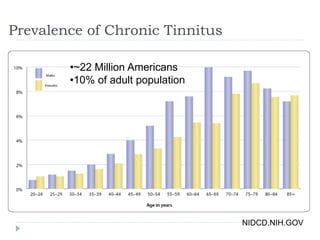
Prevalence of Chronic Tinnitus
NIDCD.NIH.GOV
•~22 Million Americans
•10% of adult population
Types
 Subjective
 Can only be perceived by the patient
 Most common type (95%)
 Objective
 Can be heard by others
 Rare (<5% of all tinnitus cases)
 Usually pulsatile (in sync with heartbeat)
 Causes: vascular or muscular
Causes of Objective Tinnitus
 Vascular
 Arteriorvenous aneurysm
 Glomus jugulare tumor
 Muscular
 Patent eustachian tube
 Palatal myoclonus: involuntary muscle jerk of the roof of
the mouth
 Spasm of stapedius or tensor tympani muscles
Bothersome/Uncompensated Tinnitus
 Only about 20% of people with tinnitus are bothered
by it
 The tinnitus itself isn’t the problem. The person’s
REACTION to it is what is problematic.
 Tinnitus may result in irritability, fatigue/sleep disturbance,
depression, suicidal thoughts
 These patient’s need to be referred to a mental health
professional
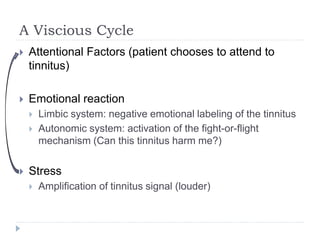
A Viscious Cycle
 Attentional Factors (patient chooses to attend to
tinnitus)
 Emotional reaction
 Limbic system: negative emotional labeling of the tinnitus
 Autonomic system: activation of the fight-or-flight
mechanism (Can this tinnitus harm me?)
 Stress
 Amplification of tinnitus signal (louder)
Tinnitus Treatment
 Surgery (uncommon option)
 Medication (usually xanax, valium,
antidepressants)
 Dietary restrictions (caffeine, alcohol, salt,
MSG)
 Masking
 Counseling
 Cognitive Behavioral Therapy
 Tinnitus Retraining Therapy
 Sound treatment
 Neuromonics
Masking
 Use of noise to temporarily mask or “cover up” the
tinnitus so it cannot be perceived
 This is often successfully accomplished when patients
with hearing loss use traditional hearing aids. The
amplification of environmental noises often reduces or
completely masks tinnitus.
 Our newest generation hearing aids have optional tinnitus
maskers built-in for when hearing aids aren’t enough to
mask tinnitus. This may benefit that 20% of patients with
tinnitus that are truly bothered by their tinnitus.
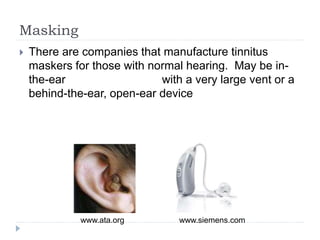
Masking
 There are companies that manufacture tinnitus
maskers for those with normal hearing. May be in-
the-ear with a very large vent or a
behind-the-ear, open-ear device
www.ata.org www.siemens.com
Masking
 The use of a sound machine or external noise
source (i.e. ceiling fan) can be very helpful at night
 Different types of noise are utilized in masking: white
noise, pink noise, brown noise, grey noise (all have
varying complexity based on frequency components)
Tinnitus Handicap Inventory
 Patient self-survey
 Sample questions
 Do you feel you have no control over your tinnitus?
 Because of your tinnitus do you feel tired?
 Because of your tinnitus do you feel depressed?
 Does your tinnitus make you feel anxious?
 Quantifies the severity of tinnitus
 Rates degree of handicap from slight to catastrophic
Tinnitus Retraining Therapy
 Jastreboff created TRT
 Combines counseling with use of noise generators
 Counseling: reclassify tinnitus to a category of neutral
signals
 Sound therapy: weaken the tinnitus-related neural activity
 Goal: Habituation to the tinnitus (no longer pay
attention to it)
Neuromonics
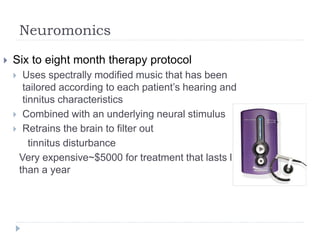
 Six to eight month therapy protocol
 Uses spectrally modified music that has been
tailored according to each patient’s hearing and
tinnitus characteristics
 Combined with an underlying neural stimulus
 Retrains the brain to filter out
tinnitus disturbance
Very expensive~$5000 for treatment that lasts less
than a year
Other Sound Disorders-Hyperacusis
 Everyday sounds seem “too loud” or “uncomfortable”
 About ½ of those with tinnitus, also have
hyperacusis
 Affects 1 in 50,000
Hyperacusis Causes
 Hearing loss
 Noise Injury
 Head injury (i.e air bag deployment)
 Ototoxicity
 Lyme disease
 Viral infections involving the inner ear or facial nerve
(Bell’S palsy)
 TMJ
 PTSD (post-traumatic stress disorder)
 Chronic fatigue syndrome
 Epilepsy
 Depression
 Migraine headaches
Hearing Aids in Patients with Hyperacusis
 The measurement of LDLs is very important to ensure
that the maximum output of the hearing aids (MPO)
never exceeds the patient’s comfort level
 Real-ear-to-coupler difference (RECD) should be performed to
convert the patient’s LDLs in dB HL (audiometer) to dB SPL
 Real-ear measurements are VERY important to confirm that the
MPO of the hearing aid in the patient’s ear is below the patient-
specific LDLs (in dB SPL)
Hearing Aids in Patients with Hyperacusis
 It may be beneficial to perform a closed ear fitting (rather
than a completely open fit)
 Using a closed dome, custom earmold, or custom aid will
prevent environmental noise from naturally entering the ear
canal
 This will allow you to better control the sounds that are allowed
through the hearing aid to make the patient as comfortable as
possible
 On the other hand, patients with hyperacusis AND tinnitus may
find that a closed fitting makes their tinnitus seem louder.
 As you can see, we walk a very fine line with hyperacusis and tinnitus
patients
Other sound disorders
 Misophonia
 Dislike of sound
 Phonophobia
 Fear of sound
 Often these patients come in reporting that they use
earplugs in everyday circumstances. This is NOT
recommended. It will actually worsen problem.
When in doubt…
 If you have a patient with bothersome tinnitus
and/or hyperacusis, it is important to refer them to an
ENT physician for medical evaluation and treatment
 A good indicator that a patient needs to be referred
for medical evaluation is when they report that the
tinnitus and/or hyperacusis is worse than their
hearing loss
 Use the Tinnitus Handicap Inventory as a guide

Tinnitus and hyperacusis

  • 1.
    Tinnitus & Hyperacusis OzarksTechnical Community College
  • 2.
    What is tinnitus? Any sound that is perceived by the listener that does not originate from an external sound source  May be perceived in one or both ears (peripheral) and/or in the head (central)  60% bilateral  30% unilateral  10% central  From latin word, tinniere, which means “to ring”
  • 3.
    Descriptive Labels  Ringing Hissing  Buzzing  Roaring  Clicking  Ocean sound  Cicadas  Pulsing  Heartbeat
  • 4.
    Causes of Tinnitus Most commonly caused by some sort of change to the auditory system  80% of patient’s with SNHL have tinnitus  Hearing loss results in changes in the neural activity of the auditory system, which the auditory cortex interprets as sound  Much like phantom limb syndrome. Areas of the cochlea where there is hair cell damage can no longer amplify sounds where damage has occurred so a phantom sound is interpreted by the brain.
  • 5.
    Other Causes ofTinnitus  Hearing loss, especially in cases of noise-induced hearing loss (NIHL)  External or middle ear issues (wax, fluid)  Acoustic neuroma (UNILATERAL tinnitus)  Medications  Sinus/allergy issues  Dental issues (TMJ-temporal-mandibular joint syndrome)  Cardiovascular  Neurological (MS)  Stress/anxiety
  • 6.
    Medications that causetinnitus  Anti-inflammatories  Antibiotics  Antidepressants  Aspirin  Quinine  Loop diuretics  Chemotherapy drugs
  • 7.
    Some musician’s considerit a badge of honor…  Peter Frampton  “I wonder how you’re feeling. There’s ringing in my ears. And no one to relate to, ‘cept the sea.”  Bob Seger  “With the echoes of amplifiers ringing in your head.”
  • 8.
    Prevalence of ChronicTinnitus NIDCD.NIH.GOV •~22 Million Americans •10% of adult population
  • 9.
    Types  Subjective  Canonly be perceived by the patient  Most common type (95%)  Objective  Can be heard by others  Rare (<5% of all tinnitus cases)  Usually pulsatile (in sync with heartbeat)  Causes: vascular or muscular
  • 10.
    Causes of ObjectiveTinnitus  Vascular  Arteriorvenous aneurysm  Glomus jugulare tumor  Muscular  Patent eustachian tube  Palatal myoclonus: involuntary muscle jerk of the roof of the mouth  Spasm of stapedius or tensor tympani muscles
  • 11.
    Bothersome/Uncompensated Tinnitus  Onlyabout 20% of people with tinnitus are bothered by it  The tinnitus itself isn’t the problem. The person’s REACTION to it is what is problematic.  Tinnitus may result in irritability, fatigue/sleep disturbance, depression, suicidal thoughts  These patient’s need to be referred to a mental health professional
  • 12.
    A Viscious Cycle Attentional Factors (patient chooses to attend to tinnitus)  Emotional reaction  Limbic system: negative emotional labeling of the tinnitus  Autonomic system: activation of the fight-or-flight mechanism (Can this tinnitus harm me?)  Stress  Amplification of tinnitus signal (louder)
  • 13.
    Tinnitus Treatment  Surgery(uncommon option)  Medication (usually xanax, valium, antidepressants)  Dietary restrictions (caffeine, alcohol, salt, MSG)  Masking  Counseling  Cognitive Behavioral Therapy  Tinnitus Retraining Therapy  Sound treatment  Neuromonics
  • 14.
    Masking  Use ofnoise to temporarily mask or “cover up” the tinnitus so it cannot be perceived  This is often successfully accomplished when patients with hearing loss use traditional hearing aids. The amplification of environmental noises often reduces or completely masks tinnitus.  Our newest generation hearing aids have optional tinnitus maskers built-in for when hearing aids aren’t enough to mask tinnitus. This may benefit that 20% of patients with tinnitus that are truly bothered by their tinnitus.
  • 15.
    Masking  There arecompanies that manufacture tinnitus maskers for those with normal hearing. May be in- the-ear with a very large vent or a behind-the-ear, open-ear device www.ata.org www.siemens.com
  • 16.
    Masking  The useof a sound machine or external noise source (i.e. ceiling fan) can be very helpful at night  Different types of noise are utilized in masking: white noise, pink noise, brown noise, grey noise (all have varying complexity based on frequency components)
  • 17.
    Tinnitus Handicap Inventory Patient self-survey  Sample questions  Do you feel you have no control over your tinnitus?  Because of your tinnitus do you feel tired?  Because of your tinnitus do you feel depressed?  Does your tinnitus make you feel anxious?  Quantifies the severity of tinnitus  Rates degree of handicap from slight to catastrophic
  • 18.
    Tinnitus Retraining Therapy Jastreboff created TRT  Combines counseling with use of noise generators  Counseling: reclassify tinnitus to a category of neutral signals  Sound therapy: weaken the tinnitus-related neural activity  Goal: Habituation to the tinnitus (no longer pay attention to it)
  • 19.
    Neuromonics  Six toeight month therapy protocol  Uses spectrally modified music that has been tailored according to each patient’s hearing and tinnitus characteristics  Combined with an underlying neural stimulus  Retrains the brain to filter out tinnitus disturbance Very expensive~$5000 for treatment that lasts less than a year
  • 20.
    Other Sound Disorders-Hyperacusis Everyday sounds seem “too loud” or “uncomfortable”  About ½ of those with tinnitus, also have hyperacusis  Affects 1 in 50,000
  • 21.
    Hyperacusis Causes  Hearingloss  Noise Injury  Head injury (i.e air bag deployment)  Ototoxicity  Lyme disease  Viral infections involving the inner ear or facial nerve (Bell’S palsy)  TMJ  PTSD (post-traumatic stress disorder)  Chronic fatigue syndrome  Epilepsy  Depression  Migraine headaches
  • 22.
    Hearing Aids inPatients with Hyperacusis  The measurement of LDLs is very important to ensure that the maximum output of the hearing aids (MPO) never exceeds the patient’s comfort level  Real-ear-to-coupler difference (RECD) should be performed to convert the patient’s LDLs in dB HL (audiometer) to dB SPL  Real-ear measurements are VERY important to confirm that the MPO of the hearing aid in the patient’s ear is below the patient- specific LDLs (in dB SPL)
  • 23.
    Hearing Aids inPatients with Hyperacusis  It may be beneficial to perform a closed ear fitting (rather than a completely open fit)  Using a closed dome, custom earmold, or custom aid will prevent environmental noise from naturally entering the ear canal  This will allow you to better control the sounds that are allowed through the hearing aid to make the patient as comfortable as possible  On the other hand, patients with hyperacusis AND tinnitus may find that a closed fitting makes their tinnitus seem louder.  As you can see, we walk a very fine line with hyperacusis and tinnitus patients
  • 24.
    Other sound disorders Misophonia  Dislike of sound  Phonophobia  Fear of sound  Often these patients come in reporting that they use earplugs in everyday circumstances. This is NOT recommended. It will actually worsen problem.
  • 25.
    When in doubt… If you have a patient with bothersome tinnitus and/or hyperacusis, it is important to refer them to an ENT physician for medical evaluation and treatment  A good indicator that a patient needs to be referred for medical evaluation is when they report that the tinnitus and/or hyperacusis is worse than their hearing loss  Use the Tinnitus Handicap Inventory as a guide