




ASSESSMENT OF VESTIBULAR
FUNCTION
Tests
Clinical Laboratory
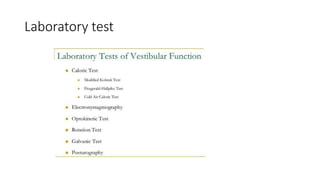
Laboratory test
NYSTAGMUS
• involuntary, rhythmical, rapid ,repetitive oscillatorymovement of eyes
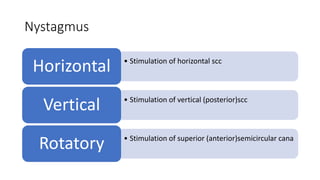
Nystagmus
• Stimulation of horizontal scc
Horizontal
• Stimulation of vertical (posterior)scc
Vertical
• Stimulation of superior (anterior)semicircular cana
Rotatory
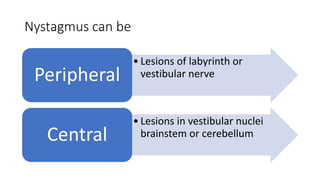
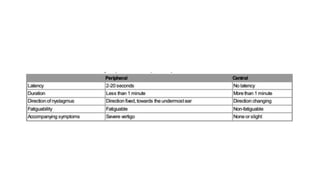
Nystagmus can be
• Lesions of labyrinth or
vestibular nervePeripheral
• Lesions in vestibular nuclei
brainstem or cerebellumCentral
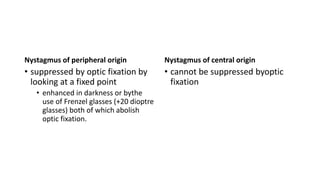
Nystagmus of peripheral origin
• suppressed by optic fixation by
looking at a fixed point
• enhanced in darkness or bythe
use of Frenzel glasses (+20 dioptre
glasses) both of which abolish
optic fixation.
Nystagmus of central origin
• cannot be suppressed byoptic
fixation
• Purely torsional nystagmus indicates lesion of the brain
stem/vestibular nuclei and is seen in syringomyelia.
• Vertical downbeat nystagmus indicates lesion at craniocervical region
such as Arnold-Chiari malformation or degenerative lesion of the
cerebellum.
• Vertical upbeat nystagmus is seen in lesions at the junction of pons
and medulla or pons and mid-brain.
• Pendular nystagmus is either congenital or acquired. The latter is seen
in multiple sclerosis. Pendular nystagmus mayalso be disconjugate,
i.e. vertical in one eye and horizontal in the other
Peripheral nystagmus
• Slow & peripheral component
• Direction of nystagmus is indicated by direction of fast component
• Irritative lesions of the labyrinth (serous labyrinthitis)
• nystagmus to the side of lesion.
• Paretic lesions (purulent labyrinthitis, trauma to labyrinth, section of
VIIIth nerve)
• nystagmus to the healthyside.
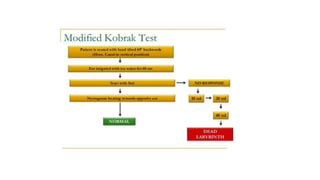
Caloric test
• Thermal stimulation 
nystagmus & sensation of
rotation
• Thermal gradient along lateral scc
• c/I in perforated TM
By caloric test only lateral scc can
be assessed
In perforated TM cold air caloric test
• Bithermal caloric test
• Cold caloric test
• Air caloric test
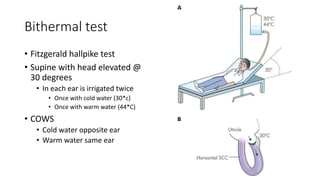
Bithermal test
• Fitzgerald hallpike test
• Supine with head elevated @
30 degrees
• In each ear is irrigated twice
• Once with cold water (30*c)
• Once with warm water (44*C)
• COWS
• Cold water opposite ear
• Warm water same ear
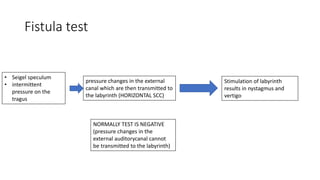
Fistula test
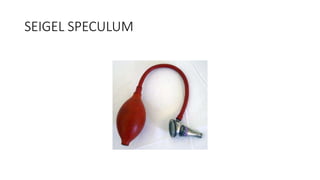
• Seigel speculum
• intermittent
pressure on the
tragus
pressure changes in the external
canal which are then transmitted to
the labyrinth (HORIZONTAL SCC)
Stimulation of labyrinth
results in nystagmus and
vertigo
NORMALLY TEST IS NEGATIVE
(pressure changes in the
external auditorycanal cannot
be transmitted to the labyrinth)
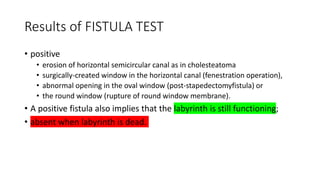
Results of FISTULA TEST
• positive
• erosion of horizontal semicircular canal as in cholesteatoma
• surgically-created window in the horizontal canal (fenestration operation),
• abnormal opening in the oval window (post-stapedectomyfistula) or
• the round window (rupture of round window membrane).
• A positive fistula also implies that the labyrinth is still functioning;
• absent when labyrinth is dead.
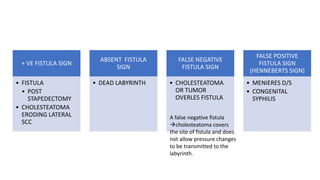
+ VE FISTULA SIGN
• FISTULA
• POST
STAPEDECTOMY
• CHOLESTEATOMA
ERODING LATERAL
SCC
ABSENT FISTULA
SIGN
• DEAD LABYRINTH
FALSE NEGATIVE
FISTULA SIGN
• CHOLESTEATOMA
OR TUMOR
OVERLES FISTULA
FALSE POSITIVE
FISTULA SIGN
(HENNEBERTS SIGN)
• MENIERES D/S
• CONGENITAL
SYPHILIS
A false negative fistula
cholesteatoma covers
the site of fistula and does
not allow pressure changes
to be transmitted to the
labyrinth.
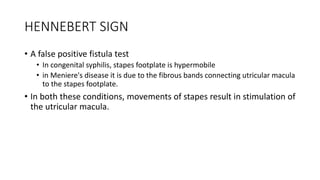
HENNEBERT SIGN
• A false positive fistula test
• In congenital syphilis, stapes footplate is hypermobile
• in Meniere's disease it is due to the fibrous bands connecting utricular macula
to the stapes footplate.
• In both these conditions, movements of stapes result in stimulation of
the utricular macula.
SEIGEL SPECULUM
USES OF SEIGEL SPECULUM
• TO TEST MOBILITY OF TYMPANIC MEMBRANE
• MAGNIFIED VIEW OF SMALL PERFORATION
• INTRODUCE MEDICINE INTO M/E
• PERFORM FISTULA TEST
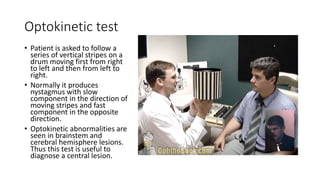
Optokinetic test
• Patient is asked to follow a
series of vertical stripes on a
drum moving first from right
to left and then from left to
right.
• Normally it produces
nystagmus with slow
component in the direction of
moving stripes and fast
component in the opposite
direction.
• Optokinetic abnormalities are
seen in brainstem and
cerebral hemisphere lesions.
Thus this test is useful to
diagnose a central lesion.
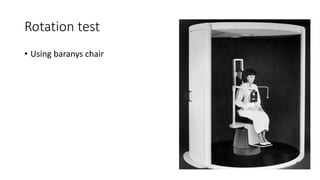
Rotation test
• Using baranys chair
Galvanic Test
• only vestibular test which helps in differentiating an end organ
lesion from that of vestibular nerve.
• Patient stands with his feet together, eyes closed and arms
outstretched and then a current of 1 mAis passed to one ear.
Normally, person sways towards the side of anodal current. Body
sway can be studied bya special platform
BPPV
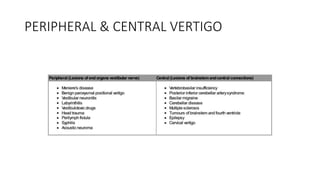
PERIPHERAL & CENTRAL VERTIGO
BPPV
• COMMONEST CAUSES OF PERIPHERAL VERTIGO
• COMMONEST CAUSE OF VERTIGO
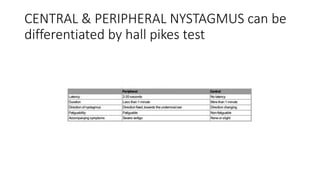
CENTRAL & PERIPHERAL NYSTAGMUS can be
differentiated by hall pikes test
PREDISPOSING CAUSES
• DEGENERATION
• TRAUMA
• HEAD INJURY
• INNER EAR DISEASE
• SUPPURATION
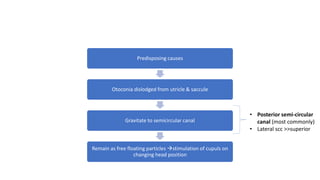
Predisposing causes
Otoconia dislodged from utricle & saccule
Gravitate to semicircular canal
Remain as free floating particles stimulation of cupuls on
changing head position
• Posterior semi-circular
canal (most commonly)
• Lateral scc >>superior
Diagnosis
• Hall pikes maneuver
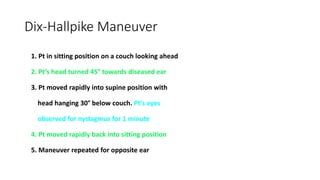
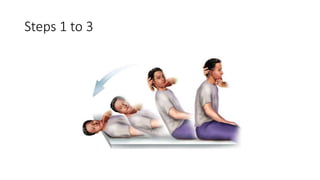
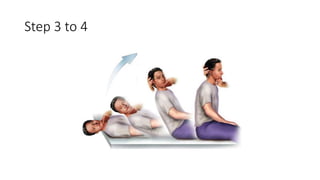
Dix-Hallpike Maneuver
1. Pt in sitting position on a couch looking ahead
2. Pt’s head turned 45° towards diseased ear
3. Pt moved rapidly into supine position with
head hanging 30° below couch. Pt’s eyes
observed for nystagmus for 1 minute
4. Pt moved rapidly back into sitting position
5. Maneuver repeated for opposite ear
Steps 1 to 3
Step 3 to 4
Rx of BPPV
Rx
• Epleys maneuver  RxOC
• Other therapeutic strategies
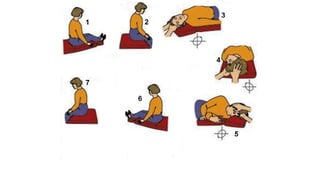
• Semonts maneuver
• Brandt darrof exercises
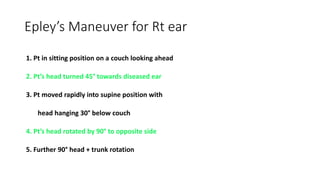
Epley’s Maneuver for Rt ear
1. Pt in sitting position on a couch looking ahead
2. Pt’s head turned 45° towards diseased ear
3. Pt moved rapidly into supine position with
head hanging 30° below couch
4. Pt’s head rotated by 90° to opposite side
5. Further 90° head + trunk rotation
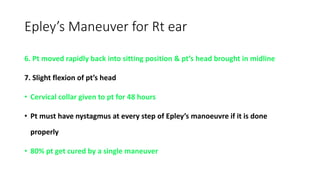
Epley’s Maneuver for Rt ear
6. Pt moved rapidly back into sitting position & pt’s head brought in midline
7. Slight flexion of pt’s head
• Cervical collar given to pt for 48 hours
• Pt must have nystagmus at every step of Epley’s manoeuvre if it is done
properly
• 80% pt get cured by a single maneuver
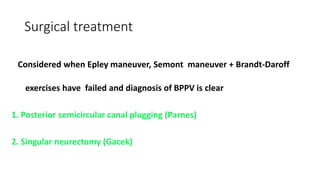
Surgical treatment
Considered when Epley maneuver, Semont maneuver + Brandt-Daroff
exercises have failed and diagnosis of BPPV is clear
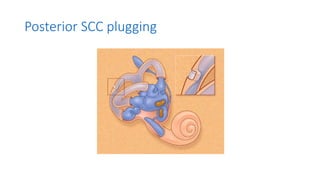
1. Posterior semicircular canal plugging (Parnes)
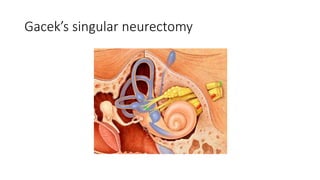
2. Singular neurectomy (Gacek)
Posterior SCC plugging
Gacek’s singular neurectomy
Vestibular neuronitis
• 2nd most common cause of peripheral vertigo after BPPV
• Following URTI  a/c onset vertigo
• Hearing is unaffected (unlike in a/c labyrinthitis )
Cogan syndrome
• Interstitial keratitis
• Audiovestibular involvement
• SNHL
• Vertigo
• Tinnitus
• Auto Ab against enothelium 
vasculitis affecting aorta renal
arteries & coronary arteries
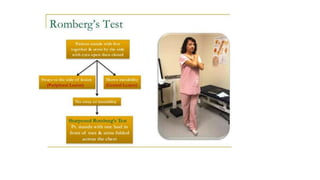
RHOMBERGS TEST

ASSESSMENT OF VESTIBULAR FUNCTION

  • 1.
  • 2.
  • 3.
  • 4.
    NYSTAGMUS • involuntary, rhythmical,rapid ,repetitive oscillatorymovement of eyes
  • 6.
    Nystagmus • Stimulation ofhorizontal scc Horizontal • Stimulation of vertical (posterior)scc Vertical • Stimulation of superior (anterior)semicircular cana Rotatory
  • 7.
    Nystagmus can be •Lesions of labyrinth or vestibular nervePeripheral • Lesions in vestibular nuclei brainstem or cerebellumCentral
  • 9.
    Nystagmus of peripheralorigin • suppressed by optic fixation by looking at a fixed point • enhanced in darkness or bythe use of Frenzel glasses (+20 dioptre glasses) both of which abolish optic fixation. Nystagmus of central origin • cannot be suppressed byoptic fixation
  • 10.
    • Purely torsionalnystagmus indicates lesion of the brain stem/vestibular nuclei and is seen in syringomyelia. • Vertical downbeat nystagmus indicates lesion at craniocervical region such as Arnold-Chiari malformation or degenerative lesion of the cerebellum. • Vertical upbeat nystagmus is seen in lesions at the junction of pons and medulla or pons and mid-brain. • Pendular nystagmus is either congenital or acquired. The latter is seen in multiple sclerosis. Pendular nystagmus mayalso be disconjugate, i.e. vertical in one eye and horizontal in the other
  • 11.
    Peripheral nystagmus • Slow& peripheral component • Direction of nystagmus is indicated by direction of fast component
  • 12.
    • Irritative lesionsof the labyrinth (serous labyrinthitis) • nystagmus to the side of lesion. • Paretic lesions (purulent labyrinthitis, trauma to labyrinth, section of VIIIth nerve) • nystagmus to the healthyside.
  • 13.
    Caloric test • Thermalstimulation  nystagmus & sensation of rotation • Thermal gradient along lateral scc • c/I in perforated TM By caloric test only lateral scc can be assessed In perforated TM cold air caloric test
  • 14.
    • Bithermal calorictest • Cold caloric test • Air caloric test
  • 15.
    Bithermal test • Fitzgeraldhallpike test • Supine with head elevated @ 30 degrees • In each ear is irrigated twice • Once with cold water (30*c) • Once with warm water (44*C) • COWS • Cold water opposite ear • Warm water same ear
  • 18.
    Fistula test • Seigelspeculum • intermittent pressure on the tragus pressure changes in the external canal which are then transmitted to the labyrinth (HORIZONTAL SCC) Stimulation of labyrinth results in nystagmus and vertigo NORMALLY TEST IS NEGATIVE (pressure changes in the external auditorycanal cannot be transmitted to the labyrinth)
  • 19.
    Results of FISTULATEST • positive • erosion of horizontal semicircular canal as in cholesteatoma • surgically-created window in the horizontal canal (fenestration operation), • abnormal opening in the oval window (post-stapedectomyfistula) or • the round window (rupture of round window membrane). • A positive fistula also implies that the labyrinth is still functioning; • absent when labyrinth is dead.
  • 20.
    + VE FISTULASIGN • FISTULA • POST STAPEDECTOMY • CHOLESTEATOMA ERODING LATERAL SCC ABSENT FISTULA SIGN • DEAD LABYRINTH FALSE NEGATIVE FISTULA SIGN • CHOLESTEATOMA OR TUMOR OVERLES FISTULA FALSE POSITIVE FISTULA SIGN (HENNEBERTS SIGN) • MENIERES D/S • CONGENITAL SYPHILIS A false negative fistula cholesteatoma covers the site of fistula and does not allow pressure changes to be transmitted to the labyrinth.
  • 21.
    HENNEBERT SIGN • Afalse positive fistula test • In congenital syphilis, stapes footplate is hypermobile • in Meniere's disease it is due to the fibrous bands connecting utricular macula to the stapes footplate. • In both these conditions, movements of stapes result in stimulation of the utricular macula.
  • 22.
  • 23.
    USES OF SEIGELSPECULUM • TO TEST MOBILITY OF TYMPANIC MEMBRANE • MAGNIFIED VIEW OF SMALL PERFORATION • INTRODUCE MEDICINE INTO M/E • PERFORM FISTULA TEST
  • 24.
    Optokinetic test • Patientis asked to follow a series of vertical stripes on a drum moving first from right to left and then from left to right. • Normally it produces nystagmus with slow component in the direction of moving stripes and fast component in the opposite direction. • Optokinetic abnormalities are seen in brainstem and cerebral hemisphere lesions. Thus this test is useful to diagnose a central lesion.
  • 25.
  • 26.
    Galvanic Test • onlyvestibular test which helps in differentiating an end organ lesion from that of vestibular nerve. • Patient stands with his feet together, eyes closed and arms outstretched and then a current of 1 mAis passed to one ear. Normally, person sways towards the side of anodal current. Body sway can be studied bya special platform
  • 27.
  • 28.
  • 29.
    BPPV • COMMONEST CAUSESOF PERIPHERAL VERTIGO • COMMONEST CAUSE OF VERTIGO
  • 30.
    CENTRAL & PERIPHERALNYSTAGMUS can be differentiated by hall pikes test
  • 31.
    PREDISPOSING CAUSES • DEGENERATION •TRAUMA • HEAD INJURY • INNER EAR DISEASE • SUPPURATION
  • 32.
    Predisposing causes Otoconia dislodgedfrom utricle & saccule Gravitate to semicircular canal Remain as free floating particles stimulation of cupuls on changing head position • Posterior semi-circular canal (most commonly) • Lateral scc >>superior
  • 33.
  • 34.
    Dix-Hallpike Maneuver 1. Ptin sitting position on a couch looking ahead 2. Pt’s head turned 45° towards diseased ear 3. Pt moved rapidly into supine position with head hanging 30° below couch. Pt’s eyes observed for nystagmus for 1 minute 4. Pt moved rapidly back into sitting position 5. Maneuver repeated for opposite ear
  • 35.
  • 36.
  • 37.
  • 38.
    Rx • Epleys maneuver RxOC • Other therapeutic strategies • Semonts maneuver • Brandt darrof exercises
  • 40.
    Epley’s Maneuver forRt ear 1. Pt in sitting position on a couch looking ahead 2. Pt’s head turned 45° towards diseased ear 3. Pt moved rapidly into supine position with head hanging 30° below couch 4. Pt’s head rotated by 90° to opposite side 5. Further 90° head + trunk rotation
  • 41.
    Epley’s Maneuver forRt ear 6. Pt moved rapidly back into sitting position & pt’s head brought in midline 7. Slight flexion of pt’s head • Cervical collar given to pt for 48 hours • Pt must have nystagmus at every step of Epley’s manoeuvre if it is done properly • 80% pt get cured by a single maneuver
  • 42.
    Surgical treatment Considered whenEpley maneuver, Semont maneuver + Brandt-Daroff exercises have failed and diagnosis of BPPV is clear 1. Posterior semicircular canal plugging (Parnes) 2. Singular neurectomy (Gacek)
  • 43.
  • 44.
  • 45.
    Vestibular neuronitis • 2ndmost common cause of peripheral vertigo after BPPV • Following URTI  a/c onset vertigo • Hearing is unaffected (unlike in a/c labyrinthitis )
  • 46.
    Cogan syndrome • Interstitialkeratitis • Audiovestibular involvement • SNHL • Vertigo • Tinnitus • Auto Ab against enothelium  vasculitis affecting aorta renal arteries & coronary arteries
  • 48.