AUDITORY NEUROPATHY SPECTRUM
DISORDER
Dr Anusree A Karun 2nd yr DLO
UIORL Madras Medical College
Chennai
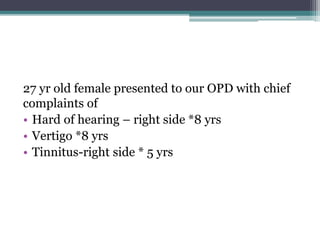
27 yr old female presented to our OPD with chief
complaints of
• Hard of hearing – right side *8 yrs
• Vertigo *8 yrs
• Tinnitus-right side * 5 yrs
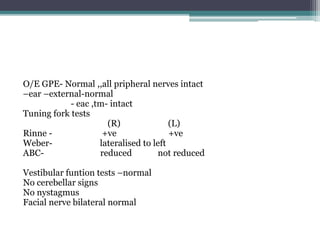
O/E GPE- Normal ,,all pripheral nerves intact
–ear –external-normal
- eac ,tm- intact
Tuning fork tests
(R) (L)
Rinne - +ve +ve
Weber- lateralised to left
ABC- reduced not reduced
Vestibular funtion tests –normal
No cerebellar signs
No nystagmus
Facial nerve bilateral normal
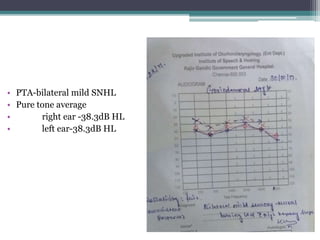
• PTA-bilateral mild SNHL
• Pure tone average
• right ear -38.3dB HL
• left ear-38.3dB HL
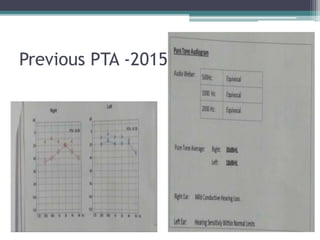
Previous PTA -2015
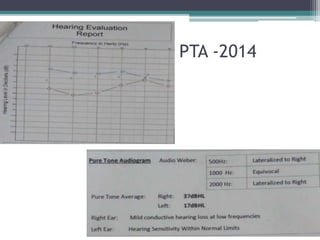
PTA -2014
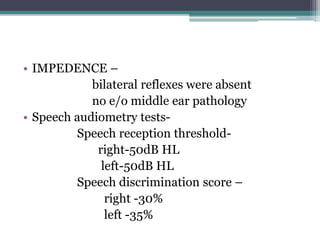
• IMPEDENCE –
bilateral reflexes were absent
no e/o middle ear pathology
• Speech audiometry tests-
Speech reception threshold-
right-50dB HL
left-50dB HL
Speech discrimination score –
right -30%
left -35%
• OAE-bilateral OHC functional
• BERA
- for all five waves peaks could not be
obtained at 90dB HL for click stimuli at a
repetition rate of 11.1 clicks per seconds
-Wave morphology & replicability was poor
• CERA
-prolonged latency and reduced amplitude
-abnormal waves
….Hearing ,feeling but never truly
comprehending
• Audiologic evaluation revealed ….
• HEARING LOSS AND SPEECH
INTELLIGIBILTY SCORES OUT OF
PROPORTION TO HER PRESUMED HEARING
LOSS
Progressive ANSD
• Only treatment options left with us to address
her complaints were–
SPEECH ENHANCING STRATEGIES
COMMUNICATION STRATEGIES
ASSERTIVE TRAINING
As she was not ideal for a hearing aid or
implantation considering her magnitude of
hearing loss
AUDITORY NEUROPATHY
or AUDITORY DYSSYNCHRONY
• Describes a diagnosis with observations of
inconsistent measures of hearing, i.e. where
hearing sensitivity is better than might have
been expected from the acoustic brainstem
evoked responses
• Cochlear amplification is preserved in these individuals,
but discharges from the auditory nerve is asynchronous
• Synchronous firing of auditory nerve fibers is important
for extracting complex acoustic features such as spectral
peaks and waveform envelopes for speech recognition.
• The inability to follow temporal fluctuations is an
important cause for poor speech perception in
individuals with ANSD
…...characterised by
 Normal outer hair cell function evidenced by
normal EOAE and / or cochlear microphonics
responses coupled with
absent or severely abnormal ABR responses
Pure tone audiogram may range from normal to
profound hearing loss
Elevated or absent middle ear reflexes
• Impaired speech discrimination scores and increased
speech reception thresholds
Rule out central auditory processing disorders
• Binaural intergration and seperation
• Monoaural low redundacy speech
• Temporal resolution measurement
gap in noise test
amplitude modulation detection test
• LLR
PREVALENCE
• Overall prevalence rare- 1-3 children per 10,000
births
• 40% in neonates with high risk for HL
• 2-15% in children with known hearing loss
• 1 in 10 children with hearing loss and severely
abnormal BERA
PREVALENCE
• Our data shows (study conducted in rgggh mmc
ISH 2010-2012) prevalence of ANSD among
sensory neural hearing impaired is not rare but
accounts for 5.06%
• Prevalence among children undergoing
screening -0.42%
More common in children
50 % of all cases and 92 % of all bilateral cases
manifests before 4 yrs of age
Late onset ANSD –Rare incidence
RISK FACTORS
• Neonatal history of
anoxia
hyperbilirubinemia
mechanical ventilation
• Congenital brain abnormalities
• Low birth weight
• Extreme Prematurity- < 28 wks
• Genetic or family history of AN/AD
• Also seen in association with Viral diseases , seizure
disorders, high grade fever
ETIOLOGY
• Abnormality causing AN/AD resides in the lower
auditory system- specifically
 damaged inner hair cells
 abnormal IHC - auditory nerve synapse
the spiral ganglion neurons
or the axons or dendrites of the auditory nerve
itself.
Reduced neuronal populations in brainstem
• Mutation in otoferlin-most common genetic
cause of non syndromic AN
• Otoferlin is a calcium detector for exostosis –required for replenishment of
vesicles in active regions
• Absence of functional otoferlin protein
selectively affects the inner hair cell synapse,
resulting in profound deafness with preserved
OHC function.
Etiology and associated conditions
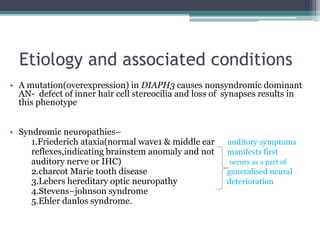
• A mutation(overexpression) in DIAPH3 causes nonsyndromic dominant
AN- defect of inner hair cell stereocilia and loss of synapses results in
this phenotype
• Syndromic neuropathies–
1.Friederich ataxia(normal wave1 & middle ear auditory symptoms
reflexes,indicating brainstem anomaly and not manifests first
auditory nerve or IHC) occurs as a part of
2.charcot Marie tooth disease generalised neural
3.Lebers hereditary optic neuropathy deterioration
4.Stevens–johnson syndrome
5.Ehler danlos syndrome.
Etiology and associated conditions
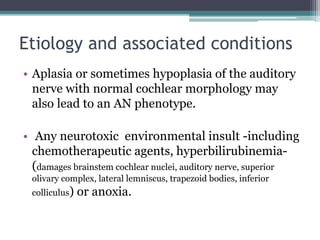
• Aplasia or sometimes hypoplasia of the auditory
nerve with normal cochlear morphology may
also lead to an AN phenotype.
• Any neurotoxic environmental insult -including
chemotherapeutic agents, hyperbilirubinemia-
(damages brainstem cochlear nuclei, auditory nerve, superior
olivary complex, lateral lemniscus, trapezoid bodies, inferior
colliculus) or anoxia.
Treatment
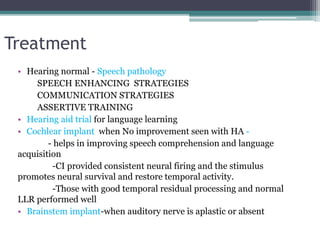
• Hearing normal - Speech pathology
SPEECH ENHANCING STRATEGIES
COMMUNICATION STRATEGIES
ASSERTIVE TRAINING
• Hearing aid trial for language learning
• Cochlear implant when No improvement seen with HA -
- helps in improving speech comprehension and language
acquisition
-CI provided consistent neural firing and the stimulus
promotes neural survival and restore temporal activity.
-Those with good temporal residual processing and normal
LLR performed well
• Brainstem implant-when auditory nerve is aplastic or absent
Our statistics
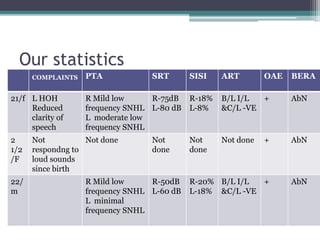
COMPLAINTS PTA SRT SISI ART OAE BERA
21/f L HOH
Reduced
clarity of
speech
R Mild low
frequency SNHL
L moderate low
frequency SNHL
R-75dB
L-80 dB
R-18%
L-8%
B/L I/L
&C/L -VE
+ AbN
2
1/2
/F
Not
respondng to
loud sounds
since birth
Not done Not
done
Not
done
Not done + AbN
22/
m
R Mild low
frequency SNHL
L minimal
frequency SNHL
R-50dB
L-60 dB
R-20%
L-18%
B/L I/L
&C/L -VE
+ AbN
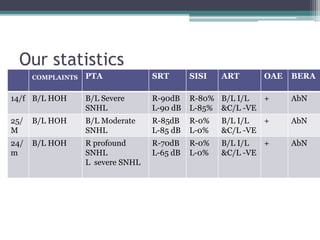
Our statistics
COMPLAINTS PTA SRT SISI ART OAE BERA
14/f B/L HOH B/L Severe
SNHL
R-90dB
L-90 dB
R-80%
L-85%
B/L I/L
&C/L -VE
+ AbN
25/
M
B/L HOH B/L Moderate
SNHL
R-85dB
L-85 dB
R-0%
L-0%
B/L I/L
&C/L -VE
+ AbN
24/
m
B/L HOH R profound
SNHL
L severe SNHL
R-70dB
L-65 dB
R-0%
L-0%
B/L I/L
&C/L -VE
+ AbN
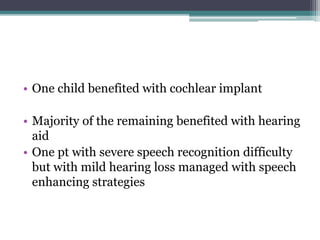
• One child benefited with cochlear implant
• Majority of the remaining benefited with hearing
aid
• One pt with severe speech recognition difficulty
but with mild hearing loss managed with speech
enhancing strategies
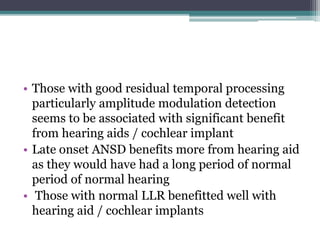
• Those with good residual temporal processing
particularly amplitude modulation detection
seems to be associated with significant benefit
from hearing aids / cochlear implant
• Late onset ANSD benefits more from hearing aid
as they would have had a long period of normal
period of normal hearing
• Those with normal LLR benefitted well with
hearing aid / cochlear implants
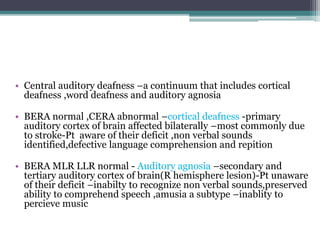
• Central auditory deafness –a continuum that includes cortical
deafness ,word deafness and auditory agnosia
• BERA normal ,CERA abnormal –cortical deafness -primary
auditory cortex of brain affected bilaterally –most commonly due
to stroke-Pt aware of their deficit ,non verbal sounds
identified,defective language comprehension and repition
• BERA MLR LLR normal - Auditory agnosia –secondary and
tertiary auditory cortex of brain(R hemisphere lesion)-Pt unaware
of their deficit –inabilty to recognize non verbal sounds,preserved
ability to comprehend speech ,amusia a subtype –inablity to
percieve music
..take home message
• Neonatal screening should include BERA and not just OAE especially in
high risk cases
• Always consider AN/AD as a DD for SNHL in children and adults especially
those with speech recognition difficulties
• Clearer protocols to locate site of insult in AD/AN is lacking ,,, eg : no tests
are available to asses the function of IHC
• Need protocols to describe
-stable AN/AD
-progressive AN/AD- manifests in adolescents or early childhood
-reversible AN/AD
-maturational defects
• Hearing aid or cochlear implant??

auditory neuropathy spectrum disorder

  • 1.
    AUDITORY NEUROPATHY SPECTRUM DISORDER DrAnusree A Karun 2nd yr DLO UIORL Madras Medical College Chennai
  • 2.
    27 yr oldfemale presented to our OPD with chief complaints of • Hard of hearing – right side *8 yrs • Vertigo *8 yrs • Tinnitus-right side * 5 yrs
  • 3.
    O/E GPE- Normal,,all pripheral nerves intact –ear –external-normal - eac ,tm- intact Tuning fork tests (R) (L) Rinne - +ve +ve Weber- lateralised to left ABC- reduced not reduced Vestibular funtion tests –normal No cerebellar signs No nystagmus Facial nerve bilateral normal
  • 4.
    • PTA-bilateral mildSNHL • Pure tone average • right ear -38.3dB HL • left ear-38.3dB HL
  • 5.
  • 6.
  • 7.
    • IMPEDENCE – bilateralreflexes were absent no e/o middle ear pathology • Speech audiometry tests- Speech reception threshold- right-50dB HL left-50dB HL Speech discrimination score – right -30% left -35%
  • 8.
    • OAE-bilateral OHCfunctional • BERA - for all five waves peaks could not be obtained at 90dB HL for click stimuli at a repetition rate of 11.1 clicks per seconds -Wave morphology & replicability was poor • CERA -prolonged latency and reduced amplitude -abnormal waves
  • 9.
    ….Hearing ,feeling butnever truly comprehending • Audiologic evaluation revealed …. • HEARING LOSS AND SPEECH INTELLIGIBILTY SCORES OUT OF PROPORTION TO HER PRESUMED HEARING LOSS Progressive ANSD
  • 10.
    • Only treatmentoptions left with us to address her complaints were– SPEECH ENHANCING STRATEGIES COMMUNICATION STRATEGIES ASSERTIVE TRAINING As she was not ideal for a hearing aid or implantation considering her magnitude of hearing loss
  • 11.
    AUDITORY NEUROPATHY or AUDITORYDYSSYNCHRONY • Describes a diagnosis with observations of inconsistent measures of hearing, i.e. where hearing sensitivity is better than might have been expected from the acoustic brainstem evoked responses
  • 12.
    • Cochlear amplificationis preserved in these individuals, but discharges from the auditory nerve is asynchronous • Synchronous firing of auditory nerve fibers is important for extracting complex acoustic features such as spectral peaks and waveform envelopes for speech recognition. • The inability to follow temporal fluctuations is an important cause for poor speech perception in individuals with ANSD
  • 13.
    …...characterised by  Normalouter hair cell function evidenced by normal EOAE and / or cochlear microphonics responses coupled with absent or severely abnormal ABR responses Pure tone audiogram may range from normal to profound hearing loss Elevated or absent middle ear reflexes
  • 14.
    • Impaired speechdiscrimination scores and increased speech reception thresholds Rule out central auditory processing disorders • Binaural intergration and seperation • Monoaural low redundacy speech • Temporal resolution measurement gap in noise test amplitude modulation detection test • LLR
  • 15.
    PREVALENCE • Overall prevalencerare- 1-3 children per 10,000 births • 40% in neonates with high risk for HL • 2-15% in children with known hearing loss • 1 in 10 children with hearing loss and severely abnormal BERA
  • 16.
    PREVALENCE • Our datashows (study conducted in rgggh mmc ISH 2010-2012) prevalence of ANSD among sensory neural hearing impaired is not rare but accounts for 5.06% • Prevalence among children undergoing screening -0.42%
  • 17.
    More common inchildren 50 % of all cases and 92 % of all bilateral cases manifests before 4 yrs of age Late onset ANSD –Rare incidence
  • 18.
    RISK FACTORS • Neonatalhistory of anoxia hyperbilirubinemia mechanical ventilation • Congenital brain abnormalities • Low birth weight • Extreme Prematurity- < 28 wks • Genetic or family history of AN/AD • Also seen in association with Viral diseases , seizure disorders, high grade fever
  • 19.
    ETIOLOGY • Abnormality causingAN/AD resides in the lower auditory system- specifically  damaged inner hair cells  abnormal IHC - auditory nerve synapse the spiral ganglion neurons or the axons or dendrites of the auditory nerve itself. Reduced neuronal populations in brainstem
  • 20.
    • Mutation inotoferlin-most common genetic cause of non syndromic AN • Otoferlin is a calcium detector for exostosis –required for replenishment of vesicles in active regions • Absence of functional otoferlin protein selectively affects the inner hair cell synapse, resulting in profound deafness with preserved OHC function.
  • 21.
    Etiology and associatedconditions • A mutation(overexpression) in DIAPH3 causes nonsyndromic dominant AN- defect of inner hair cell stereocilia and loss of synapses results in this phenotype • Syndromic neuropathies– 1.Friederich ataxia(normal wave1 & middle ear auditory symptoms reflexes,indicating brainstem anomaly and not manifests first auditory nerve or IHC) occurs as a part of 2.charcot Marie tooth disease generalised neural 3.Lebers hereditary optic neuropathy deterioration 4.Stevens–johnson syndrome 5.Ehler danlos syndrome.
  • 22.
    Etiology and associatedconditions • Aplasia or sometimes hypoplasia of the auditory nerve with normal cochlear morphology may also lead to an AN phenotype. • Any neurotoxic environmental insult -including chemotherapeutic agents, hyperbilirubinemia- (damages brainstem cochlear nuclei, auditory nerve, superior olivary complex, lateral lemniscus, trapezoid bodies, inferior colliculus) or anoxia.
  • 23.
    Treatment • Hearing normal- Speech pathology SPEECH ENHANCING STRATEGIES COMMUNICATION STRATEGIES ASSERTIVE TRAINING • Hearing aid trial for language learning • Cochlear implant when No improvement seen with HA - - helps in improving speech comprehension and language acquisition -CI provided consistent neural firing and the stimulus promotes neural survival and restore temporal activity. -Those with good temporal residual processing and normal LLR performed well • Brainstem implant-when auditory nerve is aplastic or absent
  • 24.
    Our statistics COMPLAINTS PTASRT SISI ART OAE BERA 21/f L HOH Reduced clarity of speech R Mild low frequency SNHL L moderate low frequency SNHL R-75dB L-80 dB R-18% L-8% B/L I/L &C/L -VE + AbN 2 1/2 /F Not respondng to loud sounds since birth Not done Not done Not done Not done + AbN 22/ m R Mild low frequency SNHL L minimal frequency SNHL R-50dB L-60 dB R-20% L-18% B/L I/L &C/L -VE + AbN
  • 25.
    Our statistics COMPLAINTS PTASRT SISI ART OAE BERA 14/f B/L HOH B/L Severe SNHL R-90dB L-90 dB R-80% L-85% B/L I/L &C/L -VE + AbN 25/ M B/L HOH B/L Moderate SNHL R-85dB L-85 dB R-0% L-0% B/L I/L &C/L -VE + AbN 24/ m B/L HOH R profound SNHL L severe SNHL R-70dB L-65 dB R-0% L-0% B/L I/L &C/L -VE + AbN
  • 26.
    • One childbenefited with cochlear implant • Majority of the remaining benefited with hearing aid • One pt with severe speech recognition difficulty but with mild hearing loss managed with speech enhancing strategies
  • 27.
    • Those withgood residual temporal processing particularly amplitude modulation detection seems to be associated with significant benefit from hearing aids / cochlear implant • Late onset ANSD benefits more from hearing aid as they would have had a long period of normal period of normal hearing • Those with normal LLR benefitted well with hearing aid / cochlear implants
  • 28.
    • Central auditorydeafness –a continuum that includes cortical deafness ,word deafness and auditory agnosia • BERA normal ,CERA abnormal –cortical deafness -primary auditory cortex of brain affected bilaterally –most commonly due to stroke-Pt aware of their deficit ,non verbal sounds identified,defective language comprehension and repition • BERA MLR LLR normal - Auditory agnosia –secondary and tertiary auditory cortex of brain(R hemisphere lesion)-Pt unaware of their deficit –inabilty to recognize non verbal sounds,preserved ability to comprehend speech ,amusia a subtype –inablity to percieve music
  • 29.
    ..take home message •Neonatal screening should include BERA and not just OAE especially in high risk cases • Always consider AN/AD as a DD for SNHL in children and adults especially those with speech recognition difficulties • Clearer protocols to locate site of insult in AD/AN is lacking ,,, eg : no tests are available to asses the function of IHC • Need protocols to describe -stable AN/AD -progressive AN/AD- manifests in adolescents or early childhood -reversible AN/AD -maturational defects • Hearing aid or cochlear implant??