Fever
     with
        rash
         UMA PERUMAL
   A rash is a visible lesion of the skin due to
    disease.

   RASH AND FEVER              The condition can be
  a primary skin disorder or a symptom of a
  systemic process.
 When considering the differential diagnosis of a
  rash, it is important to be able to describe its
  feature. Ask the child’s parents about the
  appearance, because rashes often change with
  time.

   Diseases that present with fever and rash are
    usually classified according to the morphology of
    primary lesion.
 MEASLES


 RUBELLA


 HAND
    FOOT AND
MOUTH DIEASES
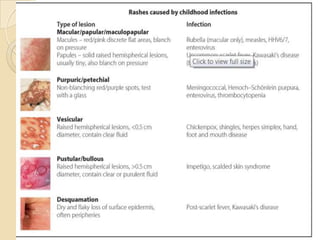
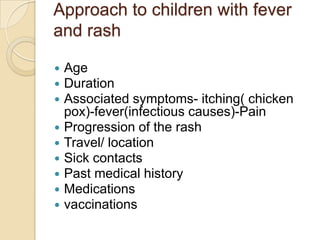
Morphology classification of
rash
 Maculapapular
 Petechial-purpuric
 Vesicular bullous pustular
 Nodular
 Diffusely erythematous with
  desqumation.
Approach to children with fever
and rash

   Age
   Duration
   Associated symptoms- itching( chicken
    pox)-fever(infectious causes)-Pain
   Progression of the rash
   Travel/ location
   Sick contacts
   Past medical history
   Medications
   vaccinations
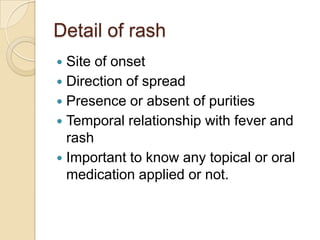
Detail of rash
 Site of onset
 Direction of spread
 Presence or absent of purities
 Temporal relationship with fever and
  rash
 Important to know any topical or oral
  medication applied or not.
Look for

   Patient’s vital sign and general
    appearance
   Sign of toxicity
   Lympho Adenopathy
   Oral, genital or conjunctiva lesion
   Hepato-splenomegaly
   Evidences of excoriation and tendrenss
   Sign of neck rigidity or neurological
    dysfunction.
   The scalp and hair for : areas of
    inflammation, scaling or hair loss.
Laboratory data
   Complete blood count with differential
    erythrocyte sedimentation rate
   Blood and urine culture
   Biochemical analysis- liver function test
   Biopsy sample from non healing or
    persistent purpuric lesion
   Biopsy of inflammatory dermal nodules
    and ulcer
   Aspirate, scraping and pustular fluid may
    be obtain for gram staining and culture
Measles
Etiology:
  Specific RNA virus. Only one serotype
  is known (life long immunity after
  infection).
Essentials of Diagnosis:
-History of exposure 10-12 days
  previously.
-3-5 days prodroma (fever,
  conjunctivitis, coryza and cough).
-Koplik spots (Pathognomonic)
-Maculopapular confluent rash.
Mode of Transmission:
-Contact with secretions or droplets of an infected child.
Period of Infectivity:
-4 days prior to and 5 days after appearance of the rash.

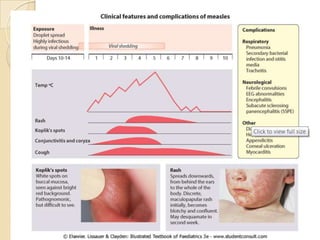
Clinical Manifestations:              An incubation stage 10-12
    days
   Prodromal stage with an enanthem (Koplik spots), usually lasts
    3-5 days. Koplik spots are grayish white dots on an
    erythematous base on the anterior portion of the buccal mucosa.
    With appearance of rash, Koplik spots start to disappear.

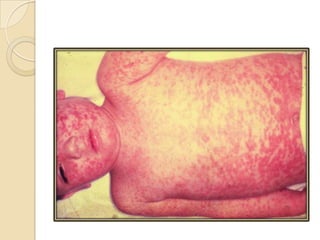
   Final stage starts with a maculopapular rash accompanied by
    high fever. The rash starts behind the ears, and along the hairline.
    Then the rash spreads on the face, neck, upper arms, and upper
    part of the chest within the first 24 hours.
   On 2nd day. The rash appears on the back, abdomen, arms and
    thighs.
   On 3rd day. It reaches the feet and begins to fade on the face.

   An abrupt drop in temperature to normal. The rash fades
    downward in the same sequence in which it appeared
Diagnosis: Clinical features but Laboratory tests is rarely
    needed.
   Leukocytic count tends to be low with a relative lymphocytosis.
    Leucocytosis is indicative of secondary bacterial infection.
Complications: *The main complications of measles are otitis
    media and pneumonia. *Encephalitis; *Diarrhea and dysentery.
    *Corneal ulcer and stomatitis.         *Activation of a tuberculous
      focus. Supportive therapy:            -Antipyretics
      (paracetamol)
   Bed rest and an adequate fluid intake are indicated.
   A nourishing easily digested diet and proper cleanliness.
   Vitamin A: A single dose of 50,000 to 200,000 IU.
   A broad spectrum antibiotic in presence of infections.
Prevention: *Isolation should be maintained from the 7th day
    after exposure until 5 days after the rash has appeared.
     *Measles vaccine.           *Post-exposure prophylaxis.
       - Hemorrhagic measles        - PEM
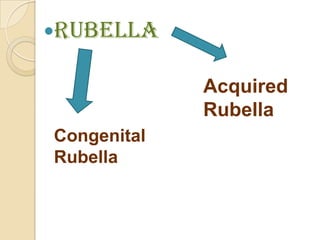
RUBELLA

             Acquired
             Rubella
Congenital
Rubella
Acquired Rubella
Etiology: Rubella virus (an RNA virus). Incubation
    Period: 2-3 weeks.
Mode of Transmission:
•   Droplet infection or direct contact with a case

Prodromal stage: Very short and mild that it goes
 unnoticed.
Contagiousness: Not as contagious as measles.
  – Virus is present in nasopharyngeal
    secretions, blood, feces and urine.
  – Virus has been recovered from the nasopharynx 7
    days before exanthema and 7-8 days after its
    disappearance.
  – Infants with congenital rubella are contagious for
    at least 10-12 months.
Clinical Manifestations:
•   Age: Any age, peak incidence 5-14 years
•   Lymphadenopathy is evident at least 24hr
    before the rash appears.

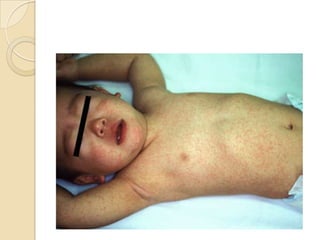
• The exanthem begins on the face and spreads
  quickly on the first day.
• 2nd day. The rash is confluent and pinpoint like
  that of scarlet fever with mild itching.
• 3rd day. The rash generally disappears with
  minimal desquamation and no scaring.

•   Rubella without rash may occur as fever with
    enlarged tender lymphadenopathy which may
    persist for a week or more.
Complications:
Complications are relatively uncommon in
  childhood.
 Encephalitis similar to that seen with measles
 Polyarthritis
Prophylaxis:
 Active immunization (MMR vaccine)
-MMR vaccine should not be given to pregnant
  women; vaccinated women should avoid
  pregnancy for 3 months after vaccination.
  Natural infection gives life- long immunity.
 Passive immunization. It is not indicated
  except in non-immune pregnant women.
  Immune serum globulin (ISG) in big doses is
  given I.M within one week of exposure.
Treatment:
1- Antipyretics for fever. 2- Treatment of
Congenital Rubella
 If rubella develops during the first trimester of
 pregnancy, (which is the period of organogenesis).

 Transplacental congenital infection from infected
 mother.


Features of congenital rubella syndrome:
1-Intrauterine growth retardation, small for
  gestational age and failure to thrive
2-Nerve deafness
3- Microcephaly and mental retardation
4- Congenital heart disease (PDA, VSD)
5- Cataract, glaucoma, and cloudy cornea
6- Thrombocytopenic purpura, hepatosplenomegaly,
  and osteopathy
 HFMD-  Is common viral infection that
 primarily effected infant and young
 children under 10 years old. Its caused
 by virus.
 Is an endemic disease in Malaysia.


 Become  an important public health
 disease due to its tendency to cause
 large outbreaks and deaths among
 children and infants.
Etiology agent
 Intestinal viruses of the picornaviridae famil
 Coxsacki virus A16
 Enterovirus 71 (EV71)


Incubation period
 3 to 7 days
 Preceded by fever
 Followed by blister/rash
Transmitted
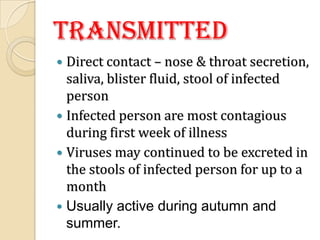
 Direct contact – nose & throat secretion,
  saliva, blister fluid, stool of infected
  person
 Infected person are most contagious
  during first week of illness
 Viruses may continued to be excreted in
  the stools of infected person for up to a
  month
 Usually active during autumn and
  summer.
Clinical feature
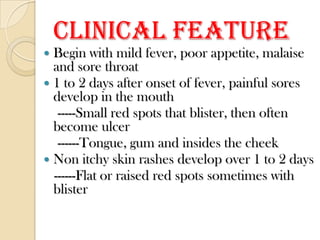
 Begin with mild fever, poor appetite, malaise
  and sore throat
 1 to 2 days after onset of fever, painful sores
  develop in the mouth
   -----Small red spots that blister, then often
  become ulcer
   ------Tongue, gum and insides the cheek
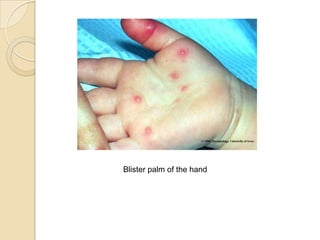
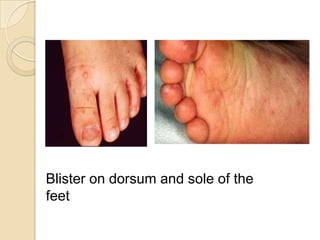
 Non itchy skin rashes develop over 1 to 2 days
  ------Flat or raised red spots sometimes with
  blister
Blister palm of the hand
Blister on dorsum and sole of the
feet
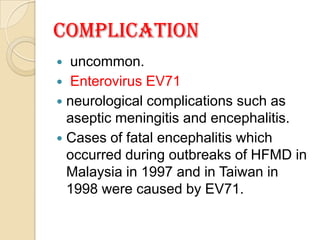
Complication
 uncommon.
 Enterovirus EV71
 neurological complications such as
  aseptic meningitis and encephalitis.
 Cases of fatal encephalitis which
  occurred during outbreaks of HFMD in
  Malaysia in 1997 and in Taiwan in
  1998 were caused by EV71.
Diagnosed
 Clinical finding
 Serological test
 Throat swab
 Stool culture
Treatment
 Symptomatic treatment
 Fever treated with antipyrexia
 Pain with analgesia
 Mouth washes to lessen the oral pain
 Adequate fluid intake- dehydration
 No specific effective antiviral and
  vaccination
THANK YOU!!!

Fever and rash by Dr.Uma

  • 1.
    Fever with rash UMA PERUMAL
  • 2.
    A rash is a visible lesion of the skin due to disease.  RASH AND FEVER The condition can be a primary skin disorder or a symptom of a systemic process.  When considering the differential diagnosis of a rash, it is important to be able to describe its feature. Ask the child’s parents about the appearance, because rashes often change with time.  Diseases that present with fever and rash are usually classified according to the morphology of primary lesion.
  • 3.
     MEASLES  RUBELLA HAND FOOT AND MOUTH DIEASES
  • 4.
    Morphology classification of rash Maculapapular  Petechial-purpuric  Vesicular bullous pustular  Nodular  Diffusely erythematous with desqumation.
  • 6.
    Approach to childrenwith fever and rash  Age  Duration  Associated symptoms- itching( chicken pox)-fever(infectious causes)-Pain  Progression of the rash  Travel/ location  Sick contacts  Past medical history  Medications  vaccinations
  • 7.
    Detail of rash Site of onset  Direction of spread  Presence or absent of purities  Temporal relationship with fever and rash  Important to know any topical or oral medication applied or not.
  • 8.
    Look for  Patient’s vital sign and general appearance  Sign of toxicity  Lympho Adenopathy  Oral, genital or conjunctiva lesion  Hepato-splenomegaly  Evidences of excoriation and tendrenss  Sign of neck rigidity or neurological dysfunction.  The scalp and hair for : areas of inflammation, scaling or hair loss.
  • 9.
    Laboratory data  Complete blood count with differential erythrocyte sedimentation rate  Blood and urine culture  Biochemical analysis- liver function test  Biopsy sample from non healing or persistent purpuric lesion  Biopsy of inflammatory dermal nodules and ulcer  Aspirate, scraping and pustular fluid may be obtain for gram staining and culture
  • 11.
    Measles Etiology: SpecificRNA virus. Only one serotype is known (life long immunity after infection). Essentials of Diagnosis: -History of exposure 10-12 days previously. -3-5 days prodroma (fever, conjunctivitis, coryza and cough). -Koplik spots (Pathognomonic) -Maculopapular confluent rash.
  • 12.
    Mode of Transmission: -Contactwith secretions or droplets of an infected child. Period of Infectivity: -4 days prior to and 5 days after appearance of the rash. Clinical Manifestations: An incubation stage 10-12 days  Prodromal stage with an enanthem (Koplik spots), usually lasts 3-5 days. Koplik spots are grayish white dots on an erythematous base on the anterior portion of the buccal mucosa. With appearance of rash, Koplik spots start to disappear.  Final stage starts with a maculopapular rash accompanied by high fever. The rash starts behind the ears, and along the hairline. Then the rash spreads on the face, neck, upper arms, and upper part of the chest within the first 24 hours.  On 2nd day. The rash appears on the back, abdomen, arms and thighs.  On 3rd day. It reaches the feet and begins to fade on the face.  An abrupt drop in temperature to normal. The rash fades downward in the same sequence in which it appeared
  • 13.
    Diagnosis: Clinical featuresbut Laboratory tests is rarely needed.  Leukocytic count tends to be low with a relative lymphocytosis. Leucocytosis is indicative of secondary bacterial infection. Complications: *The main complications of measles are otitis media and pneumonia. *Encephalitis; *Diarrhea and dysentery. *Corneal ulcer and stomatitis. *Activation of a tuberculous focus. Supportive therapy: -Antipyretics (paracetamol)  Bed rest and an adequate fluid intake are indicated.  A nourishing easily digested diet and proper cleanliness.  Vitamin A: A single dose of 50,000 to 200,000 IU.  A broad spectrum antibiotic in presence of infections. Prevention: *Isolation should be maintained from the 7th day after exposure until 5 days after the rash has appeared. *Measles vaccine. *Post-exposure prophylaxis. - Hemorrhagic measles - PEM
  • 16.
    RUBELLA Acquired Rubella Congenital Rubella
  • 17.
    Acquired Rubella Etiology: Rubellavirus (an RNA virus). Incubation Period: 2-3 weeks. Mode of Transmission: • Droplet infection or direct contact with a case Prodromal stage: Very short and mild that it goes unnoticed. Contagiousness: Not as contagious as measles. – Virus is present in nasopharyngeal secretions, blood, feces and urine. – Virus has been recovered from the nasopharynx 7 days before exanthema and 7-8 days after its disappearance. – Infants with congenital rubella are contagious for at least 10-12 months.
  • 18.
    Clinical Manifestations: • Age: Any age, peak incidence 5-14 years • Lymphadenopathy is evident at least 24hr before the rash appears. • The exanthem begins on the face and spreads quickly on the first day. • 2nd day. The rash is confluent and pinpoint like that of scarlet fever with mild itching. • 3rd day. The rash generally disappears with minimal desquamation and no scaring. • Rubella without rash may occur as fever with enlarged tender lymphadenopathy which may persist for a week or more.
  • 20.
    Complications: Complications are relativelyuncommon in childhood.  Encephalitis similar to that seen with measles  Polyarthritis Prophylaxis:  Active immunization (MMR vaccine) -MMR vaccine should not be given to pregnant women; vaccinated women should avoid pregnancy for 3 months after vaccination. Natural infection gives life- long immunity.  Passive immunization. It is not indicated except in non-immune pregnant women. Immune serum globulin (ISG) in big doses is given I.M within one week of exposure. Treatment: 1- Antipyretics for fever. 2- Treatment of
  • 21.
    Congenital Rubella Ifrubella develops during the first trimester of pregnancy, (which is the period of organogenesis). Transplacental congenital infection from infected mother. Features of congenital rubella syndrome: 1-Intrauterine growth retardation, small for gestational age and failure to thrive 2-Nerve deafness 3- Microcephaly and mental retardation 4- Congenital heart disease (PDA, VSD) 5- Cataract, glaucoma, and cloudy cornea 6- Thrombocytopenic purpura, hepatosplenomegaly, and osteopathy
  • 22.
     HFMD- Is common viral infection that primarily effected infant and young children under 10 years old. Its caused by virus.  Is an endemic disease in Malaysia.  Become an important public health disease due to its tendency to cause large outbreaks and deaths among children and infants.
  • 23.
    Etiology agent  Intestinalviruses of the picornaviridae famil  Coxsacki virus A16  Enterovirus 71 (EV71) Incubation period  3 to 7 days  Preceded by fever  Followed by blister/rash
  • 24.
    Transmitted  Direct contact– nose & throat secretion, saliva, blister fluid, stool of infected person  Infected person are most contagious during first week of illness  Viruses may continued to be excreted in the stools of infected person for up to a month  Usually active during autumn and summer.
  • 25.
    Clinical feature  Beginwith mild fever, poor appetite, malaise and sore throat  1 to 2 days after onset of fever, painful sores develop in the mouth -----Small red spots that blister, then often become ulcer ------Tongue, gum and insides the cheek  Non itchy skin rashes develop over 1 to 2 days ------Flat or raised red spots sometimes with blister
  • 26.
  • 27.
    Blister on dorsumand sole of the feet
  • 28.
    Complication  uncommon.  EnterovirusEV71  neurological complications such as aseptic meningitis and encephalitis.  Cases of fatal encephalitis which occurred during outbreaks of HFMD in Malaysia in 1997 and in Taiwan in 1998 were caused by EV71.
  • 29.
    Diagnosed  Clinical finding Serological test  Throat swab  Stool culture
  • 30.
    Treatment  Symptomatic treatment Fever treated with antipyrexia  Pain with analgesia  Mouth washes to lessen the oral pain  Adequate fluid intake- dehydration  No specific effective antiviral and vaccination
  • 31.