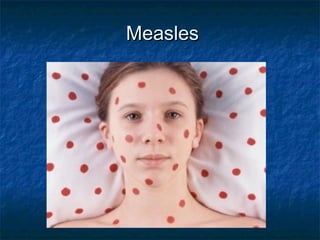

MeaslesMeasles
08/06/1508/06/15 22
Measles (Rubeola)Measles (Rubeola)
It is anIt is an acute viral infectionacute viral infection
characterized by a final stage withcharacterized by a final stage with
aa maculopapular rashmaculopapular rash
accompanied by a high fever.accompanied by a high fever.
08/06/1508/06/15 33
EtiologyEtiology
08/06/1508/06/15 44
EpidemiologyEpidemiology
 IndividualsIndividuals born before 1969born before 1969 areare
considered to have had naturalconsidered to have had natural
infection and to beinfection and to be immuneimmune
08/06/1508/06/15 55
TRANSMISSIONTRANSMISSION
 Measles is highly contagious;Measles is highly contagious;
approximately 90% of susceptibleapproximately 90% of susceptible
household contacts acquire thehousehold contacts acquire the
disease.disease.
 Maximal dissemination of virus occursMaximal dissemination of virus occurs
by droplet spray during the prodromalby droplet spray during the prodromal
period (catarrhal stage).period (catarrhal stage).
Incubation PeriodIncubation Period
 10-14 days10-14 days
Infectivity:Infectivity:
 Cases are contagious from 5 days before theCases are contagious from 5 days before the
onset of rash to 4 days after (a total of 10onset of rash to 4 days after (a total of 10
days).days).
08/06/1508/06/15 88
The prodromal phaseThe prodromal phase
 usually lastsusually lasts 3-5 days3-5 days and is characterized by:and is characterized by:
** low-grade to moderate feverlow-grade to moderate fever
** dry coughdry cough
** coryzacoryza
** conjunctivitisconjunctivitis..
 These symptoms nearly always precede theThese symptoms nearly always precede the
appearance of Koplik spots, the pathognomonicappearance of Koplik spots, the pathognomonic
sign of measles, by 2-3 days.sign of measles, by 2-3 days.
08/06/1508/06/15 99
The prodromal phaseThe prodromal phase (cont.)(cont.)
 Otitis mediaOtitis media
 bronchopneumoniabronchopneumonia
 gastrointestinal symptomsgastrointestinal symptoms such assuch as
diarrhea and vomitingdiarrhea and vomiting
Are more common in infants and smallAre more common in infants and small
children (especially if they arechildren (especially if they are
malnourished) than in older children.malnourished) than in older children.
08/06/1508/06/15 1010
The RashThe Rash
 usually starts asusually starts as faint maculesfaint macules on the:on the:
** upper lateral parts of the neckupper lateral parts of the neck
** behind the earsbehind the ears
** along the hairlinealong the hairline
** posterior parts of the cheekposterior parts of the cheek..
08/06/1508/06/15 1111
Korting GW: Hautkrankheiten bei Kindern und Jugendlichen, 3rd ed. Stuttgart, FK
Schattauer Verlag, 1982
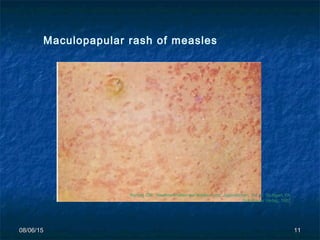
Maculopapular rash of measles
08/06/1508/06/15 1212
The RashThe Rash (cont.)(cont.)
 During the succeeding 24 hr the rashDuring the succeeding 24 hr the rash
spreads over the back, abdomen, entirespreads over the back, abdomen, entire
arm, and thighs.arm, and thighs.
 As it finally reaches the feet on the 2nd-As it finally reaches the feet on the 2nd-
3rd day, it begins to fade on the face.3rd day, it begins to fade on the face.
08/06/1508/06/15 1313
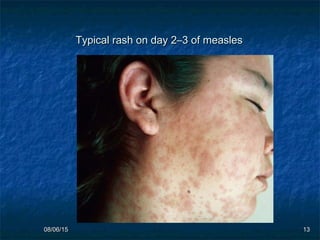
Typical rash on day 2–3 of measlesTypical rash on day 2–3 of measles   
08/06/1508/06/15 1414
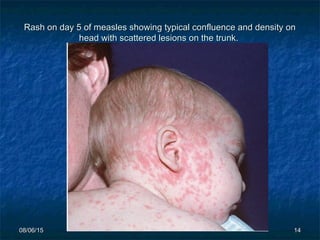
Rash on day 5 of measles showing typical confluence and density onRash on day 5 of measles showing typical confluence and density on
head with scattered lesions on the trunk.head with scattered lesions on the trunk.
08/06/1508/06/15 1515
TreatmentTreatment
 There is no specific antiviral therapy;There is no specific antiviral therapy;
 treatment is entirely supportive.treatment is entirely supportive.
1.1. Antipyretics (acetaminophen orAntipyretics (acetaminophen or
ibuprofen) for feveribuprofen) for fever
2.2. Bed restBed rest
3.3. Maintain fluid intakeMaintain fluid intake
08/06/1508/06/15 1616
PrognosisPrognosis (cont.)(cont.)
 Deaths are primarily due to pneumonia orDeaths are primarily due to pneumonia or
secondary bacterial infections.secondary bacterial infections.
 When measles is introduced into a highlyWhen measles is introduced into a highly
susceptible population, the results may besusceptible population, the results may be
disastrous.disastrous.
08/06/1508/06/15 1717
VACCINEVACCINE
 The initial measles immunization, usually asThe initial measles immunization, usually as
measles-mumps-rubella (MMR) vaccine, ismeasles-mumps-rubella (MMR) vaccine, is
recommended at 12-15 mo of agerecommended at 12-15 mo of age
 MMR vaccine may be given for:MMR vaccine may be given for:
1. Measles post exposure1. Measles post exposure
2. Outbreak prophylaxis as early as 6 mo2. Outbreak prophylaxis as early as 6 mo
of age.of age.
Any questions ???Any questions ???

Measles

  • 1.
  • 2.
    08/06/1508/06/15 22 Measles (Rubeola)Measles(Rubeola) It is anIt is an acute viral infectionacute viral infection characterized by a final stage withcharacterized by a final stage with aa maculopapular rashmaculopapular rash accompanied by a high fever.accompanied by a high fever.
  • 3.
  • 4.
    08/06/1508/06/15 44 EpidemiologyEpidemiology  IndividualsIndividualsborn before 1969born before 1969 areare considered to have had naturalconsidered to have had natural infection and to beinfection and to be immuneimmune
  • 5.
    08/06/1508/06/15 55 TRANSMISSIONTRANSMISSION  Measlesis highly contagious;Measles is highly contagious; approximately 90% of susceptibleapproximately 90% of susceptible household contacts acquire thehousehold contacts acquire the disease.disease.  Maximal dissemination of virus occursMaximal dissemination of virus occurs by droplet spray during the prodromalby droplet spray during the prodromal period (catarrhal stage).period (catarrhal stage).
  • 6.
  • 7.
    Infectivity:Infectivity:  Cases arecontagious from 5 days before theCases are contagious from 5 days before the onset of rash to 4 days after (a total of 10onset of rash to 4 days after (a total of 10 days).days).
  • 8.
    08/06/1508/06/15 88 The prodromalphaseThe prodromal phase  usually lastsusually lasts 3-5 days3-5 days and is characterized by:and is characterized by: ** low-grade to moderate feverlow-grade to moderate fever ** dry coughdry cough ** coryzacoryza ** conjunctivitisconjunctivitis..  These symptoms nearly always precede theThese symptoms nearly always precede the appearance of Koplik spots, the pathognomonicappearance of Koplik spots, the pathognomonic sign of measles, by 2-3 days.sign of measles, by 2-3 days.
  • 9.
    08/06/1508/06/15 99 The prodromalphaseThe prodromal phase (cont.)(cont.)  Otitis mediaOtitis media  bronchopneumoniabronchopneumonia  gastrointestinal symptomsgastrointestinal symptoms such assuch as diarrhea and vomitingdiarrhea and vomiting Are more common in infants and smallAre more common in infants and small children (especially if they arechildren (especially if they are malnourished) than in older children.malnourished) than in older children.
  • 10.
    08/06/1508/06/15 1010 The RashTheRash  usually starts asusually starts as faint maculesfaint macules on the:on the: ** upper lateral parts of the neckupper lateral parts of the neck ** behind the earsbehind the ears ** along the hairlinealong the hairline ** posterior parts of the cheekposterior parts of the cheek..
  • 11.
    08/06/1508/06/15 1111 Korting GW:Hautkrankheiten bei Kindern und Jugendlichen, 3rd ed. Stuttgart, FK Schattauer Verlag, 1982 Maculopapular rash of measles
  • 12.
    08/06/1508/06/15 1212 The RashTheRash (cont.)(cont.)  During the succeeding 24 hr the rashDuring the succeeding 24 hr the rash spreads over the back, abdomen, entirespreads over the back, abdomen, entire arm, and thighs.arm, and thighs.  As it finally reaches the feet on the 2nd-As it finally reaches the feet on the 2nd- 3rd day, it begins to fade on the face.3rd day, it begins to fade on the face.
  • 13.
    08/06/1508/06/15 1313 Typical rashon day 2–3 of measlesTypical rash on day 2–3 of measles   
  • 14.
    08/06/1508/06/15 1414 Rash onday 5 of measles showing typical confluence and density onRash on day 5 of measles showing typical confluence and density on head with scattered lesions on the trunk.head with scattered lesions on the trunk.
  • 15.
    08/06/1508/06/15 1515 TreatmentTreatment  Thereis no specific antiviral therapy;There is no specific antiviral therapy;  treatment is entirely supportive.treatment is entirely supportive. 1.1. Antipyretics (acetaminophen orAntipyretics (acetaminophen or ibuprofen) for feveribuprofen) for fever 2.2. Bed restBed rest 3.3. Maintain fluid intakeMaintain fluid intake
  • 16.
    08/06/1508/06/15 1616 PrognosisPrognosis (cont.)(cont.) Deaths are primarily due to pneumonia orDeaths are primarily due to pneumonia or secondary bacterial infections.secondary bacterial infections.  When measles is introduced into a highlyWhen measles is introduced into a highly susceptible population, the results may besusceptible population, the results may be disastrous.disastrous.
  • 17.
    08/06/1508/06/15 1717 VACCINEVACCINE  Theinitial measles immunization, usually asThe initial measles immunization, usually as measles-mumps-rubella (MMR) vaccine, ismeasles-mumps-rubella (MMR) vaccine, is recommended at 12-15 mo of agerecommended at 12-15 mo of age  MMR vaccine may be given for:MMR vaccine may be given for: 1. Measles post exposure1. Measles post exposure 2. Outbreak prophylaxis as early as 6 mo2. Outbreak prophylaxis as early as 6 mo of age.of age.
  • 20.
    Any questions ???Anyquestions ???