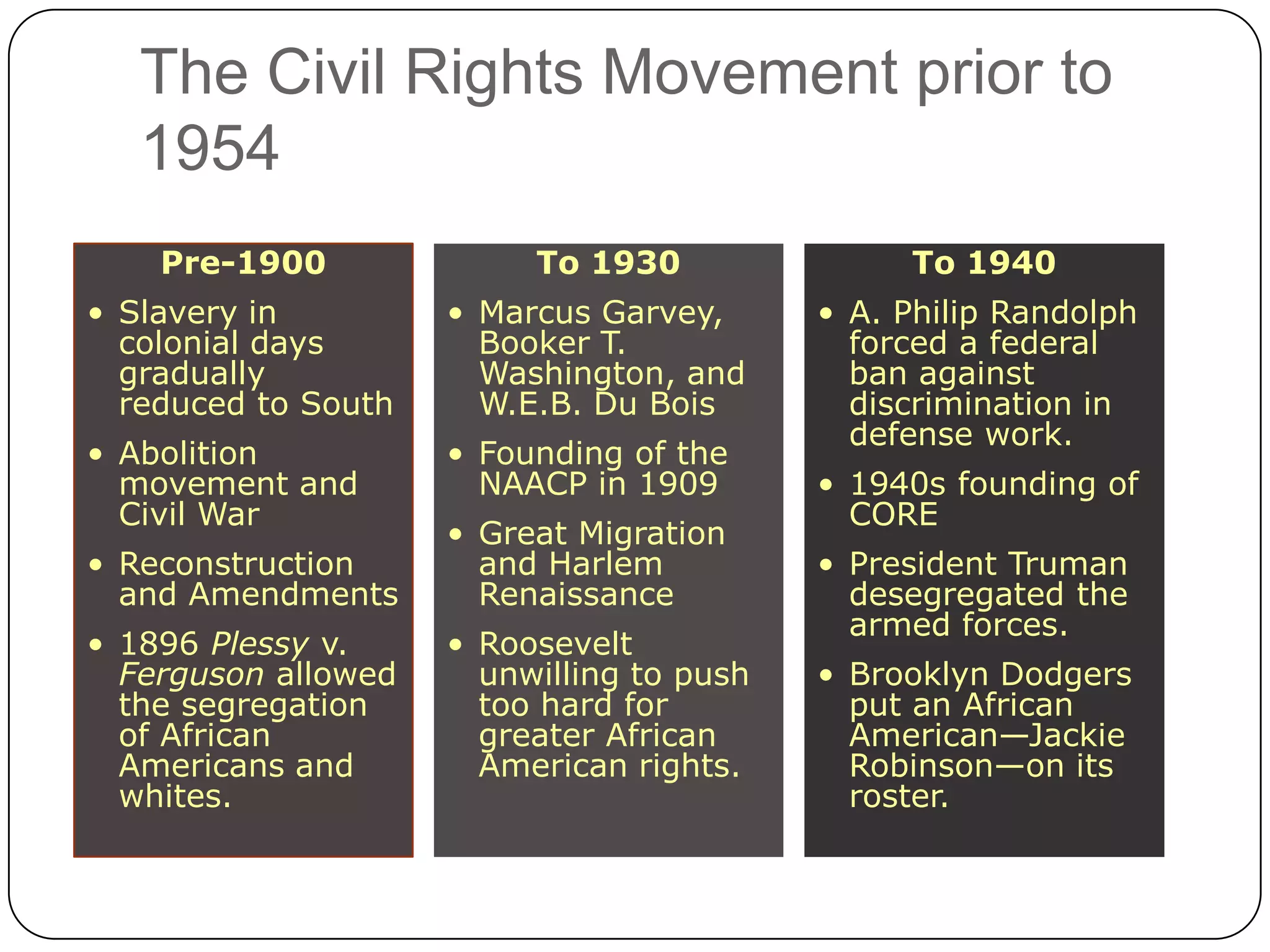
The Civil Rights Movement prior to 1954 saw the gradual abolition of slavery followed by Reconstruction and amendments granting rights to freed slaves. However, segregation was legally enforced from 1896 following Plessy v. Ferguson. Leaders like Du Bois, Garvey and the founding of the NAACP fought discrimination. Brown v. Board of Education in 1954 ruled segregation in public schools unconstitutional, but desegregation faced strong resistance across the South. The Montgomery Bus Boycott and activities like sit-ins and Freedom Rides continued pushing for full civil rights and desegregation, facing violence but achieving some victories. The 1963 March on Washington and Civil Rights Act of 1964 were major successes, but the movement also faced fractures with Black Power and Black



![American Industrial Revolution[2]](https://cdn.slidesharecdn.com/ss_thumbnails/americanindustrialrevolution2-1227208285351785-9-thumbnail.jpg?width=640&height=640&fit=bounds)


