125

Section
Chapter

Section

1

Objectives
• Identify the key factors that prodded America
to expand.
• Explain how the United States took its first
steps toward increased global power.
• Summarize the chain of events leading up to
the U.S. annexation of Hawaii.

The Cold War BeginsImperialism
The Roots of
Chapter
Section

25
1

Section

1

Terms and People
•

imperialism – policy by which stronger nations
extend their political, economic, and military,
control over weaker territories

•

extractive economy – colonial economies based
on an imperialist nation extracting or removing
raw materials

•

Alfred T. Mahan – naval historian who advocated
for naval power as the basis for a great nation;
urged the U.S. to build a modern fleet

The Cold War BeginsImperialism
The Roots of
Chapter
Section

25
1

Section

1

Terms and People

(continued)

•

Social Darwinism − belief that Darwin’s theory
of the survival of the fittest should be applied to
societies, justifying imperialism

•

Frederick J. Turner – historian who noted the
closure of the American frontier; his ideas were
used by others to urge U.S. overseas expansion

•

Matthew Perry – U.S. naval commander who
sailed a fleet into Tokyo Bay and opened trade
with Japan in 1853

The Cold War BeginsImperialism
The Roots of
Chapter
Section

25
1

Section

1

Terms and People
•

(continued)

Queen Liliuokalani – Hawaiian monarch
dethroned in 1893 by rebel American planters in
an action backed by U.S. Marines

The Cold War BeginsImperialism
The Roots of
Chapter
Section

25
1

Section

1

How and why did the United States
take a more active role in world affairs?
1. For most of its early history, the United
States played a small role in world affairs. But
in the late 1800s, some began calling for the
U.S. to join the ranks of the world’s major
powers.
Eventually, the United States abandoned
isolationism and began to acquire influence
and territories outside its continental borders.
The Cold War BeginsImperialism
The Roots of
Chapter
Section

25
1

Section

1

The mid-1800s
through the
early 1900s was
an “Age of
Imperialism.”

• Powerful European nations
extended their political,
economic, and military
influence by adding
colonies in Africa and Asia.
• Meanwhile, the United
States and Japan
considered the benefits
and implemented similar
imperialist policies.

The Cold War BeginsImperialism
The Roots of
Chapter
Section

25
1

Section

1

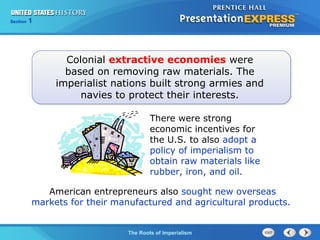
Colonial extractive economies were
based on removing raw materials. The
imperialist nations built strong armies and
navies to protect their interests.
There were strong
economic incentives for
the U.S. to also adopt a
policy of imperialism to
obtain raw materials like
rubber, iron, and oil.
American entrepreneurs also sought new overseas
markets for their manufactured and agricultural products.
The Cold War BeginsImperialism
The Roots of
Chapter
Section

25
1

Section

1

2. In The Influence of Sea Power Upon History,
historian Alfred T. Mahan argued that all great
nations owed their greatness to naval power.
He urged construction of
a fleet of steel ships,
acquisition of overseas
bases, and construction
of a canal across Central
America.
The U.S. eventually
followed all of his
recommendations.
The Cold War BeginsImperialism
The Roots of
Chapter
Section

25
1

Section

1

Imperialists justified their actions
based on beliefs about their own racial,
national, and cultural superiority.

Social Darwinism applied Darwin’s theories of
natural selection to societies. In a competitive
world, only the fittest nations survive.
Americans extended their belief in Manifest
Destiny overseas, justifying imperialism as
God’s will.

The Cold War BeginsImperialism
The Roots of
Chapter
Section

25
1

Section

1

Historian Frederick J. Turner argued that the
frontier served as a “safety valve,” siphoning
off potential discontent in the U.S.

Turner’s followers urged overseas
expansion as America’s next frontier to
avert future discontent in the U.S.

The Cold War BeginsImperialism
The Roots of
Chapter
Section

25
1

Section

1

3. In 1867, Secretary of State William Seward
purchased Alaska from Russia for $7.2 million.
Critics mocked “Seward’s
Icebox” and “Seward’s
Folly” as a far off and
useless frozen tundra.
But, valuable resources
including gold, timber,
and oil were found.
Alaska also doubled
America’s territory.

The Cold War BeginsImperialism
The Roots of
Chapter
Section

25
1

Section

1

In 1898
Congress
voted to
annex
Hawaii.

• In the 1790s Americans planters
established sugar cane plantations
in Hawaii.
• In 1887, these planters gained
control of the government from
King Kalakaua.
• In 1891, Queen Liliuokalani,
attempted to regain control of her
island.
• 4. In 1893, with the help of U.S.
Marines, the Queen was dethroned.
President McKinley backed
annexation when he took office.
The Cold War BeginsImperialism
The Roots of
Chapter
Section

25
1

Section

1

The United States expanded
overseas after 1850.
1853

Commodore Matthew Perry’s fleet entered Tokyo Bay
persuading Japan to trade with the U.S.

1865

Secretary of State William Seward purchased Alaska
from Russia.

1867

The U.S. obtained Midway Islands in the Pacific.

1898

Congress approved the annexation of Hawaii.

1898

5. The Spanish American War gave the U.S. control
of the Philippines, Puerto Rico and Guam.

The Cold War BeginsImperialism
The Roots of
Chapter
Section

25
1

Section

1

The Cold War BeginsImperialism
The Roots of
Chapter
Section

25
1

Section

1

Section Review
QuickTake Quiz

Know It, Show It Quiz

The Cold War BeginsImperialism
The Roots of

US History Ch. 9 Section 1 Notes

  • 1.
    125 Section Chapter Section 1 Objectives • Identify thekey factors that prodded America to expand. • Explain how the United States took its first steps toward increased global power. • Summarize the chain of events leading up to the U.S. annexation of Hawaii. The Cold War BeginsImperialism The Roots of
  • 2.
    Chapter Section 25 1 Section 1 Terms and People • imperialism– policy by which stronger nations extend their political, economic, and military, control over weaker territories • extractive economy – colonial economies based on an imperialist nation extracting or removing raw materials • Alfred T. Mahan – naval historian who advocated for naval power as the basis for a great nation; urged the U.S. to build a modern fleet The Cold War BeginsImperialism The Roots of
  • 3.
    Chapter Section 25 1 Section 1 Terms and People (continued) • SocialDarwinism − belief that Darwin’s theory of the survival of the fittest should be applied to societies, justifying imperialism • Frederick J. Turner – historian who noted the closure of the American frontier; his ideas were used by others to urge U.S. overseas expansion • Matthew Perry – U.S. naval commander who sailed a fleet into Tokyo Bay and opened trade with Japan in 1853 The Cold War BeginsImperialism The Roots of
  • 4.
    Chapter Section 25 1 Section 1 Terms and People • (continued) QueenLiliuokalani – Hawaiian monarch dethroned in 1893 by rebel American planters in an action backed by U.S. Marines The Cold War BeginsImperialism The Roots of
  • 5.
    Chapter Section 25 1 Section 1 How and whydid the United States take a more active role in world affairs? 1. For most of its early history, the United States played a small role in world affairs. But in the late 1800s, some began calling for the U.S. to join the ranks of the world’s major powers. Eventually, the United States abandoned isolationism and began to acquire influence and territories outside its continental borders. The Cold War BeginsImperialism The Roots of
  • 6.
    Chapter Section 25 1 Section 1 The mid-1800s through the early1900s was an “Age of Imperialism.” • Powerful European nations extended their political, economic, and military influence by adding colonies in Africa and Asia. • Meanwhile, the United States and Japan considered the benefits and implemented similar imperialist policies. The Cold War BeginsImperialism The Roots of
  • 7.
    Chapter Section 25 1 Section 1 Colonial extractive economieswere based on removing raw materials. The imperialist nations built strong armies and navies to protect their interests. There were strong economic incentives for the U.S. to also adopt a policy of imperialism to obtain raw materials like rubber, iron, and oil. American entrepreneurs also sought new overseas markets for their manufactured and agricultural products. The Cold War BeginsImperialism The Roots of
  • 8.
    Chapter Section 25 1 Section 1 2. In TheInfluence of Sea Power Upon History, historian Alfred T. Mahan argued that all great nations owed their greatness to naval power. He urged construction of a fleet of steel ships, acquisition of overseas bases, and construction of a canal across Central America. The U.S. eventually followed all of his recommendations. The Cold War BeginsImperialism The Roots of
  • 9.
    Chapter Section 25 1 Section 1 Imperialists justified theiractions based on beliefs about their own racial, national, and cultural superiority. Social Darwinism applied Darwin’s theories of natural selection to societies. In a competitive world, only the fittest nations survive. Americans extended their belief in Manifest Destiny overseas, justifying imperialism as God’s will. The Cold War BeginsImperialism The Roots of
  • 10.
    Chapter Section 25 1 Section 1 Historian Frederick J.Turner argued that the frontier served as a “safety valve,” siphoning off potential discontent in the U.S. Turner’s followers urged overseas expansion as America’s next frontier to avert future discontent in the U.S. The Cold War BeginsImperialism The Roots of
  • 11.
    Chapter Section 25 1 Section 1 3. In 1867,Secretary of State William Seward purchased Alaska from Russia for $7.2 million. Critics mocked “Seward’s Icebox” and “Seward’s Folly” as a far off and useless frozen tundra. But, valuable resources including gold, timber, and oil were found. Alaska also doubled America’s territory. The Cold War BeginsImperialism The Roots of
  • 12.
    Chapter Section 25 1 Section 1 In 1898 Congress voted to annex Hawaii. •In the 1790s Americans planters established sugar cane plantations in Hawaii. • In 1887, these planters gained control of the government from King Kalakaua. • In 1891, Queen Liliuokalani, attempted to regain control of her island. • 4. In 1893, with the help of U.S. Marines, the Queen was dethroned. President McKinley backed annexation when he took office. The Cold War BeginsImperialism The Roots of
  • 13.
    Chapter Section 25 1 Section 1 The United Statesexpanded overseas after 1850. 1853 Commodore Matthew Perry’s fleet entered Tokyo Bay persuading Japan to trade with the U.S. 1865 Secretary of State William Seward purchased Alaska from Russia. 1867 The U.S. obtained Midway Islands in the Pacific. 1898 Congress approved the annexation of Hawaii. 1898 5. The Spanish American War gave the U.S. control of the Philippines, Puerto Rico and Guam. The Cold War BeginsImperialism The Roots of
  • 14.
    Chapter Section 25 1 Section 1 The Cold WarBeginsImperialism The Roots of
  • 15.
    Chapter Section 25 1 Section 1 Section Review QuickTake Quiz KnowIt, Show It Quiz The Cold War BeginsImperialism The Roots of