7 TH  GRADE CHAPTER 4 LESSON 2 Pgs. 134-140 For Student Use Only
CHEMICAL CHARACTERISTICS Chemical Properties: The properties that describe how a substance changes while it is being converted into something else Chemical Change:  When two or more substances unit or break apart chemically After a chemical change the properties of the new substance are different from the original properties
CHEMICAL CHARACTERISTICS Microscopic Matter: Element= simplest type of substance All elements are made of atoms Atoms= smallest particles of matter An element cannot be broken down into anything smaller than one particular kind of atom Compound= a new substance formed from the chemical union of two or more elements
CHEMICAL CHARACTERISTICS Matter: Compounds differ from each by the ratio of atoms  Examples: H 2 O H 2 O 2 Chemical Formula: The written way to show compounds Chemical Reaction: The process of forming a chemical bond
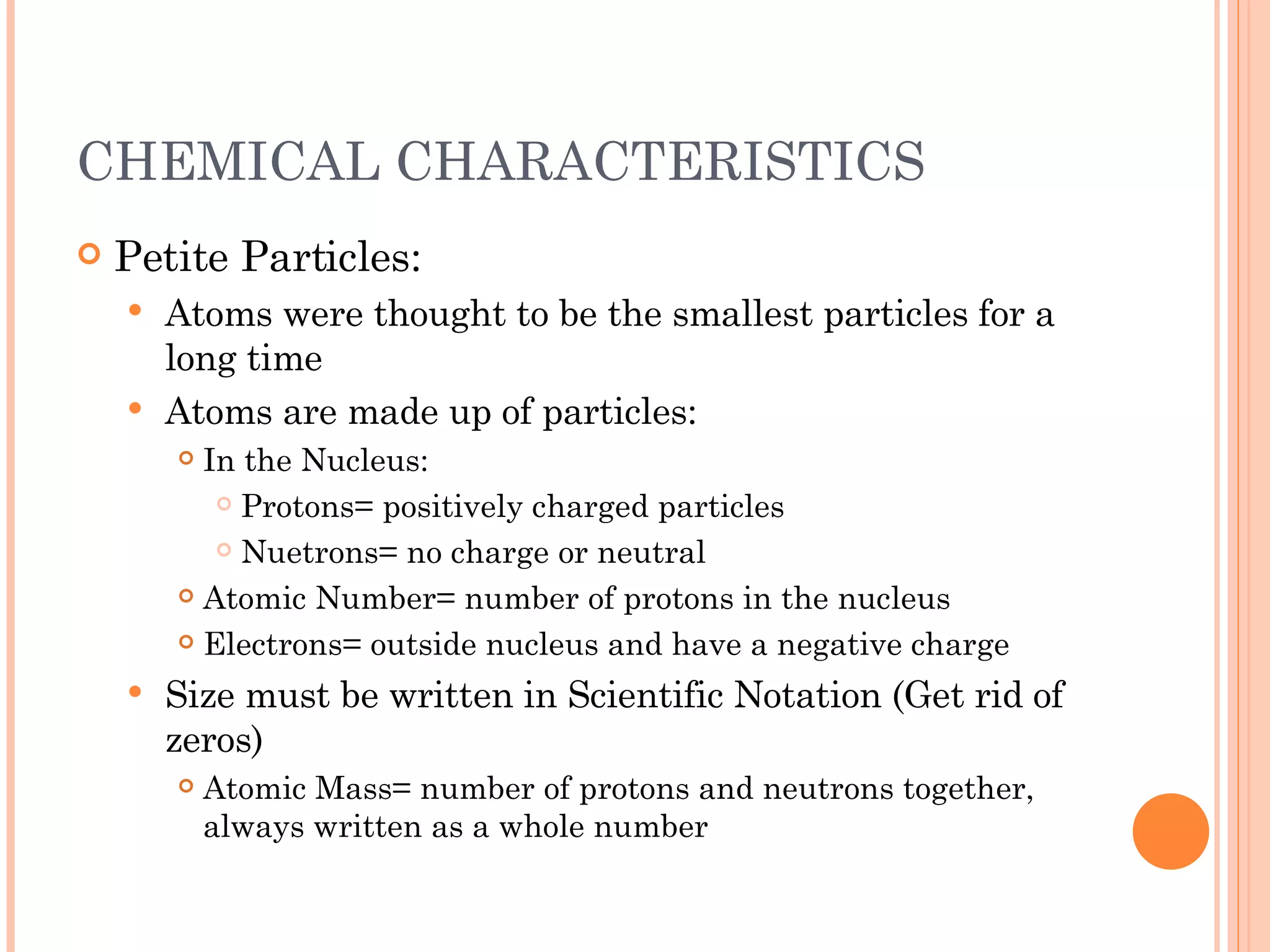
CHEMICAL CHARACTERISTICS Petite Particles: Atoms were thought to be the smallest particles for a long time Atoms are made up of particles: In the Nucleus: Protons= positively charged particles Nuetrons= no charge or neutral Atomic Number= number of protons in the nucleus Electrons= outside nucleus and have a negative charge Size must be written in Scientific Notation (Get rid of zeros) Atomic Mass= number of protons and neutrons together, always written as a whole number
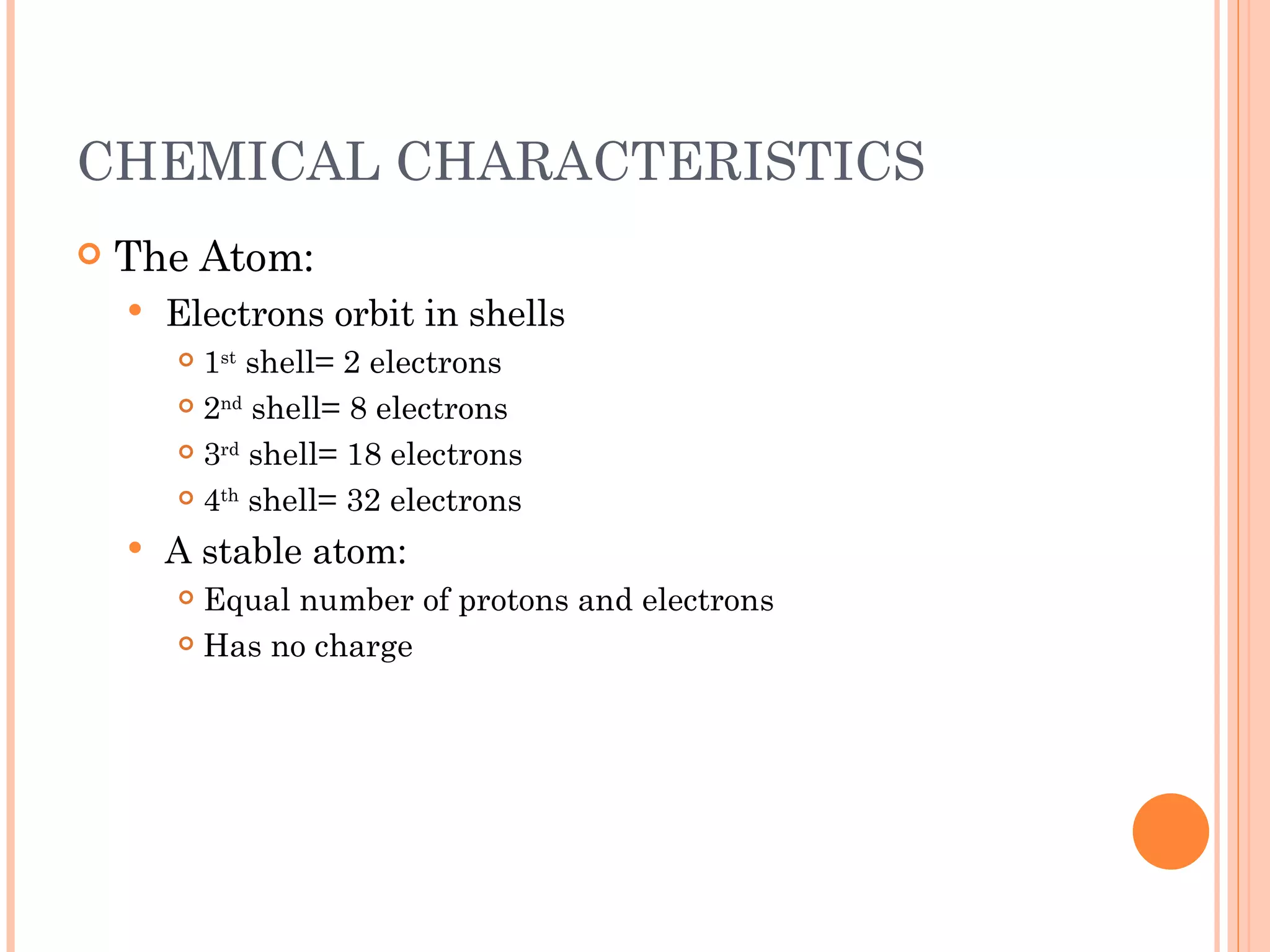
CHEMICAL CHARACTERISTICS The Atom: Electrons orbit in shells 1 st  shell= 2 electrons 2 nd  shell= 8 electrons 3 rd  shell= 18 electrons 4 th  shell= 32 electrons A stable atom: Equal number of protons and electrons Has no charge
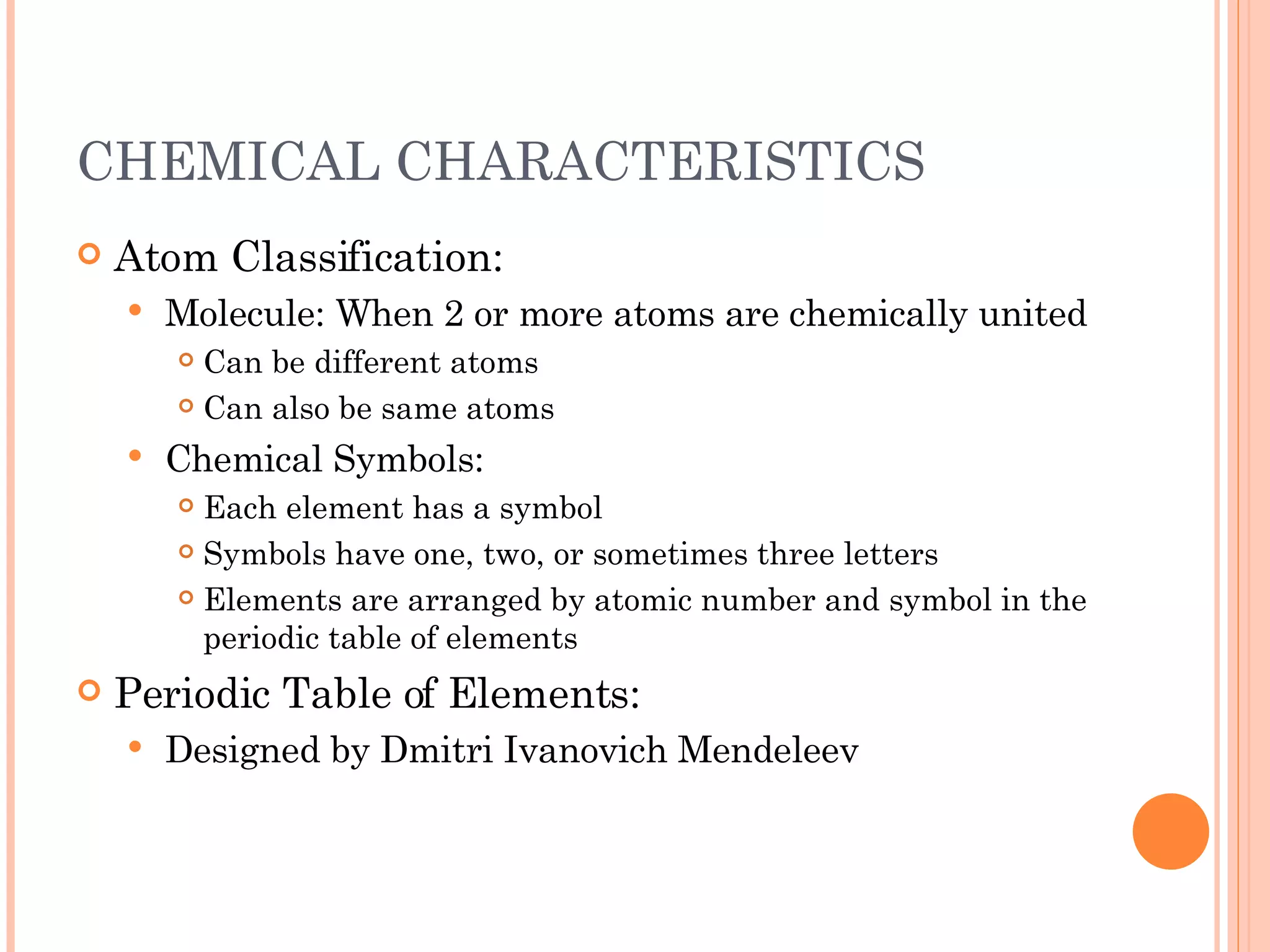
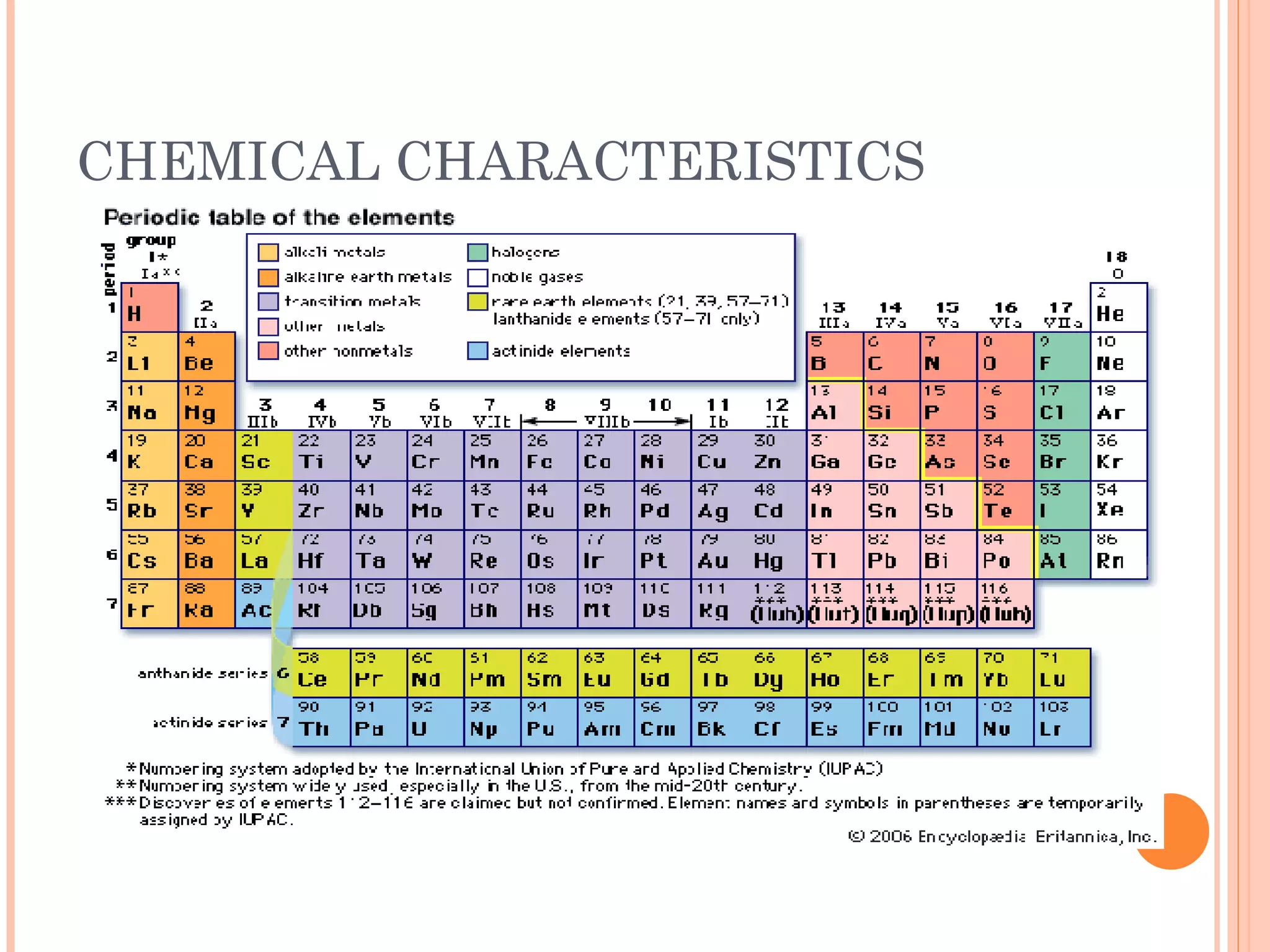
CHEMICAL CHARACTERISTICS Atom Classification: Molecule: When 2 or more atoms are chemically united Can be different atoms Can also be same atoms Chemical Symbols: Each element has a symbol Symbols have one, two, or sometimes three letters Elements are arranged by atomic number and symbol in the periodic table of elements Periodic Table of Elements: Designed by Dmitri Ivanovich Mendeleev
CHEMICAL CHARACTERISTICS

7th Grade Chapter 4 Lesson 2

  • 1.
    7 TH GRADE CHAPTER 4 LESSON 2 Pgs. 134-140 For Student Use Only
  • 2.
    CHEMICAL CHARACTERISTICS ChemicalProperties: The properties that describe how a substance changes while it is being converted into something else Chemical Change: When two or more substances unit or break apart chemically After a chemical change the properties of the new substance are different from the original properties
  • 3.
    CHEMICAL CHARACTERISTICS MicroscopicMatter: Element= simplest type of substance All elements are made of atoms Atoms= smallest particles of matter An element cannot be broken down into anything smaller than one particular kind of atom Compound= a new substance formed from the chemical union of two or more elements
  • 4.
    CHEMICAL CHARACTERISTICS Matter:Compounds differ from each by the ratio of atoms Examples: H 2 O H 2 O 2 Chemical Formula: The written way to show compounds Chemical Reaction: The process of forming a chemical bond
  • 5.
    CHEMICAL CHARACTERISTICS PetiteParticles: Atoms were thought to be the smallest particles for a long time Atoms are made up of particles: In the Nucleus: Protons= positively charged particles Nuetrons= no charge or neutral Atomic Number= number of protons in the nucleus Electrons= outside nucleus and have a negative charge Size must be written in Scientific Notation (Get rid of zeros) Atomic Mass= number of protons and neutrons together, always written as a whole number
  • 6.
    CHEMICAL CHARACTERISTICS TheAtom: Electrons orbit in shells 1 st shell= 2 electrons 2 nd shell= 8 electrons 3 rd shell= 18 electrons 4 th shell= 32 electrons A stable atom: Equal number of protons and electrons Has no charge
  • 7.
    CHEMICAL CHARACTERISTICS AtomClassification: Molecule: When 2 or more atoms are chemically united Can be different atoms Can also be same atoms Chemical Symbols: Each element has a symbol Symbols have one, two, or sometimes three letters Elements are arranged by atomic number and symbol in the periodic table of elements Periodic Table of Elements: Designed by Dmitri Ivanovich Mendeleev
  • 8.