CHEMISTRY
Composition of Matter 
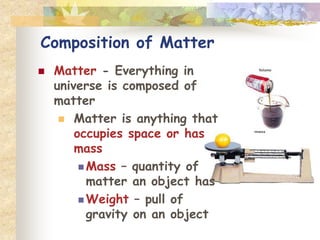
 Matter - Everything in 
universe is composed of 
matter 
 Matter is anything that 
occupies space or has 
mass 
Mass – quantity of 
matter an object has 
Weight – pull of 
gravity on an object
Elements 
 Pure substances that cannot be broken 
down chemically into simpler kinds of 
matter 
 More than 100 elements (92 naturally 
occurring)
 90% of the mass of an 
organism is composed of 4 
elements (oxygen, carbon, 
hydrogen and nitrogen) 
 Each element unique 
chemical symbol 
 Consists of 1-2 letters 
 First letter is always 
capitalized
Atoms 
 The simplest particle of 
an element that retains 
all the properties of that 
element 
 Properties of atoms 
determine the structure 
and properties of the 
matter they compose 
 Our understanding of the 
structure of atoms based 
on scientific models, not 
observation
The Nucleus 
 Central core 
 Consists of positive 
charged protons 
and neutral 
neutrons 
 Positively charged 
 Contains most of 
the mass of the 
atom
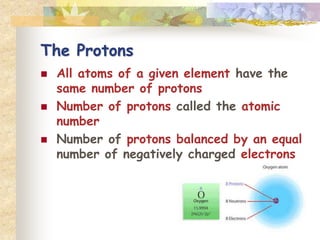
The Protons 
 All atoms of a given element have the 
same number of protons 
 Number of protons called the atomic 
number 
 Number of protons balanced by an equal 
number of negatively charged electrons
The Neutrons 
 The number varies slightly among atoms 
of the same element 
 Different number of neutrons produces 
isotopes of the same element
Atomic Mass 
 Protons & neutrons are found in the 
nucleus of an atom 
 Protons and neutrons each have a 
mass of 1 amu (atomic mass unit) 
 The atomic mass of an atom is found 
by adding the number of protons & 
neutrons in an atom
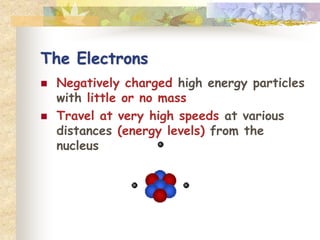
The Electrons 
 Negatively charged high energy particles 
with little or no mass 
 Travel at very high speeds at various 
distances (energy levels) from the 
nucleus
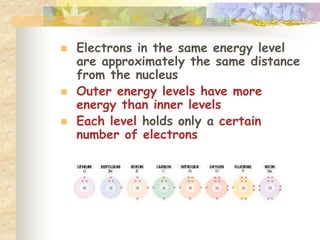
 Electrons in the same energy level 
are approximately the same distance 
from the nucleus 
 Outer energy levels have more 
energy than inner levels 
 Each level holds only a certain 
number of electrons
Energy Levels 
 Atoms have 7 energy levels 
 The levels are K (closest to the 
nucleus), L, M, N, O, P, Q 
(furthest from the nucleus) 
 The K level can only hold 2 
electrons 
 Levels L – Q can hold 8 electrons 
(octet rule)
Periodic Table 
 Elements are arranged by their 
atomic number on the Periodic Table 
 The horizontal rows are called 
Periods & tell the number of 
energy levels 
 Vertical groups are called Families & 
tell the outermost number of 
electrons
Compounds 
 Most 
elements do 
not exist by 
themselves 
 Readily 
combine with 
other 
elements in 
a 
predictable 
fashion
 A compound is a pure 
substance made up of 
atoms of two or more 
elements 
 The proportion of 
atoms are always 
fixed 
 Chemical formula shows 
the kind and proportion 
of atoms of each 
element that occurs in a 
particular compound
 Molecules are the 
simplest part of 
a substance that 
retains all of the 
properties of the 
substance and 
exists in a free 
state 
 Some molecules 
are large and 
complex
Chemical Formulas 
 Subscript after a symbol tell the 
number of atoms of each element 
 H20 has 2 atoms of hydrogen & 1 
atom of oxygen 
 Coefficients before a formula tell 
the number of molecules 
 3O2 represents 3 molecules of oxygen 
or (3x2) or 6 atoms of oxygen
 The physical 
and chemical 
properties of 
a compound 
differ from 
the physical 
and chemical 
properties of 
the individual 
elements that 
compose it
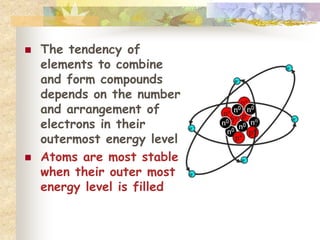
 The tendency of 
elements to combine 
and form compounds 
depends on the number 
and arrangement of 
electrons in their 
outermost energy level 
 Atoms are most stable 
when their outer most 
energy level is filled
 Most atoms are not stable 
in their natural state 
 Tend to react (combine) 
with other atoms in order 
to become more stable 
(undergo chemical 
reactions) 
 In chemical reactions 
bonds are broken; atoms 
rearranged and new 
chemical bonds are 
formed that store energy
Covalent Bonds 
 Formed when two atoms share one or 
more pairs of electrons
Ionic Bonds 
 Some atoms become stable by losing or 
gaining electrons 
 Atoms that lose electrons are called 
positive ions
 Atoms that gain electrons are called 
negative ions 
 Because positive and negative electrical 
charges attract each other ionic bonds 
form
Energy and Matter 
 Energy 
 The ability to do work or cause 
change 
 Occurs in various forms 
 Can be converted to another form 
 Forms important to biological 
systems are chemical, thermal, 
electrical and mechanical energy 
 Free energy is the energy in a 
system that is available for work
States of Matter 
 Atoms are in constant motion 
 The rate at which atoms or molecules in 
a substance move determines its state
 Solid 
Molecules tightly linked together in 
a definite shape 
Vibrate in place 
Fixed volume and shape
 Liquids 
Molecules not as tightly linked 
as a solid 
Maintain fixed volume 
Able to flow and conform to 
shape of container
Gas 
 Molecules have little 
or no attraction to each 
other 
 Fill the volume of the 
occupied container 
 Move most rapidly 
 To cause a substance to 
change state, thermal energy 
(heat) must be added to or 
removed from a substance
Energy and Chemical Reactions 
 Living things 
undergo 
thousands of 
chemical 
reactions as part 
of the life 
process
 Many are very complex 
involving multistep 
sequences called 
biochemical pathways 
 Chemical equations 
represent chemical 
reactions 
 Reactants are shown on the 
left side of the equation 
 Products are shown on the 
right side
 The number of 
each kind of atom 
must be the same 
on either side of 
the arrow 
(equation must be 
balanced) 
 Bonds may be 
broken or made 
forming new 
compounds
Energy Transfer 
 Much of the energy 
organisms need is 
provided by sugar (food) 
 Undergoes a series of 
chemical reactions in 
which energy is released 
(cell respiration) 
 The net release of free 
energy is called an 
exergonic (exothermic) 
reaction
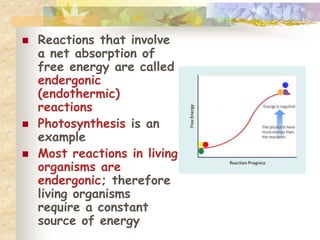
 Reactions that involve 
a net absorption of 
free energy are called 
endergonic 
(endothermic) 
reactions 
 Photosynthesis is an 
example 
 Most reactions in living 
organisms are 
endergonic; therefore 
living organisms 
require a constant 
source of energy
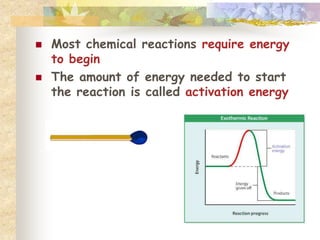
 Most chemical reactions require energy 
to begin 
 The amount of energy needed to start 
the reaction is called activation energy
 Certain 
chemical 
substances 
(catalysts) 
reduce the 
amount of 
activation 
energy 
required 
 Biological 
catalysts are 
called enzymes
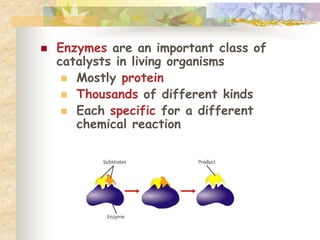
 Enzymes are an important class of 
catalysts in living organisms 
 Mostly protein 
 Thousands of different kinds 
 Each specific for a different 
chemical reaction
Enzyme Structure 
 Enzymes work on 
substances called 
substrates 
 Substrates must fit 
into a place on an 
enzyme called the 
active site 
 Enzymes are reusable!
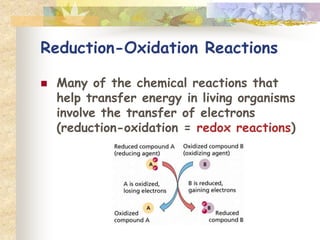
Reduction-Oxidation Reactions 
 Many of the chemical reactions that 
help transfer energy in living organisms 
involve the transfer of electrons 
(reduction-oxidation = redox reactions)
 Oxidation reaction – reactant loses 
electron(s) becoming more positive
 Reduction reaction – reactant gains 
electron(s) becoming more negative
Solutions
Solutions 
 A solution is a 
mixture in 
which 2 or 
more 
substances are 
uniformly 
distributed in 
another 
substance
 Solute is the 
substance 
dissolved in the 
solution 
 Particles may 
be ions, atoms, 
or molecules 
 Solvent is the 
substance in which 
the solute is 
dissolved 
 Water is the 
universal solvent
 Solutions can be composed 
of varying proportions of a 
given solute in a given 
solvent --- vary in 
concentration (measurement 
of the amount of solute) 
 A saturated solution is one 
in which no more solute can 
be dissolved 
 Aqueous solution (water) are 
universally important to 
living things
 Dissociation of water 
 Breaking apart of the 
water molecule into two 
ions of opposite charge 
(due to strong 
attraction of oxygen 
atom of one molecule 
for H atom of another 
water molecule) 
 H2O  H+ (hydrogen 
ion) + OH- (hydroxide 
ion) 
 H+ + H2O  H3O 
(hydronium ion)
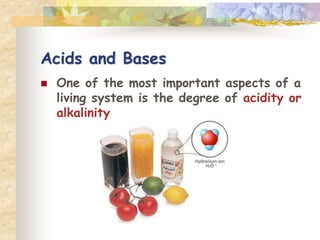
Acids and Bases 
 One of the most important aspects of a 
living system is the degree of acidity or 
alkalinity
Acids 
 Number of hydronium ions in solutions is 
greater than the number of hydroxide 
ions 
HCl  H+ + Cl-
Bases 
 Number of hydroxide ions in solution is 
greater than the number of hydronium 
ions 
NaOH  Na+ + OH-
pH Scale 
 logarithmic 
scale for 
comparing the 
relative 
concentrations 
of hydronium 
ions and 
hydroxide ions 
in a solution 
 ranges from 0 
to 14 
 Each pH is 10X 
stronger than next 
 e.g. ph 1 is 10 times 
stronger than ph 2
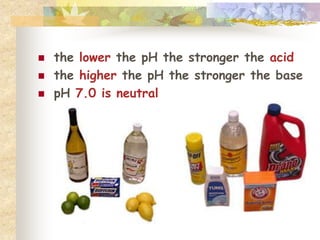
 the lower the pH the stronger the acid 
 the higher the pH the stronger the base 
 pH 7.0 is neutral
Buffers 
 Control of pH is very 
important 
 Most enzymes function 
only within a very 
narrow pH 
 Control is accomplished 
with buffers made by 
the body 
 Buffers keep a neutral 
pH (pH 7)
 Buffers neutralize 
small amounts of 
either an acid or 
base added to a 
solution 
 Complex buffering 
systems maintain 
the pH values of 
your body’s many 
fluids at normal and 
safe levels
Chemistry Presentation

Chemistry Presentation

  • 1.
  • 2.
    Composition of Matter  Matter - Everything in universe is composed of matter  Matter is anything that occupies space or has mass Mass – quantity of matter an object has Weight – pull of gravity on an object
  • 3.
    Elements  Puresubstances that cannot be broken down chemically into simpler kinds of matter  More than 100 elements (92 naturally occurring)
  • 4.
     90% ofthe mass of an organism is composed of 4 elements (oxygen, carbon, hydrogen and nitrogen)  Each element unique chemical symbol  Consists of 1-2 letters  First letter is always capitalized
  • 5.
    Atoms  Thesimplest particle of an element that retains all the properties of that element  Properties of atoms determine the structure and properties of the matter they compose  Our understanding of the structure of atoms based on scientific models, not observation
  • 6.
    The Nucleus Central core  Consists of positive charged protons and neutral neutrons  Positively charged  Contains most of the mass of the atom
  • 7.
    The Protons All atoms of a given element have the same number of protons  Number of protons called the atomic number  Number of protons balanced by an equal number of negatively charged electrons
  • 8.
    The Neutrons The number varies slightly among atoms of the same element  Different number of neutrons produces isotopes of the same element
  • 9.
    Atomic Mass Protons & neutrons are found in the nucleus of an atom  Protons and neutrons each have a mass of 1 amu (atomic mass unit)  The atomic mass of an atom is found by adding the number of protons & neutrons in an atom
  • 10.
    The Electrons Negatively charged high energy particles with little or no mass  Travel at very high speeds at various distances (energy levels) from the nucleus
  • 11.
     Electrons inthe same energy level are approximately the same distance from the nucleus  Outer energy levels have more energy than inner levels  Each level holds only a certain number of electrons
  • 12.
    Energy Levels Atoms have 7 energy levels  The levels are K (closest to the nucleus), L, M, N, O, P, Q (furthest from the nucleus)  The K level can only hold 2 electrons  Levels L – Q can hold 8 electrons (octet rule)
  • 13.
    Periodic Table Elements are arranged by their atomic number on the Periodic Table  The horizontal rows are called Periods & tell the number of energy levels  Vertical groups are called Families & tell the outermost number of electrons
  • 15.
    Compounds  Most elements do not exist by themselves  Readily combine with other elements in a predictable fashion
  • 16.
     A compoundis a pure substance made up of atoms of two or more elements  The proportion of atoms are always fixed  Chemical formula shows the kind and proportion of atoms of each element that occurs in a particular compound
  • 17.
     Molecules arethe simplest part of a substance that retains all of the properties of the substance and exists in a free state  Some molecules are large and complex
  • 18.
    Chemical Formulas Subscript after a symbol tell the number of atoms of each element  H20 has 2 atoms of hydrogen & 1 atom of oxygen  Coefficients before a formula tell the number of molecules  3O2 represents 3 molecules of oxygen or (3x2) or 6 atoms of oxygen
  • 19.
     The physical and chemical properties of a compound differ from the physical and chemical properties of the individual elements that compose it
  • 20.
     The tendencyof elements to combine and form compounds depends on the number and arrangement of electrons in their outermost energy level  Atoms are most stable when their outer most energy level is filled
  • 21.
     Most atomsare not stable in their natural state  Tend to react (combine) with other atoms in order to become more stable (undergo chemical reactions)  In chemical reactions bonds are broken; atoms rearranged and new chemical bonds are formed that store energy
  • 22.
    Covalent Bonds Formed when two atoms share one or more pairs of electrons
  • 23.
    Ionic Bonds Some atoms become stable by losing or gaining electrons  Atoms that lose electrons are called positive ions
  • 24.
     Atoms thatgain electrons are called negative ions  Because positive and negative electrical charges attract each other ionic bonds form
  • 25.
    Energy and Matter  Energy  The ability to do work or cause change  Occurs in various forms  Can be converted to another form  Forms important to biological systems are chemical, thermal, electrical and mechanical energy  Free energy is the energy in a system that is available for work
  • 26.
    States of Matter  Atoms are in constant motion  The rate at which atoms or molecules in a substance move determines its state
  • 27.
     Solid Moleculestightly linked together in a definite shape Vibrate in place Fixed volume and shape
  • 28.
     Liquids Moleculesnot as tightly linked as a solid Maintain fixed volume Able to flow and conform to shape of container
  • 29.
    Gas  Moleculeshave little or no attraction to each other  Fill the volume of the occupied container  Move most rapidly  To cause a substance to change state, thermal energy (heat) must be added to or removed from a substance
  • 30.
    Energy and ChemicalReactions  Living things undergo thousands of chemical reactions as part of the life process
  • 31.
     Many arevery complex involving multistep sequences called biochemical pathways  Chemical equations represent chemical reactions  Reactants are shown on the left side of the equation  Products are shown on the right side
  • 32.
     The numberof each kind of atom must be the same on either side of the arrow (equation must be balanced)  Bonds may be broken or made forming new compounds
  • 33.
    Energy Transfer Much of the energy organisms need is provided by sugar (food)  Undergoes a series of chemical reactions in which energy is released (cell respiration)  The net release of free energy is called an exergonic (exothermic) reaction
  • 34.
     Reactions thatinvolve a net absorption of free energy are called endergonic (endothermic) reactions  Photosynthesis is an example  Most reactions in living organisms are endergonic; therefore living organisms require a constant source of energy
  • 35.
     Most chemicalreactions require energy to begin  The amount of energy needed to start the reaction is called activation energy
  • 36.
     Certain chemical substances (catalysts) reduce the amount of activation energy required  Biological catalysts are called enzymes
  • 37.
     Enzymes arean important class of catalysts in living organisms  Mostly protein  Thousands of different kinds  Each specific for a different chemical reaction
  • 38.
    Enzyme Structure Enzymes work on substances called substrates  Substrates must fit into a place on an enzyme called the active site  Enzymes are reusable!
  • 39.
    Reduction-Oxidation Reactions Many of the chemical reactions that help transfer energy in living organisms involve the transfer of electrons (reduction-oxidation = redox reactions)
  • 40.
     Oxidation reaction– reactant loses electron(s) becoming more positive
  • 41.
     Reduction reaction– reactant gains electron(s) becoming more negative
  • 42.
  • 43.
    Solutions  Asolution is a mixture in which 2 or more substances are uniformly distributed in another substance
  • 44.
     Solute isthe substance dissolved in the solution  Particles may be ions, atoms, or molecules  Solvent is the substance in which the solute is dissolved  Water is the universal solvent
  • 45.
     Solutions canbe composed of varying proportions of a given solute in a given solvent --- vary in concentration (measurement of the amount of solute)  A saturated solution is one in which no more solute can be dissolved  Aqueous solution (water) are universally important to living things
  • 46.
     Dissociation ofwater  Breaking apart of the water molecule into two ions of opposite charge (due to strong attraction of oxygen atom of one molecule for H atom of another water molecule)  H2O  H+ (hydrogen ion) + OH- (hydroxide ion)  H+ + H2O  H3O (hydronium ion)
  • 47.
    Acids and Bases  One of the most important aspects of a living system is the degree of acidity or alkalinity
  • 48.
    Acids  Numberof hydronium ions in solutions is greater than the number of hydroxide ions HCl  H+ + Cl-
  • 49.
    Bases  Numberof hydroxide ions in solution is greater than the number of hydronium ions NaOH  Na+ + OH-
  • 50.
    pH Scale logarithmic scale for comparing the relative concentrations of hydronium ions and hydroxide ions in a solution  ranges from 0 to 14  Each pH is 10X stronger than next  e.g. ph 1 is 10 times stronger than ph 2
  • 51.
     the lowerthe pH the stronger the acid  the higher the pH the stronger the base  pH 7.0 is neutral
  • 52.
    Buffers  Controlof pH is very important  Most enzymes function only within a very narrow pH  Control is accomplished with buffers made by the body  Buffers keep a neutral pH (pH 7)
  • 53.
     Buffers neutralize small amounts of either an acid or base added to a solution  Complex buffering systems maintain the pH values of your body’s many fluids at normal and safe levels