Kimia Anorganik I
Atom dan Unsur
Kun Sri Budiasih
Atoms and Elements
• Chemistry is a science that studies the
composition and properties of matter
• Matter is anything that takes up space and
has mass
• Mass is a measure of the amount matter in a
sample
– Chemistry holds a unique place among the
sciences because all things are composed of
chemicals
– A knowledge of chemistry will be valuable
whatever branch of science you study
• Chemistry is constantly changing as new
discoveries are made by researchers
• Researchers use a commonsense approach to the
study of natural phenomena called the scientific
method
• A scientific study normally:
– Begins with a question about nature
– Involves a search of the work of others
– Requires observing the results of experiments
– Often results in a conclusion, or a statement based on
what is thought about a series of observations
• Experiments provide empirical facts
– Facts are called data
– A broad generalization based on the results of
many experiments is called a (scientific) law
– Laws are often expressed as mathematical
equations
– Laws summarize the results of experiments
• Theoretical models attempt to explain why
substances behave as they do
– A hypothesis is a tentative explanation
– A theory is an experimentally tested
explanation of the behavior of nature
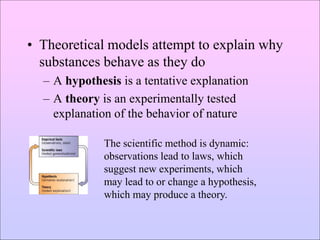
The scientific method is dynamic:
observations lead to laws, which
suggest new experiments, which
may lead to or change a hypothesis,
which may produce a theory.
• Chemical substances are comprised of
atoms
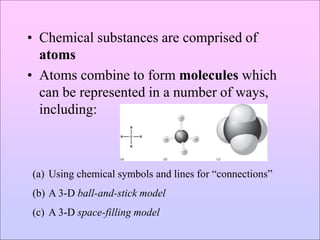
• Atoms combine to form molecules which
can be represented in a number of ways,
including:
(a) Using chemical symbols and lines for “connections”
(b) A 3-D ball-and-stick model
(c) A 3-D space-filling model
• Characteristics or properties of materials
distinguish one type of substance from
another
• Properties can be classified as physical or
chemical
– Physical properties can be observed without
changing the chemical makeup of the substance
– Chemical properties involve a chemical change
and result in different substances
– Chemical changes are described by chemical
reactions
• Properties can also be described as
intensive or extensive
– Intensive properties are independent of sample
size
• Examples: sample color and melting point
– Extensive properties depend on sample size
• Examples: sample volume and mass
• In general, intensive properties are more
useful in identifying a substance
• Matter is often classified by properties
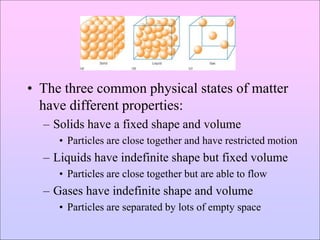
• The three common physical states of matter
have different properties:
– Solids have a fixed shape and volume
• Particles are close together and have restricted motion
– Liquids have indefinite shape but fixed volume
• Particles are close together but are able to flow
– Gases have indefinite shape and volume
• Particles are separated by lots of empty space
• Elements are substances that cannot be
decomposed by chemical means into
simpler substances
• Each element is assigned a unique chemical
symbol
– Most are one or two letters
– First letter is always capitalized
– All remaining letters are lowercase
– Names and chemical symbols of the elements
are listed on the inside front cover of the book
• Compounds are substances formed from
two or more different elements combined in
a fixed proportion by mass
• The physical and chemical properties of a
compound are, in general, different than the
physical and chemical properties of the
elements of which it is comprised
• Elements and compounds are examples of
pure substances whose composition is the
same, regardless of source
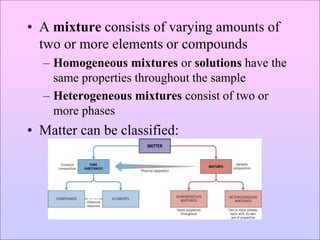
• A mixture consists of varying amounts of
two or more elements or compounds
– Homogeneous mixtures or solutions have the
same properties throughout the sample
– Heterogeneous mixtures consist of two or
more phases
• Matter can be classified:
• We take for granted the existence of atoms
and molecules
• The concept of the atom had limited
scientific usefulness until the discovery of
two important laws: the Law of
conservation of mass and the Law of
Definite Proportions
• These laws summarized the results of the
experimental observations of many
scientists
• Law of Conservation of Mass:
– No detectable gain or loss of mass occurs in
chemical reactions. Mass is conserved.
• Law of Definite Proportions:
– In a given chemical compound, the elements
are always combined in the same proportions
by mass.
• In the sciences mass is measured in units of
grams (symbol, g)
– One pound equals 453.6 g
• The laws of conservation of mass and definite
proportions provided the experimental
foundation for the atomic theory
• Dalton’s Atomic Theory:
• Matter consists of tiny particles called atoms.
• Atoms are indestructible. In chemical reactions, the atoms
rearrange but they do not themselves break apart.
• In any sample of a pure element, all the atoms are identical
in mass and other properties.
• The atoms of different elements differ in mass and other
properties.
• In a given compound the constituent atoms are always
present in the same fixed numerical ratio.
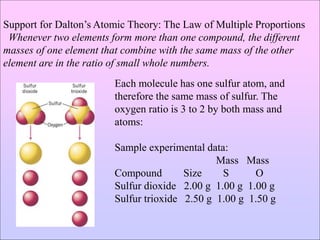
Support for Dalton’s Atomic Theory: The Law of Multiple Proportions
Whenever two elements form more than one compound, the different
masses of one element that combine with the same mass of the other
element are in the ratio of small whole numbers.
Each molecule has one sulfur atom, and
therefore the same mass of sulfur. The
oxygen ratio is 3 to 2 by both mass and
atoms:
Sample experimental data:
Mass Mass
Compound Size S O
Sulfur dioxide 2.00 g 1.00 g 1.00 g
Sulfur trioxide 2.50 g 1.00 g 1.50 g
• It follows from Dalton’s Atomic Theory
that atoms of an element have a constant,
characteristic atomic mass or atomic
weight
• For example, for any sample of hydrogen
fluoride:
• F-to-H atom ratio: 1 to 1
• F-to-H mass ratio: 19.0 to 1.00
– This is only possible if each fluorine atom is
19.0 times heavier than each hydrogen atom
• It turns out that most elements in nature are
uniform mixtures of two or more kinds of
atoms with slightly different masses
• Atoms of the same element with different
masses are called isotopes
• For example: there are 3 isotopes of hydrogen and 4
isotopes of iron
• Chemically, isotopes have virtually
identical chemical properties
• The relative proportions of the different
isotopes are essentially constant
• A uniform mass scale for atoms requires a
standard
• For atomic mass units (amu, given the
symbol u) the standard is based on carbon:
• 1 atom of carbon-12 = 12 u (exactly)
• 1 u = 1/12 mass 1 atom of carbon-12 (exactly)
• This definition results in the assignment of
approximately 1 u for the mass of hydrogen
(the lightest atom)
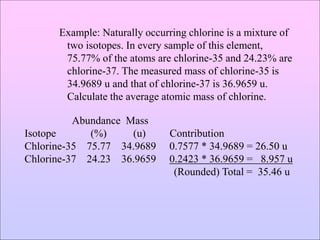
Example: Naturally occurring chlorine is a mixture of
two isotopes. In every sample of this element,
75.77% of the atoms are chlorine-35 and 24.23% are
chlorine-37. The measured mass of chlorine-35 is
34.9689 u and that of chlorine-37 is 36.9659 u.
Calculate the average atomic mass of chlorine.
Abundance Mass
Isotope (%) (u) Contribution
Chlorine-35 75.77 34.9689 0.7577 * 34.9689 = 26.50 u
Chlorine-37 24.23 36.9659 0.2423 * 36.9659 = 8.957 u
(Rounded) Total = 35.46 u
• Experiments have been performed that
show atoms are comprised of subatomic
particles
• There are three principal kinds of subatomic
particles:
• Proton – carries a positive charge, found in the
nucleus
• Electron – carries a negative charge, found outside
the nucleus, about 1/1800 the mass of a proton
• Neutron – carries no charge, found in the nucleus, a
bit heavier than a proton, about 1800 times heavier
than an electron
• An element can be defined as a substance
whose atoms all contain the identical
number of protons, called the atomic
number (Z)
• Isotopes are distinguished by mass number
(A):
• Atomic number, Z = number of protons
• Mass number, A = (number of protons) + (number
of neutrons)
• For charge neutrality, the number of
electrons and protons must be equal
• This information can be summarized
– Example: For uranium-235
• Number of protons = 92 ( = number of electrons)
• Number of neutrons = 143
• Atomic number (Z) = 92
• Mass number (A) = 92 + 143 = 235
• Chemical symbol = U
• Summary for uranium-235:
Mass number, A (protons + neutrons) 
Chemical Symbol 
Atomic number, Z (number of protons) 
235
U
92
• The Periodic Table summarizes chemical
and physical properties of the elements
• The first Periodic Tables were arrange by
increasing atomic mass
• The Modern Periodic table is arranged by
increasing atomic number:
• Elements are arranged in numbered rows called
periods
• The vertical columns are called groups or families
(group labels vary)
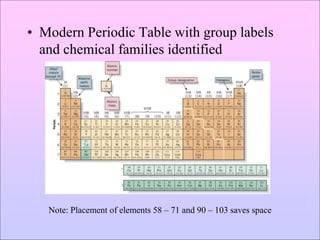
• Modern Periodic Table with group labels
and chemical families identified
Note: Placement of elements 58 – 71 and 90 – 103 saves space
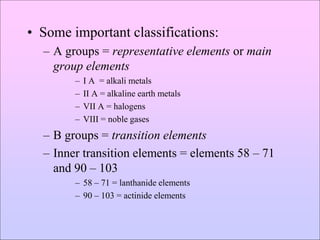
• Some important classifications:
– A groups = representative elements or main
group elements
– I A = alkali metals
– II A = alkaline earth metals
– VII A = halogens
– VIII = noble gases
– B groups = transition elements
– Inner transition elements = elements 58 – 71
and 90 – 103
– 58 – 71 = lanthanide elements
– 90 – 103 = actinide elements
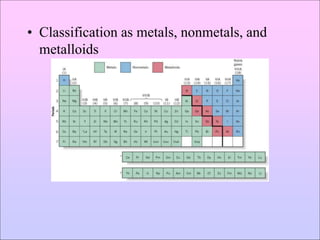
• Classification as metals, nonmetals, and
metalloids
• Metals
• Tend to shine (have metallic luster)
• Can be hammered or rolled into thin sheets
(malleable) and can be drawn into wire (ductile)
• Are solids at room temperature and conduct
electricity
• Nonmetals
• Lack the properties of metals
• React with metals to form (ionic) compounds
• Metalloids
• Have properties between metals and nonmetals

ppt-kimia-anorganik-i-atom-dan-unsur.ppt

  • 1.
    Kimia Anorganik I Atomdan Unsur Kun Sri Budiasih
  • 2.
    Atoms and Elements •Chemistry is a science that studies the composition and properties of matter • Matter is anything that takes up space and has mass • Mass is a measure of the amount matter in a sample – Chemistry holds a unique place among the sciences because all things are composed of chemicals – A knowledge of chemistry will be valuable whatever branch of science you study
  • 3.
    • Chemistry isconstantly changing as new discoveries are made by researchers • Researchers use a commonsense approach to the study of natural phenomena called the scientific method • A scientific study normally: – Begins with a question about nature – Involves a search of the work of others – Requires observing the results of experiments – Often results in a conclusion, or a statement based on what is thought about a series of observations
  • 4.
    • Experiments provideempirical facts – Facts are called data – A broad generalization based on the results of many experiments is called a (scientific) law – Laws are often expressed as mathematical equations – Laws summarize the results of experiments
  • 5.
    • Theoretical modelsattempt to explain why substances behave as they do – A hypothesis is a tentative explanation – A theory is an experimentally tested explanation of the behavior of nature The scientific method is dynamic: observations lead to laws, which suggest new experiments, which may lead to or change a hypothesis, which may produce a theory.
  • 6.
    • Chemical substancesare comprised of atoms • Atoms combine to form molecules which can be represented in a number of ways, including: (a) Using chemical symbols and lines for “connections” (b) A 3-D ball-and-stick model (c) A 3-D space-filling model
  • 7.
    • Characteristics orproperties of materials distinguish one type of substance from another • Properties can be classified as physical or chemical – Physical properties can be observed without changing the chemical makeup of the substance – Chemical properties involve a chemical change and result in different substances – Chemical changes are described by chemical reactions
  • 8.
    • Properties canalso be described as intensive or extensive – Intensive properties are independent of sample size • Examples: sample color and melting point – Extensive properties depend on sample size • Examples: sample volume and mass • In general, intensive properties are more useful in identifying a substance • Matter is often classified by properties
  • 9.
    • The threecommon physical states of matter have different properties: – Solids have a fixed shape and volume • Particles are close together and have restricted motion – Liquids have indefinite shape but fixed volume • Particles are close together but are able to flow – Gases have indefinite shape and volume • Particles are separated by lots of empty space
  • 10.
    • Elements aresubstances that cannot be decomposed by chemical means into simpler substances • Each element is assigned a unique chemical symbol – Most are one or two letters – First letter is always capitalized – All remaining letters are lowercase – Names and chemical symbols of the elements are listed on the inside front cover of the book
  • 11.
    • Compounds aresubstances formed from two or more different elements combined in a fixed proportion by mass • The physical and chemical properties of a compound are, in general, different than the physical and chemical properties of the elements of which it is comprised • Elements and compounds are examples of pure substances whose composition is the same, regardless of source
  • 12.
    • A mixtureconsists of varying amounts of two or more elements or compounds – Homogeneous mixtures or solutions have the same properties throughout the sample – Heterogeneous mixtures consist of two or more phases • Matter can be classified:
  • 13.
    • We takefor granted the existence of atoms and molecules • The concept of the atom had limited scientific usefulness until the discovery of two important laws: the Law of conservation of mass and the Law of Definite Proportions • These laws summarized the results of the experimental observations of many scientists
  • 14.
    • Law ofConservation of Mass: – No detectable gain or loss of mass occurs in chemical reactions. Mass is conserved. • Law of Definite Proportions: – In a given chemical compound, the elements are always combined in the same proportions by mass. • In the sciences mass is measured in units of grams (symbol, g) – One pound equals 453.6 g
  • 15.
    • The lawsof conservation of mass and definite proportions provided the experimental foundation for the atomic theory • Dalton’s Atomic Theory: • Matter consists of tiny particles called atoms. • Atoms are indestructible. In chemical reactions, the atoms rearrange but they do not themselves break apart. • In any sample of a pure element, all the atoms are identical in mass and other properties. • The atoms of different elements differ in mass and other properties. • In a given compound the constituent atoms are always present in the same fixed numerical ratio.
  • 16.
    Support for Dalton’sAtomic Theory: The Law of Multiple Proportions Whenever two elements form more than one compound, the different masses of one element that combine with the same mass of the other element are in the ratio of small whole numbers. Each molecule has one sulfur atom, and therefore the same mass of sulfur. The oxygen ratio is 3 to 2 by both mass and atoms: Sample experimental data: Mass Mass Compound Size S O Sulfur dioxide 2.00 g 1.00 g 1.00 g Sulfur trioxide 2.50 g 1.00 g 1.50 g
  • 17.
    • It followsfrom Dalton’s Atomic Theory that atoms of an element have a constant, characteristic atomic mass or atomic weight • For example, for any sample of hydrogen fluoride: • F-to-H atom ratio: 1 to 1 • F-to-H mass ratio: 19.0 to 1.00 – This is only possible if each fluorine atom is 19.0 times heavier than each hydrogen atom
  • 18.
    • It turnsout that most elements in nature are uniform mixtures of two or more kinds of atoms with slightly different masses • Atoms of the same element with different masses are called isotopes • For example: there are 3 isotopes of hydrogen and 4 isotopes of iron • Chemically, isotopes have virtually identical chemical properties • The relative proportions of the different isotopes are essentially constant
  • 19.
    • A uniformmass scale for atoms requires a standard • For atomic mass units (amu, given the symbol u) the standard is based on carbon: • 1 atom of carbon-12 = 12 u (exactly) • 1 u = 1/12 mass 1 atom of carbon-12 (exactly) • This definition results in the assignment of approximately 1 u for the mass of hydrogen (the lightest atom)
  • 20.
    Example: Naturally occurringchlorine is a mixture of two isotopes. In every sample of this element, 75.77% of the atoms are chlorine-35 and 24.23% are chlorine-37. The measured mass of chlorine-35 is 34.9689 u and that of chlorine-37 is 36.9659 u. Calculate the average atomic mass of chlorine. Abundance Mass Isotope (%) (u) Contribution Chlorine-35 75.77 34.9689 0.7577 * 34.9689 = 26.50 u Chlorine-37 24.23 36.9659 0.2423 * 36.9659 = 8.957 u (Rounded) Total = 35.46 u
  • 21.
    • Experiments havebeen performed that show atoms are comprised of subatomic particles • There are three principal kinds of subatomic particles: • Proton – carries a positive charge, found in the nucleus • Electron – carries a negative charge, found outside the nucleus, about 1/1800 the mass of a proton • Neutron – carries no charge, found in the nucleus, a bit heavier than a proton, about 1800 times heavier than an electron
  • 22.
    • An elementcan be defined as a substance whose atoms all contain the identical number of protons, called the atomic number (Z) • Isotopes are distinguished by mass number (A): • Atomic number, Z = number of protons • Mass number, A = (number of protons) + (number of neutrons) • For charge neutrality, the number of electrons and protons must be equal
  • 23.
    • This informationcan be summarized – Example: For uranium-235 • Number of protons = 92 ( = number of electrons) • Number of neutrons = 143 • Atomic number (Z) = 92 • Mass number (A) = 92 + 143 = 235 • Chemical symbol = U • Summary for uranium-235: Mass number, A (protons + neutrons)  Chemical Symbol  Atomic number, Z (number of protons)  235 U 92
  • 24.
    • The PeriodicTable summarizes chemical and physical properties of the elements • The first Periodic Tables were arrange by increasing atomic mass • The Modern Periodic table is arranged by increasing atomic number: • Elements are arranged in numbered rows called periods • The vertical columns are called groups or families (group labels vary)
  • 25.
    • Modern PeriodicTable with group labels and chemical families identified Note: Placement of elements 58 – 71 and 90 – 103 saves space
  • 26.
    • Some importantclassifications: – A groups = representative elements or main group elements – I A = alkali metals – II A = alkaline earth metals – VII A = halogens – VIII = noble gases – B groups = transition elements – Inner transition elements = elements 58 – 71 and 90 – 103 – 58 – 71 = lanthanide elements – 90 – 103 = actinide elements
  • 27.
    • Classification asmetals, nonmetals, and metalloids
  • 28.
    • Metals • Tendto shine (have metallic luster) • Can be hammered or rolled into thin sheets (malleable) and can be drawn into wire (ductile) • Are solids at room temperature and conduct electricity • Nonmetals • Lack the properties of metals • React with metals to form (ionic) compounds • Metalloids • Have properties between metals and nonmetals