Matter Notes
Matter:Anything that takes up space (volume) and has mass
Mass:The measure of the amount of matter in an object
Properties of Matter:Physical Properties: characteristics that can be observed without changing the compositions of the substanceEX: density, color, hardness, freezing point, boiling point, and the ability to conduct an electrical currentChemical Properties: characteristics that describe how a substance reacts with other substances to produces different substancesEX: ability to form rust, ability to form/not form certain compounds
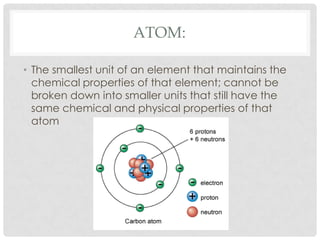
Atom:The smallest unit of an element that maintains the chemical properties of that element; cannot be broken down into smaller units that still have the same chemical and physical properties of that atom
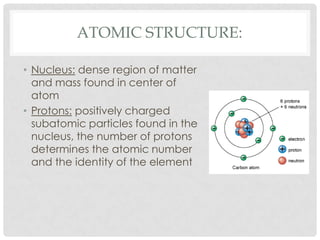
Atomic Structure:Nucleus: dense region of matter and mass found in center of atomProtons: positively charged subatomic particles found in the nucleus, the number of protons determines the atomic number and the identity of the element
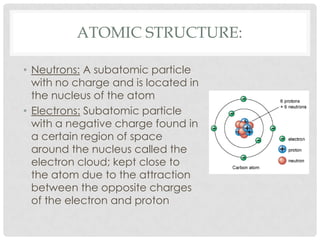
Atomic Structure:Neutrons: A subatomic particle with no charge and is located in the nucleus of the atomElectrons: Subatomic particle with a negative charge found in a certain region of space around the nucleus called the electron cloud; kept close to the atom due to the attraction between the opposite charges of the electron and proton
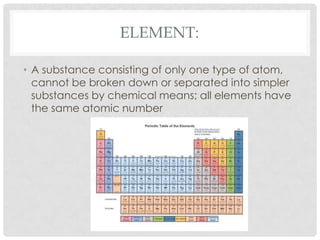
Element:A substance consisting of only one type of atom, cannot be broken down or separated into simpler substances by chemical means; all elements have the same atomic number
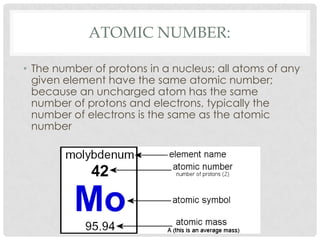
Atomic Number:The number of protons in a nucleus; all atoms of any given element have the same atomic number; because an uncharged atom has the same number of protons and electrons, typically the number of electrons is the same as the atomic number
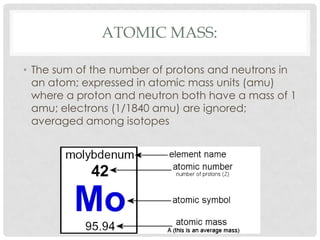
Atomic Mass:The sum of the number of protons and neutrons in an atom; expressed in atomic mass units (amu) where a proton and neutron both have a mass of 1 amu; electrons (1/1840 amu) are ignored; averaged among isotopes
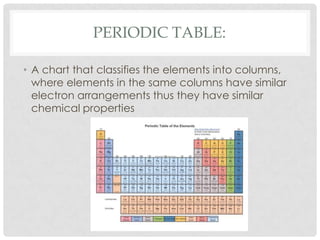
Periodic Table:A chart that classifies the elements into columns, where elements in the same columns have similar electron arrangements thus they have similar chemical properties
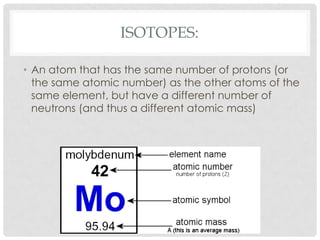
Isotopes:An atom that has the same number of protons (or the same atomic number) as the other atoms of the same element, but have a different number of neutrons (and thus a different atomic mass)
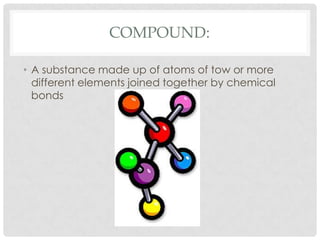
Compound:A substance made up of atoms of tow or more different elements joined together by chemical bonds
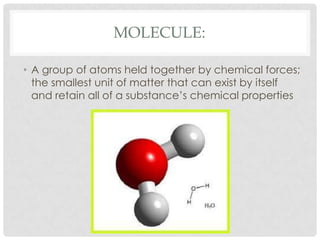
Molecule:A group of atoms held together by chemical forces; the smallest unit of matter that can exist by itself and retain all of a substance’s chemical properties
Combination of Atoms:Atoms  Elements  Molecules  CompoundsA chemical formula is a combination of letters and numbers which show what elements make up a compound:	Glucose = C6H12O6, Six carbons, twelve hydrogen, six oxygen atomsA chemical equation is a series of letter and numbers which show you the reactants and products of a chemical reaction:CH4 + 2O2  CO2 + 2H2O, one methane molecule and two oxygen molecules yields one carbon dioxide and two water molecules
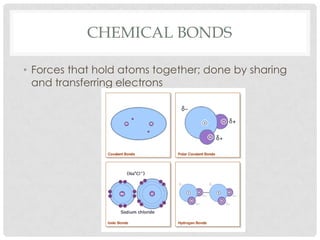
Chemical BondsForces that hold atoms together; done by sharing and transferring electrons
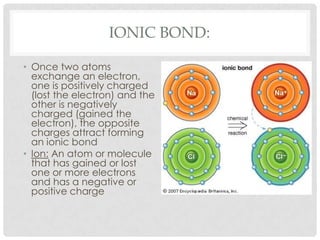
Ionic Bond:Once two atoms exchange an electron, one is positively charged (lost the electron) and the other is negatively charged (gained the electron), the opposite charges attract forming an ionic bondIon: An atom or molecule that has gained or lost one or more electrons and has a negative or positive charge
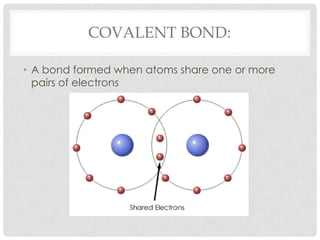
Covalent Bond:A bond formed when atoms share one or more pairs of electrons
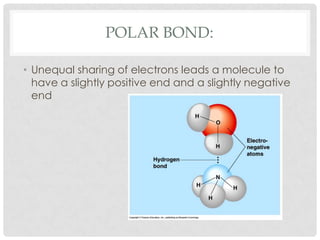
Polar Bond:Unequal sharing of electrons leads a molecule to have a slightly positive end and a slightly negative end

2. Matter Notes

  • 1.
  • 2.
    Matter:Anything that takesup space (volume) and has mass
  • 3.
    Mass:The measure ofthe amount of matter in an object
  • 4.
    Properties of Matter:PhysicalProperties: characteristics that can be observed without changing the compositions of the substanceEX: density, color, hardness, freezing point, boiling point, and the ability to conduct an electrical currentChemical Properties: characteristics that describe how a substance reacts with other substances to produces different substancesEX: ability to form rust, ability to form/not form certain compounds
  • 5.
    Atom:The smallest unitof an element that maintains the chemical properties of that element; cannot be broken down into smaller units that still have the same chemical and physical properties of that atom
  • 6.
    Atomic Structure:Nucleus: denseregion of matter and mass found in center of atomProtons: positively charged subatomic particles found in the nucleus, the number of protons determines the atomic number and the identity of the element
  • 7.
    Atomic Structure:Neutrons: Asubatomic particle with no charge and is located in the nucleus of the atomElectrons: Subatomic particle with a negative charge found in a certain region of space around the nucleus called the electron cloud; kept close to the atom due to the attraction between the opposite charges of the electron and proton
  • 8.
    Element:A substance consistingof only one type of atom, cannot be broken down or separated into simpler substances by chemical means; all elements have the same atomic number
  • 9.
    Atomic Number:The numberof protons in a nucleus; all atoms of any given element have the same atomic number; because an uncharged atom has the same number of protons and electrons, typically the number of electrons is the same as the atomic number
  • 10.
    Atomic Mass:The sumof the number of protons and neutrons in an atom; expressed in atomic mass units (amu) where a proton and neutron both have a mass of 1 amu; electrons (1/1840 amu) are ignored; averaged among isotopes
  • 11.
    Periodic Table:A chartthat classifies the elements into columns, where elements in the same columns have similar electron arrangements thus they have similar chemical properties
  • 12.
    Isotopes:An atom thathas the same number of protons (or the same atomic number) as the other atoms of the same element, but have a different number of neutrons (and thus a different atomic mass)
  • 13.
    Compound:A substance madeup of atoms of tow or more different elements joined together by chemical bonds
  • 14.
    Molecule:A group ofatoms held together by chemical forces; the smallest unit of matter that can exist by itself and retain all of a substance’s chemical properties
  • 15.
    Combination of Atoms:Atoms Elements  Molecules  CompoundsA chemical formula is a combination of letters and numbers which show what elements make up a compound: Glucose = C6H12O6, Six carbons, twelve hydrogen, six oxygen atomsA chemical equation is a series of letter and numbers which show you the reactants and products of a chemical reaction:CH4 + 2O2  CO2 + 2H2O, one methane molecule and two oxygen molecules yields one carbon dioxide and two water molecules
  • 16.
    Chemical BondsForces thathold atoms together; done by sharing and transferring electrons
  • 17.
    Ionic Bond:Once twoatoms exchange an electron, one is positively charged (lost the electron) and the other is negatively charged (gained the electron), the opposite charges attract forming an ionic bondIon: An atom or molecule that has gained or lost one or more electrons and has a negative or positive charge
  • 18.
    Covalent Bond:A bondformed when atoms share one or more pairs of electrons
  • 19.
    Polar Bond:Unequal sharingof electrons leads a molecule to have a slightly positive end and a slightly negative end