ELEMENTS, Atoms, Compounds and MoleculesBy Terry Gunning
ElementsElements are made up of atoms.All the elements are listed on the periodic table.Elements are purely one substance.
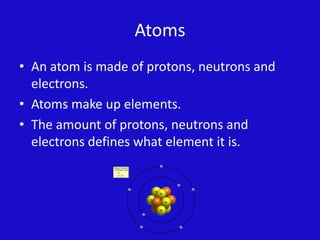
AtomsAn atom is made of protons, neutrons and electrons.Atoms make up elements.The amount of protons, neutrons and electrons defines what element it is.
Metals and Non MetalsA metal has high electrical and thermal conductivity. Metals are usually shiny, solid at room temperature, ductile and malleable. Metals normally have 1-3 electrons in their outer shell.Non Metals are poor conductors of heat and electricity. They can be solid, liquid or gas at room temperature. Non metals have 4-8 electrons in their outer shell.
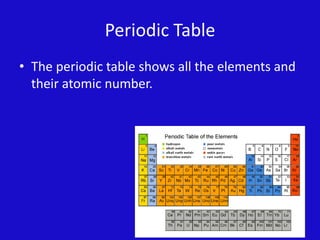
Periodic TableThe periodic table shows all the elements and their atomic number.
CompoundsA compound is a substance consisting of two or more different elements that can be separated by a chemical reaction. Water is a compound made up of two hydrogen and one oxygen atom.
Chemical ReactionsA chemical reaction is when two or more elements interact and create a new compound.Some chemical reactions are spontaneous and some are non-spontaneous needing input from some sort of energy (electricity, heat or light).
Identifying Chemical ReactionsA chemical reaction is when two elements combine.Some times a bye product can be created like a gas.
Chemical and Physical ChangesA chemical change is when the substance is changed chemically like metal rusting.A physical change is when a substance changes shape or form.
Reaction Rate and Factors Affecting It  Reaction rate can be accelerated with heat and decreased in the cold.
THE END

Chemical Reactions TG

  • 1.
    ELEMENTS, Atoms, Compoundsand MoleculesBy Terry Gunning
  • 2.
    ElementsElements are madeup of atoms.All the elements are listed on the periodic table.Elements are purely one substance.
  • 3.
    AtomsAn atom ismade of protons, neutrons and electrons.Atoms make up elements.The amount of protons, neutrons and electrons defines what element it is.
  • 4.
    Metals and NonMetalsA metal has high electrical and thermal conductivity. Metals are usually shiny, solid at room temperature, ductile and malleable. Metals normally have 1-3 electrons in their outer shell.Non Metals are poor conductors of heat and electricity. They can be solid, liquid or gas at room temperature. Non metals have 4-8 electrons in their outer shell.
  • 5.
    Periodic TableThe periodictable shows all the elements and their atomic number.
  • 6.
    CompoundsA compound isa substance consisting of two or more different elements that can be separated by a chemical reaction. Water is a compound made up of two hydrogen and one oxygen atom.
  • 7.
    Chemical ReactionsA chemicalreaction is when two or more elements interact and create a new compound.Some chemical reactions are spontaneous and some are non-spontaneous needing input from some sort of energy (electricity, heat or light).
  • 8.
    Identifying Chemical ReactionsAchemical reaction is when two elements combine.Some times a bye product can be created like a gas.
  • 9.
    Chemical and PhysicalChangesA chemical change is when the substance is changed chemically like metal rusting.A physical change is when a substance changes shape or form.
  • 10.
    Reaction Rate andFactors Affecting It Reaction rate can be accelerated with heat and decreased in the cold.
  • 11.