Dr Subhankar Kayal
2nd Year Resident
Dept Of Biochemistry
1
2
1.Periodic table,
2.Valence,
3.Atomic number,
4.Mol. Wt.,
5.Normality,
6.Molarity,
7.Molality.
Learning Objectives
3
What is Chemistry
Chemistry is a branch of science which deals with internal
structure , internal interactions of matter and effect of one
substance over other substances.
Chemistry is the integrated study of the source ,extraction,
preparation, manufacture , properties, reactions, composition,
structure, detection
and applications of the
elements and their
compounds and the
systems which form
them.
4
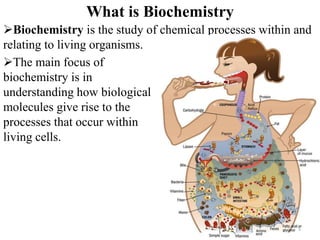
Biochemistry is the study of chemical processes within and
relating to living organisms.
What is Biochemistry
The main focus of
biochemistry is in
understanding how biological
molecules give rise to the
processes that occur within
living cells.
5
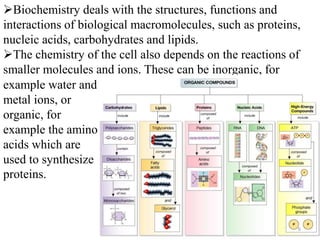
Biochemistry deals with the structures, functions and
interactions of biological macromolecules, such as proteins,
nucleic acids, carbohydrates and lipids.
The chemistry of the cell also depends on the reactions of
smaller molecules and ions. These can be inorganic, for
example water and
metal ions, or
organic, for
example the amino
acids which are
used to synthesize
proteins.
6
• UNIVERSE
• MATTER ENERGY
• SOLIDS LIQUIDS GASES PLASMA
Elements Compounds Mixtures
•
• MOLECULES
• ATOMS
7
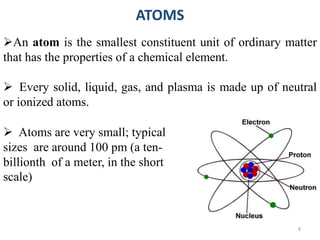
ATOMS
 Atoms are very small; typical
sizes are around 100 pm (a ten-
billionth of a meter, in the short
scale)
An atom is the smallest constituent unit of ordinary matter
that has the properties of a chemical element.
 Every solid, liquid, gas, and plasma is made up of neutral
or ionized atoms.
8
ATOMIC NUMBER
 Atomic number of a chemical element a.k.a proton
number is the number of protons found in the nucleus of an
atom of that element
Identical to the charge number of the nucleus.
It is conventionally represented by the symbol Z.
The atomic number uniquely identifies a chemical element.
 In an uncharged atom, the atomic number is also equal to
the number of electrons.
9
MASS NUMBER
 Mass number (A) is the number of nucleons, the total
number of protons (Z) and neutrons (N) in the nucleus of an
atom.
thus,
 A = Z + N
(these quantities are always whole numbers)
10
11
ATOMIC MASS
The protons and
neutrons of the nucleus
account for almost all of
the mass, and the atomic
mass measured in u has
nearly the same value as
the mass number
The atomic mass (ma) is the mass of an atomic particle. It is
commonly expressed in unified atomic mass units (u)
1 unified atomic mass unit is defined as 1/12 of the mass of
a single carbon-12 atom (at rest)
12
ISOTOPES
 Atoms having same
atomic number but
different mass numbers .
 123I, 125I, 127I, 131I
ISOBARS
 Atoms having same
number of nucleons but
differ in number of
protons i.e. have same
mass number and different
atomic number.
 40Cl, 40Ar, 40K, 40Ca
13
14
15
The periodic table is a tabular arrangement of the chemical
elements, ordered by their atomic number (number of protons
in the nucleus), electron configurations, and recurring
chemical properties.
The rows of the table are called periods; the columns are
called groups.
The periodic table can be used to derive relationships
between the properties of the elements, and predict the
properties of new elements yet to be discovered or
synthesized.
Periodic table
16
Each chemical element has a unique atomic number
representing the number of protons in its nucleus.
Isotopes are never separated in the periodic table; they are
always grouped together under a single element
In the standard periodic table, the elements are listed in
order of increasing atomic number.
17
Valence
In chemistry, the valence (or valency) of an element is a
measure of its combining power with other atoms when it
forms chemical compounds or molecules.
18
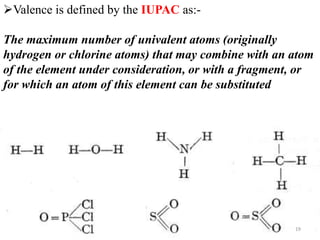
Valence is defined by the IUPAC as:-
The maximum number of univalent atoms (originally
hydrogen or chlorine atoms) that may combine with an atom
of the element under consideration, or with a fragment, or
for which an atom of this element can be substituted
19
20
21
MOLECULE
A molecule is the
smallest particle in a
chemical element or
compound that has the
chemical properties of that
element or compound.
Molecules are made up
of atoms that are held
together by chemical
bonds.
These bonds form as a
result of the sharing or
exchange of electrons
among atoms. 22
A molecule may be
 Homonuclear, i.e, it consists of atoms of a single chemical
element, as with oxygen (O2); or
 heteronuclear, a chemical compound composed of atoms of
more than one element, as with water (H2O).
 Atoms and complexes connected by non-covalent bonds
such as hydrogen bonds or ionic bonds are generally not
considered single molecules.
23
In chemistry and physics, an element is a substance that
cannot be broken down into simpler components by any non-
nuclear chemical reaction.
An element is uniquely determined by the number of protons
in the nuclei of its atoms. The number of protons in the
nucleus of the atom of an element is known as the atomic
number of that element.
Element
24
In chemistry, a compound is a substance that results from a
combination of two or more different chemical elements, in
such a way that the atoms of the different elements are held
together by chemical bonds that are difficult to break.
These bonds form as a result of the sharing or exchange of
electrons among the atoms. The smallest unbreakable unit of a
compound is called a molecule .
Compound
25
26
Molecular Mass
Molecular mass or molecular weight is the mass of a
molecule.
 It is calculated as the sum of the mass of each constituent
atom multiplied by the number of atoms of that element in the
molecular formula.
27
Both atomic and molecular masses are usually obtained
relative to the mass of the isotope 12C (carbon 12), which by
definition is equal to 12.
28
Atomic and molecular mass values are given the "unit"
Dalton (formerly atomic mass unit or AMU)
The molecular weight of methane, whose molecular formula
is CH4, is calculated as follows.
29
30
MOLE
The mole is a unit of measurement used to express
amounts of a chemical substance that contains as many
elementary entities (e.g atoms, molecules, ions, electrons)
as there are atoms in 12 grams of pure carbon-12 (12C),
the isotope of carbon with relative atomic mass of exactly 12
by definition.
31
32
The number of molecules in a mole (known as Avogadro's
constant) is defined such that the mass of one mole of a
substance, expressed in grams, is exactly equal to the
substance's mean molecular mass.
 Avogadro constant, has a value of 6.022×10²³ elementary
entities of the substance
33
Molarity
 Expresses concentration as number of moles per litre of
solution.
 Units: mol/L
 A millimole is 1/1000 of a mole.
34
 1 M NaOH contains 1 gram equivalent molecular weight
per litre.
 Or, 40 g NaOH diluted to 1000 ml with distilled water.
 Similarly, 1 millimolar (1mM) solution, or 0.001 molar
(0.001M) contains 1 millimole /litre. i.e. 0.040g diluted to
1000 ml.
35
Normality
 Expresses concentration in terms of equivalent weights of
substances. A one normal solution contains one equivalent
weight per litre.
 The equivalent weight of an element or compound is equal
to molecular weight divided by the valence.
36
Interrelationships b/w Normality and
Molarity
 1 M HCl = 1 N HCl , since 1 mole of H+ or Cl- reacts for
every mole of HCl.
 1 M H2SO4 = 2 N H2SO4 , since 2 moles of H+ reacts for
every mole of H2SO4 .
 1 M H3PO3 = 3 N H3PO3
 1 M CaSO4 = 2 N CaSO4
37
Molality
 Expresses concentration of solute as number of moles per
Kg of solvent.
 Unit: mol/kg.
38
39

Basic chemistry

  • 1.
    Dr Subhankar Kayal 2ndYear Resident Dept Of Biochemistry 1
  • 2.
  • 3.
    1.Periodic table, 2.Valence, 3.Atomic number, 4.Mol.Wt., 5.Normality, 6.Molarity, 7.Molality. Learning Objectives 3
  • 4.
    What is Chemistry Chemistryis a branch of science which deals with internal structure , internal interactions of matter and effect of one substance over other substances. Chemistry is the integrated study of the source ,extraction, preparation, manufacture , properties, reactions, composition, structure, detection and applications of the elements and their compounds and the systems which form them. 4
  • 5.
    Biochemistry is thestudy of chemical processes within and relating to living organisms. What is Biochemistry The main focus of biochemistry is in understanding how biological molecules give rise to the processes that occur within living cells. 5
  • 6.
    Biochemistry deals withthe structures, functions and interactions of biological macromolecules, such as proteins, nucleic acids, carbohydrates and lipids. The chemistry of the cell also depends on the reactions of smaller molecules and ions. These can be inorganic, for example water and metal ions, or organic, for example the amino acids which are used to synthesize proteins. 6
  • 7.
    • UNIVERSE • MATTERENERGY • SOLIDS LIQUIDS GASES PLASMA Elements Compounds Mixtures • • MOLECULES • ATOMS 7
  • 8.
    ATOMS  Atoms arevery small; typical sizes are around 100 pm (a ten- billionth of a meter, in the short scale) An atom is the smallest constituent unit of ordinary matter that has the properties of a chemical element.  Every solid, liquid, gas, and plasma is made up of neutral or ionized atoms. 8
  • 9.
    ATOMIC NUMBER  Atomicnumber of a chemical element a.k.a proton number is the number of protons found in the nucleus of an atom of that element Identical to the charge number of the nucleus. It is conventionally represented by the symbol Z. The atomic number uniquely identifies a chemical element.  In an uncharged atom, the atomic number is also equal to the number of electrons. 9
  • 10.
    MASS NUMBER  Massnumber (A) is the number of nucleons, the total number of protons (Z) and neutrons (N) in the nucleus of an atom. thus,  A = Z + N (these quantities are always whole numbers) 10
  • 11.
  • 12.
    ATOMIC MASS The protonsand neutrons of the nucleus account for almost all of the mass, and the atomic mass measured in u has nearly the same value as the mass number The atomic mass (ma) is the mass of an atomic particle. It is commonly expressed in unified atomic mass units (u) 1 unified atomic mass unit is defined as 1/12 of the mass of a single carbon-12 atom (at rest) 12
  • 13.
    ISOTOPES  Atoms havingsame atomic number but different mass numbers .  123I, 125I, 127I, 131I ISOBARS  Atoms having same number of nucleons but differ in number of protons i.e. have same mass number and different atomic number.  40Cl, 40Ar, 40K, 40Ca 13
  • 14.
  • 15.
  • 16.
    The periodic tableis a tabular arrangement of the chemical elements, ordered by their atomic number (number of protons in the nucleus), electron configurations, and recurring chemical properties. The rows of the table are called periods; the columns are called groups. The periodic table can be used to derive relationships between the properties of the elements, and predict the properties of new elements yet to be discovered or synthesized. Periodic table 16
  • 17.
    Each chemical elementhas a unique atomic number representing the number of protons in its nucleus. Isotopes are never separated in the periodic table; they are always grouped together under a single element In the standard periodic table, the elements are listed in order of increasing atomic number. 17
  • 18.
    Valence In chemistry, thevalence (or valency) of an element is a measure of its combining power with other atoms when it forms chemical compounds or molecules. 18
  • 19.
    Valence is definedby the IUPAC as:- The maximum number of univalent atoms (originally hydrogen or chlorine atoms) that may combine with an atom of the element under consideration, or with a fragment, or for which an atom of this element can be substituted 19
  • 20.
  • 21.
  • 22.
    MOLECULE A molecule isthe smallest particle in a chemical element or compound that has the chemical properties of that element or compound. Molecules are made up of atoms that are held together by chemical bonds. These bonds form as a result of the sharing or exchange of electrons among atoms. 22
  • 23.
    A molecule maybe  Homonuclear, i.e, it consists of atoms of a single chemical element, as with oxygen (O2); or  heteronuclear, a chemical compound composed of atoms of more than one element, as with water (H2O).  Atoms and complexes connected by non-covalent bonds such as hydrogen bonds or ionic bonds are generally not considered single molecules. 23
  • 24.
    In chemistry andphysics, an element is a substance that cannot be broken down into simpler components by any non- nuclear chemical reaction. An element is uniquely determined by the number of protons in the nuclei of its atoms. The number of protons in the nucleus of the atom of an element is known as the atomic number of that element. Element 24
  • 25.
    In chemistry, acompound is a substance that results from a combination of two or more different chemical elements, in such a way that the atoms of the different elements are held together by chemical bonds that are difficult to break. These bonds form as a result of the sharing or exchange of electrons among the atoms. The smallest unbreakable unit of a compound is called a molecule . Compound 25
  • 26.
  • 27.
    Molecular Mass Molecular massor molecular weight is the mass of a molecule.  It is calculated as the sum of the mass of each constituent atom multiplied by the number of atoms of that element in the molecular formula. 27
  • 28.
    Both atomic andmolecular masses are usually obtained relative to the mass of the isotope 12C (carbon 12), which by definition is equal to 12. 28
  • 29.
    Atomic and molecularmass values are given the "unit" Dalton (formerly atomic mass unit or AMU) The molecular weight of methane, whose molecular formula is CH4, is calculated as follows. 29
  • 30.
  • 31.
    MOLE The mole isa unit of measurement used to express amounts of a chemical substance that contains as many elementary entities (e.g atoms, molecules, ions, electrons) as there are atoms in 12 grams of pure carbon-12 (12C), the isotope of carbon with relative atomic mass of exactly 12 by definition. 31
  • 32.
  • 33.
    The number ofmolecules in a mole (known as Avogadro's constant) is defined such that the mass of one mole of a substance, expressed in grams, is exactly equal to the substance's mean molecular mass.  Avogadro constant, has a value of 6.022×10²³ elementary entities of the substance 33
  • 34.
    Molarity  Expresses concentrationas number of moles per litre of solution.  Units: mol/L  A millimole is 1/1000 of a mole. 34
  • 35.
     1 MNaOH contains 1 gram equivalent molecular weight per litre.  Or, 40 g NaOH diluted to 1000 ml with distilled water.  Similarly, 1 millimolar (1mM) solution, or 0.001 molar (0.001M) contains 1 millimole /litre. i.e. 0.040g diluted to 1000 ml. 35
  • 36.
    Normality  Expresses concentrationin terms of equivalent weights of substances. A one normal solution contains one equivalent weight per litre.  The equivalent weight of an element or compound is equal to molecular weight divided by the valence. 36
  • 37.
    Interrelationships b/w Normalityand Molarity  1 M HCl = 1 N HCl , since 1 mole of H+ or Cl- reacts for every mole of HCl.  1 M H2SO4 = 2 N H2SO4 , since 2 moles of H+ reacts for every mole of H2SO4 .  1 M H3PO3 = 3 N H3PO3  1 M CaSO4 = 2 N CaSO4 37
  • 38.
    Molality  Expresses concentrationof solute as number of moles per Kg of solvent.  Unit: mol/kg. 38
  • 39.