UNIT: D, PHYSICAL SCIENCE
CHAPTER: 10, PROPERTIES OF
MATTER
NOTES---1
VOCABULARY
• ATOMIC THEORY: ___ The idea that
everything is made of small particles.
• ATOM: ___ The smallest part of an element
that still has the properties of the element.
• COMPOUND: ___ A type of matter made of
two or more elements.
• MOLECULE: ___ The smallest particle of a
compound that still has the properties of that
compound.
MATTER
Anything which occupies space and has mass
is called matter.
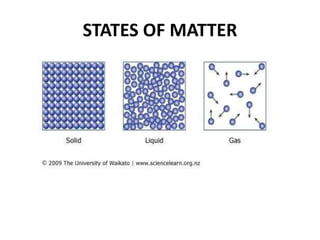
STATES OF MATTER
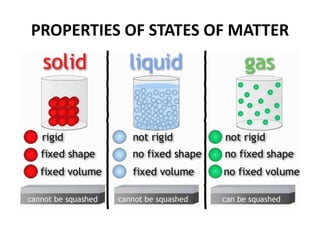
PROPERTIES OF STATES OF MATTER
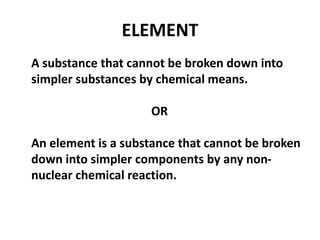
ELEMENT
A substance that cannot be broken down into
simpler substances by chemical means.
OR
An element is a substance that cannot be broken
down into simpler components by any non-
nuclear chemical reaction.
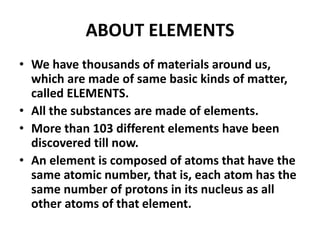
ABOUT ELEMENTS
• We have thousands of materials around us,
which are made of same basic kinds of matter,
called ELEMENTS.
• All the substances are made of elements.
• More than 103 different elements have been
discovered till now.
• An element is composed of atoms that have the
same atomic number, that is, each atom has the
same number of protons in its nucleus as all
other atoms of that element.
PROPERTIES OF ELEMENTS
• Elements cannot be broken down into other
substances with ordinary physical or chemical
processes.
• Each element has its own specific physical &
chemical characteristics.
• Elements react with other elements
according to their characteristic behavior &
atomic structure.
PERIODIC TABLE
• Scientists have arranged the discovered
elements in a “periodic table” according to
their increasing “mass number”.
PERIODIC TABLE
A table of the chemical elements arranged in
order of atomic number, usually in rows, so
that elements with similar atomic structure
(and hence similar chemical properties)
appear in vertical columns.
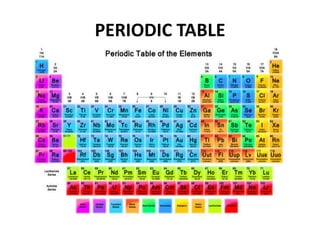
PERIODIC TABLE
PERIODIC TABLE
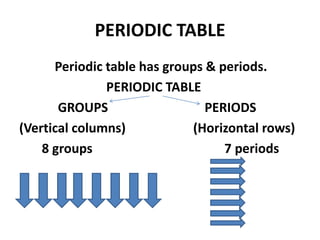
Periodic table has groups & periods.
PERIODIC TABLE
GROUPS PERIODS
(Vertical columns) (Horizontal rows)
8 groups 7 periods
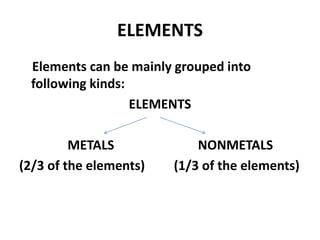
ELEMENTS
Elements can be mainly grouped into
following kinds:
ELEMENTS
METALS NONMETALS
(2/3 of the elements) (1/3 of the elements)
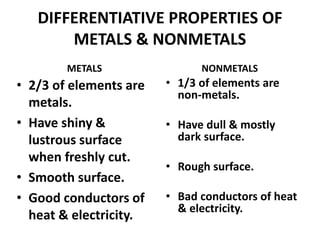
DIFFERENTIATIVE PROPERTIES OF
METALS & NONMETALS
METALS
• 2/3 of elements are
metals.
• Have shiny &
lustrous surface
when freshly cut.
• Smooth surface.
• Good conductors of
heat & electricity.
NONMETALS
• 1/3 of elements are
non-metals.
• Have dull & mostly
dark surface.
• Rough surface.
• Bad conductors of heat
& electricity.
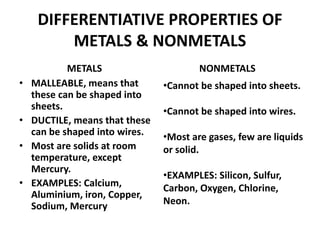
METALS
• MALLEABLE, means that
these can be shaped into
sheets.
• DUCTILE, means that these
can be shaped into wires.
• Most are solids at room
temperature, except
Mercury.
• EXAMPLES: Calcium,
Aluminium, iron, Copper,
Sodium, Mercury
NONMETALS
DIFFERENTIATIVE PROPERTIES OF
METALS & NONMETALS
•Cannot be shaped into sheets.
•Cannot be shaped into wires.
•Most are gases, few are liquids
or solid.
•EXAMPLES: Silicon, Sulfur,
Carbon, Oxygen, Chlorine,
Neon.
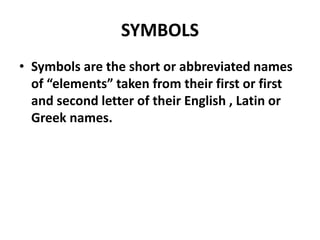
SYMBOLS
• Symbols are the short or abbreviated names
of “elements” taken from their first or first
and second letter of their English , Latin or
Greek names.
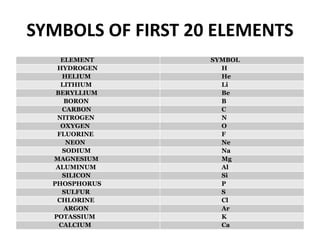
SYMBOLS OF FIRST 20 ELEMENTS
ELEMENT
ELEMENT SYMBOL
HYDROGEN H
HELIUM He
LITHIUM Li
BERYLLIUM Be
BORON B
CARBON C
NITROGEN N
OXYGEN O
FLUORINE F
NEON Ne
SODIUM Na
MAGNESIUM Mg
ALUMINUM Al
SILICON Si
PHOSPHORUS P
SULFUR S
CHLORINE Cl
ARGON Ar
POTASSIUM K
CALCIUM Ca
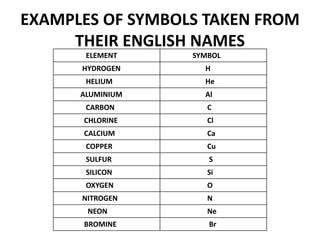
EXAMPLES OF SYMBOLS TAKEN FROM
THEIR ENGLISH NAMES
ELEMENT SYMBOL
HYDROGEN H
HELIUM He
ALUMINIUM Al
CARBON C
CHLORINE Cl
CALCIUM Ca
COPPER Cu
SULFUR S
SILICON Si
OXYGEN O
NITROGEN N
NEON Ne
BROMINE Br
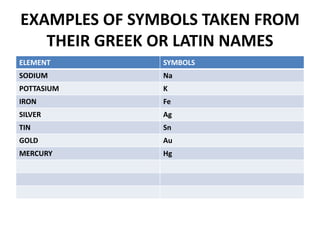
EXAMPLES OF SYMBOLS TAKEN FROM
THEIR GREEK OR LATIN NAMES
ELEMENT SYMBOLS
SODIUM Na
POTTASIUM K
IRON Fe
SILVER Ag
TIN Sn
GOLD Au
MERCURY Hg
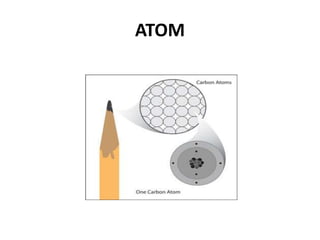
ATOM
The smallest basic part of an element that
still has the properties of the element is
called an atom.
ATOMIC THEORY
“All substances around us is matter, which is
made of different elements and all elements
are made of atoms.” This idea that every
thing is made of small particles is known as
the atomic theory”.
BASIC PROPERTIES OF ATOMS
• Atoms cannot be seen with a simple
microscope, but special powerful electronic
microscopes are used to look into an atom.
• The atoms of each element are different from
the atoms of other elements.
ATOM
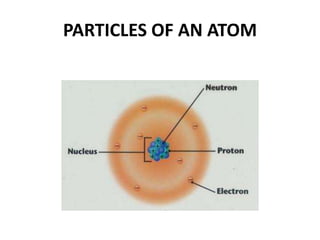
PARTICLES OF AN ATOM
• PROTON = P = Positively charged
• NEUTRON = N = Neutral = No charge
• ELECTRONS = e = Negatively charged
PARTICLES OF AN ATOM
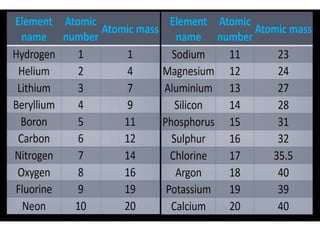
MASS NUMBER & ATOMIC NUMBER
MASS NUMBER: It is the total number of
protons and neutrons present in the nucleus of
an atom.
• Number of Protons + Number of Neutrons
ATOMIC NUMBER:
• Number of protons present in the nucleus of an
atom.
• Number of Protons
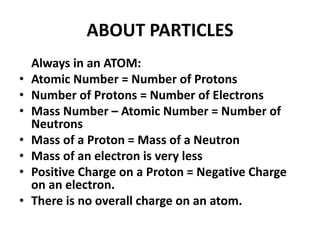
ABOUT PARTICLES
Always in an ATOM:
• Atomic Number = Number of Protons
• Number of Protons = Number of Electrons
• Mass Number – Atomic Number = Number of
Neutrons
• Mass of a Proton = Mass of a Neutron
• Mass of an electron is very less
• Positive Charge on a Proton = Negative Charge
on an electron.
• There is no overall charge on an atom.
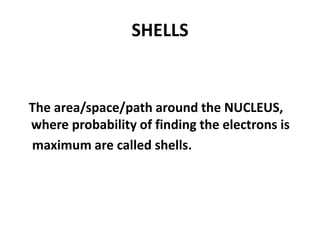
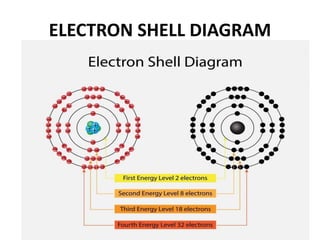
SHELLS
The area/space/path around the NUCLEUS,
where probability of finding the electrons is
maximum are called shells.
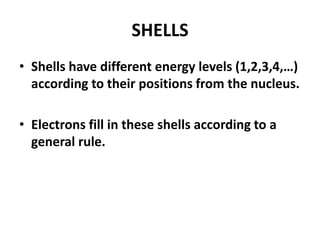
SHELLS
• Shells have different energy levels (1,2,3,4,…)
according to their positions from the nucleus.
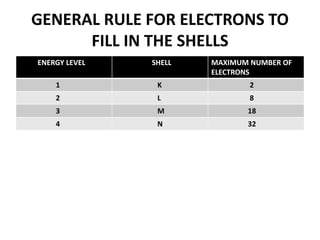
• Electrons fill in these shells according to a
general rule.
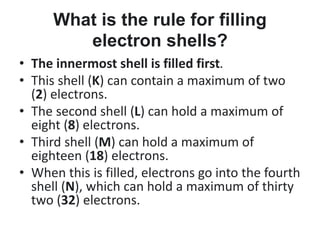
What is the rule for filling
electron shells?
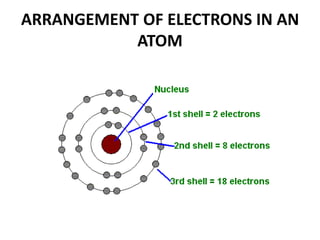
• The innermost shell is filled first.
• This shell (K) can contain a maximum of two
(2) electrons.
• The second shell (L) can hold a maximum of
eight (8) electrons.
• Third shell (M) can hold a maximum of
eighteen (18) electrons.
• When this is filled, electrons go into the fourth
shell (N), which can hold a maximum of thirty
two (32) electrons.
GENERAL RULE FOR ELECTRONS TO
FILL IN THE SHELLS
ENERGY LEVEL SHELL MAXIMUM NUMBER OF
ELECTRONS
1 K 2
2 L 8
3 M 18
4 N 32
ELECTRON SHELL DIAGRAM
ATOMIC STRUCTURES
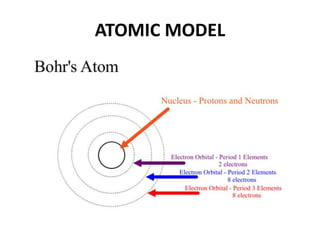
ATOMIC MODEL
ARRANGEMENT OF ELECTRONS IN AN
ATOM
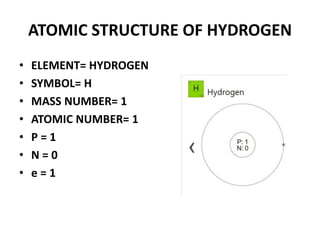
ATOMIC STRUCTURE OF HYDROGEN
• ELEMENT= HYDROGEN
• SYMBOL= H
• MASS NUMBER= 1
• ATOMIC NUMBER= 1
• P = 1
• N = 0
• e = 1
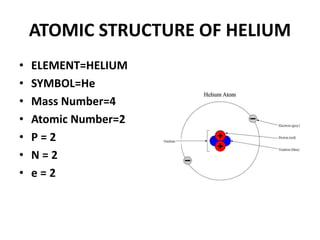
ATOMIC STRUCTURE OF HELIUM
• ELEMENT=HELIUM
• SYMBOL=He
• Mass Number=4
• Atomic Number=2
• P = 2
• N = 2
• e = 2
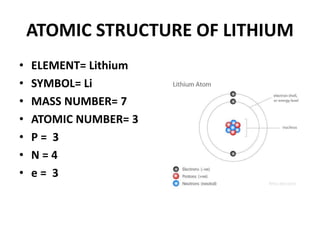
ATOMIC STRUCTURE OF LITHIUM
• ELEMENT= Lithium
• SYMBOL= Li
• MASS NUMBER= 7
• ATOMIC NUMBER= 3
• P = 3
• N = 4
• e = 3
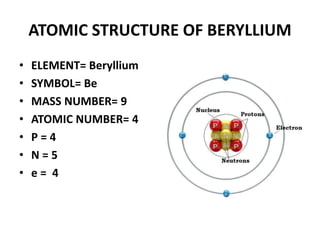
ATOMIC STRUCTURE OF BERYLLIUM
• ELEMENT= Beryllium
• SYMBOL= Be
• MASS NUMBER= 9
• ATOMIC NUMBER= 4
• P = 4
• N = 5
• e = 4
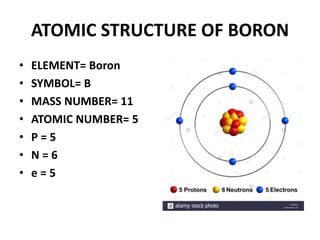
ATOMIC STRUCTURE OF BORON
• ELEMENT= Boron
• SYMBOL= B
• MASS NUMBER= 11
• ATOMIC NUMBER= 5
• P = 5
• N = 6
• e = 5
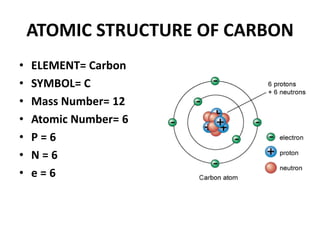
ATOMIC STRUCTURE OF CARBON
• ELEMENT= Carbon
• SYMBOL= C
• Mass Number= 12
• Atomic Number= 6
• P = 6
• N = 6
• e = 6
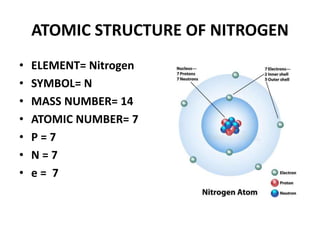
ATOMIC STRUCTURE OF NITROGEN
• ELEMENT= Nitrogen
• SYMBOL= N
• MASS NUMBER= 14
• ATOMIC NUMBER= 7
• P = 7
• N = 7
• e = 7
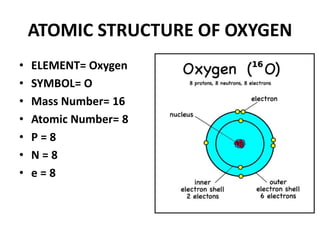
ATOMIC STRUCTURE OF OXYGEN
• ELEMENT= Oxygen
• SYMBOL= O
• Mass Number= 16
• Atomic Number= 8
• P = 8
• N = 8
• e = 8
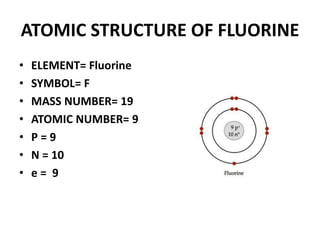
ATOMIC STRUCTURE OF FLUORINE
• ELEMENT= Fluorine
• SYMBOL= F
• MASS NUMBER= 19
• ATOMIC NUMBER= 9
• P = 9
• N = 10
• e = 9
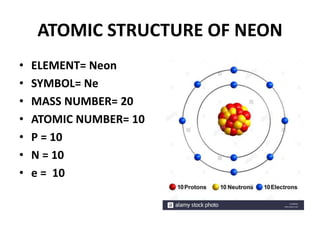
ATOMIC STRUCTURE OF NEON
• ELEMENT= Neon
• SYMBOL= Ne
• MASS NUMBER= 20
• ATOMIC NUMBER= 10
• P = 10
• N = 10
• e = 10
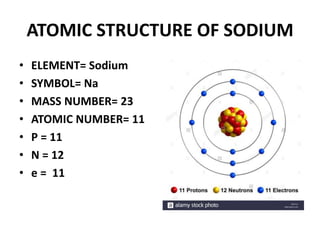
ATOMIC STRUCTURE OF SODIUM
• ELEMENT= Sodium
• SYMBOL= Na
• MASS NUMBER= 23
• ATOMIC NUMBER= 11
• P = 11
• N = 12
• e = 11
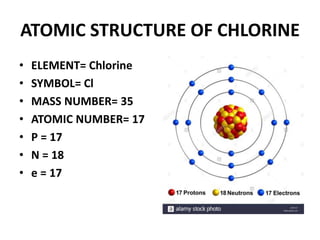
ATOMIC STRUCTURE OF CHLORINE
• ELEMENT= Chlorine
• SYMBOL= Cl
• MASS NUMBER= 35
• ATOMIC NUMBER= 17
• P = 17
• N = 18
• e = 17
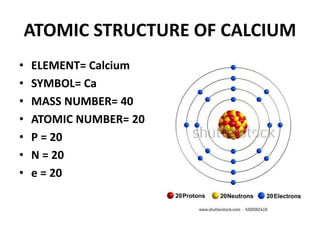
ATOMIC STRUCTURE OF CALCIUM
• ELEMENT= Calcium
• SYMBOL= Ca
• MASS NUMBER= 40
• ATOMIC NUMBER= 20
• P = 20
• N = 20
• e = 20
COMPOUNDS
• When atoms of two or more elements join
chemically in a particular ratio/way, they make a
“compound”.
• The compound is not simply a mixture of elements,
but it’s a new substance.
• Each compound has its own properties.
• A compound can be very different from the
elements it is made from .
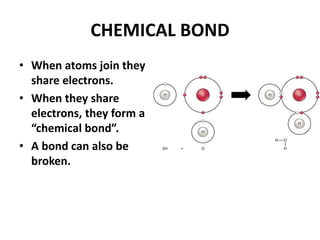
CHEMICAL BOND
• When atoms join they
share electrons.
• When they share
electrons, they form a
“chemical bond”.
• A bond can also be
broken.
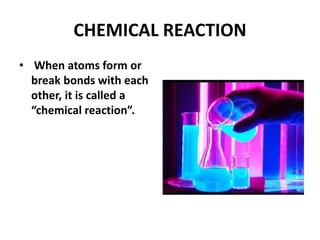
CHEMICAL REACTION
• When atoms form or
break bonds with each
other, it is called a
“chemical reaction”.
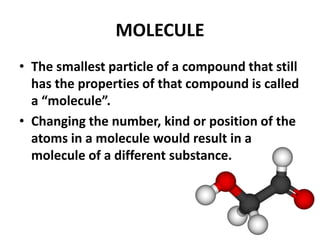
MOLECULE
• The smallest particle of a compound that still
has the properties of that compound is called
a “molecule”.
• Changing the number, kind or position of the
atoms in a molecule would result in a
molecule of a different substance.
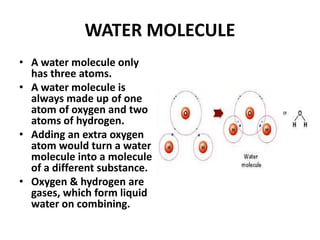
WATER MOLECULE
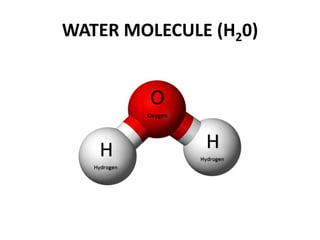
• A water molecule only
has three atoms.
• A water molecule is
always made up of one
atom of oxygen and two
atoms of hydrogen.
• Adding an extra oxygen
atom would turn a water
molecule into a molecule
of a different substance.
• Oxygen & hydrogen are
gases, which form liquid
water on combining.
WATER MOLECULE (H20)
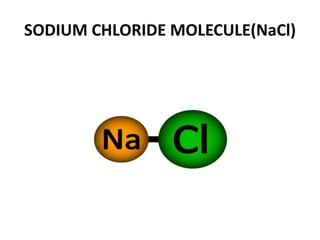
SODIUM CHLORIDE MOLECULE(NaCl)
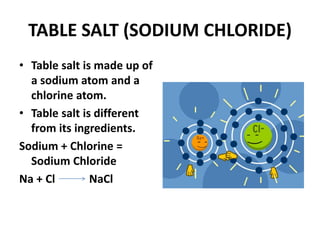
TABLE SALT (SODIUM CHLORIDE)
• Table salt is made up of
a sodium atom and a
chlorine atom.
• Table salt is different
from its ingredients.
Sodium + Chlorine =
Sodium Chloride
Na + Cl NaCl
DIFFERENCES IN THE PROPERTIES
SODIUM
• Soft metal.
• Solid at room temperature.
• It has metallic silver shine.
• It can be cut with a knife.
• Not edible.
• It reacts strongly with
chlorine.
CHLORINE
• Nonmetallic gas.
• Gas at room temperature.
• It is greenish yellow.
• Can’t be cut with a knife.
• Poisonous gas.
• It reacts strongly with
sodium.
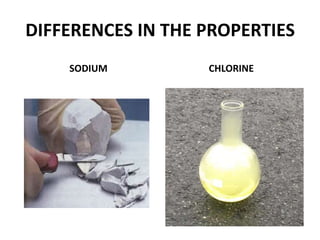
DIFFERENCES IN THE PROPERTIES
SODIUM CHLORINE
PROPERTIES OF TABLE SALT
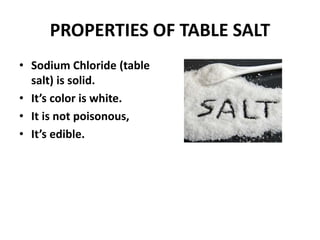
• Sodium Chloride (table
salt) is solid.
• It’s color is white.
• It is not poisonous,
• It’s edible.

NOTES OF ELEMENTS COMPOUNDS AND MIXTURES GRADE 5.pptx

  • 1.
    UNIT: D, PHYSICALSCIENCE CHAPTER: 10, PROPERTIES OF MATTER NOTES---1
  • 2.
    VOCABULARY • ATOMIC THEORY:___ The idea that everything is made of small particles. • ATOM: ___ The smallest part of an element that still has the properties of the element. • COMPOUND: ___ A type of matter made of two or more elements. • MOLECULE: ___ The smallest particle of a compound that still has the properties of that compound.
  • 3.
    MATTER Anything which occupiesspace and has mass is called matter.
  • 4.
  • 5.
  • 6.
    ELEMENT A substance thatcannot be broken down into simpler substances by chemical means. OR An element is a substance that cannot be broken down into simpler components by any non- nuclear chemical reaction.
  • 7.
    ABOUT ELEMENTS • Wehave thousands of materials around us, which are made of same basic kinds of matter, called ELEMENTS. • All the substances are made of elements. • More than 103 different elements have been discovered till now. • An element is composed of atoms that have the same atomic number, that is, each atom has the same number of protons in its nucleus as all other atoms of that element.
  • 8.
    PROPERTIES OF ELEMENTS •Elements cannot be broken down into other substances with ordinary physical or chemical processes. • Each element has its own specific physical & chemical characteristics. • Elements react with other elements according to their characteristic behavior & atomic structure.
  • 9.
    PERIODIC TABLE • Scientistshave arranged the discovered elements in a “periodic table” according to their increasing “mass number”.
  • 10.
    PERIODIC TABLE A tableof the chemical elements arranged in order of atomic number, usually in rows, so that elements with similar atomic structure (and hence similar chemical properties) appear in vertical columns.
  • 11.
  • 12.
    PERIODIC TABLE Periodic tablehas groups & periods. PERIODIC TABLE GROUPS PERIODS (Vertical columns) (Horizontal rows) 8 groups 7 periods
  • 13.
    ELEMENTS Elements can bemainly grouped into following kinds: ELEMENTS METALS NONMETALS (2/3 of the elements) (1/3 of the elements)
  • 14.
    DIFFERENTIATIVE PROPERTIES OF METALS& NONMETALS METALS • 2/3 of elements are metals. • Have shiny & lustrous surface when freshly cut. • Smooth surface. • Good conductors of heat & electricity. NONMETALS • 1/3 of elements are non-metals. • Have dull & mostly dark surface. • Rough surface. • Bad conductors of heat & electricity.
  • 15.
    METALS • MALLEABLE, meansthat these can be shaped into sheets. • DUCTILE, means that these can be shaped into wires. • Most are solids at room temperature, except Mercury. • EXAMPLES: Calcium, Aluminium, iron, Copper, Sodium, Mercury NONMETALS DIFFERENTIATIVE PROPERTIES OF METALS & NONMETALS •Cannot be shaped into sheets. •Cannot be shaped into wires. •Most are gases, few are liquids or solid. •EXAMPLES: Silicon, Sulfur, Carbon, Oxygen, Chlorine, Neon.
  • 16.
    SYMBOLS • Symbols arethe short or abbreviated names of “elements” taken from their first or first and second letter of their English , Latin or Greek names.
  • 17.
    SYMBOLS OF FIRST20 ELEMENTS ELEMENT ELEMENT SYMBOL HYDROGEN H HELIUM He LITHIUM Li BERYLLIUM Be BORON B CARBON C NITROGEN N OXYGEN O FLUORINE F NEON Ne SODIUM Na MAGNESIUM Mg ALUMINUM Al SILICON Si PHOSPHORUS P SULFUR S CHLORINE Cl ARGON Ar POTASSIUM K CALCIUM Ca
  • 18.
    EXAMPLES OF SYMBOLSTAKEN FROM THEIR ENGLISH NAMES ELEMENT SYMBOL HYDROGEN H HELIUM He ALUMINIUM Al CARBON C CHLORINE Cl CALCIUM Ca COPPER Cu SULFUR S SILICON Si OXYGEN O NITROGEN N NEON Ne BROMINE Br
  • 19.
    EXAMPLES OF SYMBOLSTAKEN FROM THEIR GREEK OR LATIN NAMES ELEMENT SYMBOLS SODIUM Na POTTASIUM K IRON Fe SILVER Ag TIN Sn GOLD Au MERCURY Hg
  • 20.
    ATOM The smallest basicpart of an element that still has the properties of the element is called an atom.
  • 21.
    ATOMIC THEORY “All substancesaround us is matter, which is made of different elements and all elements are made of atoms.” This idea that every thing is made of small particles is known as the atomic theory”.
  • 22.
    BASIC PROPERTIES OFATOMS • Atoms cannot be seen with a simple microscope, but special powerful electronic microscopes are used to look into an atom. • The atoms of each element are different from the atoms of other elements.
  • 23.
  • 24.
    PARTICLES OF ANATOM • PROTON = P = Positively charged • NEUTRON = N = Neutral = No charge • ELECTRONS = e = Negatively charged
  • 25.
  • 26.
    MASS NUMBER &ATOMIC NUMBER MASS NUMBER: It is the total number of protons and neutrons present in the nucleus of an atom. • Number of Protons + Number of Neutrons ATOMIC NUMBER: • Number of protons present in the nucleus of an atom. • Number of Protons
  • 28.
    ABOUT PARTICLES Always inan ATOM: • Atomic Number = Number of Protons • Number of Protons = Number of Electrons • Mass Number – Atomic Number = Number of Neutrons • Mass of a Proton = Mass of a Neutron • Mass of an electron is very less • Positive Charge on a Proton = Negative Charge on an electron. • There is no overall charge on an atom.
  • 29.
    SHELLS The area/space/path aroundthe NUCLEUS, where probability of finding the electrons is maximum are called shells.
  • 30.
    SHELLS • Shells havedifferent energy levels (1,2,3,4,…) according to their positions from the nucleus. • Electrons fill in these shells according to a general rule.
  • 31.
    What is therule for filling electron shells? • The innermost shell is filled first. • This shell (K) can contain a maximum of two (2) electrons. • The second shell (L) can hold a maximum of eight (8) electrons. • Third shell (M) can hold a maximum of eighteen (18) electrons. • When this is filled, electrons go into the fourth shell (N), which can hold a maximum of thirty two (32) electrons.
  • 32.
    GENERAL RULE FORELECTRONS TO FILL IN THE SHELLS ENERGY LEVEL SHELL MAXIMUM NUMBER OF ELECTRONS 1 K 2 2 L 8 3 M 18 4 N 32
  • 33.
  • 34.
  • 35.
  • 36.
  • 37.
    ATOMIC STRUCTURE OFHYDROGEN • ELEMENT= HYDROGEN • SYMBOL= H • MASS NUMBER= 1 • ATOMIC NUMBER= 1 • P = 1 • N = 0 • e = 1
  • 38.
    ATOMIC STRUCTURE OFHELIUM • ELEMENT=HELIUM • SYMBOL=He • Mass Number=4 • Atomic Number=2 • P = 2 • N = 2 • e = 2
  • 39.
    ATOMIC STRUCTURE OFLITHIUM • ELEMENT= Lithium • SYMBOL= Li • MASS NUMBER= 7 • ATOMIC NUMBER= 3 • P = 3 • N = 4 • e = 3
  • 40.
    ATOMIC STRUCTURE OFBERYLLIUM • ELEMENT= Beryllium • SYMBOL= Be • MASS NUMBER= 9 • ATOMIC NUMBER= 4 • P = 4 • N = 5 • e = 4
  • 41.
    ATOMIC STRUCTURE OFBORON • ELEMENT= Boron • SYMBOL= B • MASS NUMBER= 11 • ATOMIC NUMBER= 5 • P = 5 • N = 6 • e = 5
  • 42.
    ATOMIC STRUCTURE OFCARBON • ELEMENT= Carbon • SYMBOL= C • Mass Number= 12 • Atomic Number= 6 • P = 6 • N = 6 • e = 6
  • 43.
    ATOMIC STRUCTURE OFNITROGEN • ELEMENT= Nitrogen • SYMBOL= N • MASS NUMBER= 14 • ATOMIC NUMBER= 7 • P = 7 • N = 7 • e = 7
  • 44.
    ATOMIC STRUCTURE OFOXYGEN • ELEMENT= Oxygen • SYMBOL= O • Mass Number= 16 • Atomic Number= 8 • P = 8 • N = 8 • e = 8
  • 45.
    ATOMIC STRUCTURE OFFLUORINE • ELEMENT= Fluorine • SYMBOL= F • MASS NUMBER= 19 • ATOMIC NUMBER= 9 • P = 9 • N = 10 • e = 9
  • 46.
    ATOMIC STRUCTURE OFNEON • ELEMENT= Neon • SYMBOL= Ne • MASS NUMBER= 20 • ATOMIC NUMBER= 10 • P = 10 • N = 10 • e = 10
  • 47.
    ATOMIC STRUCTURE OFSODIUM • ELEMENT= Sodium • SYMBOL= Na • MASS NUMBER= 23 • ATOMIC NUMBER= 11 • P = 11 • N = 12 • e = 11
  • 48.
    ATOMIC STRUCTURE OFCHLORINE • ELEMENT= Chlorine • SYMBOL= Cl • MASS NUMBER= 35 • ATOMIC NUMBER= 17 • P = 17 • N = 18 • e = 17
  • 49.
    ATOMIC STRUCTURE OFCALCIUM • ELEMENT= Calcium • SYMBOL= Ca • MASS NUMBER= 40 • ATOMIC NUMBER= 20 • P = 20 • N = 20 • e = 20
  • 50.
    COMPOUNDS • When atomsof two or more elements join chemically in a particular ratio/way, they make a “compound”. • The compound is not simply a mixture of elements, but it’s a new substance. • Each compound has its own properties. • A compound can be very different from the elements it is made from .
  • 51.
    CHEMICAL BOND • Whenatoms join they share electrons. • When they share electrons, they form a “chemical bond”. • A bond can also be broken.
  • 52.
    CHEMICAL REACTION • Whenatoms form or break bonds with each other, it is called a “chemical reaction”.
  • 53.
    MOLECULE • The smallestparticle of a compound that still has the properties of that compound is called a “molecule”. • Changing the number, kind or position of the atoms in a molecule would result in a molecule of a different substance.
  • 54.
    WATER MOLECULE • Awater molecule only has three atoms. • A water molecule is always made up of one atom of oxygen and two atoms of hydrogen. • Adding an extra oxygen atom would turn a water molecule into a molecule of a different substance. • Oxygen & hydrogen are gases, which form liquid water on combining.
  • 55.
  • 56.
  • 57.
    TABLE SALT (SODIUMCHLORIDE) • Table salt is made up of a sodium atom and a chlorine atom. • Table salt is different from its ingredients. Sodium + Chlorine = Sodium Chloride Na + Cl NaCl
  • 58.
    DIFFERENCES IN THEPROPERTIES SODIUM • Soft metal. • Solid at room temperature. • It has metallic silver shine. • It can be cut with a knife. • Not edible. • It reacts strongly with chlorine. CHLORINE • Nonmetallic gas. • Gas at room temperature. • It is greenish yellow. • Can’t be cut with a knife. • Poisonous gas. • It reacts strongly with sodium.
  • 59.
    DIFFERENCES IN THEPROPERTIES SODIUM CHLORINE
  • 60.
    PROPERTIES OF TABLESALT • Sodium Chloride (table salt) is solid. • It’s color is white. • It is not poisonous, • It’s edible.