Basic Concepts in
Chemistry
ST222 – General Chemistry
Darwin F. Reyes, RCh, MSc
Natural and Applied Sciences Dept., CAS, NEUST
1
2.
Discussion Outline
• Definitionof terms
• Structure of an atom
• Atomic mass, atomic number, and isotopes
• Ions
• Periodic table
• Chemical bonding and compounds
• Chemical reactions and chemical calculations
• Mass and mole relationship in chemical reactions
3.
Definition of Terms
Chemistryis a scientific study of
matter and its properties, the changes
it undergoes and the energy
associated with those changes.
Silberberg and Amateis. Chemistry: the molecular nature of matter and change: with advanced topics. 8E. New York, NY: McGraw Hill; 2018. 3
4.
Definition of Terms
Matteris the “stuff” of the universe. It is anything that has
mass and volume.
• Pure substances vs. Mixtures
• Elements vs. Compounds
• Homogenous mixtures vs. Heterogenous mixtures
Silberberg and Amateis. Chemistry: the molecular nature of matter and change: with advanced topics. 8E. New York, NY: McGraw Hill; 2018. 4
5.
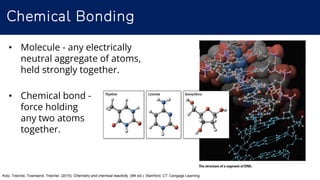
Definition of Terms
Silberbergand Amateis. Chemistry: the molecular nature of matter and change: with advanced topics. 8E. New York, NY: McGraw Hill; 2018.
States of Matter
• Solid
• Liquid
• Gas
5
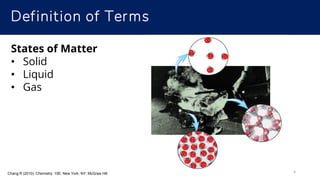
6.
Definition of Terms
ChangR (2010). Chemistry. 10E. New York, NY: McGraw Hill.
States of Matter
• Solid
• Liquid
• Gas
6
7.
Physical vs. ChemicalProperties
Silberberg and Amateis. Chemistry: the molecular nature of matter and change: with advanced topics. 8E. New York, NY: McGraw Hill; 2018.
Physical properties are characteristics a substance
shows by itself, without changing into or interacting with
another substance.
Chemical properties are characteristics a substance
shows as it changes into or interacts with another
substance (or substances).
7
8.
Physical vs. ChemicalProperties
Silberberg and Amateis. Chemistry: the molecular nature of matter and change: with advanced topics. 8E. New York, NY: McGraw Hill; 2018.
Intensive properties are characteristics a substance that
does not depend on how much matter is being considered.
Extensive properties are characteristics a substance
that depends on how much matter is being considered.
8
9.
Physical vs. ChemicalProperties
Silberberg and Amateis. Chemistry: the molecular nature of matter and change: with advanced topics. 8E. New York, NY: McGraw Hill; 2018. 9
10.
Physical vs. ChemicalChanges
Silberberg and Amateis. Chemistry: the molecular nature of matter and change: with advanced topics. 8E. New York, NY: McGraw Hill; 2018.
Physical change is where a substance alter its physical
properties, not, the composition.
Chemical change, also called as chemical reaction,
occurs when one or more substances are converted into
one or more substances with different composition and
properties.
10
11.
Physical vs. ChemicalChanges
Silberberg and Amateis. Chemistry: the molecular nature of matter and change: with advanced topics. 8E. New York, NY: McGraw Hill; 2018. 11
12.
Physical vs. ChemicalChanges
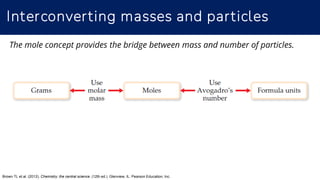
Silberberg and Amateis. Chemistry: the molecular nature of matter and change: with advanced topics. 8E. New York, NY: McGraw Hill; 2018. 12
13.
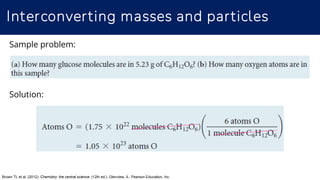
Energy and Matter
Silberbergand Amateis. Chemistry: the molecular nature of matter and change: with advanced topics. 8E. New York, NY: McGraw Hill; 2018.
Energy is the ability to do work.
Total energy = potential energy + kinetic energy
Potential energy is the energy due to position of the
object relative to other objects.
Kinetic energy is the energy due to the motion of the
object.
13
14.
Atomic theory
• Greekphilosopher Democritus
expressed the belief that all matter
consists of very small, indivisible
particles, which he named atomos
(meaning uncuttable or indivisible).
Chang R. (2010). Chemistry. (10th ed.). New York, NY: McGraw Hill.
Google images
15.
Atomic theory
• JohnDalton formulated a precise definition of the indivisible
building blocks of matter that we call atoms.
Chang R. (2010). Chemistry. (10th ed.). New York, NY: McGraw Hill.
16.
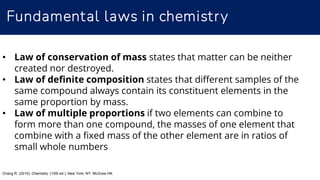
Fundamental laws inchemistry
• Law of conservation of mass states that matter can be neither
created nor destroyed.
• Law of definite composition states that different samples of the
same compound always contain its constituent elements in the
same proportion by mass.
• Law of multiple proportions if two elements can combine to
form more than one compound, the masses of one element that
combine with a fixed mass of the other element are in ratios of
small whole numbers
Chang R. (2010). Chemistry. (10th ed.). New York, NY: McGraw Hill.
17.
The structure ofthe atom
The History of the Atom – Theories and Models (2016). Retrieved from: https://www.compoundchem.com/2016/10/13/atomicmodels/
18.
The structure ofthe atom
• Atom is an electrically neutral, spherical entity composed of a
positively charged central nucleus surrounded by one or more
negatively charged electrons.
Silberberg. Chemistry: the molecular nature of matter and change. 5E. New York, NY: McGraw Hill; 2009.
• atomic nucleus consists of
protons and neutrons.
• Protons has positive charge
while neutron has no charge.
• Magnitude of charge possessed
by a proton is equal to that of an
electron, but the signs of the
charges are opposite..
19.
The structure ofthe atom
Silberberg. Chemistry: the molecular nature of matter and change. 5E. New York, NY: McGraw Hill; 2009.
20.
Atomic number, massand atomic symbol
Silberberg. Chemistry: the molecular nature of matter and change. 5E. New York, NY: McGraw Hill; 2009.
• Atomic number (Z) of an element equals the
number of protons in the nucleus of each of its
atoms. All atoms of a particular element have the
same atomic number, and each element has a
different atomic number from that of any other
element.
• The total number of protons and neutrons in the
nucleus of an atom is its mass number (A). Each
proton and each neutron contributes one unit to the
mass number.
• The nuclear mass number and charge are often
written with the atomic symbol (or element
symbol).
21.
Atomic number, massand atomic symbol
Silberberg. Chemistry: the molecular nature of matter and change. 5E. New York, NY: McGraw Hill; 2009.
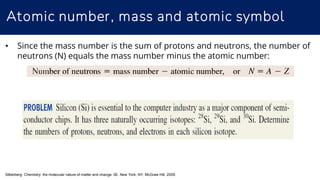
• Since the mass number is the sum of protons and neutrons, the number of
neutrons (N) equals the mass number minus the atomic number:
22.
Isotopes and atomicmasses of elements
Silberberg. Chemistry: the molecular nature of matter and change. 5E. New York, NY: McGraw Hill; 2009.
• All atoms of an element are identical in atomic number but not in mass
number.
• Isotopes of an element are atoms that have different numbers of neutrons
and therefore different mass numbers.
• A key point is that the chemical properties of an element are primarily
determined by the number of electrons, so all isotopes of an element have
nearly identical chemical behavior, even though they have different masses.
• The atomic mass unit (amu) is the mass of a carbon-12 atom.
• dalton (Da) - one 12C atom has a mass of 12 daltons (12 Da, or 12 amu).
• The atomic mass unit, which is a unit of relative mass, has an absolute
mass of
23.
Isotopes and atomicmasses of elements
Silberberg. Chemistry: the molecular nature of matter and change. 5E. New York, NY: McGraw Hill; 2009.
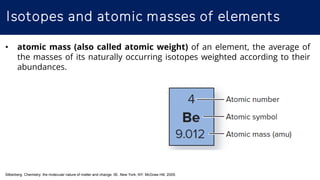
• atomic mass (also called atomic weight) of an element, the average of
the masses of its naturally occurring isotopes weighted according to their
abundances.
24.
Molecules and ions
ChangR. (2010). Chemistry. (10E). New York, NY: McGraw Hill
• A molecule is an aggregate of at least two atoms in a definite arrangement
held together by chemical forces (also called chemical bonds ).
A. Diatomic molecules - molecules containing only 2 atoms
B. Polyatomic molecules - molecules containing more than 2 atoms
25.
Molecules and ions
ChangR. (2010). Chemistry. (10E). New York, NY: McGraw Hill
• An ion is an atom or a group of atoms that has a net positive or negative
charge.
A. Cation - an ion with a net positive charge.
B. Anion - an ion with a net negative charge.
Take note that:
• An ion with a net positive charge lost an electron.
• An ion with a net negative charge gained an electron.
• The number of electrons changes in the formation of ions, but not the
number of protons and neutrons.
26.
Elements: a firstlook at the periodic table
Silberberg. Chemistry: the molecular nature of matter and change. 5E. New York, NY: McGraw Hill; 2009.
• In 1871, the Russian chemist Dmitri
Mendeleev (1836–1907) published the most
successful of these organizing schemes as a
table of the elements listed by increasing
atomic mass and arranged so that elements
with similar chemical properties fell in the
same column.
• The modern periodic table of the
elements, based on Mendeleev’s earlier
version (but arranged by atomic number, not
mass), is one of the great classifying schemes
in science and is now an indispensable tool to
chemists.
Elements: a firstlook at the periodic table
Silberberg. Chemistry: the molecular nature of matter and change. 5E. New York, NY: McGraw Hill; 2009.
Organization of the Periodic Table
29.
Elements: a firstlook at the periodic table
Silberberg. Chemistry: the molecular nature of matter and change. 5E. New York, NY: McGraw Hill; 2009.
• Metals appear in the large lower-left portion of the table. They are
generally shiny solids at room temperature (mercury is the only liquid) that
conduct heat and electricity well and can be tooled into sheets (malleable)
and wires (ductile).
• Nonmetals appear in the small upper-right portion of the table. They are
generally gases or dull, brittle solids at room temperature (bromine is the
only liquid) and conduct heat and electricity poorly.
• Along the staircase line lie the metalloids (also called semimetals),
elements that have properties between those of metals and nonmetals.
30.
Elements: a firstlook at the periodic table
Silberberg. Chemistry: the molecular nature of matter and change. 5E. New York, NY: McGraw Hill; 2009.
It is also important to know some of the group (family) names:
• Group 1A(1) (except for hydrogen)—alkali metals (reactive metals)
• Group 2A(2)—alkaline earth metals (reactive metals)
• Group 7A(17)—halogens (reactive nonmetals)
• Group 8A(18)—noble gases (relatively nonreactive nonmetals)
• Other main groups [3A(13) to 6A(16)] are often named for the first element
in the group; for example, Group 6A is the oxygen family.
31.
Elements: a firstlook at the periodic table
Silberberg. Chemistry: the molecular nature of matter and change. 5E. New York, NY: McGraw Hill; 2009.
32.
Chemical Bonding
Kotz, Treichel,Townsend, Treichel. (2015). Chemistry and chemical reactivity. (9th ed.). Stamford, CT: Cengage Learning.
• Molecule - any electrically
neutral aggregate of atoms,
held strongly together.
• Chemical bond -
force holding
any two atoms
together.
33.
Covalent bonding
• Covalentbonding involves a sharing of electrons from each
atom’s outermost shell (valence electrons) between atoms. Two
chlorine atoms, for example, share a pair of electrons, one
electron from each atom, to form a covalent bond.
Kotz, Treichel, Townsend, Treichel. (2015). Chemistry and chemical reactivity. (9th ed.). Stamford, CT: Cengage Learning.
34.
Naming of covalentcompounds
• Binary molecular compounds are a combination of nonmetallic
elements from Groups 4A–7A with one another or with
hydrogen.
• Name the first element as is and the end of the second element
will be changed to “-ide”
• The number of atoms of a given type in the compound is
designated with a prefix, such as “di-,” “tri-,” “tetra-,”“penta-,” and
so on.
Kotz, Treichel, Townsend, Treichel. (2015). Chemistry and chemical reactivity. (9th ed.). Stamford, CT: Cengage Learning.
35.
Naming of covalentcompounds
Kotz, Treichel, Townsend, Treichel. (2015). Chemistry and chemical reactivity. (9th ed.). Stamford, CT: Cengage Learning.
36.
Ionic bonding
Kotz, Treichel,Townsend, Treichel. (2015). Chemistry and chemical reactivity. (9th ed.). Stamford, CT: Cengage Learning.
• Ionic bonding involves a transfer of electrons from each atom’s
outermost shell (valence electrons) between atoms, forming
ions.
• For example, the resulting Na+ and Cl− ions are attracted to each
other due to their electrostatic charges, and it is this electrostatic
attraction between oppositely charged ions that constitutes the
ionic bond.
37.
Ionic bonding
Kotz, Treichel,Townsend, Treichel. (2015). Chemistry and chemical reactivity. (9th ed.). Stamford, CT: Cengage Learning.
• Ionic bonding involves a transfer of electrons from each atom’s
outermost shell (valence electrons) between atoms, forming
ions.
• For example, the resulting Na+ and Cl− ions are attracted to each
other due to their electrostatic charges, and it is this electrostatic
attraction between oppositely charged ions that constitutes the
ionic bond.
• Metals generally lose one or more electrons.
• Nonmetals frequently gain one or more electrons.
38.
Ionic bonding
Kotz, Treichel,Townsend, Treichel. (2015). Chemistry and chemical reactivity. (9th ed.). Stamford, CT: Cengage Learning.
CATION + ANION = IONIC COMPOUND
• The subscript refers to the element preceding it.
• The subscript 1 is understood from the presence of the element symbol alone
• The charge (without the sign) of one ion becomes the subscript of the other:
Ionic bonding
Silberberg M.(2009) Chemistry: the molecular nature of matter and change (5th ed) New York, NY: McGraw Hill
41.
Ionic bonding
Silberberg M.(2009) Chemistry: the molecular nature of matter and change (5th ed) New York, NY: McGraw Hill
42.
Ionic bonding
Silberberg M.(2009) Chemistry: the molecular nature of matter and change (5th ed) New York, NY: McGraw Hill
43.
Ionic bonding
Silberberg M.(2009) Chemistry: the molecular nature of matter and change (5th ed) New York, NY: McGraw Hill
44.
Ionic bonding
Silberberg M.(2009) Chemistry: the molecular nature of matter and change (5th ed) New York, NY: McGraw Hill
45.
Metallic bonding
Silberberg M.(2009) Chemistry: the molecular nature of matter and change (5th ed) New York, NY: McGraw Hill
• In metallic bonding, all the metal atoms in a sample pool their
valence electrons into an evenly distributed “sea” of electrons
that “flows” between and around the metal-ion cores (nucleus
plus inner electrons), attracting them and holding them together.
Unlike the localized electrons in covalent bonding, electrons in
metallic bonding are delocalized, moving freely throughout the
piece of metal.
46.
Summary
Silberberg M. (2009)Chemistry: the molecular nature of matter and change (5th ed) New York, NY: McGraw Hill
Ionic bonding Covalent bonding Metallic bonding
Metal + Nonmetal Nonmetal + Nonmetal Metal + Metal
47.
Chemical Reactions
Google images
TroNJ. (2009). Chemistry in focus:a molecular view of our world, (4th ed.). Belmont, CA: Brooks/Cole
Chemical reactions are transformation of elements and/or
compounds into another compounds with different composition
and properties.
× ✔
48.
Chemical equations
Tro NJ.(2009). Chemistry infocus:a molecular view of our world, (4th ed.). Belmont, CA: Brooks/Cole
• Chemical reactions are represented by chemical equations.
• The starting substances on the left side of the equation are
called the reactants, and the new substances on the right side
are called the products.
49.
Balacing chemical equation
TroNJ. (2009). Chemistry infocus:a molecular view of our world, (4th ed.). Belmont, CA: Brooks/Cole
• Because chemical equations represent real chemical
reactions, the number of atoms of each element on both
sides of the equation must be equal—the equation must be
balanced.
• “New atoms do not form during a reaction, nor do atoms vanish;
matter is conserved” → Law of Conservation of Matter
50.
Balacing chemical equation
TroNJ. (2009). Chemistry in focus:a molecular view of our world, (4th ed.). Belmont, CA: Brooks/Cole
51.
Balacing chemical equation
TroNJ. (2009). Chemistry in focus:a molecular view of our world, (4th ed.). Belmont, CA: Brooks/Cole
Types of chemicalreactions
Brown TL et al. (2012). Chemistry: the central science. (12th ed.). Glenview, IL: Pearson Education, Inc.
1. Combination reactions or synthesis
In combination reactions, two or more substances react to form
one product. For example, magnesium metal burns brilliantly in
air to produce magnesium oxide
54.
Types of chemicalreactions
Brown TL et al. (2012). Chemistry: the central science. (12th ed.). Glenview, IL: Pearson Education, Inc.
1. Combination reactions or synthesis
In combination reactions, two or more substances react to form
one product. For example, magnesium metal burns brilliantly in
air to produce magnesium oxide
55.
Types of chemicalreactions
Brown TL et al. (2012). Chemistry: the central science. (12th ed.). Glenview, IL: Pearson Education, Inc.
2. Decomposition reactions
In a decomposition reaction, one substance undergoes a
reaction to produce two or more other substances. For
example, the decomposition of sodium azide (NaN3) rapidly
releases N2(g), so this reaction is used to inflate safety air
bags in automobiles:
The system is designed so that an impact ignites a
detonator cap, which in turn causes NaN3 to decompose
explosively. A small quantity of NaN3 (about 100 g) forms a
large quantity of gas (about 50 L).
56.
Types of chemicalreactions
Brown TL et al. (2012). Chemistry: the central science. (12th ed.). Glenview, IL: Pearson Education, Inc.
2. Decomposition reactions
57.
Types of chemicalreactions
Brown TL et al. (2012). Chemistry: the central science. (12th ed.). Glenview, IL: Pearson Education, Inc.
3. Combustion reactions
Combustion reactions are rapid reactions that produce a
flame. Most combustion reactions we observe involve O2
from air as a reactant. It is a general class of reaction
involving the burning, or combustion, of hydrocarbons
(compounds that contain only carbon and hydrogen, such
as CH4 and C2H4).
58.
Types of chemicalreactions
Types of Chemical Reactions. Retrieved from:
https://chem.libretexts.org/Courses/Valley_City_State_University/Chem_121/Chapter_5%3A_Introduction_to_Redox_Chemistry/5.3%3A_Types_of_Chemical_Reactions
4. Single displacement reactions
A single-replacement reaction is a reaction in which one element replaces a
similar element in a compound. The general form of a single-replacement
(also called single-displacement) reaction is:
A+BC→AC+B
In this general reaction, element A is a metal and replaces element B , also a
metal, in the compound. When the element that is doing the replacing is a
nonmetal, it must replace another nonmetal in a compound, and the general
equation becomes: Y (metal) + XZ (compound) → XY+Z (metal)
59.
Types of chemicalreactions
Types of Chemical Reactions. Retrieved from:
https://chem.libretexts.org/Courses/Valley_City_State_University/Chem_121/Chapter_5%3A_Introduction_to_Redox_Chemistry/5.3%3A_Types_of_Chemical_Reactions
4. Single displacement reactions
2Na + 2H2O → 2NaOH + H2
60.
Types of chemicalreactions
Types of Chemical Reactions. Retrieved from:
https://chem.libretexts.org/Courses/Valley_City_State_University/Chem_121/Chapter_5%3A_Introduction_to_Redox_Chemistry/5.3%3A_Types_of_Chemical_Reactions
5. Double displacement reactions
A double-replacement reaction is a reaction in which the positive and
negative ions of two ionic compounds exchange places to form two new
compounds. The general form of a double-replacement (also called double-
displacement) reaction is: AB+CD→AD+CB
In this reaction, A and C are positively-charged cations, while B and D are
negatively-charged anions. Double-replacement reactions generally occur
between substances in aqueous solution. In order for a reaction to occur, one
of the products is usually a solid precipitate, a gas, or a molecular compound
such as water.
61.
Types of chemicalreactions
Types of Chemical Reactions. Retrieved from:
https://chem.libretexts.org/Courses/Valley_City_State_University/Chem_121/Chapter_5%3A_Introduction_to_Redox_Chemistry/5.3%3A_Types_of_Chemical_Reactions
5. Double displacement reactions
62.
Types of chemicalreactions
Brown TL et al. (2012). Chemistry: the central science. (12th ed.). Glenview, IL: Pearson Education, Inc.
Sample problems:
Identify the type of reaction in the given equations:
63.
Precipitation reactions
63
The KeyEvent: Formation of a Solid from
Dissolved Ions
In precipitation reactions, two soluble ionic
compounds react to form an insoluble product, a
precipitate.
The key event in a precipitation reaction is the
formation of an insoluble product through the net
removal of solvated ions from solution.
Silberberg M. (2009) Chemistry: the molecular nature of matter and change (5th ed). New York, NY: McGraw Hill
64.
Precipitation reactions
64
Predicting Whethera Precipitate Will Form
1. Note the ions present in the reactants.
2. Consider the possible cation-anion combinations.
3. Decide whether any of the combinations is insoluble.
Silberberg M. (2009) Chemistry: the molecular nature of matter and change (5th ed). New York, NY: McGraw Hill
65.
Acid-base reactions
65
Aqueous acid-basereactions involve water not only as solvent but also in the more active
roles of reactant and product.
An acid-base reaction (also called a neutralization reaction) occurs when an acid reacts
with a base.
• An acid is a substance that produces ions when dissolved in water.
• A base is a substance that produces ions when dissolved in water.
Silberberg M. (2009) Chemistry: the molecular nature of matter and change (5th ed). New York, NY: McGraw Hill
66.
Acid-base reactions
66
Acids andthe Solvated Proton
Acidic solutions arise from a special class of covalent molecules that do dissociate in
water. In every case, these molecules contain a polar bond to hydrogen in which the atom
bonded to H pulls more strongly on the shared electron pair.
Hydronium ion:
Acids and Bases as Electrolytes
Acids and bases are categorized in terms of their “strength”—the degree to which they
dissociate into ions in aqueous solution. In water, strong acids and strong bases dissociate
completely into ions.
Silberberg M. (2009) Chemistry: the molecular nature of matter and change (5th ed). New York, NY: McGraw Hill
Acid-base reactions
68
The KeyEvent: Formation of Water from Hydrogen and Hydroxides Ions
The essential change in all aqueous reactions between a strong acid and a strong base is
that a hydrogen ion from the acid and a hydroxide ion from the base form a water molecule.
An ionic compound that results from the reaction of an acid and a base is called a salt.
Thus, in a typical aqueous neutralization reaction, the reactants are an acid and a base,
and the products are a salt solution and water:
Silberberg M. (2009) Chemistry: the molecular nature of matter and change (5th ed). New York, NY: McGraw Hill
69.
Acid-base reactions
69
Proton Transfer:A Closer Look at Acid-Base Reactions
Silberberg M. (2009) Chemistry: the molecular nature of matter and change (5th ed). New York, NY: McGraw Hill
70.
Oxidation-reduction (redox) reactions
70
TheKey Event: Movement of Electrons Between Reactants
In oxidation-reduction (or redox) reactions, the key chemical event is the net movement of
electrons from one reactant to the other. This movement of electrons occurs from the
reactant (or atom in the reactant) with less attraction for electrons to the reactant (or atom)
with more attraction for electrons.
Some Essential Redox Terminology
• Oxidation is the loss of electrons and reduction is the gain of electrons.
• Oxidizing agent is the substance that accepts electrons in a reaction and undergoes a
decrease in oxidation number.
• Reducing agent is the substance that donates electrons in a redox reaction and
undergoes an increase in oxidation number.
Silberberg M. (2009) Chemistry: the molecular nature of matter and change (5th ed). New York, NY: McGraw Hill
71.
Oxidation-reduction (redox) reactions
71
UsingOxidation Numbers to Monitor the Movement of Electron Charge
Silberberg M. (2009) Chemistry: the molecular nature of matter and change (5th ed). New York, NY: McGraw Hill
Oxidation-reduction (redox) reactions
75
SilberbergM. (2009) Chemistry: the molecular nature of matter and change (5th ed). New York, NY: McGraw Hill
Elements In Redox Reactions
• Combination reactions
1. Metal and nonmetal form an ionic compound (Example: Aluminum and hydrochloric
acid).
2. Two nonmetals form a covalent compound (Example: Nitrogen gas and hydrogen gas).
3. Combining compound and element (Example: Nitrogen monoxide and oxygen gas)
• Decomposition reactions
1. Thermal decomposition (Example: decomposition of potassium chlorate)
2. Electrolytic decomposition (Example: decomposition of water)
76.
Oxidation-reduction (redox) reactions
76
SilberbergM. (2009) Chemistry: the molecular nature of matter and change (5th ed). New York, NY: McGraw Hill
Elements In Redox Reactions
• Displacement reactions
1. A metal displaces H2 from water or acid (Example: Al in water
and HCl)
2. A metal displaces another metal ion from solution (Example:
Zn metal and copper (II) sulfate)
• Combustion reactions
Combustion is the process of combining with oxygen, often with
the release of heat and light, as in a flame.
77.
Formula and molecularmass
Tro NJ. (2009). Chemistry in focus:a molecular view of our world, (4th ed.). Belmont, CA: Brooks/Cole
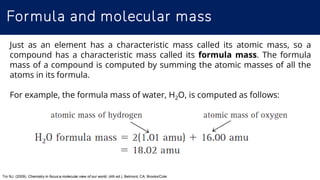
Just as an element has a characteristic mass called its atomic mass, so a
compound has a characteristic mass called its formula mass. The formula
mass of a compound is computed by summing the atomic masses of all the
atoms in its formula.
For example, the formula mass of water, H2O, is computed as follows:
78.
Formula and molecularmass
Tro NJ. (2009). Chemistry in focus:a molecular view of our world, (4th ed.). Belmont, CA: Brooks/Cole
79.
Formula and molecularmass
Tro NJ. (2009). Chemistry in focus:a molecular view of our world, (4th ed.). Belmont, CA: Brooks/Cole
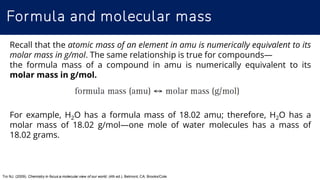
Recall that the atomic mass of an element in amu is numerically equivalent to its
molar mass in g/mol. The same relationship is true for compounds—
the formula mass of a compound in amu is numerically equivalent to its
molar mass in g/mol.
For example, H2O has a formula mass of 18.02 amu; therefore, H2O has a
molar mass of 18.02 g/mol—one mole of water molecules has a mass of
18.02 grams.
80.
Formula and molecularmass
Tro NJ. (2009). Chemistry in focus:a molecular view of our world, (4th ed.). Belmont, CA: Brooks/Cole
Sample problems:
Calculate the molar mass of the following compounds:
81.
Avogadro's number
Brown TLet al. (2012). Chemistry: the central science. (12th ed.). Glenview, IL: Pearson Education, Inc.
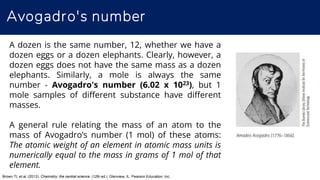
A dozen is the same number, 12, whether we have a
dozen eggs or a dozen elephants. Clearly, however, a
dozen eggs does not have the same mass as a dozen
elephants. Similarly, a mole is always the same
number - Avogadro's number (6.02 x 10²³), but 1
mole samples of different substance have different
masses.
A general rule relating the mass of an atom to the
mass of Avogadro’s number (1 mol) of these atoms:
The atomic weight of an element in atomic mass units is
numerically equal to the mass in grams of 1 mol of that
element.
82.
Avogadro's number
Brown TLet al. (2012). Chemistry: the central science. (12th ed.). Glenview, IL: Pearson Education, Inc.
83.
Interconverting masses andparticles
Brown TL et al. (2012). Chemistry: the central science. (12th ed.). Glenview, IL: Pearson Education, Inc.
The mole concept provides the bridge between mass and number of particles.
To illustrate how this bridge works, let’s calculate the number of copper
atoms in an old copper penny. Such a penny has a mass of about 3 g, and
we assume it is 100% copper:
84.
Interconverting masses andparticles
Brown TL et al. (2012). Chemistry: the central science. (12th ed.). Glenview, IL: Pearson Education, Inc.
The mole concept provides the bridge between mass and number of particles.
85.
Interconverting masses andparticles
Brown TL et al. (2012). Chemistry: the central science. (12th ed.). Glenview, IL: Pearson Education, Inc.
Sample problem:
Solution:
86.
Interconverting masses andparticles
Brown TL et al. (2012). Chemistry: the central science. (12th ed.). Glenview, IL: Pearson Education, Inc.
Sample problem:
Solution:
87.
Interconverting masses andparticles
Brown TL et al. (2012). Chemistry: the central science. (12th ed.). Glenview, IL: Pearson Education, Inc.
88.
Stoichiometry
Silberberg M. (2009)Chemistry: the molecular nature of matter and change (5th ed). New York, NY: McGraw Hill
88
Stoichiometry: Quantitative Information of Chemical Equations
In a balanced equation, the number of moles of one substance is stoichiometrically
equivalent to the number of moles of any other substance. The term stoichiometrically
equivalent means that a definite amount of one substance is formed from, produces, or
reacts with a definite amount of the other.
For a given reaction,
89.
Stoichiometry
Silberberg M. (2009)Chemistry: the molecular nature of matter and change (5th ed). New York, NY: McGraw Hill
89
Stoichiometry: Quantitative Information of Chemical Equations
90.
Stoichiometry
Silberberg M. (2009)Chemistry: the molecular nature of matter and change (5th ed). New York, NY: McGraw Hill
90
Stoichiometry: Quantitative Information of Chemical Equations
91.
Stoichiometry
Silberberg M. (2009)Chemistry: the molecular nature of matter and change (5th ed). New York, NY: McGraw Hill
91
Stoichiometry: Quantitative Information of Chemical Equations
PROBLEM
92.
Limiting and excessreactants
Silberberg M. (2009) Chemistry: the molecular nature of matter and change (5th ed). New York, NY: McGraw Hill
92
The reactant used up first in a reaction is called the limiting reactants, because the
maximum amount of product formed depends on how much of this reactant was
originally present. When this reactant is used up, no more product can be formed.
Excess reactants are the reactants present in quantities greater than necessary to react
with the quantity of the limiting reagent.
93.
Limiting and excessreactants
Silberberg M. (2009) Chemistry: the molecular nature of matter and change (5th ed). New York, NY: McGraw Hill
93
PROBLEM
94.
Reaction yield
Silberberg M.(2009) Chemistry: the molecular nature of matter and change (5th ed). New York, NY: McGraw Hill
94
Theoretical yield, the amount indicated by the
stoichiometrically equivalent molar ratio in the
balanced equation.
The amount of product that you actually obtain is the
actual yield.
The percent yield (% yield) is the actual yield
expressed as a percentage of the theoretical yield:
95.
Reaction yield
Silberberg M.(2009) Chemistry: the molecular nature of matter and change (5th ed). New York, NY: McGraw Hill
95
96.
Reaction yield
Silberberg M.(2009) Chemistry: the molecular nature of matter and change (5th ed). New York, NY: McGraw Hill
96
PROBLEM









![Elements: a first look at the periodic table
Silberberg. Chemistry: the molecular nature of matter and change. 5E. New York, NY: McGraw Hill; 2009.
It is also important to know some of the group (family) names:
• Group 1A(1) (except for hydrogen)—alkali metals (reactive metals)
• Group 2A(2)—alkaline earth metals (reactive metals)
• Group 7A(17)—halogens (reactive nonmetals)
• Group 8A(18)—noble gases (relatively nonreactive nonmetals)
• Other main groups [3A(13) to 6A(16)] are often named for the first element
in the group; for example, Group 6A is the oxygen family.](https://image.slidesharecdn.com/st222-lec1-basicconcepts-251103122853-63079fb7/85/Basic-Concepts-in-Chemistry-Lecture-notes-30-320.jpg)