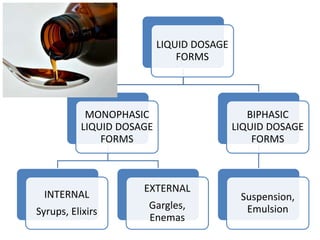
LIQUID DOSAGE
FORMS
MONOPHASIC
LIQUID DOSAGE
FORMS
INTERNAL
Syrups, Elixirs
EXTERNAL
Gargles,
Enemas
BIPHASIC
LIQUID DOSAGE
FORMS
Suspension,
Emulsion
MONOPHASIC LIQUID DOSAGE FORMS
• Monophasic liquid dosage form is a liquid
preparation containing two or more components
in one phase system. It is represented by a true
solution.
• A true solution is a clear homogenous mixture
that is prepared by dissolving solute in a suitable
solvent.
• The component of the solution which is present
in a large quantity is known as “SOLVENT” where
as the component present in small quantity is
termed as “SOLUTE”.
ADVANTAGES
1. It is easier to swallow, therefore easier for
children and old age people.
2. Facilitate absorption of drug faster than solid
dosage form as drug is already in solution form.
3. It is homogenous therefore give uniform dose
than suspension or emulsion which need
shaking.
4. Simple and fast to formulate.
5. It can be administered by various routes : Oral,
Parenteral (injection),enema for rectal use,
otic(ear), nasal and ophthalmic preparation.
DISADVANTAGES
1. They are bulky, so difficult to transport and store.
2. Water is commonly used solvent, which is prone to
microbial growth. So addition of preservative is
needed.
3. When expose to direct sunlight it may undergo
hydrolysis, so need to store in cool and dark place.
4. Drug stability is reduced by hydrolysis or oxidation.
So, they have shorter expire date than solid dosage
form.
5. Other major sign of drug instability are colour
change, Precipitation, microbial growth etc.
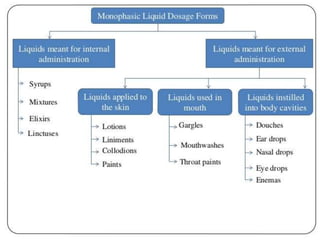
LIQUIDS MEANT FOR INTERNAL ADMINISTRATIONS
• Syrup: Aqueous preparations of 60% to 85%
sucrose with or without flavoring agents and
medicinal substances. e.g. Chlorpheniramine
maleate syrup, Chloral hydrate .
• Elixirs: Clear, aromatic, sweetened hydro
alcoholic solutions with or without medicinal
substances, intended for oral use. Eg:
Dexamethasone elixir.
• Linctuses: Viscous, liquid and oral preparations
that are generally prescribed for the relief of
cough. Eg: Codeine Linctus.
LIQUIDS MEANT FOR EXTERNAL ADMINISTRATION
LIQUIDS USED IN THE MOUTH
• Gargles: Aqueous solutions containing antiseptics
or antibiotics used to treat throat infections.
Available in concentrated form with direction for
dilution with warm water before use. eg: Povidone
Iodine gargle.
• Mouthwash: Aqueous solution with a pleasant
taste and odor used to clean and deodorize the
buccal cavity. Have antiseptic and astringent
activity.eg: Antiseptics-phenol derivatives.
• Throat paints: Viscous liquid preparation used for
mouth and throat infections. Eg: Phenol glycerine,
Compound Iodine.
LIQUIDS MEANT FOR EXTERNAL ADMINISTRATION
LIQUIDS INSTILLED INTO BODY CAVITY
• Eye drops: Sterile, aqueous/oily solutions
intended for instillation in eye. Eg: Timolol
maleate eye drops.
• Nasal drops: Administered through the nose to
obtain local effect. Used during nasal congestion
and upper-respiratory tract problem. Eg:
Oxymetazoline Hydrochloride nasal drops.
• Enemas: Aqueous or oily solution that is
introduced into the rectum and colon via the
anus for cleansing, therapeutic or diagnostic
purposes.
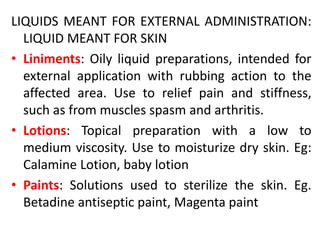
LIQUIDS MEANT FOR EXTERNAL ADMINISTRATION:
LIQUID MEANT FOR SKIN
• Liniments: Oily liquid preparations, intended for
external application with rubbing action to the
affected area. Use to relief pain and stiffness,
such as from muscles spasm and arthritis.
• Lotions: Topical preparation with a low to
medium viscosity. Use to moisturize dry skin. Eg:
Calamine Lotion, baby lotion
• Paints: Solutions used to sterilize the skin. Eg.
Betadine antiseptic paint, Magenta paint

monophasic liquid dosage forms

  • 1.
    LIQUID DOSAGE FORMS MONOPHASIC LIQUID DOSAGE FORMS INTERNAL Syrups,Elixirs EXTERNAL Gargles, Enemas BIPHASIC LIQUID DOSAGE FORMS Suspension, Emulsion
  • 2.
    MONOPHASIC LIQUID DOSAGEFORMS • Monophasic liquid dosage form is a liquid preparation containing two or more components in one phase system. It is represented by a true solution. • A true solution is a clear homogenous mixture that is prepared by dissolving solute in a suitable solvent. • The component of the solution which is present in a large quantity is known as “SOLVENT” where as the component present in small quantity is termed as “SOLUTE”.
  • 3.
    ADVANTAGES 1. It iseasier to swallow, therefore easier for children and old age people. 2. Facilitate absorption of drug faster than solid dosage form as drug is already in solution form. 3. It is homogenous therefore give uniform dose than suspension or emulsion which need shaking. 4. Simple and fast to formulate. 5. It can be administered by various routes : Oral, Parenteral (injection),enema for rectal use, otic(ear), nasal and ophthalmic preparation.
  • 4.
    DISADVANTAGES 1. They arebulky, so difficult to transport and store. 2. Water is commonly used solvent, which is prone to microbial growth. So addition of preservative is needed. 3. When expose to direct sunlight it may undergo hydrolysis, so need to store in cool and dark place. 4. Drug stability is reduced by hydrolysis or oxidation. So, they have shorter expire date than solid dosage form. 5. Other major sign of drug instability are colour change, Precipitation, microbial growth etc.
  • 6.
    LIQUIDS MEANT FORINTERNAL ADMINISTRATIONS • Syrup: Aqueous preparations of 60% to 85% sucrose with or without flavoring agents and medicinal substances. e.g. Chlorpheniramine maleate syrup, Chloral hydrate . • Elixirs: Clear, aromatic, sweetened hydro alcoholic solutions with or without medicinal substances, intended for oral use. Eg: Dexamethasone elixir. • Linctuses: Viscous, liquid and oral preparations that are generally prescribed for the relief of cough. Eg: Codeine Linctus.
  • 7.
    LIQUIDS MEANT FOREXTERNAL ADMINISTRATION LIQUIDS USED IN THE MOUTH • Gargles: Aqueous solutions containing antiseptics or antibiotics used to treat throat infections. Available in concentrated form with direction for dilution with warm water before use. eg: Povidone Iodine gargle. • Mouthwash: Aqueous solution with a pleasant taste and odor used to clean and deodorize the buccal cavity. Have antiseptic and astringent activity.eg: Antiseptics-phenol derivatives. • Throat paints: Viscous liquid preparation used for mouth and throat infections. Eg: Phenol glycerine, Compound Iodine.
  • 8.
    LIQUIDS MEANT FOREXTERNAL ADMINISTRATION LIQUIDS INSTILLED INTO BODY CAVITY • Eye drops: Sterile, aqueous/oily solutions intended for instillation in eye. Eg: Timolol maleate eye drops. • Nasal drops: Administered through the nose to obtain local effect. Used during nasal congestion and upper-respiratory tract problem. Eg: Oxymetazoline Hydrochloride nasal drops. • Enemas: Aqueous or oily solution that is introduced into the rectum and colon via the anus for cleansing, therapeutic or diagnostic purposes.
  • 9.
    LIQUIDS MEANT FOREXTERNAL ADMINISTRATION: LIQUID MEANT FOR SKIN • Liniments: Oily liquid preparations, intended for external application with rubbing action to the affected area. Use to relief pain and stiffness, such as from muscles spasm and arthritis. • Lotions: Topical preparation with a low to medium viscosity. Use to moisturize dry skin. Eg: Calamine Lotion, baby lotion • Paints: Solutions used to sterilize the skin. Eg. Betadine antiseptic paint, Magenta paint