Solids of known cross section WS
EXAMPLE
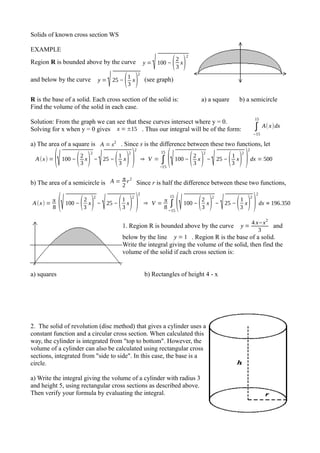
Region R is bounded above by the curve y =
√100 −(2
3
x)
2
and below by the curve y =
√25 −(1
3
x)
2
(see graph)
R is the base of a solid. Each cross section of the solid is: a) a square b) a semicircle
Find the volume of the solid in each case.
Solution: From the graph we can see that these curves intersect where y = 0.
Solving for x when y = 0 gives x = ±15 . Thus our integral will be of the form:
a) The area of a square is A = s2
. Since s is the difference between these two functions, let
A(x) = (√100 −(2
3
x)
2
−
√25 −(1
3
x)
2
)
2
⇒ V = ∫
−15
15
(√100 −(2
3
x)
2
−
√25 −(1
3
x)
2
)
2
dx = 500
b) The area of a semicircle is A = π
2
r2
Since r is half the difference between these two functions,
1. Region R is bounded above by the curve y =
4 x−x2
3
and
below by the line y = 1 . Region R is the base of a solid.
Write the integral giving the volume of the solid, then find the
volume of the solid if each cross section is:
a) squares b) Rectangles of height 4 - x
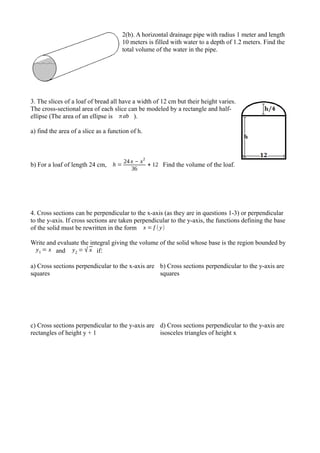
2. The solid of revolution (disc method) that gives a cylinder uses a
constant function and a circular cross section. When calculated this
way, the cylinder is integrated from "top to bottom". However, the
volume of a cylinder can also be calculated using rectangular cross
sections, integrated from "side to side". In this case, the base is a
circle.
a) Write the integral giving the volume of a cylinder with radius 3
and height 5, using rectangular cross sections as described above.
Then verify your formula by evaluating the integral.
∫
−15
15
A(x)dx
A(x) = π
8 (√100 −(2
3
x)
2
−
√25 −(1
3
x)
2
)
2
⇒ V = π
8
∫
−15
15
(√100 −(2
3
x)
2
−
√25 −(1
3
x)
2
)
2
dx ≈ 196.350
2(b). A horizontal drainage pipe with radius 1 meter and length
10 meters is filled with water to a depth of 1.2 meters. Find the
total volume of the water in the pipe.
3. The slices of a loaf of bread all have a width of 12 cm but their height varies.
The cross-sectional area of each slice can be modeled by a rectangle and half-
ellipse (The area of an ellipse is πab ).
a) find the area of a slice as a function of h.
b) For a loaf of length 24 cm, h =
24 x − x2
36
+ 12 Find the volume of the loaf.
4. Cross sections can be perpendicular to the x-axis (as they are in questions 1-3) or perpendicular
to the y-axis. If cross sections are taken perpendicular to the y-axis, the functions defining the base
of the solid must be rewritten in the form x = f (y)
Write and evaluate the integral giving the volume of the solid whose base is the region bounded by
y1 = x and y2 = √x if:
a) Cross sections perpendicular to the x-axis are
squares
b) Cross sections perpendicular to the y-axis are
squares
c) Cross sections perpendicular to the y-axis are
rectangles of height y + 1
d) Cross sections perpendicular to the y-axis are
isosceles triangles of height x

Solids of known cross section WS

  • 1.
    Solids of knowncross section WS EXAMPLE Region R is bounded above by the curve y = √100 −(2 3 x) 2 and below by the curve y = √25 −(1 3 x) 2 (see graph) R is the base of a solid. Each cross section of the solid is: a) a square b) a semicircle Find the volume of the solid in each case. Solution: From the graph we can see that these curves intersect where y = 0. Solving for x when y = 0 gives x = ±15 . Thus our integral will be of the form: a) The area of a square is A = s2 . Since s is the difference between these two functions, let A(x) = (√100 −(2 3 x) 2 − √25 −(1 3 x) 2 ) 2 ⇒ V = ∫ −15 15 (√100 −(2 3 x) 2 − √25 −(1 3 x) 2 ) 2 dx = 500 b) The area of a semicircle is A = π 2 r2 Since r is half the difference between these two functions, 1. Region R is bounded above by the curve y = 4 x−x2 3 and below by the line y = 1 . Region R is the base of a solid. Write the integral giving the volume of the solid, then find the volume of the solid if each cross section is: a) squares b) Rectangles of height 4 - x 2. The solid of revolution (disc method) that gives a cylinder uses a constant function and a circular cross section. When calculated this way, the cylinder is integrated from "top to bottom". However, the volume of a cylinder can also be calculated using rectangular cross sections, integrated from "side to side". In this case, the base is a circle. a) Write the integral giving the volume of a cylinder with radius 3 and height 5, using rectangular cross sections as described above. Then verify your formula by evaluating the integral. ∫ −15 15 A(x)dx A(x) = π 8 (√100 −(2 3 x) 2 − √25 −(1 3 x) 2 ) 2 ⇒ V = π 8 ∫ −15 15 (√100 −(2 3 x) 2 − √25 −(1 3 x) 2 ) 2 dx ≈ 196.350
  • 2.
    2(b). A horizontaldrainage pipe with radius 1 meter and length 10 meters is filled with water to a depth of 1.2 meters. Find the total volume of the water in the pipe. 3. The slices of a loaf of bread all have a width of 12 cm but their height varies. The cross-sectional area of each slice can be modeled by a rectangle and half- ellipse (The area of an ellipse is πab ). a) find the area of a slice as a function of h. b) For a loaf of length 24 cm, h = 24 x − x2 36 + 12 Find the volume of the loaf. 4. Cross sections can be perpendicular to the x-axis (as they are in questions 1-3) or perpendicular to the y-axis. If cross sections are taken perpendicular to the y-axis, the functions defining the base of the solid must be rewritten in the form x = f (y) Write and evaluate the integral giving the volume of the solid whose base is the region bounded by y1 = x and y2 = √x if: a) Cross sections perpendicular to the x-axis are squares b) Cross sections perpendicular to the y-axis are squares c) Cross sections perpendicular to the y-axis are rectangles of height y + 1 d) Cross sections perpendicular to the y-axis are isosceles triangles of height x