APPICATION OF INTEGRATIONAPPICATION OF INTEGRATION
SARDAR VALLABHBHAI PATEL
INSTITAUTE OF TECHNOLOGY
GTU
CONTENTCONTENT
1.Volume by cylindrical shell
2.Volume of solids of revolutions by
washers method
APPLICATIONS OF INTEGRATIONAPPLICATIONS OF INTEGRATION
Volumes by
Cylindrical Shells
APPLICATIONS OF INTEGRATION
In this section, we will learn:
How to apply the method of cylindrical shells
to find out the volume of a solid.
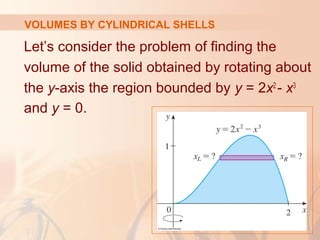
Let’s consider the problem of finding the
volume of the solid obtained by rotating about
the y-axis the region bounded by y = 2x2
- x3
and y = 0.
VOLUMES BY CYLINDRICAL SHELLS
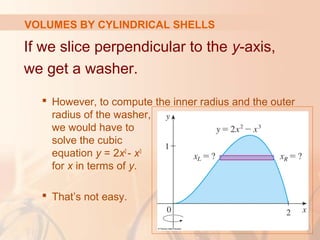
If we slice perpendicular to the y-axis,
we get a washer.
 However, to compute the inner radius and the outer
radius of the washer,
we would have to
solve the cubic
equation y = 2x2
- x3
for x in terms of y.
 That’s not easy.
VOLUMES BY CYLINDRICAL SHELLS
Fortunately, there is a method—the
method of cylindrical shells—that is
easier to use in such a case.
VOLUMES BY CYLINDRICAL SHELLS
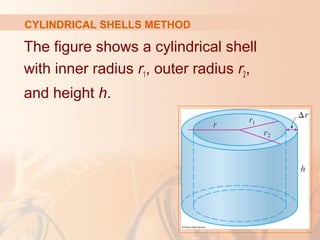
The figure shows a cylindrical shell
with inner radius r1, outer radius r2,
and height h.
CYLINDRICAL SHELLS METHOD
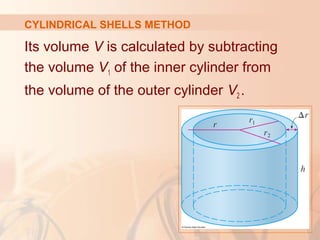
Its volume V is calculated by subtracting
the volume V1 of the inner cylinder from
the volume of the outer cylinder V2 .
CYLINDRICAL SHELLS METHOD
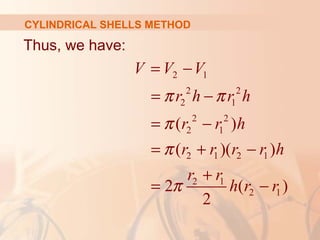
Thus, we have:
2 1
2 2
2 1
2 2
2 1
2 1 2 1
2 1
2 1
( )
( )( )
2 ( )
2
V V V
r h r h
r r h
r r r r h
r r
h r r
π π
π
π
π
= −
= −
= −
= + −
+
= −
CYLINDRICAL SHELLS METHOD
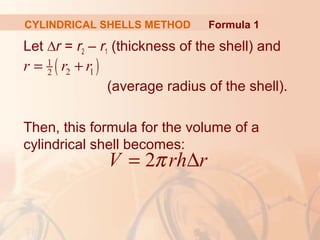
Let ∆r = r2 – r1 (thickness of the shell) and
(average radius of the shell).
Then, this formula for the volume of a
cylindrical shell becomes:
2V rh rπ= ∆
Formula 1
( )1
2 12r r r= +
CYLINDRICAL SHELLS METHOD
The equation can be remembered as:
V = [circumference] [height] [thickness]
CYLINDRICAL SHELLS METHOD
2V rh rπ= ∆
Now, let S be the solid
obtained by rotating
about the y-axis the
region bounded by
y = f(x) [where f(x) ≥ 0],
y = 0, x = a and x = b,
where b > a ≥ 0.
CYLINDRICAL SHELLS METHOD
Divide the interval [a, b] into n subintervals
[xi - 1, xi ] of equal width and let be
the midpoint of the i th subinterval.
x∆ix
CYLINDRICAL SHELLS METHOD
The rectangle with
base [xi - 1, xi ] and
height is rotated
about the y-axis.
 The result is a
cylindrical shell with
average radius ,
height , and
thickness ∆x.
( )if x
( )if x
ix
CYLINDRICAL SHELLS METHOD
Thus, by Formula 1, its volume is
calculated as follows:
(2 )[ ( )]i i iV x f x xπ= ∆
CYLINDRICAL SHELLS METHOD
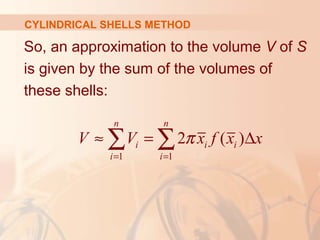
So, an approximation to the volume V of S
is given by the sum of the volumes of
these shells:
1 1
2 ( )
n n
i i i
i i
V V x f x xπ
= =
≈ = ∆∑ ∑
CYLINDRICAL SHELLS METHOD
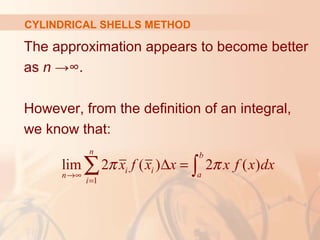
The approximation appears to become better
as n →∞.
However, from the definition of an integral,
we know that:
1
lim 2 ( ) 2 ( )
n b
i i an
i
x f x x x f x dxπ π
→∞
=
∆ =∑ ∫
CYLINDRICAL SHELLS METHOD
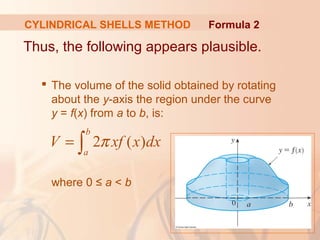
Thus, the following appears plausible.
 The volume of the solid obtained by rotating
about the y-axis the region under the curve
y = f(x) from a to b, is:
where 0 ≤ a < b
2 ( )
b
a
V xf x dxπ= ∫
Formula 2CYLINDRICAL SHELLS METHOD
The argument using cylindrical shells
makes Formula 2 seem reasonable,
but later we will be able to prove it.
CYLINDRICAL SHELLS METHOD
Here’s the best way to remember
the formula.
 Think of a typical shell,
cut and flattened,
with radius x,
circumference 2πx,
height f(x), and
thickness ∆x or dx:
( ){
[ ] {2 ( )
b
a
thicknesscircumference height
x f x dxπ∫ 123
CYLINDRICAL SHELLS METHOD
This type of reasoning will be helpful
in other situations—such as when we
rotate about lines other than the y-axis.
CYLINDRICAL SHELLS METHOD
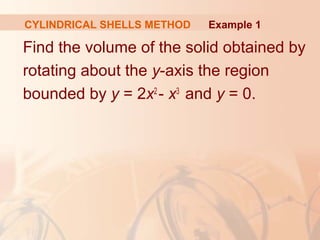
Find the volume of the solid obtained by
rotating about the y-axis the region
bounded by y = 2x2
- x3
and y = 0.
Example 1CYLINDRICAL SHELLS METHOD
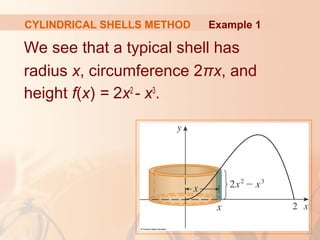
We see that a typical shell has
radius x, circumference 2πx, and
height f(x) = 2x2
- x3
.
Example 1CYLINDRICAL SHELLS METHOD
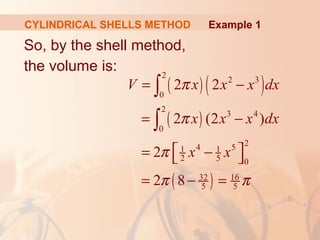
So, by the shell method,
the volume is:
( ) ( )
( )
( )
2
2 3
0
2
3 4
0
24 51 1
2 5 0
32 16
5 5
2 2
2 (2 )
2
2 8
π
π
π
π π
= −
= −
 = − 
= − =
∫
∫
V x x x dx
x x x dx
x x
Example 1CYLINDRICAL SHELLS METHOD
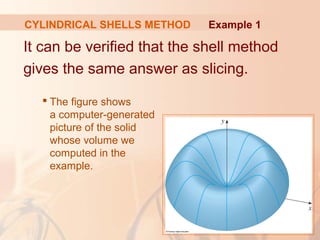
It can be verified that the shell method
gives the same answer as slicing.
 The figure shows
a computer-generated
picture of the solid
whose volume we
computed in the
example.
Example 1CYLINDRICAL SHELLS METHOD
Comparing the solution of Example 1 with
the remarks at the beginning of the section,
we see that the cylindrical shells method
is much easier than the washer method
for the problem.
 We did not have to find the coordinates of the local
maximum.
 We did not have to solve the equation of the curve
for x in terms of y.
NOTE
However, in other examples,
the methods learned in Section 6.2
may be easier.
NOTE
Find the volume of the solid obtained
by rotating about the y-axis the region
between y = x and y = x2
.
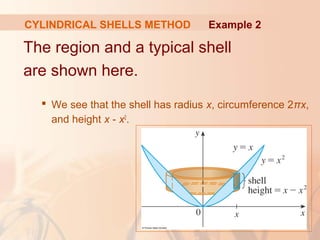
Example 2CYLINDRICAL SHELLS METHOD
The region and a typical shell
are shown here.
 We see that the shell has radius x, circumference 2πx,
and height x - x2
.
Example 2CYLINDRICAL SHELLS METHOD
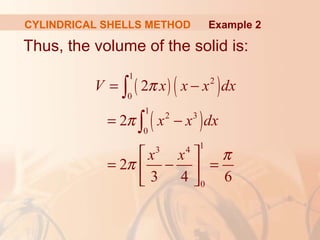
Thus, the volume of the solid is:
( ) ( )
( )
1
2
0
1
2 3
0
13 4
0
2
2
2
3 4 6
V x x x dx
x x dx
x x
π
π
π
π
= −
= −
 
= − = 
 
∫
∫
Example 2CYLINDRICAL SHELLS METHOD
As the following example shows,
the shell method works just as well
if we rotate about the x-axis.
 We simply have to draw a diagram to identify
the radius and height of a shell.
CYLINDRICAL SHELLS METHOD
Use cylindrical shells to find the volume of
the solid obtained by rotating about the x-axis
the region under the curve from 0 to
1.
 This problem was solved using disks in Example 2
in Section 6.2
y x=
Example 3CYLINDRICAL SHELLS METHOD
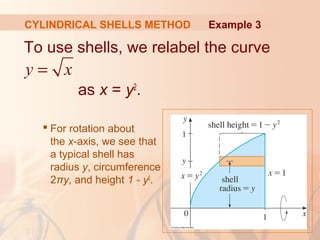
To use shells, we relabel the curve
as x = y2
.
 For rotation about
the x-axis, we see that
a typical shell has
radius y, circumference
2πy, and height 1 - y2
.
y x=
Example 3CYLINDRICAL SHELLS METHOD
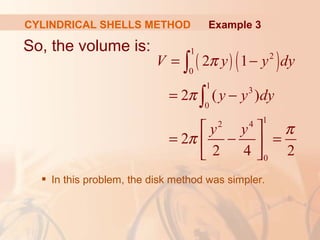
So, the volume is:
 In this problem, the disk method was simpler.
( ) ( )
1
2
0
1
3
0
12 4
0
2 1
2 ( )
2
2 4 2
V y y dy
y y dy
y y
π
π
π
π
= −
= −
 
= − = 
 
∫
∫
Example 3CYLINDRICAL SHELLS METHOD
Find the volume of the solid obtained by
rotating the region bounded by y = x - x2
and y = 0 about the line x = 2.
Example 4CYLINDRICAL SHELLS METHOD
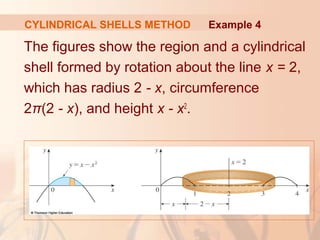
The figures show the region and a cylindrical
shell formed by rotation about the line x = 2,
which has radius 2 - x, circumference
2π(2 - x), and height x - x2
.
Example 4CYLINDRICAL SHELLS METHOD
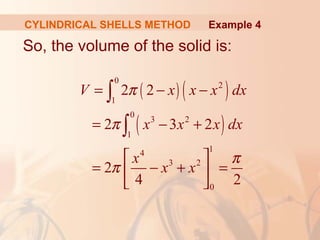
So, the volume of the solid is:
( ) ( )
( )
0
2
1
0
3 2
1
14
3 2
0
2 2
2 3 2
2
4 2
V x x x dx
x x x dx
x
x x
π
π
π
π
= − −
= − +
 
= − + = 
 
∫
∫
Example 4CYLINDRICAL SHELLS METHOD
Volumes of Solids of
Revolution:
Washer Method
Washers!
Washers
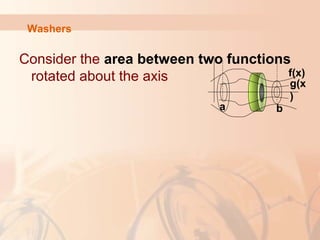
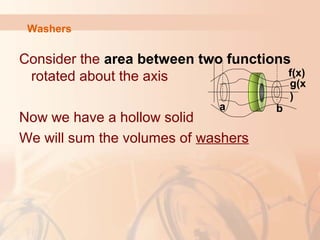
Consider the area between two functions
rotated about the axis f(x)
a b
g(x
)
Washers
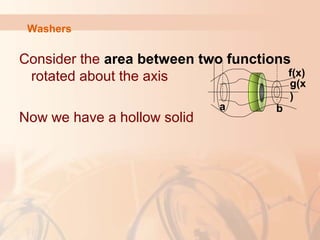
Consider the area between two functions
rotated about the axis
Now we have a hollow solid
f(x)
a b
g(x
)
Washers
Consider the area between two functions
rotated about the axis
Now we have a hollow solid
We will sum the volumes of washers
f(x)
a b
g(x
)
Washers
f(x)
a b
g(x
)[ ] [ ]{ }2 2
( ) ( )
b
a
V f x g x dxπ= −∫
Outer
Function
Inner
Function
Find the volume of the solid formed by revolving the
region bounded by y = √(x) and y = x² over the interval
[0, 1] about the x – axis.
Find the volume of the solid formed by revolving the
region bounded by y = √(x) and y = x² over the interval
[0, 1] about the x – axis.
2 2
([ ( )] [ ( )] )
b
a
V f x g x dxπ= −∫
Find the volume of the solid formed by revolving the
region bounded by y = √(x) and y = x² over the interval
[0, 1] about the x – axis.
2 2
([ ( )] [ ( )] )
b
a
V f x g x dxπ= −∫
( ) ( )∫ −=
1
0
222
dxxxV π
Find the volume of the solid formed by revolving the
region bounded by y = √(x) and y = x² over the interval
[0, 1] about the x – axis.
2 2
([ ( )] [ ( )] )
b
a
V f x g x dxπ= −∫
( ) ( )∫ −=
1
0
222
dxxxV π
( )∫ −=
1
0
4
dxxxV π
Find the volume of the solid formed by revolving the
region bounded by y = √(x) and y = x² over the interval
[0, 1] about the x – axis.
2 2
([ ( )] [ ( )] )
b
a
V f x g x dxπ= −∫
( ) ( )∫ −=
1
0
222
dxxxV π
( )∫ −=
1
0
4
dxxxV π
1
0
52
5
1
2
1






−= xxV π
Find the volume of the solid formed by revolving the
region bounded by y = √(x) and y = x² over the interval
[0, 1] about the x – axis.
2 2
([ ( )] [ ( )] )
b
a
V f x g x dxπ= −∫
( ) ( )∫ −=
1
0
222
dxxxV π
( )∫ −=
1
0
4
dxxxV π
1
0
52
5
1
2
1






−= xxV π
10
3π
=

Application of integration

  • 1.
    APPICATION OF INTEGRATIONAPPICATIONOF INTEGRATION SARDAR VALLABHBHAI PATEL INSTITAUTE OF TECHNOLOGY GTU
  • 2.
    CONTENTCONTENT 1.Volume by cylindricalshell 2.Volume of solids of revolutions by washers method
  • 3.
  • 4.
    Volumes by Cylindrical Shells APPLICATIONSOF INTEGRATION In this section, we will learn: How to apply the method of cylindrical shells to find out the volume of a solid.
  • 5.
    Let’s consider theproblem of finding the volume of the solid obtained by rotating about the y-axis the region bounded by y = 2x2 - x3 and y = 0. VOLUMES BY CYLINDRICAL SHELLS
  • 6.
    If we sliceperpendicular to the y-axis, we get a washer.  However, to compute the inner radius and the outer radius of the washer, we would have to solve the cubic equation y = 2x2 - x3 for x in terms of y.  That’s not easy. VOLUMES BY CYLINDRICAL SHELLS
  • 7.
    Fortunately, there isa method—the method of cylindrical shells—that is easier to use in such a case. VOLUMES BY CYLINDRICAL SHELLS
  • 8.
    The figure showsa cylindrical shell with inner radius r1, outer radius r2, and height h. CYLINDRICAL SHELLS METHOD
  • 9.
    Its volume Vis calculated by subtracting the volume V1 of the inner cylinder from the volume of the outer cylinder V2 . CYLINDRICAL SHELLS METHOD
  • 10.
    Thus, we have: 21 2 2 2 1 2 2 2 1 2 1 2 1 2 1 2 1 ( ) ( )( ) 2 ( ) 2 V V V r h r h r r h r r r r h r r h r r π π π π π = − = − = − = + − + = − CYLINDRICAL SHELLS METHOD
  • 11.
    Let ∆r =r2 – r1 (thickness of the shell) and (average radius of the shell). Then, this formula for the volume of a cylindrical shell becomes: 2V rh rπ= ∆ Formula 1 ( )1 2 12r r r= + CYLINDRICAL SHELLS METHOD
  • 12.
    The equation canbe remembered as: V = [circumference] [height] [thickness] CYLINDRICAL SHELLS METHOD 2V rh rπ= ∆
  • 13.
    Now, let Sbe the solid obtained by rotating about the y-axis the region bounded by y = f(x) [where f(x) ≥ 0], y = 0, x = a and x = b, where b > a ≥ 0. CYLINDRICAL SHELLS METHOD
  • 14.
    Divide the interval[a, b] into n subintervals [xi - 1, xi ] of equal width and let be the midpoint of the i th subinterval. x∆ix CYLINDRICAL SHELLS METHOD
  • 15.
    The rectangle with base[xi - 1, xi ] and height is rotated about the y-axis.  The result is a cylindrical shell with average radius , height , and thickness ∆x. ( )if x ( )if x ix CYLINDRICAL SHELLS METHOD
  • 16.
    Thus, by Formula1, its volume is calculated as follows: (2 )[ ( )]i i iV x f x xπ= ∆ CYLINDRICAL SHELLS METHOD
  • 17.
    So, an approximationto the volume V of S is given by the sum of the volumes of these shells: 1 1 2 ( ) n n i i i i i V V x f x xπ = = ≈ = ∆∑ ∑ CYLINDRICAL SHELLS METHOD
  • 18.
    The approximation appearsto become better as n →∞. However, from the definition of an integral, we know that: 1 lim 2 ( ) 2 ( ) n b i i an i x f x x x f x dxπ π →∞ = ∆ =∑ ∫ CYLINDRICAL SHELLS METHOD
  • 19.
    Thus, the followingappears plausible.  The volume of the solid obtained by rotating about the y-axis the region under the curve y = f(x) from a to b, is: where 0 ≤ a < b 2 ( ) b a V xf x dxπ= ∫ Formula 2CYLINDRICAL SHELLS METHOD
  • 20.
    The argument usingcylindrical shells makes Formula 2 seem reasonable, but later we will be able to prove it. CYLINDRICAL SHELLS METHOD
  • 21.
    Here’s the bestway to remember the formula.  Think of a typical shell, cut and flattened, with radius x, circumference 2πx, height f(x), and thickness ∆x or dx: ( ){ [ ] {2 ( ) b a thicknesscircumference height x f x dxπ∫ 123 CYLINDRICAL SHELLS METHOD
  • 22.
    This type ofreasoning will be helpful in other situations—such as when we rotate about lines other than the y-axis. CYLINDRICAL SHELLS METHOD
  • 23.
    Find the volumeof the solid obtained by rotating about the y-axis the region bounded by y = 2x2 - x3 and y = 0. Example 1CYLINDRICAL SHELLS METHOD
  • 24.
    We see thata typical shell has radius x, circumference 2πx, and height f(x) = 2x2 - x3 . Example 1CYLINDRICAL SHELLS METHOD
  • 25.
    So, by theshell method, the volume is: ( ) ( ) ( ) ( ) 2 2 3 0 2 3 4 0 24 51 1 2 5 0 32 16 5 5 2 2 2 (2 ) 2 2 8 π π π π π = − = −  = −  = − = ∫ ∫ V x x x dx x x x dx x x Example 1CYLINDRICAL SHELLS METHOD
  • 26.
    It can beverified that the shell method gives the same answer as slicing.  The figure shows a computer-generated picture of the solid whose volume we computed in the example. Example 1CYLINDRICAL SHELLS METHOD
  • 27.
    Comparing the solutionof Example 1 with the remarks at the beginning of the section, we see that the cylindrical shells method is much easier than the washer method for the problem.  We did not have to find the coordinates of the local maximum.  We did not have to solve the equation of the curve for x in terms of y. NOTE
  • 28.
    However, in otherexamples, the methods learned in Section 6.2 may be easier. NOTE
  • 29.
    Find the volumeof the solid obtained by rotating about the y-axis the region between y = x and y = x2 . Example 2CYLINDRICAL SHELLS METHOD
  • 30.
    The region anda typical shell are shown here.  We see that the shell has radius x, circumference 2πx, and height x - x2 . Example 2CYLINDRICAL SHELLS METHOD
  • 31.
    Thus, the volumeof the solid is: ( ) ( ) ( ) 1 2 0 1 2 3 0 13 4 0 2 2 2 3 4 6 V x x x dx x x dx x x π π π π = − = −   = − =    ∫ ∫ Example 2CYLINDRICAL SHELLS METHOD
  • 32.
    As the followingexample shows, the shell method works just as well if we rotate about the x-axis.  We simply have to draw a diagram to identify the radius and height of a shell. CYLINDRICAL SHELLS METHOD
  • 33.
    Use cylindrical shellsto find the volume of the solid obtained by rotating about the x-axis the region under the curve from 0 to 1.  This problem was solved using disks in Example 2 in Section 6.2 y x= Example 3CYLINDRICAL SHELLS METHOD
  • 34.
    To use shells,we relabel the curve as x = y2 .  For rotation about the x-axis, we see that a typical shell has radius y, circumference 2πy, and height 1 - y2 . y x= Example 3CYLINDRICAL SHELLS METHOD
  • 35.
    So, the volumeis:  In this problem, the disk method was simpler. ( ) ( ) 1 2 0 1 3 0 12 4 0 2 1 2 ( ) 2 2 4 2 V y y dy y y dy y y π π π π = − = −   = − =    ∫ ∫ Example 3CYLINDRICAL SHELLS METHOD
  • 36.
    Find the volumeof the solid obtained by rotating the region bounded by y = x - x2 and y = 0 about the line x = 2. Example 4CYLINDRICAL SHELLS METHOD
  • 37.
    The figures showthe region and a cylindrical shell formed by rotation about the line x = 2, which has radius 2 - x, circumference 2π(2 - x), and height x - x2 . Example 4CYLINDRICAL SHELLS METHOD
  • 38.
    So, the volumeof the solid is: ( ) ( ) ( ) 0 2 1 0 3 2 1 14 3 2 0 2 2 2 3 2 2 4 2 V x x x dx x x x dx x x x π π π π = − − = − +   = − + =    ∫ ∫ Example 4CYLINDRICAL SHELLS METHOD
  • 39.
    Volumes of Solidsof Revolution: Washer Method
  • 40.
  • 41.
    Washers Consider the areabetween two functions rotated about the axis f(x) a b g(x )
  • 42.
    Washers Consider the areabetween two functions rotated about the axis Now we have a hollow solid f(x) a b g(x )
  • 43.
    Washers Consider the areabetween two functions rotated about the axis Now we have a hollow solid We will sum the volumes of washers f(x) a b g(x )
  • 44.
    Washers f(x) a b g(x )[ ][ ]{ }2 2 ( ) ( ) b a V f x g x dxπ= −∫ Outer Function Inner Function
  • 45.
    Find the volumeof the solid formed by revolving the region bounded by y = √(x) and y = x² over the interval [0, 1] about the x – axis.
  • 46.
    Find the volumeof the solid formed by revolving the region bounded by y = √(x) and y = x² over the interval [0, 1] about the x – axis. 2 2 ([ ( )] [ ( )] ) b a V f x g x dxπ= −∫
  • 47.
    Find the volumeof the solid formed by revolving the region bounded by y = √(x) and y = x² over the interval [0, 1] about the x – axis. 2 2 ([ ( )] [ ( )] ) b a V f x g x dxπ= −∫ ( ) ( )∫ −= 1 0 222 dxxxV π
  • 48.
    Find the volumeof the solid formed by revolving the region bounded by y = √(x) and y = x² over the interval [0, 1] about the x – axis. 2 2 ([ ( )] [ ( )] ) b a V f x g x dxπ= −∫ ( ) ( )∫ −= 1 0 222 dxxxV π ( )∫ −= 1 0 4 dxxxV π
  • 49.
    Find the volumeof the solid formed by revolving the region bounded by y = √(x) and y = x² over the interval [0, 1] about the x – axis. 2 2 ([ ( )] [ ( )] ) b a V f x g x dxπ= −∫ ( ) ( )∫ −= 1 0 222 dxxxV π ( )∫ −= 1 0 4 dxxxV π 1 0 52 5 1 2 1       −= xxV π
  • 50.
    Find the volumeof the solid formed by revolving the region bounded by y = √(x) and y = x² over the interval [0, 1] about the x – axis. 2 2 ([ ( )] [ ( )] ) b a V f x g x dxπ= −∫ ( ) ( )∫ −= 1 0 222 dxxxV π ( )∫ −= 1 0 4 dxxxV π 1 0 52 5 1 2 1       −= xxV π 10 3π =