
The Differentials
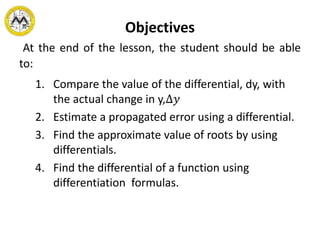
Objectives
At the end of the lesson, the student should be able
to:
1. Compare the value of the differential, dy, with
the actual change in y,∆𝑦
2. Estimate a propagated error using a differential.
3. Find the approximate value of roots by using
differentials.
4. Find the differential of a function using
differentiation formulas.
Consider a function defined by y=f(x) where x is
the independent variable. In the four-step rule we
introduced the symbol Δx to denote the increment of
x. Now we introduce the symbol dx which we call the
differential of x. Similarly, we shall call the symbol dy
as the differential of y. To give separate meanings to
dx and dy, we shall adopt the following definitions of
a function defined by the equation y=f(x).
DEFINITION 1: dx = Δx
In words, the differential of the independent
variable is equal to the increment of the variable.
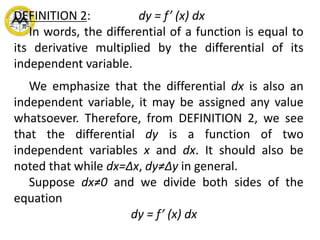
DEFINITION 2: dy = f’ (x) dx
In words, the differential of a function is equal to
its derivative multiplied by the differential of its
independent variable.
We emphasize that the differential dx is also an
independent variable, it may be assigned any value
whatsoever. Therefore, from DEFINITION 2, we see
that the differential dy is a function of two
independent variables x and dx. It should also be
noted that while dx=Δx, dy≠Δy in general.
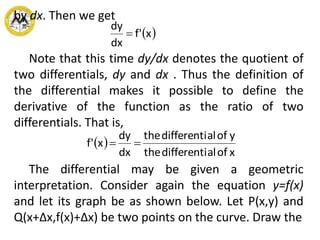
Suppose dx≠0 and we divide both sides of the
equation
dy = f’ (x) dx
by dx. Then we get
 x'f
dx
dy

Note that this time dy/dx denotes the quotient of
two differentials, dy and dx . Thus the definition of
the differential makes it possible to define the
derivative of the function as the ratio of two
differentials. That is,
 
xofaldifferentithe
yofaldifferentithe
dx
dy
x'f 
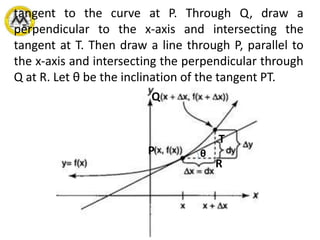
The differential may be given a geometric
interpretation. Consider again the equation y=f(x)
and let its graph be as shown below. Let P(x,y) and
Q(x+Δx,f(x)+Δx) be two points on the curve. Draw the
tangent to the curve at P. Through Q, draw a
perpendicular to the x-axis and intersecting the
tangent at T. Then draw a line through P, parallel to
the x-axis and intersecting the perpendicular through
Q at R. Let θ be the inclination of the tangent PT.
P
Q
T
R
θ
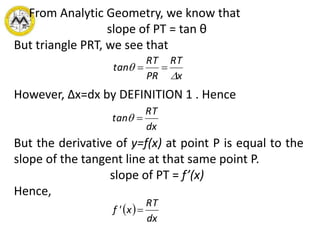
From Analytic Geometry, we know that
slope of PT = tan θ
But triangle PRT, we see that
x
RT
PR
RT
tan

 
However, Δx=dx by DEFINITION 1 . Hence
dx
RT
tan 
But the derivative of y=f(x) at point P is equal to the
slope of the tangent line at that same point P.
slope of PT = f’(x)
Hence,
 
dx
RT
x'f 
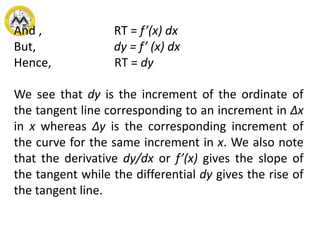
And , RT = f’(x) dx
But, dy = f’ (x) dx
Hence, RT = dy
We see that dy is the increment of the ordinate of
the tangent line corresponding to an increment in Δx
in x whereas Δy is the corresponding increment of
the curve for the same increment in x. We also note
that the derivative dy/dx or f’(x) gives the slope of
the tangent while the differential dy gives the rise of
the tangent line.
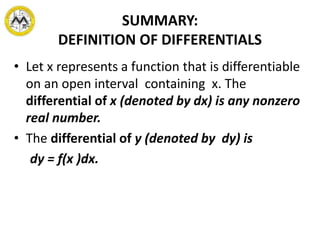
SUMMARY:
DEFINITION OF DIFFERENTIALS
• Let x represents a function that is differentiable
on an open interval containing x. The
differential of x (denoted by dx) is any nonzero
real number.
• The differential of y (denoted by dy) is
dy = f(x )dx.
DIFFERENTIAL FORMULAS
Let u and v and be differentiable functions of x.
• Constant multiple: d(cu)= c du
• Sum or difference: d[u±v] =du±dv
• Product: d[uv]=udv+vdu
• Quotient: d
𝒖
𝒗
=
𝒗𝒅𝒖−𝒖𝒅𝒗
𝒗 𝟐
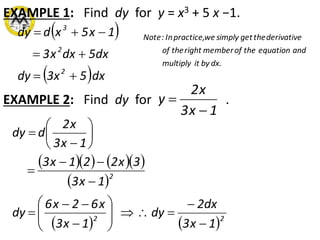
EXAMPLE 1: Find dy for y = x3 + 5 x −1.
 
 dx53xdy
dx5dxx3
1x5xddy
2
2
3



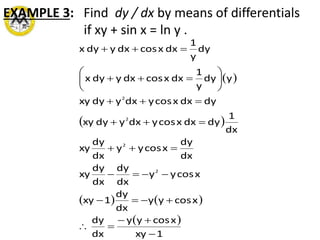
EXAMPLE 2: Find dy for .
1x3
x2
y


     
 
   22
2
1x3
2dx
dy
1x3
x62x6
dy
1x3
3x221x3
1x3
x2
ddy






















dx.byitmultiply
andequationtheofmemberrighttheof
derivativethegetsimplywepractice,In:Note
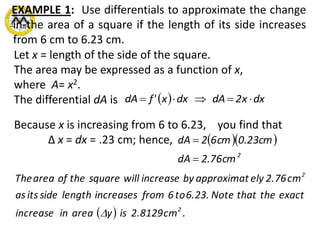
EXAMPLE 3: Find dy / dx by means of differentials
if xy + sin x = ln y .
 
 
   
 
1xy
xcosyy
dx
dy
xcosyy
dx
dy
1xy
xcosyy
dx
dy
dx
dy
xy
dx
dy
xcosyy
dx
dy
xy
dx
1
dydxxcosydxydyxy
dydxxcosydxydyxy
ydy
y
1
dxxcosdxydyx
dy
y
1
dxxcosdxydyx
2
2
2
2
















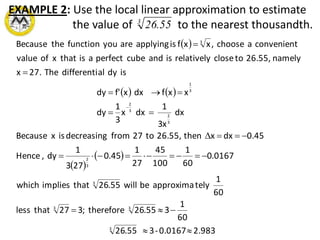
EXAMPLE 1: Use differentials to approximate the change
in the area of a square if the length of its side increases
from 6 cm to 6.23 cm.
Let x = length of the side of the square.
The area may be expressed as a function of x,
where A= x2.
The differential dA is   dxx2dAdxx'fdA 
Because x is increasing from 6 to 6.23, you find that
Δ x = dx = .23 cm; hence,   
2
cm76.2dA
cm23.0cm62dA


  .cm2.8129isyareainincrease
exactthethatNote6.23.to6fromincreaseslengthsideitsas
cm2.76elyapproximatbyincreasewillsquaretheofareaThe
2
2

EXAMPLE 2: Use the local linear approximation to estimate
the value of to the nearest thousandth.3
55.26
 
   
 
 
2.9830.0167-355.26
60
1
355.26therefore;327thatless
60
1
telyapproximabewill55.26thatimplieswhich
0167.0
60
1
100
45
27
1
45.0
273
1
dy,Hence
0.45dxxthen26.55,to27fromdecreasingisxBecause
dx
x3
1
dxx
3
1
dy
xxfdxxf'dy
isdyaldifferentiThe27.x
namely26.55,tocloserelativelyisandcubeperfectaisthatxofvalue
convenientachoose,xxfisapplyingareyoufunctiontheBecause
3
33
3
3
2
3
2
3
2
3
1
3









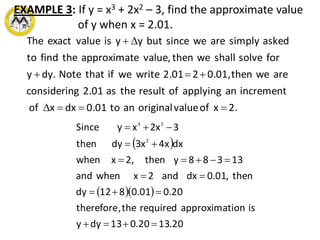
EXAMPLE 3: If y = x3 + 2x2 – 3, find the approximate value
of y when x = 2.01.
2.xofvalueoriginalanto0.01dxxof
incrementanapplyingofresulttheas2.01gconsiderin
arewethen0.01,22.01writeweifthatNotedy.y
forsolveshallwethenvalue,eapproximatthefindto
askedsimplyarewesincebutyyisvalueexactThe



 
  
20.1320.013dyy
isionapproximatrequiredthe,therefore
20.001.0812dy
then,01.0dxand2xwhenand
13388ythen,2xwhen
dxx4x3dythen
3x2xySince
2
23






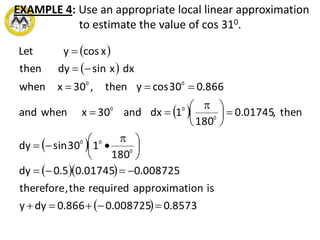
EXAMPLE 4: Use an appropriate local linear approximation
to estimate the value of cos 310.
 
 
 
 
  
  8573.0008725.0866.0dyy
isionapproximatrequiredthe,therefore
008725.001745.05.0dy
180
130sindy
then,01745.0
180
1dxand30xwhenand
866.030cosythen,30xwhen
dxxsindythen
xcosyLet
0
00
0
00
00







 






 




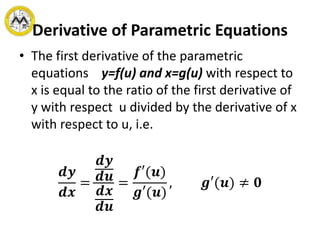
Derivative of Parametric Equations
• The first derivative of the parametric
equations y=f(u) and x=g(u) with respect to
x is equal to the ratio of the first derivative of
y with respect u divided by the derivative of x
with respect to u, i.e.
𝒅𝒚
𝒅𝒙
=
𝒅𝒚
𝒅𝒖
𝒅𝒙
𝒅𝒖
=
𝒇′(𝒖)
𝒈′(𝒖)
, 𝒈′(𝒖) ≠ 𝟎
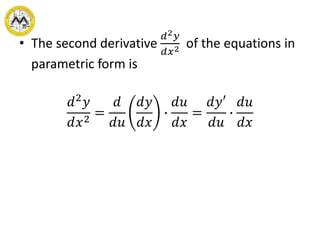
• The second derivative
𝑑2 𝑦
𝑑𝑥2 of the equations in
parametric form is
𝑑2
𝑦
𝑑𝑥2
=
𝑑
𝑑𝑢
𝑑𝑦
𝑑𝑥
∙
𝑑𝑢
𝑑𝑥
=
𝑑𝑦′
𝑑𝑢
∙
𝑑𝑢
𝑑𝑥
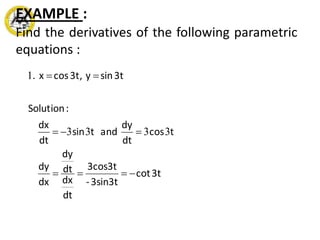
Find the derivatives of the following parametric
equations :
3tcot
3sin3t-
3cos3t
dt
dx
dt
dy
dx
dy
tcos
dt
dy
andtsin
dt
dx
:Solution
3tsiny3t,cosx.



3333
1
EXAMPLE :
 
 
tsintsin
tcostcos
tsintsin
tcostcos
tsintsin
tcostcos
dt
dx
dt
dy
dx
dy
tcostcos
dt
dy
andtsintsin
dt
dx
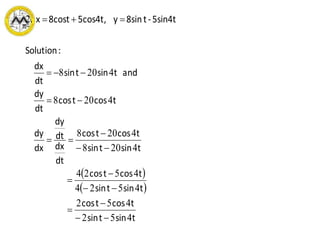
:Solution
5sin4t-t8siny5cos4t,8costx.
452
452
4524
4524
4208
4208
4208
4208
2












2
2
2
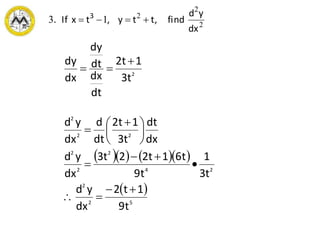
13
dx
yd
find,tty,txIf. 3

2
t3
1t2
dt
dx
dt
dy
dx
dy 

     
 
52
2
24
2
2
2
22
2
t9
1t2
dx
yd
t3
1
t9
t61t22t3
dx
yd
dx
dt
t3
1t2
dt
d
dx
yd










 

2
2
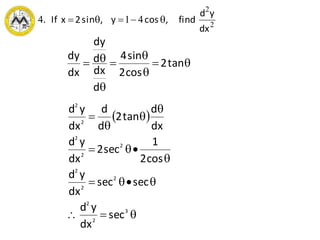
414
dx
yd
find,cosy,sin2xIf. 





 tan2
cos2
sin4
d
dx
d
dy
dx
dy
 








3
2
2
2
2
2
2
2
2
2
2
sec
dx
yd
secsec
dx
yd
cos2
1
sec2
dx
yd
dx
d
tan2
d
d
dx
yd
 
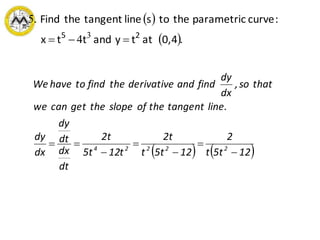
 .0,4attyandttx
:curveparametricthetoslinetangenttheFind.
25
 3
4
5
   125tt
2
125tt
2t
t125t
2t
dt
dx
dt
dy
dx
dy
line.tangenttheofslopethegetcanwe
thatso,
dx
dy
findandderivativethefindtohaveWe
22224






 
 
  
 
  
 
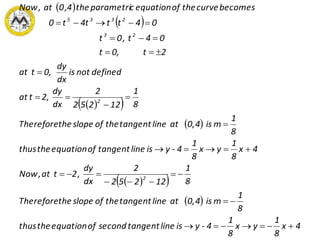
4x
8
1
yx
8
1
4-yislinetangentsecondofequationthethus
8
1
mis0,4atlinetangenttheofslopetheTherefore
8
1
12252
2
dx
dy
,2tat,Now
4x
8
1
yx
8
1
4-yislinetangentofequationthethus
8
1
mis0,4atlinetangenttheofslopetheTherefore
8
1
12252
2
dx
dy
2,tat
definednotis
dx
dy
0,tat
2t0,t
04t,0t
04ttt4t0
becomescurvetheofequationcparametrithe4,0at,Now
2
2
23
2335














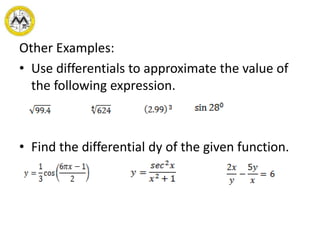
Other Examples:
• Use differentials to approximate the value of
the following expression.
• Find the differential dy of the given function.
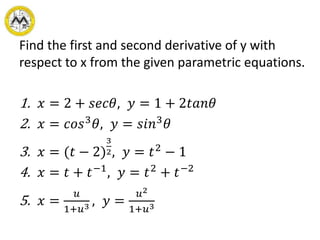
Find the first and second derivative of y with
respect to x from the given parametric equations.
1. 𝑥 = 2 + 𝑠𝑒𝑐𝜃, 𝑦 = 1 + 2𝑡𝑎𝑛𝜃
2. 𝑥 = 𝑐𝑜𝑠3
𝜃, 𝑦 = 𝑠𝑖𝑛3
𝜃
3. 𝑥 = (𝑡 − 2)
3
2, 𝑦 = 𝑡2
− 1
4. 𝑥 = 𝑡 + 𝑡−1
, 𝑦 = 𝑡2
+ 𝑡−2
5. 𝑥 =
𝑢
1+𝑢3 , 𝑦 =
𝑢2
1+𝑢3
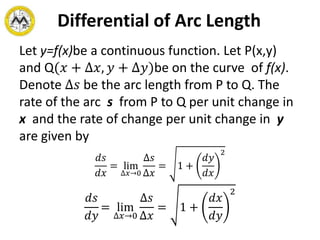
Differential of Arc Length
Let y=f(x)be a continuous function. Let P(x,y)
and Q(𝑥 + ∆𝑥, 𝑦 + ∆𝑦)be on the curve of f(x).
Denote ∆𝑠 be the arc length from P to Q. The
rate of the arc s from P to Q per unit change in
x and the rate of change per unit change in y
are given by
𝑑𝑠
𝑑𝑥
= lim
∆𝑥→0
∆𝑠
∆𝑥
= 1 +
𝑑𝑦
𝑑𝑥
2
𝑑𝑠
𝑑𝑦
= lim
∆𝑥→0
∆𝑠
∆𝑥
= 1 +
𝑑𝑥
𝑑𝑦
2
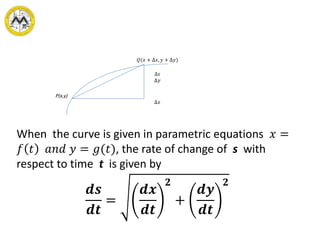
𝑄(𝑥 + ∆𝑥, 𝑦 + ∆𝑦)
∆𝑠
∆𝑦
P(x,y)
∆𝑥
When the curve is given in parametric equations 𝑥 =
𝑓 𝑡 𝑎𝑛𝑑 𝑦 = 𝑔(𝑡), the rate of change of s with
respect to time t is given by
𝒅𝒔
𝒅𝒕
=
𝒅𝒙
𝒅𝒕
𝟐
+
𝒅𝒚
𝒅𝒕
𝟐
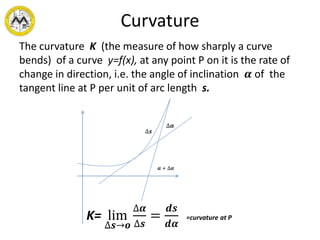
Curvature
The curvature K (the measure of how sharply a curve
bends) of a curve y=f(x), at any point P on it is the rate of
change in direction, i.e. the angle of inclination 𝜶 of the
tangent line at P per unit of arc length s.
K= lim
∆𝒔→𝒐
∆𝜶
∆𝒔
=
𝒅𝒔
𝒅𝜶
=curvature at P
𝜶 + ∆𝜶
∆𝒔
∆𝜶
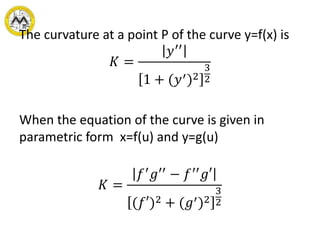
The curvature at a point P of the curve y=f(x) is
𝐾 =
𝑦′′
1 + (𝑦′)2
3
2
When the equation of the curve is given in
parametric form x=f(u) and y=g(u)
𝐾 =
𝑓′
𝑔′′
− 𝑓′′
𝑔′
(𝑓′)2 + (𝑔′)2
3
2
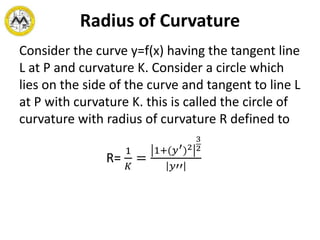
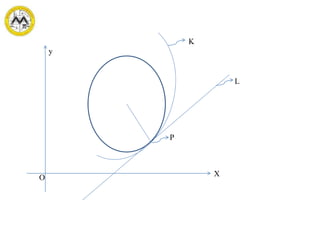
Radius of Curvature
Consider the curve y=f(x) having the tangent line
L at P and curvature K. Consider a circle which
lies on the side of the curve and tangent to line L
at P with curvature K. this is called the circle of
curvature with radius of curvature R defined to
R=
1
𝐾
=
1+(𝑦′)2
3
2
𝑦′′
K
L
P
y
XO
Example
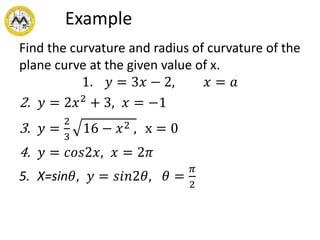
Find the curvature and radius of curvature of the
plane curve at the given value of x.
1. 𝑦 = 3𝑥 − 2, 𝑥 = 𝑎
2. 𝑦 = 2𝑥2
+ 3, 𝑥 = −1
3. 𝑦 =
2
3
16 − 𝑥2 , x = 0
4. 𝑦 = 𝑐𝑜𝑠2𝑥, 𝑥 = 2𝜋
5. X=sin𝜃, 𝑦 = 𝑠𝑖𝑛2𝜃, 𝜃 =
𝜋
2

Lesson 6 differentials parametric-curvature

  • 1.
  • 2.
    Objectives At the endof the lesson, the student should be able to: 1. Compare the value of the differential, dy, with the actual change in y,∆𝑦 2. Estimate a propagated error using a differential. 3. Find the approximate value of roots by using differentials. 4. Find the differential of a function using differentiation formulas.
  • 3.
    Consider a functiondefined by y=f(x) where x is the independent variable. In the four-step rule we introduced the symbol Δx to denote the increment of x. Now we introduce the symbol dx which we call the differential of x. Similarly, we shall call the symbol dy as the differential of y. To give separate meanings to dx and dy, we shall adopt the following definitions of a function defined by the equation y=f(x). DEFINITION 1: dx = Δx In words, the differential of the independent variable is equal to the increment of the variable.
  • 4.
    DEFINITION 2: dy= f’ (x) dx In words, the differential of a function is equal to its derivative multiplied by the differential of its independent variable. We emphasize that the differential dx is also an independent variable, it may be assigned any value whatsoever. Therefore, from DEFINITION 2, we see that the differential dy is a function of two independent variables x and dx. It should also be noted that while dx=Δx, dy≠Δy in general. Suppose dx≠0 and we divide both sides of the equation dy = f’ (x) dx
  • 5.
    by dx. Thenwe get  x'f dx dy  Note that this time dy/dx denotes the quotient of two differentials, dy and dx . Thus the definition of the differential makes it possible to define the derivative of the function as the ratio of two differentials. That is,   xofaldifferentithe yofaldifferentithe dx dy x'f  The differential may be given a geometric interpretation. Consider again the equation y=f(x) and let its graph be as shown below. Let P(x,y) and Q(x+Δx,f(x)+Δx) be two points on the curve. Draw the
  • 6.
    tangent to thecurve at P. Through Q, draw a perpendicular to the x-axis and intersecting the tangent at T. Then draw a line through P, parallel to the x-axis and intersecting the perpendicular through Q at R. Let θ be the inclination of the tangent PT. P Q T R θ
  • 7.
    From Analytic Geometry,we know that slope of PT = tan θ But triangle PRT, we see that x RT PR RT tan    However, Δx=dx by DEFINITION 1 . Hence dx RT tan  But the derivative of y=f(x) at point P is equal to the slope of the tangent line at that same point P. slope of PT = f’(x) Hence,   dx RT x'f 
  • 8.
    And , RT= f’(x) dx But, dy = f’ (x) dx Hence, RT = dy We see that dy is the increment of the ordinate of the tangent line corresponding to an increment in Δx in x whereas Δy is the corresponding increment of the curve for the same increment in x. We also note that the derivative dy/dx or f’(x) gives the slope of the tangent while the differential dy gives the rise of the tangent line.
  • 9.
    SUMMARY: DEFINITION OF DIFFERENTIALS •Let x represents a function that is differentiable on an open interval containing x. The differential of x (denoted by dx) is any nonzero real number. • The differential of y (denoted by dy) is dy = f(x )dx.
  • 10.
    DIFFERENTIAL FORMULAS Let uand v and be differentiable functions of x. • Constant multiple: d(cu)= c du • Sum or difference: d[u±v] =du±dv • Product: d[uv]=udv+vdu • Quotient: d 𝒖 𝒗 = 𝒗𝒅𝒖−𝒖𝒅𝒗 𝒗 𝟐
  • 11.
    EXAMPLE 1: Finddy for y = x3 + 5 x −1.    dx53xdy dx5dxx3 1x5xddy 2 2 3    EXAMPLE 2: Find dy for . 1x3 x2 y              22 2 1x3 2dx dy 1x3 x62x6 dy 1x3 3x221x3 1x3 x2 ddy                       dx.byitmultiply andequationtheofmemberrighttheof derivativethegetsimplywepractice,In:Note
  • 12.
    EXAMPLE 3: Finddy / dx by means of differentials if xy + sin x = ln y .           1xy xcosyy dx dy xcosyy dx dy 1xy xcosyy dx dy dx dy xy dx dy xcosyy dx dy xy dx 1 dydxxcosydxydyxy dydxxcosydxydyxy ydy y 1 dxxcosdxydyx dy y 1 dxxcosdxydyx 2 2 2 2                
  • 13.
    EXAMPLE 1: Usedifferentials to approximate the change in the area of a square if the length of its side increases from 6 cm to 6.23 cm. Let x = length of the side of the square. The area may be expressed as a function of x, where A= x2. The differential dA is   dxx2dAdxx'fdA  Because x is increasing from 6 to 6.23, you find that Δ x = dx = .23 cm; hence,    2 cm76.2dA cm23.0cm62dA     .cm2.8129isyareainincrease exactthethatNote6.23.to6fromincreaseslengthsideitsas cm2.76elyapproximatbyincreasewillsquaretheofareaThe 2 2 
  • 14.
    EXAMPLE 2: Usethe local linear approximation to estimate the value of to the nearest thousandth.3 55.26           2.9830.0167-355.26 60 1 355.26therefore;327thatless 60 1 telyapproximabewill55.26thatimplieswhich 0167.0 60 1 100 45 27 1 45.0 273 1 dy,Hence 0.45dxxthen26.55,to27fromdecreasingisxBecause dx x3 1 dxx 3 1 dy xxfdxxf'dy isdyaldifferentiThe27.x namely26.55,tocloserelativelyisandcubeperfectaisthatxofvalue convenientachoose,xxfisapplyingareyoufunctiontheBecause 3 33 3 3 2 3 2 3 2 3 1 3         
  • 15.
    EXAMPLE 3: Ify = x3 + 2x2 – 3, find the approximate value of y when x = 2.01. 2.xofvalueoriginalanto0.01dxxof incrementanapplyingofresulttheas2.01gconsiderin arewethen0.01,22.01writeweifthatNotedy.y forsolveshallwethenvalue,eapproximatthefindto askedsimplyarewesincebutyyisvalueexactThe         20.1320.013dyy isionapproximatrequiredthe,therefore 20.001.0812dy then,01.0dxand2xwhenand 13388ythen,2xwhen dxx4x3dythen 3x2xySince 2 23      
  • 16.
    EXAMPLE 4: Usean appropriate local linear approximation to estimate the value of cos 310.              8573.0008725.0866.0dyy isionapproximatrequiredthe,therefore 008725.001745.05.0dy 180 130sindy then,01745.0 180 1dxand30xwhenand 866.030cosythen,30xwhen dxxsindythen xcosyLet 0 00 0 00 00                     
  • 17.
    Derivative of ParametricEquations • The first derivative of the parametric equations y=f(u) and x=g(u) with respect to x is equal to the ratio of the first derivative of y with respect u divided by the derivative of x with respect to u, i.e. 𝒅𝒚 𝒅𝒙 = 𝒅𝒚 𝒅𝒖 𝒅𝒙 𝒅𝒖 = 𝒇′(𝒖) 𝒈′(𝒖) , 𝒈′(𝒖) ≠ 𝟎
  • 18.
    • The secondderivative 𝑑2 𝑦 𝑑𝑥2 of the equations in parametric form is 𝑑2 𝑦 𝑑𝑥2 = 𝑑 𝑑𝑢 𝑑𝑦 𝑑𝑥 ∙ 𝑑𝑢 𝑑𝑥 = 𝑑𝑦′ 𝑑𝑢 ∙ 𝑑𝑢 𝑑𝑥
  • 19.
    Find the derivativesof the following parametric equations : 3tcot 3sin3t- 3cos3t dt dx dt dy dx dy tcos dt dy andtsin dt dx :Solution 3tsiny3t,cosx.    3333 1 EXAMPLE :
  • 20.
  • 21.
    2 2 2 13 dx yd find,tty,txIf. 3  2 t3 1t2 dt dx dt dy dx dy          52 2 24 2 2 2 22 2 t9 1t2 dx yd t3 1 t9 t61t22t3 dx yd dx dt t3 1t2 dt d dx yd             
  • 22.
    2 2 414 dx yd find,cosy,sin2xIf.        tan2 cos2 sin4 d dx d dy dx dy          3 2 2 2 2 2 2 2 2 2 2 sec dx yd secsec dx yd cos2 1 sec2 dx yd dx d tan2 d d dx yd
  • 23.
       .0,4attyandttx :curveparametricthetoslinetangenttheFind. 25 3 4 5    125tt 2 125tt 2t t125t 2t dt dx dt dy dx dy line.tangenttheofslopethegetcanwe thatso, dx dy findandderivativethefindtohaveWe 22224      
  • 24.
                 4x 8 1 yx 8 1 4-yislinetangentsecondofequationthethus 8 1 mis0,4atlinetangenttheofslopetheTherefore 8 1 12252 2 dx dy ,2tat,Now 4x 8 1 yx 8 1 4-yislinetangentofequationthethus 8 1 mis0,4atlinetangenttheofslopetheTherefore 8 1 12252 2 dx dy 2,tat definednotis dx dy 0,tat 2t0,t 04t,0t 04ttt4t0 becomescurvetheofequationcparametrithe4,0at,Now 2 2 23 2335              
  • 25.
    Other Examples: • Usedifferentials to approximate the value of the following expression. • Find the differential dy of the given function.
  • 26.
    Find the firstand second derivative of y with respect to x from the given parametric equations. 1. 𝑥 = 2 + 𝑠𝑒𝑐𝜃, 𝑦 = 1 + 2𝑡𝑎𝑛𝜃 2. 𝑥 = 𝑐𝑜𝑠3 𝜃, 𝑦 = 𝑠𝑖𝑛3 𝜃 3. 𝑥 = (𝑡 − 2) 3 2, 𝑦 = 𝑡2 − 1 4. 𝑥 = 𝑡 + 𝑡−1 , 𝑦 = 𝑡2 + 𝑡−2 5. 𝑥 = 𝑢 1+𝑢3 , 𝑦 = 𝑢2 1+𝑢3
  • 27.
    Differential of ArcLength Let y=f(x)be a continuous function. Let P(x,y) and Q(𝑥 + ∆𝑥, 𝑦 + ∆𝑦)be on the curve of f(x). Denote ∆𝑠 be the arc length from P to Q. The rate of the arc s from P to Q per unit change in x and the rate of change per unit change in y are given by 𝑑𝑠 𝑑𝑥 = lim ∆𝑥→0 ∆𝑠 ∆𝑥 = 1 + 𝑑𝑦 𝑑𝑥 2 𝑑𝑠 𝑑𝑦 = lim ∆𝑥→0 ∆𝑠 ∆𝑥 = 1 + 𝑑𝑥 𝑑𝑦 2
  • 28.
    𝑄(𝑥 + ∆𝑥,𝑦 + ∆𝑦) ∆𝑠 ∆𝑦 P(x,y) ∆𝑥 When the curve is given in parametric equations 𝑥 = 𝑓 𝑡 𝑎𝑛𝑑 𝑦 = 𝑔(𝑡), the rate of change of s with respect to time t is given by 𝒅𝒔 𝒅𝒕 = 𝒅𝒙 𝒅𝒕 𝟐 + 𝒅𝒚 𝒅𝒕 𝟐
  • 29.
    Curvature The curvature K(the measure of how sharply a curve bends) of a curve y=f(x), at any point P on it is the rate of change in direction, i.e. the angle of inclination 𝜶 of the tangent line at P per unit of arc length s. K= lim ∆𝒔→𝒐 ∆𝜶 ∆𝒔 = 𝒅𝒔 𝒅𝜶 =curvature at P 𝜶 + ∆𝜶 ∆𝒔 ∆𝜶
  • 30.
    The curvature ata point P of the curve y=f(x) is 𝐾 = 𝑦′′ 1 + (𝑦′)2 3 2 When the equation of the curve is given in parametric form x=f(u) and y=g(u) 𝐾 = 𝑓′ 𝑔′′ − 𝑓′′ 𝑔′ (𝑓′)2 + (𝑔′)2 3 2
  • 31.
    Radius of Curvature Considerthe curve y=f(x) having the tangent line L at P and curvature K. Consider a circle which lies on the side of the curve and tangent to line L at P with curvature K. this is called the circle of curvature with radius of curvature R defined to R= 1 𝐾 = 1+(𝑦′)2 3 2 𝑦′′
  • 32.
  • 33.
    Example Find the curvatureand radius of curvature of the plane curve at the given value of x. 1. 𝑦 = 3𝑥 − 2, 𝑥 = 𝑎 2. 𝑦 = 2𝑥2 + 3, 𝑥 = −1 3. 𝑦 = 2 3 16 − 𝑥2 , x = 0 4. 𝑦 = 𝑐𝑜𝑠2𝑥, 𝑥 = 2𝜋 5. X=sin𝜃, 𝑦 = 𝑠𝑖𝑛2𝜃, 𝜃 = 𝜋 2