STAGES OF EXPORT ORDER
Course Instructor: Sneha Sharma
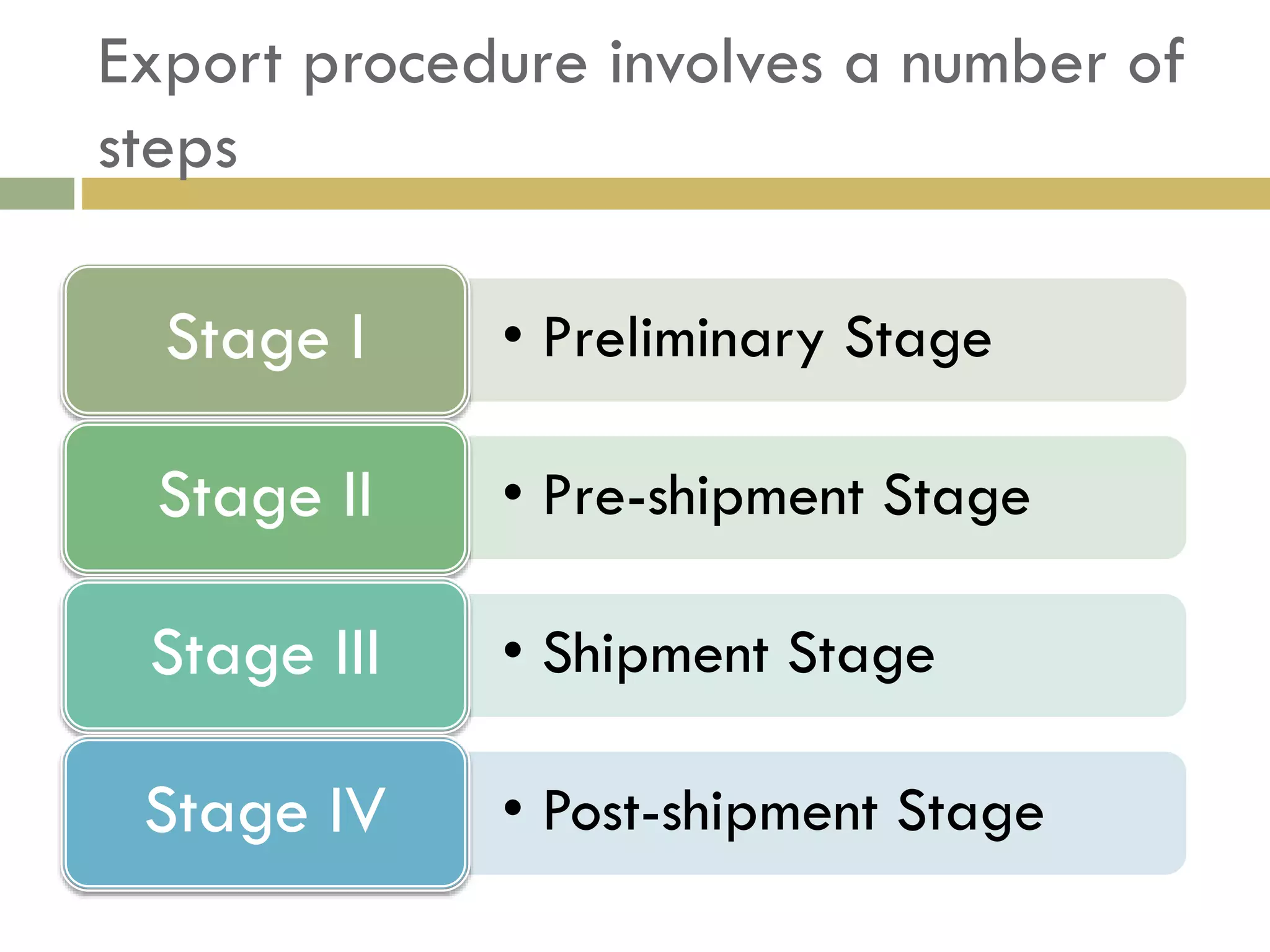
Export procedure involves a number of
steps
• Preliminary StageStage I
• Pre-shipment StageStage II
• Shipment StageStage III
• Post-shipment StageStage IV
PRELIMINARY STAGE
1.Organizing
 The exporter should have an organization to look
after exports.
 Exporters may set up a complete new organization or
add on export section to an existing one.
 Decisions regarding
 Target market
 Product mix
2. Registering with various Authorities
 The exporter should register his organizations with
various authorities. These are as follows.
Income Tax
Authorities to obtain
permanent Account
Number (PAN).
DGFT – to obtain
Importer’s exporter’s
code Number
(IEC No.)
EPC – to obtain
Registration – cum –
membership –
certificate (RCMC)
Other authorities,
such as FIEO, sales
Tax authorities,
chambers of
commerce etc.
3. Appointing Agent / Distributors
 Appointment of agents or distributors in the
selected overseas markets.
4. Approaching Foreign Buyers
 The overseas agents / representatives approach
foreign buyers with a quotation.
 The foreign buyer, if satisfied with the quotation and
after clarifications, if any, will place an order with the
exporter
PRE-SHIPMENT STAGE
1. Inquiry and Offer
 Request from importer about description of goods
their standard or grade , size , weight or quantity ,
terms of payment, etc.
 On getting enquiry the exporter processes the inquiry in
form of
Proforma invoice
2. Confirmation of order
 Negotiation of terms and conditions between buyer
and the seller.
 Exporter sends three copies of proforma invoice to
the importer for confirmation of order.
 Importer signs the copies sends back two, retains one.
3. Obtaining Letter of credit
 With the acknowledgement letter confirming the
receipt of an export order,
 the exporter may send a formal request to the
importer to open a letter of credit in his favour.
4. Obtaining pre-shipment Finance
 As soon as the exporter receives a confirmed order
and the L/C,
 approach made to the bank for securing pre-shipment
finance to meet working capital requirements.
5. Production and Procurement of
goods
 After securing the pre-shipment advance from bank,
 the exporter has to arrange for production and
procurement of goods for shipment.
6. Packing and Marketing
 After procuring the goods meant for export,
 the exporter has to arrange for proper packing and
marking of the goods.
 Packaging must ensure proper protection of the goods.
 The packing material should be selected after considering
the distance to be covered, mode of transportation, types of
handling of the goods at ports etc.
 After the goods are ready for shipment, they
should be properly be packed and marked.
 Importer’s specific instructions in respect of packing
and marking should be complied with, totally.
▪ In the absence of instructions from importer, exporter has to
follow the packing rules prescribed by The Bureau of Indian
Standards for certain items
 The British Standard Packing Code,
 published by the British Standards Institute and
the Exporters’ Encyclopedia published in the
U.S.A.
▪ gives detailed packing instructions which can be
followed by the exporters to match international
standards in respect of packing.
 In respect of hazardous goods, shipping
companies too give certain packing instructions,
which are to be followed, scrupulously.
 Shipping companies do not accept the goods unless
their rules are followed in respect of such goods.
▪ If necessary, assistance can be taken from Indian Institute of
Packing (IIP) in respect of packing.
7. Pre-shipment Inspection
 If the export cargo is subject to qualify compulsory
inspection as a part of quality control.
 Exporter contacts Export Inspection Agency by sending
 Intimation for Inspection for obtaining Inspection
Certificate.
8. Central Excise Clearance
 Goods meant for export are exempted from the
payment of excise duty.
 Excise clearance is obtained by two methods
 Export Under Rebate
 Export Under Bond
Export Under Rebate
 Under this method, the exporter has to pay excise
duty, initially, and can claim refund of excise duty,
after exportation of goods to countries except
Nepal and Bhutan.
 Exporter can request clearance of goods either with
examination or without examination by central excise
authorities.
Export Under Bond
 Under this method, exporter does not make
payment of excise duty.
 He has to obtain bank guarantee or surety to an
amount equivalent to excise duty payable.
 Once evidence of export is shown, the excise authorities
would release the bond.
 In case of manufacturer-exporter, he can execute
undertaking for the amount of excise duty payable instead
of submitting Bond
9. ECGC (Export Credit Guarantee
Corporation of India Ltd) Cover
 The exporter must take appropriate policy to
protect him from credit risk.
 ECGC provides a range of credit risk insurance covers
to exporters against loss in export of goods and
services
10. Marine Insurance policy
 In order to protect the cargo from perils on high
sea, the exporter has to obtain marine insurance
policy.
 Payment of insurance premium depends on the type of
price quotation accepted by the importer.
11. Appointment of clearing and
Forwarding Agent
 It is always advisable to appoint C & F agent to
look after forwarding work which includes
 booking of shipping space,
 preparing and submitting various documents to
customs.
SHIPMENT STAGE
1. Reservation of space in the ship
 Exporter contacts the shipping company for booking
the required space in the vessel for shipment of his
consignment
 Necessary information like date of shipment, gross and
net weight of each package, particulars of the importer
etc are provided.
 When shipping company accepts the exporter’s
request, the company or its agent issues
“shipping order”
2. Internal Transportation up to Port of
Shipment
 Exporter makes necessary arrangements for
transportation of goods to the port by
road/railways.
 Railways issue Railway receipt on loading goods
into the railways which serves as title to goods.
3. Preparation and processing of
shipping documents
 When goods reach the port of shipment, the exporter
has to arrange for preparation of a complete set of
documents to be passed on to the forwarding agent.
 Letter of credit along with the export contract
 Commercial Invoice (2 copies)
 Packing List
 Certificate of Origin
 GR Form (Original and Duplicate)
 ARE-I Form
 Certificate of Inspection
 Marine Insurance Policy
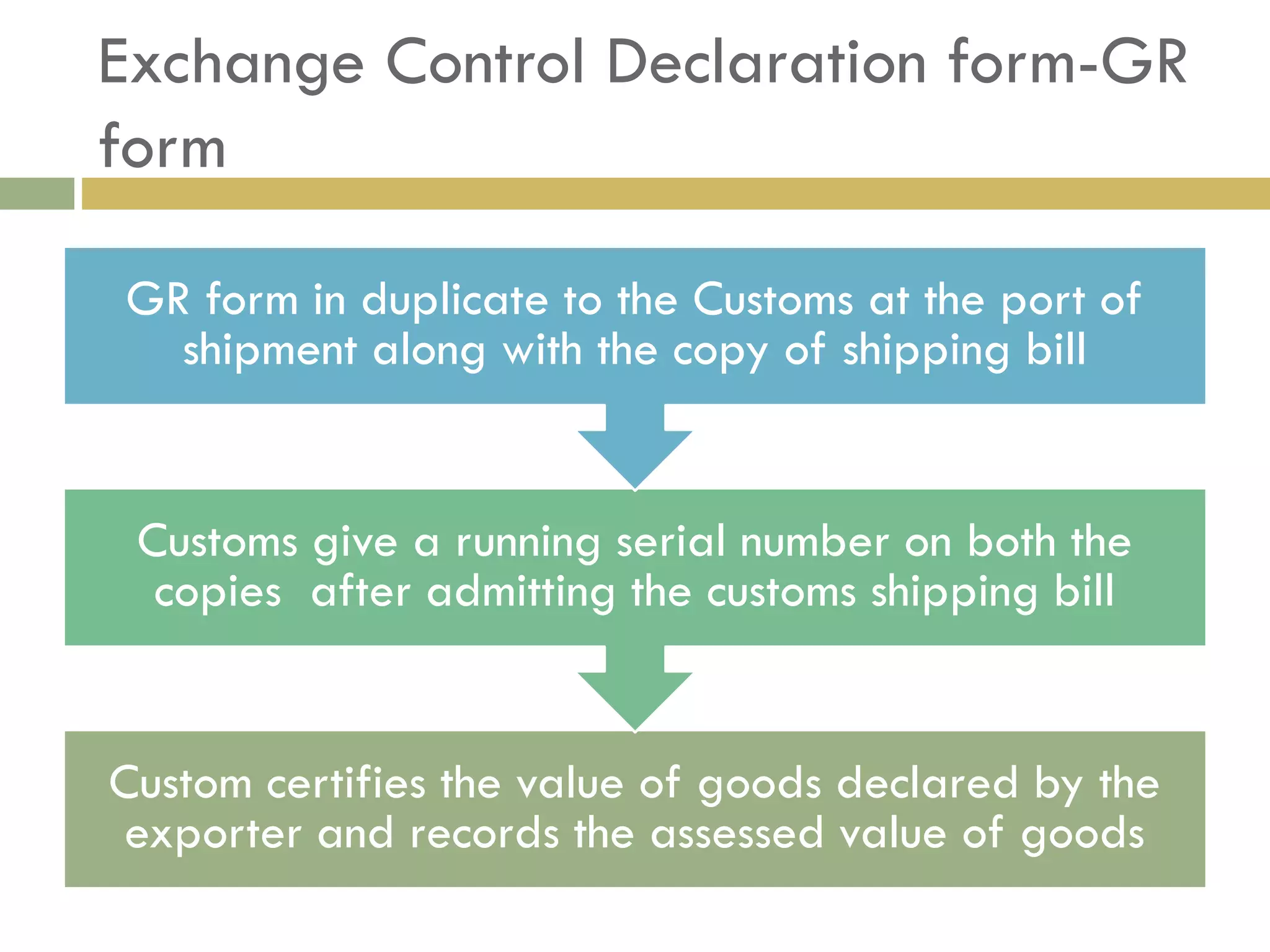
Exchange Control Declaration form-GR
form
Custom certifies the value of goods declared by the
exporter and records the assessed value of goods
Customs give a running serial number on both the
copies after admitting the customs shipping bill
GR form in duplicate to the Customs at the port of
shipment along with the copy of shipping bill
Exchange Control Declaration form-GR
form
Authorized dealer negotiates the bills and submits the duplicate
copy of GR to RBI on realizing export proceeds.
Exporter submits duplicate copy of GR to the authorized dealer for
negotiation of export bills (within 21 days from shipment of goods)
Duplicate copy of GR is returned to exporter and original is
retained for transmission to the RBI
4. Customs Clearance
 The following documents need to be submitted to
customs appraiser at customs house.
 Letter of credit along with the export contract
 Commercial Invoice (2 copies)
 Packing List
 Certificate of Origin
 GR Form (Original and Duplicate)
 ARE-I Form
 Certificate of Inspection
 Marine Insurance Policy
 Five copies of Shipping Bill
4. Customs Clearance
Custom Appraiser Verifies all documents
Returns
- Original GR
- Original Shipping Bill
- One copy of Commercial Invoice
“Examination Order” on the duplicate copy of shipping bill given by
custom appraiser.
C & F Agent
5. Obtaining Carting Order from Port
Trust Authorities
 Carting Order is the permission to bring the goods
inside the docks.
 The carting order is issued by the superintendent of Port
Trust.
 Carting Order is issued only after verifying the
endorsement on the duplicate copy of shipping bill.
 The Carting Order enables the exporter’s agent to cart
goods inside the docks and store them in proper sheds.
6. Physical Examination of goods at the
port
 The C & F agent obtains the carting order from the
Port Trust to Cart the goods inside the docks.
 The exporter/agent presents the following documents
to Dock Appraiser along with check List.
 Packing List
 Invoice
 ARE-Forms
6. Physical Examination of goods at the
port
 The Appraiser Dock (export) orders for samples to be drawn
and tested, the Customs Officer/Examiner may proceed to
draw two samples from the consignment and enter particulars
thereof. There is no separate register for recording dates of
samples drawn.
 Three copies of test memo are prepared and signed by the
Customs Officer and Appraising Officer on behalf of Customs
and the exporter or his agent. The disposal of three test memo
copies is as follows:
 Original—to be sent along with the sample to the test agency.
 Duplicate—Customs copy to be retained with the second sample.
 Triplicate—Exporter’s copy
After physically examines the goods and seals the packages in
his presence and issues the “Let Export order”
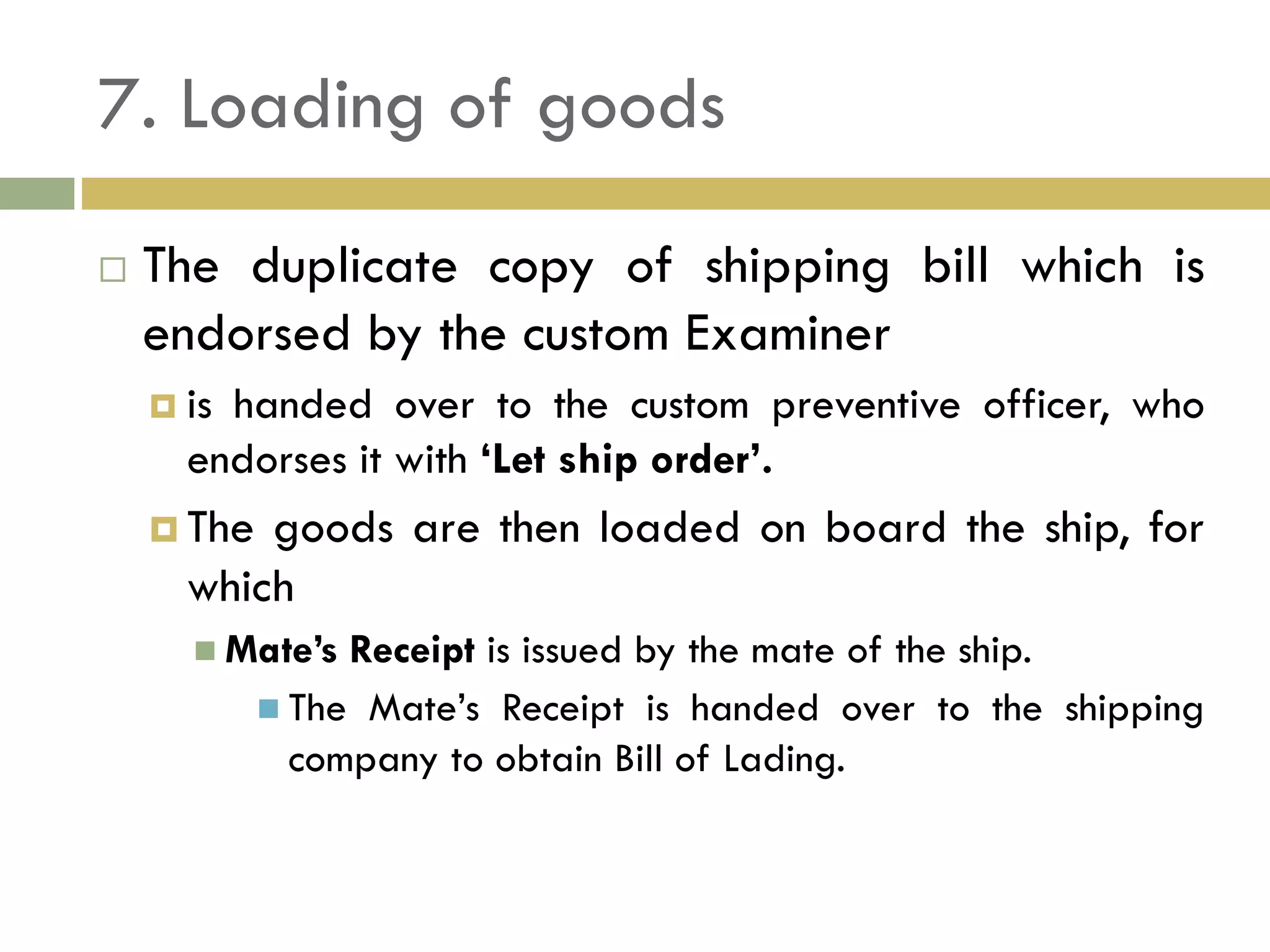
7. Loading of goods
 The duplicate copy of shipping bill which is
endorsed by the custom Examiner
 is handed over to the custom preventive officer, who
endorses it with ‘Let ship order’.
 The goods are then loaded on board the ship, for
which
 Mate’s Receipt is issued by the mate of the ship.
 The Mate’s Receipt is handed over to the shipping
company to obtain Bill of Lading.
8. Obtaining Bill of Lading
Goods loaded on ship
Mate’s Receipt issued to port superintendent
Mate’s receipt handed over to C & F agent on receipt of port
dues
Mate’s Receipt surrendered to shipping company for obtaining
Bill of Lading
Shipping Company issues 2-3 negotiable and 2-3 non negotiable
copies of bill of lading
POST-SHIPMENT STAGE
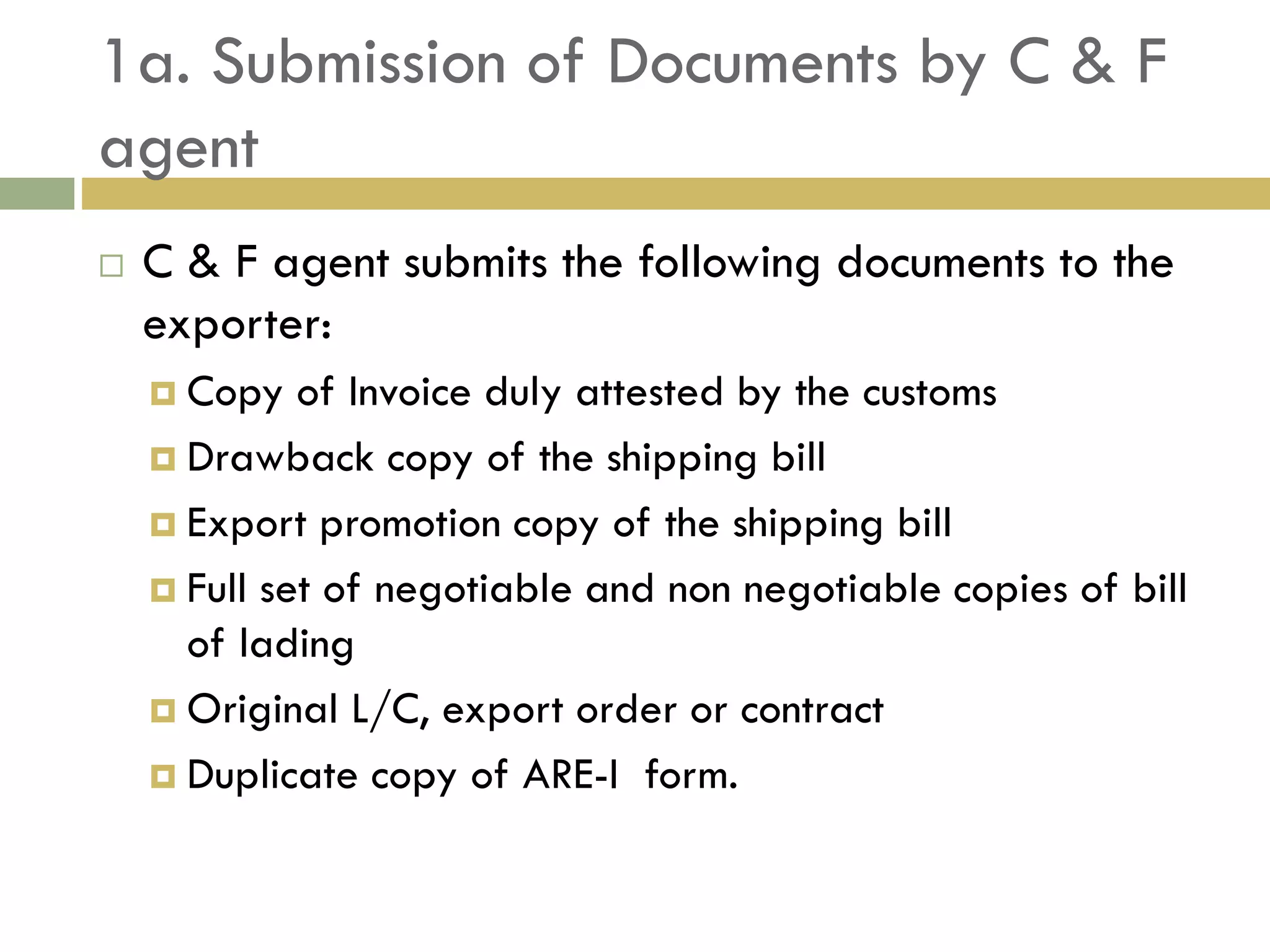
1a. Submission of Documents by C & F
agent
 C & F agent submits the following documents to the
exporter:
 Copy of Invoice duly attested by the customs
 Drawback copy of the shipping bill
 Export promotion copy of the shipping bill
 Full set of negotiable and non negotiable copies of bill
of lading
 Original L/C, export order or contract
 Duplicate copy of ARE-I form.
1b. Dispatch of Documents
 Dispatch of documents by C & F Agent to the
exporter
 the details and the mode of dispatch of the shipping
documents are specified in the L/C.
 Mailing of dispatching a set of documents to ensure
that the importer or his agent receives the same in time
so that the delivery of the exported goods can be
done.
2. Shipment advice to importer
 After the shipment of goods, the exporter has to
send suitable intimation to the importer for his
information.
 By this intimation, the date of shipment, the name of the
vessel, date on which the goods will reach the
destination should be informed to the importer.
 A copy of non-negotiable bill of lading is also sent for
information.
 The importer gets the remaining documents through his
bank
3. Presentation of Documents to the
Bank
 A complete set of documents is submitted by the
exporter to his bank for the purpose of negotiating
the same and obtaining export proceeds in time.
3. Presentation of Documents to the
Bank
 The bank then sends the same documents to the exporter.
1. Sight or Usance Bill of Exchange
2. Full set clean-on-board Bill of lading(all negotiable copies)/Airway
Bill/Combined transport document
3. Original letter of credit along with amendments made up to date
4. Customs Invoice
5. Commercial Invoice duly attested by customs
6. Packing List
7. GR-1/SDF Form, in duplicate
8. Exchange control copy of the shipping bill
9. Inspection Certificate
10. Marine insurance policy/certificate, in duplicate
11. Certificate of Origin
4. Dispatch of Documents
 The bank negotiates the documents with the
importers bank as detailed in L/C.
 Exporter’s bank scrutinizes the documents
 Bank sends the bank certificate and attested copies of
commercial invoice to the exporter.
5. Realization of export proceeds
 The exporter then proceeds to claim export
incentives on the basis of bank certificate.
 The bank certificate gives description of the product, its
value, the rate of conversion, the details of invoice etc.
Letter of Indemnity
 Exporter can get immediate payment from the bank
on submission of documents by signing a letter of
indemnity .
 By signing the letter exporter undertakes to
indemnify the bank in the event of non-receipt of
payment from the importer long with accrued
interest.
6. Processing of GR form
 On receiving export proceeds the exporter’s bank
intimates the same to RBI by recording the fact on
the duplicate copy of GR.
 RBI verifies the details in duplicate copy of GR with the
original GR received from customs
 If details are in order the export transaction is treated as
complete.
7. Follow-up of Export sales
 An exporter should always have a follow-up after
sales
 provide necessary after sale service,
 find out buyer’s opinion towards the product
 It further helps in generating more sales in the international
market.

Stages of export order

  • 1.
    STAGES OF EXPORTORDER Course Instructor: Sneha Sharma
  • 2.
    Export procedure involvesa number of steps • Preliminary StageStage I • Pre-shipment StageStage II • Shipment StageStage III • Post-shipment StageStage IV
  • 3.
  • 4.
    1.Organizing  The exportershould have an organization to look after exports.  Exporters may set up a complete new organization or add on export section to an existing one.  Decisions regarding  Target market  Product mix
  • 5.
    2. Registering withvarious Authorities  The exporter should register his organizations with various authorities. These are as follows. Income Tax Authorities to obtain permanent Account Number (PAN). DGFT – to obtain Importer’s exporter’s code Number (IEC No.) EPC – to obtain Registration – cum – membership – certificate (RCMC) Other authorities, such as FIEO, sales Tax authorities, chambers of commerce etc.
  • 6.
    3. Appointing Agent/ Distributors  Appointment of agents or distributors in the selected overseas markets.
  • 7.
    4. Approaching ForeignBuyers  The overseas agents / representatives approach foreign buyers with a quotation.  The foreign buyer, if satisfied with the quotation and after clarifications, if any, will place an order with the exporter
  • 8.
  • 9.
    1. Inquiry andOffer  Request from importer about description of goods their standard or grade , size , weight or quantity , terms of payment, etc.  On getting enquiry the exporter processes the inquiry in form of Proforma invoice
  • 10.
    2. Confirmation oforder  Negotiation of terms and conditions between buyer and the seller.  Exporter sends three copies of proforma invoice to the importer for confirmation of order.  Importer signs the copies sends back two, retains one.
  • 11.
    3. Obtaining Letterof credit  With the acknowledgement letter confirming the receipt of an export order,  the exporter may send a formal request to the importer to open a letter of credit in his favour.
  • 12.
    4. Obtaining pre-shipmentFinance  As soon as the exporter receives a confirmed order and the L/C,  approach made to the bank for securing pre-shipment finance to meet working capital requirements.
  • 13.
    5. Production andProcurement of goods  After securing the pre-shipment advance from bank,  the exporter has to arrange for production and procurement of goods for shipment.
  • 14.
    6. Packing andMarketing  After procuring the goods meant for export,  the exporter has to arrange for proper packing and marking of the goods.  Packaging must ensure proper protection of the goods.  The packing material should be selected after considering the distance to be covered, mode of transportation, types of handling of the goods at ports etc.
  • 16.
     After thegoods are ready for shipment, they should be properly be packed and marked.  Importer’s specific instructions in respect of packing and marking should be complied with, totally. ▪ In the absence of instructions from importer, exporter has to follow the packing rules prescribed by The Bureau of Indian Standards for certain items
  • 17.
     The BritishStandard Packing Code,  published by the British Standards Institute and the Exporters’ Encyclopedia published in the U.S.A. ▪ gives detailed packing instructions which can be followed by the exporters to match international standards in respect of packing.
  • 18.
     In respectof hazardous goods, shipping companies too give certain packing instructions, which are to be followed, scrupulously.  Shipping companies do not accept the goods unless their rules are followed in respect of such goods. ▪ If necessary, assistance can be taken from Indian Institute of Packing (IIP) in respect of packing.
  • 19.
    7. Pre-shipment Inspection If the export cargo is subject to qualify compulsory inspection as a part of quality control.  Exporter contacts Export Inspection Agency by sending  Intimation for Inspection for obtaining Inspection Certificate.
  • 20.
    8. Central ExciseClearance  Goods meant for export are exempted from the payment of excise duty.  Excise clearance is obtained by two methods  Export Under Rebate  Export Under Bond
  • 21.
    Export Under Rebate Under this method, the exporter has to pay excise duty, initially, and can claim refund of excise duty, after exportation of goods to countries except Nepal and Bhutan.  Exporter can request clearance of goods either with examination or without examination by central excise authorities.
  • 22.
    Export Under Bond Under this method, exporter does not make payment of excise duty.  He has to obtain bank guarantee or surety to an amount equivalent to excise duty payable.  Once evidence of export is shown, the excise authorities would release the bond.  In case of manufacturer-exporter, he can execute undertaking for the amount of excise duty payable instead of submitting Bond
  • 23.
    9. ECGC (ExportCredit Guarantee Corporation of India Ltd) Cover  The exporter must take appropriate policy to protect him from credit risk.  ECGC provides a range of credit risk insurance covers to exporters against loss in export of goods and services
  • 24.
    10. Marine Insurancepolicy  In order to protect the cargo from perils on high sea, the exporter has to obtain marine insurance policy.  Payment of insurance premium depends on the type of price quotation accepted by the importer.
  • 25.
    11. Appointment ofclearing and Forwarding Agent  It is always advisable to appoint C & F agent to look after forwarding work which includes  booking of shipping space,  preparing and submitting various documents to customs.
  • 26.
  • 27.
    1. Reservation ofspace in the ship  Exporter contacts the shipping company for booking the required space in the vessel for shipment of his consignment  Necessary information like date of shipment, gross and net weight of each package, particulars of the importer etc are provided.  When shipping company accepts the exporter’s request, the company or its agent issues “shipping order”
  • 28.
    2. Internal Transportationup to Port of Shipment  Exporter makes necessary arrangements for transportation of goods to the port by road/railways.  Railways issue Railway receipt on loading goods into the railways which serves as title to goods.
  • 29.
    3. Preparation andprocessing of shipping documents  When goods reach the port of shipment, the exporter has to arrange for preparation of a complete set of documents to be passed on to the forwarding agent.  Letter of credit along with the export contract  Commercial Invoice (2 copies)  Packing List  Certificate of Origin  GR Form (Original and Duplicate)  ARE-I Form  Certificate of Inspection  Marine Insurance Policy
  • 30.
    Exchange Control Declarationform-GR form Custom certifies the value of goods declared by the exporter and records the assessed value of goods Customs give a running serial number on both the copies after admitting the customs shipping bill GR form in duplicate to the Customs at the port of shipment along with the copy of shipping bill
  • 31.
    Exchange Control Declarationform-GR form Authorized dealer negotiates the bills and submits the duplicate copy of GR to RBI on realizing export proceeds. Exporter submits duplicate copy of GR to the authorized dealer for negotiation of export bills (within 21 days from shipment of goods) Duplicate copy of GR is returned to exporter and original is retained for transmission to the RBI
  • 32.
    4. Customs Clearance The following documents need to be submitted to customs appraiser at customs house.  Letter of credit along with the export contract  Commercial Invoice (2 copies)  Packing List  Certificate of Origin  GR Form (Original and Duplicate)  ARE-I Form  Certificate of Inspection  Marine Insurance Policy  Five copies of Shipping Bill
  • 33.
    4. Customs Clearance CustomAppraiser Verifies all documents Returns - Original GR - Original Shipping Bill - One copy of Commercial Invoice “Examination Order” on the duplicate copy of shipping bill given by custom appraiser. C & F Agent
  • 34.
    5. Obtaining CartingOrder from Port Trust Authorities  Carting Order is the permission to bring the goods inside the docks.  The carting order is issued by the superintendent of Port Trust.  Carting Order is issued only after verifying the endorsement on the duplicate copy of shipping bill.  The Carting Order enables the exporter’s agent to cart goods inside the docks and store them in proper sheds.
  • 35.
    6. Physical Examinationof goods at the port  The C & F agent obtains the carting order from the Port Trust to Cart the goods inside the docks.  The exporter/agent presents the following documents to Dock Appraiser along with check List.  Packing List  Invoice  ARE-Forms
  • 36.
    6. Physical Examinationof goods at the port  The Appraiser Dock (export) orders for samples to be drawn and tested, the Customs Officer/Examiner may proceed to draw two samples from the consignment and enter particulars thereof. There is no separate register for recording dates of samples drawn.  Three copies of test memo are prepared and signed by the Customs Officer and Appraising Officer on behalf of Customs and the exporter or his agent. The disposal of three test memo copies is as follows:  Original—to be sent along with the sample to the test agency.  Duplicate—Customs copy to be retained with the second sample.  Triplicate—Exporter’s copy After physically examines the goods and seals the packages in his presence and issues the “Let Export order”
  • 37.
    7. Loading ofgoods  The duplicate copy of shipping bill which is endorsed by the custom Examiner  is handed over to the custom preventive officer, who endorses it with ‘Let ship order’.  The goods are then loaded on board the ship, for which  Mate’s Receipt is issued by the mate of the ship.  The Mate’s Receipt is handed over to the shipping company to obtain Bill of Lading.
  • 38.
    8. Obtaining Billof Lading Goods loaded on ship Mate’s Receipt issued to port superintendent Mate’s receipt handed over to C & F agent on receipt of port dues Mate’s Receipt surrendered to shipping company for obtaining Bill of Lading Shipping Company issues 2-3 negotiable and 2-3 non negotiable copies of bill of lading
  • 39.
  • 40.
    1a. Submission ofDocuments by C & F agent  C & F agent submits the following documents to the exporter:  Copy of Invoice duly attested by the customs  Drawback copy of the shipping bill  Export promotion copy of the shipping bill  Full set of negotiable and non negotiable copies of bill of lading  Original L/C, export order or contract  Duplicate copy of ARE-I form.
  • 41.
    1b. Dispatch ofDocuments  Dispatch of documents by C & F Agent to the exporter  the details and the mode of dispatch of the shipping documents are specified in the L/C.  Mailing of dispatching a set of documents to ensure that the importer or his agent receives the same in time so that the delivery of the exported goods can be done.
  • 42.
    2. Shipment adviceto importer  After the shipment of goods, the exporter has to send suitable intimation to the importer for his information.  By this intimation, the date of shipment, the name of the vessel, date on which the goods will reach the destination should be informed to the importer.  A copy of non-negotiable bill of lading is also sent for information.  The importer gets the remaining documents through his bank
  • 43.
    3. Presentation ofDocuments to the Bank  A complete set of documents is submitted by the exporter to his bank for the purpose of negotiating the same and obtaining export proceeds in time.
  • 44.
    3. Presentation ofDocuments to the Bank  The bank then sends the same documents to the exporter. 1. Sight or Usance Bill of Exchange 2. Full set clean-on-board Bill of lading(all negotiable copies)/Airway Bill/Combined transport document 3. Original letter of credit along with amendments made up to date 4. Customs Invoice 5. Commercial Invoice duly attested by customs 6. Packing List 7. GR-1/SDF Form, in duplicate 8. Exchange control copy of the shipping bill 9. Inspection Certificate 10. Marine insurance policy/certificate, in duplicate 11. Certificate of Origin
  • 45.
    4. Dispatch ofDocuments  The bank negotiates the documents with the importers bank as detailed in L/C.  Exporter’s bank scrutinizes the documents  Bank sends the bank certificate and attested copies of commercial invoice to the exporter.
  • 46.
    5. Realization ofexport proceeds  The exporter then proceeds to claim export incentives on the basis of bank certificate.  The bank certificate gives description of the product, its value, the rate of conversion, the details of invoice etc.
  • 47.
    Letter of Indemnity Exporter can get immediate payment from the bank on submission of documents by signing a letter of indemnity .  By signing the letter exporter undertakes to indemnify the bank in the event of non-receipt of payment from the importer long with accrued interest.
  • 48.
    6. Processing ofGR form  On receiving export proceeds the exporter’s bank intimates the same to RBI by recording the fact on the duplicate copy of GR.  RBI verifies the details in duplicate copy of GR with the original GR received from customs  If details are in order the export transaction is treated as complete.
  • 49.
    7. Follow-up ofExport sales  An exporter should always have a follow-up after sales  provide necessary after sale service,  find out buyer’s opinion towards the product  It further helps in generating more sales in the international market.