1
ANCY JOHN
2nd Sem,
mcom
No- 2
2
3
Import
Procedure
• Preliminaries
• Enquiring and placing the indent
• Obtaining the Foreign Exchange
• Arranging for Payment
• Payment of customs duties and taking the
delivery of goods.
4
1) Preliminaries :
The importing firm or an individual
has to obtain a license and Importer-Exporter Code (IEC)
number from the Controller of Exports and Imports. The
import licenses are usually issued for a period of one year
at a time.
5
2) Enquiring and placing the indent :
After obtaining
the import license, the importer has to enquire about
the goods he would like to import with various
exporters. Then he would identify an exporter and
request him to sent the invoice.
After accepting the
invoice, the importer sends the indent directly to the
exporters. Otherwise, he may sent the indent through
specialized intermediaries called Indent houses.
6
Indent may be open or closed.
• Open indent does not specify the price and other details
of the goods and leaves them to the discretion of the
exporter.
• Closed indent specifies the brand, price, number,
packing, shipping mode, insurance, etc.
The indent houses help the importers in
negotiating price, discounts, etc., as they
maintain close links with the foreign firms.
7
3) Obtaining Foreign Exchange:
After sending the indent,
the importer has to procure the required foreign
exchange from the Exchange Control Department of the
Reserve Bank of India. The importer has to produce the
import license and the prescribed forms for securing
foreign exchange needed for the payment.
8
4) Arranging for payment:
The importer has to make
necessary arrangements for paying for import after
obtaining the foreign exchange. The following documents
are to be submitted to the exporter-
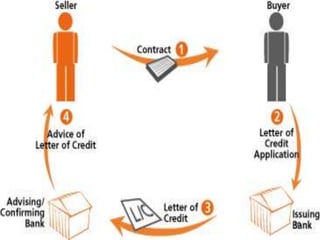
I. Letter of credit : Letter of credit is an obligation
taken on by a bank to make a payment once certain criteria are
met. Once these terms are completed and confirmed, the bank will
transfer the funds. This ensure the payment will be made as long as
the services are performed.
9
10
II. Documentary Bill: The importer may request the
exporter to forward the documentary bill through his
banker, which would be delivered to him either against
acceptance of the Bill of Exchange or against its payment.
Thus, the documents may be received either through
D/A(documents against acceptance of Bill of Exchange) or
D/P (documents against payment).
III. Bill of Lading: Bill of Lading is an important
instrument in financing international trade. It is a
document/receipt issued by a shipping company or its
agent acknowledging the receipt of goods mentioned in
the bill for shipment on board of the vessel.
11
IV. Bill of Exchange/Draft: Bill of Exchange or draft is an order
written by an exporter instructing an importer or his/her agent
to pay a specified amount of money at a specified time.
5) Payment of customs duty and taking delivery of
goods:
The importer has to pay the customs duties.
The customs duty may be based on the weight and size of the
goods or based on the value of the goods. The customs dut
may be paid under the “Permanent Deposit System”
12
13
Import Finance
• Letter of credit.
• Documentary Collection
• Cash-in-Advance (Pre-payment).
• Open Account.
• Bill of Lading.
14
Documentary Collections
• Collection terms offer an important bank payment mechanism that
can serve the needs of both the exporter and importer. Under this
arrangement, the sale transaction is settled by the bank through an
exchange of documents, thus enabling simultaneous payment and
transfer of title.
• The importer is not obliged to pay for the goods prior to shipment
and the exporter retains title to the goods until the importer either
pays for the value of the draft upon presentation(sight draft) or
accept to pay at later date and time(term draft). The Prinipal
obligations of the parties to a documentary collections are arranged
under the guidelines of “ uniform rules for coolections (URC)
drafted by the Paris based International Chamber of Commerce.
15
Cash-in-Advance
• Under these terms of purchase, the importer must sent payment to the
supplier prior to shipment of goods. The importer must trust that the
supplier will ship the product on time and that the goods will be as
advertised. Basically, Cash-in-advance terms place all the risk with the
importer/buyer. An importer may find his seller requiring prepayment
in the following circumstances:
The importer has not been long established.
The importer’s credit status is doubtful, unsatisfactory or the country
political and economic risks are very high.
16
There are advantages and disadvantages with
cash-in-advance terms. This method of payment involves direct
buyer/seller contact without commercial bank involvement and is there
for inexpensive.
However, the buyer faces a very high degree of payment
risk . In addition there is a possibility that an unscrupulous Seller may
never deliver the goods even though the buyer has made full
prepayment. Although prepayment terms eliminates virtually all risk to
the seller these terms can place the seller at a competitive disadvantage.
17
Open Account
• Unsecured Open Account terms allow the importer to make
payment at some specific date in the future and without the buyer
issuing any negotiable instrument evidencing his legal commitment
to pay at the appointed time.
• These terms are most common when the importer/buyer has a strong
credit history and is well-known to the seller.
• This mechanism offers the seller no protection in case of non-
payment. However, an exporter can structure his open account sale
transaction to minimize the risk of non-payment.
18
• There are many advantages and disadvantages of open account terms.
Under an Open Account payment method, title to the goods usually
passes from the seller to the buyer prior to the payment and subject the
Seller to risk of default by the buyer.
• Furthermore, there may be a time delay in payment, depending on how
quickly documents are exchanged between seller and buyer
19
Bill of Lading
• Bill of Lading is an important instrument in financing international
trade. It is a document issued by the shipping company or its agent
acknowledging the receipt of goods mentioned in the bill for shipment
on board of the vessel.
• In this method, the importers bank receive all the documents from the
exporters bank. Then the importers bank provide the document to the
importer. After obtaining all the documents the importer will wait for
the arrival of the ship. On arrival of the ship, the master of the ship
gives a report called ‘Ships Report’ specifying the details of the ship
and cargo to the customs authority. 20
• Then the goods are delivered to the customs authorities. The importer
obtains the Endorsement for Delivery on the back of Bill of Lading
from the shipping company by paying the freight, if needed. Then the
importer presents ‘Port Trust Due Receipts’ (two copies) and Bill of
Entry to the Port trust office to obtain clearance regarding dock dues.
21
Letter of Credit
• Before exporting goods the exporter has to ensure the credit worthiness
of the buyer abroad. For this purpose, he will request the importer to
provide him with a letter of credit from a bank.
• A Letter of Credit is a document which is issued by a bank at the
request of the importer in favour of the exporter. The Letter of Credit
authorizes the bank in the exporting country to accept Bill of
Exchange on the behalf of the importer. It states the period within
which the bill must be presented and the amount for which the letter of
credit is opened.
22
Parties to the Letter of Credit
• Applicant
• Issuing Bank(opening bank)
• Beneficiary Bank.
• Advising Bank.
• Confirming Bank.
• Nominated Bank.
• Reimbursing Bank.
23
Types of Letter of Credit
1. Revocable letter of credit
2. Irrevocable letter of credit
3. Payment credit
4. Deferred payment credit
5. Acceptance credit
6. Negotiation credit
7. Confirmed letter of credit
8. Unconfirmed letter of credit
24
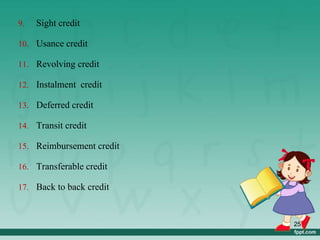
9. Sight credit
10. Usance credit
11. Revolving credit
12. Instalment credit
13. Deferred credit
14. Transit credit
15. Reimbursement credit
16. Transferable credit
17. Back to back credit
25
26

Import procedure and finance

  • 1.
  • 2.
  • 3.
  • 4.
    Import Procedure • Preliminaries • Enquiringand placing the indent • Obtaining the Foreign Exchange • Arranging for Payment • Payment of customs duties and taking the delivery of goods. 4
  • 5.
    1) Preliminaries : Theimporting firm or an individual has to obtain a license and Importer-Exporter Code (IEC) number from the Controller of Exports and Imports. The import licenses are usually issued for a period of one year at a time. 5
  • 6.
    2) Enquiring andplacing the indent : After obtaining the import license, the importer has to enquire about the goods he would like to import with various exporters. Then he would identify an exporter and request him to sent the invoice. After accepting the invoice, the importer sends the indent directly to the exporters. Otherwise, he may sent the indent through specialized intermediaries called Indent houses. 6
  • 7.
    Indent may beopen or closed. • Open indent does not specify the price and other details of the goods and leaves them to the discretion of the exporter. • Closed indent specifies the brand, price, number, packing, shipping mode, insurance, etc. The indent houses help the importers in negotiating price, discounts, etc., as they maintain close links with the foreign firms. 7
  • 8.
    3) Obtaining ForeignExchange: After sending the indent, the importer has to procure the required foreign exchange from the Exchange Control Department of the Reserve Bank of India. The importer has to produce the import license and the prescribed forms for securing foreign exchange needed for the payment. 8
  • 9.
    4) Arranging forpayment: The importer has to make necessary arrangements for paying for import after obtaining the foreign exchange. The following documents are to be submitted to the exporter- I. Letter of credit : Letter of credit is an obligation taken on by a bank to make a payment once certain criteria are met. Once these terms are completed and confirmed, the bank will transfer the funds. This ensure the payment will be made as long as the services are performed. 9
  • 10.
  • 11.
    II. Documentary Bill:The importer may request the exporter to forward the documentary bill through his banker, which would be delivered to him either against acceptance of the Bill of Exchange or against its payment. Thus, the documents may be received either through D/A(documents against acceptance of Bill of Exchange) or D/P (documents against payment). III. Bill of Lading: Bill of Lading is an important instrument in financing international trade. It is a document/receipt issued by a shipping company or its agent acknowledging the receipt of goods mentioned in the bill for shipment on board of the vessel. 11
  • 12.
    IV. Bill ofExchange/Draft: Bill of Exchange or draft is an order written by an exporter instructing an importer or his/her agent to pay a specified amount of money at a specified time. 5) Payment of customs duty and taking delivery of goods: The importer has to pay the customs duties. The customs duty may be based on the weight and size of the goods or based on the value of the goods. The customs dut may be paid under the “Permanent Deposit System” 12
  • 13.
  • 14.
    Import Finance • Letterof credit. • Documentary Collection • Cash-in-Advance (Pre-payment). • Open Account. • Bill of Lading. 14
  • 15.
    Documentary Collections • Collectionterms offer an important bank payment mechanism that can serve the needs of both the exporter and importer. Under this arrangement, the sale transaction is settled by the bank through an exchange of documents, thus enabling simultaneous payment and transfer of title. • The importer is not obliged to pay for the goods prior to shipment and the exporter retains title to the goods until the importer either pays for the value of the draft upon presentation(sight draft) or accept to pay at later date and time(term draft). The Prinipal obligations of the parties to a documentary collections are arranged under the guidelines of “ uniform rules for coolections (URC) drafted by the Paris based International Chamber of Commerce. 15
  • 16.
    Cash-in-Advance • Under theseterms of purchase, the importer must sent payment to the supplier prior to shipment of goods. The importer must trust that the supplier will ship the product on time and that the goods will be as advertised. Basically, Cash-in-advance terms place all the risk with the importer/buyer. An importer may find his seller requiring prepayment in the following circumstances: The importer has not been long established. The importer’s credit status is doubtful, unsatisfactory or the country political and economic risks are very high. 16
  • 17.
    There are advantagesand disadvantages with cash-in-advance terms. This method of payment involves direct buyer/seller contact without commercial bank involvement and is there for inexpensive. However, the buyer faces a very high degree of payment risk . In addition there is a possibility that an unscrupulous Seller may never deliver the goods even though the buyer has made full prepayment. Although prepayment terms eliminates virtually all risk to the seller these terms can place the seller at a competitive disadvantage. 17
  • 18.
    Open Account • UnsecuredOpen Account terms allow the importer to make payment at some specific date in the future and without the buyer issuing any negotiable instrument evidencing his legal commitment to pay at the appointed time. • These terms are most common when the importer/buyer has a strong credit history and is well-known to the seller. • This mechanism offers the seller no protection in case of non- payment. However, an exporter can structure his open account sale transaction to minimize the risk of non-payment. 18
  • 19.
    • There aremany advantages and disadvantages of open account terms. Under an Open Account payment method, title to the goods usually passes from the seller to the buyer prior to the payment and subject the Seller to risk of default by the buyer. • Furthermore, there may be a time delay in payment, depending on how quickly documents are exchanged between seller and buyer 19
  • 20.
    Bill of Lading •Bill of Lading is an important instrument in financing international trade. It is a document issued by the shipping company or its agent acknowledging the receipt of goods mentioned in the bill for shipment on board of the vessel. • In this method, the importers bank receive all the documents from the exporters bank. Then the importers bank provide the document to the importer. After obtaining all the documents the importer will wait for the arrival of the ship. On arrival of the ship, the master of the ship gives a report called ‘Ships Report’ specifying the details of the ship and cargo to the customs authority. 20
  • 21.
    • Then thegoods are delivered to the customs authorities. The importer obtains the Endorsement for Delivery on the back of Bill of Lading from the shipping company by paying the freight, if needed. Then the importer presents ‘Port Trust Due Receipts’ (two copies) and Bill of Entry to the Port trust office to obtain clearance regarding dock dues. 21
  • 22.
    Letter of Credit •Before exporting goods the exporter has to ensure the credit worthiness of the buyer abroad. For this purpose, he will request the importer to provide him with a letter of credit from a bank. • A Letter of Credit is a document which is issued by a bank at the request of the importer in favour of the exporter. The Letter of Credit authorizes the bank in the exporting country to accept Bill of Exchange on the behalf of the importer. It states the period within which the bill must be presented and the amount for which the letter of credit is opened. 22
  • 23.
    Parties to theLetter of Credit • Applicant • Issuing Bank(opening bank) • Beneficiary Bank. • Advising Bank. • Confirming Bank. • Nominated Bank. • Reimbursing Bank. 23
  • 24.
    Types of Letterof Credit 1. Revocable letter of credit 2. Irrevocable letter of credit 3. Payment credit 4. Deferred payment credit 5. Acceptance credit 6. Negotiation credit 7. Confirmed letter of credit 8. Unconfirmed letter of credit 24
  • 25.
    9. Sight credit 10.Usance credit 11. Revolving credit 12. Instalment credit 13. Deferred credit 14. Transit credit 15. Reimbursement credit 16. Transferable credit 17. Back to back credit 25
  • 26.