PROCEDURE FOR PROCUREMENT
THROUGH IMPORT PROCEDURES
Dr. N. Yuvaraj
Assistant Professor
Achariya Arts and Science College
Villianur , Puducherry
IMPORT
 Import trade refers to the purchase of goods from the
foreign country.
 The procedure for import trade differs from country to
country, depending upon the import policy, the statutory
requirements and customs of different countries.
 In almost all the countries of the world import trade is
controlled by the government.
IMPORT PROCEDURE
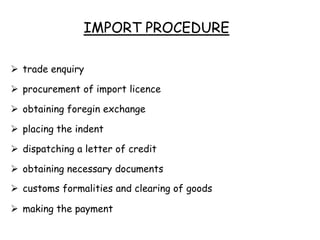
 trade enquiry
 procurement of import licence
 obtaining foregin exchange
 placing the indent
 dispatching a letter of credit
 obtaining necessary documents
 customs formalities and clearing of goods
 making the payment
1.TRADE ENQUIRY
An enquiry is a written request from the intending buyer or
its agent for information regarding the price and terms on
which the exporter and terms on which the exporter will
be able to supply goods.
2.PROCUREMENT OF IMPORT LICENCE
 A person or a firm cannot import goods into India without
a valid import license.
 An import license may be either general license or specific
license.
 Under general license goods can be imported from any
country.
 Individual license authorizes to import only from specific
countries.
For the purpose of issuing
licence, the importers are
divided into three categories
 Established Importer
 Actual users
 Registered Exporter
Established Importer
If the person imported goods of the class in which he is
interested during the basic period prescribed for such
class, he is treated as an established importer.
Actual user
If the person [importer] import goods for his own use in
industrial manufacturing process is called actual users.
Registered exporter
Registered exporter importing against exports made under
a scheme of export promotion and others have to obtain
license from the chief controller of exports and imports.
Open General Licence List[O.G.L]
The Government issues from time to time a list of
commodities and products which can be imported
obtaining a general permission only. This is called open
General Licence List.
3.OBTAINING FOREIGN EXCHANGE
 Importer has to make payment for imports in the currency
of exporting country.
 The foreign exchange reserves of any country are
controlled by Government and are released through its
central bank.
 In India, the exchange control department of Reserves
Bank of India deals with the foreign exchange.
STEPS
 The importers has to submit an application in the
prescribed form along with the import licence to any
exchange bank as per the provisions of exchange
control act.
 Scrutinizing the application on the basis of exchange
policy of government of India in force at the time of
application.
 Reserve Bank of India sanctions or reject the release
of foreign exchange.
4.PLACING INDENT OR ORDER
 The order is known as Indent. It contains the instructions
from the importer so as to the quantity and quality of
goods required, methods for forwarding them.
 In opened indent all the necessary particular of goods,
prices etc. are not mentioned .
 A confirmatory indent is one where an order is placed
subject to the confirmation by the importers agent
5.DISPACTCHING A LETTER OF CREDIT
Exporter wants to be sure that there is no risk of non-
payment. Usually for this purpose he asks the importer to
send a letter of credit to him. A letter of credit is
popularly known as L/C.
6.OBTAINING NECESSARY DOCUMENTS
 On the receipt of letter of credit the exporter arrange
for shipment of goods and sends an advice note to the
importer immediately after the shipment of goods.
 The exporter then draws a bill of exchange on the
importer for the invoice value of goods.
 The shipping documents such as the bill of lading, invoice
insurance policy, certificate or origin, customer invoice
etc. also attached to the bill of exchange.
 Such bill of exchange with all these attached documents is
called documentary bill.
 Documentary bill of exchange is forwarded to the
importer through a foreign exchange bank which has a
branch or an agent in the importers country for collecting
payments of the bill.
7.CUSTOM FORMALITIES AND
CLEARING OF GOODS
 After receiving documents of title of the goods, the
importers only concern is to take the delivery of goods
when the ship arrive at the port and to bring them to his
own place of business.
8.MAKING THE PAYMENT
 The mode and time of making the payment is determined
according to the terms and conditions as agreed to earlier
between the importer and exporter, usually 30 to90 days
are allowed to the importer for making the payment of
D/A (Documents against Acceptance) and D/P (Documents
against Purchase) bills.
9.CLOSING THE TRANSACTION
 Last step in import procedure is closing the transaction. But
if he is not satisfied with the quality of goods he will write to
the exporter and settle the matters.
 Incase the goods have been damaged in transit the insurance
company will pay him the compensation under an advice to the
exporters.

Import export procedures

  • 1.
    PROCEDURE FOR PROCUREMENT THROUGHIMPORT PROCEDURES Dr. N. Yuvaraj Assistant Professor Achariya Arts and Science College Villianur , Puducherry
  • 2.
    IMPORT  Import traderefers to the purchase of goods from the foreign country.  The procedure for import trade differs from country to country, depending upon the import policy, the statutory requirements and customs of different countries.  In almost all the countries of the world import trade is controlled by the government.
  • 3.
    IMPORT PROCEDURE  tradeenquiry  procurement of import licence  obtaining foregin exchange  placing the indent  dispatching a letter of credit  obtaining necessary documents  customs formalities and clearing of goods  making the payment
  • 4.
    1.TRADE ENQUIRY An enquiryis a written request from the intending buyer or its agent for information regarding the price and terms on which the exporter and terms on which the exporter will be able to supply goods.
  • 5.
    2.PROCUREMENT OF IMPORTLICENCE  A person or a firm cannot import goods into India without a valid import license.  An import license may be either general license or specific license.  Under general license goods can be imported from any country.  Individual license authorizes to import only from specific countries.
  • 6.
    For the purposeof issuing licence, the importers are divided into three categories  Established Importer  Actual users  Registered Exporter
  • 7.
    Established Importer If theperson imported goods of the class in which he is interested during the basic period prescribed for such class, he is treated as an established importer. Actual user If the person [importer] import goods for his own use in industrial manufacturing process is called actual users.
  • 8.
    Registered exporter Registered exporterimporting against exports made under a scheme of export promotion and others have to obtain license from the chief controller of exports and imports. Open General Licence List[O.G.L] The Government issues from time to time a list of commodities and products which can be imported obtaining a general permission only. This is called open General Licence List.
  • 9.
    3.OBTAINING FOREIGN EXCHANGE Importer has to make payment for imports in the currency of exporting country.  The foreign exchange reserves of any country are controlled by Government and are released through its central bank.  In India, the exchange control department of Reserves Bank of India deals with the foreign exchange.
  • 10.
    STEPS  The importershas to submit an application in the prescribed form along with the import licence to any exchange bank as per the provisions of exchange control act.  Scrutinizing the application on the basis of exchange policy of government of India in force at the time of application.  Reserve Bank of India sanctions or reject the release of foreign exchange.
  • 11.
    4.PLACING INDENT ORORDER  The order is known as Indent. It contains the instructions from the importer so as to the quantity and quality of goods required, methods for forwarding them.  In opened indent all the necessary particular of goods, prices etc. are not mentioned .  A confirmatory indent is one where an order is placed subject to the confirmation by the importers agent
  • 12.
    5.DISPACTCHING A LETTEROF CREDIT Exporter wants to be sure that there is no risk of non- payment. Usually for this purpose he asks the importer to send a letter of credit to him. A letter of credit is popularly known as L/C.
  • 13.
    6.OBTAINING NECESSARY DOCUMENTS On the receipt of letter of credit the exporter arrange for shipment of goods and sends an advice note to the importer immediately after the shipment of goods.  The exporter then draws a bill of exchange on the importer for the invoice value of goods.  The shipping documents such as the bill of lading, invoice insurance policy, certificate or origin, customer invoice etc. also attached to the bill of exchange.
  • 14.
     Such billof exchange with all these attached documents is called documentary bill.  Documentary bill of exchange is forwarded to the importer through a foreign exchange bank which has a branch or an agent in the importers country for collecting payments of the bill.
  • 15.
    7.CUSTOM FORMALITIES AND CLEARINGOF GOODS  After receiving documents of title of the goods, the importers only concern is to take the delivery of goods when the ship arrive at the port and to bring them to his own place of business.
  • 16.
    8.MAKING THE PAYMENT The mode and time of making the payment is determined according to the terms and conditions as agreed to earlier between the importer and exporter, usually 30 to90 days are allowed to the importer for making the payment of D/A (Documents against Acceptance) and D/P (Documents against Purchase) bills.
  • 17.
    9.CLOSING THE TRANSACTION Last step in import procedure is closing the transaction. But if he is not satisfied with the quality of goods he will write to the exporter and settle the matters.  Incase the goods have been damaged in transit the insurance company will pay him the compensation under an advice to the exporters.