MBA 906
1
Pricing of services: Pricing
approaches, Pricing Strategies
Services Marketing
Course Instructor: Sneha Sharma (PhD*, MBA, Dip T & D)
MBA 906
Pricing Strategy
It is a strategic tool that organizations
use to differentiate their products from
competitors and thereby gain the
competitive edge to capture the
market.
MBA 906
Three Key Ways Service Prices are
Different for Consumers
• Customer Knowledge of service prices
– Service heterogeneity limits knowledge
– Providers are unwilling to estimate prices
• Medical, legal services
– Individual customer needs vary
• Hotel room , hair stylist
– Price information is overwhelming in services
– Prices are not visible
MBA 906
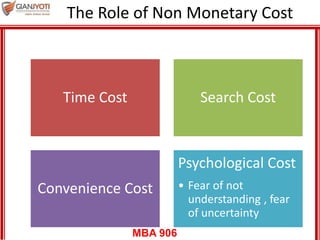
The Role of Non Monetary Cost
Time Cost Search Cost
Convenience Cost
Psychological Cost
• Fear of not
understanding , fear
of uncertainty
MBA 906
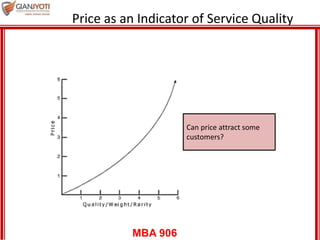
Price as an Indicator of Service Quality
Can price attract some
customers?
MBA 906
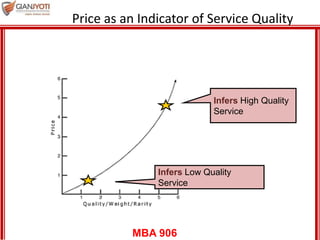
Price as an Indicator of Service Quality
Infers Low Quality
Service
Infers High Quality
Service
MBA 906
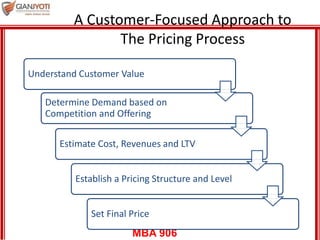
A Customer-Focused Approach to
The Pricing Process
Understand Customer Value
Determine Demand based on
Competition and Offering
Estimate Cost, Revenues and LTV
Establish a Pricing Structure and Level
Set Final Price
MBA 906
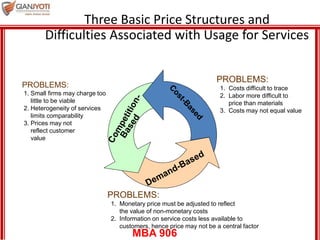
Three Basic Price Structures and
Difficulties Associated with Usage for Services
PROBLEMS:
1. Costs difficult to trace
2. Labor more difficult to
price than materials
3. Costs may not equal value
PROBLEMS:
1. Small firms may charge too
little to be viable
2. Heterogeneity of services
limits comparability
3. Prices may not
reflect customer
value
PROBLEMS:
1. Monetary price must be adjusted to reflect
the value of non-monetary costs
2. Information on service costs less available to
customers, hence price may not be a central factor
MBA 906
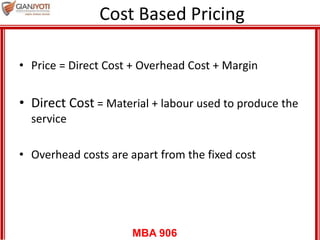
Cost Based Pricing
• Price = Direct Cost + Overhead Cost + Margin
• Direct Cost = Material + labour used to produce the
service
• Overhead costs are apart from the fixed cost
MBA 906
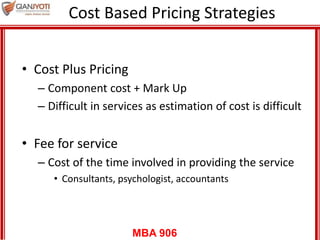
Cost Based Pricing Strategies
• Cost Plus Pricing
– Component cost + Mark Up
– Difficult in services as estimation of cost is difficult
• Fee for service
– Cost of the time involved in providing the service
• Consultants, psychologist, accountants
MBA 906
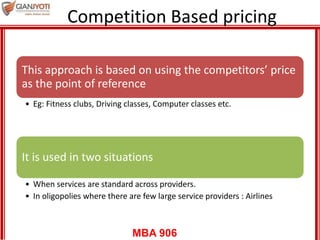
Competition Based pricing
This approach is based on using the competitors’ price
as the point of reference
• Eg: Fitness clubs, Driving classes, Computer classes etc.
It is used in two situations
• When services are standard across providers.
• In oligopolies where there are few large service providers : Airlines
MBA 906
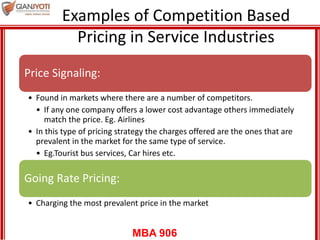
Examples of Competition Based
Pricing in Service Industries
Price Signaling:
• Found in markets where there are a number of competitors.
• If any one company offers a lower cost advantage others immediately
match the price. Eg. Airlines
• In this type of pricing strategy the charges offered are the ones that are
prevalent in the market for the same type of service.
• Eg.Tourist bus services, Car hires etc.
Going Rate Pricing:
• Charging the most prevalent price in the market
MBA 906
Demand Based pricing
• Unlike in cost based and competition based pricing,
demand based pricing is customer focused and not
company or market focused.
– This type of pricing is fixed keeping in mind what the
customers are likely to pay for the perceived value offered
by the service.
– For the determination of demand based pricing non
monetary costs also have to be considered, as these
contribute to the perception of value.
MBA 906
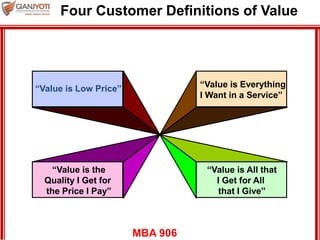
Four Customer Definitions of Value
“Value is Low Price” “Value is Everything
I Want in a Service”
“Value is the
Quality I Get for
the Price I Pay”
“Value is All that
I Get for All
that I Give”
MBA 906
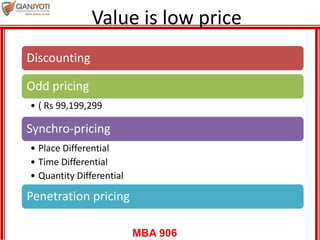
Value is low price
Discounting
Odd pricing
• ( Rs 99,199,299
Synchro-pricing
• Place Differential
• Time Differential
• Quantity Differential
Penetration pricing
MBA 906
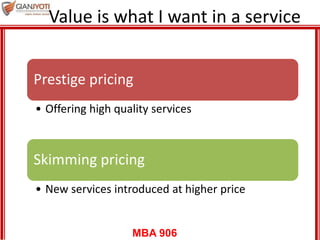
Value is what I want in a service
Prestige pricing
• Offering high quality services
Skimming pricing
• New services introduced at higher price
MBA 906
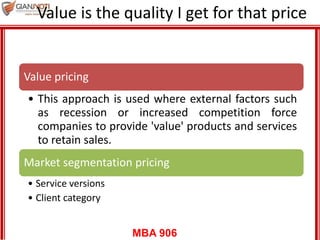
Value is the quality I get for that price
Value pricing
• This approach is used where external factors such
as recession or increased competition force
companies to provide 'value' products and services
to retain sales.
Market segmentation pricing
• Service versions
• Client category
MBA 906
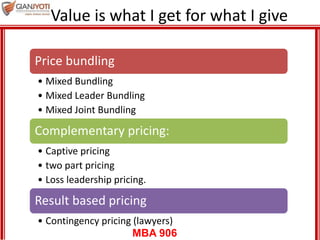
Value is what I get for what I give
Price bundling
• Mixed Bundling
• Mixed Leader Bundling
• Mixed Joint Bundling
Complementary pricing:
• Captive pricing
• two part pricing
• Loss leadership pricing.
Result based pricing
• Contingency pricing (lawyers)

Pricing of services

  • 1.
    MBA 906 1 Pricing ofservices: Pricing approaches, Pricing Strategies Services Marketing Course Instructor: Sneha Sharma (PhD*, MBA, Dip T & D)
  • 2.
    MBA 906 Pricing Strategy Itis a strategic tool that organizations use to differentiate their products from competitors and thereby gain the competitive edge to capture the market.
  • 3.
    MBA 906 Three KeyWays Service Prices are Different for Consumers • Customer Knowledge of service prices – Service heterogeneity limits knowledge – Providers are unwilling to estimate prices • Medical, legal services – Individual customer needs vary • Hotel room , hair stylist – Price information is overwhelming in services – Prices are not visible
  • 4.
    MBA 906 The Roleof Non Monetary Cost Time Cost Search Cost Convenience Cost Psychological Cost • Fear of not understanding , fear of uncertainty
  • 5.
    MBA 906 Price asan Indicator of Service Quality Can price attract some customers?
  • 6.
    MBA 906 Price asan Indicator of Service Quality Infers Low Quality Service Infers High Quality Service
  • 7.
    MBA 906 A Customer-FocusedApproach to The Pricing Process Understand Customer Value Determine Demand based on Competition and Offering Estimate Cost, Revenues and LTV Establish a Pricing Structure and Level Set Final Price
  • 8.
    MBA 906 Three BasicPrice Structures and Difficulties Associated with Usage for Services PROBLEMS: 1. Costs difficult to trace 2. Labor more difficult to price than materials 3. Costs may not equal value PROBLEMS: 1. Small firms may charge too little to be viable 2. Heterogeneity of services limits comparability 3. Prices may not reflect customer value PROBLEMS: 1. Monetary price must be adjusted to reflect the value of non-monetary costs 2. Information on service costs less available to customers, hence price may not be a central factor
  • 9.
    MBA 906 Cost BasedPricing • Price = Direct Cost + Overhead Cost + Margin • Direct Cost = Material + labour used to produce the service • Overhead costs are apart from the fixed cost
  • 10.
    MBA 906 Cost BasedPricing Strategies • Cost Plus Pricing – Component cost + Mark Up – Difficult in services as estimation of cost is difficult • Fee for service – Cost of the time involved in providing the service • Consultants, psychologist, accountants
  • 11.
    MBA 906 Competition Basedpricing This approach is based on using the competitors’ price as the point of reference • Eg: Fitness clubs, Driving classes, Computer classes etc. It is used in two situations • When services are standard across providers. • In oligopolies where there are few large service providers : Airlines
  • 12.
    MBA 906 Examples ofCompetition Based Pricing in Service Industries Price Signaling: • Found in markets where there are a number of competitors. • If any one company offers a lower cost advantage others immediately match the price. Eg. Airlines • In this type of pricing strategy the charges offered are the ones that are prevalent in the market for the same type of service. • Eg.Tourist bus services, Car hires etc. Going Rate Pricing: • Charging the most prevalent price in the market
  • 13.
    MBA 906 Demand Basedpricing • Unlike in cost based and competition based pricing, demand based pricing is customer focused and not company or market focused. – This type of pricing is fixed keeping in mind what the customers are likely to pay for the perceived value offered by the service. – For the determination of demand based pricing non monetary costs also have to be considered, as these contribute to the perception of value.
  • 14.
    MBA 906 Four CustomerDefinitions of Value “Value is Low Price” “Value is Everything I Want in a Service” “Value is the Quality I Get for the Price I Pay” “Value is All that I Get for All that I Give”
  • 15.
    MBA 906 Value islow price Discounting Odd pricing • ( Rs 99,199,299 Synchro-pricing • Place Differential • Time Differential • Quantity Differential Penetration pricing
  • 16.
    MBA 906 Value iswhat I want in a service Prestige pricing • Offering high quality services Skimming pricing • New services introduced at higher price
  • 17.
    MBA 906 Value isthe quality I get for that price Value pricing • This approach is used where external factors such as recession or increased competition force companies to provide 'value' products and services to retain sales. Market segmentation pricing • Service versions • Client category
  • 18.
    MBA 906 Value iswhat I get for what I give Price bundling • Mixed Bundling • Mixed Leader Bundling • Mixed Joint Bundling Complementary pricing: • Captive pricing • two part pricing • Loss leadership pricing. Result based pricing • Contingency pricing (lawyers)