R.Atheeswari
An export of a good occurs when
there is a change of ownership from a resident
to a non-resident.
Exporting activity involves several
commercial and regulatory procedures.
Exporter has to submit ‘shipping bill’
for export by sea or air and ‘bill of export’ for
export by road.
Relevant documents i.e. copies of
packing list, invoices, export contract, letter of
credit etc. are also to be submitted.
https://www.slideshare.net/EricLee14/import-
export-presentation?next_slideshow=1
Every person importing or
exporting goods require an IEC Number. It is
normally allotted by the regional licensing
authorities. IEC is issued by DGFT.
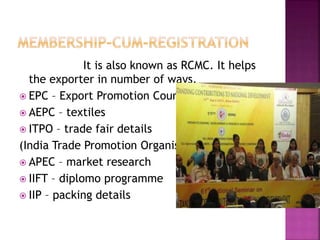
It is also known as RCMC. It helps
the exporter in number of ways.
 EPC – Export Promotion Councils
 AEPC – textiles
 ITPO – trade fair details
(India Trade Promotion Organisation)
 APEC – market research
 IIFT – diplomo programme
 IIP – packing details
It is a request from a importer to be
informed of the terms and conditions of sale.
It may full details of the
 goods required
 their description
 catalogue numbers or grades , sizes weights
or other distinguishing features
 time and method of delivery
Exporter investigate the buyer
using Several Trade Journals . It publish
trade inquiries.
Importer knows about the
exporter. So the exporter would have to
make offer to he foreign customer.
An offer is a proposal in which an
exporter submits , may be in the form of
letter and other relevant information. The
offer, when accepted by the foreign buyer,
becomes an order.
It is usually takes the form of a
contract. The contract should contain details
of Goods, Quantity, Quality, Price, Period of
delivery/shipment, Packing and Marking ,
Terms of payment, Licenses, Insurance ,
Documentary requirements, etc.
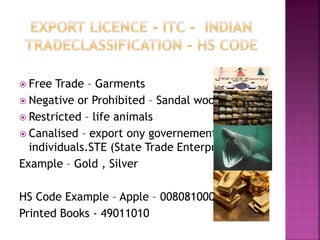
 Free Trade – Garments
 Negative or Prohibited – Sandal wood, Dals
 Restricted – life animals
 Canalised – export ony governement not an
individuals.STE (State Trade Enterprises)
Example – Gold , Silver
HS Code Example – Apple – 008081000
Printed Books - 49011010
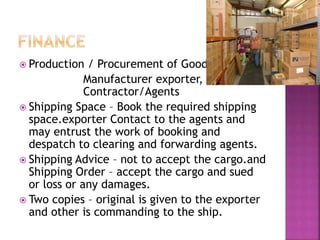
 Production / Procurement of Goods
Manufacturer exporter,
Contractor/Agents
 Shipping Space – Book the required shipping
space.exporter Contact to the agents and
may entrust the work of booking and
despatch to clearing and forwarding agents.
 Shipping Advice – not to accept the cargo.and
Shipping Order – accept the cargo and sued
or loss or any damages.
 Two copies – original is given to the exporter
and other is commanding to the ship.
The Export (Quality Control and
Inspection)Act, 1963
Self – Certification Scheme
1. Excise Clearance – duty paid and refunded
2. Customs Formalities – Shipping bill,
Declaration- truth statement , Invoice, GR
form, Export Licence, Quality Control
Inspection , Original contract, Contract
Registration , Letter of Credit, Packing List,
AR- 4 form, Any other documents. –
checked by the assistant collector of
customs then properly sealed
The exchange control regulations require all
the exporters to:
1. Make a declaration on the prescribed form
to the Collector of Customs that foreign
exchange, representing the full export
value of the goods, has been or will be
disposed of in the manner and within the
period specified by the RBI.,
2. Negotiate all shipping documents, including
those relating to sales on consignment
basis, through authorised dealers.
 Receive payment by an approved method
 Surrender the foreign exchange received
from exports to the foreign exchange control
authority through authorised dealers.
 Marine Insurance – maritime perils
 GIC – General Insurance Corporation
four subsidiaries like The
National Insurance Company, The New India
Assurance Company, The Oriental Fire and
General Insurance Company and The United
India and General Insurance Company.
The ECGC (Export Credit Guarantee
Corporation) covers certain export risks
which are not covered by the general
insurers.
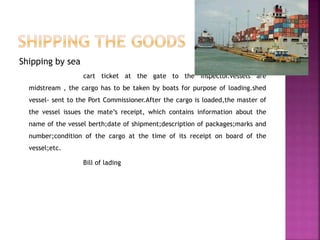
Shipping by sea
cart ticket at the gate to the inspector.vessels are
midstream , the cargo has to be taken by boats for purpose of loading.shed
vessel- sent to the Port Commissioner.After the cargo is loaded,the master of
the vessel issues the mate’s receipt, which contains information about the
name of the vessel berth;date of shipment;description of packages;marks and
number;condition of the cargo at the time of its receipt on board of the
vessel;etc.
Bill of lading
 Shipping by Air
Quicker delivery. Lower packing charges.
Less handling of the goods in transit.damages
are reduced.
 Shipping by Post
parcel post.proper export licence is
necessary covered by parcel.if it is failing
cancel the parcel.
 Shipping by Land
AR-4 form.
Letter of Credit, Commercial
Invoice, together with the packing slip, GR-1
form, Certificate of Origin, Marine Insurance
Policy, Bill of Lading .
Export Incentives
EPC, SPZ.
Export procedures

Export procedures

  • 1.
  • 2.
    An export ofa good occurs when there is a change of ownership from a resident to a non-resident. Exporting activity involves several commercial and regulatory procedures. Exporter has to submit ‘shipping bill’ for export by sea or air and ‘bill of export’ for export by road. Relevant documents i.e. copies of packing list, invoices, export contract, letter of credit etc. are also to be submitted. https://www.slideshare.net/EricLee14/import- export-presentation?next_slideshow=1
  • 3.
    Every person importingor exporting goods require an IEC Number. It is normally allotted by the regional licensing authorities. IEC is issued by DGFT.
  • 4.
    It is alsoknown as RCMC. It helps the exporter in number of ways.  EPC – Export Promotion Councils  AEPC – textiles  ITPO – trade fair details (India Trade Promotion Organisation)  APEC – market research  IIFT – diplomo programme  IIP – packing details
  • 5.
    It is arequest from a importer to be informed of the terms and conditions of sale. It may full details of the  goods required  their description  catalogue numbers or grades , sizes weights or other distinguishing features  time and method of delivery
  • 6.
    Exporter investigate thebuyer using Several Trade Journals . It publish trade inquiries. Importer knows about the exporter. So the exporter would have to make offer to he foreign customer. An offer is a proposal in which an exporter submits , may be in the form of letter and other relevant information. The offer, when accepted by the foreign buyer, becomes an order.
  • 7.
    It is usuallytakes the form of a contract. The contract should contain details of Goods, Quantity, Quality, Price, Period of delivery/shipment, Packing and Marking , Terms of payment, Licenses, Insurance , Documentary requirements, etc.
  • 8.
     Free Trade– Garments  Negative or Prohibited – Sandal wood, Dals  Restricted – life animals  Canalised – export ony governement not an individuals.STE (State Trade Enterprises) Example – Gold , Silver HS Code Example – Apple – 008081000 Printed Books - 49011010
  • 9.
     Production /Procurement of Goods Manufacturer exporter, Contractor/Agents  Shipping Space – Book the required shipping space.exporter Contact to the agents and may entrust the work of booking and despatch to clearing and forwarding agents.  Shipping Advice – not to accept the cargo.and Shipping Order – accept the cargo and sued or loss or any damages.  Two copies – original is given to the exporter and other is commanding to the ship.
  • 10.
    The Export (QualityControl and Inspection)Act, 1963 Self – Certification Scheme 1. Excise Clearance – duty paid and refunded 2. Customs Formalities – Shipping bill, Declaration- truth statement , Invoice, GR form, Export Licence, Quality Control Inspection , Original contract, Contract Registration , Letter of Credit, Packing List, AR- 4 form, Any other documents. – checked by the assistant collector of customs then properly sealed
  • 11.
    The exchange controlregulations require all the exporters to: 1. Make a declaration on the prescribed form to the Collector of Customs that foreign exchange, representing the full export value of the goods, has been or will be disposed of in the manner and within the period specified by the RBI., 2. Negotiate all shipping documents, including those relating to sales on consignment basis, through authorised dealers.
  • 12.
     Receive paymentby an approved method  Surrender the foreign exchange received from exports to the foreign exchange control authority through authorised dealers.
  • 13.
     Marine Insurance– maritime perils  GIC – General Insurance Corporation four subsidiaries like The National Insurance Company, The New India Assurance Company, The Oriental Fire and General Insurance Company and The United India and General Insurance Company. The ECGC (Export Credit Guarantee Corporation) covers certain export risks which are not covered by the general insurers.
  • 14.
    Shipping by sea cartticket at the gate to the inspector.vessels are midstream , the cargo has to be taken by boats for purpose of loading.shed vessel- sent to the Port Commissioner.After the cargo is loaded,the master of the vessel issues the mate’s receipt, which contains information about the name of the vessel berth;date of shipment;description of packages;marks and number;condition of the cargo at the time of its receipt on board of the vessel;etc. Bill of lading
  • 15.
     Shipping byAir Quicker delivery. Lower packing charges. Less handling of the goods in transit.damages are reduced.  Shipping by Post parcel post.proper export licence is necessary covered by parcel.if it is failing cancel the parcel.  Shipping by Land AR-4 form.
  • 16.
    Letter of Credit,Commercial Invoice, together with the packing slip, GR-1 form, Certificate of Origin, Marine Insurance Policy, Bill of Lading . Export Incentives EPC, SPZ.