PRE-SHIPMENT
INSPECTION
Course Instructor: Sneha Sharma
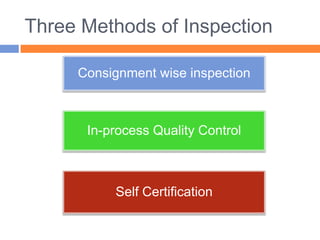
Three Methods of Inspection
Consignment wise inspection
In-process Quality Control
Self Certification
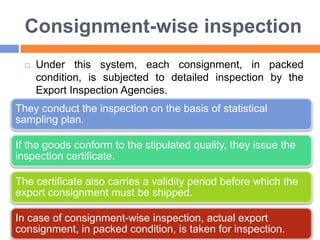
Consignment-wise inspection
 Under this system, each consignment, in packed
condition, is subjected to detailed inspection by the
Export Inspection Agencies.
They conduct the inspection on the basis of statistical
sampling plan.
If the goods conform to the stipulated quality, they issue the
inspection certificate.
The certificate also carries a validity period before which the
export consignment must be shipped.
In case of consignment-wise inspection, actual export
consignment, in packed condition, is taken for inspection.
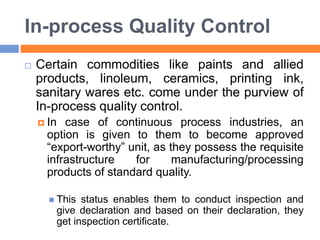
In-process Quality Control
 Certain commodities like paints and allied
products, linoleum, ceramics, printing ink,
sanitary wares etc. come under the purview of
In-process quality control.
 In case of continuous process industries, an
option is given to them to become approved
“export-worthy” unit, as they possess the requisite
infrastructure for manufacturing/processing
products of standard quality.
 This status enables them to conduct inspection and
give declaration and based on their declaration, they
get inspection certificate.
Self-Certification
 It is a self-certification system
 It is based on the concept that the
manufacturing unit which has in-built
responsibility for quality control should have
the freedom to certify its own product for
export.
PROCEDURE FOR PRE-
SHIPMENT INSPECTION
 There are different procedures for
obtaining pre-shipment inspection
certificates.
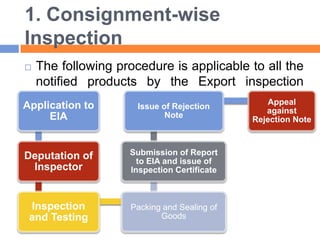
1. Consignment-wise
Inspection
 The following procedure is applicable to all the
notified products by the Export inspection
Council.
Application to
EIA
Deputation of
Inspector
Inspection
and Testing
Packing and Sealing of
Goods
Submission of Report
to EIA and issue of
Inspection Certificate
Issue of Rejection
Note
Appeal
against
Rejection Note
1. Application to EIA
 The exporter has to apply in the prescribed
„Intimation for Inspection‟, well in advance, to the
date of shipment to avoid delays, along with the
following documents:
 Copy of export contract;
 Copy of letter of credit;
 Details of packing specifications;
 Commercial invoice giving evidence of FOB value of
export consignment;
 Crossed cheque/DD in favour of EIA towards
inspection fees and
 Declaration regarding importer‟s technical
specifications.
2. Deputation of Inspector
After getting the ‘Intimation for Inspection’,
 EIA deputes an inspector to conduct an
inspection of the consignment, in packed
conditions, at the factory/warehouse of exporter.
 The exporter should keep the consignment, in
packed condition for export, ready for inspection
at the appointed place and time.
3. Inspection and Testing
 The inspector conducts inspection on a
random basis.
 He will conduct inspection with reference to the
agreed specifications, which should not be inferior
to the notified specifications.
 Samples may be drawn and sent to the laboratory, if
required.
 Where testing facilities are not available at the exporter‟s
place, sample may be sent to the private independent
laboratories.
 Inspector submits the field report based on his inspection
and test results obtained.
4. Packing and Sealing of
Goods
 If the inspector is satisfied with the quality of
goods, he issues order for packing of goods in
his presence.
 After packing, the consignment is marked and
sealed with the official seal of Export Inspection
Agency.
5. Submission of Report to EIA and
issue of Inspection Certificate
 Based on the field inspection report,
 the Deputy Director, Export Inspection Agency
issue the Inspection Certificate to the exporter, in
triplicate, which will be disposed as under:
 The original copy is to be submitted to the customs.
 The duplicate copy is dispatched to the importer.
 The triplicate copy is retained by the exporter for his
record.
6. Issue of Rejection Note
 If the inspection report is not favourable, the
Deputy Director of EIA issues Rejection Note.
7. Appeal against Rejection
Note
 Exporter can file an appeal against the
order of the Deputy Director, EIA.
 The appeal is to be made within 10 days from the
date of receipt of Rejection Note.
 On receipt of the appeal, EIC arranges to
convene a meeting of the Appellate Panel. The
appellate panel reviews the inspection report and
examines the consignment again, if necessary.
 The decision of the Appellate Panel is final and
binding on both the parties i.e. Exporter and
Export Inspection Agency
2. In Process Quality Control
 Manufacturing/processing units, having
continuous processing system, are given an
option to become “export-worthy” status units so
that they get the inspection certificate, based on
their own declaration.
 These units are highly quality conscious and conduct
thorough quality control at each and every stage of
production that includes:
 Raw materials and bought out components,
 Process control,
 Product control and
 Packing and packaging control.
Export-worthy Status Units
 These units possess the required infrastructure
facilities for manufacturing/processing standard
quality products.
 To secure recognition and approval of “export-
worthy” status, export-oriented
manufacturing/processing units have to submit a
application, in the prescribed format, to Export
Inspection Agency.
 Based on the declaration of the unit that the goods have
been manufactured/processed, as required under the
prescribed regulations, the agency issues certificate of
inspection.
 The EIC and inspection agencies ensure that adequate
2. In Process Quality Control
 After a preliminary visit by the officer of Export
Inspection Agency, it appoints a panel of experts to
investigate the quality control facilities available in the
unit.
 The panel thoroughly investigates the quality control
facilities available from the stage of raw materials to
packing. It submits its report to the agency.
 On the basis of those recommendations, the unit is
accorded the status of an “export-worthy” unit.
 The Export Inspection Council may recognise a
manufacturing unit as an “export-worthy”, only after
ensuring that the unit is adequately supported with facilities
for the enforcement of quality control standards required by
the Council.
2. In Process Quality Control
 Such a unit is allowed to inspect and clear the
goods for export, without inspection by the
Export Inspection Agency.
3. Self Certification
 Certain manufacturing units are given the
freedom to certify their inspection
certificates.
 The philosophy behind the scheme is that
manufacturing units, with proven track record
of maintenance of quality, deserve to enjoy
the freedom for issuance of pre-shipment
inspection certificate themselves.
 The essential condition is that the unit has not
received any complaint during the last three
years.
3. Self Certification
 For the purpose of qualifying to become eligible,
the reputed manufacturing unit should comply
with the prescribed norms that include the
following:
 Product Quality
 Design and Development
 Raw materials/Bought out Components
 Organisation and personnel for quality control
 Process Control
 Laboratory
 Quality Audit
 Packaging
 After-sales-service and
3. Self Certification
 After conducting inspection, EIC recognizes the
units for issue of self-certification.
 The approved unit under this system is
recognised by notification under section 7 of
the act as the Agency for Quality Control and
Inspection of specific products, manufactured
in the unit.
 Validity of such recognition is for a period of
one year.
 Period may be extended provided the unit
continues to enjoy the above facilities.
Exemption from Pre-Shipment
Inspection
 The following units are exempt from the
requirement of compulsory pre-shipment
inspection:
(A) Export House, Trading House, Super Trading House and Super
Star Trading House;
(B) 100% Export oriented unit set up in the Export Processing Zones
or Free Trade Zones;
(C) Where the overseas buyer does not want pre-shipment inspection
certificate and
(D) Products bearing ISI mark or the AGMARK for exports.

Pre- shipment inspection during Export

  • 1.
  • 2.
    Three Methods ofInspection Consignment wise inspection In-process Quality Control Self Certification
  • 3.
    Consignment-wise inspection  Underthis system, each consignment, in packed condition, is subjected to detailed inspection by the Export Inspection Agencies. They conduct the inspection on the basis of statistical sampling plan. If the goods conform to the stipulated quality, they issue the inspection certificate. The certificate also carries a validity period before which the export consignment must be shipped. In case of consignment-wise inspection, actual export consignment, in packed condition, is taken for inspection.
  • 4.
    In-process Quality Control Certain commodities like paints and allied products, linoleum, ceramics, printing ink, sanitary wares etc. come under the purview of In-process quality control.  In case of continuous process industries, an option is given to them to become approved “export-worthy” unit, as they possess the requisite infrastructure for manufacturing/processing products of standard quality.  This status enables them to conduct inspection and give declaration and based on their declaration, they get inspection certificate.
  • 5.
    Self-Certification  It isa self-certification system  It is based on the concept that the manufacturing unit which has in-built responsibility for quality control should have the freedom to certify its own product for export.
  • 6.
    PROCEDURE FOR PRE- SHIPMENTINSPECTION  There are different procedures for obtaining pre-shipment inspection certificates.
  • 7.
    1. Consignment-wise Inspection  Thefollowing procedure is applicable to all the notified products by the Export inspection Council. Application to EIA Deputation of Inspector Inspection and Testing Packing and Sealing of Goods Submission of Report to EIA and issue of Inspection Certificate Issue of Rejection Note Appeal against Rejection Note
  • 8.
    1. Application toEIA  The exporter has to apply in the prescribed „Intimation for Inspection‟, well in advance, to the date of shipment to avoid delays, along with the following documents:  Copy of export contract;  Copy of letter of credit;  Details of packing specifications;  Commercial invoice giving evidence of FOB value of export consignment;  Crossed cheque/DD in favour of EIA towards inspection fees and  Declaration regarding importer‟s technical specifications.
  • 9.
    2. Deputation ofInspector After getting the ‘Intimation for Inspection’,  EIA deputes an inspector to conduct an inspection of the consignment, in packed conditions, at the factory/warehouse of exporter.  The exporter should keep the consignment, in packed condition for export, ready for inspection at the appointed place and time.
  • 10.
    3. Inspection andTesting  The inspector conducts inspection on a random basis.  He will conduct inspection with reference to the agreed specifications, which should not be inferior to the notified specifications.  Samples may be drawn and sent to the laboratory, if required.  Where testing facilities are not available at the exporter‟s place, sample may be sent to the private independent laboratories.  Inspector submits the field report based on his inspection and test results obtained.
  • 11.
    4. Packing andSealing of Goods  If the inspector is satisfied with the quality of goods, he issues order for packing of goods in his presence.  After packing, the consignment is marked and sealed with the official seal of Export Inspection Agency.
  • 12.
    5. Submission ofReport to EIA and issue of Inspection Certificate  Based on the field inspection report,  the Deputy Director, Export Inspection Agency issue the Inspection Certificate to the exporter, in triplicate, which will be disposed as under:  The original copy is to be submitted to the customs.  The duplicate copy is dispatched to the importer.  The triplicate copy is retained by the exporter for his record.
  • 13.
    6. Issue ofRejection Note  If the inspection report is not favourable, the Deputy Director of EIA issues Rejection Note.
  • 14.
    7. Appeal againstRejection Note  Exporter can file an appeal against the order of the Deputy Director, EIA.  The appeal is to be made within 10 days from the date of receipt of Rejection Note.  On receipt of the appeal, EIC arranges to convene a meeting of the Appellate Panel. The appellate panel reviews the inspection report and examines the consignment again, if necessary.  The decision of the Appellate Panel is final and binding on both the parties i.e. Exporter and Export Inspection Agency
  • 15.
    2. In ProcessQuality Control  Manufacturing/processing units, having continuous processing system, are given an option to become “export-worthy” status units so that they get the inspection certificate, based on their own declaration.  These units are highly quality conscious and conduct thorough quality control at each and every stage of production that includes:  Raw materials and bought out components,  Process control,  Product control and  Packing and packaging control.
  • 16.
    Export-worthy Status Units These units possess the required infrastructure facilities for manufacturing/processing standard quality products.  To secure recognition and approval of “export- worthy” status, export-oriented manufacturing/processing units have to submit a application, in the prescribed format, to Export Inspection Agency.  Based on the declaration of the unit that the goods have been manufactured/processed, as required under the prescribed regulations, the agency issues certificate of inspection.  The EIC and inspection agencies ensure that adequate
  • 17.
    2. In ProcessQuality Control  After a preliminary visit by the officer of Export Inspection Agency, it appoints a panel of experts to investigate the quality control facilities available in the unit.  The panel thoroughly investigates the quality control facilities available from the stage of raw materials to packing. It submits its report to the agency.  On the basis of those recommendations, the unit is accorded the status of an “export-worthy” unit.  The Export Inspection Council may recognise a manufacturing unit as an “export-worthy”, only after ensuring that the unit is adequately supported with facilities for the enforcement of quality control standards required by the Council.
  • 18.
    2. In ProcessQuality Control  Such a unit is allowed to inspect and clear the goods for export, without inspection by the Export Inspection Agency.
  • 19.
    3. Self Certification Certain manufacturing units are given the freedom to certify their inspection certificates.  The philosophy behind the scheme is that manufacturing units, with proven track record of maintenance of quality, deserve to enjoy the freedom for issuance of pre-shipment inspection certificate themselves.  The essential condition is that the unit has not received any complaint during the last three years.
  • 20.
    3. Self Certification For the purpose of qualifying to become eligible, the reputed manufacturing unit should comply with the prescribed norms that include the following:  Product Quality  Design and Development  Raw materials/Bought out Components  Organisation and personnel for quality control  Process Control  Laboratory  Quality Audit  Packaging  After-sales-service and
  • 21.
    3. Self Certification After conducting inspection, EIC recognizes the units for issue of self-certification.  The approved unit under this system is recognised by notification under section 7 of the act as the Agency for Quality Control and Inspection of specific products, manufactured in the unit.  Validity of such recognition is for a period of one year.  Period may be extended provided the unit continues to enjoy the above facilities.
  • 22.
    Exemption from Pre-Shipment Inspection The following units are exempt from the requirement of compulsory pre-shipment inspection: (A) Export House, Trading House, Super Trading House and Super Star Trading House; (B) 100% Export oriented unit set up in the Export Processing Zones or Free Trade Zones; (C) Where the overseas buyer does not want pre-shipment inspection certificate and (D) Products bearing ISI mark or the AGMARK for exports.