International Business II
PAYMENT METHODS
International Trade Payment Methods
They are banking instruments that allow the
successfull closure of an international trade
operation therefore guaranteeing the payment
derived from the purchase or sale of goods.
International Trade Payment Methods
Letter of Credit
Documentary
Collection
Foreign
Remittances
Payment
Orders
Current
Accounts in
Foreign
Currency
Foreign
Warranty
Foreign
Permission
Payment Form
• It is determined by the exporter according to:
– Company’s policies
– Corporate objectives (long, medium, short term)
– Market conditions
– Government regulations
Currency of Negociation
• In Colombia all international business
transactions are expressed in USD
– However in the practice, business can be made in
€, £, ¥ too
• The currency exchange risk is up to the seller
when the transaction is made in the buyer’s
currency of choice.
– It goes to the buyer when the currency used is
from the seller’s country.
International Trade Payment Methods
• Advance payment (most secure for seller)
– Where the buyer parts with money first and waits
for the seller to forward the goods
• Documentary Credit (more secure for seller as
well as buyer)
– Letter of Credit
• Revocable
• Irrevocable
International Trade Payment Methods
• Documentary collection (more secure for
buyer and to a certain extent to seller)
– Also called "Cash Against Documents
• Direct payment (most secure for buyer)
– Where the supplier ships the goods and waits for
the buyer to remit the bill proceeds, on open
account terms.
Documentary Credit
• The importer’s word is not a warrant.
• The buyer has to ask his bank the opening of a
documentary credit.
• A documentary credit is the written promise from
a bank on behalf of a customer authorizing a third
party to claim some money.
– Reasons:
• To assure the seller the seriousness of the business.
• Because of the changing currency exchange rates.
• To involve a serious firm in the negotiation.
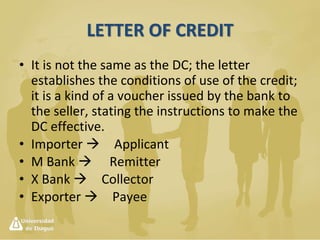
Letter of Credit
• It is not the same as the DC; the letter
establishes the conditions of use of the credit;
it is a kind of a voucher issued by the bank to
the seller, stating the instructions to make the
DC effective.
• Importer  Applicant
• M Bank  Remitter
• X Bank  Collector
• Exporter  Payee
Applicant – Account Party
• Obligations:
– Receive the merchandise
– Pay the price
– Comply with all the requirements established by
the bank
Remitter
• Obligations:
– Inform the payee of the transaction.
• Using SWIFT (Society for Worldwide Interbank Financial
Communication)
• Fax, e-mail (secured connection)
– Consider the request by the applicant.
– Pay
Collector
• Obligations:
– Verify the nature of the transaction.
– Confirm the credit by Remitter’s request (the bank
has the right no to do so)
• If confirmed, the collector is directly involved in the
transaction.
Payee
• Obligations:
– Present all the required documents.
– Present them in the established deadline.
– Comply with all the general conditions of the
contract.
– The seller doesn’t have to accept the Letter of
Credit, the notice is not an offer.
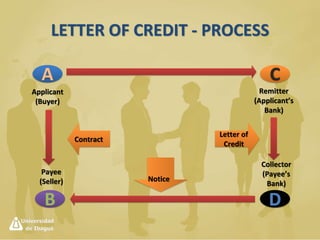
Letter of Credit - Process
A
B
Applicant
(Buyer)
Payee
(Seller)
C
Remitter
(Applicant’s
Bank)
D
Collector
(Payee’s
Bank)
Contract
Letter of
Credit
Notice
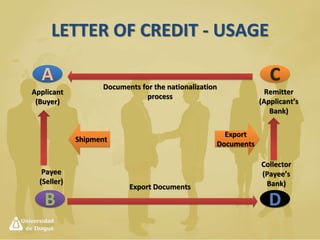
Letter of Credit - Usage
A
Applicant
(Buyer)
B
Payee
(Seller)
C
Remitter
(Applicant’s
Bank)
D
Collector
(Payee’s
Bank)
Shipment
Export
Documents
Export Documents
Documents for the nationalization
process
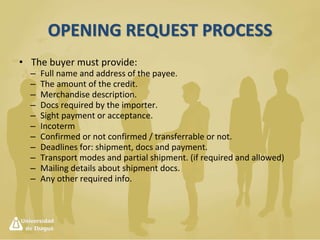
Opening Request Process
• The buyer must provide:
– Full name and address of the payee.
– The amount of the credit.
– Merchandise description.
– Docs required by the importer.
– Sight payment or acceptance.
– Incoterm
– Confirmed or not confirmed / transferrable or not.
– Deadlines for: shipment, docs and payment.
– Transport modes and partial shipment. (if required and allowed)
– Mailing details about shipment docs.
– Any other required info.
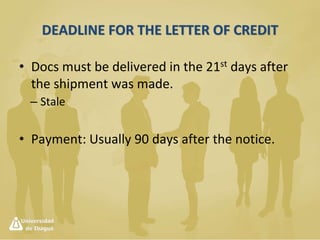
Deadline for the Letter of Credit
• Docs must be delivered in the 21st days after
the shipment was made.
– Abandon
• Payment: Usually 90 days after the notice.
Classes of Letter of Credit
Confirmed
• The remitter requests the collector’s
confirmation.
Non Confirmed
• The collector has no obligation with the payee
and just notifies him about the credit’s existence.
Revocable
The credit can be modified or cancelled by any of
the parts.
Irrevocable
• Ensures that the seller would receive the
payment.
Classes of Letter of Credit
Rotative
• It enables the payee to use the credit several
times up to the total ammount of the credit itself.
Transferable
• The payee can transfer partially or totally the
amount of the credit.
Intransferable
It cannot be transferred
Pay the bearer at sight
• It is used when the payee gets paid as soon as
he delivers the documents to the Collector.
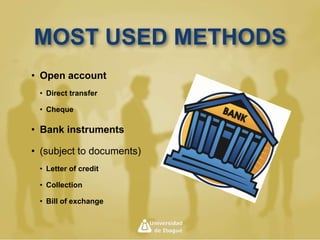
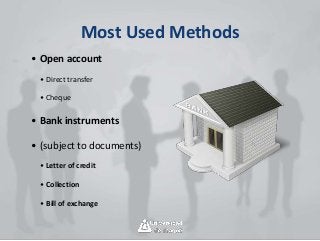
Most Used Methods
• Open account
• Direct transfer
• Cheque
• Bank instruments
• (subject to documents)
• Letter of credit
• Collection
• Bill of exchange
International Payment Methods
• The decision of which method of payment must be
used also depends on:
• The risk assumed by the parties.
• The cost of the transaction.
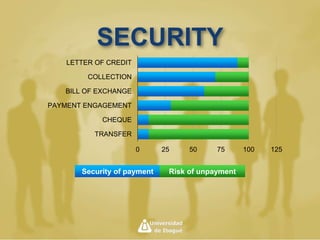
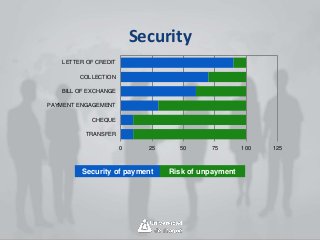
Security
0 25 50 75 100 125
LETTER OF CREDIT
COLLECTION
BILL OF EXCHANGE
PAYMENT ENGAGEMENT
CHEQUE
TRANSFER
Security of payment Risk of unpayment

Payment modes

  • 1.
  • 2.
    International Trade PaymentMethods They are banking instruments that allow the successfull closure of an international trade operation therefore guaranteeing the payment derived from the purchase or sale of goods.
  • 3.
    International Trade PaymentMethods Letter of Credit Documentary Collection Foreign Remittances Payment Orders Current Accounts in Foreign Currency Foreign Warranty Foreign Permission
  • 4.
    Payment Form • Itis determined by the exporter according to: – Company’s policies – Corporate objectives (long, medium, short term) – Market conditions – Government regulations
  • 5.
    Currency of Negociation •In Colombia all international business transactions are expressed in USD – However in the practice, business can be made in €, £, ¥ too • The currency exchange risk is up to the seller when the transaction is made in the buyer’s currency of choice. – It goes to the buyer when the currency used is from the seller’s country.
  • 6.
    International Trade PaymentMethods • Advance payment (most secure for seller) – Where the buyer parts with money first and waits for the seller to forward the goods • Documentary Credit (more secure for seller as well as buyer) – Letter of Credit • Revocable • Irrevocable
  • 7.
    International Trade PaymentMethods • Documentary collection (more secure for buyer and to a certain extent to seller) – Also called "Cash Against Documents • Direct payment (most secure for buyer) – Where the supplier ships the goods and waits for the buyer to remit the bill proceeds, on open account terms.
  • 8.
    Documentary Credit • Theimporter’s word is not a warrant. • The buyer has to ask his bank the opening of a documentary credit. • A documentary credit is the written promise from a bank on behalf of a customer authorizing a third party to claim some money. – Reasons: • To assure the seller the seriousness of the business. • Because of the changing currency exchange rates. • To involve a serious firm in the negotiation.
  • 9.
    Letter of Credit •It is not the same as the DC; the letter establishes the conditions of use of the credit; it is a kind of a voucher issued by the bank to the seller, stating the instructions to make the DC effective. • Importer  Applicant • M Bank  Remitter • X Bank  Collector • Exporter  Payee
  • 10.
    Applicant – AccountParty • Obligations: – Receive the merchandise – Pay the price – Comply with all the requirements established by the bank
  • 11.
    Remitter • Obligations: – Informthe payee of the transaction. • Using SWIFT (Society for Worldwide Interbank Financial Communication) • Fax, e-mail (secured connection) – Consider the request by the applicant. – Pay
  • 12.
    Collector • Obligations: – Verifythe nature of the transaction. – Confirm the credit by Remitter’s request (the bank has the right no to do so) • If confirmed, the collector is directly involved in the transaction.
  • 13.
    Payee • Obligations: – Presentall the required documents. – Present them in the established deadline. – Comply with all the general conditions of the contract. – The seller doesn’t have to accept the Letter of Credit, the notice is not an offer.
  • 14.
    Letter of Credit- Process A B Applicant (Buyer) Payee (Seller) C Remitter (Applicant’s Bank) D Collector (Payee’s Bank) Contract Letter of Credit Notice
  • 15.
    Letter of Credit- Usage A Applicant (Buyer) B Payee (Seller) C Remitter (Applicant’s Bank) D Collector (Payee’s Bank) Shipment Export Documents Export Documents Documents for the nationalization process
  • 16.
    Opening Request Process •The buyer must provide: – Full name and address of the payee. – The amount of the credit. – Merchandise description. – Docs required by the importer. – Sight payment or acceptance. – Incoterm – Confirmed or not confirmed / transferrable or not. – Deadlines for: shipment, docs and payment. – Transport modes and partial shipment. (if required and allowed) – Mailing details about shipment docs. – Any other required info.
  • 17.
    Deadline for theLetter of Credit • Docs must be delivered in the 21st days after the shipment was made. – Abandon • Payment: Usually 90 days after the notice.
  • 18.
    Classes of Letterof Credit Confirmed • The remitter requests the collector’s confirmation. Non Confirmed • The collector has no obligation with the payee and just notifies him about the credit’s existence. Revocable The credit can be modified or cancelled by any of the parts. Irrevocable • Ensures that the seller would receive the payment.
  • 19.
    Classes of Letterof Credit Rotative • It enables the payee to use the credit several times up to the total ammount of the credit itself. Transferable • The payee can transfer partially or totally the amount of the credit. Intransferable It cannot be transferred Pay the bearer at sight • It is used when the payee gets paid as soon as he delivers the documents to the Collector.
  • 20.
    Most Used Methods •Open account • Direct transfer • Cheque • Bank instruments • (subject to documents) • Letter of credit • Collection • Bill of exchange
  • 21.
    International Payment Methods •The decision of which method of payment must be used also depends on: • The risk assumed by the parties. • The cost of the transaction.
  • 22.
    Security 0 25 5075 100 125 LETTER OF CREDIT COLLECTION BILL OF EXCHANGE PAYMENT ENGAGEMENT CHEQUE TRANSFER Security of payment Risk of unpayment

Editor's Notes

  • #3 Normally all letters of credit are irrevocable unless the seller has not complied with the obligation so in that case the seller has to fulfill the contract without a payment in the next 90 days.
  • #4 Normally all letters of credit are irrevocable unless the seller has not complied with the obligation so in that case the seller has to fulfill the contract without a payment in the next 90 days.
  • #7 Normally all letters of credit are irrevocable unless the seller has not complied with the obligation so in that case the seller has to fulfill the contract without a payment in the next 90 days.