PROCEDURE FOR
EXPORT
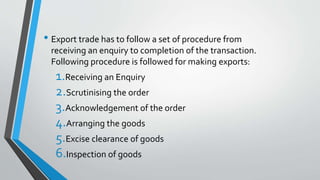
• Export trade has to follow a set of procedure from
receiving an enquiry to completion of the transaction.
Following procedure is followed for making exports:
1.Receiving an Enquiry
2.Scrutinising the order
3.Acknowledgement of the order
4.Arranging the goods
5.Excise clearance of goods
6.Inspection of goods
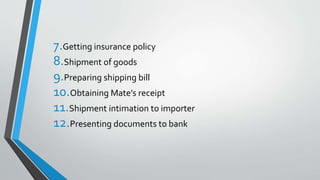
7.Getting insurance policy
8.Shipment of goods
9.Preparing shipping bill
10.Obtaining Mate’s receipt
11.Shipment intimation to importer
12.Presenting documents to bank
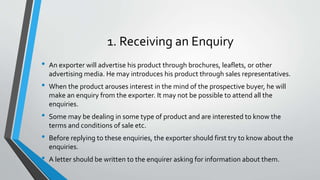
1. Receiving an Enquiry
• An exporter will advertise his product through brochures, leaflets, or other
advertising media. He may introduces his product through sales representatives.
• When the product arouses interest in the mind of the prospective buyer, he will
make an enquiry from the exporter. It may not be possible to attend all the
enquiries.
• Some may be dealing in some type of product and are interested to know the
terms and conditions of sale etc.
• Before replying to these enquiries, the exporter should first try to know about the
enquiries.
• A letter should be written to the enquirer asking for information about them.
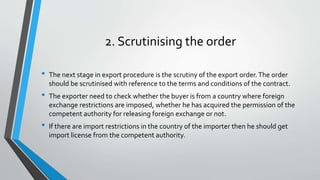
2. Scrutinising the order
• The next stage in export procedure is the scrutiny of the export order.The order
should be scrutinised with reference to the terms and conditions of the contract.
• The exporter need to check whether the buyer is from a country where foreign
exchange restrictions are imposed, whether he has acquired the permission of the
competent authority for releasing foreign exchange or not.
• If there are import restrictions in the country of the importer then he should get
import license from the competent authority.
3. Acknowledgement of the order
• After scrutiny of the order, it should be acknowledged if everything is as per
decided terms and conditions. If the importer is an old customer then there
will not be any hitch in confirming the order because credit limits, etc. will
already be in operation and he will comply with the conditions of foreign
exchange and import license at the first instance.
• The confirmation of the order should contain the following information:
• Acknowledging the receipt of the order with thanks.
• The likely dates if dispatch of goods from the factory and the seaboard.
• If there is any variation in price from the one given in the order by giving sound
explanation for the same.
• Mode of shipment of the goods.
• Method of packing
• Packing marks which will be used while sending the goods.
• The name of the bank which will be used for collecting the draft.
These information will enable the importer to plan the receipt of goods and arranging for
payments in a specific period of time.
4. Arranging the goods
• As soon as the order is confirmed, efforts should be made to arrange the
goods. A manufacturer exporter will issue an indent to the Factory Manager
orWorks Manager giving details of goods to be supplied, the time when
goods should be ready and date of shipment, etc.
5. Excise Clearance for Goods
• If the goods are excisable, there are two methods of getting the goods
cleared. One method is that whenever the goods are to be removed for
export, the excise duty is paid by the exporter. Later when the goods are
exported a claim is made for refund of excise duty.
• Second method is to fill a bond in form B-I (General Security) or from B-I
(General Surety).The duty is not paid in this case.The bond is discharged
when the goods are exported.
6. Inspection of goods
• The government of India has introduced a compulsory preshipment inspection of
selected goods of export in order to ensure their high quality.
• Under this scheme the exporter makes an application in the prescribed form to the
Export Inspection Agency (EIA) with the following documents:
• A copy of the commercial invoice
• A draft for the necessary fees for inspection
• A copy of export contract
• Declaration of the importer’s technical specifications of quality or a sample approved by the
importer in support of the declaration of specifications.
• The application for inspection is made well in time before the date of
shipment. An inspector is deputed by the inspecting agency to inspect the
export consignment. If the goods conform to prescribed specifications, and
inspection certificate is issued.The goods are then dispatched to the port of
shipment.
• Under the new Exim Policy pre-shipment inspection for export houses and
large houses stands withdrawn. However small units are still subjected to
inspection.
7. Getting insurance policy
• After getting a certificate of inspection the exporter applies for insurance
cover or policy as the case may be. CIF value plus 10 percent to cover
expenses.
8. Shipment of goods
• The exporter has the option of using sea or air route to send the goods. A
decision is taken depending upon the volume and weight of goods and
amount of freight involved. When goods are to be sent by sea then these are
sent to the concerned port. A number of formalities are to be performed
upto the time the goods are boarded on ship. For this purpose the services
of clearing and forwarding agents are used.
• These agents are supplied the following documents:
• Commercial invoice
• Original export order
• Original letter of credit
• GR-I form showing exporter’s code number
• AR-4 form in original and in duplicate
• Excise gate pass in original
• Certificate of inspection
• Declaration form
• Packing andWeight lists
• Railway receipt
9. Preparing shipping bill
• On the basis of railway receipt the clearing and forwarding agent takes
delivery of the goods and arranges their storage in a warehouse.The agent
prepares the requisite copies of the shipping bill.
• The shipping bill incorporates the following information
• Name and address of the importer
• Vessel’s name and rotation number
• Agent’s name
• Port
• Final destination
• Exporter’s name and address
• Number of packages
• Marks on packages
• Gross and Net Weight
• Description of goods
• RealValue
• Country of Origin
• Code number of goods
• Number and date of GR form, AR-4 form etc
• Export licence number
10. Obtaining Mate’s Receipt
• After the clearance of goods by the customs authorities the cargo is loaded
in the ship.The Mate’s receipt is signed by the captain of the ship or his
agent indicating that goods have been received on the board.The mate’s
receipt is delivered to the port commissioner’s shed.The clearing and
forwarding agent pays the dock dues and obtain mate’s receipt. The mate’s
receipt is presented to the shipping company and requisite copies of Bill of
lading are obtained by the agent.
11. Shipment intimation to Importer
• After the receipt of various documents from clearing and forwarding agent
an intimation of shipment is sent to the importer.The intimation contains
the date of despatch of goods, name of the ship etc.The exporter also sends
• Non-negotiable copy of bill of lading
• Master document copy
12. Presenting documents to Bank
• Once the goods have been sent, the exporter should arrange to obtain his
payment for the exports by submitting relevant documents to the bank.The
process of submitting documents and obtaining payments is known as
‘negotiating the documents’.The bank examines the documents with
reference to the terms and conditions of the original letter of credit.

Procedure for export

  • 1.
  • 2.
    • Export tradehas to follow a set of procedure from receiving an enquiry to completion of the transaction. Following procedure is followed for making exports: 1.Receiving an Enquiry 2.Scrutinising the order 3.Acknowledgement of the order 4.Arranging the goods 5.Excise clearance of goods 6.Inspection of goods
  • 3.
    7.Getting insurance policy 8.Shipmentof goods 9.Preparing shipping bill 10.Obtaining Mate’s receipt 11.Shipment intimation to importer 12.Presenting documents to bank
  • 4.
    1. Receiving anEnquiry • An exporter will advertise his product through brochures, leaflets, or other advertising media. He may introduces his product through sales representatives. • When the product arouses interest in the mind of the prospective buyer, he will make an enquiry from the exporter. It may not be possible to attend all the enquiries. • Some may be dealing in some type of product and are interested to know the terms and conditions of sale etc. • Before replying to these enquiries, the exporter should first try to know about the enquiries. • A letter should be written to the enquirer asking for information about them.
  • 5.
    2. Scrutinising theorder • The next stage in export procedure is the scrutiny of the export order.The order should be scrutinised with reference to the terms and conditions of the contract. • The exporter need to check whether the buyer is from a country where foreign exchange restrictions are imposed, whether he has acquired the permission of the competent authority for releasing foreign exchange or not. • If there are import restrictions in the country of the importer then he should get import license from the competent authority.
  • 6.
    3. Acknowledgement ofthe order • After scrutiny of the order, it should be acknowledged if everything is as per decided terms and conditions. If the importer is an old customer then there will not be any hitch in confirming the order because credit limits, etc. will already be in operation and he will comply with the conditions of foreign exchange and import license at the first instance.
  • 7.
    • The confirmationof the order should contain the following information: • Acknowledging the receipt of the order with thanks. • The likely dates if dispatch of goods from the factory and the seaboard. • If there is any variation in price from the one given in the order by giving sound explanation for the same. • Mode of shipment of the goods. • Method of packing • Packing marks which will be used while sending the goods. • The name of the bank which will be used for collecting the draft. These information will enable the importer to plan the receipt of goods and arranging for payments in a specific period of time.
  • 8.
    4. Arranging thegoods • As soon as the order is confirmed, efforts should be made to arrange the goods. A manufacturer exporter will issue an indent to the Factory Manager orWorks Manager giving details of goods to be supplied, the time when goods should be ready and date of shipment, etc.
  • 9.
    5. Excise Clearancefor Goods • If the goods are excisable, there are two methods of getting the goods cleared. One method is that whenever the goods are to be removed for export, the excise duty is paid by the exporter. Later when the goods are exported a claim is made for refund of excise duty. • Second method is to fill a bond in form B-I (General Security) or from B-I (General Surety).The duty is not paid in this case.The bond is discharged when the goods are exported.
  • 10.
    6. Inspection ofgoods • The government of India has introduced a compulsory preshipment inspection of selected goods of export in order to ensure their high quality. • Under this scheme the exporter makes an application in the prescribed form to the Export Inspection Agency (EIA) with the following documents: • A copy of the commercial invoice • A draft for the necessary fees for inspection • A copy of export contract • Declaration of the importer’s technical specifications of quality or a sample approved by the importer in support of the declaration of specifications.
  • 11.
    • The applicationfor inspection is made well in time before the date of shipment. An inspector is deputed by the inspecting agency to inspect the export consignment. If the goods conform to prescribed specifications, and inspection certificate is issued.The goods are then dispatched to the port of shipment. • Under the new Exim Policy pre-shipment inspection for export houses and large houses stands withdrawn. However small units are still subjected to inspection.
  • 12.
    7. Getting insurancepolicy • After getting a certificate of inspection the exporter applies for insurance cover or policy as the case may be. CIF value plus 10 percent to cover expenses.
  • 13.
    8. Shipment ofgoods • The exporter has the option of using sea or air route to send the goods. A decision is taken depending upon the volume and weight of goods and amount of freight involved. When goods are to be sent by sea then these are sent to the concerned port. A number of formalities are to be performed upto the time the goods are boarded on ship. For this purpose the services of clearing and forwarding agents are used.
  • 14.
    • These agentsare supplied the following documents: • Commercial invoice • Original export order • Original letter of credit • GR-I form showing exporter’s code number • AR-4 form in original and in duplicate • Excise gate pass in original • Certificate of inspection • Declaration form • Packing andWeight lists • Railway receipt
  • 15.
    9. Preparing shippingbill • On the basis of railway receipt the clearing and forwarding agent takes delivery of the goods and arranges their storage in a warehouse.The agent prepares the requisite copies of the shipping bill.
  • 16.
    • The shippingbill incorporates the following information • Name and address of the importer • Vessel’s name and rotation number • Agent’s name • Port • Final destination • Exporter’s name and address • Number of packages • Marks on packages • Gross and Net Weight • Description of goods • RealValue • Country of Origin • Code number of goods • Number and date of GR form, AR-4 form etc • Export licence number
  • 17.
    10. Obtaining Mate’sReceipt • After the clearance of goods by the customs authorities the cargo is loaded in the ship.The Mate’s receipt is signed by the captain of the ship or his agent indicating that goods have been received on the board.The mate’s receipt is delivered to the port commissioner’s shed.The clearing and forwarding agent pays the dock dues and obtain mate’s receipt. The mate’s receipt is presented to the shipping company and requisite copies of Bill of lading are obtained by the agent.
  • 18.
    11. Shipment intimationto Importer • After the receipt of various documents from clearing and forwarding agent an intimation of shipment is sent to the importer.The intimation contains the date of despatch of goods, name of the ship etc.The exporter also sends • Non-negotiable copy of bill of lading • Master document copy
  • 19.
    12. Presenting documentsto Bank • Once the goods have been sent, the exporter should arrange to obtain his payment for the exports by submitting relevant documents to the bank.The process of submitting documents and obtaining payments is known as ‘negotiating the documents’.The bank examines the documents with reference to the terms and conditions of the original letter of credit.