

processing of an
export order
04/09/2012
Dear MIB ians
Lets have some basic
talk on Export order
and how it can be
processed
EXPORT ORDER !
 Export order is a document communicating decision of the
importer to purchase certain items from the exporter
 Export order represents an offer to sell´ by the exporter
and its acceptance´ by the importer.
 Exchange of promises by the parties to the agreement.
 Every set of promises forms part of consideration for each
other.
 The export order could be written in a proper legal format
or it could as well be evidenced by the exchange of
letters between the parties
Do you know what is contract??
 if yes, what are the differences
between domestic and
international contract?
Can you throw some illustrations ?
Lets have look at ‘ Birth and Death
of an contract!!!
What is export order???
•Is that the origin point
of contract??
•What's is your
answer??
How to name it !!!!
Export order
Export agreement
Export contract
Sales contract
Purchase order
Buying contract
How to secure it ?
Exporter locates a trade enquiry
Visits to websites of either party by other party
Participation in trade fairs by either party
Visits to trade fairs by either party
Business promotion visits
Contacts through marketing agents
SECURE………..
 Contacts through buying agent in the exporter’s country
 Exporter’s retail outlets in a foreign country
 Circulation of the trade enquiry by the trade promotion bodies
like:
 India Trade Promotion Organization
 Chambers of Commerce
 Export Promotion Councils
 Commodity Boards
Pre-purchase order process
 On receipt of trade enquiry, the exporter sends to importer:
 Company profile
 Product profile
 Promotional literature
 Product range
 The importer may like to have additional information which will
be arranged by the exporter
 The exporter will send the quotations for the products specified
by the importer.
• Such quotation includes details such as FOB Price, mode
of payment, photographs of the items, likely delivery time,
technical details of the products.
• Process of negotiation on each of the specifications, terms
& conditions
• Exporter sends proforma invoice
• containing all the above details as per the negotiations.
• Once Proforma invoice is approved by both the parties the
same will become Purchase Order
• The Export order need not be in the shape of proforma
invoice but can be by virtue of letters exchanged.
Terms and conditions of ‘E/O’
• The following are the standard clauses of an export order but
may vary based on the requirements
• Description of goods
• Quantity
• Quality specifications
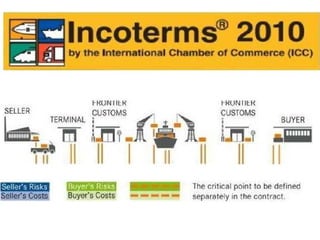
• Unit price: FOB / CIF etc as per
INCOTERMS( Updated)
• Payment terms :
• Sight Payment
• Acceptance & Payment
• Differed Payment
• Letter of Credit
• Advance Payment
Mode of shipment: Air / Sea / Road / Post
Port of shipment (discharge)
Port of delivery (destination)
Type of shipment: Direct / Trans-shipment
Last date for shipment
Partial shipments permitted / not permitted
Delivery terms
Shipping Marks
Insurance: By exporter / importer
Insurance clauses to be covered
Packing, labeling requirements
Prep-shipment inspection
Cost escalation clauses
Force Majeure clauses: Clause providing for
excuse of non- performance due to acts of God
Arbitration clause
Fines / Penalties
Jurisdiction clause : Applicability of Law
Documents required
Arrange for license / quota
o In case of restricted items exporter has to obtain the license
from the competent licensing authority
o Certain conditions are to be complied with by the
exporter before shipment in case of certain items which are
included in Appendix I to Schedule 2 (Export Policy) as
given in ITC(HS) Classification of Import-Export Items.
o Any lapse on the part of exporter either will delay in
shipment which may not be acceptable to importer or may
not export at all.
o Application for export license should be submitted to DGFT
in the prescribed form as given in the Hand book
of Procedures Vol .I
Team to execute E/ O’
Production
Procurement
Finance
Shipping
Quality control
Inspection
How about logistics ???
Terms of supply
Financial strength
Technical capability
Management
R & D facility
Planning for import of input material
Sources of import material
Imports restrictions if any>>>
Procurement of input material
• Locating sources of input material
Domestic
International/ imported.
• Selection of the supplier
• Reliability
• Production capacity of the supplier
• Reputation of the supplier
Developing logistics to the export order
Determination of the materials / input material
required
Making arrangement for the procurement of input
material
Arrangement for Pre-shipment finance
Labeling, Packaging and marking of the input material
Arranging for pre-shipment inspection of input
material
Complying with statutory pre-shipment formalities
Appointing the clearing and forwarding agents
Preparing Pre-shipment documents
Compliance with exchange control mechanism
Anything else ?????
Commercial invoice
Consular Invoice / Visaed invoice / Customs
invoice
Bill of lading / Airway bill / Postal receipt / Courier
receipt
Certificate of origin / GSP certificate
Packing list
Insurance Policy / Insurance Cover note
Pre-shipment inspection certificate Number of
copies in addition to Original or otherwise are to be
indicated. Terms / documents are to be specific
and vague terms should be avoided
Follow up with the supplier /
Manufacturer of input material
Reservation of shipping space
Production
Shipment of goods
Post shipment finance ..
23
NEGOTIATION OF SHIPPINGNEGOTIATION OF SHIPPING
DOCUMENTSDOCUMENTS
Instructions for Opening a Letter of Credit
Examination of a Letter of Credit
Common Discrepancies
Negotiation with Discrepancies
Documents for Negotiation
Presentation of Documents
24
NegotiationNegotiation
Negotiation means the purchase by the nominated
(negotiating) bank of drafts and shipping
documents under a complying presentation by
advancing or agreeing to advance funds to the
beneficiary
An exporter presents a draft (a bill of exchange) and
shipping documents specified in the letter of credit
to a nominated bank or any bank if there is no
nominated bank, which becomes a negotiating
bank, to get paid.
25
Instructions for Opening a LetterInstructions for Opening a Letter
of Creditof Credit
Items usually included in the instructions to open an L/C.
(1) An Irrevocable letter of credit subject to the UCP of the latest
version; UCP No. 600 (2007 Revision)
(2) Whether the L/C is to be confirmed by a U.S. bank or not.
(3) The name and address of the beneficiary: in favor of exporter.
(4) Whether the L/C is to be transferable or not
(5) Terms of payment such as at sight or usance
(6) Where negotiation or payment is to be effected
26
Instructions for Opening a LetterInstructions for Opening a Letter
of Creditof Credit
(7) Whether the payment is to be made in U.S. dollars or other
foreign currency
(8) What trade terms are to be used: FOB, CFR or CIF?
(9) Coverage of marine insurance: Institute Cargo
Clauses (A) (Similar to All Risks), (B) (Similar to WA), (C) (Similar to
FPA), or any special coverage such as a rejection clause
(10) Documents to be required for negotiation
Commercial invoice
Packing list
Marine insurance policy or certificate
Ocean bill of lading
Other documents specified in the L/C
27
Instructions for Opening a LetterInstructions for Opening a Letter
of Creditof Credit
(11) Whether partial shipments are allowed or
not
(12) Whether transshipments are allowed or
prohibited
(13) Presentation period/date: A period of time
for presentation of documents after shipment
(14) Ports of loading and unloading
(15) The latest shipment date
(16) The expiry date
28
Examination of a Letter of CreditExamination of a Letter of Credit
When a letter of credit is received, exporter must:
(1)Examine the conditions and documents specified in
the L/C and determine whether he can meet them or
not.
(2) If there are any conditions he cannot meet, request
his buyer to amend the L/C as ap before he starts
manufacturing export goods.
(3) If the L/C calls for a time draft, have the L/C specify
that the discount interest for the time draft shall be
for account of accountee (importer), when agreement
was a sight draft but L/C is opened with a time draft
(4) Hold off shipping the order until he receives an
amendments to the L/C as requested.
29
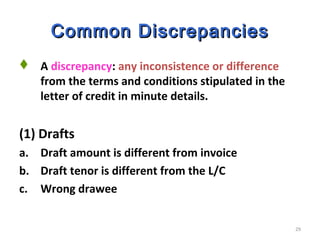
Common DiscrepanciesCommon Discrepancies
 A discrepancy: any inconsistence or difference
from the terms and conditions stipulated in the
letter of credit in minute details.
(1) Drafts
a. Draft amount is different from invoice
b. Draft tenor is different from the L/C
c. Wrong drawee
30
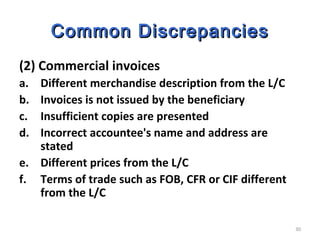
Common DiscrepanciesCommon Discrepancies
(2) Commercial invoices
a. Different merchandise description from the L/C
b. Invoices is not issued by the beneficiary
c. Insufficient copies are presented
d. Incorrect accountee's name and address are
stated
e. Different prices from the L/C
f. Terms of trade such as FOB, CFR or CIF different
from the L/C
31
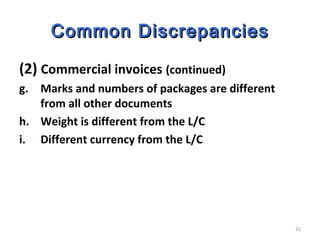
Common DiscrepanciesCommon Discrepancies
(2) Commercial invoices (continued)
g. Marks and numbers of packages are different
from all other documents
h. Weight is different from the L/C
i. Different currency from the L/C
32
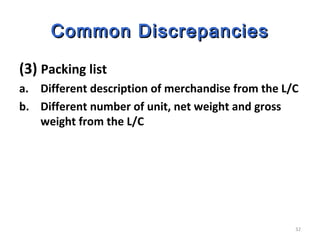
Common DiscrepanciesCommon Discrepancies
(3) Packing list
a. Different description of merchandise from the L/C
b. Different number of unit, net weight and gross
weight from the L/C
33
Common DiscrepanciesCommon Discrepancies
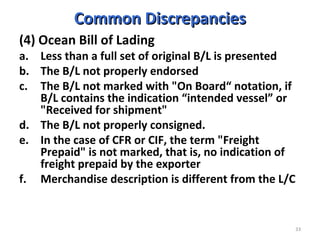
(4) Ocean Bill of Lading
a. Less than a full set of original B/L is presented
b. The B/L not properly endorsed
c. The B/L not marked with "On Board“ notation, if
B/L contains the indication “intended vessel” or
"Received for shipment"
d. The B/L not properly consigned.
e. In the case of CFR or CIF, the term "Freight
Prepaid" is not marked, that is, no indication of
freight prepaid by the exporter
f. Merchandise description is different from the L/C
34
Common Discrepancies
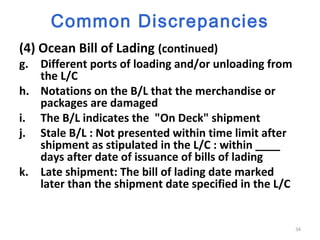
(4) Ocean Bill of Lading (continued)
g. Different ports of loading and/or unloading from
the L/C
h. Notations on the B/L that the merchandise or
packages are damaged
i. The B/L indicates the "On Deck" shipment
j. Stale B/L : Not presented within time limit after
shipment as stipulated in the L/C : within ____
days after date of issuance of bills of lading
k. Late shipment: The bill of lading date marked
later than the shipment date specified in the L/C
35
Common DiscrepanciesCommon Discrepancies
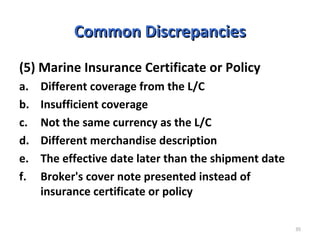
(5) Marine Insurance Certificate or Policy
a. Different coverage from the L/C
b. Insufficient coverage
c. Not the same currency as the L/C
d. Different merchandise description
e. The effective date later than the shipment date
f. Broker's cover note presented instead of
insurance certificate or policy
36
Common DiscrepanciesCommon Discrepancies
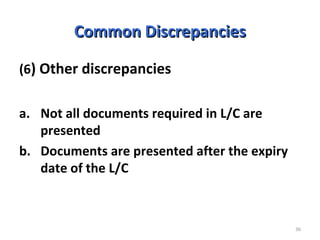
(6) Other discrepancies
a. Not all documents required in L/C are
presented
b. Documents are presented after the expiry
date of the L/C
37
Negotiation withNegotiation with
DiscrepanciesDiscrepancies In case discrepancies are found by negotiating bank,
exporter must correct the discrepancies.
 If exporter cannot correct them such as the shipping date,
then exporter should
(1) request the issuing bank to amend the letter of credit to
cover discrepancies or authorize to pay in lieu of
discrepancies
(2) At the same time, inform the buyer of the discrepancies
and request his acceptance and amendment to the Letter
of Credit.
(3) Release shipping documents to issuing bank after the L/C
is amended. Buyer’s acceptance of discrepancies are not
enough. The Letter of Credit must be amended.
(4) Do not send the shipping documents to the issuing bank
on a collection basis.
38
Documents for NegotiationDocuments for Negotiation
Depend on the stipulation in the letter of
credit.
 Exporter must present all documents specified in
the letter of credit for negotiation.
 Any missing document or incorrect document
becomes a discrepancy.
 Issuing bank of the L/C has under no circumstances
an obligation to honor the draft and shipping
documents with discrepancies.
39
Documents for NegotiationDocuments for Negotiation
Common documents used in the international trade
accompanying exporter’s Draft (Bill of Exchange)
(1) Commercial Invoice
(2) Packing List
(3) Ocean Bill of Lading
(4) Marine Insurance Certificate
(5) Any other documents if required by the L/C
• Certificate of Country Origin
• Consular Invoice
• Inspection Certificate
• Beneficiary's statement
40
Presentation of DocumentsPresentation of Documents
Draft and all shipping documents must be
presented to a negotiating bank together with the
original letter of credit.
Presentation must be made within a specified
period of time after shipment in the L/C, but not
later than 21 days after shipment
A bank must determine whether or not
presentation is a complying presentation in 5
banking days
41
Presentation of DocumentsPresentation of Documents
If a nominated (negotiating) bank, a
confirming bank, if any, or the issuing bank
determines that a presentation does not
comply,
 it may refuse to honor or negotiate, then
 it must give a single notice to presenter no later
than the close of the 5th
banking days.
42
Presentation of DocumentsPresentation of Documents
The notice must state
 The bank is refusing to honor or negotiate
 Each discrepancy
 The bank’s disposal of shipping documents:
• The bank is holding documents pending instructions
from the presenter or
• The issuing bank is holding documents until it receives
a waiver from the applicant & agrees to accept it or
• The bank is returning documents or
• The bank is acting according to the previous
instructions from the presenter.
43
Presentation of DocumentsPresentation of Documents
 If a bank does not follow these negotiation and notice
provisions,
• The bank cannot claim that the documents do not
constitute a complying presentation.
• The bank must honor or negotiate.
 A document presented but not required by the Credit will be
disregarded.
 If a Credit contains a condition without stipulating the
document to indicate compliance with the condition,
• Banks will deem such condition not stated and will
disregard it.
Processing of export order on 4 09 12

Processing of export order on 4 09 12

  • 1.
    processing of an exportorder 04/09/2012
  • 2.
    Dear MIB ians Letshave some basic talk on Export order and how it can be processed
  • 3.
    EXPORT ORDER ! Export order is a document communicating decision of the importer to purchase certain items from the exporter  Export order represents an offer to sell´ by the exporter and its acceptance´ by the importer.  Exchange of promises by the parties to the agreement.  Every set of promises forms part of consideration for each other.  The export order could be written in a proper legal format or it could as well be evidenced by the exchange of letters between the parties
  • 4.
    Do you knowwhat is contract??  if yes, what are the differences between domestic and international contract? Can you throw some illustrations ? Lets have look at ‘ Birth and Death of an contract!!!
  • 5.
    What is exportorder??? •Is that the origin point of contract?? •What's is your answer??
  • 6.
    How to nameit !!!! Export order Export agreement Export contract Sales contract Purchase order Buying contract
  • 7.
    How to secureit ? Exporter locates a trade enquiry Visits to websites of either party by other party Participation in trade fairs by either party Visits to trade fairs by either party Business promotion visits Contacts through marketing agents
  • 8.
    SECURE………..  Contacts throughbuying agent in the exporter’s country  Exporter’s retail outlets in a foreign country  Circulation of the trade enquiry by the trade promotion bodies like:  India Trade Promotion Organization  Chambers of Commerce  Export Promotion Councils  Commodity Boards
  • 9.
    Pre-purchase order process On receipt of trade enquiry, the exporter sends to importer:  Company profile  Product profile  Promotional literature  Product range  The importer may like to have additional information which will be arranged by the exporter  The exporter will send the quotations for the products specified by the importer.
  • 10.
    • Such quotationincludes details such as FOB Price, mode of payment, photographs of the items, likely delivery time, technical details of the products. • Process of negotiation on each of the specifications, terms & conditions • Exporter sends proforma invoice • containing all the above details as per the negotiations. • Once Proforma invoice is approved by both the parties the same will become Purchase Order • The Export order need not be in the shape of proforma invoice but can be by virtue of letters exchanged.
  • 11.
    Terms and conditionsof ‘E/O’ • The following are the standard clauses of an export order but may vary based on the requirements • Description of goods • Quantity • Quality specifications • Unit price: FOB / CIF etc as per INCOTERMS( Updated) • Payment terms : • Sight Payment • Acceptance & Payment • Differed Payment • Letter of Credit • Advance Payment
  • 12.
    Mode of shipment:Air / Sea / Road / Post Port of shipment (discharge) Port of delivery (destination) Type of shipment: Direct / Trans-shipment Last date for shipment Partial shipments permitted / not permitted Delivery terms Shipping Marks Insurance: By exporter / importer Insurance clauses to be covered
  • 13.
    Packing, labeling requirements Prep-shipmentinspection Cost escalation clauses Force Majeure clauses: Clause providing for excuse of non- performance due to acts of God Arbitration clause Fines / Penalties Jurisdiction clause : Applicability of Law Documents required
  • 14.
    Arrange for license/ quota o In case of restricted items exporter has to obtain the license from the competent licensing authority o Certain conditions are to be complied with by the exporter before shipment in case of certain items which are included in Appendix I to Schedule 2 (Export Policy) as given in ITC(HS) Classification of Import-Export Items. o Any lapse on the part of exporter either will delay in shipment which may not be acceptable to importer or may not export at all. o Application for export license should be submitted to DGFT in the prescribed form as given in the Hand book of Procedures Vol .I
  • 16.
    Team to executeE/ O’ Production Procurement Finance Shipping Quality control Inspection
  • 17.
    How about logistics??? Terms of supply Financial strength Technical capability Management R & D facility Planning for import of input material Sources of import material Imports restrictions if any>>>
  • 18.
    Procurement of inputmaterial • Locating sources of input material Domestic International/ imported. • Selection of the supplier • Reliability • Production capacity of the supplier • Reputation of the supplier
  • 19.
    Developing logistics tothe export order Determination of the materials / input material required Making arrangement for the procurement of input material Arrangement for Pre-shipment finance Labeling, Packaging and marking of the input material Arranging for pre-shipment inspection of input material Complying with statutory pre-shipment formalities Appointing the clearing and forwarding agents Preparing Pre-shipment documents Compliance with exchange control mechanism
  • 20.
    Anything else ????? Commercialinvoice Consular Invoice / Visaed invoice / Customs invoice Bill of lading / Airway bill / Postal receipt / Courier receipt Certificate of origin / GSP certificate Packing list Insurance Policy / Insurance Cover note Pre-shipment inspection certificate Number of copies in addition to Original or otherwise are to be indicated. Terms / documents are to be specific and vague terms should be avoided
  • 21.
    Follow up withthe supplier / Manufacturer of input material Reservation of shipping space Production Shipment of goods Post shipment finance ..
  • 23.
    23 NEGOTIATION OF SHIPPINGNEGOTIATIONOF SHIPPING DOCUMENTSDOCUMENTS Instructions for Opening a Letter of Credit Examination of a Letter of Credit Common Discrepancies Negotiation with Discrepancies Documents for Negotiation Presentation of Documents
  • 24.
    24 NegotiationNegotiation Negotiation means thepurchase by the nominated (negotiating) bank of drafts and shipping documents under a complying presentation by advancing or agreeing to advance funds to the beneficiary An exporter presents a draft (a bill of exchange) and shipping documents specified in the letter of credit to a nominated bank or any bank if there is no nominated bank, which becomes a negotiating bank, to get paid.
  • 25.
    25 Instructions for Openinga LetterInstructions for Opening a Letter of Creditof Credit Items usually included in the instructions to open an L/C. (1) An Irrevocable letter of credit subject to the UCP of the latest version; UCP No. 600 (2007 Revision) (2) Whether the L/C is to be confirmed by a U.S. bank or not. (3) The name and address of the beneficiary: in favor of exporter. (4) Whether the L/C is to be transferable or not (5) Terms of payment such as at sight or usance (6) Where negotiation or payment is to be effected
  • 26.
    26 Instructions for Openinga LetterInstructions for Opening a Letter of Creditof Credit (7) Whether the payment is to be made in U.S. dollars or other foreign currency (8) What trade terms are to be used: FOB, CFR or CIF? (9) Coverage of marine insurance: Institute Cargo Clauses (A) (Similar to All Risks), (B) (Similar to WA), (C) (Similar to FPA), or any special coverage such as a rejection clause (10) Documents to be required for negotiation Commercial invoice Packing list Marine insurance policy or certificate Ocean bill of lading Other documents specified in the L/C
  • 27.
    27 Instructions for Openinga LetterInstructions for Opening a Letter of Creditof Credit (11) Whether partial shipments are allowed or not (12) Whether transshipments are allowed or prohibited (13) Presentation period/date: A period of time for presentation of documents after shipment (14) Ports of loading and unloading (15) The latest shipment date (16) The expiry date
  • 28.
    28 Examination of aLetter of CreditExamination of a Letter of Credit When a letter of credit is received, exporter must: (1)Examine the conditions and documents specified in the L/C and determine whether he can meet them or not. (2) If there are any conditions he cannot meet, request his buyer to amend the L/C as ap before he starts manufacturing export goods. (3) If the L/C calls for a time draft, have the L/C specify that the discount interest for the time draft shall be for account of accountee (importer), when agreement was a sight draft but L/C is opened with a time draft (4) Hold off shipping the order until he receives an amendments to the L/C as requested.
  • 29.
    29 Common DiscrepanciesCommon Discrepancies A discrepancy: any inconsistence or difference from the terms and conditions stipulated in the letter of credit in minute details. (1) Drafts a. Draft amount is different from invoice b. Draft tenor is different from the L/C c. Wrong drawee
  • 30.
    30 Common DiscrepanciesCommon Discrepancies (2)Commercial invoices a. Different merchandise description from the L/C b. Invoices is not issued by the beneficiary c. Insufficient copies are presented d. Incorrect accountee's name and address are stated e. Different prices from the L/C f. Terms of trade such as FOB, CFR or CIF different from the L/C
  • 31.
    31 Common DiscrepanciesCommon Discrepancies (2)Commercial invoices (continued) g. Marks and numbers of packages are different from all other documents h. Weight is different from the L/C i. Different currency from the L/C
  • 32.
    32 Common DiscrepanciesCommon Discrepancies (3)Packing list a. Different description of merchandise from the L/C b. Different number of unit, net weight and gross weight from the L/C
  • 33.
    33 Common DiscrepanciesCommon Discrepancies (4)Ocean Bill of Lading a. Less than a full set of original B/L is presented b. The B/L not properly endorsed c. The B/L not marked with "On Board“ notation, if B/L contains the indication “intended vessel” or "Received for shipment" d. The B/L not properly consigned. e. In the case of CFR or CIF, the term "Freight Prepaid" is not marked, that is, no indication of freight prepaid by the exporter f. Merchandise description is different from the L/C
  • 34.
    34 Common Discrepancies (4) OceanBill of Lading (continued) g. Different ports of loading and/or unloading from the L/C h. Notations on the B/L that the merchandise or packages are damaged i. The B/L indicates the "On Deck" shipment j. Stale B/L : Not presented within time limit after shipment as stipulated in the L/C : within ____ days after date of issuance of bills of lading k. Late shipment: The bill of lading date marked later than the shipment date specified in the L/C
  • 35.
    35 Common DiscrepanciesCommon Discrepancies (5)Marine Insurance Certificate or Policy a. Different coverage from the L/C b. Insufficient coverage c. Not the same currency as the L/C d. Different merchandise description e. The effective date later than the shipment date f. Broker's cover note presented instead of insurance certificate or policy
  • 36.
    36 Common DiscrepanciesCommon Discrepancies (6)Other discrepancies a. Not all documents required in L/C are presented b. Documents are presented after the expiry date of the L/C
  • 37.
    37 Negotiation withNegotiation with DiscrepanciesDiscrepanciesIn case discrepancies are found by negotiating bank, exporter must correct the discrepancies.  If exporter cannot correct them such as the shipping date, then exporter should (1) request the issuing bank to amend the letter of credit to cover discrepancies or authorize to pay in lieu of discrepancies (2) At the same time, inform the buyer of the discrepancies and request his acceptance and amendment to the Letter of Credit. (3) Release shipping documents to issuing bank after the L/C is amended. Buyer’s acceptance of discrepancies are not enough. The Letter of Credit must be amended. (4) Do not send the shipping documents to the issuing bank on a collection basis.
  • 38.
    38 Documents for NegotiationDocumentsfor Negotiation Depend on the stipulation in the letter of credit.  Exporter must present all documents specified in the letter of credit for negotiation.  Any missing document or incorrect document becomes a discrepancy.  Issuing bank of the L/C has under no circumstances an obligation to honor the draft and shipping documents with discrepancies.
  • 39.
    39 Documents for NegotiationDocumentsfor Negotiation Common documents used in the international trade accompanying exporter’s Draft (Bill of Exchange) (1) Commercial Invoice (2) Packing List (3) Ocean Bill of Lading (4) Marine Insurance Certificate (5) Any other documents if required by the L/C • Certificate of Country Origin • Consular Invoice • Inspection Certificate • Beneficiary's statement
  • 40.
    40 Presentation of DocumentsPresentationof Documents Draft and all shipping documents must be presented to a negotiating bank together with the original letter of credit. Presentation must be made within a specified period of time after shipment in the L/C, but not later than 21 days after shipment A bank must determine whether or not presentation is a complying presentation in 5 banking days
  • 41.
    41 Presentation of DocumentsPresentationof Documents If a nominated (negotiating) bank, a confirming bank, if any, or the issuing bank determines that a presentation does not comply,  it may refuse to honor or negotiate, then  it must give a single notice to presenter no later than the close of the 5th banking days.
  • 42.
    42 Presentation of DocumentsPresentationof Documents The notice must state  The bank is refusing to honor or negotiate  Each discrepancy  The bank’s disposal of shipping documents: • The bank is holding documents pending instructions from the presenter or • The issuing bank is holding documents until it receives a waiver from the applicant & agrees to accept it or • The bank is returning documents or • The bank is acting according to the previous instructions from the presenter.
  • 43.
    43 Presentation of DocumentsPresentationof Documents  If a bank does not follow these negotiation and notice provisions, • The bank cannot claim that the documents do not constitute a complying presentation. • The bank must honor or negotiate.  A document presented but not required by the Credit will be disregarded.  If a Credit contains a condition without stipulating the document to indicate compliance with the condition, • Banks will deem such condition not stated and will disregard it.