7. Annual Cash Flow Analysis
Dr. Mohsin Siddique
Assistant Professor
msiddique@sharjah.ac.ae
Ext: 29431
Date: 18/11/2014
Engineering Economics
University of Sharjah
Dept. of Civil and Env. Engg.
2
Part I
Outcome of Today’s Lecture
3
After completing this lecture…
The students should be able to:
Define equivalent uniform annual cost (EUAC) and Equivalent
uniform annual benefits (EUAB)
Resolve an engineering economic analysis problem into its annual
cash flow equivalent
Conduct an equivalent uniform annual worth (EUAW) analysis
for a single investment
Use EUAW, EUAC, and EUAB to compare alternatives with equal,
common multiple, or continuous lives, or over some fixed study
period.
Techniques for Cash Flow Analysis
4
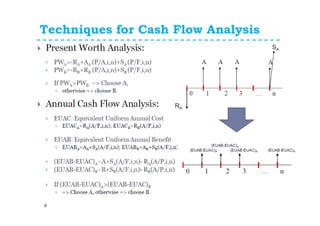
Present Worth Analysis
Annual Cash Flow Analysis
Rate of Return Analysis
Incremental Analysis
OtherTechniques:
Future Worth Analysis
Benefit-Cost Ratio Analysis
Payback Period Analysis
Annual Cash Flow Analysis
5
Concepts of Annual Cash Flow Analysis
Comparing Alternatives using Annual Cash Flow Analysis:
Same-Length Analysis Period
Different-Length Analysis Periods
Infinite-Length Analysis Period
Other Analysis Periods
Techniques for Cash Flow Analysis
6
Problem 6-1
7
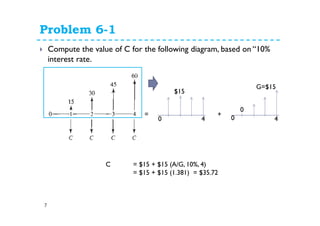
Compute the value of C for the following diagram, based on “10%
interest rate.
C = $15 + $15 (A/G, 10%, 4)
= $15 + $15 (1.381) = $35.72
0
$15
4 0
G=$15
4
0
= +
Problem 6-8
8
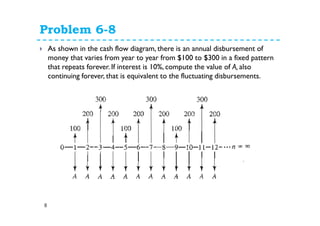
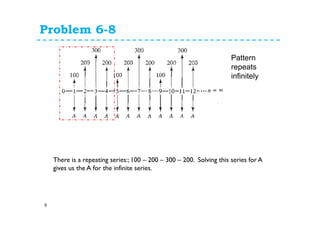
As shown in the cash flow diagram, there is an annual disbursement of
money that varies from year to year from $100 to $300 in a fixed pattern
that repeats forever. If interest is 10%, compute the value of A, also
continuing forever, that is equivalent to the fluctuating disbursements.
Problem 6-8
9
Pattern
repeats
infinitely
There is a repeating series:; 100 – 200 – 300 – 200. Solving this series for A
gives us the A for the infinite series.
Problem 6-8
10
A= $100 + [$100 (P/F, 10%, 2) + $200 (P/F, 10%, 3) + $100 (P/F, 10%, 4)] (A/P, 10%, 4)
= $100 + [$100 (0.8254) + $200 (0.7513) + $100 (0.6830)] (0.3155)
= $100 + [$301.20] (0.3155)
= $195.03
0
$100
4 0
200
4
+
100100
Annual Cash Flow Analysis
11
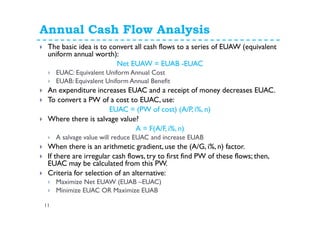
The basic idea is to convert all cash flows to a series of EUAW (equivalent
uniform annual worth):
Net EUAW = EUAB -EUAC
EUAC: Equivalent Uniform Annual Cost
EUAB: Equivalent Uniform Annual Benefit
An expenditure increases EUAC and a receipt of money decreases EUAC.
To convert a PW of a cost to EUAC, use:
EUAC = (PW of cost) (A/P, i%, n)
Where there is salvage value?
A = F(A/F, i%, n)
A salvage value will reduce EUAC and increase EUAB
When there is an arithmetic gradient, use the (A/G, i%, n) factor.
If there are irregular cash flows, try to first find PW of these flows; then,
EUAC may be calculated from this PW.
Criteria for selection of an alternative:
Maximize Net EUAW (EUAB –EUAC)
Minimize EUAC OR Maximize EUAB
Analysis Period
12
Five different analysis-period situations occur:
1.Analysis Period Equal to Alternative Lives
2.Analysis Period a Common Multiple
3.Analysis Period for a Continuing Requirement
4. Infinite Analysis Period
5. Some Other Analysis Period:
Analysis period may be equal to life of the shorter-life
alternative, the longer-life alternative, or something
different. In this case, terminal values at the end of a
specific year become very important.
Analysis Period Equal to Alternative Lives
13
We have an ideal situation (rarely the case in ‘real-life’ ):
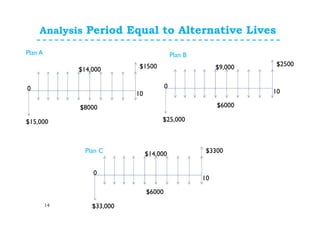
Study period = life-cycle of any of the alternatives
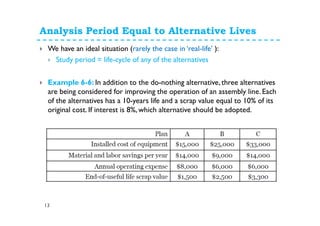
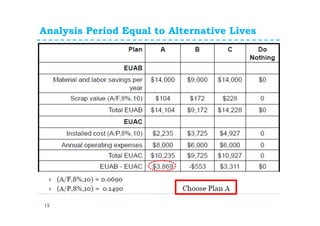
Example 6-6: In addition to the do-nothing alternative, three alternatives
are being considered for improving the operation of an assembly line. Each
of the alternatives has a 10-years life and a scrap value equal to 10% of its
original cost. If interest is 8%, which alternative should be adopted.
Analysis Period Equal to Alternative Lives
14
$6000
$25,000
$9,000 $2500
0
10
$8000
$15,000
$14,000 $1500
0
10
$6000
$33,000
$14,000 $3300
0
10
Plan A Plan B
Plan C
Analysis Period Equal to Alternative Lives
15
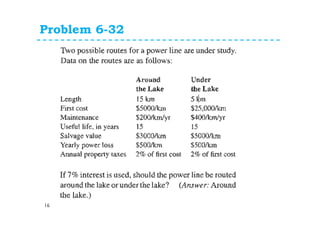
Problem 6-32
16
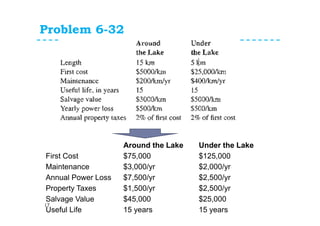
Problem 6-32
17
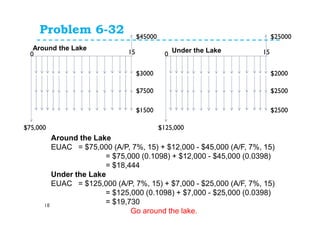
Around the Lake Under the Lake
First Cost $75,000 $125,000
Maintenance $3,000/yr $2,000/yr
Annual Power Loss $7,500/yr $2,500/yr
Property Taxes $1,500/yr $2,500/yr
Salvage Value $45,000 $25,000
Useful Life 15 years 15 years
Problem 6-32
18
0 15
$75,000
$3000
$7500
$1500
$45000
0 15
$125,000
$2000
$2500
$2500
$25000
Around the Lake Under the Lake
Around the Lake
EUAC = $75,000 (A/P, 7%, 15) + $12,000 - $45,000 (A/F, 7%, 15)
= $75,000 (0.1098) + $12,000 - $45,000 (0.0398)
= $18,444
Under the Lake
EUAC = $125,000 (A/P, 7%, 15) + $7,000 - $25,000 (A/F, 7%, 15)
= $125,000 (0.1098) + $7,000 - $25,000 (0.0398)
= $19,730
Go around the lake.
Analysis Period a Common Multiple of
Alternative Lives
19
Assume a replacement with an identical item with same cost and
performance.When the lives of two alternatives vary, one can use a
common multiple of the two lives to determine the better project.
Nevertheless, compare alternatives based on their own service lives.
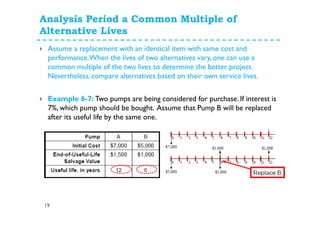
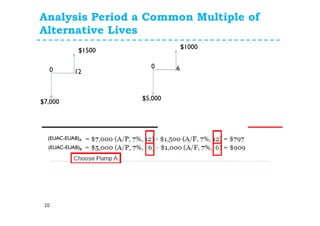
Example 6-7: Two pumps are being considered for purchase. If interest is
7%, which pump should be bought. Assume that Pump B will be replaced
after its useful life by the same one.
Analysis Period a Common Multiple of
Alternative Lives
20
(EUAC-EUAB)A
(EUAC-EUAB)B
0
$7,000
$1500
12
0
$5,000
$1000
6
Analysis Period with a Repeatability
Assumption
21
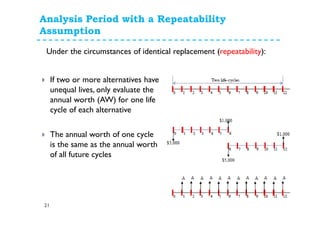
If two or more alternatives have
unequal lives, only evaluate the
annual worth (AW) for one life
cycle of each alternative
The annual worth of one cycle
is the same as the annual worth
of all future cycles
Under the circumstances of identical replacement (repeatability):
Problem 6-37
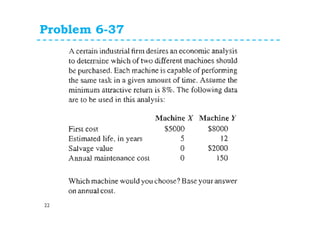
22
Problem 6-37
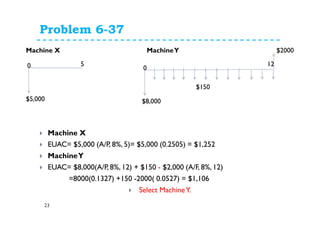
23
Machine X
EUAC= $5,000 (A/P, 8%, 5)= $5,000 (0.2505) = $1,252
MachineY
EUAC= $8,000(A/P, 8%, 12) + $150 - $2,000 (A/F, 8%, 12)
=8000(0.1327) +150 -2000( 0.0527) = $1,106
Select MachineY.
$5,000
0 5
$150
$8,000
$2000
0
12
Machine X MachineY
24
Part II
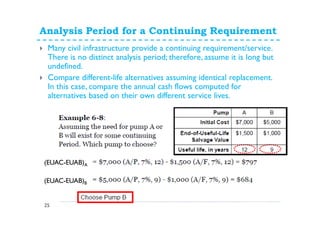
Analysis Period for a Continuing Requirement
25
Many civil infrastructure provide a continuing requirement/service.
There is no distinct analysis period; therefore, assume it is long but
undefined.
Compare different-life alternatives assuming identical replacement.
In this case, compare the annual cash flows computed for
alternatives based on their own different service lives.
(EUAC-EUAB)A
(EUAC-EUAB)B
Infinite Analysis Period
26
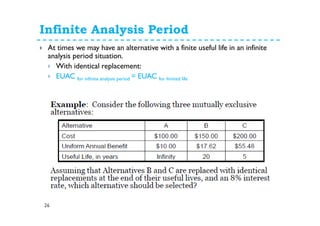
At times we may have an alternative with a finite useful life in an infinite
analysis period situation.
With identical replacement:
EUAC for infinite analysis period = EUAC for limited life
Infinite Analysis Period
27
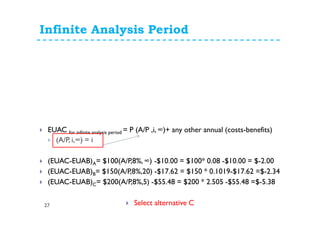
EUAC for infinite analysis period = P (A/P ,i, ∞)+ any other annual (costs-benefits)
(A/P, i,∞) = i
(EUAC-EUAB)A= $100(A/P,8%, ∞) -$10.00 = $100* 0.08 -$10.00 = $-2.00
(EUAC-EUAB)B= $150(A/P,8%,20) -$17.62 = $150 * 0.1019-$17.62 =$-2.34
(EUAC-EUAB)C= $200(A/P,8%,5) -$55.48 = $200 * 2.505 -$55.48 =$-5.38
Select alternative C
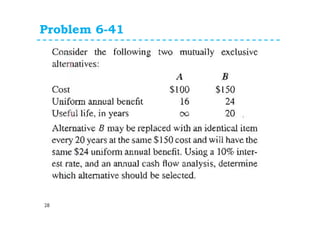
Problem 6-41
28
Problem 6-41
29
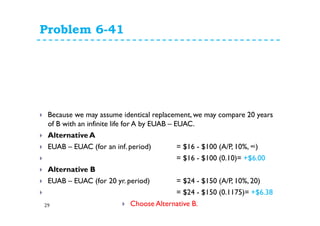
Because we may assume identical replacement, we may compare 20 years
of B with an infinite life for A by EUAB – EUAC.
Alternative A
EUAB – EUAC (for an inf. period) = $16 - $100 (A/P, 10%, ∞)
= $16 - $100 (0.10)= +$6.00
Alternative B
EUAB – EUAC (for 20 yr. period) = $24 - $150 (A/P, 10%, 20)
= $24 - $150 (0.1175)= +$6.38
Choose Alternative B.
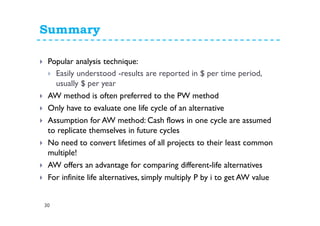
Summary
30
Popular analysis technique:
Easily understood -results are reported in $ per time period,
usually $ per year
AW method is often preferred to the PW method
Only have to evaluate one life cycle of an alternative
Assumption for AW method: Cash flows in one cycle are assumed
to replicate themselves in future cycles
No need to convert lifetimes of all projects to their least common
multiple!
AW offers an advantage for comparing different-life alternatives
For infinite life alternatives, simply multiply P by i to get AW value
Assignment # 7
31
6.7, 6.16, 6.21, 6.29, 6.42
Date of Submission: _____________
Assignment should be hand written
32
ThankYou
Feel Free to Contact
msiddique@sharjah.ac.ae
Tel. +971 6 5050943 (Ext. 2943)

7. annual cash flow analysis

  • 1.
    7. Annual CashFlow Analysis Dr. Mohsin Siddique Assistant Professor msiddique@sharjah.ac.ae Ext: 29431 Date: 18/11/2014 Engineering Economics University of Sharjah Dept. of Civil and Env. Engg.
  • 2.
  • 3.
    Outcome of Today’sLecture 3 After completing this lecture… The students should be able to: Define equivalent uniform annual cost (EUAC) and Equivalent uniform annual benefits (EUAB) Resolve an engineering economic analysis problem into its annual cash flow equivalent Conduct an equivalent uniform annual worth (EUAW) analysis for a single investment Use EUAW, EUAC, and EUAB to compare alternatives with equal, common multiple, or continuous lives, or over some fixed study period.
  • 4.
    Techniques for CashFlow Analysis 4 Present Worth Analysis Annual Cash Flow Analysis Rate of Return Analysis Incremental Analysis OtherTechniques: Future Worth Analysis Benefit-Cost Ratio Analysis Payback Period Analysis
  • 5.
    Annual Cash FlowAnalysis 5 Concepts of Annual Cash Flow Analysis Comparing Alternatives using Annual Cash Flow Analysis: Same-Length Analysis Period Different-Length Analysis Periods Infinite-Length Analysis Period Other Analysis Periods
  • 6.
    Techniques for CashFlow Analysis 6
  • 7.
    Problem 6-1 7 Compute thevalue of C for the following diagram, based on “10% interest rate. C = $15 + $15 (A/G, 10%, 4) = $15 + $15 (1.381) = $35.72 0 $15 4 0 G=$15 4 0 = +
  • 8.
    Problem 6-8 8 As shownin the cash flow diagram, there is an annual disbursement of money that varies from year to year from $100 to $300 in a fixed pattern that repeats forever. If interest is 10%, compute the value of A, also continuing forever, that is equivalent to the fluctuating disbursements.
  • 9.
    Problem 6-8 9 Pattern repeats infinitely There isa repeating series:; 100 – 200 – 300 – 200. Solving this series for A gives us the A for the infinite series.
  • 10.
    Problem 6-8 10 A= $100+ [$100 (P/F, 10%, 2) + $200 (P/F, 10%, 3) + $100 (P/F, 10%, 4)] (A/P, 10%, 4) = $100 + [$100 (0.8254) + $200 (0.7513) + $100 (0.6830)] (0.3155) = $100 + [$301.20] (0.3155) = $195.03 0 $100 4 0 200 4 + 100100
  • 11.
    Annual Cash FlowAnalysis 11 The basic idea is to convert all cash flows to a series of EUAW (equivalent uniform annual worth): Net EUAW = EUAB -EUAC EUAC: Equivalent Uniform Annual Cost EUAB: Equivalent Uniform Annual Benefit An expenditure increases EUAC and a receipt of money decreases EUAC. To convert a PW of a cost to EUAC, use: EUAC = (PW of cost) (A/P, i%, n) Where there is salvage value? A = F(A/F, i%, n) A salvage value will reduce EUAC and increase EUAB When there is an arithmetic gradient, use the (A/G, i%, n) factor. If there are irregular cash flows, try to first find PW of these flows; then, EUAC may be calculated from this PW. Criteria for selection of an alternative: Maximize Net EUAW (EUAB –EUAC) Minimize EUAC OR Maximize EUAB
  • 12.
    Analysis Period 12 Five differentanalysis-period situations occur: 1.Analysis Period Equal to Alternative Lives 2.Analysis Period a Common Multiple 3.Analysis Period for a Continuing Requirement 4. Infinite Analysis Period 5. Some Other Analysis Period: Analysis period may be equal to life of the shorter-life alternative, the longer-life alternative, or something different. In this case, terminal values at the end of a specific year become very important.
  • 13.
    Analysis Period Equalto Alternative Lives 13 We have an ideal situation (rarely the case in ‘real-life’ ): Study period = life-cycle of any of the alternatives Example 6-6: In addition to the do-nothing alternative, three alternatives are being considered for improving the operation of an assembly line. Each of the alternatives has a 10-years life and a scrap value equal to 10% of its original cost. If interest is 8%, which alternative should be adopted.
  • 14.
    Analysis Period Equalto Alternative Lives 14 $6000 $25,000 $9,000 $2500 0 10 $8000 $15,000 $14,000 $1500 0 10 $6000 $33,000 $14,000 $3300 0 10 Plan A Plan B Plan C
  • 15.
    Analysis Period Equalto Alternative Lives 15
  • 16.
  • 17.
    Problem 6-32 17 Around theLake Under the Lake First Cost $75,000 $125,000 Maintenance $3,000/yr $2,000/yr Annual Power Loss $7,500/yr $2,500/yr Property Taxes $1,500/yr $2,500/yr Salvage Value $45,000 $25,000 Useful Life 15 years 15 years
  • 18.
    Problem 6-32 18 0 15 $75,000 $3000 $7500 $1500 $45000 015 $125,000 $2000 $2500 $2500 $25000 Around the Lake Under the Lake Around the Lake EUAC = $75,000 (A/P, 7%, 15) + $12,000 - $45,000 (A/F, 7%, 15) = $75,000 (0.1098) + $12,000 - $45,000 (0.0398) = $18,444 Under the Lake EUAC = $125,000 (A/P, 7%, 15) + $7,000 - $25,000 (A/F, 7%, 15) = $125,000 (0.1098) + $7,000 - $25,000 (0.0398) = $19,730 Go around the lake.
  • 19.
    Analysis Period aCommon Multiple of Alternative Lives 19 Assume a replacement with an identical item with same cost and performance.When the lives of two alternatives vary, one can use a common multiple of the two lives to determine the better project. Nevertheless, compare alternatives based on their own service lives. Example 6-7: Two pumps are being considered for purchase. If interest is 7%, which pump should be bought. Assume that Pump B will be replaced after its useful life by the same one.
  • 20.
    Analysis Period aCommon Multiple of Alternative Lives 20 (EUAC-EUAB)A (EUAC-EUAB)B 0 $7,000 $1500 12 0 $5,000 $1000 6
  • 21.
    Analysis Period witha Repeatability Assumption 21 If two or more alternatives have unequal lives, only evaluate the annual worth (AW) for one life cycle of each alternative The annual worth of one cycle is the same as the annual worth of all future cycles Under the circumstances of identical replacement (repeatability):
  • 22.
  • 23.
    Problem 6-37 23 Machine X EUAC=$5,000 (A/P, 8%, 5)= $5,000 (0.2505) = $1,252 MachineY EUAC= $8,000(A/P, 8%, 12) + $150 - $2,000 (A/F, 8%, 12) =8000(0.1327) +150 -2000( 0.0527) = $1,106 Select MachineY. $5,000 0 5 $150 $8,000 $2000 0 12 Machine X MachineY
  • 24.
  • 25.
    Analysis Period fora Continuing Requirement 25 Many civil infrastructure provide a continuing requirement/service. There is no distinct analysis period; therefore, assume it is long but undefined. Compare different-life alternatives assuming identical replacement. In this case, compare the annual cash flows computed for alternatives based on their own different service lives. (EUAC-EUAB)A (EUAC-EUAB)B
  • 26.
    Infinite Analysis Period 26 Attimes we may have an alternative with a finite useful life in an infinite analysis period situation. With identical replacement: EUAC for infinite analysis period = EUAC for limited life
  • 27.
    Infinite Analysis Period 27 EUACfor infinite analysis period = P (A/P ,i, ∞)+ any other annual (costs-benefits) (A/P, i,∞) = i (EUAC-EUAB)A= $100(A/P,8%, ∞) -$10.00 = $100* 0.08 -$10.00 = $-2.00 (EUAC-EUAB)B= $150(A/P,8%,20) -$17.62 = $150 * 0.1019-$17.62 =$-2.34 (EUAC-EUAB)C= $200(A/P,8%,5) -$55.48 = $200 * 2.505 -$55.48 =$-5.38 Select alternative C
  • 28.
  • 29.
    Problem 6-41 29 Because wemay assume identical replacement, we may compare 20 years of B with an infinite life for A by EUAB – EUAC. Alternative A EUAB – EUAC (for an inf. period) = $16 - $100 (A/P, 10%, ∞) = $16 - $100 (0.10)= +$6.00 Alternative B EUAB – EUAC (for 20 yr. period) = $24 - $150 (A/P, 10%, 20) = $24 - $150 (0.1175)= +$6.38 Choose Alternative B.
  • 30.
    Summary 30 Popular analysis technique: Easilyunderstood -results are reported in $ per time period, usually $ per year AW method is often preferred to the PW method Only have to evaluate one life cycle of an alternative Assumption for AW method: Cash flows in one cycle are assumed to replicate themselves in future cycles No need to convert lifetimes of all projects to their least common multiple! AW offers an advantage for comparing different-life alternatives For infinite life alternatives, simply multiply P by i to get AW value
  • 31.
    Assignment # 7 31 6.7,6.16, 6.21, 6.29, 6.42 Date of Submission: _____________ Assignment should be hand written
  • 32.
    32 ThankYou Feel Free toContact msiddique@sharjah.ac.ae Tel. +971 6 5050943 (Ext. 2943)