Global Cash Flow Analysis:
What, When, Why, and How
Presented by:
Chuck Nwokocha
Director of Advisory Services, Sageworks
David Matricciano
Owner, DM Analytics LLC
About Sageworks

 Financial information company that provides credit and risk management
solutions to financial institutions

 Data and applications used by thousands of financial institutions,
corporations and accounting firms across North America

 Awards
 Named to Inc. 500 list of fastest growing privately held companies in the U.S.
 Named to Deloitte’s Technology Fast 500

2
About the Presenters
 Chuck Nwokocha – Director of Advisory Services, Financial Markets –
Sageworks
 Chuck is a graduate of Harvard University, with a B.A. in Psychology with a focus in
Organizations and Economics. He began his professional career with Guardsmark, a private
security services company where he held various positions and responsibilities – in
operations, human resources, and sales, and management. He has founded two ecommerce sites, Ndekanyi.com – a social networking site for the Igbo people and
SwapU.com – a college classifieds network. Additionally, he has consulted on Marketing,
Social Media, and User-Generated content. At Sageworks, Mr. Nwokocha leads the Advisory
and Bank Consulting team, focusing on Credit Analysis and Risk Rating.

 David Matricciano – Owner – DM Analytics LLC
 David graduated from Rowan University in Glassboro, NJ after serving four years active duty
in the U.S. Marines. He began his professional career with Commerce Bank, NA performing
research for the bank’s chief economist. He then entered the bank’s credit training program
and ended up working as a credit analyst, underwriter, portfolio manager, and junior lender
for over 5 years. He formed DM Analytics, LLC in 2008 to assist banks with underwriting,
collections, work out, and loan review on a short term contract basis.

3
Agenda

1. What is global cash flow analysis?
2. Why is global cash flow analysis important?
3. When to use global cash flow analysis
4. How is global cash flow analysis performed?
5. Best practices for global cash flow analysis
6. Special considerations in global cash flow
7. Common mistakes
8. Global cash flow as part of larger global analysis

9. Q&A

4
Global Cash Flow
 Complex borrower scenarios introduces fresh challenges for financial
institutions
 Put standards in place across the credit and lending departments for when to
conduct a global cash flow analysis
 What information to collect from borrowers
 Best practices for conducting global cash flow analysis
 How spreadsheet based programs can lead to inconsistencies
 Double counting
 How a probability of default can be implemented in the credit and lending
process
5
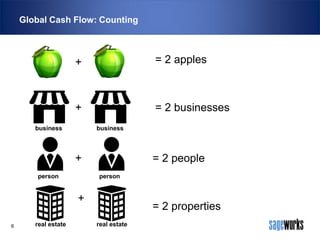
Global Cash Flow: Counting

+

= 2 apples

+

= 2 businesses

business

business

+
person

= 2 people
person

+
6

real estate

= 2 properties
real estate
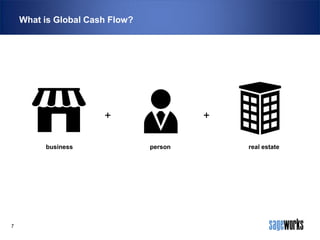
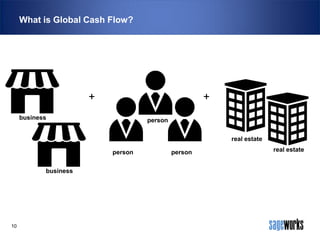
What is Global Cash Flow?

+
business

7

+
person

real estate
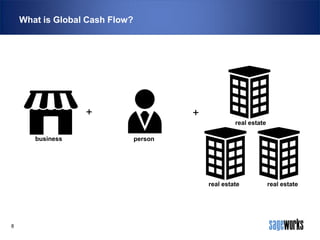
What is Global Cash Flow?

+

+
real estate

business

person

real estate

8

real estate
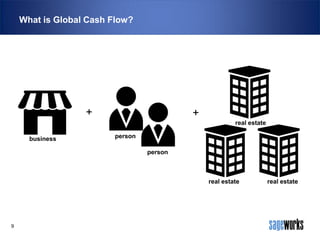
What is Global Cash Flow?

+

+
real estate

business

person
person

real estate

9

real estate
What is Global Cash Flow?

+

+

business

person
real estate
person

business

10

person

real estate
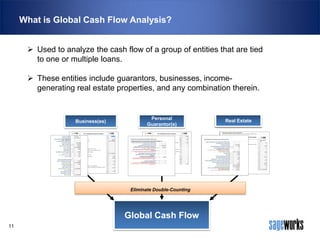
What is Global Cash Flow Analysis?
 Used to analyze the cash flow of a group of entities that are tied
to one or multiple loans.
 These entities include guarantors, businesses, incomegenerating real estate properties, and any combination therein.

Business(es)

Personal
Guarantor(s)

Eliminate Double-Counting

Global Cash Flow
11

Real Estate
Real Estate
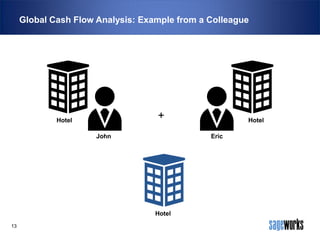
Global Cash Flow Analysis: Example from a Colleague
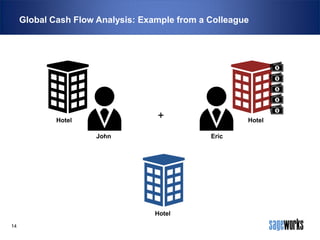
 A few years ago, my colleague’s father (John) sought to purchase
another hotel property along with a family friend (Eric)
 The two files of financials that were being submitted to two different
banks were of different sizes
 Eric’s bank (Bank A) asked for the business financials for the new
purchase, and the personal financials for both of them. I don’t think
anyone would be surprised by this
 However, John’s bank (Bank B) asked for more information. Bank B
wanted the financials for John’s two existing hotels and Eric’s three
existing hotels
 Same project, same hotel, same loan, but two very different processes
and sets of information were required for the lending decision
 Why? Global cash flow analysis
12
Global Cash Flow Analysis: Example from a Colleague

+

Hotel
John

Eric

Hotel
13

Hotel
Global Cash Flow Analysis: Example from a Colleague

+

Hotel
John

Eric

Hotel
14

Hotel
Why is Global Cash Flow Analysis Important?

 In many ways, business and personal cash flow may be combined:
 It’s common for owners to lend personal funds to, or borrow funds from,
their businesses.
 It’s common for the business (for tax advantages, primarily) to rent its
office/warehouse/production facilities from a real estate holding company
or partnership controlled by the business owners.
 It’s common for owners to control their own levels of salaries, bonuses,
benefits, and dividends to the extent allowed by prudence and tax
regulations.

15
Why is Global Cash Flow Analysis Important?

 Without global cash flow analysis:
 Income or debt could be easily overstated.
 Loan decisions could be made with inaccurate debt and cash flow information.
 Scenario: A high net worth guarantor, who has all of his assets tied up in noncash producing real estate or a business venture that is losing money, may not
have the capacity to support the debt if the bank calls upon him to honor his
guarantee. Without a global analysis, the bank wouldn’t know it about this risk.

16
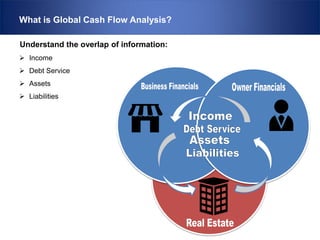
What is Global Cash Flow Analysis?
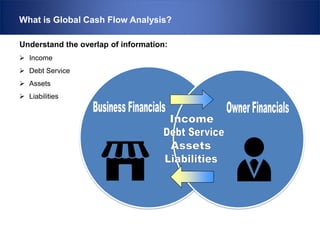
Understand the overlap of information:
 Income
 Debt Service
 Assets
 Liabilities
What is Global Cash Flow Analysis?
Understand the overlap of information:
 Income
 Debt Service
 Assets
 Liabilities
Global Cash Flow Analysis- Two Types Discussed

 For CRE investors / owners (often 10+ properties with varying levels of
ownership):
 Compare total RE Cash flow to Personal Cash Flow measure
 Easier to do it this way because of varied % ownership, varied data formats and
level of detail, and resistance from customer to get detail on projects not financed
by the bank

 For small business/ self- employed/ C&I situations:
 Can also include CRE, but primary cash flow from operating business
 Analyze all business and individual holdings (cash flow and debt service)
 Analyze all entities associated as obligors or guarantors

19
Global Cash Flow Analysis- When to Use?

 When?





Small business where guarantor income important
Works well with small number of owners (<3) and 70-100% aggregate ownership
Business income primary source of income
Recognizes commingled nature of personal and business income

 Best Practices:





Business and Personal Income combined with no double-counting
Business and Personal Debt combined
No such thing as interest only loans; include all as amortizing
Lines of Credit fully drawn; higher than minimum payments for credit cards
 Ex. Line of Credit
 Current balance: $250,000
 Full commitment: $500,000

20

@ 5% int. rate mo.pymt: $4,784
@ 5% int. rate mo.pymt: $9,568
How is Global Cash Flow Analysis Performed?

 According to the OCC’s Internal Guidance from April 9, 2008:
“An analysis of the guarantor’s global cash flow should consider inflows, as
well as both required and discretionary cash outflows from all activities. This
may involve integrating multiple partnership and corporate tax returns,
business financial statements, K-1 forms, and individual tax filings. Anything
short of a comprehensive global cash flow analysis diminishes confidence in
the assessment of guarantor strength, even in the face of significant liquid
assets since that liquidity may be needed to fund contingent liabilities and
global cash shortfalls.”

21
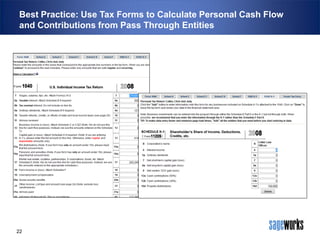
Best Practice: Use Tax Forms to Calculate Personal Cash Flow
and Contributions from Pass Through Entities

22
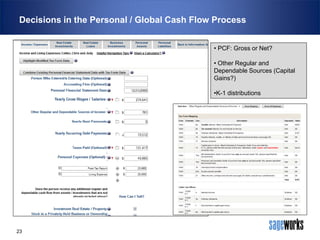
Decisions in the Personal / Global Cash Flow Process
• PCF: Gross or Net?
• Other Regular and
Dependable Sources (Capital
Gains?)
•K-1 distributions

23
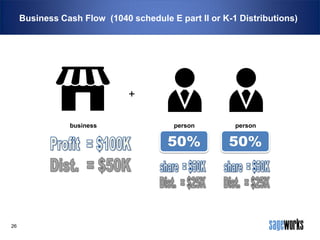
Include Full Business Cash Flow or K-1 Distributions

 Some lenders include K-1 Distributions (Contributions) only regardless of
percent ownership
 This approach is not necessarily a true global analysis if they are not also
including any of the debt service from the business entity in instances where the
individual is a clear majority owner

 Others will base their decision on the percent ownership
 For pass-through entity where individual has majority ownership (70-100%), will
include full business cash flow (and debt service)
 For pass-through entity where individual has clear minority ownership (<30%),
include K-1 distributions (contributions) only; exclude most if not all debt service
 In between situations, must use judgment

24
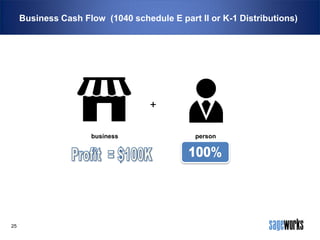
Business Cash Flow (1040 schedule E part II or K-1 Distributions)

+
business

25

person
Business Cash Flow (1040 schedule E part II or K-1 Distributions)

+
business

26

person

person
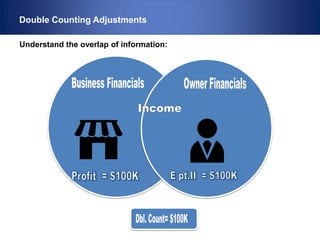
Double Counting Adjustments
Understand the overlap of information:
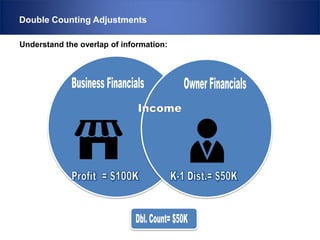
Double Counting Adjustments
Understand the overlap of information:
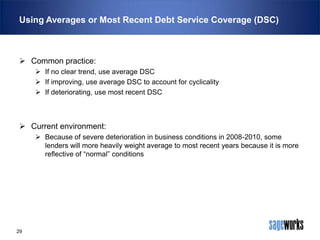
Using Averages or Most Recent Debt Service Coverage (DSC)

 Common practice:
 If no clear trend, use average DSC
 If improving, use average DSC to account for cyclicality
 If deteriorating, use most recent DSC

 Current environment:
 Because of severe deterioration in business conditions in 2008-2010, some
lenders will more heavily weight average to most recent years because it is more
reflective of “normal” conditions

29
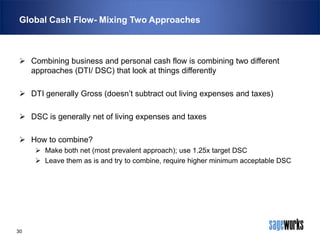
Global Cash Flow- Mixing Two Approaches

 Combining business and personal cash flow is combining two different
approaches (DTI/ DSC) that look at things differently
 DTI generally Gross (doesn’t subtract out living expenses and taxes)
 DSC is generally net of living expenses and taxes
 How to combine?
 Make both net (most prevalent approach); use 1.25x target DSC
 Leave them as is and try to combine, require higher minimum acceptable DSC

30
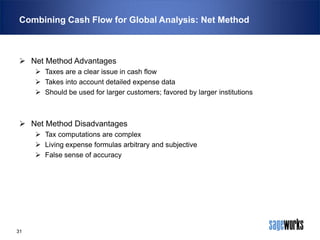
Combining Cash Flow for Global Analysis: Net Method

 Net Method Advantages
 Taxes are a clear issue in cash flow
 Takes into account detailed expense data
 Should be used for larger customers; favored by larger institutions

 Net Method Disadvantages
 Tax computations are complex
 Living expense formulas arbitrary and subjective
 False sense of accuracy

31
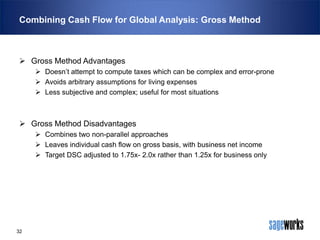
Combining Cash Flow for Global Analysis: Gross Method

 Gross Method Advantages
 Doesn’t attempt to compute taxes which can be complex and error-prone
 Avoids arbitrary assumptions for living expenses
 Less subjective and complex; useful for most situations

 Gross Method Disadvantages
 Combines two non-parallel approaches
 Leaves individual cash flow on gross basis, with business net income
 Target DSC adjusted to 1.75x- 2.0x rather than 1.25x for business only

32
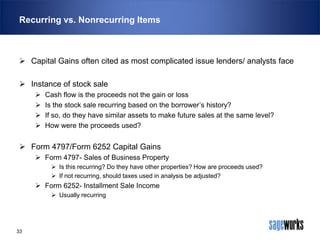
Recurring vs. Nonrecurring Items

 Capital Gains often cited as most complicated issue lenders/ analysts face
 Instance of stock sale





Cash flow is the proceeds not the gain or loss
Is the stock sale recurring based on the borrower’s history?
If so, do they have similar assets to make future sales at the same level?
How were the proceeds used?

 Form 4797/Form 6252 Capital Gains
 Form 4797- Sales of Business Property
 Is this recurring? Do they have other properties? How are proceeds used?
 If not recurring, should taxes used in analysis be adjusted?

 Form 6252- Installment Sale Income
 Usually recurring

33
Other Items of Increasing Importance

 Net Operating Loss carry-forwards and carry-backs
 Exclude the Net Operating Loss carry-forward as noncash item
 May need amended tax returns for prior years if using NOL carry-back

 Section 179 Deduction
 Ability to write off qualified equipment purchases even on last day of the year
 Limited to small businesses by phase-out where purchases over set amount
reduce the write-off
 Amount allowed for deduction and amount of phase-out have been increasing
based on recent legislation

34
Global Cash Flow- More Complex Situations

 Both Gross and Net method as described use a simplified business cash
flow (Net Income + Depreciation + Interest)
 Preferable to use a full UCA Statement of Cash Flow analysis of the
business for larger situations, which examines sources/uses of cash flow
from changes in Balance Sheet items
 For situations involving more than 3 guarantors, some suggest an
alternative approach to GCF
 Use the Net Personal CF after Debt Service for each individual and add to the
total business cash flow
 Use target DSC of 1.5x
 Example: Law firm with 25 partners
 Standalone Business CF and the Global Cash Flow should be examined

35
Common Mistakes in Global Cash Flow Analysis

 Common Mistakes:
 Obtaining business and personal financials, but not combining them into a
single cash flow
 Overlooking or not requesting all of the necessary tax forms
 Not obtaining additional needed information beyond the tax forms
 Neglecting to discern any overlapping income in the single cash flow
figure
 Allowing employees to use inconsistent global cash flow methodologies

 Things to Watch:
 Distributions can be misleading when taken in isolation. Sometimes
owners choose to pay themselves more or less depending on the
economic environment or the business’s position
 Financial data from recent periods should not be treated similarly to
financial data from past periods. They need to be reviewed in context
 Situations with multiple borrowers or guarantors should be fully analyzed
to take into account any low performing business for which the guarantors
are responsible
36
GCF as Part of Larger Global Analysis

 10/30/09 Policy Statement on Prudent CRE Loan Workouts
 Updated and comprehensive financial information on the borrower, real estate
project and any guarantor
 An analysis of the borrower’s global debt service that reflects a realistic
projection of the borrower’s and guarantor’s expenses
 Global Debt is the aggregate of a borrower’s or guarantor’s financial obligations,
including contingent obligations

 “Sufficient information on the guarantor’s global financial condition, income,
liquidity, cash flow, contingent liabilities, and other relevant factors… to
demonstrate the guarantor’s financial capacity to fulfill the obligation… should
include total number and amount of guarantees extended by a guarantor in order
to assess whether the guarantor has the financial capacity to fulfill contingent
claims that exist.”

37
Contact Information
 Presenter Contact Information:






Chuck Nwokocha, Sageworks
(919) 851-7474 ext. 637
chuck.nwokocha@sageworks.com
www.sageworksanalyst.com

 David Matricciano, DM Analytics LLC
 (609) 410-4949
 dm4270@yahoo.com

38

Global Cash Flow Analysis: What, When, Why, and How

  • 1.
    Global Cash FlowAnalysis: What, When, Why, and How Presented by: Chuck Nwokocha Director of Advisory Services, Sageworks David Matricciano Owner, DM Analytics LLC
  • 2.
    About Sageworks  Financialinformation company that provides credit and risk management solutions to financial institutions  Data and applications used by thousands of financial institutions, corporations and accounting firms across North America  Awards  Named to Inc. 500 list of fastest growing privately held companies in the U.S.  Named to Deloitte’s Technology Fast 500 2
  • 3.
    About the Presenters Chuck Nwokocha – Director of Advisory Services, Financial Markets – Sageworks  Chuck is a graduate of Harvard University, with a B.A. in Psychology with a focus in Organizations and Economics. He began his professional career with Guardsmark, a private security services company where he held various positions and responsibilities – in operations, human resources, and sales, and management. He has founded two ecommerce sites, Ndekanyi.com – a social networking site for the Igbo people and SwapU.com – a college classifieds network. Additionally, he has consulted on Marketing, Social Media, and User-Generated content. At Sageworks, Mr. Nwokocha leads the Advisory and Bank Consulting team, focusing on Credit Analysis and Risk Rating.  David Matricciano – Owner – DM Analytics LLC  David graduated from Rowan University in Glassboro, NJ after serving four years active duty in the U.S. Marines. He began his professional career with Commerce Bank, NA performing research for the bank’s chief economist. He then entered the bank’s credit training program and ended up working as a credit analyst, underwriter, portfolio manager, and junior lender for over 5 years. He formed DM Analytics, LLC in 2008 to assist banks with underwriting, collections, work out, and loan review on a short term contract basis. 3
  • 4.
    Agenda 1. What isglobal cash flow analysis? 2. Why is global cash flow analysis important? 3. When to use global cash flow analysis 4. How is global cash flow analysis performed? 5. Best practices for global cash flow analysis 6. Special considerations in global cash flow 7. Common mistakes 8. Global cash flow as part of larger global analysis 9. Q&A 4
  • 5.
    Global Cash Flow Complex borrower scenarios introduces fresh challenges for financial institutions  Put standards in place across the credit and lending departments for when to conduct a global cash flow analysis  What information to collect from borrowers  Best practices for conducting global cash flow analysis  How spreadsheet based programs can lead to inconsistencies  Double counting  How a probability of default can be implemented in the credit and lending process 5
  • 6.
    Global Cash Flow:Counting + = 2 apples + = 2 businesses business business + person = 2 people person + 6 real estate = 2 properties real estate
  • 7.
    What is GlobalCash Flow? + business 7 + person real estate
  • 8.
    What is GlobalCash Flow? + + real estate business person real estate 8 real estate
  • 9.
    What is GlobalCash Flow? + + real estate business person person real estate 9 real estate
  • 10.
    What is GlobalCash Flow? + + business person real estate person business 10 person real estate
  • 11.
    What is GlobalCash Flow Analysis?  Used to analyze the cash flow of a group of entities that are tied to one or multiple loans.  These entities include guarantors, businesses, incomegenerating real estate properties, and any combination therein. Business(es) Personal Guarantor(s) Eliminate Double-Counting Global Cash Flow 11 Real Estate Real Estate
  • 12.
    Global Cash FlowAnalysis: Example from a Colleague  A few years ago, my colleague’s father (John) sought to purchase another hotel property along with a family friend (Eric)  The two files of financials that were being submitted to two different banks were of different sizes  Eric’s bank (Bank A) asked for the business financials for the new purchase, and the personal financials for both of them. I don’t think anyone would be surprised by this  However, John’s bank (Bank B) asked for more information. Bank B wanted the financials for John’s two existing hotels and Eric’s three existing hotels  Same project, same hotel, same loan, but two very different processes and sets of information were required for the lending decision  Why? Global cash flow analysis 12
  • 13.
    Global Cash FlowAnalysis: Example from a Colleague + Hotel John Eric Hotel 13 Hotel
  • 14.
    Global Cash FlowAnalysis: Example from a Colleague + Hotel John Eric Hotel 14 Hotel
  • 15.
    Why is GlobalCash Flow Analysis Important?  In many ways, business and personal cash flow may be combined:  It’s common for owners to lend personal funds to, or borrow funds from, their businesses.  It’s common for the business (for tax advantages, primarily) to rent its office/warehouse/production facilities from a real estate holding company or partnership controlled by the business owners.  It’s common for owners to control their own levels of salaries, bonuses, benefits, and dividends to the extent allowed by prudence and tax regulations. 15
  • 16.
    Why is GlobalCash Flow Analysis Important?  Without global cash flow analysis:  Income or debt could be easily overstated.  Loan decisions could be made with inaccurate debt and cash flow information.  Scenario: A high net worth guarantor, who has all of his assets tied up in noncash producing real estate or a business venture that is losing money, may not have the capacity to support the debt if the bank calls upon him to honor his guarantee. Without a global analysis, the bank wouldn’t know it about this risk. 16
  • 17.
    What is GlobalCash Flow Analysis? Understand the overlap of information:  Income  Debt Service  Assets  Liabilities
  • 18.
    What is GlobalCash Flow Analysis? Understand the overlap of information:  Income  Debt Service  Assets  Liabilities
  • 19.
    Global Cash FlowAnalysis- Two Types Discussed  For CRE investors / owners (often 10+ properties with varying levels of ownership):  Compare total RE Cash flow to Personal Cash Flow measure  Easier to do it this way because of varied % ownership, varied data formats and level of detail, and resistance from customer to get detail on projects not financed by the bank  For small business/ self- employed/ C&I situations:  Can also include CRE, but primary cash flow from operating business  Analyze all business and individual holdings (cash flow and debt service)  Analyze all entities associated as obligors or guarantors 19
  • 20.
    Global Cash FlowAnalysis- When to Use?  When?     Small business where guarantor income important Works well with small number of owners (<3) and 70-100% aggregate ownership Business income primary source of income Recognizes commingled nature of personal and business income  Best Practices:     Business and Personal Income combined with no double-counting Business and Personal Debt combined No such thing as interest only loans; include all as amortizing Lines of Credit fully drawn; higher than minimum payments for credit cards  Ex. Line of Credit  Current balance: $250,000  Full commitment: $500,000 20 @ 5% int. rate mo.pymt: $4,784 @ 5% int. rate mo.pymt: $9,568
  • 21.
    How is GlobalCash Flow Analysis Performed?  According to the OCC’s Internal Guidance from April 9, 2008: “An analysis of the guarantor’s global cash flow should consider inflows, as well as both required and discretionary cash outflows from all activities. This may involve integrating multiple partnership and corporate tax returns, business financial statements, K-1 forms, and individual tax filings. Anything short of a comprehensive global cash flow analysis diminishes confidence in the assessment of guarantor strength, even in the face of significant liquid assets since that liquidity may be needed to fund contingent liabilities and global cash shortfalls.” 21
  • 22.
    Best Practice: UseTax Forms to Calculate Personal Cash Flow and Contributions from Pass Through Entities 22
  • 23.
    Decisions in thePersonal / Global Cash Flow Process • PCF: Gross or Net? • Other Regular and Dependable Sources (Capital Gains?) •K-1 distributions 23
  • 24.
    Include Full BusinessCash Flow or K-1 Distributions  Some lenders include K-1 Distributions (Contributions) only regardless of percent ownership  This approach is not necessarily a true global analysis if they are not also including any of the debt service from the business entity in instances where the individual is a clear majority owner  Others will base their decision on the percent ownership  For pass-through entity where individual has majority ownership (70-100%), will include full business cash flow (and debt service)  For pass-through entity where individual has clear minority ownership (<30%), include K-1 distributions (contributions) only; exclude most if not all debt service  In between situations, must use judgment 24
  • 25.
    Business Cash Flow(1040 schedule E part II or K-1 Distributions) + business 25 person
  • 26.
    Business Cash Flow(1040 schedule E part II or K-1 Distributions) + business 26 person person
  • 27.
    Double Counting Adjustments Understandthe overlap of information:
  • 28.
    Double Counting Adjustments Understandthe overlap of information:
  • 29.
    Using Averages orMost Recent Debt Service Coverage (DSC)  Common practice:  If no clear trend, use average DSC  If improving, use average DSC to account for cyclicality  If deteriorating, use most recent DSC  Current environment:  Because of severe deterioration in business conditions in 2008-2010, some lenders will more heavily weight average to most recent years because it is more reflective of “normal” conditions 29
  • 30.
    Global Cash Flow-Mixing Two Approaches  Combining business and personal cash flow is combining two different approaches (DTI/ DSC) that look at things differently  DTI generally Gross (doesn’t subtract out living expenses and taxes)  DSC is generally net of living expenses and taxes  How to combine?  Make both net (most prevalent approach); use 1.25x target DSC  Leave them as is and try to combine, require higher minimum acceptable DSC 30
  • 31.
    Combining Cash Flowfor Global Analysis: Net Method  Net Method Advantages  Taxes are a clear issue in cash flow  Takes into account detailed expense data  Should be used for larger customers; favored by larger institutions  Net Method Disadvantages  Tax computations are complex  Living expense formulas arbitrary and subjective  False sense of accuracy 31
  • 32.
    Combining Cash Flowfor Global Analysis: Gross Method  Gross Method Advantages  Doesn’t attempt to compute taxes which can be complex and error-prone  Avoids arbitrary assumptions for living expenses  Less subjective and complex; useful for most situations  Gross Method Disadvantages  Combines two non-parallel approaches  Leaves individual cash flow on gross basis, with business net income  Target DSC adjusted to 1.75x- 2.0x rather than 1.25x for business only 32
  • 33.
    Recurring vs. NonrecurringItems  Capital Gains often cited as most complicated issue lenders/ analysts face  Instance of stock sale     Cash flow is the proceeds not the gain or loss Is the stock sale recurring based on the borrower’s history? If so, do they have similar assets to make future sales at the same level? How were the proceeds used?  Form 4797/Form 6252 Capital Gains  Form 4797- Sales of Business Property  Is this recurring? Do they have other properties? How are proceeds used?  If not recurring, should taxes used in analysis be adjusted?  Form 6252- Installment Sale Income  Usually recurring 33
  • 34.
    Other Items ofIncreasing Importance  Net Operating Loss carry-forwards and carry-backs  Exclude the Net Operating Loss carry-forward as noncash item  May need amended tax returns for prior years if using NOL carry-back  Section 179 Deduction  Ability to write off qualified equipment purchases even on last day of the year  Limited to small businesses by phase-out where purchases over set amount reduce the write-off  Amount allowed for deduction and amount of phase-out have been increasing based on recent legislation 34
  • 35.
    Global Cash Flow-More Complex Situations  Both Gross and Net method as described use a simplified business cash flow (Net Income + Depreciation + Interest)  Preferable to use a full UCA Statement of Cash Flow analysis of the business for larger situations, which examines sources/uses of cash flow from changes in Balance Sheet items  For situations involving more than 3 guarantors, some suggest an alternative approach to GCF  Use the Net Personal CF after Debt Service for each individual and add to the total business cash flow  Use target DSC of 1.5x  Example: Law firm with 25 partners  Standalone Business CF and the Global Cash Flow should be examined 35
  • 36.
    Common Mistakes inGlobal Cash Flow Analysis  Common Mistakes:  Obtaining business and personal financials, but not combining them into a single cash flow  Overlooking or not requesting all of the necessary tax forms  Not obtaining additional needed information beyond the tax forms  Neglecting to discern any overlapping income in the single cash flow figure  Allowing employees to use inconsistent global cash flow methodologies  Things to Watch:  Distributions can be misleading when taken in isolation. Sometimes owners choose to pay themselves more or less depending on the economic environment or the business’s position  Financial data from recent periods should not be treated similarly to financial data from past periods. They need to be reviewed in context  Situations with multiple borrowers or guarantors should be fully analyzed to take into account any low performing business for which the guarantors are responsible 36
  • 37.
    GCF as Partof Larger Global Analysis  10/30/09 Policy Statement on Prudent CRE Loan Workouts  Updated and comprehensive financial information on the borrower, real estate project and any guarantor  An analysis of the borrower’s global debt service that reflects a realistic projection of the borrower’s and guarantor’s expenses  Global Debt is the aggregate of a borrower’s or guarantor’s financial obligations, including contingent obligations  “Sufficient information on the guarantor’s global financial condition, income, liquidity, cash flow, contingent liabilities, and other relevant factors… to demonstrate the guarantor’s financial capacity to fulfill the obligation… should include total number and amount of guarantees extended by a guarantor in order to assess whether the guarantor has the financial capacity to fulfill contingent claims that exist.” 37
  • 38.
    Contact Information  PresenterContact Information:     Chuck Nwokocha, Sageworks (919) 851-7474 ext. 637 chuck.nwokocha@sageworks.com www.sageworksanalyst.com  David Matricciano, DM Analytics LLC  (609) 410-4949  dm4270@yahoo.com 38