CH 5
Present Worth Analysis –
Part1
08/07/142
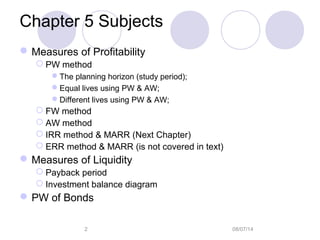
Chapter 5 Subjects
Measures of Profitability
 PW method
The planning horizon (study period);
Equal lives using PW & AW;
Different lives using PW & AW;
 FW method
 AW method
 IRR method & MARR (Next Chapter)
 ERR method & MARR (is not covered in text)
Measures of Liquidity
 Payback period
 Investment balance diagram
PW of Bonds
Measure of Profitability
1)PW, FW, & AW methods
2)IRR method & MARR
3)ERR method & MARR
08/07/144
PW, AW, & FW
For a single alternative, compute either
PW, AW, FW. If PW, AW, or FW is equal
or greater than zero then the project is
viable, otherwise it should be rejected.
08/07/14Dr. Ayman Abu Hammad5
SELECT THE EQUIVALENT WORTH ALTERNATIVE WITH
THE GREATER WORTH
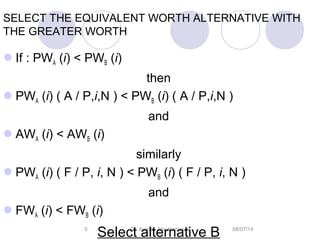
If : PWA (i) < PWB (i)
then
PWA (i) ( A / P,i,N ) < PWB (i) ( A / P,i,N )
and
AWA (i) < AWB (i)
similarly
PWA (i) ( F / P, i, N ) < PWB (i) ( F / P, i, N )
and
FWA (i) < FWB (i)
Select alternative B
08/07/14 6
COMPARING COST ALTERNATIVES
• For cost alternatives that are compared using the PW
method, the alternative that has the least negative
PW is most economically desirable.
• For cost alternatives that are compared using the AW
method, the alternative that has the least negative
AW is most economically desirable.
• For cost alternatives that are compared using the FW
method, the alternative that has the least negative
FW is most economically desirable.
08/07/147
THREE GROUPS OF MAJOR INVESTMENT ALTERNATIVES
1. Mutually exclusive :
At most one project out of the group can be chosen
2. Independent :
The choice of a project is independent of the choice of any
other project in the group, so that all or none of the projects
may be selected or some number in between
3. Contingent :
The choice of the project is conditional on the choice of one or
more other projects
08/07/148
CASH FLOW ANALYSIS METHODS
The cash-flow analysis methods (previously
described in Chapter 4) for a single project are:
Present Worth ( PW )
Annual Worth ( AW )
Future Worth ( FW )
Internal Rate of Return ( IRR )
External Rate of Return ( ERR )
08/07/149
COTERMINATED ASSUMPTION
You cannot compare alternatives using PW method if
life is not equal.
 A finite and identical study period is used for all
alternatives. Cash flows are repeated per the least
common multiple of lives.
A planning horizon is proposed when AW method is
used. Truncate the remaining useful life by
substituting a salvage value. This planning horizon,
combined with appropriate adjustments to the
estimated cash flows, puts the alternatives on a
common comparable basis
08/07/1410
PLANNING HORIZON
The selected time period over which mutually
exclusive alternatives are compared -- study
period
May be influenced by factors including:
 service period required
 useful life of the shorter-lived alternative
 useful life of the longer-lived alternative
 company policy
It is key that the study period be appropriate
for the decision situation under investigation
08/07/1411
COTERMINATED ASSUMPTION
Guidelines when useful life(s) different in length
than study period
Useful life < study period
a. Cost alternatives -- each cost alternative must
provide same level of service as study period : 1)
contract for service or lease equipment for remaining
time; 2) repeat part of useful life of original alternative
until study period ends
b. investment alternatives -- assume all cash flows
reinvested in other opportunities at MARR to end of
study period
08/07/1412
Comparing Projects of Equal Lives
08/07/14
13
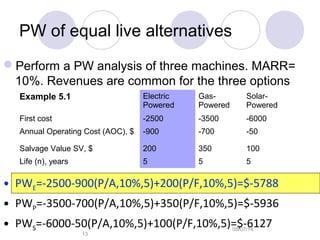
PW of equal live alternatives
Perform a PW analysis of three machines. MARR=
10%. Revenues are common for the three options
Example 5.1 Electric
Powered
Gas-
Powered
Solar-
Powered
First cost -2500 -3500 -6000
Annual Operating Cost (AOC), $ -900 -700 -50
Salvage Value SV, $ 200 350 100
Life (n), years 5 5 5
• PWE=-2500-900(P/A,10%,5)+200(P/F,10%,5)=$-5788
• PWP=-3500-700(P/A,10%,5)+350(P/F,10%,5)=$-5936
• PWS=-6000-50(P/A,10%,5)+100(P/F,10%,5)=$-6127
08/07/1414
Comparing Projects of Different Lives
08/07/1415
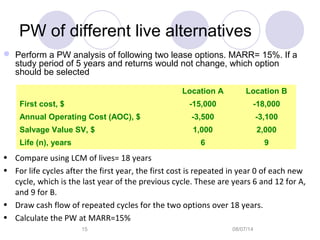
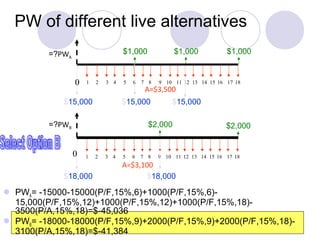
PW of different live alternatives
 Perform a PW analysis of following two lease options. MARR= 15%. If a
study period of 5 years and returns would not change, which option
should be selected
Location A Location B
First cost, $ -15,000 -18,000
Annual Operating Cost (AOC), $ -3,500 -3,100
Salvage Value SV, $ 1,000 2,000
Life (n), years 6 9
• Compare using LCM of lives= 18 years
• For life cycles after the first year, the first cost is repeated in year 0 of each new
cycle, which is the last year of the previous cycle. These are years 6 and 12 for A,
and 9 for B.
• Draw cash flow of repeated cycles for the two options over 18 years.
• Calculate the PW at MARR=15%
08/07/14Dr. Ayman Abu Hammad16
 PWA= -15000-15000(P/F,15%,6)+1000(P/F,15%,6)-
15,000(P/F,15%,12)+1000(P/F,15%,12)+1000(P/F,15%,18)-
3500(P/A,15%,18)=$-45,036
 PWB= -18000-18000(P/F,15%,9)+2000(P/F,15%,9)+2000(P/F,15%,18)-
3100(P/A,15%,18)=$-41,384
PW of different live alternatives
0 1 2 3 4
A=$3,100
5 6 7 8 9 10 11 12 13 14 15 16 17 18
PWB=?
A=$3,500
7 8 9 10 11 12 13 14 15 16 17 180 1 2 3 4 5 6
PWA=?
$15,000
$1,000 $1,000
$15,000
$1,000
$15,000
$1,000
$2,000
$18,000 $18,000
$2,000
08/07/1417
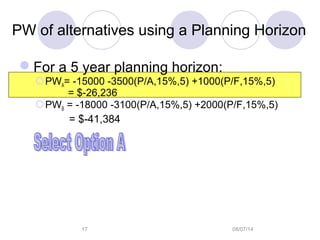
PW of alternatives using a Planning Horizon
For a 5 year planning horizon:
PWA= -15000 -3500(P/A,15%,5) +1000(P/F,15%,5)
= $-26,236
PWB = -18000 -3100(P/A,15%,5) +2000(P/F,15%,5)
= $-41,384
08/07/1418
COMPARING ALTERNATIVES USING THE
CAPITALIZED WORTH METHOD
Capitalized Worth (CW) method -- Determining the
present worth of all revenues and / or expenses over
an infinite length of time
Capitalized cost -- Determining the present worth of
expenses only over an infinite length of time
Capitalized worth or capitalized cost is a convenient
basis for comparing mutually exclusive alternatives
when a period of needed services is indefinitely long
and the repeatability assumption is applicable
08/07/1419
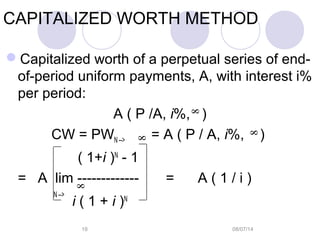
CAPITALIZED WORTH METHOD
Capitalized worth of a perpetual series of end-
of-period uniform payments, A, with interest i%
per period:
A ( P /A, i%, )
CW = PWN --> = A ( P / A, i%, )
( 1+i )N
- 1
= A lim ------------- = A ( 1 / i )
N -->
i ( 1 + i )N 8
8
8
8
08/07/1420
Capitalized Cost Calculation
PW Computations when N → ∞
 These cases are also called "perpetuities" - e.g. scholarships,
endowments, etc.
 There are many engineering projects where the life of the
project is so long as to be considered ‘forever’. Usually ≥50
years as a rule of thumb, but assume cash flows continue
indefinitely.
 There are other projects where a sum of money is provided at
the beginning of the project and it is then invested to yield the
amount used for the project (annuities for ≥50 years)
 For both, the PW of the infinitely long uniform series of cash
flows becomes the Capitalized Value
08/07/1421
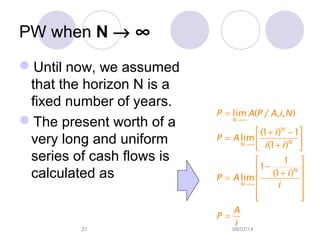
PW when N → ∞
Until now, we assumed
that the horizon N is a
fixed number of years.
The present worth of a
very long and uniform
series of cash flows is
calculated as
→∞
→∞
→∞
=
 + −
=  + 
 
− +
=  
 
  
=
lim ( / , , )
(1 ) 1
lim
(1 )
1
1
(1 )
lim
N
N
NN
N
N
P A P A i N
i
P A
i i
i
P A
i
A
P
i
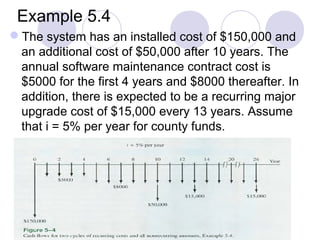
Example 5.4
The system has an installed cost of $150,000 and
an additional cost of $50,000 after 10 years. The
annual software maintenance contract cost is
$5000 for the first 4 years and $8000 thereafter. In
addition, there is expected to be a recurring major
upgrade cost of $15,000 every 13 years. Assume
that i = 5% per year for county funds.
Example – cont.
 Find the present worth of the nonrecurring costs of $150,000 now
and $50,000 in year 10 at i = 5%. Label this CCI‘
 CCI = - 150,000 - 50,000(P/F,5%,10) = $-180,695
 Convert the recurring cost of $15,000 every 13 years into an annual
worth AI for the first 13 years.
 AI = - 15 ,000(A/ F,5 %, 13) = $-847
 The same value, AI = $- 847, applies to all the other 13-year periods
as well.
 The capitalized cost for the two annual maintenance cost series
may be determined in either of two ways:
 (I) consider a series of $- 5000 from now to infinity and find the
present worth of -$8000 - ($-5000) = $-3000 from year 5 on; or
 (2) find the CC of $-5000 for 4 years and the present worth of $-
8000 from year 5 to infinity. Using the first method, the annual
cost (A2) is $- 5000 forever. The capitalized cost CC2 of $- 3000
from year 5 to infinity is found using Equation [5.1] times the P /
F factor.
 CC2=-3000/0.05(P/F,5%,4)=$-49,362
Example –cont.
The two annual cost series are converted into a
capitalized cost CC3.
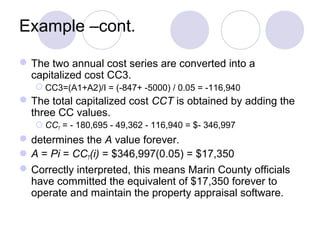
 CC3=(A1+A2)/I = (-847+ -5000) / 0.05 = -116,940
The total capitalized cost CCT is obtained by adding the
three CC values.
 CCT = - 180,695 - 49,362 - 116,940 = $- 346,997
determines the A value forever.
A = Pi = CCT(i) = $346,997(0.05) = $17,350
Correctly interpreted, this means Marin County officials
have committed the equivalent of $17,350 forever to
operate and maintain the property appraisal software.
Problem 2
Determine the capitalized cost of an expenditure
of $200,000 at time 0, $25,000 in years 2
through 5, and $40,000 per year from year 6 on.
Use an interest rate of 12% per year.
Soln:
CC = -200,000 – 25,000(P/A,12%,4)(P/F,12%,1)
– [40,000/0.12])P/F,12%,5)
= -200,000 – 25,000(3.0373)(0.8929) –
[40,000/0.12])(0.5674)
= $-456,933
Problem 3
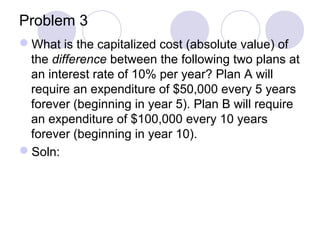
What is the capitalized cost (absolute value) of
the difference between the following two plans at
an interest rate of 10% per year? Plan A will
require an expenditure of $50,000 every 5 years
forever (beginning in year 5). Plan B will require
an expenditure of $100,000 every 10 years
forever (beginning in year 10).
Soln:
Problem 3- Cont.
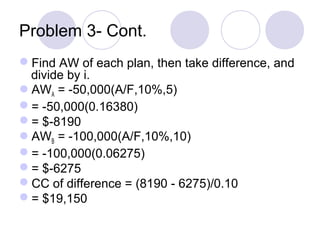
Find AW of each plan, then take difference, and
divide by i.
AWA = -50,000(A/F,10%,5)
= -50,000(0.16380)
= $-8190
AWB = -100,000(A/F,10%,10)
= -100,000(0.06275)
= $-6275
CC of difference = (8190 - 6275)/0.10
= $19,150
Problem 4
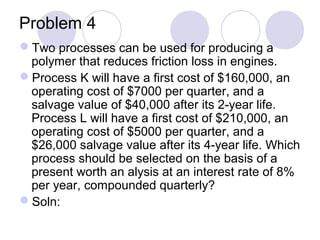
Two processes can be used for producing a
polymer that reduces friction loss in engines.
Process K will have a first cost of $160,000, an
operating cost of $7000 per quarter, and a
salvage value of $40,000 after its 2-year life.
Process L will have a first cost of $210,000, an
operating cost of $5000 per quarter, and a
$26,000 salvage value after its 4-year life. Which
process should be selected on the basis of a
present worth an alysis at an interest rate of 8%
per year, compounded quarterly?
Soln:
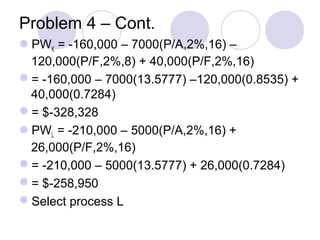
Problem 4 – Cont.
PWK = -160,000 – 7000(P/A,2%,16) –
120,000(P/F,2%,8) + 40,000(P/F,2%,16)
= -160,000 – 7000(13.5777) –120,000(0.8535) +
40,000(0.7284)
= $-328,328
PWL = -210,000 – 5000(P/A,2%,16) +
26,000(P/F,2%,16)
= -210,000 – 5000(13.5777) + 26,000(0.7284)
= $-258,950
Select process L

Ch5 pw analysis_part1_rev4

  • 1.
    CH 5 Present WorthAnalysis – Part1
  • 2.
    08/07/142 Chapter 5 Subjects Measuresof Profitability  PW method The planning horizon (study period); Equal lives using PW & AW; Different lives using PW & AW;  FW method  AW method  IRR method & MARR (Next Chapter)  ERR method & MARR (is not covered in text) Measures of Liquidity  Payback period  Investment balance diagram PW of Bonds
  • 3.
    Measure of Profitability 1)PW,FW, & AW methods 2)IRR method & MARR 3)ERR method & MARR
  • 4.
    08/07/144 PW, AW, &FW For a single alternative, compute either PW, AW, FW. If PW, AW, or FW is equal or greater than zero then the project is viable, otherwise it should be rejected.
  • 5.
    08/07/14Dr. Ayman AbuHammad5 SELECT THE EQUIVALENT WORTH ALTERNATIVE WITH THE GREATER WORTH If : PWA (i) < PWB (i) then PWA (i) ( A / P,i,N ) < PWB (i) ( A / P,i,N ) and AWA (i) < AWB (i) similarly PWA (i) ( F / P, i, N ) < PWB (i) ( F / P, i, N ) and FWA (i) < FWB (i) Select alternative B
  • 6.
    08/07/14 6 COMPARING COSTALTERNATIVES • For cost alternatives that are compared using the PW method, the alternative that has the least negative PW is most economically desirable. • For cost alternatives that are compared using the AW method, the alternative that has the least negative AW is most economically desirable. • For cost alternatives that are compared using the FW method, the alternative that has the least negative FW is most economically desirable.
  • 7.
    08/07/147 THREE GROUPS OFMAJOR INVESTMENT ALTERNATIVES 1. Mutually exclusive : At most one project out of the group can be chosen 2. Independent : The choice of a project is independent of the choice of any other project in the group, so that all or none of the projects may be selected or some number in between 3. Contingent : The choice of the project is conditional on the choice of one or more other projects
  • 8.
    08/07/148 CASH FLOW ANALYSISMETHODS The cash-flow analysis methods (previously described in Chapter 4) for a single project are: Present Worth ( PW ) Annual Worth ( AW ) Future Worth ( FW ) Internal Rate of Return ( IRR ) External Rate of Return ( ERR )
  • 9.
    08/07/149 COTERMINATED ASSUMPTION You cannotcompare alternatives using PW method if life is not equal.  A finite and identical study period is used for all alternatives. Cash flows are repeated per the least common multiple of lives. A planning horizon is proposed when AW method is used. Truncate the remaining useful life by substituting a salvage value. This planning horizon, combined with appropriate adjustments to the estimated cash flows, puts the alternatives on a common comparable basis
  • 10.
    08/07/1410 PLANNING HORIZON The selectedtime period over which mutually exclusive alternatives are compared -- study period May be influenced by factors including:  service period required  useful life of the shorter-lived alternative  useful life of the longer-lived alternative  company policy It is key that the study period be appropriate for the decision situation under investigation
  • 11.
    08/07/1411 COTERMINATED ASSUMPTION Guidelines whenuseful life(s) different in length than study period Useful life < study period a. Cost alternatives -- each cost alternative must provide same level of service as study period : 1) contract for service or lease equipment for remaining time; 2) repeat part of useful life of original alternative until study period ends b. investment alternatives -- assume all cash flows reinvested in other opportunities at MARR to end of study period
  • 12.
  • 13.
    08/07/14 13 PW of equallive alternatives Perform a PW analysis of three machines. MARR= 10%. Revenues are common for the three options Example 5.1 Electric Powered Gas- Powered Solar- Powered First cost -2500 -3500 -6000 Annual Operating Cost (AOC), $ -900 -700 -50 Salvage Value SV, $ 200 350 100 Life (n), years 5 5 5 • PWE=-2500-900(P/A,10%,5)+200(P/F,10%,5)=$-5788 • PWP=-3500-700(P/A,10%,5)+350(P/F,10%,5)=$-5936 • PWS=-6000-50(P/A,10%,5)+100(P/F,10%,5)=$-6127
  • 14.
  • 15.
    08/07/1415 PW of differentlive alternatives  Perform a PW analysis of following two lease options. MARR= 15%. If a study period of 5 years and returns would not change, which option should be selected Location A Location B First cost, $ -15,000 -18,000 Annual Operating Cost (AOC), $ -3,500 -3,100 Salvage Value SV, $ 1,000 2,000 Life (n), years 6 9 • Compare using LCM of lives= 18 years • For life cycles after the first year, the first cost is repeated in year 0 of each new cycle, which is the last year of the previous cycle. These are years 6 and 12 for A, and 9 for B. • Draw cash flow of repeated cycles for the two options over 18 years. • Calculate the PW at MARR=15%
  • 16.
    08/07/14Dr. Ayman AbuHammad16  PWA= -15000-15000(P/F,15%,6)+1000(P/F,15%,6)- 15,000(P/F,15%,12)+1000(P/F,15%,12)+1000(P/F,15%,18)- 3500(P/A,15%,18)=$-45,036  PWB= -18000-18000(P/F,15%,9)+2000(P/F,15%,9)+2000(P/F,15%,18)- 3100(P/A,15%,18)=$-41,384 PW of different live alternatives 0 1 2 3 4 A=$3,100 5 6 7 8 9 10 11 12 13 14 15 16 17 18 PWB=? A=$3,500 7 8 9 10 11 12 13 14 15 16 17 180 1 2 3 4 5 6 PWA=? $15,000 $1,000 $1,000 $15,000 $1,000 $15,000 $1,000 $2,000 $18,000 $18,000 $2,000
  • 17.
    08/07/1417 PW of alternativesusing a Planning Horizon For a 5 year planning horizon: PWA= -15000 -3500(P/A,15%,5) +1000(P/F,15%,5) = $-26,236 PWB = -18000 -3100(P/A,15%,5) +2000(P/F,15%,5) = $-41,384
  • 18.
    08/07/1418 COMPARING ALTERNATIVES USINGTHE CAPITALIZED WORTH METHOD Capitalized Worth (CW) method -- Determining the present worth of all revenues and / or expenses over an infinite length of time Capitalized cost -- Determining the present worth of expenses only over an infinite length of time Capitalized worth or capitalized cost is a convenient basis for comparing mutually exclusive alternatives when a period of needed services is indefinitely long and the repeatability assumption is applicable
  • 19.
    08/07/1419 CAPITALIZED WORTH METHOD Capitalizedworth of a perpetual series of end- of-period uniform payments, A, with interest i% per period: A ( P /A, i%, ) CW = PWN --> = A ( P / A, i%, ) ( 1+i )N - 1 = A lim ------------- = A ( 1 / i ) N --> i ( 1 + i )N 8 8 8 8
  • 20.
    08/07/1420 Capitalized Cost Calculation PWComputations when N → ∞  These cases are also called "perpetuities" - e.g. scholarships, endowments, etc.  There are many engineering projects where the life of the project is so long as to be considered ‘forever’. Usually ≥50 years as a rule of thumb, but assume cash flows continue indefinitely.  There are other projects where a sum of money is provided at the beginning of the project and it is then invested to yield the amount used for the project (annuities for ≥50 years)  For both, the PW of the infinitely long uniform series of cash flows becomes the Capitalized Value
  • 21.
    08/07/1421 PW when N→ ∞ Until now, we assumed that the horizon N is a fixed number of years. The present worth of a very long and uniform series of cash flows is calculated as →∞ →∞ →∞ =  + − =  +    − + =        = lim ( / , , ) (1 ) 1 lim (1 ) 1 1 (1 ) lim N N NN N N P A P A i N i P A i i i P A i A P i
  • 22.
    Example 5.4 The systemhas an installed cost of $150,000 and an additional cost of $50,000 after 10 years. The annual software maintenance contract cost is $5000 for the first 4 years and $8000 thereafter. In addition, there is expected to be a recurring major upgrade cost of $15,000 every 13 years. Assume that i = 5% per year for county funds.
  • 23.
    Example – cont. Find the present worth of the nonrecurring costs of $150,000 now and $50,000 in year 10 at i = 5%. Label this CCI‘  CCI = - 150,000 - 50,000(P/F,5%,10) = $-180,695  Convert the recurring cost of $15,000 every 13 years into an annual worth AI for the first 13 years.  AI = - 15 ,000(A/ F,5 %, 13) = $-847  The same value, AI = $- 847, applies to all the other 13-year periods as well.  The capitalized cost for the two annual maintenance cost series may be determined in either of two ways:  (I) consider a series of $- 5000 from now to infinity and find the present worth of -$8000 - ($-5000) = $-3000 from year 5 on; or  (2) find the CC of $-5000 for 4 years and the present worth of $- 8000 from year 5 to infinity. Using the first method, the annual cost (A2) is $- 5000 forever. The capitalized cost CC2 of $- 3000 from year 5 to infinity is found using Equation [5.1] times the P / F factor.  CC2=-3000/0.05(P/F,5%,4)=$-49,362
  • 24.
    Example –cont. The twoannual cost series are converted into a capitalized cost CC3.  CC3=(A1+A2)/I = (-847+ -5000) / 0.05 = -116,940 The total capitalized cost CCT is obtained by adding the three CC values.  CCT = - 180,695 - 49,362 - 116,940 = $- 346,997 determines the A value forever. A = Pi = CCT(i) = $346,997(0.05) = $17,350 Correctly interpreted, this means Marin County officials have committed the equivalent of $17,350 forever to operate and maintain the property appraisal software.
  • 25.
    Problem 2 Determine thecapitalized cost of an expenditure of $200,000 at time 0, $25,000 in years 2 through 5, and $40,000 per year from year 6 on. Use an interest rate of 12% per year. Soln: CC = -200,000 – 25,000(P/A,12%,4)(P/F,12%,1) – [40,000/0.12])P/F,12%,5) = -200,000 – 25,000(3.0373)(0.8929) – [40,000/0.12])(0.5674) = $-456,933
  • 26.
    Problem 3 What isthe capitalized cost (absolute value) of the difference between the following two plans at an interest rate of 10% per year? Plan A will require an expenditure of $50,000 every 5 years forever (beginning in year 5). Plan B will require an expenditure of $100,000 every 10 years forever (beginning in year 10). Soln:
  • 27.
    Problem 3- Cont. FindAW of each plan, then take difference, and divide by i. AWA = -50,000(A/F,10%,5) = -50,000(0.16380) = $-8190 AWB = -100,000(A/F,10%,10) = -100,000(0.06275) = $-6275 CC of difference = (8190 - 6275)/0.10 = $19,150
  • 28.
    Problem 4 Two processescan be used for producing a polymer that reduces friction loss in engines. Process K will have a first cost of $160,000, an operating cost of $7000 per quarter, and a salvage value of $40,000 after its 2-year life. Process L will have a first cost of $210,000, an operating cost of $5000 per quarter, and a $26,000 salvage value after its 4-year life. Which process should be selected on the basis of a present worth an alysis at an interest rate of 8% per year, compounded quarterly? Soln:
  • 29.
    Problem 4 –Cont. PWK = -160,000 – 7000(P/A,2%,16) – 120,000(P/F,2%,8) + 40,000(P/F,2%,16) = -160,000 – 7000(13.5777) –120,000(0.8535) + 40,000(0.7284) = $-328,328 PWL = -210,000 – 5000(P/A,2%,16) + 26,000(P/F,2%,16) = -210,000 – 5000(13.5777) + 26,000(0.7284) = $-258,950 Select process L