BY/ 
SANGEETH RAJ 
HARI.V 
JOHN GEORGE 
LIVIN VARGHEESE
CONTENTS 
ADOLF HITLER & NAZISM 
 BIRTH 
 CHILDHOOD 
 EDUCATION 
 FAMILY 
 CAREER 
 THE GERMAN ARMY 
 NAZISM 
 NAZISM PARTY RISE TO POWER 
 DICTATORSHIP 
 WORLD WAR II 
 FALL OF HITLER 
 MEIN KAMPF 
 DEATH
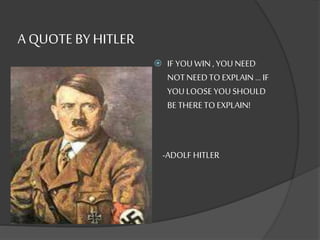
A QUOTE BY HITLER 
 IF YOU WIN , YOU NEED 
NOT NEED TO EXPLAIN … IF 
YOU LOOSE YOU SHOULD 
BE THERE TO EXPLAIN! 
-ADOLF HITLER
CLICK TO GO CONTENTS 
BIRTH OF A TITAN 
 At 6:30 p.m. on the evening of April 20, 1889, he was born in the 
small Austrian village of Braunau Am Inn just across the border 
from German Bavaria. 
 Adolf Hitler would one day lead a movement that placed supreme 
importance on a person's family tree even making it a matter of life 
and death. However, his own family tree was quite mixed up and 
would be a lifelong source of embarrassment and concern to him. 
 His father, Alois, was born in 1837. He was the illegitimate son of 
Maria Anna Schicklgruber and her unknown mate, which may have 
been someone from the neighborhood or a poor millworker named 
Johann Georg Hiedler. It is also remotely possible Adolf Hitler's 
grandfather was Jewish. 
 Maria Schicklgruber was said to have been employed as a cook in 
the household of a wealthy Jewish family named Frankenberger. 
There is some speculation their 19-year-old son got her pregnant 
and regularly sent her money after the birth of Alois. 
 Adolf Hitler would never know for sure just who his grandfather 
was.
CLICK TO GO CONTENTS 
HITLER’S CHILDHOOD 
 though Adolf Hitler would grow up to be one of the most 
well-known political leaders of all time, he had very humble 
beginnings. Looking at his youth, it's difficult to pinpoint 
where he began to have the deeply disturbing anti-Semitic 
tendencies that would pervade his every action as Germany's 
dictator. Adolf Hitler was born on April 20, 1889. He was 
born in Austria-Hungry. Hitler's parents, Alois Hitler and 
Klara Polzl had six children, though only Hitler and a single 
sister would survive to become adults. Hitler's early 
childhood was very difficult because his father was abusive 
to his entire family. 
Looking back, it's possible to credit Hitler's earliest 
childhood with many of his character flaws. It's well-known 
today that abusive parents tend to breed children who are 
also cruel and abusive. It is interesting to note that Hitler 
was ashamed enough of his childhood to attempt to lie about 
it. In Mein Kamph, he paints his upbringing as very idyllic, 
describing a doting mother and responsible father. With all 
evidence pointing to the contrary, it seems that this was
CLICK TO GO CONTENTS 
EDUCATION 
 Adolf Hitler considered education to be a very 
important factor in Nazi Germany. When he 
wrote Mein Kampf while serving out a prison sentence 
at Landsberg, Hitler wrote “whoever has the youth 
has the future”. In Hitler’s Germany, education would 
be the key that ensured that he had “the youth” of 
Germany. 
 Hitler’s view on education was that it served a sole 
purpose – to ensure that a child was loyal to the Nazi 
state to ensure that the Third Reich lasted for 1000 
years. A lot of the Nazi education system also 
reflected Hitler’s educational experiences. After his 
failure to get into the Academy of Fine Arts in Vienna 
Hitler developed a loathing of intellectuals who in his 
opinion based their teaching on what could be learned 
behind desks or in lectures halls. Hitler wrote that 
the first duty of the state was to care for the 
physical well-being and physical development of the 
young: 
 “The whole education in a national state must aim first 
of all not at stuffing the student with mere knowledge
CLICK TO GO CONTENTS 
FAMILY 
 PARENTS 
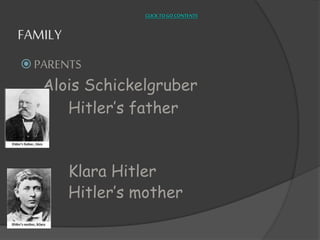
Alois Schickelgruber 
Hitler’s father 
Klara Hitler 
Hitler’s mother
CLICK TO GO CONTENT 
THE GERMAN ARMY 
 The German offensive against Moscow was proving to be a 
disaster. A perimeter had been established by the Soviets 
200 miles from the city—and the Germans couldn't break 
through. The harsh winter weather—with temperatures 
often dropping to 31 degrees below zero—had virtually 
frozen German tanks in their tracks. Soviet General Georgi 
Zhukov had unleashed a ferocious counteroffensive of 
infantry, tanks, and planes that had forced the flailing 
Germans into retreat. In short, the Germans were being 
beaten for the first time in the war, and the toll to their 
collective psyche was great. "The myth of the invincibility of 
the German army was broken," German General Franz Halder 
would write later. 
 But Hitler refused to accept this notion. He began removing 
officers from their command. General Fedor von Bock, who 
had been suffering severe stomach pains and who on 
December 1 had complained to Halder that he was no longer 
able to "operate" with his debilitated troops, was replaced 
by General Hans von Kluge, whose own 4th Army had been 
pushed into permanent retreat from Moscow. General Karl 
von Runstedt was relieved of the southern armies because 
he had retreated from Rostov. Hitler clearly did not believe 
in giving back captured territory, so in the biggest shake-up 
of all, he declared himself commander in chief of the army.
CLICK TO GO CONTENTS 
CAREER 
 After Hitler became the leader of the Nazi party, he quickly began 
acquiring paramilitary-like titles and using Nazi Party paramilitary 
uniforms to denote his position. Hitler's main title within the Nazi 
party was simply that of Führer and there was never any special 
uniform designed for Hitler's position, although a rank pin for a 
civilian lapel (used by Hitler until 1934) was known as the "Eagle of 
Sovereignty Pin". Hitler ceased wearing this pin after the Night oF 
Long Knives due to widespread issuance of the Golden Party 
Badge and Hitler's preference for this decoration. 
 The brown Nazi Party uniform that Hitler is most often associated 
with was a paramilitary uniform of the SA and denoted Hitler's 
position as Oberste SA-FührerIn the late 1920s, Hitler occasionally 
wore a black uniform, but this was during a period when Hitler was 
emulating Benito Mussolini. Hitler's admiration for the Italian 
dictator later faded as Germany became more powerful than her 
Italian ally and Mussolini was, in the end, looked down upon by 
Hitler as a puppet-dictator under German control. 
 From 1933 to 1934, Hitler held the political position as Chancellor 
of Germany and it is during this period that Hitler is most often 
seen in newsreels and photographs as wearing civilian clothes. After 
the death of the President of Germany Paul von Hindenburg. Hitler 
declared himself Führer und Reichskanzler (Leader and Reich 
Chancellor) by combining the offices of the President, and of that 
of Chancellor, and adopted a brown uniform, similar to his earlier 
SA uniform, but with a much cleaner cut.
CLICK TO GO CONTENTS 
NAZISM 
 Nazism, or National Socialism in full (German: Nationalsozialismus), is the 
ideology and practice associated with the 20th-century German Nazi 
Party and state as well as other related far-right groups. It was also 
contemporaneous or promoted in other European countries, particularly those 
with large ethnic German communities such 
as Czechoslovakia, Hungary, Romania and Yugoslavia 
 German Nazism subscribed to theories of racial hierarchy and social Darwinism, 
asserted the superiority of an Aryan master race, and criticised 
both capitalism and communism for being associated with Jewish materialism. It 
aimed to overcome social divisions, with all parts of a racially homogenous 
society cooperating for national unity and regeneration and to secure territorial 
enlargement at the expense of supposedly inferior neighbouring nations. The use 
of the name “National Socialism” arose out of earlier attempts by German right-wing 
figures to create a nationalist redefinition of “socialism”, as a reactionary 
alternative to both internationalist Marxist socialism and free market capitalism. 
This involved the idea of uniting rich and poor Germans for a common national 
project without eliminating class differences (a concept known as 
"Volksgemeinschaft”, or "people's community"), and promoted the subordination 
of individuals and groups to the needs of the nation, state and leader. National 
Socialism rejected the Marxist concept of class struggle, opposed ideas of 
equality and international solidarity, and sought to defend private property.
CLICK TO GO CONTENTS 
NAZISM PARTY RISE TO POWER 
 Hitler and the Nazi Party rose to power due to the social 
and political circumstances that characterized the 
interwar period in Germany. Many Germans could not 
concede their country’s defeat in World War I, arguing 
that “backstabbing” and weakness in the rear had 
paralyzed and, eventually, caused the front to collapse. 
The Jews, they claimed, had done much to spread 
defeatism and thus destroy the German army. Democracy 
in the Weimar Republic, they argued, was a form of 
governance that had been imposed on Germany and was 
unsuited to the German nature and way of life. They 
construed the terms of the Versailles peace treaty and 
the steep compensation payments that it entailed as 
revenge by the victors and a glaring injustice. This 
frustration, together with intransigent resistance and 
warnings about the surging menace of Communism, 
created fertile soil for the growth of radical right-wing 
groups in Germany, spawning entities such as the Nazi 
Party.
CLICK TO GO CONTENT 
DICTATORSHIP 
 Nazi Germany under the leadership of Hitler soon 
became a dictatorship. A dictatorship requires one 
person and one party to be in control of a nation 
and a climate of fear - this was provided 
by Himmler's SS. Personal freedom disappeared 
in Nazi Germany. 
 When Hitler was appointed chancellor on January 
30th 1933, it was at the head of a coalition 
government. It was very clear in his mind that it 
would not remain this way for long. By the end of 
March 1933, he had acquired much greater powers 
than the former leading politicians of the Weimar 
Republic could ever have foreseen when they 
supported his appointment as chancellor. The death 
of President Hindenburg in August 1934, allowed 
him to combine both chancellor's and president's 
positions into one when Hitler became the Fuehrer 
and Reich Chancellor.
CLICK TO GO CONTENT 
WORLD WAR II 
 Because of his experiences in Vienna, World War One, the M�nich 
putsch and in prison, Adolf Hitler dreamed of building a vast German 
Empire sprawling across Central and Eastern 
Europe. Lebensraum could only be obtained and sustained by waging a 
war of conquest against the Soviet Union: German security demanded 
it and Hitler's racial ideology required it. War, then, was essential. 
It was essential to Hitler the man as well as essential to Hitler's 
dream of a new Germany. In the end, most historians have reached 
the consensus that World War Two was Hitler's war (for more on 
Hitler, see Lecture 9 and Lecture 10). Unfortunately, although most 
western statAesmen had sufficient warning that Hitler was a threat 
to a general European peace, they failed to rally their people and 
take a stand until it was too late. In this respect, you could argue 
that the responsibility for World War Two ought to remain on the 
shoulders of Britain, France and the United States. 
 Following 1933 -- the year when Hitler consolidated his power as 
Chancellor through the Enabling Act -- Hitler implemented his 
foreign policy objectives. These objectives clearly violated the
CLICK TO GO CONTENT 
FALL OF HITLER 
 By July, 1944, the German military situation was 
desperate, and a group of high military and civil officials 
(including Field Marshal Erwin von Witzleben and 
Karl Goerdeler) attempted an assassination. Hitler 
escaped a bomb explosion with slight injuries; most of 
the plotters were executed. Although the war was 
hopelessly lost by early 1945, Hitler insisted that 
Germans fight on to the death. During the final German 
collapse in Apr., 1945, Hitler denounced Nazi leaders 
who wished to negotiate, and remained in Berlin when it 
was stormed by the Russians. 
 On Apr. 29 Hitler married his long-time mistress, 
Eva Braun, and on Apr. 30 they committed suicide 
together in an underground bunker of the chancellery 
building, having ordered that their bodies be burned. 
Hitler left Germany devastated; his legacy is the memory 
of one of the most dreadful tyrannies of modern times.
CLICK TO GO CONTENT 
MEIN KAMPF 
 Mein Kampf (pronounced [maɪ̯n kampf], "My 
Struggle") is 
an autobiographical manifesto by Nazi leader Adolf 
Hitler, in which he outlines his political ideology and 
future plans for Germany. Volume 1 of Mein 
Kampf was published in 1925 and Volume 2 in 
1926.The book was edited by the 
former Hieronymite friar Bernhard Stempfle, who 
was murdered during the Night of the Long Knives. 
 Hitler began dictating the book to his deputy Rudolf 
Hess while imprisoned for what he considered to be 
"political crimes" following his failed Putsch in 
Munich in November 1923. Although Hitler received 
many visitors initially, he soon devoted himself 
entirely to the book. As he continued, Hitler 
realized that it would have to be a two-volume 
work, with the first volume scheduled for release in 
early 1925.
CLICK TO GO CONTENT 
DEATH 
 Adolf Hitler committed suicide by gunshot 
on 30 April 1945 in his Führerbunker in 
Berlin. His wife Eva (née Braun) committed 
suicide with him by ingesting cyanide. That 
afternoon, in accordance with Hitler's prior 
instructions, their remains were carried up 
the stairs through the bunker's emergency 
exit, doused in petrol, and set alight in 
the Reich Chancellery garden outside the 
bunker. Records in the Soviet archives 
show that their burnt remains were 
recovered and interred in successive 
locations until 1970, when they were again 
exhumed, cremated, and the ashes 
scattered.
Nazism & hitler
Nazism & hitler

Nazism & hitler

  • 1.
    BY/ SANGEETH RAJ HARI.V JOHN GEORGE LIVIN VARGHEESE
  • 2.
    CONTENTS ADOLF HITLER& NAZISM  BIRTH  CHILDHOOD  EDUCATION  FAMILY  CAREER  THE GERMAN ARMY  NAZISM  NAZISM PARTY RISE TO POWER  DICTATORSHIP  WORLD WAR II  FALL OF HITLER  MEIN KAMPF  DEATH
  • 3.
    A QUOTE BYHITLER  IF YOU WIN , YOU NEED NOT NEED TO EXPLAIN … IF YOU LOOSE YOU SHOULD BE THERE TO EXPLAIN! -ADOLF HITLER
  • 4.
    CLICK TO GOCONTENTS BIRTH OF A TITAN  At 6:30 p.m. on the evening of April 20, 1889, he was born in the small Austrian village of Braunau Am Inn just across the border from German Bavaria.  Adolf Hitler would one day lead a movement that placed supreme importance on a person's family tree even making it a matter of life and death. However, his own family tree was quite mixed up and would be a lifelong source of embarrassment and concern to him.  His father, Alois, was born in 1837. He was the illegitimate son of Maria Anna Schicklgruber and her unknown mate, which may have been someone from the neighborhood or a poor millworker named Johann Georg Hiedler. It is also remotely possible Adolf Hitler's grandfather was Jewish.  Maria Schicklgruber was said to have been employed as a cook in the household of a wealthy Jewish family named Frankenberger. There is some speculation their 19-year-old son got her pregnant and regularly sent her money after the birth of Alois.  Adolf Hitler would never know for sure just who his grandfather was.
  • 5.
    CLICK TO GOCONTENTS HITLER’S CHILDHOOD  though Adolf Hitler would grow up to be one of the most well-known political leaders of all time, he had very humble beginnings. Looking at his youth, it's difficult to pinpoint where he began to have the deeply disturbing anti-Semitic tendencies that would pervade his every action as Germany's dictator. Adolf Hitler was born on April 20, 1889. He was born in Austria-Hungry. Hitler's parents, Alois Hitler and Klara Polzl had six children, though only Hitler and a single sister would survive to become adults. Hitler's early childhood was very difficult because his father was abusive to his entire family. Looking back, it's possible to credit Hitler's earliest childhood with many of his character flaws. It's well-known today that abusive parents tend to breed children who are also cruel and abusive. It is interesting to note that Hitler was ashamed enough of his childhood to attempt to lie about it. In Mein Kamph, he paints his upbringing as very idyllic, describing a doting mother and responsible father. With all evidence pointing to the contrary, it seems that this was
  • 6.
    CLICK TO GOCONTENTS EDUCATION  Adolf Hitler considered education to be a very important factor in Nazi Germany. When he wrote Mein Kampf while serving out a prison sentence at Landsberg, Hitler wrote “whoever has the youth has the future”. In Hitler’s Germany, education would be the key that ensured that he had “the youth” of Germany.  Hitler’s view on education was that it served a sole purpose – to ensure that a child was loyal to the Nazi state to ensure that the Third Reich lasted for 1000 years. A lot of the Nazi education system also reflected Hitler’s educational experiences. After his failure to get into the Academy of Fine Arts in Vienna Hitler developed a loathing of intellectuals who in his opinion based their teaching on what could be learned behind desks or in lectures halls. Hitler wrote that the first duty of the state was to care for the physical well-being and physical development of the young:  “The whole education in a national state must aim first of all not at stuffing the student with mere knowledge
  • 7.
    CLICK TO GOCONTENTS FAMILY  PARENTS Alois Schickelgruber Hitler’s father Klara Hitler Hitler’s mother
  • 8.
    CLICK TO GOCONTENT THE GERMAN ARMY  The German offensive against Moscow was proving to be a disaster. A perimeter had been established by the Soviets 200 miles from the city—and the Germans couldn't break through. The harsh winter weather—with temperatures often dropping to 31 degrees below zero—had virtually frozen German tanks in their tracks. Soviet General Georgi Zhukov had unleashed a ferocious counteroffensive of infantry, tanks, and planes that had forced the flailing Germans into retreat. In short, the Germans were being beaten for the first time in the war, and the toll to their collective psyche was great. "The myth of the invincibility of the German army was broken," German General Franz Halder would write later.  But Hitler refused to accept this notion. He began removing officers from their command. General Fedor von Bock, who had been suffering severe stomach pains and who on December 1 had complained to Halder that he was no longer able to "operate" with his debilitated troops, was replaced by General Hans von Kluge, whose own 4th Army had been pushed into permanent retreat from Moscow. General Karl von Runstedt was relieved of the southern armies because he had retreated from Rostov. Hitler clearly did not believe in giving back captured territory, so in the biggest shake-up of all, he declared himself commander in chief of the army.
  • 9.
    CLICK TO GOCONTENTS CAREER  After Hitler became the leader of the Nazi party, he quickly began acquiring paramilitary-like titles and using Nazi Party paramilitary uniforms to denote his position. Hitler's main title within the Nazi party was simply that of Führer and there was never any special uniform designed for Hitler's position, although a rank pin for a civilian lapel (used by Hitler until 1934) was known as the "Eagle of Sovereignty Pin". Hitler ceased wearing this pin after the Night oF Long Knives due to widespread issuance of the Golden Party Badge and Hitler's preference for this decoration.  The brown Nazi Party uniform that Hitler is most often associated with was a paramilitary uniform of the SA and denoted Hitler's position as Oberste SA-FührerIn the late 1920s, Hitler occasionally wore a black uniform, but this was during a period when Hitler was emulating Benito Mussolini. Hitler's admiration for the Italian dictator later faded as Germany became more powerful than her Italian ally and Mussolini was, in the end, looked down upon by Hitler as a puppet-dictator under German control.  From 1933 to 1934, Hitler held the political position as Chancellor of Germany and it is during this period that Hitler is most often seen in newsreels and photographs as wearing civilian clothes. After the death of the President of Germany Paul von Hindenburg. Hitler declared himself Führer und Reichskanzler (Leader and Reich Chancellor) by combining the offices of the President, and of that of Chancellor, and adopted a brown uniform, similar to his earlier SA uniform, but with a much cleaner cut.
  • 10.
    CLICK TO GOCONTENTS NAZISM  Nazism, or National Socialism in full (German: Nationalsozialismus), is the ideology and practice associated with the 20th-century German Nazi Party and state as well as other related far-right groups. It was also contemporaneous or promoted in other European countries, particularly those with large ethnic German communities such as Czechoslovakia, Hungary, Romania and Yugoslavia  German Nazism subscribed to theories of racial hierarchy and social Darwinism, asserted the superiority of an Aryan master race, and criticised both capitalism and communism for being associated with Jewish materialism. It aimed to overcome social divisions, with all parts of a racially homogenous society cooperating for national unity and regeneration and to secure territorial enlargement at the expense of supposedly inferior neighbouring nations. The use of the name “National Socialism” arose out of earlier attempts by German right-wing figures to create a nationalist redefinition of “socialism”, as a reactionary alternative to both internationalist Marxist socialism and free market capitalism. This involved the idea of uniting rich and poor Germans for a common national project without eliminating class differences (a concept known as "Volksgemeinschaft”, or "people's community"), and promoted the subordination of individuals and groups to the needs of the nation, state and leader. National Socialism rejected the Marxist concept of class struggle, opposed ideas of equality and international solidarity, and sought to defend private property.
  • 11.
    CLICK TO GOCONTENTS NAZISM PARTY RISE TO POWER  Hitler and the Nazi Party rose to power due to the social and political circumstances that characterized the interwar period in Germany. Many Germans could not concede their country’s defeat in World War I, arguing that “backstabbing” and weakness in the rear had paralyzed and, eventually, caused the front to collapse. The Jews, they claimed, had done much to spread defeatism and thus destroy the German army. Democracy in the Weimar Republic, they argued, was a form of governance that had been imposed on Germany and was unsuited to the German nature and way of life. They construed the terms of the Versailles peace treaty and the steep compensation payments that it entailed as revenge by the victors and a glaring injustice. This frustration, together with intransigent resistance and warnings about the surging menace of Communism, created fertile soil for the growth of radical right-wing groups in Germany, spawning entities such as the Nazi Party.
  • 12.
    CLICK TO GOCONTENT DICTATORSHIP  Nazi Germany under the leadership of Hitler soon became a dictatorship. A dictatorship requires one person and one party to be in control of a nation and a climate of fear - this was provided by Himmler's SS. Personal freedom disappeared in Nazi Germany.  When Hitler was appointed chancellor on January 30th 1933, it was at the head of a coalition government. It was very clear in his mind that it would not remain this way for long. By the end of March 1933, he had acquired much greater powers than the former leading politicians of the Weimar Republic could ever have foreseen when they supported his appointment as chancellor. The death of President Hindenburg in August 1934, allowed him to combine both chancellor's and president's positions into one when Hitler became the Fuehrer and Reich Chancellor.
  • 13.
    CLICK TO GOCONTENT WORLD WAR II  Because of his experiences in Vienna, World War One, the M�nich putsch and in prison, Adolf Hitler dreamed of building a vast German Empire sprawling across Central and Eastern Europe. Lebensraum could only be obtained and sustained by waging a war of conquest against the Soviet Union: German security demanded it and Hitler's racial ideology required it. War, then, was essential. It was essential to Hitler the man as well as essential to Hitler's dream of a new Germany. In the end, most historians have reached the consensus that World War Two was Hitler's war (for more on Hitler, see Lecture 9 and Lecture 10). Unfortunately, although most western statAesmen had sufficient warning that Hitler was a threat to a general European peace, they failed to rally their people and take a stand until it was too late. In this respect, you could argue that the responsibility for World War Two ought to remain on the shoulders of Britain, France and the United States.  Following 1933 -- the year when Hitler consolidated his power as Chancellor through the Enabling Act -- Hitler implemented his foreign policy objectives. These objectives clearly violated the
  • 14.
    CLICK TO GOCONTENT FALL OF HITLER  By July, 1944, the German military situation was desperate, and a group of high military and civil officials (including Field Marshal Erwin von Witzleben and Karl Goerdeler) attempted an assassination. Hitler escaped a bomb explosion with slight injuries; most of the plotters were executed. Although the war was hopelessly lost by early 1945, Hitler insisted that Germans fight on to the death. During the final German collapse in Apr., 1945, Hitler denounced Nazi leaders who wished to negotiate, and remained in Berlin when it was stormed by the Russians.  On Apr. 29 Hitler married his long-time mistress, Eva Braun, and on Apr. 30 they committed suicide together in an underground bunker of the chancellery building, having ordered that their bodies be burned. Hitler left Germany devastated; his legacy is the memory of one of the most dreadful tyrannies of modern times.
  • 15.
    CLICK TO GOCONTENT MEIN KAMPF  Mein Kampf (pronounced [maɪ̯n kampf], "My Struggle") is an autobiographical manifesto by Nazi leader Adolf Hitler, in which he outlines his political ideology and future plans for Germany. Volume 1 of Mein Kampf was published in 1925 and Volume 2 in 1926.The book was edited by the former Hieronymite friar Bernhard Stempfle, who was murdered during the Night of the Long Knives.  Hitler began dictating the book to his deputy Rudolf Hess while imprisoned for what he considered to be "political crimes" following his failed Putsch in Munich in November 1923. Although Hitler received many visitors initially, he soon devoted himself entirely to the book. As he continued, Hitler realized that it would have to be a two-volume work, with the first volume scheduled for release in early 1925.
  • 16.
    CLICK TO GOCONTENT DEATH  Adolf Hitler committed suicide by gunshot on 30 April 1945 in his Führerbunker in Berlin. His wife Eva (née Braun) committed suicide with him by ingesting cyanide. That afternoon, in accordance with Hitler's prior instructions, their remains were carried up the stairs through the bunker's emergency exit, doused in petrol, and set alight in the Reich Chancellery garden outside the bunker. Records in the Soviet archives show that their burnt remains were recovered and interred in successive locations until 1970, when they were again exhumed, cremated, and the ashes scattered.