Working Capital Management &  Cash Flow Analysis Anjana Vivek   Ketoki Basu www.venturebean.com   www.finexsolutions.com [email_address]   [email_address]
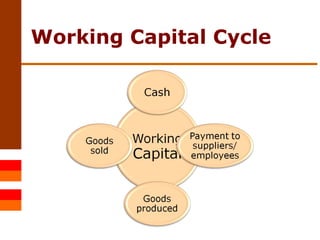
Working Capital Cycle
Working Capital Cycle What does it measure? Moment business starts investing in a business to the time when business receives payment for that product/service. Why is it important? A good management of working capital balances incoming and outgoing to maximize working capital
How can you maximize working capital? Determine time lag between each item  Identify items with long time lag Reduce time lag Cycle is critical for success in some types of business. Eg. - retail, consumer goods and consumer goods manufacturer
Working capital changes due to Changes in operational activities/ level of sales Changes in company policy-internal Changes in business environment-external
Factors affecting working capital Nature of business Production cycle Business cycle and operations-efficiency Production policy Credit policy
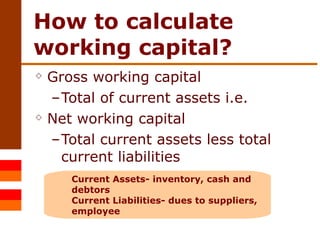
How to calculate working capital? Gross working capital Total of current assets i.e.  Net working capital Total current assets less total current liabilities Current Assets- inventory, cash and debtors Current Liabilities- dues to suppliers, employee
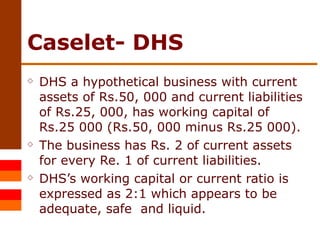
Caselet- DHS DHS a hypothetical business with current assets of Rs.50, 000 and current liabilities of Rs.25, 000, has working capital of Rs.25 000 (Rs.50, 000 minus Rs.25 000).  The business has Rs. 2 of current assets for every Re. 1 of current liabilities.  DHS’s working capital or current ratio is expressed as 2:1 which appears to be adequate, safe  and liquid.
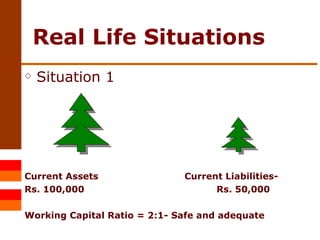
Real Life Situations Situation 1 Current Assets  Current Liabilities- Rs. 100,000 Rs. 50,000 Working Capital Ratio = 2:1- Safe and adequate
Real Life Situations Situation 2 Current Assets = Rs. 100,000 = Current Liabilities Working Capital Ratio = 1:1- Too low for businesses. But often the case in organizations with high turnover and low debtors- eg. supermarket
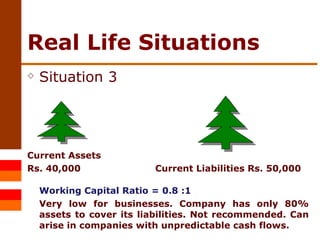
Real Life Situations Situation 3 Current Assets Rs. 40,000 Current Liabilities Rs. 50,000 Working Capital Ratio = 0.8 :1 Very low for businesses. Company has only 80% assets to cover its liabilities. Not recommended. Can arise in companies with unpredictable cash flows.
Cash Flow Movement of money in and out of your business Cycle of the inflow and outflow of cash determines your business solvency Cash flow analysis: To study the inflow and outflow of cash of the business to maintain adequate cash balance Study each component of cash cycle and determine how to increase efficiency
Cash flow: importance Similar to a bank statement- deposits and withdrawals Importance is not only cash flow but also timing
Cash Flow From Operations Principal revenue producing activities and others that are not investing or financing From Investing Acquisition and disposal of long-term assets and other investments which are not short term From Financing Result in changes in equity and borrowings of enterprise
Cash from operational activities Earning from operations before deducting income tax, depreciation and amortization Deduct income tax Adjust for movement in working capital Increase in Debtors/ Inventory – money has not come in-reduces cash Decrease in Debtors/ Inventory- money has been collected-increases cash Increase in Supplier dues- money has not gone out- cash balance is high Decrease in Supplier dues- payment made- cash reduced
Cash from investing activities Assets purchased- money spent- cash balance down Assets sold- money comes in to increase cash balance New Investments made- money spent- decreases cash balance Investments liquidated- money comes in to increase cash balance Assets-  Computers, Software, Furniture, Building Investments-Bonds, Fixed Deposits
Cash from financing activities New loan taken- money comes in – cash balance goes up Loan repaid- payment made- cash moves out Interest paid on loan- cash balance reduces Capital contribution- inflow of cash
Quick solutions… to improve cash flow Invoice without delay Ask for an advance payment upfront- before you start a project Introduce rewards for quick payments Make all efforts to collect sales promptly Pay all your bills only when due
Close the cash flow gap Cash flow gap is when your cash inflows and cash outflows don’t keep pace with one another, leaving the business with cash shortage Common among small businesses Monitor closely- if total unpaid bills > sales due at the end of each month
Cash flow need Projection of future cash flow helps  i ntegrate short term and long term needs to anticipate surplus and deficits to plan helps compare actuals with budgets to make sure funds are available when needed Immediate solutions in cash crunch situations Increase borrowings, reschedule plans & payments, in worst case distress sale of assets
Inventories Raw material Work in progress Finished goods
Inventories Inventory balance to be maintained also depends on: Projected sales for each product Availability of raw material, supplies Storage space available Life of stock, based on expected obsolescence, deterioration
Accounts receivable: Motives for credit Financial - generally at higher sale price Operating -  eg. when inventory accumulates Contracting motive – eg. in warranty period Marketing motive - to push sales
Control on trade credit Mental attitude to credit control Clear practices as company policy, to be understood by executives, suppliers, customers Check on potential customer  Continuously review limits set for customer Invoice promptly, clearly Consider charging penalty, as per invoice
Control on trade credit Determine whether invoices are paid according to sales terms Status of unshipped orders to be known Determine total outstanding in any customers account Monitor total debtors accounts very closely Develop close links with large customers
Some possible problem areas Single large or key customer Improper credit judgement Poor collection procedures Lax enforcement of credit terms Delay in invoicing  Errors in invoicing Customer dissatisfaction
Accounts payable Trade credit vs bank credit Relatively shorter (30 - 90 days) Usually unsecured, more lenient in lending credit Amounts involved with individual suppliers usually smaller
Dues to creditors Purchase authorisation in company Purchase quantities to be planned based on financial & non-financial requirements Alternate sources of supply to be identified, shop for best deals, credit terms and dependence on single supplier If supplier defaults in delivery, what is the impact
Caselet :  MainLab - Cash Flow MainLab develops pharmaceutical products and has several patents to its credit. The company has grown fast, chiefly due to new products being developed and sold. The company does not pay dividend, but has a high P/E ratio. Due to very rapid growth, the company has experienced cash shortages and wants to improve this.
Caselet :  MainLab - Cash Flow Strategies suggested: Customers to pay within 30 days as against 60 days now allowed Reduce R&D expenditure by 20%. Evaluate this as  A short term creditor An investor
Caselet :  MachCo – Cur. Ratio MachCo owns many retail stores selling machinery and hardware. The current ratio in October is 1.7:1. This is lower than that of its competitors. To get better credit terms from suppliers, the company wants to improve this ratio to at least 2:1 by year end in December
Caselet :  MachCo – Cur. Ratio Strategies suggested: Pay some current liabilities Purchase inventory on account Offer debtors discount on quick payment Evaluate whether current ratio will increase or decrease in each case Propose some ethical steps to increase the current ratio before year end.
Thank you

Working Capital Management And Cash Flow Analysis 06.07

  • 1.
    Working Capital Management& Cash Flow Analysis Anjana Vivek Ketoki Basu www.venturebean.com www.finexsolutions.com [email_address] [email_address]
  • 2.
  • 3.
    Working Capital CycleWhat does it measure? Moment business starts investing in a business to the time when business receives payment for that product/service. Why is it important? A good management of working capital balances incoming and outgoing to maximize working capital
  • 4.
    How can youmaximize working capital? Determine time lag between each item Identify items with long time lag Reduce time lag Cycle is critical for success in some types of business. Eg. - retail, consumer goods and consumer goods manufacturer
  • 5.
    Working capital changesdue to Changes in operational activities/ level of sales Changes in company policy-internal Changes in business environment-external
  • 6.
    Factors affecting workingcapital Nature of business Production cycle Business cycle and operations-efficiency Production policy Credit policy
  • 7.
    How to calculateworking capital? Gross working capital Total of current assets i.e. Net working capital Total current assets less total current liabilities Current Assets- inventory, cash and debtors Current Liabilities- dues to suppliers, employee
  • 8.
    Caselet- DHS DHSa hypothetical business with current assets of Rs.50, 000 and current liabilities of Rs.25, 000, has working capital of Rs.25 000 (Rs.50, 000 minus Rs.25 000). The business has Rs. 2 of current assets for every Re. 1 of current liabilities. DHS’s working capital or current ratio is expressed as 2:1 which appears to be adequate, safe and liquid.
  • 9.
    Real Life SituationsSituation 1 Current Assets Current Liabilities- Rs. 100,000 Rs. 50,000 Working Capital Ratio = 2:1- Safe and adequate
  • 10.
    Real Life SituationsSituation 2 Current Assets = Rs. 100,000 = Current Liabilities Working Capital Ratio = 1:1- Too low for businesses. But often the case in organizations with high turnover and low debtors- eg. supermarket
  • 11.
    Real Life SituationsSituation 3 Current Assets Rs. 40,000 Current Liabilities Rs. 50,000 Working Capital Ratio = 0.8 :1 Very low for businesses. Company has only 80% assets to cover its liabilities. Not recommended. Can arise in companies with unpredictable cash flows.
  • 12.
    Cash Flow Movementof money in and out of your business Cycle of the inflow and outflow of cash determines your business solvency Cash flow analysis: To study the inflow and outflow of cash of the business to maintain adequate cash balance Study each component of cash cycle and determine how to increase efficiency
  • 13.
    Cash flow: importanceSimilar to a bank statement- deposits and withdrawals Importance is not only cash flow but also timing
  • 14.
    Cash Flow FromOperations Principal revenue producing activities and others that are not investing or financing From Investing Acquisition and disposal of long-term assets and other investments which are not short term From Financing Result in changes in equity and borrowings of enterprise
  • 15.
    Cash from operationalactivities Earning from operations before deducting income tax, depreciation and amortization Deduct income tax Adjust for movement in working capital Increase in Debtors/ Inventory – money has not come in-reduces cash Decrease in Debtors/ Inventory- money has been collected-increases cash Increase in Supplier dues- money has not gone out- cash balance is high Decrease in Supplier dues- payment made- cash reduced
  • 16.
    Cash from investingactivities Assets purchased- money spent- cash balance down Assets sold- money comes in to increase cash balance New Investments made- money spent- decreases cash balance Investments liquidated- money comes in to increase cash balance Assets- Computers, Software, Furniture, Building Investments-Bonds, Fixed Deposits
  • 17.
    Cash from financingactivities New loan taken- money comes in – cash balance goes up Loan repaid- payment made- cash moves out Interest paid on loan- cash balance reduces Capital contribution- inflow of cash
  • 18.
    Quick solutions… toimprove cash flow Invoice without delay Ask for an advance payment upfront- before you start a project Introduce rewards for quick payments Make all efforts to collect sales promptly Pay all your bills only when due
  • 19.
    Close the cashflow gap Cash flow gap is when your cash inflows and cash outflows don’t keep pace with one another, leaving the business with cash shortage Common among small businesses Monitor closely- if total unpaid bills > sales due at the end of each month
  • 20.
    Cash flow needProjection of future cash flow helps i ntegrate short term and long term needs to anticipate surplus and deficits to plan helps compare actuals with budgets to make sure funds are available when needed Immediate solutions in cash crunch situations Increase borrowings, reschedule plans & payments, in worst case distress sale of assets
  • 21.
    Inventories Raw materialWork in progress Finished goods
  • 22.
    Inventories Inventory balanceto be maintained also depends on: Projected sales for each product Availability of raw material, supplies Storage space available Life of stock, based on expected obsolescence, deterioration
  • 23.
    Accounts receivable: Motivesfor credit Financial - generally at higher sale price Operating - eg. when inventory accumulates Contracting motive – eg. in warranty period Marketing motive - to push sales
  • 24.
    Control on tradecredit Mental attitude to credit control Clear practices as company policy, to be understood by executives, suppliers, customers Check on potential customer Continuously review limits set for customer Invoice promptly, clearly Consider charging penalty, as per invoice
  • 25.
    Control on tradecredit Determine whether invoices are paid according to sales terms Status of unshipped orders to be known Determine total outstanding in any customers account Monitor total debtors accounts very closely Develop close links with large customers
  • 26.
    Some possible problemareas Single large or key customer Improper credit judgement Poor collection procedures Lax enforcement of credit terms Delay in invoicing Errors in invoicing Customer dissatisfaction
  • 27.
    Accounts payable Tradecredit vs bank credit Relatively shorter (30 - 90 days) Usually unsecured, more lenient in lending credit Amounts involved with individual suppliers usually smaller
  • 28.
    Dues to creditorsPurchase authorisation in company Purchase quantities to be planned based on financial & non-financial requirements Alternate sources of supply to be identified, shop for best deals, credit terms and dependence on single supplier If supplier defaults in delivery, what is the impact
  • 29.
    Dues to creditorsPurchase authorisation in company Purchase quantities to be planned based on financial & non-financial requirements Alternate sources of supply to be identified, shop for best deals, credit terms and dependence on single supplier If supplier defaults in delivery, what is the impact
  • 30.
    Caselet : MainLab - Cash Flow MainLab develops pharmaceutical products and has several patents to its credit. The company has grown fast, chiefly due to new products being developed and sold. The company does not pay dividend, but has a high P/E ratio. Due to very rapid growth, the company has experienced cash shortages and wants to improve this.
  • 31.
    Caselet : MainLab - Cash Flow Strategies suggested: Customers to pay within 30 days as against 60 days now allowed Reduce R&D expenditure by 20%. Evaluate this as A short term creditor An investor
  • 32.
    Caselet : MachCo – Cur. Ratio MachCo owns many retail stores selling machinery and hardware. The current ratio in October is 1.7:1. This is lower than that of its competitors. To get better credit terms from suppliers, the company wants to improve this ratio to at least 2:1 by year end in December
  • 33.
    Caselet : MachCo – Cur. Ratio Strategies suggested: Pay some current liabilities Purchase inventory on account Offer debtors discount on quick payment Evaluate whether current ratio will increase or decrease in each case Propose some ethical steps to increase the current ratio before year end.
  • 34.