Introduction to Engineering Economics
Dr. Mohsin Siddique
Assistant Professor
Email: msiddique@sharjah.ac.ae
Office: 0650509431
Date: 08/09/2014
Engineering Economics
University of Sharjah
Dept. of Civil and Env. Engg.
INTRODUCTION
DR. MOHSIN SIDDIQUE
Specialization:
Coastal Engineering, Hydraulic
Engineering, Sediment transport,
hydrodynamics, Numerical modeling,
Water resources
Education:
Ph.D. (2008-2011):
The University ofTokyo
M.Sc. (2005-2007):
The University ofTokyo
B.Sc. (2000-2004):
UET Lahore
Teaching Experiences:
Asst. Prof (9/2013~)
Asst. Prof (8/2012~9/2013): FAST NU
Asst. Prof (1/2012-8/2012): UET Lahore
Lecturer (12/2004~12/2011); UET
Lahore
• Contact Detail:
• Email: msiddique@sharjah.ac.ae
• Phone: 06-5050943
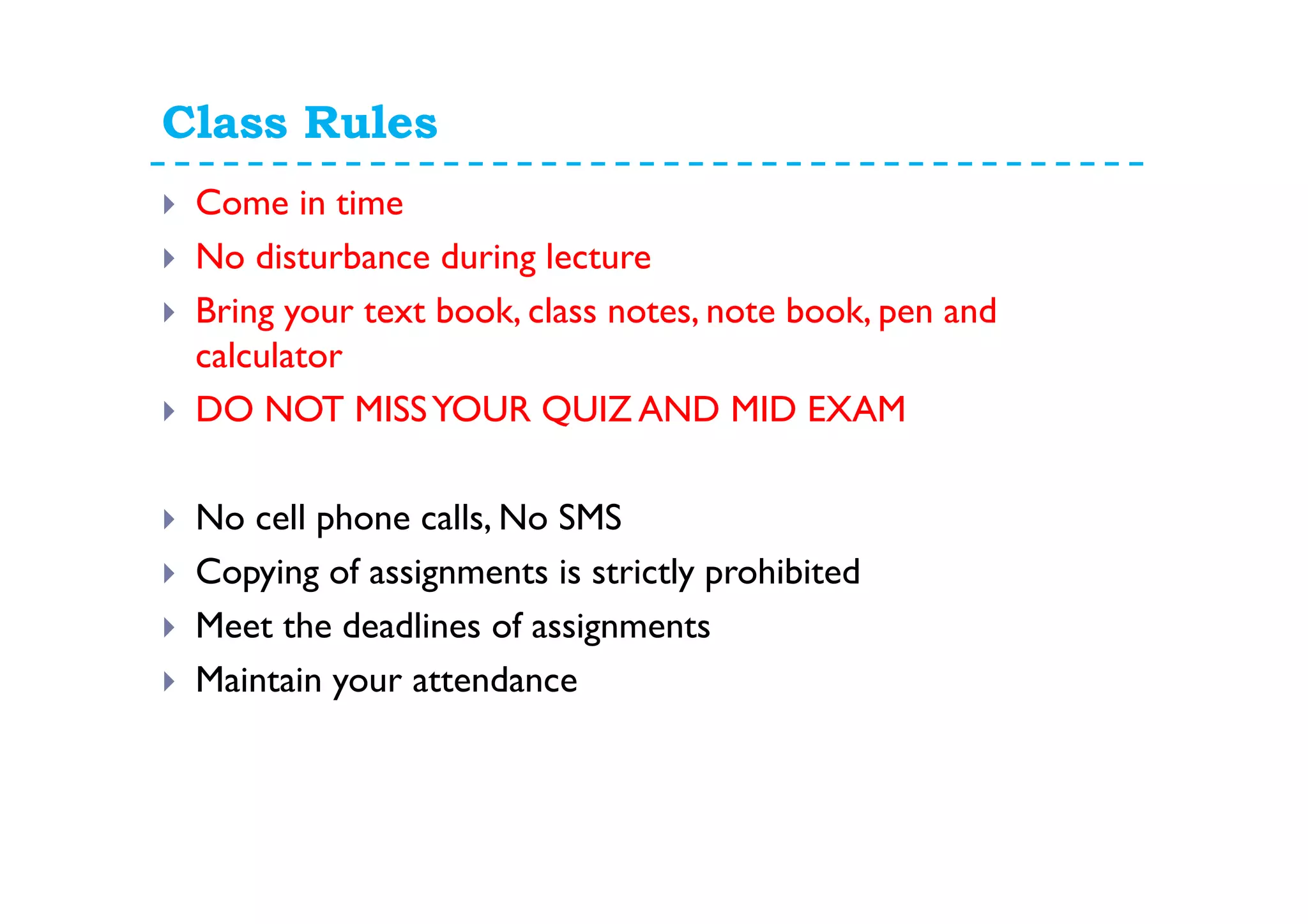
Class Rules
Come in time
No disturbance during lecture
Bring your text book, class notes, note book, pen and
calculator
DO NOT MISSYOUR QUIZ AND MID EXAM
No cell phone calls, No SMS
Copying of assignments is strictly prohibited
Meet the deadlines of assignments
Maintain your attendance
4
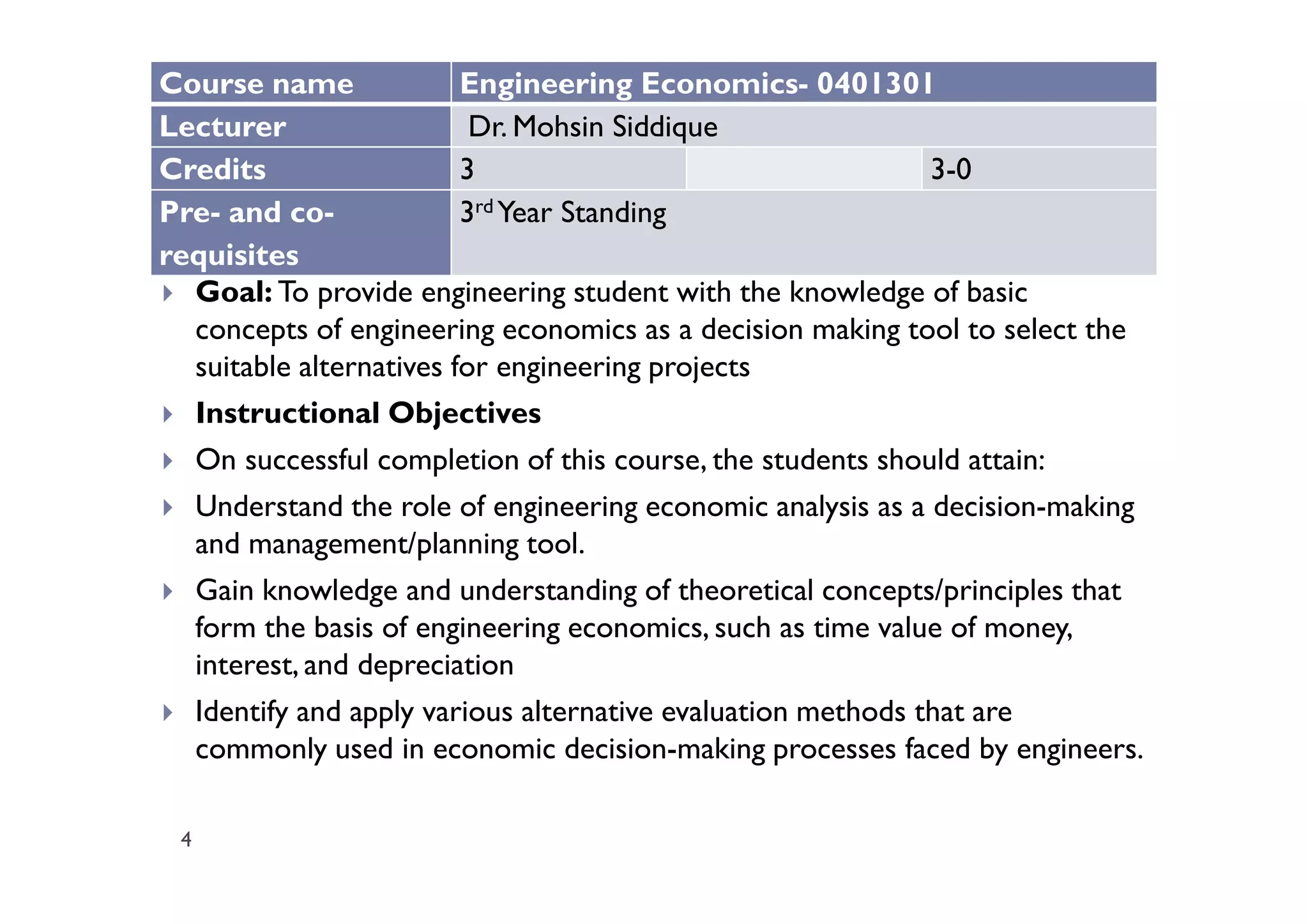
Course name Engineering Economics- 0401301
Lecturer Dr. Mohsin Siddique
Credits 3 3-0
Pre- and co-
requisites
3rd Year Standing
Goal: To provide engineering student with the knowledge of basic
concepts of engineering economics as a decision making tool to select the
suitable alternatives for engineering projects
Instructional Objectives
On successful completion of this course, the students should attain:
Understand the role of engineering economic analysis as a decision-making
and management/planning tool.
Gain knowledge and understanding of theoretical concepts/principles that
form the basis of engineering economics, such as time value of money,
interest, and depreciation
Identify and apply various alternative evaluation methods that are
commonly used in economic decision-making processes faced by engineers.
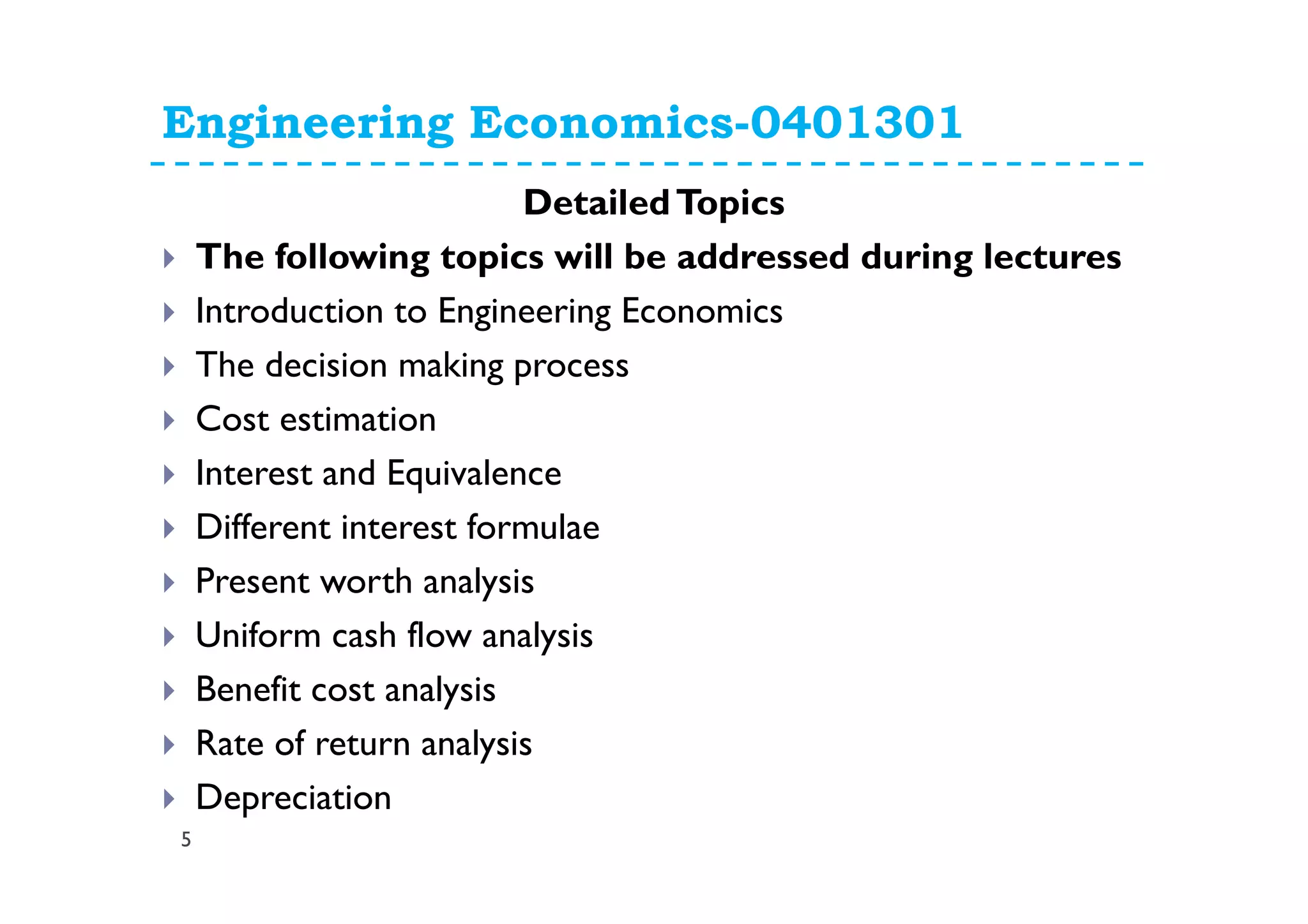
Engineering Economics-0401301
5
DetailedTopics
The following topics will be addressed during lectures
Introduction to Engineering Economics
The decision making process
Cost estimation
Interest and Equivalence
Different interest formulae
Present worth analysis
Uniform cash flow analysis
Benefit cost analysis
Rate of return analysis
Depreciation
Engineering Economics-0401301
6
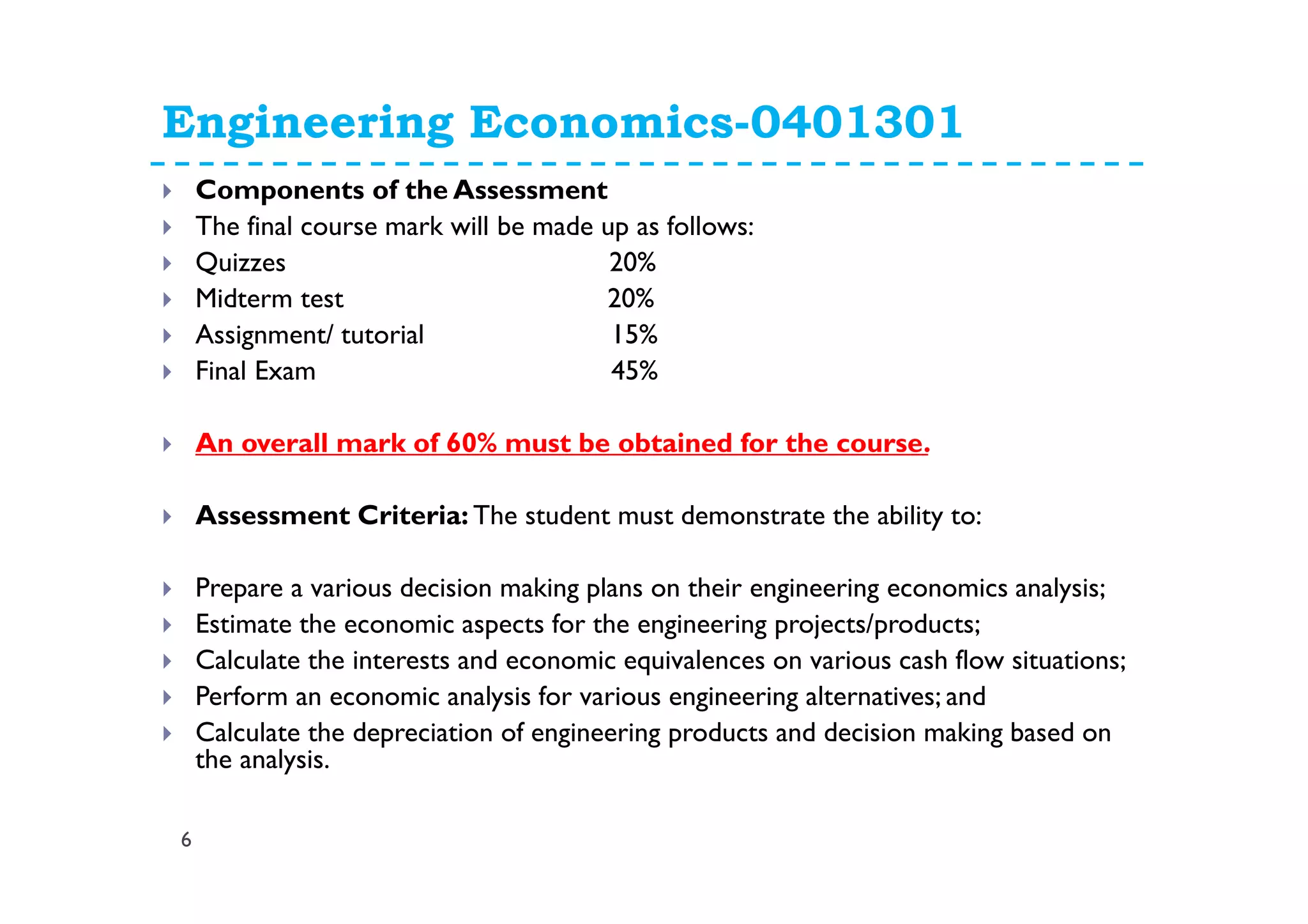
Components of the Assessment
The final course mark will be made up as follows:
Quizzes 20%
Midterm test 20%
Assignment/ tutorial 15%
Final Exam 45%
An overall mark of 60% must be obtained for the course.
Assessment Criteria: The student must demonstrate the ability to:
Prepare a various decision making plans on their engineering economics analysis;
Estimate the economic aspects for the engineering projects/products;
Calculate the interests and economic equivalences on various cash flow situations;
Perform an economic analysis for various engineering alternatives; and
Calculate the depreciation of engineering products and decision making based on
the analysis.
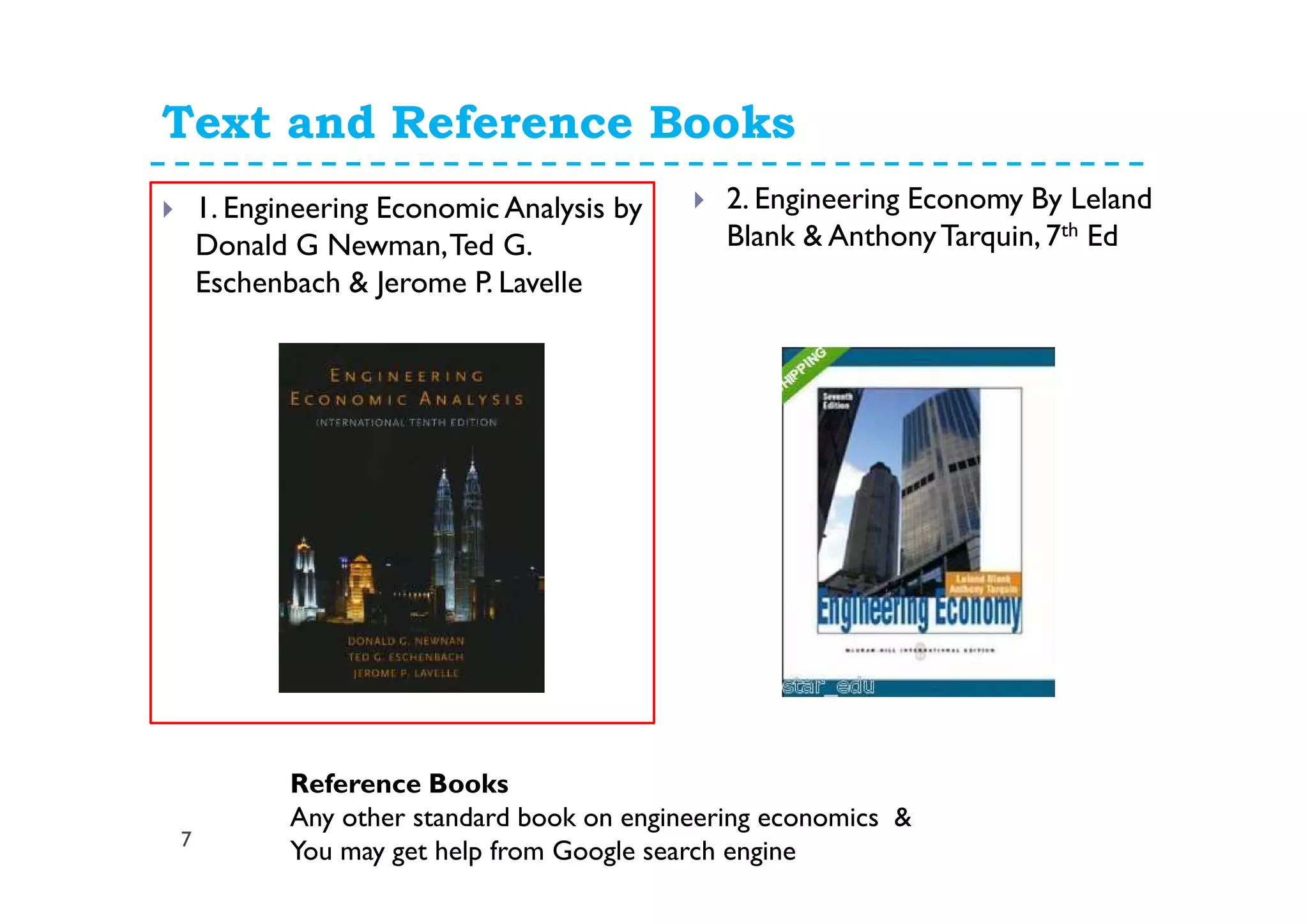
Text and Reference Books
7
2. Engineering Economy By Leland
Blank & AnthonyTarquin, 7th Ed
1. Engineering Economic Analysis by
Donald G Newman,Ted G.
Eschenbach & Jerome P. Lavelle
Reference Books
Any other standard book on engineering economics &
You may get help from Google search engine
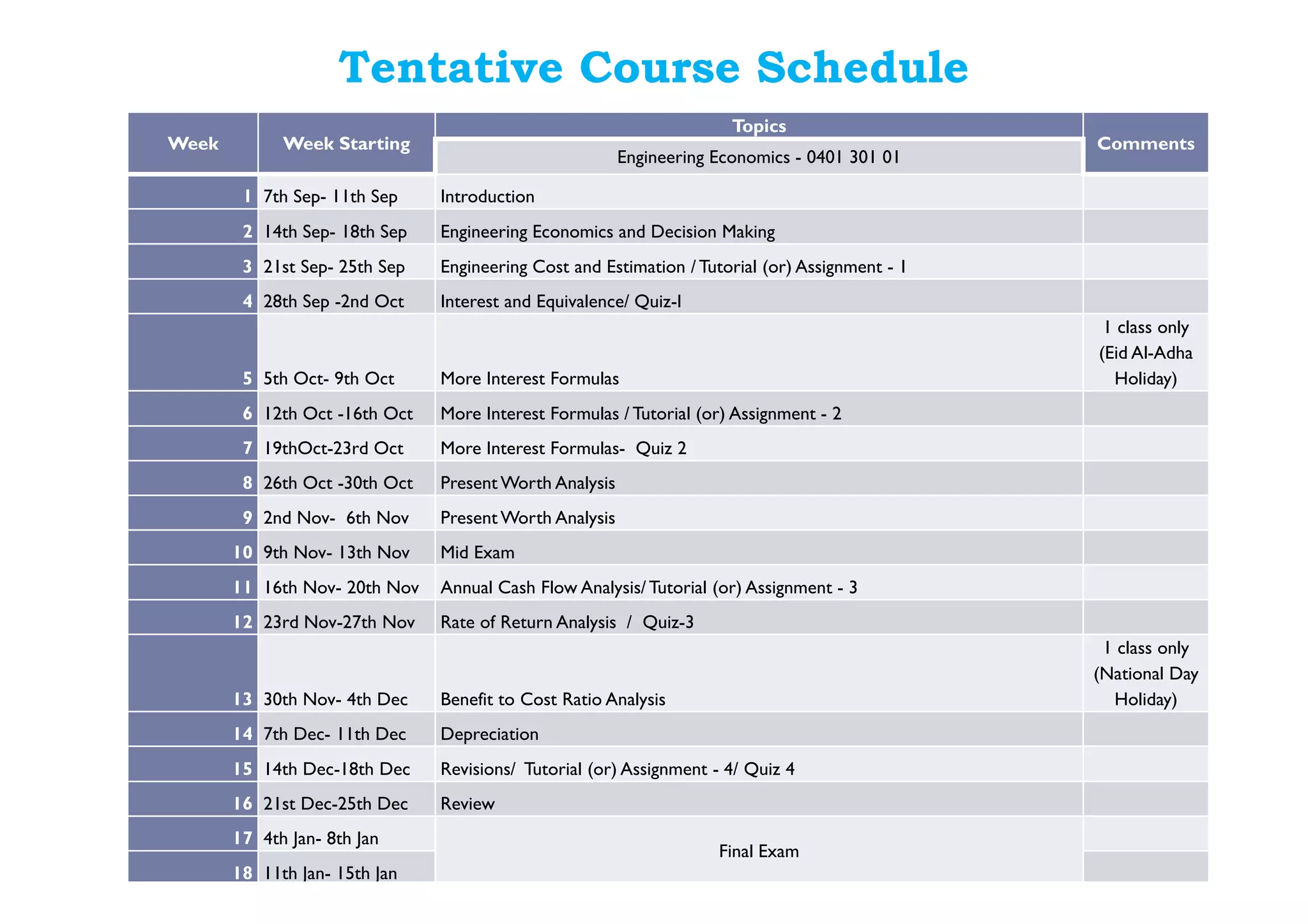
Tentative Course Schedule
8
Week Week Starting
Topics
Comments
Engineering Economics - 0401 301 01
1 7th Sep- 11th Sep Introduction
2 14th Sep- 18th Sep Engineering Economics and Decision Making
3 21st Sep- 25th Sep Engineering Cost and Estimation /Tutorial (or) Assignment - 1
4 28th Sep -2nd Oct Interest and Equivalence/ Quiz-I
5 5th Oct- 9th Oct More Interest Formulas
1 class only
(Eid Al-Adha
Holiday)
6 12th Oct -16th Oct More Interest Formulas / Tutorial (or) Assignment - 2
7 19thOct-23rd Oct More Interest Formulas- Quiz 2
8 26th Oct -30th Oct Present Worth Analysis
9 2nd Nov- 6th Nov Present Worth Analysis
10 9th Nov- 13th Nov Mid Exam
11 16th Nov- 20th Nov Annual Cash Flow Analysis/Tutorial (or) Assignment - 3
12 23rd Nov-27th Nov Rate of Return Analysis / Quiz-3
13 30th Nov- 4th Dec Benefit to Cost Ratio Analysis
1 class only
(National Day
Holiday)
14 7th Dec- 11th Dec Depreciation
15 14th Dec-18th Dec Revisions/ Tutorial (or) Assignment - 4/ Quiz 4
16 21st Dec-25th Dec Review
17 4th Jan- 8th Jan
Final Exam
18 11th Jan- 15th Jan
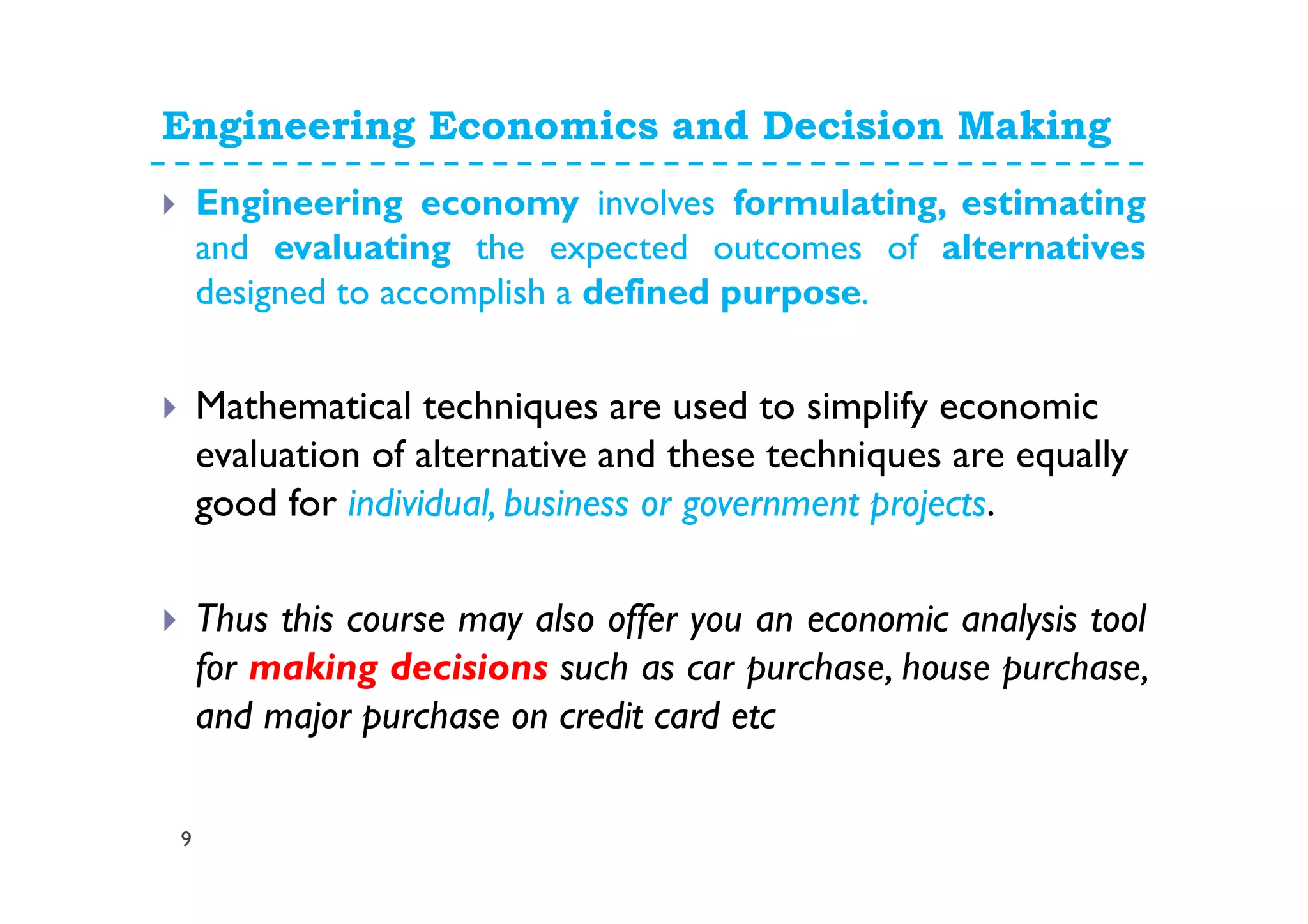
Engineering Economics and Decision Making
9
Engineering economy involves formulating, estimating
and evaluating the expected outcomes of alternatives
designed to accomplish a defined purpose.
Mathematical techniques are used to simplify economic
evaluation of alternative and these techniques are equally
good for individual, business or government projects.
Thus this course may also offer you an economic analysis tool
for making decisions such as car purchase, house purchase,
and major purchase on credit card etc
Engineering Economics and Decision Making
10
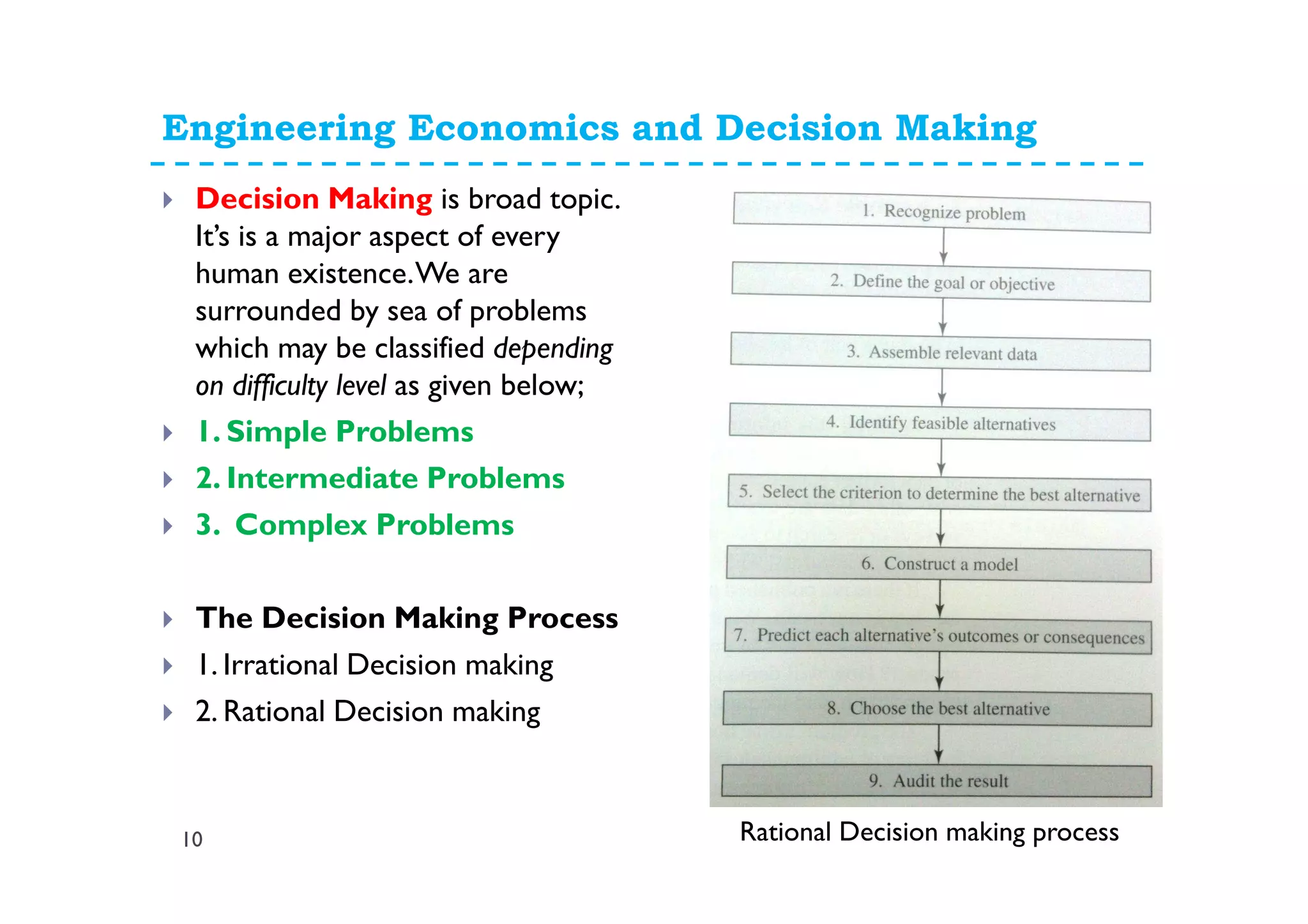
Decision Making is broad topic.
It’s is a major aspect of every
human existence.We are
surrounded by sea of problems
which may be classified depending
on difficulty level as given below;
1. Simple Problems
2. Intermediate Problems
3. Complex Problems
The Decision Making Process
1. Irrational Decision making
2. Rational Decision making
Rational Decision making process
Engineering Costs
11
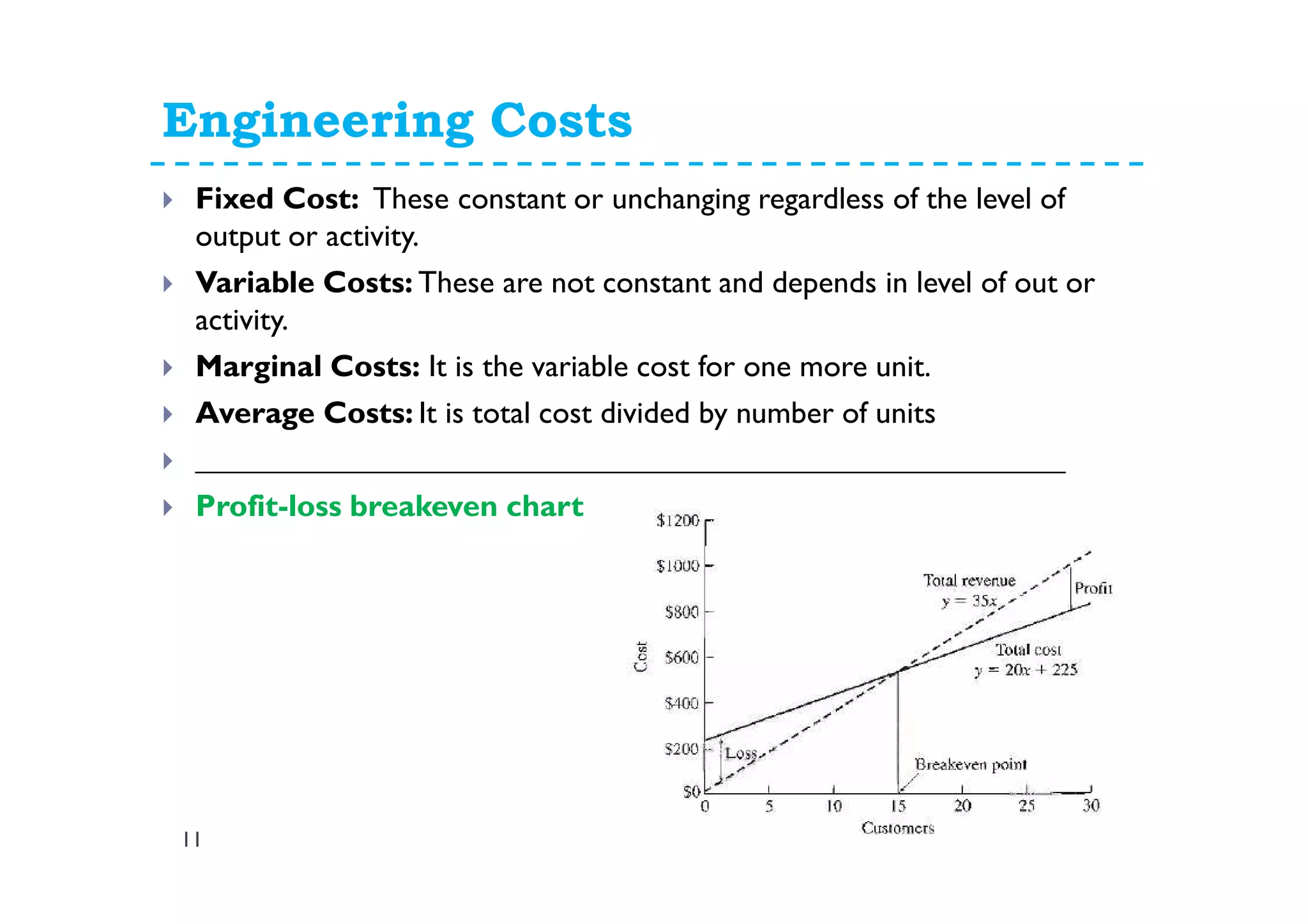
Fixed Cost: These constant or unchanging regardless of the level of
output or activity.
Variable Costs: These are not constant and depends in level of out or
activity.
Marginal Costs: It is the variable cost for one more unit.
Average Costs: It is total cost divided by number of units
________________________________________________________
Profit-loss breakeven chart
Engineering Costs
12
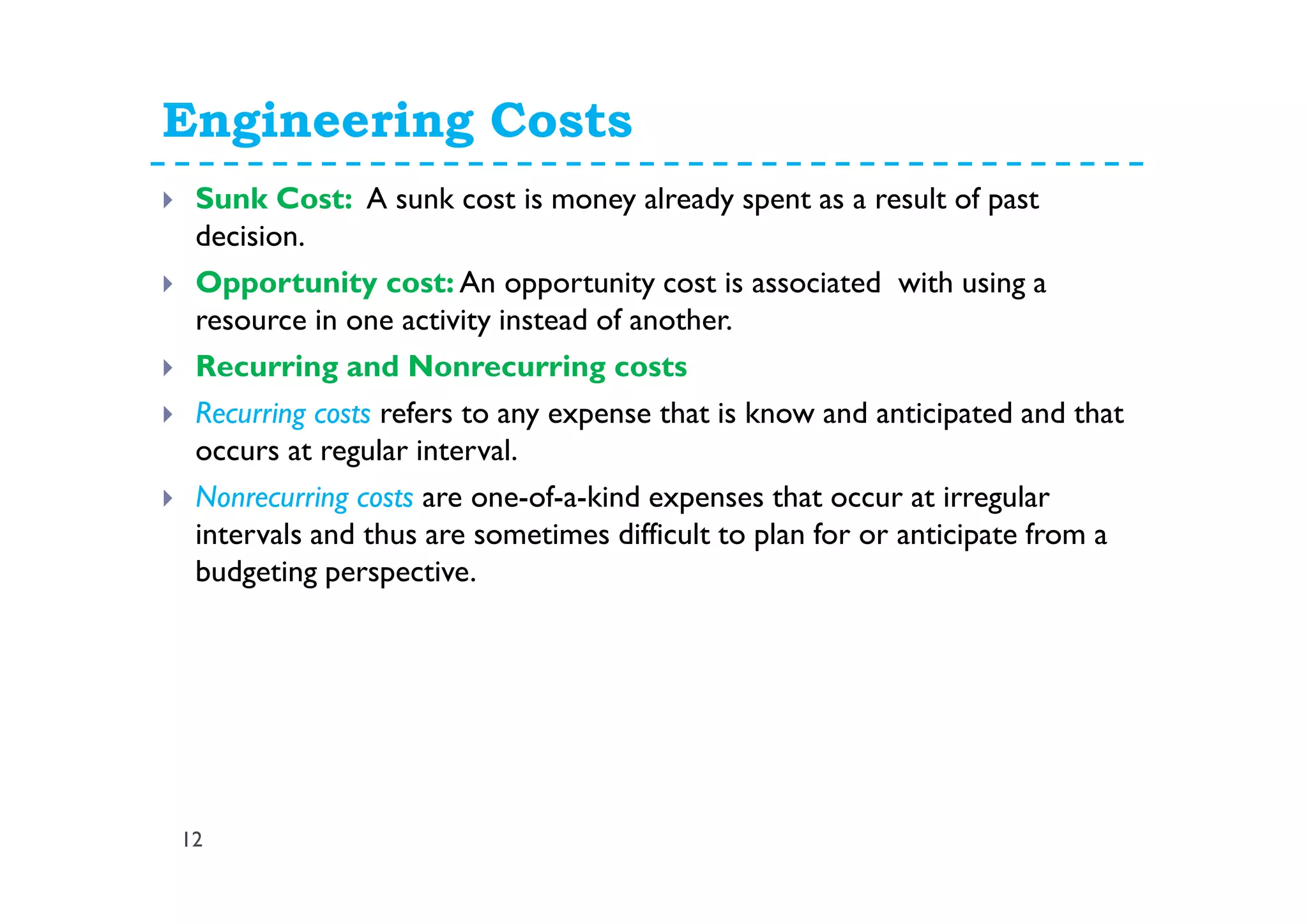
Sunk Cost: A sunk cost is money already spent as a result of past
decision.
Opportunity cost: An opportunity cost is associated with using a
resource in one activity instead of another.
Recurring and Nonrecurring costs
Recurring costs refers to any expense that is know and anticipated and that
occurs at regular interval.
Nonrecurring costs are one-of-a-kind expenses that occur at irregular
intervals and thus are sometimes difficult to plan for or anticipate from a
budgeting perspective.
Cost Estimating
13
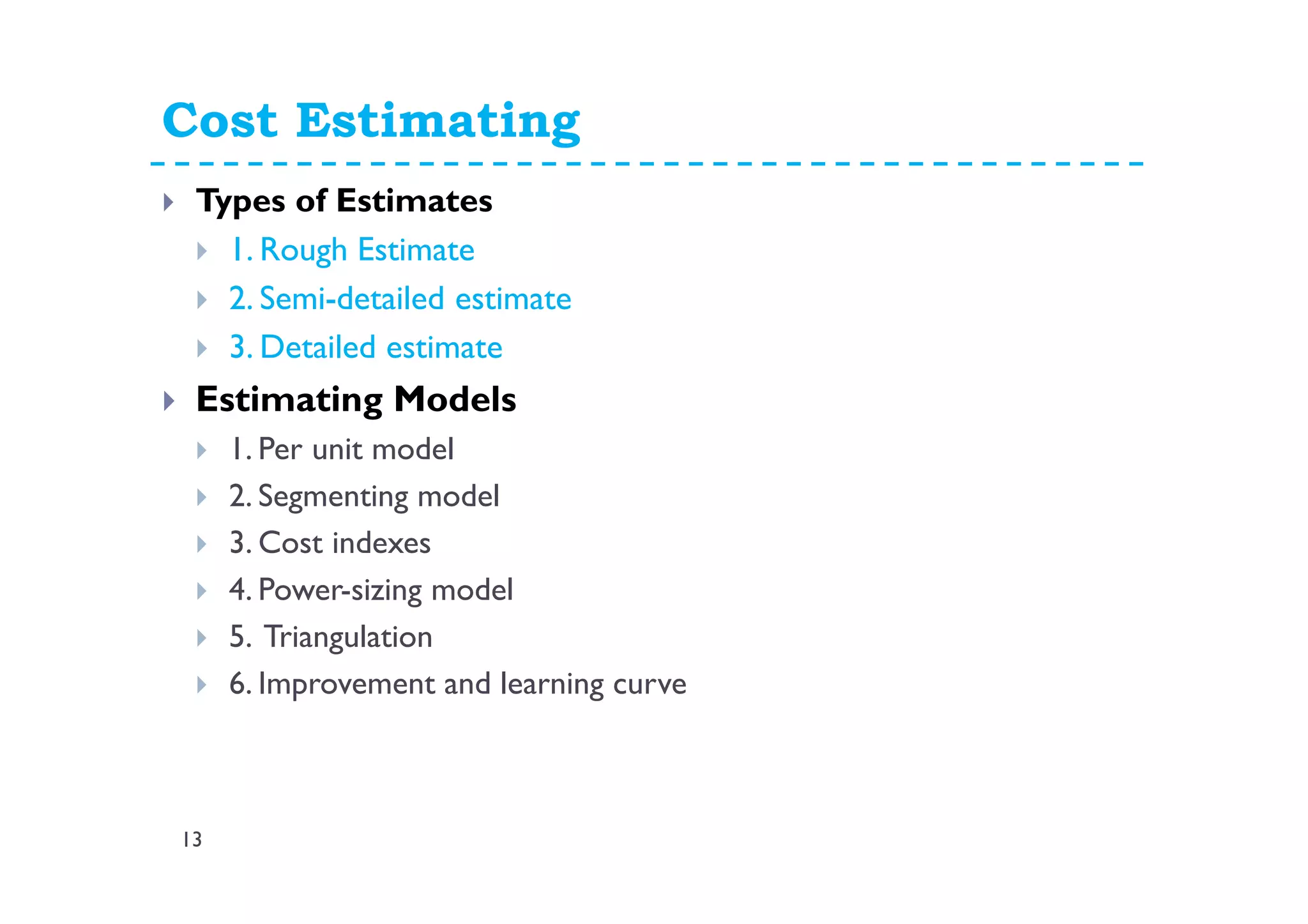
Types of Estimates
1. Rough Estimate
2. Semi-detailed estimate
3. Detailed estimate
Estimating Models
1. Per unit model
2. Segmenting model
3. Cost indexes
4. Power-sizing model
5. Triangulation
6. Improvement and learning curve
Cash Flow Diagram (CFD)
14
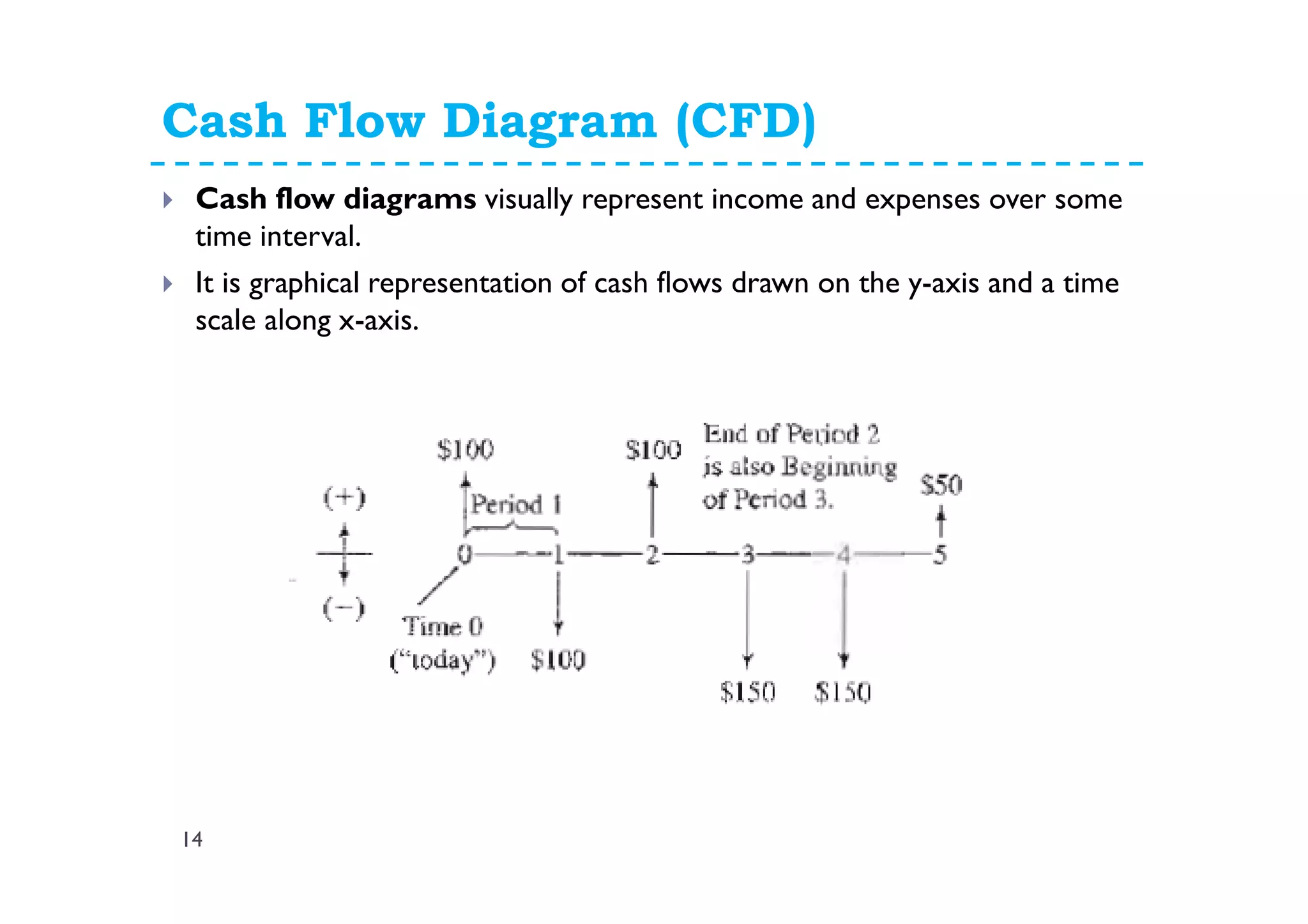
Cash flow diagrams visually represent income and expenses over some
time interval.
It is graphical representation of cash flows drawn on the y-axis and a time
scale along x-axis.
Cash Flow Diagram (CFD)
15
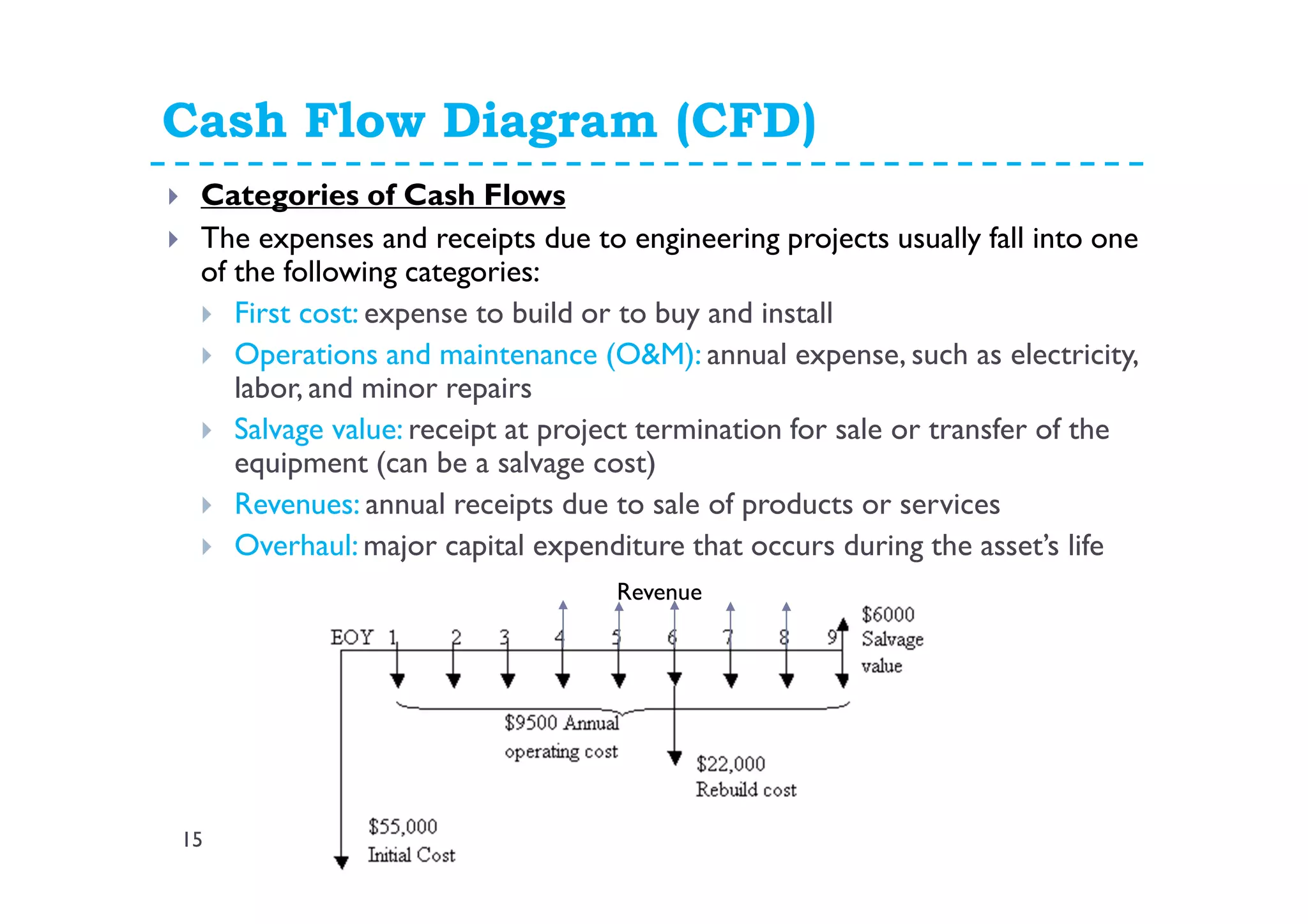
Categories of Cash Flows
The expenses and receipts due to engineering projects usually fall into one
of the following categories:
First cost: expense to build or to buy and install
Operations and maintenance (O&M): annual expense, such as electricity,
labor, and minor repairs
Salvage value: receipt at project termination for sale or transfer of the
equipment (can be a salvage cost)
Revenues: annual receipts due to sale of products or services
Overhaul: major capital expenditure that occurs during the asset’s life
Revenue
Interest
16
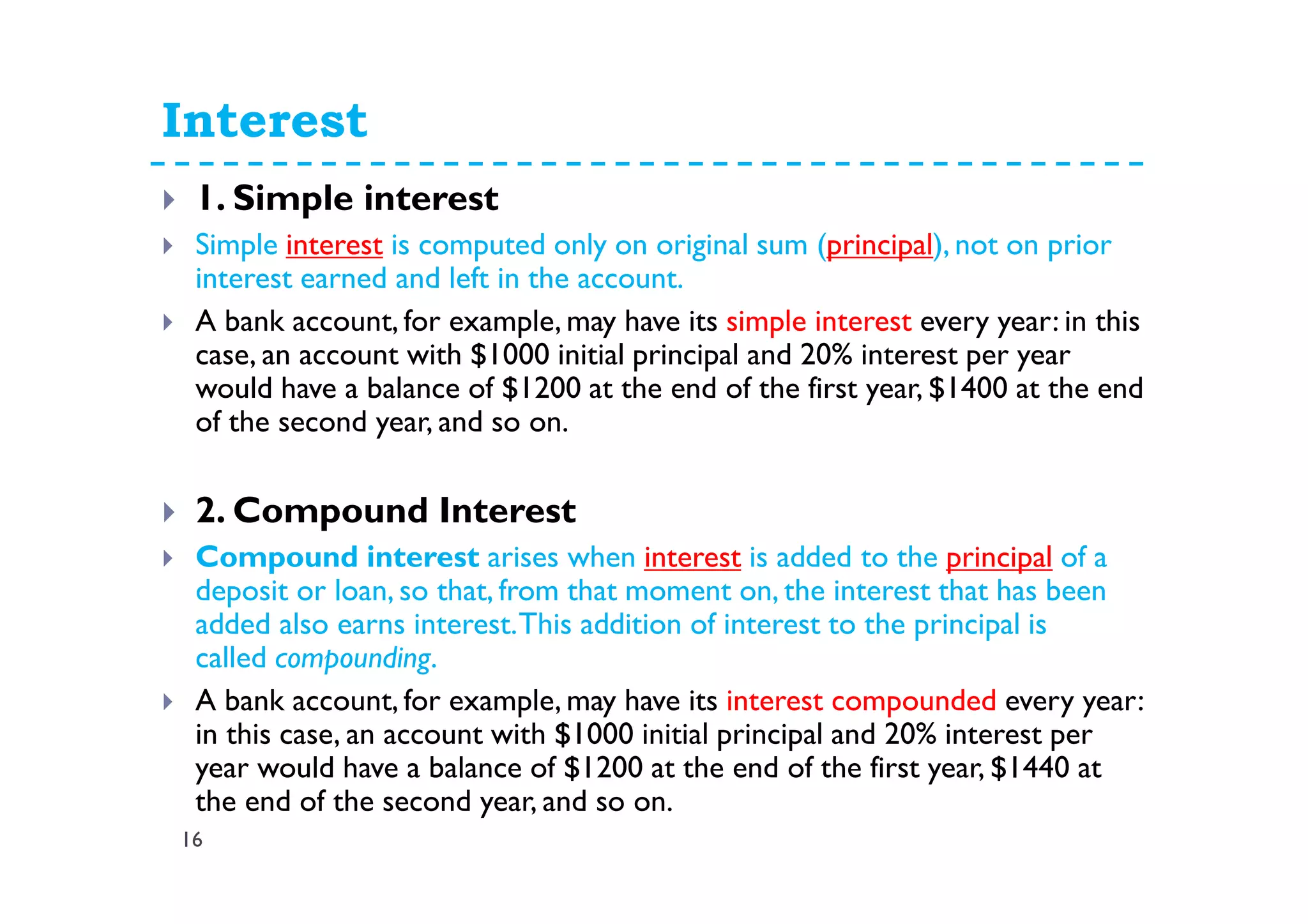
1. Simple interest
Simple interest is computed only on original sum (principal), not on prior
interest earned and left in the account.
A bank account, for example, may have its simple interest every year: in this
case, an account with $1000 initial principal and 20% interest per year
would have a balance of $1200 at the end of the first year, $1400 at the end
of the second year, and so on.
2. Compound Interest
Compound interest arises when interest is added to the principal of a
deposit or loan, so that, from that moment on, the interest that has been
added also earns interest.This addition of interest to the principal is
called compounding.
A bank account, for example, may have its interest compounded every year:
in this case, an account with $1000 initial principal and 20% interest per
year would have a balance of $1200 at the end of the first year, $1440 at
the end of the second year, and so on.
Uniform Series Formula
17
( )
[ ]niFAF
i
i
F n
%,,/
11
A =





−+
=
0 1 2 n-1 n
A
F
( )
( )
( )niPAP
i
ii
P n
n
%,,/
11
1
A =





−+
+
=
0 1 2 n-1 n
A
P
Arithmetic Gradient Series
18
( ) [ ]niGFG
i
ini
GF
n
%,,/
11
2
=




 −−+
=
( )
( )
[ ]niGPG
ii
ini
GP n
n
%,,/
1
11
2
=





+
−−+
=
Analysis Techniques
19
Present Worth Analysis
Annual Cash Flow Analysis
Rate of Return Analysis
Incremental Analysis
OtherTechniques:
Future Worth Analysis
Benefit-Cost Ratio Analysis
Payback Period Analysis
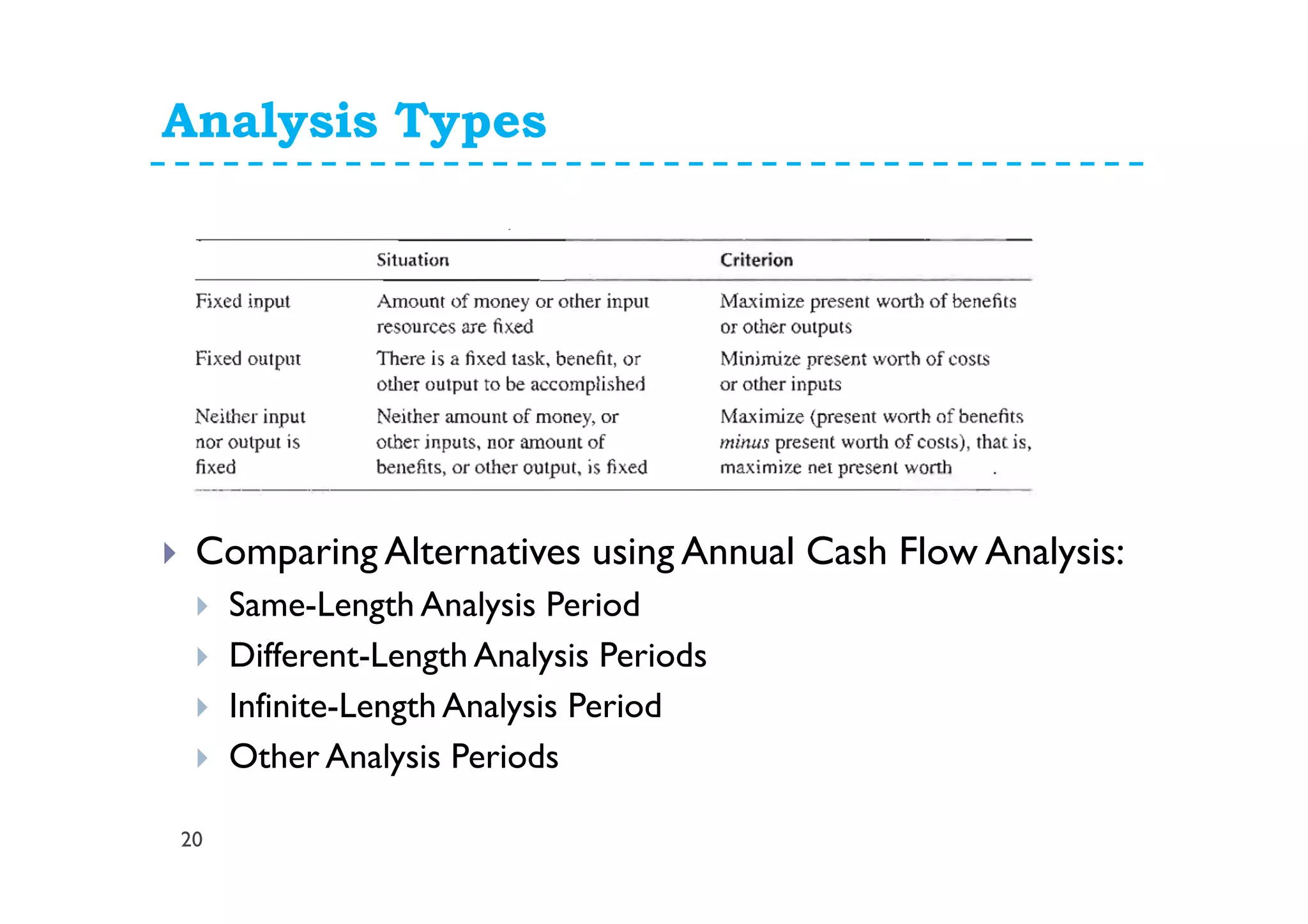
Analysis Types
20
Comparing Alternatives using Annual Cash Flow Analysis:
Same-Length Analysis Period
Different-Length Analysis Periods
Infinite-Length Analysis Period
Other Analysis Periods
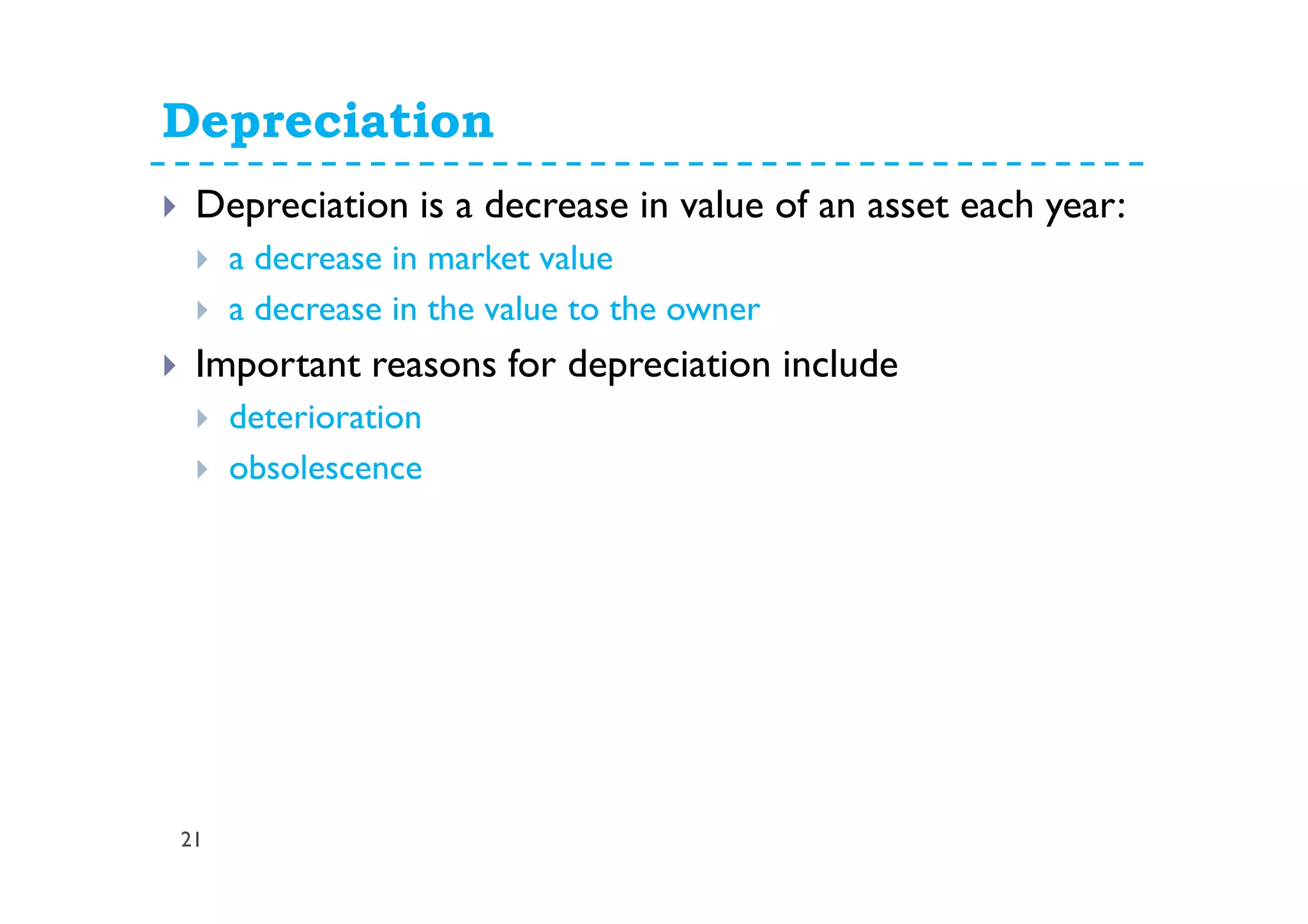
Depreciation
21
Depreciation is a decrease in value of an asset each year:
a decrease in market value
a decrease in the value to the owner
Important reasons for depreciation include
deterioration
obsolescence
Question of the Day ?
22
Write your impression on need of engineering economics
course for your study?
(only a few lines are enough)
23
That’s all. Have fun…however from next week we will
study well
Thank you
Questions….
24

1 introduction to engineering economics

  • 1.
    Introduction to EngineeringEconomics Dr. Mohsin Siddique Assistant Professor Email: msiddique@sharjah.ac.ae Office: 0650509431 Date: 08/09/2014 Engineering Economics University of Sharjah Dept. of Civil and Env. Engg.
  • 2.
    INTRODUCTION DR. MOHSIN SIDDIQUE Specialization: CoastalEngineering, Hydraulic Engineering, Sediment transport, hydrodynamics, Numerical modeling, Water resources Education: Ph.D. (2008-2011): The University ofTokyo M.Sc. (2005-2007): The University ofTokyo B.Sc. (2000-2004): UET Lahore Teaching Experiences: Asst. Prof (9/2013~) Asst. Prof (8/2012~9/2013): FAST NU Asst. Prof (1/2012-8/2012): UET Lahore Lecturer (12/2004~12/2011); UET Lahore • Contact Detail: • Email: msiddique@sharjah.ac.ae • Phone: 06-5050943
  • 3.
    Class Rules Come intime No disturbance during lecture Bring your text book, class notes, note book, pen and calculator DO NOT MISSYOUR QUIZ AND MID EXAM No cell phone calls, No SMS Copying of assignments is strictly prohibited Meet the deadlines of assignments Maintain your attendance
  • 4.
    4 Course name EngineeringEconomics- 0401301 Lecturer Dr. Mohsin Siddique Credits 3 3-0 Pre- and co- requisites 3rd Year Standing Goal: To provide engineering student with the knowledge of basic concepts of engineering economics as a decision making tool to select the suitable alternatives for engineering projects Instructional Objectives On successful completion of this course, the students should attain: Understand the role of engineering economic analysis as a decision-making and management/planning tool. Gain knowledge and understanding of theoretical concepts/principles that form the basis of engineering economics, such as time value of money, interest, and depreciation Identify and apply various alternative evaluation methods that are commonly used in economic decision-making processes faced by engineers.
  • 5.
    Engineering Economics-0401301 5 DetailedTopics The followingtopics will be addressed during lectures Introduction to Engineering Economics The decision making process Cost estimation Interest and Equivalence Different interest formulae Present worth analysis Uniform cash flow analysis Benefit cost analysis Rate of return analysis Depreciation
  • 6.
    Engineering Economics-0401301 6 Components ofthe Assessment The final course mark will be made up as follows: Quizzes 20% Midterm test 20% Assignment/ tutorial 15% Final Exam 45% An overall mark of 60% must be obtained for the course. Assessment Criteria: The student must demonstrate the ability to: Prepare a various decision making plans on their engineering economics analysis; Estimate the economic aspects for the engineering projects/products; Calculate the interests and economic equivalences on various cash flow situations; Perform an economic analysis for various engineering alternatives; and Calculate the depreciation of engineering products and decision making based on the analysis.
  • 7.
    Text and ReferenceBooks 7 2. Engineering Economy By Leland Blank & AnthonyTarquin, 7th Ed 1. Engineering Economic Analysis by Donald G Newman,Ted G. Eschenbach & Jerome P. Lavelle Reference Books Any other standard book on engineering economics & You may get help from Google search engine
  • 8.
    Tentative Course Schedule 8 WeekWeek Starting Topics Comments Engineering Economics - 0401 301 01 1 7th Sep- 11th Sep Introduction 2 14th Sep- 18th Sep Engineering Economics and Decision Making 3 21st Sep- 25th Sep Engineering Cost and Estimation /Tutorial (or) Assignment - 1 4 28th Sep -2nd Oct Interest and Equivalence/ Quiz-I 5 5th Oct- 9th Oct More Interest Formulas 1 class only (Eid Al-Adha Holiday) 6 12th Oct -16th Oct More Interest Formulas / Tutorial (or) Assignment - 2 7 19thOct-23rd Oct More Interest Formulas- Quiz 2 8 26th Oct -30th Oct Present Worth Analysis 9 2nd Nov- 6th Nov Present Worth Analysis 10 9th Nov- 13th Nov Mid Exam 11 16th Nov- 20th Nov Annual Cash Flow Analysis/Tutorial (or) Assignment - 3 12 23rd Nov-27th Nov Rate of Return Analysis / Quiz-3 13 30th Nov- 4th Dec Benefit to Cost Ratio Analysis 1 class only (National Day Holiday) 14 7th Dec- 11th Dec Depreciation 15 14th Dec-18th Dec Revisions/ Tutorial (or) Assignment - 4/ Quiz 4 16 21st Dec-25th Dec Review 17 4th Jan- 8th Jan Final Exam 18 11th Jan- 15th Jan
  • 9.
    Engineering Economics andDecision Making 9 Engineering economy involves formulating, estimating and evaluating the expected outcomes of alternatives designed to accomplish a defined purpose. Mathematical techniques are used to simplify economic evaluation of alternative and these techniques are equally good for individual, business or government projects. Thus this course may also offer you an economic analysis tool for making decisions such as car purchase, house purchase, and major purchase on credit card etc
  • 10.
    Engineering Economics andDecision Making 10 Decision Making is broad topic. It’s is a major aspect of every human existence.We are surrounded by sea of problems which may be classified depending on difficulty level as given below; 1. Simple Problems 2. Intermediate Problems 3. Complex Problems The Decision Making Process 1. Irrational Decision making 2. Rational Decision making Rational Decision making process
  • 11.
    Engineering Costs 11 Fixed Cost:These constant or unchanging regardless of the level of output or activity. Variable Costs: These are not constant and depends in level of out or activity. Marginal Costs: It is the variable cost for one more unit. Average Costs: It is total cost divided by number of units ________________________________________________________ Profit-loss breakeven chart
  • 12.
    Engineering Costs 12 Sunk Cost:A sunk cost is money already spent as a result of past decision. Opportunity cost: An opportunity cost is associated with using a resource in one activity instead of another. Recurring and Nonrecurring costs Recurring costs refers to any expense that is know and anticipated and that occurs at regular interval. Nonrecurring costs are one-of-a-kind expenses that occur at irregular intervals and thus are sometimes difficult to plan for or anticipate from a budgeting perspective.
  • 13.
    Cost Estimating 13 Types ofEstimates 1. Rough Estimate 2. Semi-detailed estimate 3. Detailed estimate Estimating Models 1. Per unit model 2. Segmenting model 3. Cost indexes 4. Power-sizing model 5. Triangulation 6. Improvement and learning curve
  • 14.
    Cash Flow Diagram(CFD) 14 Cash flow diagrams visually represent income and expenses over some time interval. It is graphical representation of cash flows drawn on the y-axis and a time scale along x-axis.
  • 15.
    Cash Flow Diagram(CFD) 15 Categories of Cash Flows The expenses and receipts due to engineering projects usually fall into one of the following categories: First cost: expense to build or to buy and install Operations and maintenance (O&M): annual expense, such as electricity, labor, and minor repairs Salvage value: receipt at project termination for sale or transfer of the equipment (can be a salvage cost) Revenues: annual receipts due to sale of products or services Overhaul: major capital expenditure that occurs during the asset’s life Revenue
  • 16.
    Interest 16 1. Simple interest Simpleinterest is computed only on original sum (principal), not on prior interest earned and left in the account. A bank account, for example, may have its simple interest every year: in this case, an account with $1000 initial principal and 20% interest per year would have a balance of $1200 at the end of the first year, $1400 at the end of the second year, and so on. 2. Compound Interest Compound interest arises when interest is added to the principal of a deposit or loan, so that, from that moment on, the interest that has been added also earns interest.This addition of interest to the principal is called compounding. A bank account, for example, may have its interest compounded every year: in this case, an account with $1000 initial principal and 20% interest per year would have a balance of $1200 at the end of the first year, $1440 at the end of the second year, and so on.
  • 17.
    Uniform Series Formula 17 () [ ]niFAF i i F n %,,/ 11 A =      −+ = 0 1 2 n-1 n A F ( ) ( ) ( )niPAP i ii P n n %,,/ 11 1 A =      −+ + = 0 1 2 n-1 n A P
  • 18.
    Arithmetic Gradient Series 18 () [ ]niGFG i ini GF n %,,/ 11 2 =      −−+ = ( ) ( ) [ ]niGPG ii ini GP n n %,,/ 1 11 2 =      + −−+ =
  • 19.
    Analysis Techniques 19 Present WorthAnalysis Annual Cash Flow Analysis Rate of Return Analysis Incremental Analysis OtherTechniques: Future Worth Analysis Benefit-Cost Ratio Analysis Payback Period Analysis
  • 20.
    Analysis Types 20 Comparing Alternativesusing Annual Cash Flow Analysis: Same-Length Analysis Period Different-Length Analysis Periods Infinite-Length Analysis Period Other Analysis Periods
  • 21.
    Depreciation 21 Depreciation is adecrease in value of an asset each year: a decrease in market value a decrease in the value to the owner Important reasons for depreciation include deterioration obsolescence
  • 22.
    Question of theDay ? 22 Write your impression on need of engineering economics course for your study? (only a few lines are enough)
  • 23.
    23 That’s all. Havefun…however from next week we will study well
  • 24.