HUMAN POPULATION
        and
   ITS IMPACTS
• The world population is increasing every
  year.

• This increase in population is followed by
  the increase of needs.

• Uncontrol population growth can cause
  problems in the avaibility of resources
  needed by people.

• In   addition, it will     also    increase
  environmental damage.

• Therefore, some effort to control the
  population growth should be put into action
  in order to minimize the problems that may
  occur.
A. Popupation of Inhabitants
• The change in the population in an area over a
  period of time is called population dynamics.

• A population dynamics showing an increasing
  number of inhabitants is called population
  growth.

• A rapid population growth which exceeds the
  avaibility of natural resources is called
  population explotion or overpopulation.

• If  the    population     growth    cannot   be
  controlled, it is estimated that overpopulation
  will occur.
B. Population Dynamics


• Population dynamics is affected by
  three following factors ;

1. Birth rate (Natality)
2. Death rate (Mortality)
3. Number of population movements
   (Migration)
1. Natality
• The    number     of  birth   affects
  population growth.
• The level of birth is defined as an
  index called natality or birth rate.
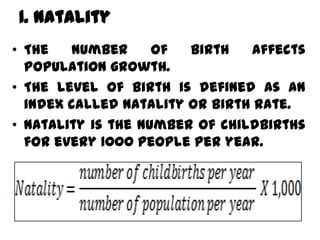
• Natality is the number of childbirths
  for every 1000 people per year.
• The criteria   of   natality   are   as
  follows :

a. Natality is considered high when the
   birth rate is >30
b. Natality is considered moderate
   when the birth rate is between 20 –
   30
c. Natality is considered low when the
   birth rate is < 20
2. Mortality
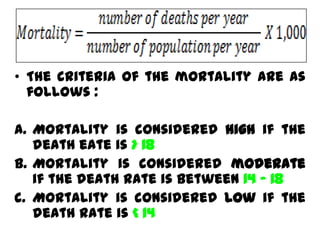
• The death rate or mortality is the
  number of deaths for every 1,000
  people per year.

• The death rate is correlated with the
  conditions of a country, for example,
  with the levels of prosperity, health,
  or the occurence of war.

• In a rich and developed country, the
  inhabitants may well maintain their
  health, so that the death rate is low.
• The criteria of the mortality are as
  follows :

a. Mortality is considered high if the
   death eate is > 18
b. Mortality is considered moderate
   if the death rate is between 14 – 18
c. Mortality is considered low if the
   death rate is < 14
3. Migration
• Migration is the movement of inhabitants
  from one place to another and it is normally
  affected by the change of conditions.

• Migration is influenced by the following
  factors :

a. Difficult economic situations    and   low
   earnings in the home location.

b.    Sociocultural situations in the origin
     location, for instance, due to forced
     marriages, or very tight traditional
     practices in cultural environments.
c.Educational facilities in the     origin
  location are not sufficient.

d.Working      opportunities   in     the
  destination area are more abundant.

e.More opportunities to get a better
  education and career in the area of
  destination.

f.There is an assumption that living in big
  cities is more interesting because of the
  avaibility of recreational facilities,
  amusement, and shopping centers.
• Migration can be placed into five categories
  :

a. Emigration, which is the movement of the
   inhabitants leaving a country to settle in
   another country.
b. Immigration, which is the movement of
   inhabitants entering a new country to
   settle permanently.
c. Transmigration, which is the movement of
   inhabitants from a densely populated area
   into an area with a lesser population.
d. Urbanization, which is the movement of
   inhabitants from villages to cities.
e. Remigration, which is the movement of
   inhabitants back to their home country.
C. The Density of Human
            Population
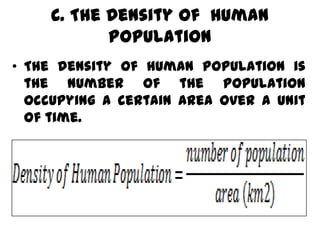
• The density of human population is
  the number of the population
  occupying a certain area over a unit
  of time.
• The densities of human populations
  in various areas are not the same
  and is always changing.

• It is caused by population dynamics
  which include birth, death and
  migration.

• It may also be caused by an uneven
  spread of population in certain
  regions.
• The densest region in Indonesia is   in Java
  island which is approximately         127,499
  square kilometers in area and         had a
  population of approximately 121.3    million
  people in the year 2000.

• That means that the population density was
  951 people/km2.

• In the year 2010, the population of Java
  island increased to 136.6 million people.

• That means, the population density of Java
  island in 2010 became 1,071 people/km2.
• Uneven   density  and  the   spread   of
  population can cause a development gap,
  both   in   physical  and   non-physical
  development.

• Physical    development    includes,  the
  construction of buildings, houses, roads,
  bridges, and amusement parks.

• Non-physical    development        includes
  developments related to the improvement
  of the quality of living, including mental
  and spiritual.

• Some examples are public services,
  education facilities, healthcare facilities,
  religious facilities, and cultural centers.
• Another issue which is related to the
  uneven population spread is the
  difference between the population
  density in villages and in the cities.

• Cities have a denser population
  compared to villages because cities
  are more appealing and there are
  more job opportunities.
D. Issues Related to
       Population Density
1. Welfare

Good levels of population welfare are
 indicated by good healthcare and
 nutrient      sufficiency,     sufficient
 education, and decent housing.

Efforts that are being done by the
 government to improve the welfare of
 Indonesians are as follow ;
2. Social and economics issues
3. Land avaibility
4. Food avaibility
5. Clean water and fresh air
  avaibility
6. Public safety
7. Environtmental damage
EXERCISE
1. What does migration mean? Write
   and explain various types of
   migration!
2. What does population density mean?
3. Mention     5   issues   related    to
   population density!
4. What is natality and mortality?
5. In 2009 a city has 150.000 people, the
   birth is 150 in year 2010, count the
   birth rate!

7 7. human population and its impacts

  • 1.
    HUMAN POPULATION and ITS IMPACTS
  • 2.
    • The worldpopulation is increasing every year. • This increase in population is followed by the increase of needs. • Uncontrol population growth can cause problems in the avaibility of resources needed by people. • In addition, it will also increase environmental damage. • Therefore, some effort to control the population growth should be put into action in order to minimize the problems that may occur.
  • 3.
    A. Popupation ofInhabitants • The change in the population in an area over a period of time is called population dynamics. • A population dynamics showing an increasing number of inhabitants is called population growth. • A rapid population growth which exceeds the avaibility of natural resources is called population explotion or overpopulation. • If the population growth cannot be controlled, it is estimated that overpopulation will occur.
  • 4.
    B. Population Dynamics •Population dynamics is affected by three following factors ; 1. Birth rate (Natality) 2. Death rate (Mortality) 3. Number of population movements (Migration)
  • 5.
    1. Natality • The number of birth affects population growth. • The level of birth is defined as an index called natality or birth rate. • Natality is the number of childbirths for every 1000 people per year.
  • 6.
    • The criteria of natality are as follows : a. Natality is considered high when the birth rate is >30 b. Natality is considered moderate when the birth rate is between 20 – 30 c. Natality is considered low when the birth rate is < 20
  • 7.
    2. Mortality • Thedeath rate or mortality is the number of deaths for every 1,000 people per year. • The death rate is correlated with the conditions of a country, for example, with the levels of prosperity, health, or the occurence of war. • In a rich and developed country, the inhabitants may well maintain their health, so that the death rate is low.
  • 8.
    • The criteriaof the mortality are as follows : a. Mortality is considered high if the death eate is > 18 b. Mortality is considered moderate if the death rate is between 14 – 18 c. Mortality is considered low if the death rate is < 14
  • 9.
    3. Migration • Migrationis the movement of inhabitants from one place to another and it is normally affected by the change of conditions. • Migration is influenced by the following factors : a. Difficult economic situations and low earnings in the home location. b. Sociocultural situations in the origin location, for instance, due to forced marriages, or very tight traditional practices in cultural environments.
  • 10.
    c.Educational facilities inthe origin location are not sufficient. d.Working opportunities in the destination area are more abundant. e.More opportunities to get a better education and career in the area of destination. f.There is an assumption that living in big cities is more interesting because of the avaibility of recreational facilities, amusement, and shopping centers.
  • 11.
    • Migration canbe placed into five categories : a. Emigration, which is the movement of the inhabitants leaving a country to settle in another country. b. Immigration, which is the movement of inhabitants entering a new country to settle permanently. c. Transmigration, which is the movement of inhabitants from a densely populated area into an area with a lesser population. d. Urbanization, which is the movement of inhabitants from villages to cities. e. Remigration, which is the movement of inhabitants back to their home country.
  • 12.
    C. The Densityof Human Population • The density of human population is the number of the population occupying a certain area over a unit of time.
  • 13.
    • The densitiesof human populations in various areas are not the same and is always changing. • It is caused by population dynamics which include birth, death and migration. • It may also be caused by an uneven spread of population in certain regions.
  • 14.
    • The densestregion in Indonesia is in Java island which is approximately 127,499 square kilometers in area and had a population of approximately 121.3 million people in the year 2000. • That means that the population density was 951 people/km2. • In the year 2010, the population of Java island increased to 136.6 million people. • That means, the population density of Java island in 2010 became 1,071 people/km2.
  • 15.
    • Uneven density and the spread of population can cause a development gap, both in physical and non-physical development. • Physical development includes, the construction of buildings, houses, roads, bridges, and amusement parks. • Non-physical development includes developments related to the improvement of the quality of living, including mental and spiritual. • Some examples are public services, education facilities, healthcare facilities, religious facilities, and cultural centers.
  • 16.
    • Another issuewhich is related to the uneven population spread is the difference between the population density in villages and in the cities. • Cities have a denser population compared to villages because cities are more appealing and there are more job opportunities.
  • 17.
    D. Issues Relatedto Population Density 1. Welfare Good levels of population welfare are indicated by good healthcare and nutrient sufficiency, sufficient education, and decent housing. Efforts that are being done by the government to improve the welfare of Indonesians are as follow ;
  • 18.
    2. Social andeconomics issues 3. Land avaibility 4. Food avaibility 5. Clean water and fresh air avaibility 6. Public safety 7. Environtmental damage
  • 19.
    EXERCISE 1. What doesmigration mean? Write and explain various types of migration! 2. What does population density mean? 3. Mention 5 issues related to population density! 4. What is natality and mortality? 5. In 2009 a city has 150.000 people, the birth is 150 in year 2010, count the birth rate!