Forests, biodiversity and food security
                             Terry Sunderland, PhD
                             2nd World Biodiversity Congress,
                                    Kuching, Malaysia
THINKING beyond the canopy
                                   10th September 2011
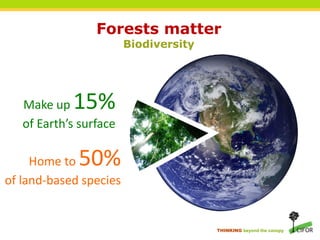
Forests matter
                        Biodiversity


   Make up  15%
   of Earth’s surface

     Home to 50%
of land-based species


                                       THINKING beyond the canopy
Deforestation
                                          Net change
-5        -4         -3         -2         -1        0       1       2


                                                                         South America

                                                                         Africa

                                                                         Asia

                                                                         Europe

                                                                         North and Central America

                                                                         Oceania

                                         1990-2000       2000-2005
Source: FAO Forest Resource Assessment (FRA) 2005                    THINKING beyond the canopy
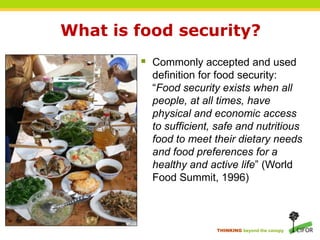
What is food security?
         Commonly accepted and used
          definition for food security:
          “Food security exists when all
          people, at all times, have
          physical and economic access
          to sufficient, safe and nutritious
          food to meet their dietary needs
          and food preferences for a
          healthy and active life” (World
          Food Summit, 1996)


                        THINKING beyond the canopy
However….
     This definition infers that
        access to enough food is an
        adequate criterion to achieve
        food security
       Yet access to food must be
        sustainable in the long term
       Human well-being is closely
        related to access to wider
        environmental health such as
        access to clean water,
        sanitation and biodiverse
        productive ecosystems
       Food security does not always
        equate to nutritional security


                   THINKING beyond the canopy
Forests, biodiversity and food security
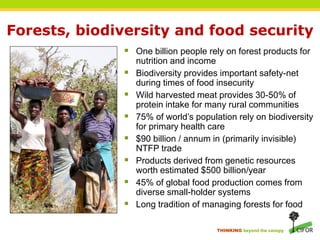
               One billion people rely on forest products for
                  nutrition and income
                 Biodiversity provides important safety-net
                  during times of food insecurity
                 Wild harvested meat provides 30-50% of
                  protein intake for many rural communities
                 75% of world’s population rely on biodiversity
                  for primary health care
                 $90 billion / annum in (primarily invisible)
                  NTFP trade
                 Products derived from genetic resources
                  worth estimated $500 billion/year
                 45% of global food production comes from
                  diverse small-holder systems
                 Long tradition of managing forests for food

                                       THINKING beyond the canopy
Forests matter
             Borneo

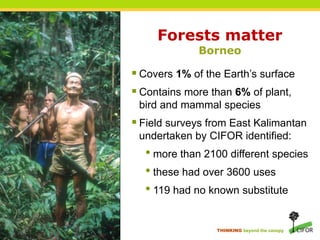
 Covers 1% of the Earth’s surface
 Contains more than 6% of plant,
 bird and mammal species
 Field surveys from East Kalimantan
 undertaken by CIFOR identified:
  • more than 2100 different species
  • these had over 3600 uses
  • 119 had no known substitute

                 THINKING beyond the canopy
Global trends in food production
               Agriculture began around
                  12,000 years ago
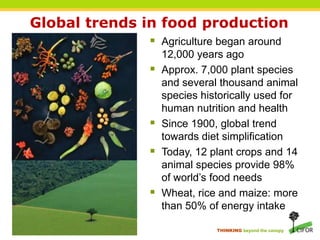
                 Approx. 7,000 plant species
                  and several thousand animal
                  species historically used for
                  human nutrition and health
                 Since 1900, global trend
                  towards diet simplification
                 Today, 12 plant crops and 14
                  animal species provide 98%
                  of world’s food needs
                 Wheat, rice and maize: more
                  than 50% of energy intake

                             THINKING beyond the canopy
Effects of diet simplification
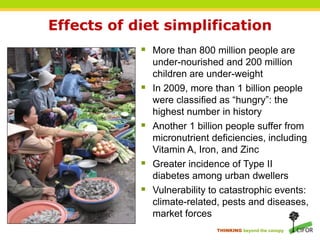
             More than 800 million people are
                under-nourished and 200 million
                children are under-weight
               In 2009, more than 1 billion people
                were classified as “hungry”: the
                highest number in history
               Another 1 billion people suffer from
                micronutrient deficiencies, including
                Vitamin A, Iron, and Zinc
               Greater incidence of Type II
                diabetes among urban dwellers
               Vulnerability to catastrophic events:
                climate-related, pests and diseases,
                market forces
                               THINKING beyond the canopy
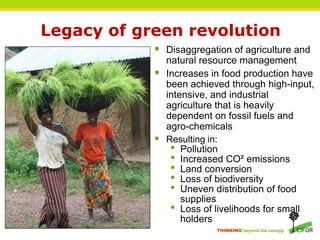
Legacy of green revolution
             Disaggregation of agriculture and
              natural resource management
             Increases in food production have
              been achieved through high-input,
              intensive, and industrial
              agriculture that is heavily
              dependent on fossil fuels and
              agro-chemicals
             Resulting in:
               • Pollution
               • Increased CO² emissions
               • Land conversion
               • Loss of biodiversity
               • Uneven distribution of food
                  supplies
               • Loss of livelihoods for small
                  holders
                          THINKING beyond the canopy
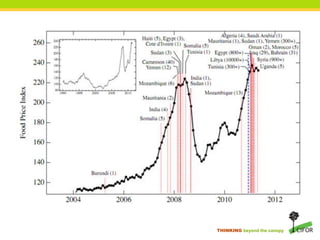
Challenges to achieving global
        food security

                     Population growth
                     Climate change
                     Food inequity
                     Gender inequity
                     Globalisation
                     Continued forest and
                      biodiversity loss


                         THINKING beyond the canopy
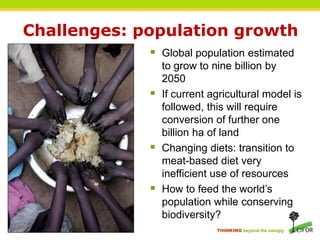
Challenges: population growth
              Global population estimated
                 to grow to nine billion by
                 2050
                If current agricultural model is
                 followed, this will require
                 conversion of further one
                 billion ha of land
                Changing diets: transition to
                 meat-based diet very
                 inefficient use of resources
                How to feed the world’s
                 population while conserving
                 biodiversity?
                             THINKING beyond the canopy
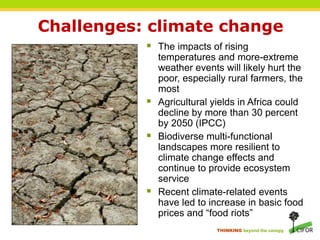
Challenges: climate change
            The impacts of rising
               temperatures and more-extreme
               weather events will likely hurt the
               poor, especially rural farmers, the
               most
              Agricultural yields in Africa could
               decline by more than 30 percent
               by 2050 (IPCC)
              Biodiverse multi-functional
               landscapes more resilient to
               climate change effects and
               continue to provide ecosystem
               service
              Recent climate-related events
               have led to increase in basic food
               prices and “food riots”
                             THINKING beyond the canopy
THINKING beyond the canopy
Challenges: Food inequity


 Food inequity: While one billion people go hungry, one billion
    people are over-weight or obese (daily feast or famine)
   Food waste (post harvest and post purchase)
   Purchasing power: Singapore/Hong Kong are food secure,
    while India, a major agricultural producer, is not beyond the canopy
                                                 THINKING
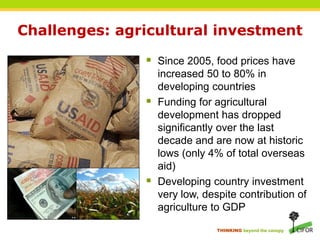
Challenges: agricultural investment

                Since 2005, food prices have
                   increased 50 to 80% in
                   developing countries
                  Funding for agricultural
                   development has dropped
                   significantly over the last
                   decade and are now at historic
                   lows (only 4% of total overseas
                   aid)
                  Developing country investment
                   very low, despite contribution of
                   agriculture to GDP

                                THINKING beyond the canopy
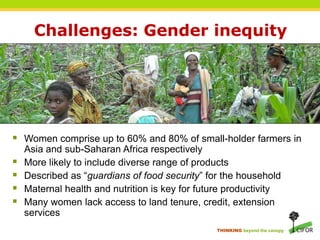
Challenges: Gender inequity


 Women comprise up to 60% and 80% of small-holder farmers in
    Asia and sub-Saharan Africa respectively
   More likely to include diverse range of products
   Described as “guardians of food security” for the household
   Maternal health and nutrition is key for future productivity
   Many women lack access to land tenure, credit, extension
    services
                                                 THINKING beyond the canopy
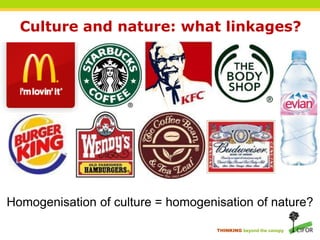
Culture and nature: what linkages?


Homogenisation of culture = homogenisation of nature?

                                    THINKING beyond the canopy
Innovations for integrated biodiversity
     and food security benefits?
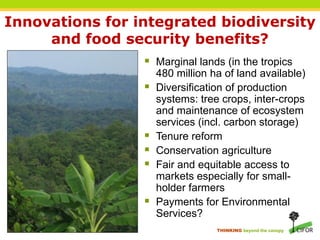
                  Marginal lands (in the tropics
                     480 million ha of land available)
                    Diversification of production
                     systems: tree crops, inter-crops
                     and maintenance of ecosystem
                     services (incl. carbon storage)
                    Tenure reform
                    Conservation agriculture
                    Fair and equitable access to
                     markets especially for small-
                     holder farmers
                    Payments for Environmental
                     Services?
                                  THINKING beyond the canopy
New approaches for integrating
           agriculture and biodiversity?


   “Eco-agriculture” (Scherr and McNeely 2006)
   “Conservation agriculture” (Hobbs et al. 2006)
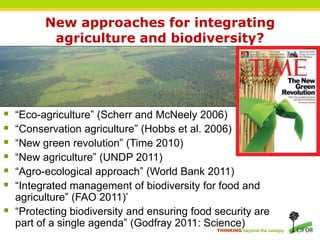
   “New green revolution” (Time 2010)
   “New agriculture” (UNDP 2011)
   “Agro-ecological approach” (World Bank 2011)
   “Integrated management of biodiversity for food and
    agriculture” (FAO 2011)’
   “Protecting biodiversity and ensuring food security are
    part of a single agenda” (Godfray 2011: Science)
                                               THINKING beyond the canopy
Guinea.. a success story


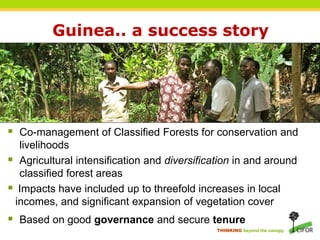
 Co-management of Classified Forests for conservation and
  livelihoods
 Agricultural intensification and diversification in and around
  classified forest areas
 Impacts have included up to threefold increases in local
 incomes, and significant expansion of vegetation cover
 Based on good governance and secure tenure
                                              THINKING beyond the canopy
Read more….
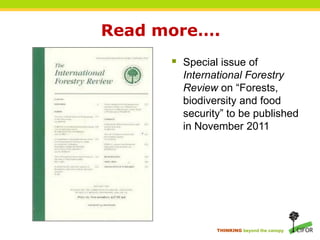
       Special issue of
        International Forestry
        Review on “Forests,
        biodiversity and food
        security” to be published
        in November 2011


               THINKING beyond the canopy
t.sunderland@cgiar.org
www.cifor.cgiar.org      THINKING beyond the canopy

Forests, biodiversity and food security

  • 1.
    Forests, biodiversity andfood security Terry Sunderland, PhD 2nd World Biodiversity Congress, Kuching, Malaysia THINKING beyond the canopy 10th September 2011
  • 2.
    Forests matter Biodiversity Make up 15% of Earth’s surface Home to 50% of land-based species THINKING beyond the canopy
  • 3.
    Deforestation Net change -5 -4 -3 -2 -1 0 1 2 South America Africa Asia Europe North and Central America Oceania 1990-2000 2000-2005 Source: FAO Forest Resource Assessment (FRA) 2005 THINKING beyond the canopy
  • 4.
    What is foodsecurity?  Commonly accepted and used definition for food security: “Food security exists when all people, at all times, have physical and economic access to sufficient, safe and nutritious food to meet their dietary needs and food preferences for a healthy and active life” (World Food Summit, 1996) THINKING beyond the canopy
  • 5.
    However….  This definition infers that access to enough food is an adequate criterion to achieve food security  Yet access to food must be sustainable in the long term  Human well-being is closely related to access to wider environmental health such as access to clean water, sanitation and biodiverse productive ecosystems  Food security does not always equate to nutritional security THINKING beyond the canopy
  • 6.
    Forests, biodiversity andfood security  One billion people rely on forest products for nutrition and income  Biodiversity provides important safety-net during times of food insecurity  Wild harvested meat provides 30-50% of protein intake for many rural communities  75% of world’s population rely on biodiversity for primary health care  $90 billion / annum in (primarily invisible) NTFP trade  Products derived from genetic resources worth estimated $500 billion/year  45% of global food production comes from diverse small-holder systems  Long tradition of managing forests for food THINKING beyond the canopy
  • 7.
    Forests matter Borneo  Covers 1% of the Earth’s surface  Contains more than 6% of plant, bird and mammal species  Field surveys from East Kalimantan undertaken by CIFOR identified: • more than 2100 different species • these had over 3600 uses • 119 had no known substitute THINKING beyond the canopy
  • 8.
    Global trends infood production  Agriculture began around 12,000 years ago  Approx. 7,000 plant species and several thousand animal species historically used for human nutrition and health  Since 1900, global trend towards diet simplification  Today, 12 plant crops and 14 animal species provide 98% of world’s food needs  Wheat, rice and maize: more than 50% of energy intake THINKING beyond the canopy
  • 9.
    Effects of dietsimplification  More than 800 million people are under-nourished and 200 million children are under-weight  In 2009, more than 1 billion people were classified as “hungry”: the highest number in history  Another 1 billion people suffer from micronutrient deficiencies, including Vitamin A, Iron, and Zinc  Greater incidence of Type II diabetes among urban dwellers  Vulnerability to catastrophic events: climate-related, pests and diseases, market forces THINKING beyond the canopy
  • 10.
    Legacy of greenrevolution  Disaggregation of agriculture and natural resource management  Increases in food production have been achieved through high-input, intensive, and industrial agriculture that is heavily dependent on fossil fuels and agro-chemicals  Resulting in: • Pollution • Increased CO² emissions • Land conversion • Loss of biodiversity • Uneven distribution of food supplies • Loss of livelihoods for small holders THINKING beyond the canopy
  • 11.
    Challenges to achievingglobal food security  Population growth  Climate change  Food inequity  Gender inequity  Globalisation  Continued forest and biodiversity loss THINKING beyond the canopy
  • 12.
    Challenges: population growth  Global population estimated to grow to nine billion by 2050  If current agricultural model is followed, this will require conversion of further one billion ha of land  Changing diets: transition to meat-based diet very inefficient use of resources  How to feed the world’s population while conserving biodiversity? THINKING beyond the canopy
  • 13.
    Challenges: climate change  The impacts of rising temperatures and more-extreme weather events will likely hurt the poor, especially rural farmers, the most  Agricultural yields in Africa could decline by more than 30 percent by 2050 (IPCC)  Biodiverse multi-functional landscapes more resilient to climate change effects and continue to provide ecosystem service  Recent climate-related events have led to increase in basic food prices and “food riots” THINKING beyond the canopy
  • 14.
  • 15.
    Challenges: Food inequity Food inequity: While one billion people go hungry, one billion people are over-weight or obese (daily feast or famine)  Food waste (post harvest and post purchase)  Purchasing power: Singapore/Hong Kong are food secure, while India, a major agricultural producer, is not beyond the canopy THINKING
  • 16.
    Challenges: agricultural investment  Since 2005, food prices have increased 50 to 80% in developing countries  Funding for agricultural development has dropped significantly over the last decade and are now at historic lows (only 4% of total overseas aid)  Developing country investment very low, despite contribution of agriculture to GDP THINKING beyond the canopy
  • 17.
    Challenges: Gender inequity Women comprise up to 60% and 80% of small-holder farmers in Asia and sub-Saharan Africa respectively  More likely to include diverse range of products  Described as “guardians of food security” for the household  Maternal health and nutrition is key for future productivity  Many women lack access to land tenure, credit, extension services THINKING beyond the canopy
  • 18.
    Culture and nature:what linkages? Homogenisation of culture = homogenisation of nature? THINKING beyond the canopy
  • 19.
    Innovations for integratedbiodiversity and food security benefits?  Marginal lands (in the tropics 480 million ha of land available)  Diversification of production systems: tree crops, inter-crops and maintenance of ecosystem services (incl. carbon storage)  Tenure reform  Conservation agriculture  Fair and equitable access to markets especially for small- holder farmers  Payments for Environmental Services? THINKING beyond the canopy
  • 20.
    New approaches forintegrating agriculture and biodiversity?  “Eco-agriculture” (Scherr and McNeely 2006)  “Conservation agriculture” (Hobbs et al. 2006)  “New green revolution” (Time 2010)  “New agriculture” (UNDP 2011)  “Agro-ecological approach” (World Bank 2011)  “Integrated management of biodiversity for food and agriculture” (FAO 2011)’  “Protecting biodiversity and ensuring food security are part of a single agenda” (Godfray 2011: Science) THINKING beyond the canopy
  • 21.
    Guinea.. a successstory  Co-management of Classified Forests for conservation and livelihoods  Agricultural intensification and diversification in and around classified forest areas  Impacts have included up to threefold increases in local incomes, and significant expansion of vegetation cover  Based on good governance and secure tenure THINKING beyond the canopy
  • 22.
    Read more….  Special issue of International Forestry Review on “Forests, biodiversity and food security” to be published in November 2011 THINKING beyond the canopy
  • 23.