Population dynamics
• Lesson Objectives:
• Understand the concept of population
dynamics.
• Analyze how populations of organisms change
over time.
Why do we study population?
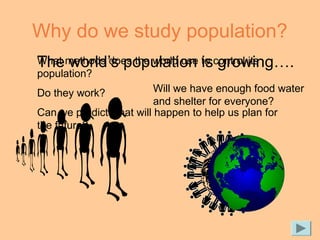
The world’s population is growing….
Will we have enough food water
and shelter for everyone?
What methods does the world use to control its
population?
Do they work?
Can we predict what will happen to help us plan for
the future?
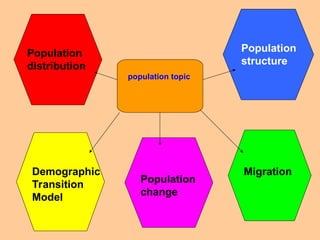
Migration
Population
structure
Population
distribution
Demographic
Transition
Model
Population
change
population topic
Population distribution
• Key words and definitions
Population density – The number of people
per square km
Dense – Many people per square km
Sparse – Few people per square km
Distribution – How people are spread out
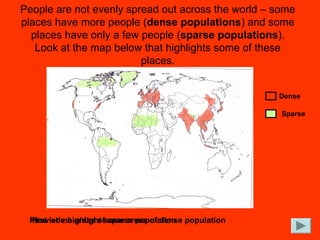
People are not evenly spread out across the world – some
places have more people (dense populations) and some
places have only a few people (sparse populations).
Look at the map below that highlights some of these
places.
First let’s highlight some areas of dense population
Now some areas of sparse population
Dense
Sparse
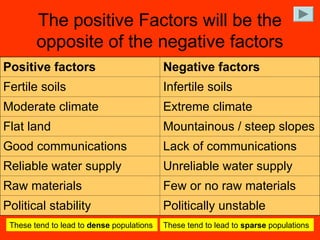
The positive Factors will be the
opposite of the negative factors
Positive factors Negative factors
Fertile soils Infertile soils
Moderate climate Extreme climate
Flat land Mountainous / steep slopes
Good communications Lack of communications
Reliable water supply Unreliable water supply
Raw materials Few or no raw materials
Political stability Politically unstable
These tend to lead to dense populations These tend to lead to sparse populations
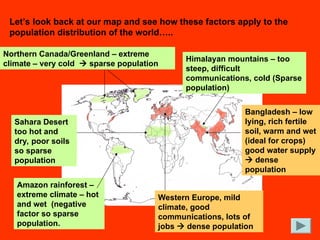
Let’s look back at our map and see how these factors apply to the
population distribution of the world…..
Amazon rainforest –
extreme climate – hot
and wet (negative
factor so sparse
population.
Northern Canada/Greenland – extreme
climate – very cold  sparse population
Sahara Desert
too hot and
dry, poor soils
so sparse
population
Himalayan mountains – too
steep, difficult
communications, cold (Sparse
population)
Bangladesh – low
lying, rich fertile
soil, warm and wet
(ideal for crops)
good water supply
 dense
population
Western Europe, mild
climate, good
communications, lots of
jobs  dense population
POPULATION GROWTH
LESSON OBJECTIVE:
Critically analyze the meaning of population
growth.
12 September 2022
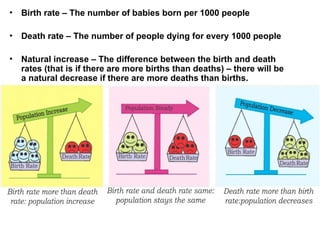
• Birth rate – The number of babies born per 1000 people
• Death rate – The number of people dying for every 1000 people
• Natural increase – The difference between the birth and death
rates (that is if there are more births than deaths) – there will be
a natural decrease if there are more deaths than births.
In order to understand population structure
there are several definitions that you must
remember.
• Infant mortality – Death of children under the age of 1 year
• Life expectancy – The average length of life
• Economically active – People of working age (16-65 in the UK)
• Child dependants – People under the age of 16
• Elderly dependants – People over 65 years (pensioners)
• Dependency ratio – The number of dependants for every economically
active person
FACTORS AFFECTING DISTRIBUTION AND DENSITY: PHYSICAL FACTORS:
■ Climate: People settle where the climate is moderate and where the area receive
enough rainfall to practise farming activities;
■ Water: People settle near water resources as water is essential for life and
human/farming activities;
■ Soil: The soil must be fertile to ensure that people will settle there. The more fertile the
soil, the bigger the yield.
■ Relief: People tend to settle on flat areas where there is enough space.
■ Natural vegetation: People need vegetated areas for grazing land.
■ Resources: People settle where there is enough resources like coal, fish, wood and
minerals. The mining of minerals help with job opportunities and lead to the development
of settlements.
SOCIAL FACTORS:
■ Economy: Economic developed areas attract businesses and
industries and can support a bigger population;
■ Political: People prefer to live in political stable areas. Laws can
restrict certain race groups to live in a specific area.
■ Technology: Improved technology improve the development of
secondary and tertiary sectors. This will cause a increase in the
population density;
■ Transport and communication: A good transport and
communication network will attract people to live in that area.
■ Infrastructure: Areas with good infrastructure like water supply,
electricity, sewage systems and access to internet will increase the
population density.
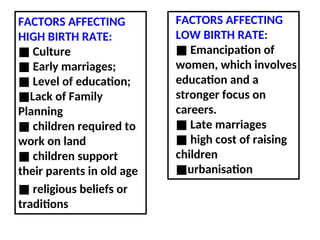
FACTORS AFFECTING
HIGH BIRTH RATE:
■ Culture
■ Early marriages;
■ Level of education;
■Lack of Family
Planning
■ children required to
work on land
■ children support
their parents in old age
■ religious beliefs or
traditions
FACTORS AFFECTING
LOW BIRTH RATE:
■ Emancipation of
women, which involves
education and a
stronger focus on
careers.
■ Late marriages
■ high cost of raising
children
■urbanisation
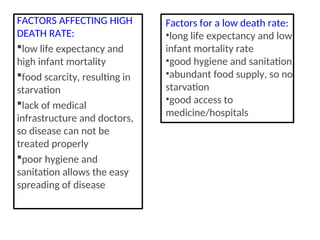
FACTORS AFFECTING HIGH
DEATH RATE:
low life expectancy and
high infant mortality
food scarcity, resulting in
starvation
lack of medical
infrastructure and doctors,
so disease can not be
treated properly
poor hygiene and
sanitation allows the easy
spreading of disease
Factors for a low death rate:
•long life expectancy and low
infant mortality rate
•good hygiene and sanitation
•abundant food supply, so no
starvation
•good access to
medicine/hospitals
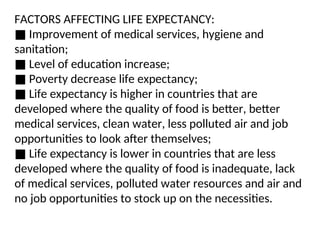
FACTORS AFFECTING LIFE EXPECTANCY:
■ Improvement of medical services, hygiene and
sanitation;
■ Level of education increase;
■ Poverty decrease life expectancy;
■ Life expectancy is higher in countries that are
developed where the quality of food is better, better
medical services, clean water, less polluted air and job
opportunities to look after themselves;
■ Life expectancy is lower in countries that are less
developed where the quality of food is inadequate, lack
of medical services, polluted water resources and air and
no job opportunities to stock up on the necessities.
Population Structure
The composition of population in
terms of age groups and gender
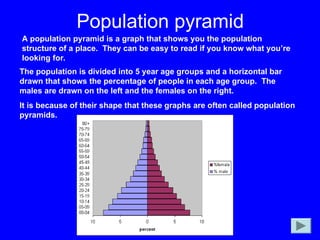
Population pyramid
A population pyramid is a graph that shows you the population
structure of a place. They can be easy to read if you know what you’re
looking for.
The population is divided into 5 year age groups and a horizontal bar
drawn that shows the percentage of people in each age group. The
males are drawn on the left and the females on the right.
It is because of their shape that these graphs are often called population
pyramids.
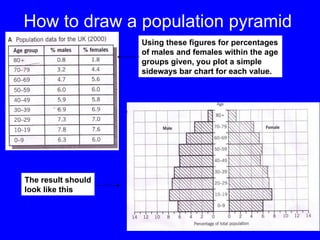
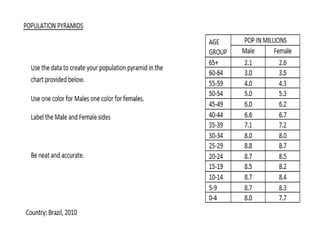
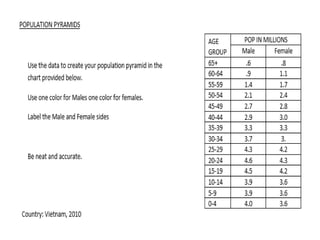
How to draw a population pyramid
Using these figures for percentages
of males and females within the age
groups given, you plot a simple
sideways bar chart for each value.
The result should
look like this
Steps to read a population pyramid
• Note the title – are you looking at a whole country
or a special part of one eg. Rural or urban
populations
• Look at the general shape
• Note the proportions of the working population and
the elderly and child dependants (ages 17-65,
above 65 and 0-16)
• Look at the height of the pyramid (indicates life
expectancy)
• Look at the sex ratio (the proportion of males to
females)
Migration
Migration is the movement of people
from one place to another
Remember these terms…
• Emigrant – someone moving OUT of a
country
• Migrant – a person moving from one
area to another
• Immigrant – someone moving INTO a
country
Migration can be classified by
distance
• International migration – when people
move from one country to another
• Regional migration – when people move
to another region inside the same country
• Local migration – when people move a
short distance within the same region
Migration can also be classified by
reason or timescale…
• Migration may be forced or voluntary
• Migration may be temporary or permanent
Remember migration will affect both the area the
migrants come from as well as the are they are going to.
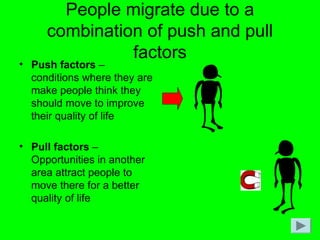
People migrate due to a
combination of push and pull
factors
• Push factors –
conditions where they are
make people think they
should move to improve
their quality of life
• Pull factors –
Opportunities in another
area attract people to
move there for a better
quality of life
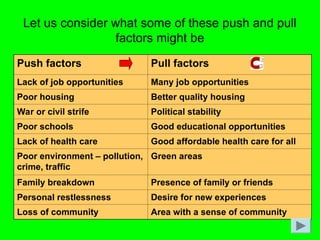
Let us consider what some of these push and pull
factors might be
Push factors Pull factors
Lack of job opportunities Many job opportunities
Poor housing Better quality housing
War or civil strife Political stability
Poor schools Good educational opportunities
Lack of health care Good affordable health care for all
Poor environment – pollution,
crime, traffic
Green areas
Family breakdown Presence of family or friends
Personal restlessness Desire for new experiences
Loss of community Area with a sense of community
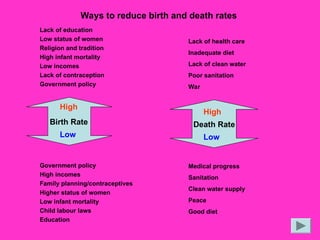
Ways to reduce birth and death rates
Lack of education
Low status of women
Religion and tradition
High infant mortality
Low incomes
Lack of contraception
Government policy
Government policy
High incomes
Family planning/contraceptives
Higher status of women
Low infant mortality
Child labour laws
Education
Birth Rate
High
Low
Death Rate
High
Low
Lack of health care
Inadequate diet
Lack of clean water
Poor sanitation
War
Medical progress
Sanitation
Clean water supply
Peace
Good diet
GEOGRAPHY Population Studies GRADE 8.ppt.ppt

  • 2.
    Population dynamics • LessonObjectives: • Understand the concept of population dynamics. • Analyze how populations of organisms change over time.
  • 3.
    Why do westudy population? The world’s population is growing…. Will we have enough food water and shelter for everyone? What methods does the world use to control its population? Do they work? Can we predict what will happen to help us plan for the future?
  • 4.
  • 5.
    Population distribution • Keywords and definitions Population density – The number of people per square km Dense – Many people per square km Sparse – Few people per square km Distribution – How people are spread out
  • 6.
    People are notevenly spread out across the world – some places have more people (dense populations) and some places have only a few people (sparse populations). Look at the map below that highlights some of these places. First let’s highlight some areas of dense population Now some areas of sparse population Dense Sparse
  • 7.
    The positive Factorswill be the opposite of the negative factors Positive factors Negative factors Fertile soils Infertile soils Moderate climate Extreme climate Flat land Mountainous / steep slopes Good communications Lack of communications Reliable water supply Unreliable water supply Raw materials Few or no raw materials Political stability Politically unstable These tend to lead to dense populations These tend to lead to sparse populations
  • 8.
    Let’s look backat our map and see how these factors apply to the population distribution of the world….. Amazon rainforest – extreme climate – hot and wet (negative factor so sparse population. Northern Canada/Greenland – extreme climate – very cold  sparse population Sahara Desert too hot and dry, poor soils so sparse population Himalayan mountains – too steep, difficult communications, cold (Sparse population) Bangladesh – low lying, rich fertile soil, warm and wet (ideal for crops) good water supply  dense population Western Europe, mild climate, good communications, lots of jobs  dense population
  • 9.
    POPULATION GROWTH LESSON OBJECTIVE: Criticallyanalyze the meaning of population growth. 12 September 2022
  • 10.
    • Birth rate– The number of babies born per 1000 people • Death rate – The number of people dying for every 1000 people • Natural increase – The difference between the birth and death rates (that is if there are more births than deaths) – there will be a natural decrease if there are more deaths than births.
  • 11.
    In order tounderstand population structure there are several definitions that you must remember. • Infant mortality – Death of children under the age of 1 year • Life expectancy – The average length of life • Economically active – People of working age (16-65 in the UK) • Child dependants – People under the age of 16 • Elderly dependants – People over 65 years (pensioners) • Dependency ratio – The number of dependants for every economically active person
  • 12.
    FACTORS AFFECTING DISTRIBUTIONAND DENSITY: PHYSICAL FACTORS: ■ Climate: People settle where the climate is moderate and where the area receive enough rainfall to practise farming activities; ■ Water: People settle near water resources as water is essential for life and human/farming activities; ■ Soil: The soil must be fertile to ensure that people will settle there. The more fertile the soil, the bigger the yield. ■ Relief: People tend to settle on flat areas where there is enough space. ■ Natural vegetation: People need vegetated areas for grazing land. ■ Resources: People settle where there is enough resources like coal, fish, wood and minerals. The mining of minerals help with job opportunities and lead to the development of settlements.
  • 13.
    SOCIAL FACTORS: ■ Economy:Economic developed areas attract businesses and industries and can support a bigger population; ■ Political: People prefer to live in political stable areas. Laws can restrict certain race groups to live in a specific area. ■ Technology: Improved technology improve the development of secondary and tertiary sectors. This will cause a increase in the population density; ■ Transport and communication: A good transport and communication network will attract people to live in that area. ■ Infrastructure: Areas with good infrastructure like water supply, electricity, sewage systems and access to internet will increase the population density.
  • 14.
    FACTORS AFFECTING HIGH BIRTHRATE: ■ Culture ■ Early marriages; ■ Level of education; ■Lack of Family Planning ■ children required to work on land ■ children support their parents in old age ■ religious beliefs or traditions FACTORS AFFECTING LOW BIRTH RATE: ■ Emancipation of women, which involves education and a stronger focus on careers. ■ Late marriages ■ high cost of raising children ■urbanisation
  • 15.
    FACTORS AFFECTING HIGH DEATHRATE: low life expectancy and high infant mortality food scarcity, resulting in starvation lack of medical infrastructure and doctors, so disease can not be treated properly poor hygiene and sanitation allows the easy spreading of disease Factors for a low death rate: •long life expectancy and low infant mortality rate •good hygiene and sanitation •abundant food supply, so no starvation •good access to medicine/hospitals
  • 16.
    FACTORS AFFECTING LIFEEXPECTANCY: ■ Improvement of medical services, hygiene and sanitation; ■ Level of education increase; ■ Poverty decrease life expectancy; ■ Life expectancy is higher in countries that are developed where the quality of food is better, better medical services, clean water, less polluted air and job opportunities to look after themselves; ■ Life expectancy is lower in countries that are less developed where the quality of food is inadequate, lack of medical services, polluted water resources and air and no job opportunities to stock up on the necessities.
  • 17.
    Population Structure The compositionof population in terms of age groups and gender
  • 18.
    Population pyramid A populationpyramid is a graph that shows you the population structure of a place. They can be easy to read if you know what you’re looking for. The population is divided into 5 year age groups and a horizontal bar drawn that shows the percentage of people in each age group. The males are drawn on the left and the females on the right. It is because of their shape that these graphs are often called population pyramids.
  • 19.
    How to drawa population pyramid Using these figures for percentages of males and females within the age groups given, you plot a simple sideways bar chart for each value. The result should look like this
  • 20.
    Steps to reada population pyramid • Note the title – are you looking at a whole country or a special part of one eg. Rural or urban populations • Look at the general shape • Note the proportions of the working population and the elderly and child dependants (ages 17-65, above 65 and 0-16) • Look at the height of the pyramid (indicates life expectancy) • Look at the sex ratio (the proportion of males to females)
  • 24.
    Migration Migration is themovement of people from one place to another
  • 25.
    Remember these terms… •Emigrant – someone moving OUT of a country • Migrant – a person moving from one area to another • Immigrant – someone moving INTO a country
  • 26.
    Migration can beclassified by distance • International migration – when people move from one country to another • Regional migration – when people move to another region inside the same country • Local migration – when people move a short distance within the same region
  • 27.
    Migration can alsobe classified by reason or timescale… • Migration may be forced or voluntary • Migration may be temporary or permanent Remember migration will affect both the area the migrants come from as well as the are they are going to.
  • 28.
    People migrate dueto a combination of push and pull factors • Push factors – conditions where they are make people think they should move to improve their quality of life • Pull factors – Opportunities in another area attract people to move there for a better quality of life
  • 29.
    Let us considerwhat some of these push and pull factors might be Push factors Pull factors Lack of job opportunities Many job opportunities Poor housing Better quality housing War or civil strife Political stability Poor schools Good educational opportunities Lack of health care Good affordable health care for all Poor environment – pollution, crime, traffic Green areas Family breakdown Presence of family or friends Personal restlessness Desire for new experiences Loss of community Area with a sense of community
  • 30.
    Ways to reducebirth and death rates Lack of education Low status of women Religion and tradition High infant mortality Low incomes Lack of contraception Government policy Government policy High incomes Family planning/contraceptives Higher status of women Low infant mortality Child labour laws Education Birth Rate High Low Death Rate High Low Lack of health care Inadequate diet Lack of clean water Poor sanitation War Medical progress Sanitation Clean water supply Peace Good diet