Submitted by,
Hiya Bhatia..
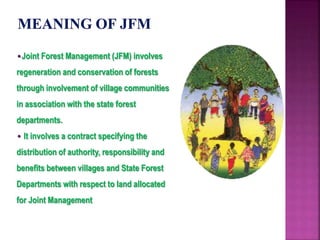
•Joint Forest Management (JFM) involves
regeneration and conservation of forests
through involvement of village communities
in association with the state forest
departments.
• It involves a contract specifying the
distribution of authority, responsibility and
benefits between villages and State Forest
Departments with respect to land allocated
for Joint Management
Two most well known pilot experiments in
early 1970s
 1972-arabari (west Bengal)
 Mid-1970s – Sukhomajri (Haryana)
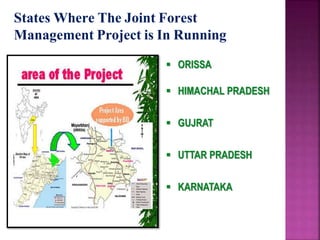
States Where The Joint Forest
Management Project is In Running
 ORISSA
 HIMACHAL PRADESH
 GUJRAT
 UTTAR PRADESH
 KARNATAKA
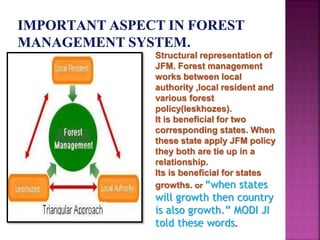
Structural representation of
JFM. Forest management
works between local
authority ,local resident and
various forest
policy(leskhozes).
It is beneficial for two
corresponding states. When
these state apply JFM policy
they both are tie up in a
relationship.
Its is beneficial for states
growths. or “when states
will growth then country
is also growth.” MODI JI
told these words.
How do
communities
work with joint
forest
management
system.??
Trainings have been provided to officials from
Forest/Agriculture departments
Horticulture Departments
 Village Development Boards/NEPED on various aspects of
JFM such that theoretical background and methods for micro
plan through Participatory Rural Appraisal and various issues
related to JFM such as gender and equity, conflict resolution etc.
Different government is also involve in it.
by involving Regional Center, NAEB, MOEF, Govt. of India,
Shillong and other eminent resource persons.
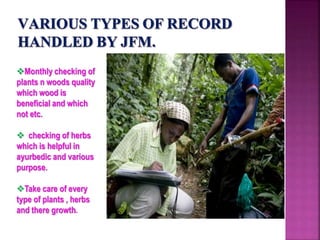
Monthly checking of
plants n woods quality
which wood is
beneficial and which
not etc.
 checking of herbs
which is helpful in
ayurbedic and various
purpose.
Take care of every
type of plants , herbs
and there growth.
There are lots of people which involve in this work. It is
good for employment because lots of villages which has only
forest. there is no jobs n work there so “JFM provide
employment to those persons”.
. To provide sustainable and assured employment
opportunities to the tribal's in such areas.
To check environmental degradation and soil erosion
To increase area under forest cover and to conserve Bio-
diversity
1.To elicit active participation of
villagers in
(a) creation
(b) management and
(c) protection of plantations;
2.To achieve ecological needs
consonant with sustainable
productivity of wood and
other non-timber forest
resources ;
3. To wean away the land owning communities
from shifting cultivation by adopting
an alternative I. e. Tree Farming ;
4.To productively utilize the degraded jhumland
thereby checking soil erosion;
5.To conserve Biodiversity through people’s
action ;
6.To create and generate forest –based economy
for the villagers .
1. It is first yojana that was organized by
government for joint forest management.
2. Forest Development Agencies have been
registered and detailed project report has been
submitted to the Government for sanction and
release of fund under ‘‘SAMANVIT GRAM
VANIKARAN SAMIRDDHI
YOJANA’’(INTEGRATED VILLAGE
AFFORESTATION AND ECO DEVELOPMENT
SCHEME) under different FDAs .
1. To control removal of forest produce from forests by
making the community responsible for monitoring removals from
the forests;
2. To provide sustainable and assured employment
opportunities to the tribal's in such areas
3. Creation of durable assets for tribal population which
contribute over all Eco development in the area;
4. To make local people for participation in implementation of
scheme;
5. To make self income generating schemes for villagers to stop
cutting of forests by them;
6. To check environmental degradation and soil erosion;
and
7. To increase area under forest cover and to conserve Bio-
diversity.
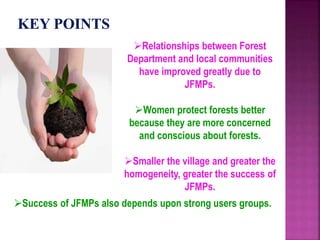
Relationships between Forest
Department and local communities
have improved greatly due to
JFMPs.
Women protect forests better
because they are more concerned
and conscious about forests.
Smaller the village and greater the
homogeneity, greater the success of
JFMPs.
Success of JFMPs also depends upon strong users groups.
Potential returns from JFM are large and
available to the entire community.
JFMPs reduce greatly the regeneration costs of
degraded lands.
THANK YOU

Joint forest management

  • 1.
  • 2.
    •Joint Forest Management(JFM) involves regeneration and conservation of forests through involvement of village communities in association with the state forest departments. • It involves a contract specifying the distribution of authority, responsibility and benefits between villages and State Forest Departments with respect to land allocated for Joint Management
  • 3.
    Two most wellknown pilot experiments in early 1970s  1972-arabari (west Bengal)  Mid-1970s – Sukhomajri (Haryana)
  • 4.
    States Where TheJoint Forest Management Project is In Running  ORISSA  HIMACHAL PRADESH  GUJRAT  UTTAR PRADESH  KARNATAKA
  • 5.
    Structural representation of JFM.Forest management works between local authority ,local resident and various forest policy(leskhozes). It is beneficial for two corresponding states. When these state apply JFM policy they both are tie up in a relationship. Its is beneficial for states growths. or “when states will growth then country is also growth.” MODI JI told these words.
  • 6.
    How do communities work withjoint forest management system.??
  • 7.
    Trainings have beenprovided to officials from Forest/Agriculture departments Horticulture Departments  Village Development Boards/NEPED on various aspects of JFM such that theoretical background and methods for micro plan through Participatory Rural Appraisal and various issues related to JFM such as gender and equity, conflict resolution etc. Different government is also involve in it. by involving Regional Center, NAEB, MOEF, Govt. of India, Shillong and other eminent resource persons.
  • 8.
    Monthly checking of plantsn woods quality which wood is beneficial and which not etc.  checking of herbs which is helpful in ayurbedic and various purpose. Take care of every type of plants , herbs and there growth.
  • 9.
    There are lotsof people which involve in this work. It is good for employment because lots of villages which has only forest. there is no jobs n work there so “JFM provide employment to those persons”. . To provide sustainable and assured employment opportunities to the tribal's in such areas. To check environmental degradation and soil erosion To increase area under forest cover and to conserve Bio- diversity
  • 10.
    1.To elicit activeparticipation of villagers in (a) creation (b) management and (c) protection of plantations; 2.To achieve ecological needs consonant with sustainable productivity of wood and other non-timber forest resources ;
  • 11.
    3. To weanaway the land owning communities from shifting cultivation by adopting an alternative I. e. Tree Farming ; 4.To productively utilize the degraded jhumland thereby checking soil erosion; 5.To conserve Biodiversity through people’s action ; 6.To create and generate forest –based economy for the villagers .
  • 12.
    1. It isfirst yojana that was organized by government for joint forest management. 2. Forest Development Agencies have been registered and detailed project report has been submitted to the Government for sanction and release of fund under ‘‘SAMANVIT GRAM VANIKARAN SAMIRDDHI YOJANA’’(INTEGRATED VILLAGE AFFORESTATION AND ECO DEVELOPMENT SCHEME) under different FDAs .
  • 13.
    1. To controlremoval of forest produce from forests by making the community responsible for monitoring removals from the forests; 2. To provide sustainable and assured employment opportunities to the tribal's in such areas 3. Creation of durable assets for tribal population which contribute over all Eco development in the area; 4. To make local people for participation in implementation of scheme; 5. To make self income generating schemes for villagers to stop cutting of forests by them; 6. To check environmental degradation and soil erosion; and 7. To increase area under forest cover and to conserve Bio- diversity.
  • 14.
    Relationships between Forest Departmentand local communities have improved greatly due to JFMPs. Women protect forests better because they are more concerned and conscious about forests. Smaller the village and greater the homogeneity, greater the success of JFMPs. Success of JFMPs also depends upon strong users groups.
  • 15.
    Potential returns fromJFM are large and available to the entire community. JFMPs reduce greatly the regeneration costs of degraded lands.
  • 16.