GENDER DIMENSIONS IN
FOREST MANAGEMENT
MEGHANA ROSE JOSEPH
2017-17-006
NRM Department
College of Forestry, Vellanikkara
1
Why gender?
2
3
Incorporating a gender perspective in forest management and
decision-making processes will help:
• Increase awareness of the roles of women and men in the
sustainable management of forests and trees
• Avoid or manage conflicts among competing uses of forests
and their products, and ensure that women’s and men’s
traditional
• Indigenous rights to forest use are maintained
• Promote equal access of women to forests and other resources
necessary for effective socioeconomic participation
• Ensure that both women and men receive training, gain access to
information and other external services to increase productivity
through the use of new and improved technologies
• Increase the capacity of communities to capitalize on the
complementary roles of women and men and mobilize people for
collective action in, for example, forest regeneration, biodiversity
conservation, watershed protection and the allocation of forest-use
permits.
4
(Gender in forestry, FAO)
• Do women contribute more than men to household
income from unprocessed forest products?
• Do men contribute more than women to household
income from processed forest products?
• Do women tend to collect forest products for
consumption while men collect them for sale?
• Do men participate more in forest user groups than
women?
5
MYTHS AND REALITIES
• Many of the claims that are often made in the
literature, on gender and forest products, are
based on case studies.
• We cannot generalize these studies-regional
variation
6
PEN- Poverty and Environment
Network
7
• The PEN network was launched in September 2004 by the
Center for International Forestry Research (CIFOR) with the
aim of collecting uniform socio-economic and environmental
data at household and village levels in rural areas of
developing countries.
8
• Forest product collection and sale: considering the forest
products brought to the household by women and men
respectively across several broad categories, including types
and quantities of products, whether they are processed or not,
and whether they are collected for consumption and/or sale.
• Access to forest products: the value of forest products
collected in lands under different land and resource tenure
systems
• Community forest management: men and women’s
participation in formal FUGs.
9
DIMENSIONS
10
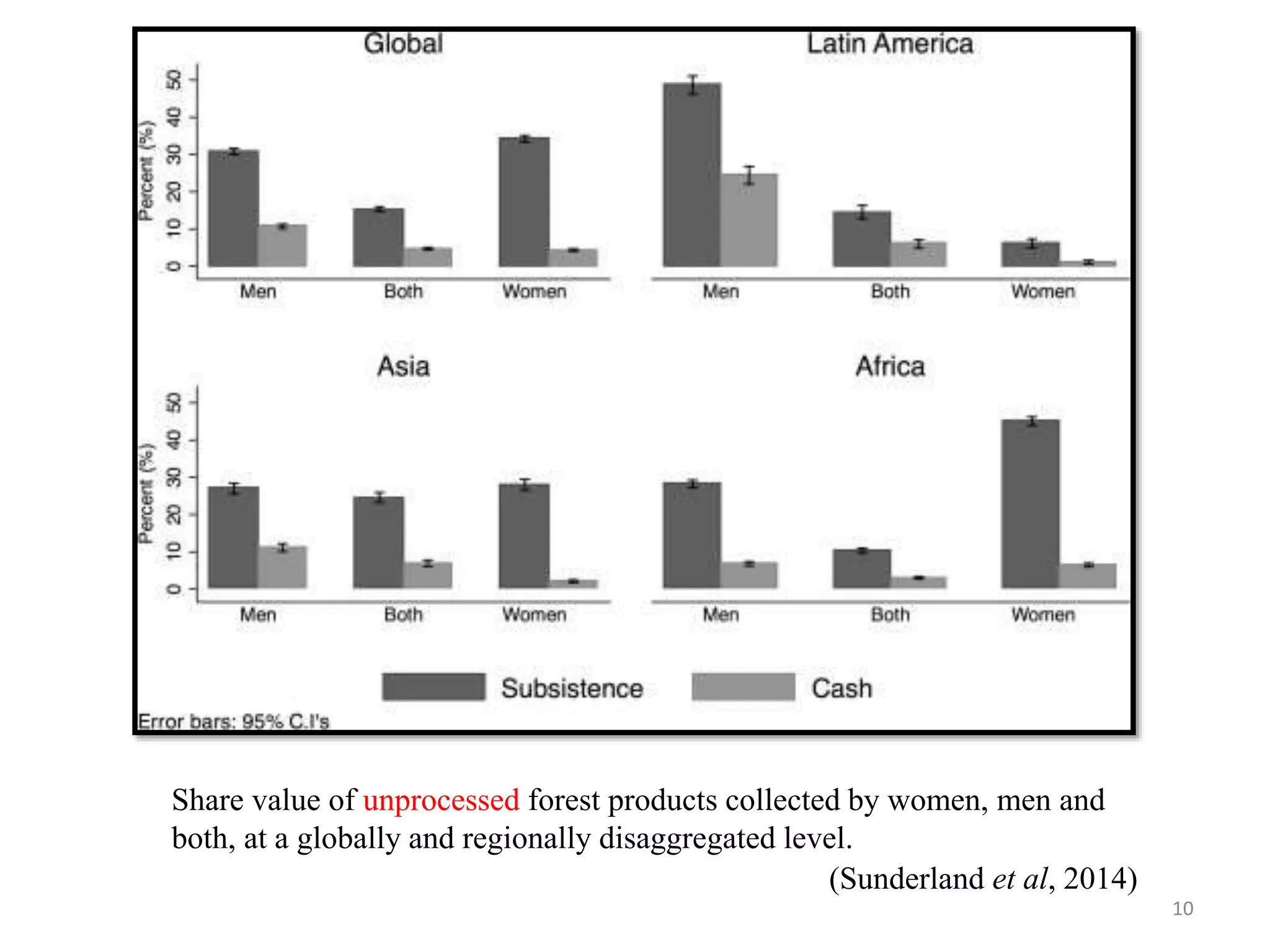
Share value of unprocessed forest products collected by women, men and
both, at a globally and regionally disaggregated level.
(Sunderland et al, 2014)
11
Share value of processed forest products collected by women, men and
both, at a globally and regionally disaggregated level.
Share of income from unprocessed and processed products (by gender categories
and types of products)
12
Percentage of women who participate in forest user groups
(FUGs).
13
INDIA
14
Women at forefront in conservation movements like Chipko and Khejrali
15
The women have to spend major part of their time and have to
walk long distances daily to collect fuelwood, fodder and other
Non Timber Forest Products (NTFPs) from forests
Awareness about trees, shrubs and grasses is higher amongst
women than in men because women devote more time than men
to collect forest produce to meet family needs. About one-third of
poor women are directly involved in forestry or forestry related
works in the unorganized sector (Nanavaty, 1996)
16
Constraints for Women
Participation in JFM
• Women were not informed about meetings
• Unsuitable time for meetings when women could not be free
from household work
• Social customs restraining women from attending such
meetings
• Women perceived no gain from attending such meetings
• Generally, the men respond when questions are directed even
specifically to the women
17
Possible Approaches for Increased
Women Participation in JFM
• Awareness among women needs to be increased
• The policy provisions regarding women participation should
be clear and mandatory
• Female extension workers need to be employed with whom
women may talk freely
• Provide proper extension support to motivate women and also
their husbands for their active participation in JFM
• The need for their participation and benefits accruing to them
from JFM need to be properly explained to women to create
their interest in the programme
18
SELF HELP GROUPS
19
Self Employed Women’s association (SEWA) –
Gujarat-gum Karaya
20
SEWA
VASANTHASENA
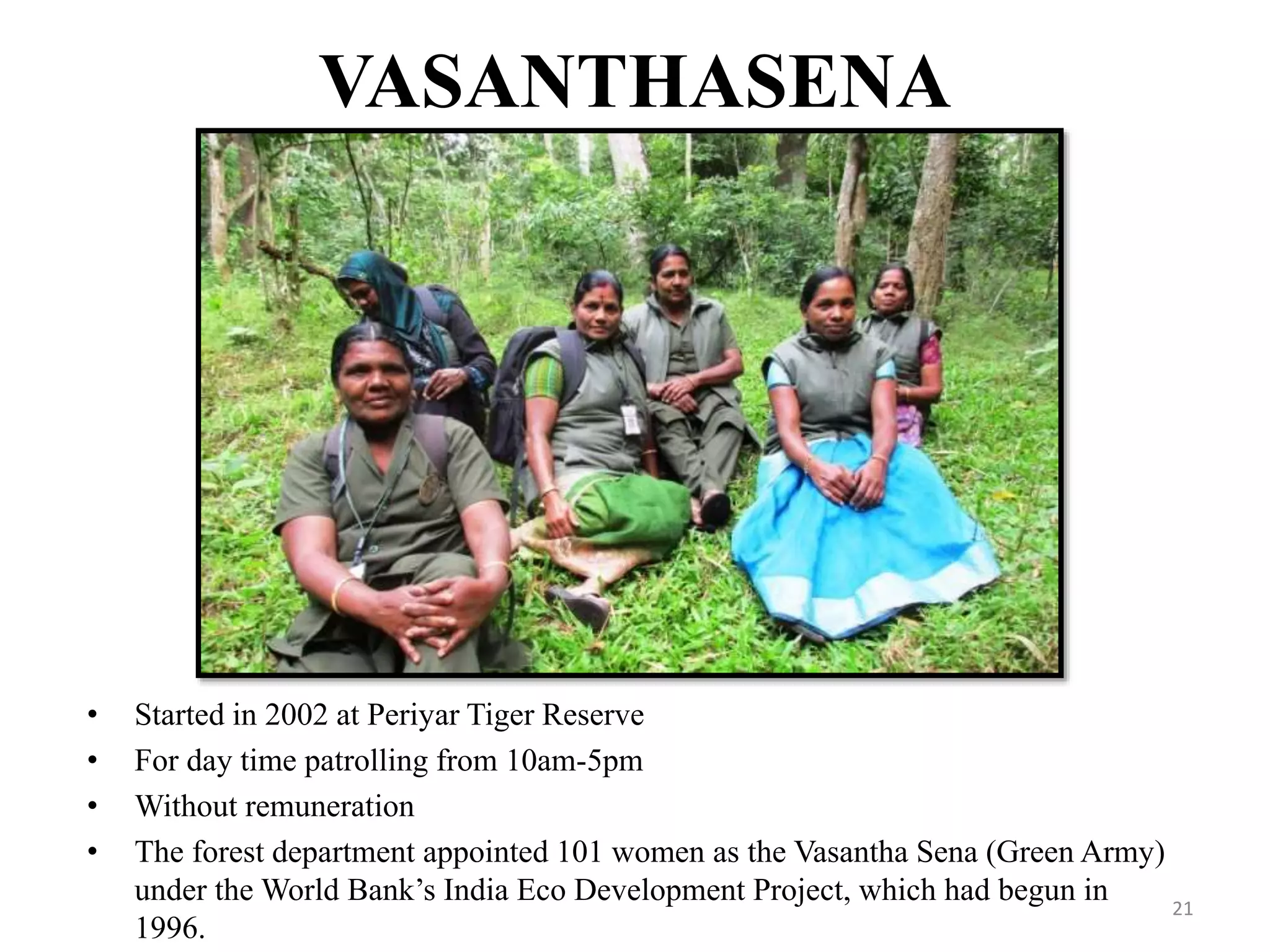
• Started in 2002 at Periyar Tiger Reserve
• For day time patrolling from 10am-5pm
• Without remuneration
• The forest department appointed 101 women as the Vasantha Sena (Green Army)
under the World Bank’s India Eco Development Project, which had begun in
1996.
21
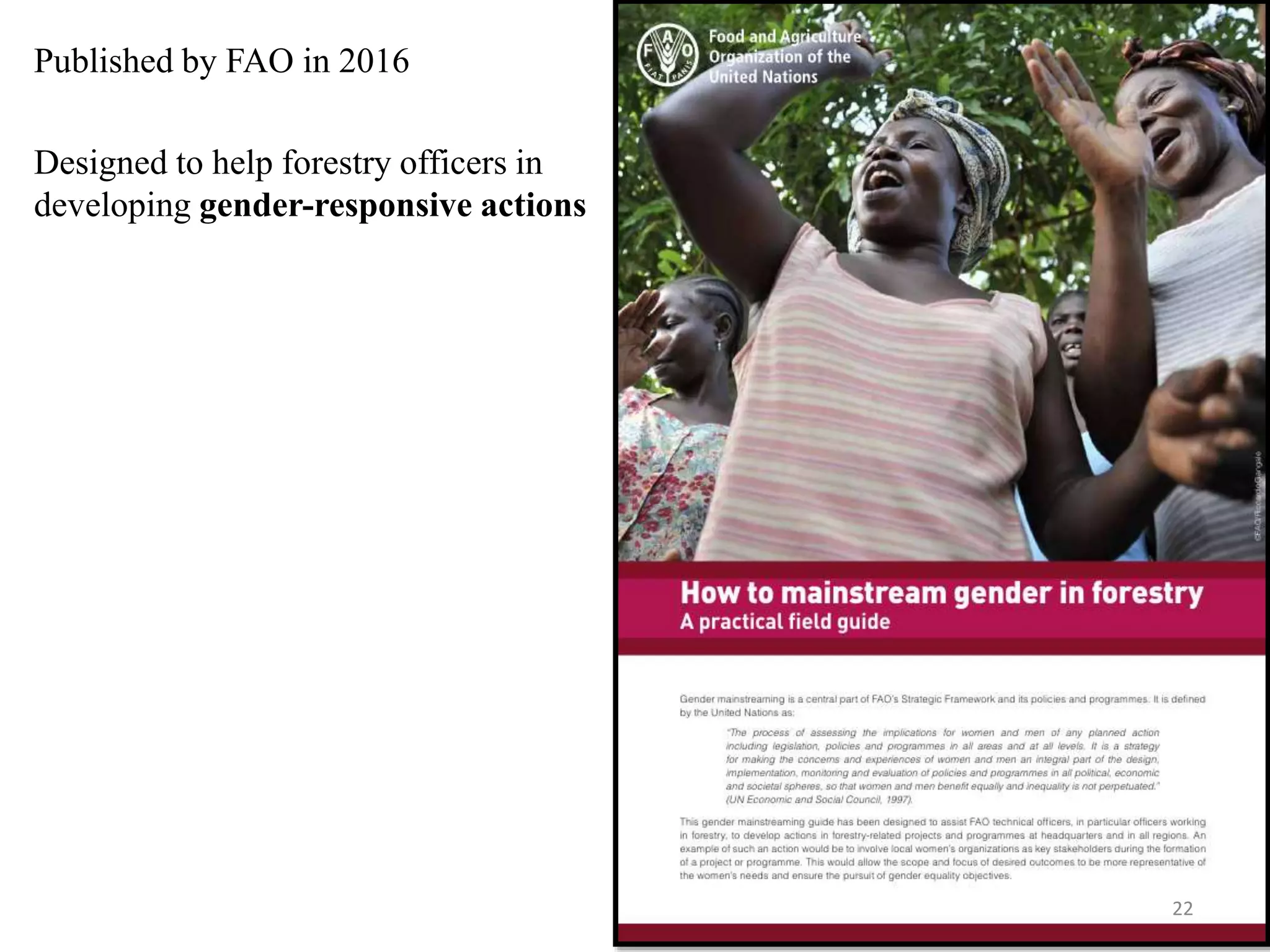
Published by FAO in 2016
Designed to help forestry officers in
developing gender-responsive actions
22
23
The field guide provides practical advice, such as:
• Understand the particular challenges women face when participating in
policy-making, income-generating and community-level activities.
• Plan meetings and activities at a time and place that fits with the schedules
of women stakeholders, and allow children when possible.
• Maintain a dialogue between women’s advocacy groups and the
government.
• Advocate for a stronger role for women in policy and decision-making.
• Ensure women have leadership and decision-making roles rather than
simply counting the number of females at meetings.
REFERENCE
• Sunderland, T., Achdiawan, R., Angelsen,A., Babigumira,R., Ickowitz,A.,
Paumgarten,F., Reyes-García,V., Shively,G., 2014,Challenging Perceptions about
Men, Women, and Forest Product Use: A Global Comparative Study, World
Development,64:56-66
• Nanavaty, Reena. 1996. Feminise our forests. Consultation World Commission on
Forests and Sustainable Development, New Delhi., 1996. SEWA, Ahmedabad. 9
pp.
• http://www.unwomen.org/en/news/stories/2013/11/joint-report-on-women-in-
natural-resource-management
• https://www.cifor.org/gender
• http://www.fao.org/forestry/gender/en/
24
THANK YOU
25

Gender dimensions in forest management

  • 1.
    GENDER DIMENSIONS IN FORESTMANAGEMENT MEGHANA ROSE JOSEPH 2017-17-006 NRM Department College of Forestry, Vellanikkara 1
  • 2.
  • 3.
    3 Incorporating a genderperspective in forest management and decision-making processes will help: • Increase awareness of the roles of women and men in the sustainable management of forests and trees • Avoid or manage conflicts among competing uses of forests and their products, and ensure that women’s and men’s traditional • Indigenous rights to forest use are maintained
  • 4.
    • Promote equalaccess of women to forests and other resources necessary for effective socioeconomic participation • Ensure that both women and men receive training, gain access to information and other external services to increase productivity through the use of new and improved technologies • Increase the capacity of communities to capitalize on the complementary roles of women and men and mobilize people for collective action in, for example, forest regeneration, biodiversity conservation, watershed protection and the allocation of forest-use permits. 4 (Gender in forestry, FAO)
  • 5.
    • Do womencontribute more than men to household income from unprocessed forest products? • Do men contribute more than women to household income from processed forest products? • Do women tend to collect forest products for consumption while men collect them for sale? • Do men participate more in forest user groups than women? 5 MYTHS AND REALITIES
  • 6.
    • Many ofthe claims that are often made in the literature, on gender and forest products, are based on case studies. • We cannot generalize these studies-regional variation 6
  • 7.
    PEN- Poverty andEnvironment Network 7 • The PEN network was launched in September 2004 by the Center for International Forestry Research (CIFOR) with the aim of collecting uniform socio-economic and environmental data at household and village levels in rural areas of developing countries.
  • 8.
  • 9.
    • Forest productcollection and sale: considering the forest products brought to the household by women and men respectively across several broad categories, including types and quantities of products, whether they are processed or not, and whether they are collected for consumption and/or sale. • Access to forest products: the value of forest products collected in lands under different land and resource tenure systems • Community forest management: men and women’s participation in formal FUGs. 9 DIMENSIONS
  • 10.
    10 Share value ofunprocessed forest products collected by women, men and both, at a globally and regionally disaggregated level. (Sunderland et al, 2014)
  • 11.
    11 Share value ofprocessed forest products collected by women, men and both, at a globally and regionally disaggregated level.
  • 12.
    Share of incomefrom unprocessed and processed products (by gender categories and types of products) 12
  • 13.
    Percentage of womenwho participate in forest user groups (FUGs). 13
  • 14.
  • 15.
    Women at forefrontin conservation movements like Chipko and Khejrali 15
  • 16.
    The women haveto spend major part of their time and have to walk long distances daily to collect fuelwood, fodder and other Non Timber Forest Products (NTFPs) from forests Awareness about trees, shrubs and grasses is higher amongst women than in men because women devote more time than men to collect forest produce to meet family needs. About one-third of poor women are directly involved in forestry or forestry related works in the unorganized sector (Nanavaty, 1996) 16
  • 17.
    Constraints for Women Participationin JFM • Women were not informed about meetings • Unsuitable time for meetings when women could not be free from household work • Social customs restraining women from attending such meetings • Women perceived no gain from attending such meetings • Generally, the men respond when questions are directed even specifically to the women 17
  • 18.
    Possible Approaches forIncreased Women Participation in JFM • Awareness among women needs to be increased • The policy provisions regarding women participation should be clear and mandatory • Female extension workers need to be employed with whom women may talk freely • Provide proper extension support to motivate women and also their husbands for their active participation in JFM • The need for their participation and benefits accruing to them from JFM need to be properly explained to women to create their interest in the programme 18
  • 19.
  • 20.
    Self Employed Women’sassociation (SEWA) – Gujarat-gum Karaya 20 SEWA
  • 21.
    VASANTHASENA • Started in2002 at Periyar Tiger Reserve • For day time patrolling from 10am-5pm • Without remuneration • The forest department appointed 101 women as the Vasantha Sena (Green Army) under the World Bank’s India Eco Development Project, which had begun in 1996. 21
  • 22.
    Published by FAOin 2016 Designed to help forestry officers in developing gender-responsive actions 22
  • 23.
    23 The field guideprovides practical advice, such as: • Understand the particular challenges women face when participating in policy-making, income-generating and community-level activities. • Plan meetings and activities at a time and place that fits with the schedules of women stakeholders, and allow children when possible. • Maintain a dialogue between women’s advocacy groups and the government. • Advocate for a stronger role for women in policy and decision-making. • Ensure women have leadership and decision-making roles rather than simply counting the number of females at meetings.
  • 24.
    REFERENCE • Sunderland, T.,Achdiawan, R., Angelsen,A., Babigumira,R., Ickowitz,A., Paumgarten,F., Reyes-García,V., Shively,G., 2014,Challenging Perceptions about Men, Women, and Forest Product Use: A Global Comparative Study, World Development,64:56-66 • Nanavaty, Reena. 1996. Feminise our forests. Consultation World Commission on Forests and Sustainable Development, New Delhi., 1996. SEWA, Ahmedabad. 9 pp. • http://www.unwomen.org/en/news/stories/2013/11/joint-report-on-women-in- natural-resource-management • https://www.cifor.org/gender • http://www.fao.org/forestry/gender/en/ 24
  • 25.

Editor's Notes

  • #7 Regional variations.. Culture, climate, social aspects etc
  • #11 Globally, men and women contribute almost equally to the value of household income from unprocessed forest products, but this conceals some regional differences- Thus the gender division with respect to collection of unprocessed forest products in Africa is opposite to that in Latin America. Do women contribute more than men to household income from unprocessed forest products?
  • #12 men bring a considerably higher share of processed forest product income (61%) than women (25%) in contrast with the striking regional differences found for unprocessed forest products, the pattern of male income dominance is uniform across the three regions.
  • #13 Compared to women, globally men brought in more than twice the value share of sales of both unprocessed and processed forest products Men’s primary contribution of forest income to the household is in the form of subsistence goods and not in the form of cash income. 
  • #14 Of the households where there is participation, women’s involvement is lowest in Latin America and highest in Africa, with Asia falling in between
  • #16 AMRITA DEVI BISHNOI RAJASTHAN KHEJARALI- FOREBEARER OF CHIPKO
  • #17 Different scenarios can happen at different places all over the world and also within the countries Women and men of age between 36-50 participate more in JFM and VSS activities Jfm- male 64 , f-44.5
  • #18 JOINT FOREST MANAGEMENT
  • #21 Most of them Do not have collection licences and are forced to sell for cheap prices. Groups secured collection licences for memebrs and sell in good prices for gujarat forest devlpmnt coop