PHYSICS
PROJECT
TYPES OF MOTION
:-
WHAT IS CIRCULAR MOTION ?
In physics, circular motion is a movement of an object
along the circumference of a circle or rotation along a
circular path. It can be uniform, with constant angular
rate of rotation (and constant speed), or non-uniform
with a changing rate of rotation. The rotation around
a fixed axis of a three-dimensional body involves
circular motion of its parts. The equations of motion
describe the movement of the center of mass of a
body. Examples of circular motion include: an artificial
satellite orbiting the Earth at constant height. A stone
which is tied to a rope and is being swung in circles, a
car turning through a curve in a race track.
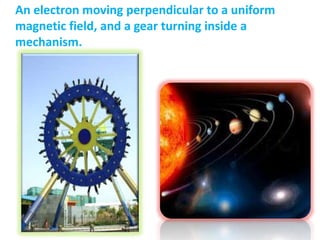
An electron moving perpendicular to a uniform
magnetic field, and a gear turning inside a
mechanism.
TYPES OF CIRCULAR MOTION
There are two types of circular motion :-
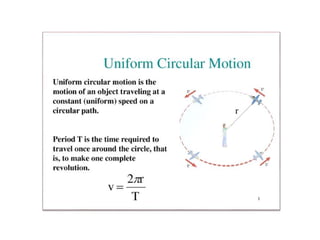
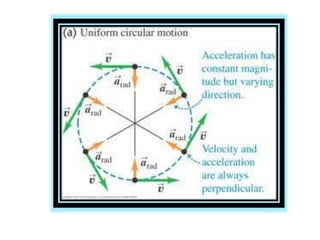
 Uniform circular motion :-Uniform circular motion
can be described as the motion of an object in a
circle at a constant speed. As an object moves in a
circle, it is constantly changing its direction. At all
instances, the object is moving tangent to the
circle. Since the direction of the velocity vector is
the same as the direction of the object's motion,
the velocity vector is directed tangent to the circle
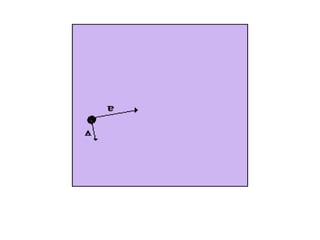
as well. The animation in the next depicts this by
means of a vector arrow.
 Your speedometer tells you the magnitude of your
car's velocity vector, so when you go around a curve
while keeping your speedometer needle steady, you
are executing uniform circular motion. If your
speedometer reading is changing as you turn, your
circular motion is non-uniform. Uniform circular
motion is simpler to analyze mathematically, so we
will attack it first and then pass to the non-uniform
case.
VOCABULARY
• uniform circular motion — circular motion in which
the magnitude of the velocity vector remains
constant
• Non-uniform circular motion — circular motion in
which the magnitude of the velocity vector
changes
Summary
• If an object is to have circular motion, a force must be
exerted on it toward the center of the circle. There is
no outward force on the object; the illusion of an
outward force comes from our experiences in which
our point of view was rotating,
A PRESENTATION BY
-VASUDHA ARORA
-IX-B
-38

Physics-CIRCULAR MOTION

  • 1.
  • 4.
  • 8.
    WHAT IS CIRCULARMOTION ? In physics, circular motion is a movement of an object along the circumference of a circle or rotation along a circular path. It can be uniform, with constant angular rate of rotation (and constant speed), or non-uniform with a changing rate of rotation. The rotation around a fixed axis of a three-dimensional body involves circular motion of its parts. The equations of motion describe the movement of the center of mass of a body. Examples of circular motion include: an artificial satellite orbiting the Earth at constant height. A stone which is tied to a rope and is being swung in circles, a car turning through a curve in a race track.
  • 9.
    An electron movingperpendicular to a uniform magnetic field, and a gear turning inside a mechanism.
  • 10.
    TYPES OF CIRCULARMOTION There are two types of circular motion :-  Uniform circular motion :-Uniform circular motion can be described as the motion of an object in a circle at a constant speed. As an object moves in a circle, it is constantly changing its direction. At all instances, the object is moving tangent to the circle. Since the direction of the velocity vector is the same as the direction of the object's motion, the velocity vector is directed tangent to the circle as well. The animation in the next depicts this by means of a vector arrow.
  • 15.
     Your speedometertells you the magnitude of your car's velocity vector, so when you go around a curve while keeping your speedometer needle steady, you are executing uniform circular motion. If your speedometer reading is changing as you turn, your circular motion is non-uniform. Uniform circular motion is simpler to analyze mathematically, so we will attack it first and then pass to the non-uniform case.
  • 16.
    VOCABULARY • uniform circularmotion — circular motion in which the magnitude of the velocity vector remains constant • Non-uniform circular motion — circular motion in which the magnitude of the velocity vector changes
  • 17.
    Summary • If anobject is to have circular motion, a force must be exerted on it toward the center of the circle. There is no outward force on the object; the illusion of an outward force comes from our experiences in which our point of view was rotating,
  • 18.